
Lamentations 3:60

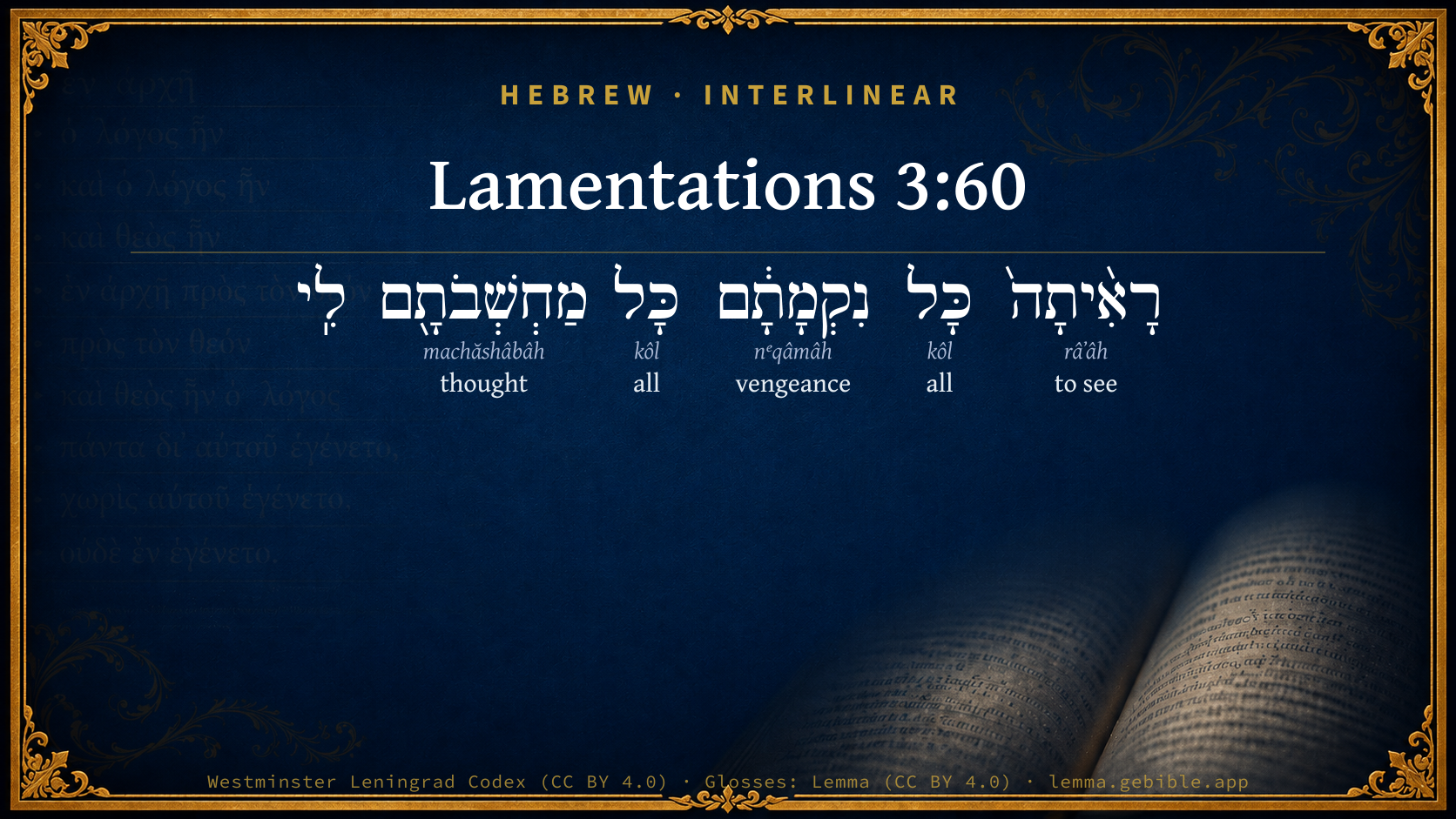
Hebrew (Westminster Leningrad Codex) Lamentations 3:60 appears in the Hebrew Old Testament. The text above is from the Westminster Leningrad Codex. Each word links to its Strong’s number, a concise gloss, and parsing drawn from the Open Scriptures Hebrew Bible morphology. Click any word for its full Brown-Driver-Briggs (BDB) entry.
Download image
Cite this verse

Lamentations 3:60 (World English Bible). Public Domain. Lemma interlinear Bible study tool, https://lemma.gebible.app/v/lamentations/3/60.

Show BibTeX & RIS
BibTeX
RIS
English Translation
You have seen all their vengeance and all their devices against me.
World English Bible · Public Domain
Download a study sheet

One document with this verse’s original text, its word-by-word gloss line, the meaning frame, cross-references with their text, attributed commentary, and full source and license credits — printable, and it pastes into notes with its structure intact.

This verse Autodidact and up

Study sheet (.html) Plain text (.txt)

A passage Seminary Student

Up to 50 verses in one chapter. A passage sheet keeps up to 6 commentary sources and 12 cross-references per verse, in the order this page ranks them, and says so on the sheet whenever that leaves anything out. Ask for a single verse and you get the Autodidact verse sheet above.

Everything on this page stays free to read, with no account — the sheet is a download of what is already on screen, not access to it.

Want to remove ads? Support Godless Engineer
Compare translations 3

The same verse in 3 English versions, stacked beneath the original-language interlinear above. Click any original word for its lexicon entry.

Each is an independent rendering of the whole verse — the interlinear is not word-aligned to these translations.

Highlighted words mark where these versions differ — a whole-verse word diff, not a word-by-word alignment.

  • World English Bible Public Domain
    You have seen all their vengeance and all their devices against me.
  • King James Version Public Domain
    Thou hast seen all their vengeance and all their imaginations against me.
  • unfoldingWord Literal Text CC BY-SA 4.0
    You have seen all their vengeance, all their plans against me. SIN

unfoldingWord Literal Text — © unfoldingWord, licensed CC BY-SA 4.0. Word-aligned USFM3 via Door43 (git.door43.org/unfoldingWord/en_ult).

Versions to compare (up to 4)

3 of 4 selected

Show all 18 translations

Every available English version of this verse, each an independent rendering of the whole verse.

  • World English Bible Public Domain
    You have seen all their vengeance and all their devices against me.
  • Berean Standard Bible Public Domain
    You have seen all their malice, all their plots against me.
  • Majority Standard Bible Public Domain
    You have seen all their malice, all their plots against me.
  • King James Version Public Domain
    Thou hast seen all their vengeance and all their imaginations against me.
  • American Standard Version (1901) Public Domain
    Thou hast seen all their vengeance and all their devices against me.
  • Revised Version (1885) Public Domain
    Thou hast seen all their vengeance and all their devices against me.
  • Geneva Bible (1599) Public Domain
    Thou hast seene all their vengeance, and all their deuises against me.
  • Douay-Rheims (1899) Public Domain
    Res. Thou hast seen all their fury, and all their thoughts against me.
  • Young's Literal Translation Public Domain
    Thou hast seen all their vengeance, All their thoughts of me.
  • Literal Standard Version CC BY-SA 4.0
    You have seen all their vengeance, || All their thoughts of me.
  • Unlocked Literal Bible CC BY-SA 4.0
    You have seen their insults, all their plots against me—
  • unfoldingWord Literal Text CC BY-SA 4.0
    You have seen all their vengeance, all their plans against me. SIN
  • Darby Bible Public Domain
    Thou hast seen all their vengeance, all their imaginations against me.
  • World Messianic Bible Public Domain
    You have seen all their vengeance and all their plans against me.
  • Webster's Bible Public Domain
    Thou hast seen all their vengeance and all their imaginations against me.
  • Free Bible Version CC BY-SA 4.0
    You have observed how vengeful they are and how often they've plotted against me.
  • Bible in Basic English Public Domain
    You have seen all the evil rewards they have sent on me, and all their designs against me.
  • JPS Tanakh (1917) Public Domain
    Thou hast seen all their vengeance and all their devices against me.

Literal Standard Version (2020), Covenant Press — licensed CC BY-SA 4.0. Text via the HelloAO Bible API (eBible.org). Unlocked Literal Bible (unfoldingWord) — licensed CC BY-SA 4.0. Text via the HelloAO Bible API (eBible.org). unfoldingWord Literal Text — © unfoldingWord, licensed CC BY-SA 4.0. Word-aligned USFM3 via Door43 (git.door43.org/unfoldingWord/en_ult). Free Bible Version, Dr. Jonathan Gallagher — licensed CC BY-SA 4.0. Text via the HelloAO Bible API (eBible.org).

Word by word

More ways to search: Search by grammar → Find every occurrence → Compare this word →

Practice this passage: Drill this verse → Learn its vocabulary →

About this verse

These counts appear in no published source. They are computed here, from the morphology-tagged text and Lemma’s own curated glosses. What Lemma adds →

6
words
4
distinct lemmas
Prophets
section

Shared distinctive vocabulary

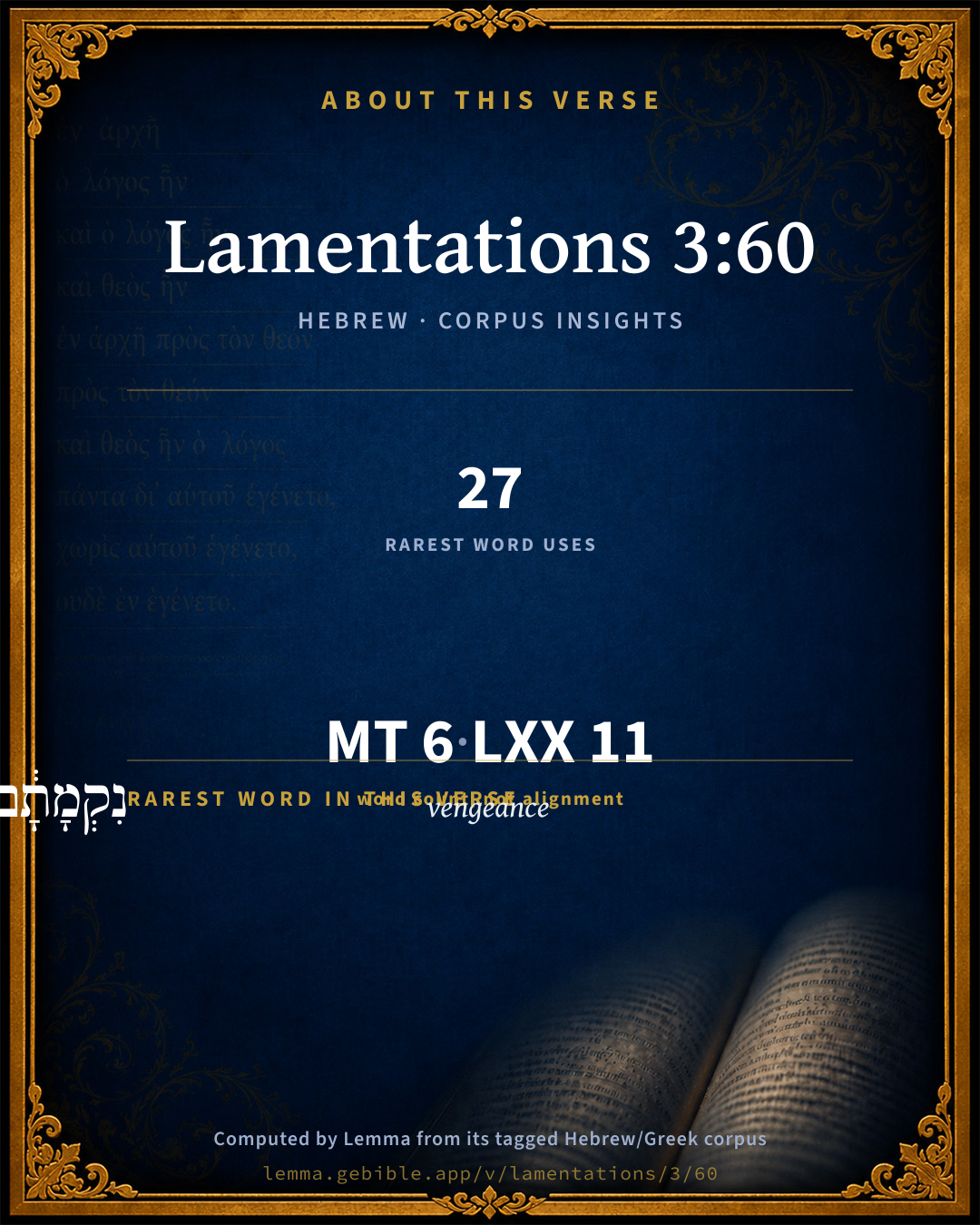
נִקְמָתָ֔ם vengeance H5360 occurs in 22 verses of the Hebrew Bible. Also found in:

Grammatical profile

  • 1 verb
  • 4 nouns
  • 1 preposition

Verb forms

  • רָאִ֨יתָה֙ Qal · Perfect

Repetition

A word recurs within this verse — often emphatic in Hebrew:

Hebrew & Septuagint length

In English translation the verse runs 12 words from the Hebrew and 15 from the Septuagint (LXX English) — closely comparable.

A rough comparison of the two English renderings, which tokenize alike — not a word-level alignment.

Word counts can differ between the Hebrew and the Greek without any difference in meaning — e.g. the Hebrew direct-object marker אֵת has no separate Greek word, and Greek often adds the article ὁ.

In the original languages it is 6 Hebrew tokens and 11 Greek tokens — but the two are counted differently (Hebrew bundles its prefixes and suffixes into one token; the Greek is in lemma form), so that isn’t a like-for-like length.

Cross-references

3

Topical passages linked to Lamentations 3:60 in the Treasury of Scripture Knowledge — connected by theme and wording, ordered by reader-vote popularity; previews shown in the World English Bible.

  • Jeremiah 11:19–20 But I was like a gentle lamb that is led to the slaughter; and I didn't know that they had devised devices against me, [saying], Let us destroy the tree with the fruit of it, and let us cut him off from the land of the living, that his name may be no more remembered.
  • Psalms 10:14 But you do see trouble and grief; You consider it to take it into your hand. You help the victim and the fatherless.
  • Lamentations 3:59 Yahweh, you have seen my wrong; judge you my cause.

Cross-references courtesy of OpenBible.info (CC BY 4.0).

Hebrew and Greek witnesses Masoretic Hebrew ↔ Greek Septuagint

The same verse in the two great witnesses to the Old Testament, shown verse-for-verse.

These are two independent witnesses, not word-aligned to each other, and the Septuagint is shown in lemma (dictionary) form.

Hebrew Lamentations 3:60 Masoretic · Westminster Leningrad Codex

רָאִ֨יתָה֙ כָּל נִקְמָתָ֔ם כָּל מַחְשְׁבֹתָ֖ם לִֽי

You have seen all their vengeance and all their devices against me.

World English Bible · Public Domain

Greek LXX Lamentations 3:60 Septuagint · lemma form

ὁράω πᾶς ὁ ἐκδίκησις αὐτός εἰς πᾶς διαλογισμός αὐτός ἐν ἐγώ

You have seen all their vengeance, you have looked on all their devices against me.

LXX2012 (modern English Septuagint) · Public Domain

Hebrew: Westminster Leningrad Codex (CC BY 4.0). Greek: Septuagint (public domain); English from LXX2012 (modern English Septuagint) (Public Domain). How the Septuagint differs from the Hebrew →

Commentary

Notes on Lamentations 3:60 from classic Christian and Jewish commentators (each source and its license shown beneath its notes). The classic Christian expositions comment on the surrounding passage and are grouped to its opening verse, so a note may address several verses; the Jewish commentaries on the Tanakh (Rashi and others) are per-verse, so they appear only where the commentator wrote on this verse.

Lemma curates 59 commentaries, every one of them public domain or Creative Commons licensed, each selected and text-cleaned for this edition rather than reprinted as found. About our sources →

Trapp's Complete Commentary

John Trapp

Lam 3:60 Thou hast seen all their vengeance [and] all their imaginations against me.

Ver. 60. Thou hast seen all their vengeance.] See on Lam 3:59. The saints fare the better for their enemies’ spite and cruelty; and they may very well plead and present it to God in prayer.

John Trapp, A Commentary or Exposition upon All the Books of the Old and New Testament (1647–1656) — public domain. Text from a community e-Sword module.

Jamieson, Fausset & Brown

Robert Jamieson, A. R. Fausset & David Brown

imaginations--devices (Jer 11:19).

Their vengeance--means their malice. Jeremiah gives his conduct, when plotted against by his foes, as an example how the Jews should bring their wrongs at the hands of the Chaldeans before God.

Jamieson, Fausset & Brown — Commentary Critical and Explanatory on the Whole Bible (1871) — public domain (CC PDM 1.0). Text via the HelloAO Bible API.

Adam Clarke's Commentary

Verse 60. Thou hast seen - all their imaginations] Every thing is open to the eye of God. Distressed soul! though thou knowest not what thy enemies meditate against thee; yet he who loves thee does, and will infallibly defeat all their plots, and save thee.

Adam Clarke's Commentary on the Bible (1810–1826) — public domain. Text from a community e-Sword/MySword module.

John Calvin's Commentaries

This mode of speaking was often used by the saints, because God, when it pleased him to look on their miseries, was ever ready to bring them help. Nor were they words without meaning, when the faithful said, O Lord, thou hast seen; for they said this for their own sake, that they might shake off all unbelief. For as soon as any trial assails us, we imagine that God is turned away from us; and thus our flesh tempts us to despair. It is hence necessary that the faithful should in this respect struggle with themselves and feel assured that God has seen them. Though, then, human reason may say, that God does not see, but neglect and disregard his people, yet on the other hand, this doctrine ought to sustain them, it being certain that God does see them. This is the reason why David so often uses this mode of expression.

Thou, Jehovah, he says, hast seen all their vengeances By vengeances here he means acts of violence, according to what we find in Psalm 8:2, where God is said “to put to flight the enemy and the avenger.” By the avenger there he simply means, not such as retaliate wrongs, but cruel and violent men. So also, in this place, by vengeances, he means all kinds of cruelty, as also by thoughts he means wicked counsels, by which the ungodly sought to oppress the miserable and the innocent. He again repeats the same thing, —

John Calvin's Commentaries (1540-1563) — public domain. Text from the Calvin Translation Society English edition (1840s-50s) via the Christian Classics Ethereal Library (ccel.org). Calvin's coverage is partial (roughly two-thirds of the Bible); uncommented books and verses are honest gaps, never fabricated. The 19th-century editor's footnotes and remarks are omitted so the notes are faithfully Calvin's own voice.

Ellicott's Commentary for English Readers

(60) All their imaginations . . .—Same word as the “devices” of Jer_11:19; Jer_18:18, to which the writer obviously refers.

A Bible Commentary for English Readers, edited by Charles John Ellicott (1878–1897) — public domain. Text from a community e-Sword module.

The Cambridge Bible for Schools and Colleges

gen. ed. J. J. S. Perowne

60, 61. Cp. Jer_11:19.

The Cambridge Bible for Schools and Colleges (gen. ed. J. J. S. Perowne; Cambridge University Press, 1878–1918) — public domain. Text from a community e-Sword module.

John Gill's Exposition

Persecute and destroy them in anger,.... As they have persecuted the people of God, do thou persecute them; and never leave pursuing them untie thou hast made a full end of them, as the effect of vindictive wrath and vengeance:

from under the heavens of the Lord; which are made by him, and in which he dwells; let them not have the benefit of them, nor so much as the sight of them; but let them perish from under them, Jer 10:11.

Next: Lamentations Chapter 4

John Gill's Exposition of the Whole Bible (1746–1763) — public domain (CC PDM 1.0). Text via the HelloAO Bible API.

Matthew Poole's English Annotations

Thou hast been a witness to all their fury and rage, and all their malicious and bloody contrivances against me.

Matthew Poole's English Annotations on the Holy Bible (1683–1685) — public domain. Text from a community e-Sword/MySword module.

The Pulpit Commentary

Vers. 60-66. Jeremiah and his enemies.

I THE PROCEEDINGS OF THESE ENEMIES. The spirit of vengeance is in their hearts. Jeremiah has spoken steadily against them what Jehovah had laid on him to say. They know the language in which they have been described. It was, of course, just the thing to be expected that bad men should cherish vengeful purposes. And Jeremiah had to bear the consciousness of this the very painful consciousness that he was the cause, however innocent, of showing up the worst passions in the hearts of others. This spirit of vengeance manifested itself in two ways.

1. Reproach. He was called all sorts of names, held up to derision and execration. He indeed had to reproach, but then there was a measure and dignity in the words he employed. His reproaches were meant to call the reproached ones to repentance. But the reproaches from his enemies meant immediate danger to him danger from the populace on the one hand, and the authorities on the other.

2. Plotting. Society was just in the state when plots could be carried out with success. Jeremiah did not make one enemy or a few enemies, hut many. They were wicked men, and doubtless had subordinates ready to hand for any knavery that was going on.

II JEREMIAH"S BELIEF THAT GOD"S EYE WAS UPON THESE ENEMIES. "Thou hast seen? It is a great matter to feel that God has his eye upon all human wickedness. We may suffer greatly from it, and yet see only a very small part of what he sees. We are forever running into extremes, exaggerating or palliating, magnifying the reality or else diminishing it. We look at things too much in reference to our individual selves, and as they concern us. But God sees things as they truly are, in all their relations and possibilities. Some things are worse than we think them, others better. And so we are enabled to feel that all wickedness is kept within comparatively innocuous limits, The mischief only reaches the outside of what is attacked, for the same God who watches the wicked watches the good at the same time.

III THE PRAYER OF JEREMIAH. (Vers. 64-66.) The vehemence, the almost savageness of these words staggers us. But then, we are not to expect the gentleness of a Christian from an old Jewish prophet. We are not required to justify every petition of God"s servants. We have to distinguish between the prophet taken out of himself by inspiration and the man of like passions with ourselves, who has to pass through a long discipline before he can pray as he ought to pray. We may feel here that a silent waiting upon God would have been better than any imprecations of vengeance, and yet, at the same time, we must acquit Jeremiah of anything like personal malice. He wished that the wicked might be recompensed according to the work of their hands. The wicked wished Jeremiah to be treated according to the ferocity of their own hearts. Y.

The Pulpit Commentary (1880–1919), ed. H.D.M. Spence-Jones & Joseph S. Exell — public domain. Text from a community e-Sword module.

John Wesley's Explanatory Notes

Seen - Thou hast been a witness to all their fury.

John Wesley, Explanatory Notes Upon the Whole Bible (1754–1765) — public domain. Text via the GEBible commentary corpus.

Lesson kit

Teaching starters — assembled from the data on this page, not authored interpretation. Every prompt links to the verse data it draws on. Edit before teaching.

Lamentations, in the Prophets, opens this verse with 6 words (4 distinct Hebrew lemmas). Its most distinctive word is nᵉqâmâh (“vengeance”). A historical commentator’s framing appears above. Read the whole chapter for the surrounding context.

Discussion questions

  1. How does “vengeance” (nᵉqâmâh) shape what this verse is saying?
  2. Numbers 31:2 shares the word «vengeance» with this verse. How do the two illuminate each other?
  3. “all” occurs 2× in this one verse. What is the effect of the repetition?
  4. The translations on this page render this verse differently — a whole-verse word diff, not a word-by-word alignment. What might account for the different wordings?
  5. The verb «רָאִ֨יתָה֙» is Qal Perfect. How does its form color the action?
  6. Reading how Trapp's Complete Commentary and Jamieson, Fausset & Brown read this verse, where do the two commentators agree and where do they part?

Things to notice

Reading settings

Reading text

Shown beneath each verse's original-language words.

Old Testament
Old Testament edition

Read the OT as the Masoretic Hebrew (MT) or the Greek Septuagint (LXX).

English shown for the Greek Septuagint (in the Hebrew ↔ Greek comparison).

Comparing translations? Open the Compare panel on any verse page to stack up to four side by side.