Isaiah 55:9

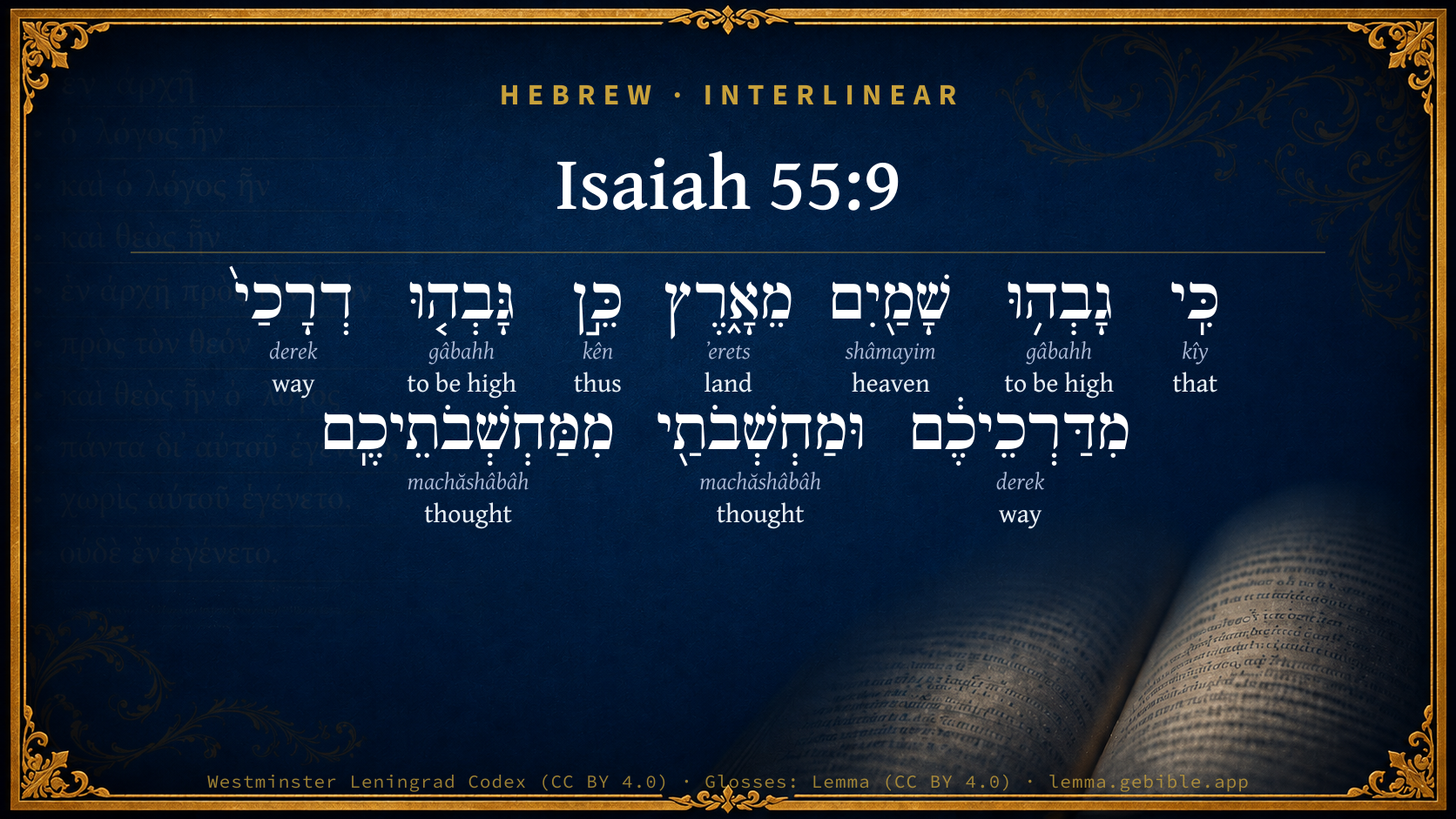
Hebrew (Westminster Leningrad Codex) Isaiah 55:9 appears in the Hebrew Old Testament. The text above is from the Westminster Leningrad Codex. Each word links to its Strong’s number, a concise gloss, and parsing drawn from the Open Scriptures Hebrew Bible morphology. Click any word for its full Brown-Driver-Briggs (BDB) entry.
Download image
Cite this verse

Isaiah 55:9 (World English Bible). Public Domain. Lemma interlinear Bible study tool, https://lemma.gebible.app/v/isaiah/55/9.

Show BibTeX & RIS
BibTeX
RIS
English Translation
For as the heavens are higher than the earth, so are my ways higher than your ways, and my thoughts than your thoughts.
World English Bible · Public Domain
Download a study sheet

One document with this verse’s original text, its word-by-word gloss line, the meaning frame, cross-references with their text, attributed commentary, and full source and license credits — printable, and it pastes into notes with its structure intact.

This verse Autodidact and up

Study sheet (.html) Plain text (.txt)

A passage Seminary Student

Up to 50 verses in one chapter. A passage sheet keeps up to 6 commentary sources and 12 cross-references per verse, in the order this page ranks them, and says so on the sheet whenever that leaves anything out. Ask for a single verse and you get the Autodidact verse sheet above.

Everything on this page stays free to read, with no account — the sheet is a download of what is already on screen, not access to it.

Want to remove ads? Support Godless Engineer
Compare translations 3

The same verse in 3 English versions, stacked beneath the original-language interlinear above. Click any original word for its lexicon entry.

Each is an independent rendering of the whole verse — the interlinear is not word-aligned to these translations.

Highlighted words mark where these versions differ — a whole-verse word diff, not a word-by-word alignment.

  • World English Bible Public Domain
    For as the heavens are higher than the earth, so are my ways higher than your ways, and my thoughts than your thoughts.
  • King James Version Public Domain
    For as the heavens are higher than the earth, so are my ways higher than your ways, and my thoughts than your thoughts.
  • unfoldingWord Literal Text CC BY-SA 4.0
    “For the heavens are higher than the earth, so my ways are higher than your ways, and my thoughts, than your thoughts.

unfoldingWord Literal Text — © unfoldingWord, licensed CC BY-SA 4.0. Word-aligned USFM3 via Door43 (git.door43.org/unfoldingWord/en_ult).

Versions to compare (up to 4)

3 of 4 selected

Show all 18 translations

Every available English version of this verse, each an independent rendering of the whole verse.

  • World English Bible Public Domain
    For as the heavens are higher than the earth, so are my ways higher than your ways, and my thoughts than your thoughts.
  • Berean Standard Bible Public Domain
    “For as the heavens are higher than the earth, so My ways are higher than your ways and My thoughts than your thoughts.
  • Majority Standard Bible Public Domain
    “For as the heavens are higher than the earth, so My ways are higher than your ways and My thoughts than your thoughts.
  • King James Version Public Domain
    For as the heavens are higher than the earth, so are my ways higher than your ways, and my thoughts than your thoughts.
  • American Standard Version (1901) Public Domain
    For as the heavens are higher than the earth, so are my ways higher than your ways, and my thoughts than your thoughts.
  • Revised Version (1885) Public Domain
    For as the heavens are higher than the earth, so are my ways higher than your ways, and my thoughts than your thoughts.
  • Geneva Bible (1599) Public Domain
    For as ye heauens are higher then the earth, so are my wayes higher then your wayes, and my thoughtes aboue your thoughts.
  • Douay-Rheims (1899) Public Domain
    For as the heavens are exalted above the earth, so are my ways exalted above your ways, and my thoughts above your thoughts.
  • Young's Literal Translation Public Domain
    For high have the heavens been above the earth, So high have been My ways above your ways, And My thoughts above your thoughts.
  • Literal Standard Version CC BY-SA 4.0
    “For [as] high [as] the heavens have been above the earth, || So high have been My ways above your ways, || And My thoughts above your thoughts.
  • Unlocked Literal Bible CC BY-SA 4.0
    for as the heavens are higher than the earth, so are my ways higher than your ways, and my thoughts than your thoughts.
  • unfoldingWord Literal Text CC BY-SA 4.0
    “For the heavens are higher than the earth, so my ways are higher than your ways, and my thoughts, than your thoughts.
  • Darby Bible Public Domain
    For [as] the heavens are higher than the earth, so are my ways higher than your ways, and my thoughts than your thoughts.
  • World Messianic Bible Public Domain
    “For as the heavens are higher than the earth, so are my ways higher than your ways, and my thoughts than your thoughts.
  • Webster's Bible Public Domain
    For as the heavens are higher than the earth, so are my ways higher than your ways, and my thoughts than your thoughts.
  • Free Bible Version CC BY-SA 4.0
    In the same way the heavens are higher than the earth, my ways are higher than your ways, and my thoughts higher than your thoughts.
  • Bible in Basic English Public Domain
    For as the heavens are higher than the earth, so are my ways higher than your ways, and my thoughts than your thoughts.
  • JPS Tanakh (1917) Public Domain
    For as the heavens are higher than the earth, so are My ways higher than your ways, and My thoughts than your thoughts.

Literal Standard Version (2020), Covenant Press — licensed CC BY-SA 4.0. Text via the HelloAO Bible API (eBible.org). Unlocked Literal Bible (unfoldingWord) — licensed CC BY-SA 4.0. Text via the HelloAO Bible API (eBible.org). unfoldingWord Literal Text — © unfoldingWord, licensed CC BY-SA 4.0. Word-aligned USFM3 via Door43 (git.door43.org/unfoldingWord/en_ult). Free Bible Version, Dr. Jonathan Gallagher — licensed CC BY-SA 4.0. Text via the HelloAO Bible API (eBible.org).

Word by word

More ways to search: Search by grammar → Find every occurrence → Compare this word →

Practice this passage: Drill this verse → Learn its vocabulary →

גָבְה֥וּ
gâbahh
H1361
“to be high”
Verb, Qal, Perfect, 3rd Person, Common, Plural
Part of Speech
Verb
Stem
Qal
Form
Perfect
Person
3rd Person
Gender
Common
Number
Plural
Full BDB Definition

Origin: a primitive root

TWOT: 305

to be high, be exalted - (Qal) - to be high, lofty, tall - to be exalted - to be lofty - to be lofty (of Jehovah's ways - good sense) - to be haughty, be arrogant (bad sense) - (Hiphil) to make high, exalt
  1. כִּֽי kîy H3588 “that” Conjunction
  2. שָׁמַ֖יִם shâmayim H8064 “heaven(s)” Noun, Common, Masculine, Plural, Absolute
  3. מֵאָ֑רֶץ ʼerets H776 “from · land” Preposition + Noun, Common, Both, Singular, Absolute
  4. כֵּ֣ן kên H3651 “thus” Particle, Demonstrative
  5. גָּבְה֤וּ gâbahh H1361 “to be high” Verb, Qal, Perfect, 3rd Person, Common, Plural
  6. דְרָכַי֙ derek H1870 “ways · my” Noun, Common, Both, Plural, Construct + Suffix, Personal, 1st Person, Common, Singular
  7. מִדַּרְכֵיכֶ֔ם derek H1870 “from · ways · your” Preposition + Noun, Common, Both, Plural, Construct + Suffix, Personal, 2nd Person, Masculine, Plural
  8. וּמַחְשְׁבֹתַ֖י machăshâbâh H4284 “and · thoughts · my” Conjunction + Noun, Common, Feminine, Plural, Construct + Suffix, Personal, 1st Person, Common, Singular
  9. מִמַּחְשְׁבֹתֵיכֶֽם machăshâbâh H4284 “from · thoughts · your” Preposition + Noun, Common, Feminine, Plural, Construct + Suffix, Personal, 2nd Person, Masculine, Plural

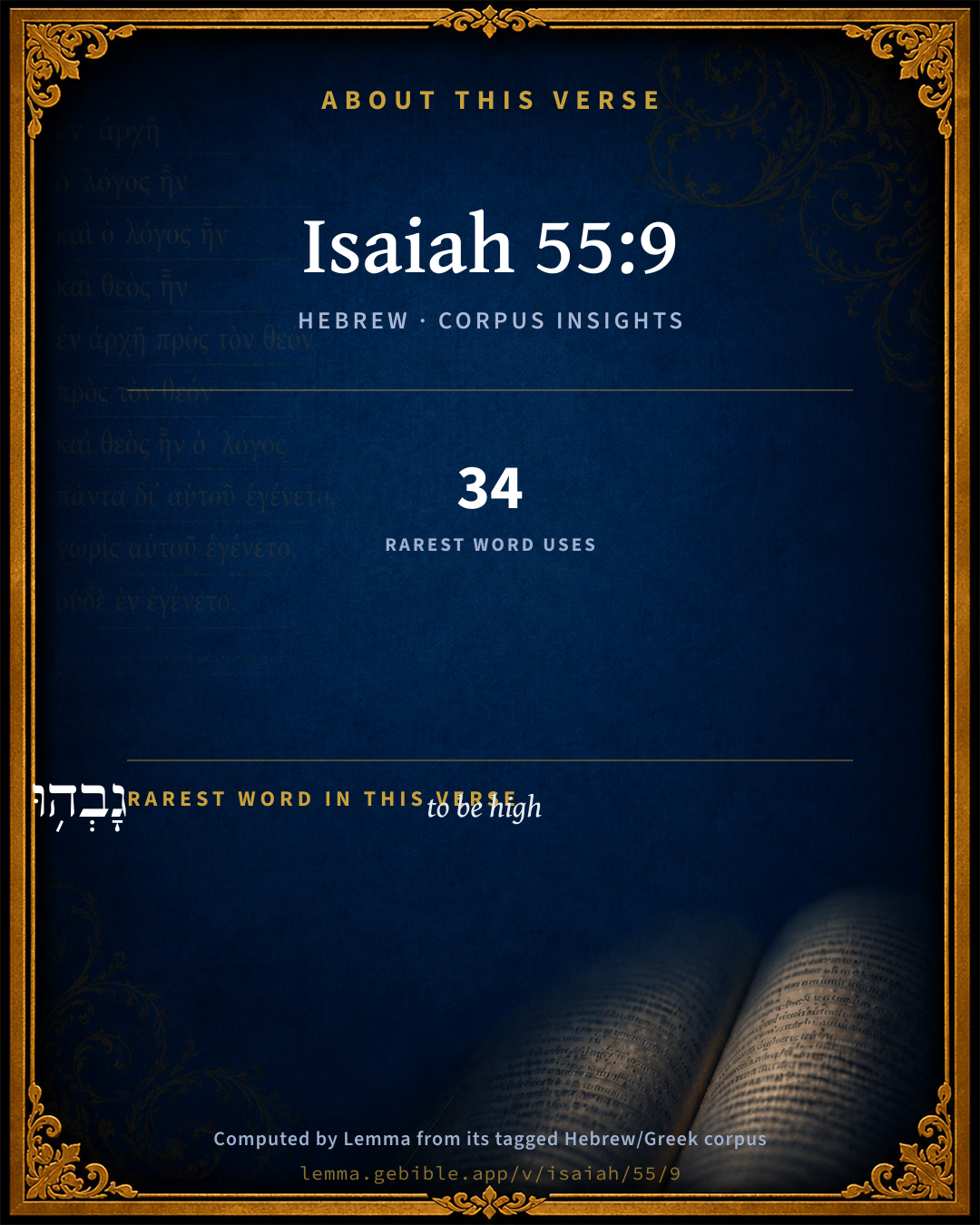
About this verse

These counts appear in no published source. They are computed here, from the morphology-tagged text and Lemma’s own curated glosses. What Lemma adds →

10
words
7
distinct lemmas
Prophets
section

Shared distinctive vocabulary

גָבְה֥וּ to be high H1361 occurs in 33 verses of the Hebrew Bible. Also found in:

Grammatical profile

  • 2 verbs
  • 6 nouns
  • 1 conjunction
  • 1 particle

Verb forms

  • גָבְה֥וּ Qal · Perfect
  • גָּבְה֤וּ Qal · Perfect

Repetition

Words recur within this verse — often emphatic in Hebrew:

  • גָבְה֥וּ to be high H1361 ×2
  • דְרָכַי֙ way H1870 ×2
  • וּמַחְשְׁבֹתַ֖י thought H4284 ×2

Hebrew & Septuagint length

In English translation the verse runs 23 words from the Hebrew and 23 from the Septuagint (LXX English) — the same length.

A rough comparison of the two English renderings, which tokenize alike — not a word-level alignment.

Word counts can differ between the Hebrew and the Greek without any difference in meaning — e.g. the Hebrew direct-object marker אֵת has no separate Greek word, and Greek often adds the article ὁ.

Cross-references

6

Topical passages linked to Isaiah 55:9 in the Treasury of Scripture Knowledge — connected by theme and wording, ordered by reader-vote popularity; previews shown in the World English Bible.

  • Romans 11:31–36 even so these also have now been disobedient, that by the mercy shown to you they may also obtain mercy.
  • Psalms 103:11 For as the heavens are high above the earth, So great is his loving kindness toward those who fear him.
  • Matthew 11:25 At that time, Jesus answered, "I thank you, Father, Lord of heaven and earth, that you hid these things from the wise and understanding, and revealed them to infants.
  • Psalms 77:19 Your way was through the sea; Your paths through the great waters. Your footsteps were not known.
  • Psalms 36:5 Your loving kindness, Yahweh, is in the heavens. Your faithfulness reaches to the skies.
  • Psalms 89:2 I indeed declare, "Love stands firm forever. You established the heavens. Your faithfulness is in them."

Cross-references courtesy of OpenBible.info (CC BY 4.0).

Hebrew and Greek witnesses Masoretic Hebrew ↔ Greek Septuagint

The same verse in the two great witnesses to the Old Testament, shown verse-for-verse.

These are two independent witnesses, not word-aligned to each other, and the Septuagint is shown in lemma (dictionary) form.

Hebrew Isaiah 55:9 Masoretic · Westminster Leningrad Codex

כִּֽי גָבְה֥וּ שָׁמַ֖יִם מֵאָ֑רֶץ כֵּ֣ן גָּבְה֤וּ דְרָכַי֙ מִדַּרְכֵיכֶ֔ם וּמַחְשְׁבֹתַ֖י מִמַּחְשְׁבֹתֵיכֶֽם

For as the heavens are higher than the earth, so are my ways higher than your ways, and my thoughts than your thoughts.

World English Bible · Public Domain

Greek LXX Isaiah 55:9 Septuagint · lemma form

ἀλλά ὡς ἀποἔχω ὁ οὐρανός ἀπό ὁ γῆ οὕτως ἀποἔχω ὁ ὁδός ἐγώ ἀπό ὁ ὁδός σύ καί ὁ διανόημα σύ ἀπό ὁ διάνοια ἐγώ

But as the heaven is distant from the earth, so is my way distant from your ways, and your thoughts from my mind.

LXX2012 (modern English Septuagint) · Public Domain

Hebrew: Westminster Leningrad Codex (CC BY 4.0). Greek: Septuagint (public domain); English from LXX2012 (modern English Septuagint) (Public Domain). How the Septuagint differs from the Hebrew →

Targum (Aramaic paraphrase)

1

The Targum is the ancient Jewish Aramaic paraphrase of the Hebrew Scriptures — an interpretive translation, not the Hebrew text itself. Onkelos (literal) and Pseudo-Jonathan (expansive) render the Torah, and Jonathan the Prophets. Coverage is partial: where no permissively-licensed English translation exists for a verse, only the Aramaic is shown. This is verse-level text, not a word-by-word alignment to the Hebrew.

  1. Targum Jonathan Prophets (Joshua–Malachi)
    אֲרֵי כְמָא דְרָמִין שְׁמַיָא מִן אַרְעָא כֵּן תַּקְנָן אוֹרְחָתַי מֵאוּרְחַתְכוֹן וּמַחֲשְׁבָתִי תַּקְנָן מִמַחְשְׁבָתְכוֹן:

    For as the heavens are higher than the earth, thus are my ways better than your ways, and my thoughts better than your thoughts.

    Targum Jonathan — Aramaic: “Mikraot Gedolot” (public domain). English: “Sefaria Community Translation” (CC0 1.0 (public-domain dedication)); “London "Chaldee Paraphrase," 1871” (public domain). Text via Sefaria.

Commentary

Notes on Isaiah 55:9 from classic Christian and Jewish commentators (each source and its license shown beneath its notes). The classic Christian expositions comment on the surrounding passage and are grouped to its opening verse, so a note may address several verses; the Jewish commentaries on the Tanakh (Rashi and others) are per-verse, so they appear only where the commentator wrote on this verse.

Lemma curates 59 commentaries, every one of them public domain or Creative Commons licensed, each selected and text-cleaned for this edition rather than reprinted as found. About our sources →

Trapp's Complete Commentary

John Trapp

Isa 55:9 For [as] the heavens are higher than the earth, so are my ways higher than your ways, and my thoughts than your thoughts.

Ver. 9. For as the heavens are higher than the earth.] And that is no small deal; see the note on Psa 103:11-12. Lo, such is the proportion that my mercy beareth to your mercy, even the very best of you, that the heaven doth to the earth - i.e., that a most vast circumference doth to one little point or centre.

John Trapp, A Commentary or Exposition upon All the Books of the Old and New Testament (1647–1656) — public domain. Text from a community e-Sword module.

The Biblical Illustrator

Joseph S. Exell

Isa_55:9

For as the heavens are higher than the earth,--

The near and heavenly horizons

I.

THE HEAVENS ARE SO FAR ABOVE THE EARTH, AND THEREFORE SO PURE. By nature, the trend of our thinkings and activities is downward, earthly, sensual, devilish. Hence the awful disparity between the ways and thoughts of God and ours. It is impossible, therefore, for the natural man to understand God, or, to please God. It is impossible, also, for the natural man to live with God for ever, unless the wicked forsake his ways, and the unrighteous man his thoughts.

II. SO FOR, AND THEREFORE SO ABUNDANT. This is the thought which the apostle expands in one of the most glowing passages on the page of revelation (Rom_5:12-21). His point is, that whatever was done by sin, and through sin, must be paralleled and outdone by the grace of God. There is no parallel between our forgiveness and Gods. When God forgives, He ceases to remember; He blots out iniquities as a cloud, and sins as a thick cloud; He does not treat us simply as pardoned criminals, but takes us to His heart as beloved sons, He transforms the sad consequences of our sins into blessings, instead of the thorn comes up the fir-tree, and instead of the briar the myrtle-tree. This surely is as much above mans notions of forgiveness as the heavens are high above the earth

III. SO FAR, AND THEREFORE SO BENEFICENT. (F. B. Meyer, B. A.)

The transcendent elevation of God

It is a wonderful and beautiful turn which the prophet here gives to the thought of the transcendent elevation of God. The heavens are the very type of the unattainable; and to say that they are higher than the earth, seems, at first sight, to be but to say, No man hath ascended into the heavens, and you sinful men must grovel here down upon your plain, whilst they are far above, out of your reach. But the heavens bend. They are an arch, and not a straight line. They touch the horizon; and there come from them the sweet influences of sunshine and of rain, of dew and of blessing, which bring fertility. So they are not only far and unattainable, but friendly and beneficent, and communicative of good. Like them in true analogy, but yet infinite superiority to the best and noblest in man, is the boundless mercy of our pardoning God. (A. Maclaren, D. D.)

The Biblical Illustrator, edited by Joseph S. Exell (c. 1880s–1900s) — public domain. Text from a community e-Sword module.

Jamieson, Fausset & Brown

Robert Jamieson, A. R. Fausset & David Brown

(Psa 57:10; Psa 89:2; Psa 103:11). "For" is repeated from Isa 55:8. But MAURER, after the negation, translates, "but."

Jamieson, Fausset & Brown — Commentary Critical and Explanatory on the Whole Bible (1871) — public domain (CC PDM 1.0). Text via the HelloAO Bible API.

Adam Clarke's Commentary

Verse 9. For as the heavens are higher] I am persuaded that כ caph, the particle of comparison, is lost in this place, from the likeness of the particle כי ki, immediately preceding it. So Houbigant and Secker. And their remark is confirmed by all the ancient Versions, which express it; and by the following passage of Ps 103:11, which is almost the same: -

הארץ על שמים כגבה כי

haarets al shamayim chigboah ki

יראיו על חסדו גבר

yereaiv al chasdo gabar

"For as the heavens are high above the earth,

So high is his goodness over them that fear him."

Where, by the nature of the sentence, the verb in the second line ought to be the same with that in the first; גבה gabah, not גבר gabar: so Archbishop Secker conjectured; referring however to Ps 117:2.

Adam Clarke's Commentary on the Bible (1810–1826) — public domain. Text from a community e-Sword/MySword module.

John Gill's Exposition

For as the heavens, are higher than the earth,.... Than which there cannot be conceived a greater distance:

so are my ways higher than your ways, and my thoughts than your thoughts; which may denote the heavenliness of the ways and thoughts of God, the eternity and unsearchableness of them, and their excellency and preciousness; as well as the very great distance between his ways and thoughts and men's which this is designed to illustrate.

John Gill's Exposition of the Whole Bible (1746–1763) — public domain (CC PDM 1.0). Text via the HelloAO Bible API.

Albert Barnes' Notes on the Bible

For as the heavens ... - This verse is designed merely to illustrate the idea in the former. There is as great a difference between the plans of God and those of people, as between the heavens and the earth. A similar comparison occurs in Psa 103:11 -

For as the heaven is high alcove the earth,

So great is his mercy toward them that fear him.

Compare Psa 57:10 -

For thy mercy is great unto the heavens,

And thy truth unto the clouds.

Also Psa 89:2 -

Mercy shall be built up forever,

Thy faithfulness shalt thou establish in the very heavens.

The idea in all these passages is substantially the same - that the mercy and compassion of God are illimitable.

Albert Barnes' Notes on the Bible (1834–1885) — public domain. Text from a community e-Sword/MySword module.

Matthew Poole's English Annotations

Higher than the earth; inexpressibly and infinitely; for the distance between the earth and the highest heavens is unmeasurable by any man upon earth.

Matthew Poole's English Annotations on the Holy Bible (1683–1685) — public domain. Text from a community e-Sword/MySword module.

J. A. Alexander on Isaiah

Joseph Addison Alexander

“For (as) the heavens are higher than the earth, so are my ways higher than your ways, and my thoughts than your thoughts.” This is an illustration by comparison of the negative assertion in the verse preceding. The ‘as’ in the first member of the comparison is left out, as in Hos 11:2; Psa 48:5; Job 7:9; Jer 3:20. The full expression may be seen in Isa 10:11. The Hebrew preposition might here be taken in its proper sense of ‘from, away from’, as the reference is in fact to an interval of space; but our idiom would hardly bear the strict translation, and comparison is certainly implied, if not expressed. The same comparison and in a similar application occurs Psa 103:11.

Joseph Addison Alexander, The Prophecies of Isaiah (1846–1847; New York: Scribner, 1870–1878) — public domain. Text from a community e-Sword module.

Rashi

Rabbi Shlomo Yitzchaki (Rashi)

As the heavens are higher, etc. That is to say that there is a distinction and a difference, advantages and superiority in My ways more than your ways and in My thoughts more than your thoughts, as the heavens are higher than the earth; you are intent upon rebelling against Me, whereas I am intent upon bringing you back.

Rashi on the Tanakh — English translations: “The Judaica Press complete Tanach with Rashi, translated by A. J. Rosenberg” (CC BY 4.0); “Pentateuch with Rashi's commentary by M. Rosenbaum and A.M. Silbermann, 1929-1934” (public domain); “The Metsudah Tanach series, Lakewood, N.J” (CC BY 4.0); and “The Book of Joshua, Metsudah Publications, 1997” (CC BY 4.0). Text via Sefaria.

Ibn Ezra

Rabbi Abraham ibn Ezra

For as the heavens, etc., so are my ways higher, etc. This is a figurative expression.

Ibn Ezra on the Tanakh — English translations: “Sefaria Community Translation” (CC0 1.0 (public-domain dedication)); “Yalkut, Sifsei Chachomim Chumash, Metsudah Publications, 2009” (CC BY 4.0); and “Commentary of Ibn Ezra on Isaiah - trans. by M. Friedlander, 1873” (public domain). Text via Sefaria.

Lesson kit

Teaching starters — assembled from the data on this page, not authored interpretation. Every prompt links to the verse data it draws on. Edit before teaching.

Isaiah, in the Prophets, opens this verse with 10 words (7 distinct Hebrew lemmas). Its most distinctive word is gâbahh (“to be high”). A historical commentator’s framing appears above. Read the whole chapter for the surrounding context.

Discussion questions

  1. What does “to be high” (gâbahh) contribute to the verse as a whole?
  2. 1 Samuel 10:23 shares the word «to be high» with this verse. How do the two illuminate each other?
  3. “to be high” occurs 2× in this one verse. What is the effect of the repetition?
  4. The verb «גָבְה֥וּ» is Qal Perfect. How does its form color the action?
  5. Reading how Trapp's Complete Commentary and The Biblical Illustrator read this verse, where do the two commentators agree and where do they part?

Things to notice

Reading settings

Reading text

Shown beneath each verse's original-language words.

Old Testament
Old Testament edition

Read the OT as the Masoretic Hebrew (MT) or the Greek Septuagint (LXX).

English shown for the Greek Septuagint (in the Hebrew ↔ Greek comparison).

Comparing translations? Open the Compare panel on any verse page to stack up to four side by side.