Obadiah 1:14

Hebrew (Westminster Leningrad Codex) Obadiah 1:14 appears in the Hebrew Old Testament. The text above is from the Westminster Leningrad Codex. Each word links to its Strong’s number, a concise gloss, and parsing drawn from the Open Scriptures Hebrew Bible morphology. Click any word for its full Brown-Driver-Briggs (BDB) entry.
Download image
Cite this verse

Obadiah 1:14 (World English Bible). Public Domain. Lemma interlinear Bible study tool, https://lemma.gebible.app/v/obadiah/1/14.

Show BibTeX & RIS
BibTeX
RIS
English Translation
Don't stand in the crossroads to cut off those of his who escape. Don't deliver up those of his who remain in the day of distress.
World English Bible · Public Domain
Highlights
  • 1 first appearance in the Hebrew Bible
Full analysis ↓
Download a study sheet

One document with this verse’s original text, its word-by-word gloss line, the meaning frame, cross-references with their text, attributed commentary, and full source and license credits — printable, and it pastes into notes with its structure intact.

This verse Autodidact and up

Study sheet (.html) Plain text (.txt)

A passage Seminary Student

Up to 50 verses in one chapter. A passage sheet keeps up to 6 commentary sources and 12 cross-references per verse, in the order this page ranks them, and says so on the sheet whenever that leaves anything out. Ask for a single verse and you get the Autodidact verse sheet above.

Everything on this page stays free to read, with no account — the sheet is a download of what is already on screen, not access to it.

Want to remove ads? Support Godless Engineer
Compare translations 3

The same verse in 3 English versions, stacked beneath the original-language interlinear above. Click any original word for its lexicon entry.

Each is an independent rendering of the whole verse — the interlinear is not word-aligned to these translations.

Highlighted words mark where these versions differ — a whole-verse word diff, not a word-by-word alignment.

  • World English Bible Public Domain
    Don't stand in the crossroads to cut off those of his who escape. Don't deliver up those of his who remain in the day of distress.
  • King James Version Public Domain
    Neither shouldest thou have stood in the crossway, to cut off those of his that did escape; neither shouldest thou have delivered up those of his that did remain in the day of distress.
  • unfoldingWord Literal Text CC BY-SA 4.0
    And you should not have stood at the crossroads to cut down his fugitives. And you should not have delivered up his survivors in a day of distress. ts\*

unfoldingWord Literal Text — © unfoldingWord, licensed CC BY-SA 4.0. Word-aligned USFM3 via Door43 (git.door43.org/unfoldingWord/en_ult).

Versions to compare (up to 4)

3 of 4 selected

Show all 18 translations

Every available English version of this verse, each an independent rendering of the whole verse.

  • World English Bible Public Domain
    Don't stand in the crossroads to cut off those of his who escape. Don't deliver up those of his who remain in the day of distress.
  • Berean Standard Bible Public Domain
    Nor should you stand at the crossroads to cut off their fugitives, nor deliver up their survivors in the day of their distress.
  • Majority Standard Bible Public Domain
    Nor should you stand at the crossroads to cut off their fugitives, nor deliver up their survivors in the day of their distress.
  • King James Version Public Domain
    Neither shouldest thou have stood in the crossway, to cut off those of his that did escape; neither shouldest thou have delivered up those of his that did remain in the day of distress.
  • American Standard Version (1901) Public Domain
    And stand thou not in the crossway, to cut off those of his that escape; and deliver not up those of his that remain in the day of distress.
  • Revised Version (1885) Public Domain
    And stand thou not in the crossway, to cut off those of his that escape; and deliver not up those of his that remain in the day of distress.
  • Geneva Bible (1599) Public Domain
    Neyther shouldest thou haue stande in the crosse wayes to cut off them, that shoulde escape, neither shouldest thou haue shut vp the remnant thereof in the day of affliction.
  • Douay-Rheims (1899) Public Domain
    Neither shalt thou stand in the crossways to kill them that flee: and thou shalt not shut up them that remain of him in the day of tribulation.
  • Young's Literal Translation Public Domain
    Nor stand by the breach to cut off its escaped, Nor deliver up its remnant in a day of distress.
  • Literal Standard Version CC BY-SA 4.0
    Nor stand by the breach to cut off its escaped, || Nor deliver up its remnant in a day of distress.
  • Unlocked Literal Bible CC BY-SA 4.0
    Do not stand at the crossroads to cut down his fugitives, and do not deliver up his survivors in the day of distress.
  • unfoldingWord Literal Text CC BY-SA 4.0
    And you should not have stood at the crossroads to cut down his fugitives. And you should not have delivered up his survivors in a day of distress. ts\*
  • Darby Bible Public Domain
    and thou shouldest not have stood on the crossway, to cut off those of his that did escape, nor have delivered up those remaining of him in the day of distress.
  • World Messianic Bible Public Domain
    Don’t stand in the crossroads to cut off those of his who escape. Don’t deliver up those of his who remain in the day of distress.
  • Webster's Bible Public Domain
    Neither shouldst thou have stood in the cross-way, to cut off those of his that escaped; neither shouldst thou have delivered up those of his that remained in the day of distress.
  • Free Bible Version CC BY-SA 4.0
    You should not have stood at the crossroads, cutting down those trying to escape. You should not have handed over those who survived on the day of their distress.
  • Bible in Basic English Public Domain
    And do not take your place at the cross-roads, cutting off those of his people who get away; and do not give up to their haters those who are still there in the day of trouble.
  • JPS Tanakh (1917) Public Domain
    Neither shouldest thou have stood in the crossway, to cut off those of his that escape; neither shouldest thou have delivered up those of his that did remain in the day of distress.

Literal Standard Version (2020), Covenant Press — licensed CC BY-SA 4.0. Text via the HelloAO Bible API (eBible.org). Unlocked Literal Bible (unfoldingWord) — licensed CC BY-SA 4.0. Text via the HelloAO Bible API (eBible.org). unfoldingWord Literal Text — © unfoldingWord, licensed CC BY-SA 4.0. Word-aligned USFM3 via Door43 (git.door43.org/unfoldingWord/en_ult). Free Bible Version, Dr. Jonathan Gallagher — licensed CC BY-SA 4.0. Text via the HelloAO Bible API (eBible.org).

Word by word

More ways to search: Search by grammar → Find every occurrence → Compare this word →

Practice this passage: Drill this verse → Learn its vocabulary →

הַפֶּ֔רֶק
pereq
H6563
“the · crossroad”
Particle, Definite Article + Noun, Common, Masculine, Singular, Absolute
Part of Speech
Particle + Noun
Type
Common
Gender
Masculine
Number
Singular
State
Absolute
Full BDB Definition

Origin: from H6561

TWOT: 1828a

parting of ways, breaking in upon, plunder, crossroad
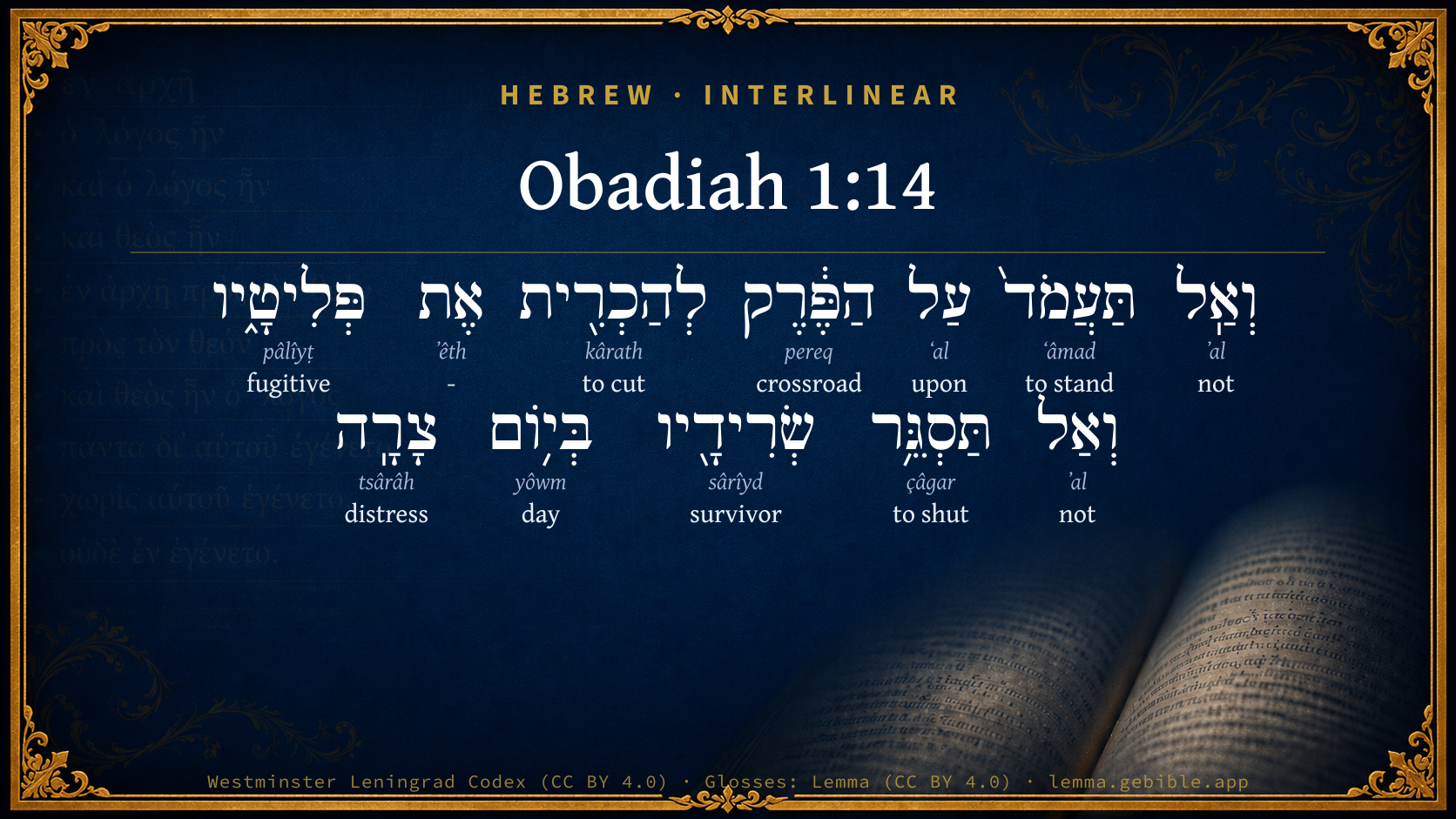
  1. וְאַֽל ʼal H408 “and · not” Conjunction + Particle, Negative
  2. תַּעֲמֹד֙ ʻâmad H5975 “to stand” Verb, Qal, Jussive, 2nd Person, Masculine, Singular
  3. עַל ʻal H5921 “upon” Preposition
  4. לְהַכְרִ֖ית kârath H3772 “to cut” Preposition + Verb, Hiphil, Infinitive Construct
  5. אֶת ʼêth H853 “-” Particle, Direct Object
  6. פְּלִיטָ֑יו pâlîyṭ H6412 “fugitives · his” Noun, Common, Masculine, Plural, Construct + Suffix, Personal, 3rd Person, Masculine, Singular
  7. וְאַל ʼal H408 “and · not” Conjunction + Particle, Negative
  8. תַּסְגֵּ֥ר çâgar H5462 “to shut” Verb, Hiphil, Jussive, 2nd Person, Masculine, Singular
  9. שְׂרִידָ֖יו sârîyd H8300 “survivors · his” Noun, Common, Masculine, Plural, Construct + Suffix, Personal, 3rd Person, Masculine, Singular
  10. בְּי֥וֹם yôwm H3117 “in/at · day of” Preposition + Noun, Common, Masculine, Singular, Construct
  11. צָרָֽה tsârâh H6869 “distress” Noun, Common, Feminine, Singular, Absolute

About this verse

These counts appear in no published source. They are computed here, from the morphology-tagged text and Lemma’s own curated glosses. What Lemma adds →

12
words
11
distinct lemmas
Prophets
section

Notable vocabulary

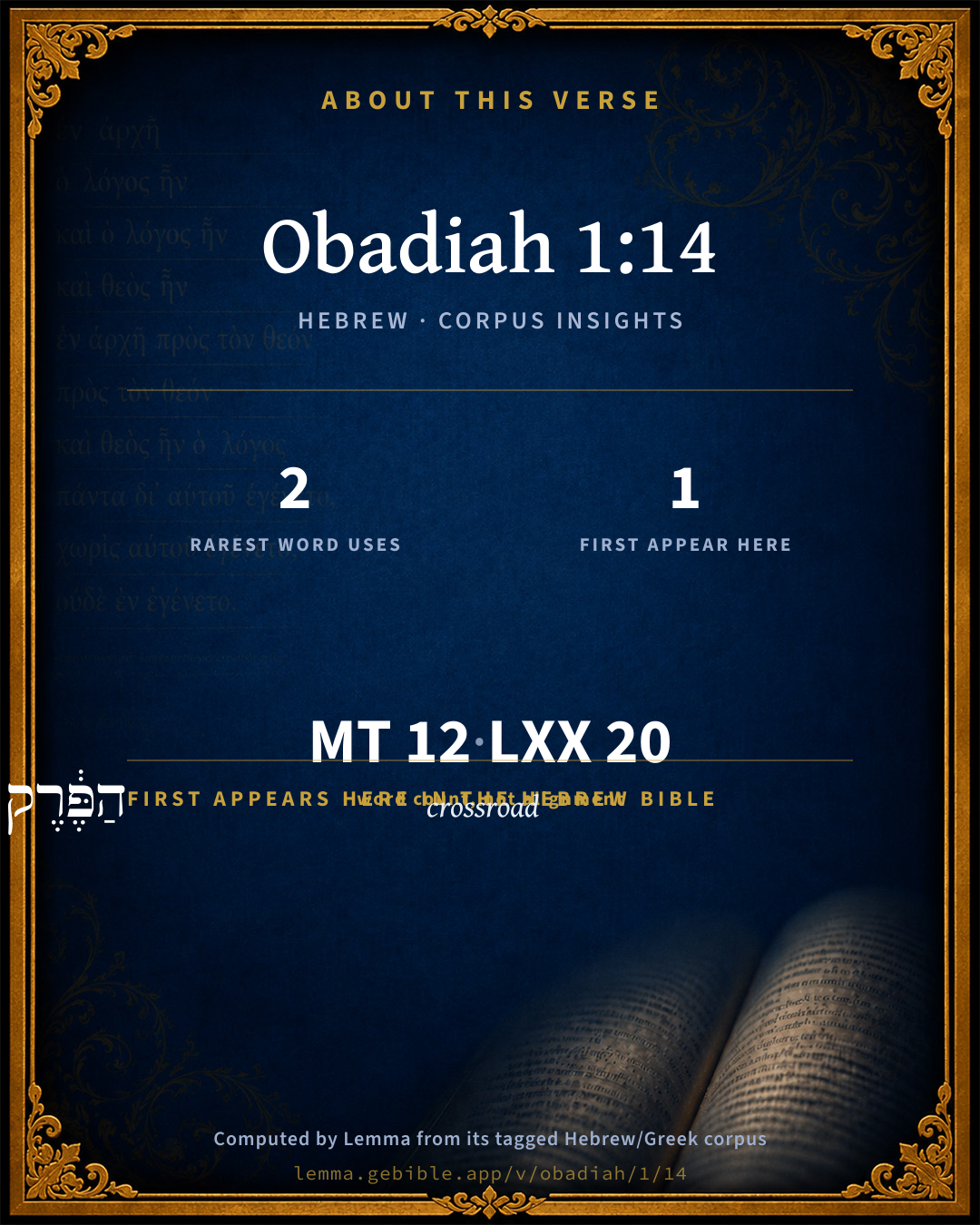
The rarest word here is הַפֶּ֔רֶק crossroad H6563 — appearing just 2 times in the whole Hebrew Bible.

First appearance in Scripture

This word makes its first canonical appearance in the Hebrew Bible here:

  • הַפֶּ֔רֶק crossroad H6563

Shared distinctive vocabulary

הַפֶּ֔רֶק crossroad H6563 occurs in 2 verses of the Hebrew Bible. Also found in:

Grammatical profile

  • 3 verbs
  • 5 nouns
  • 1 preposition
  • 3 particles

Verb forms

  • תַּעֲמֹד֙ Qal · Jussive
  • לְהַכְרִ֖ית Hiphil · Infinitive Construct
  • תַּסְגֵּ֥ר Hiphil · Jussive

Repetition

A word recurs within this verse — often emphatic in Hebrew:

  • וְאַֽל not H408 ×2

Hebrew & Septuagint length

In English translation the verse runs 26 words from the Hebrew and 33 from the Septuagint (LXX English) — closely comparable.

A rough comparison of the two English renderings, which tokenize alike — not a word-level alignment.

Word counts can differ between the Hebrew and the Greek without any difference in meaning — e.g. the Hebrew direct-object marker אֵת has no separate Greek word, and Greek often adds the article ὁ.

In the original languages it is 12 Hebrew tokens and 20 Greek tokens — but the two are counted differently (Hebrew bundles its prefixes and suffixes into one token; the Greek is in lemma form), so that isn’t a like-for-like length.

Cross-references

7

Topical passages linked to Obadiah 1:14 in the Treasury of Scripture Knowledge — connected by theme and wording, ordered by reader-vote popularity; previews shown in the World English Bible.

  • Genesis 35:3 Let us arise, and go up to Bethel. I will make there an altar to God, who answered me in the day of my distress, and was with me in the way which I went."
  • Psalms 31:8 You have not shut me up into the hand of the enemy. You have set my feet in a large place.
  • Isaiah 37:3 They said to him, Thus says Hezekiah, This day is a day of trouble, and of rebuke, and of rejection; for the children have come to the birth, and there is no strength to bring forth.
  • Jeremiah 30:7 Alas! for that day is great, so that none is like it: it is even the time of Jacob's trouble; but he shall be saved out of it.
  • Amos 1:6 Thus says Yahweh: "For three transgressions of Gaza, yes, for four, I will not turn away its punishment; Because they carried away captive the whole community, To deliver them up to Edom;
  • Amos 1:9 Thus says Yahweh: "For three transgressions of Tyre, yes, for four, I will not turn away its punishment; Because they delivered up the whole community to Edom, And didn't remember the brotherly covenant;
  • Obadiah 1:12 But don't look down on your brother in the day of his disaster, and don't rejoice over the children of Judah in the day of their destruction. Don't speak proudly in the day of distress.

Cross-references courtesy of OpenBible.info (CC BY 4.0).

Hebrew and Greek witnesses Masoretic Hebrew ↔ Greek Septuagint

The same verse in the two great witnesses to the Old Testament, shown verse-for-verse.

These are two independent witnesses, not word-aligned to each other, and the Septuagint is shown in lemma (dictionary) form.

Hebrew Obadiah 1:14 Masoretic · Westminster Leningrad Codex

וְאַֽל תַּעֲמֹד֙ עַל הַפֶּ֔רֶק לְהַכְרִ֖ית אֶת פְּלִיטָ֑יו וְאַל תַּסְגֵּ֥ר שְׂרִידָ֖יו בְּי֥וֹם צָרָֽה

Don't stand in the crossroads to cut off those of his who escape. Don't deliver up those of his who remain in the day of distress.

World English Bible · Public Domain

Greek LXX Obadiah 1:14 Septuagint · lemma form

μηδέ ἐπιἵστημι ἐπί ὁ διεκβολή αὐτός ὁ ἐκὀλεθρεύω ὁ ἀνασώζω αὐτός μηδέ συνκλείω ὁ φεύγω ἐκ αὐτός ἐν ἡμέρα θλῖψις

Neither should you have stood at the opening of their passages, to destroy utterly those of them that were escaping; neither should you have shut up his fugitives in the day of affliction.

LXX2012 (modern English Septuagint) · Public Domain

On this verse, The Pulpit Commentary discusses the Septuagint’s reading. Read the note in Commentary ↓

Hebrew: Westminster Leningrad Codex (CC BY 4.0). Greek: Septuagint (public domain); English from LXX2012 (modern English Septuagint) (Public Domain). How the Septuagint differs from the Hebrew →

Targum (Aramaic paraphrase)

1

The Targum is the ancient Jewish Aramaic paraphrase of the Hebrew Scriptures — an interpretive translation, not the Hebrew text itself. Onkelos (literal) and Pseudo-Jonathan (expansive) render the Torah, and Jonathan the Prophets. Coverage is partial: where no permissively-licensed English translation exists for a verse, only the Aramaic is shown. This is verse-level text, not a word-by-word alignment to the Hebrew.

  1. Targum Jonathan Prophets (Joshua–Malachi)
    וּדְקַמְתָּא עַל פִּרְקָא לְשֵׁיצָאָה יַת מְעַרְקוֹהִי וְדִמְסַרְתָּא מְשֵׁיזְבוֹהִי בְּעִדַן עָקָא:

    (no public-domain English translation for this verse)

    Targum Jonathan — Aramaic: “Mikraot Gedolot” (public domain). English: “Sefaria Community Translation” (CC0 1.0 (public-domain dedication)); “London "Chaldee Paraphrase," 1871” (public domain). Text via Sefaria.

Commentary

Notes on Obadiah 1:14 from classic Christian and Jewish commentators (each source and its license shown beneath its notes). The classic Christian expositions comment on the surrounding passage and are grouped to its opening verse, so a note may address several verses; the Jewish commentaries on the Tanakh (Rashi and others) are per-verse, so they appear only where the commentator wrote on this verse.

Lemma curates 59 commentaries, every one of them public domain or Creative Commons licensed, each selected and text-cleaned for this edition rather than reprinted as found. About our sources →

Trapp's Complete Commentary

John Trapp

Oba 1:14 Neither shouldest thou have stood in the crossway, to cut off those of his that did escape; neither shouldest thou have delivered up those of his that did remain in the day of distress.

Ver. 14. Neither shouldest thou have stood in the crossway] To intercept those poor fugitives, who sought to save themselves by flight, since they could not by fight. But alas,

“ Una salus victis, nullam sperare salutem. ”

Seeking to shun the shelves, they ran upon a rock. Mischievous Edomites waylaid them; and either slew them or drew them back to prison, as in the next words.

Neither shouldest thou have delivered up] Or shut up close prisoners the residue, Heb. Serido (the same almost with the English, the letters only transposed), those poor few that were yet undevoured by the sword. This was the greatest cruelty of all. And see the Edomites’ progress in it, and what proficients they prove. Nemo repente fit deterrimus. Sin proceeds by degrees; neither is any man at his worst at first. First they looked at the Church’s calamity, and then they laughed, and then they insulted and spoke big words, and then they plundered, and lastly they butchered some and imprisoned others. Did not God’s enemies do all this among us in our late unnatural commotions? wherein, besides the many massacres made everywhere, it was a like difficult thing, in those parts where they prevailed, to find a wicked man in their prisons or a good man out of them.

John Trapp, A Commentary or Exposition upon All the Books of the Old and New Testament (1647–1656) — public domain. Text from a community e-Sword module.

Jamieson, Fausset & Brown

Robert Jamieson, A. R. Fausset & David Brown

stood in the crossway, to cut off those of his--Judah's.

that did escape--The Jews naturally fled by the crossways. (MAURER translates, "narrow mountain passes") well known to them, to escape to the desert, and through Edom to Egypt; but the Edomites stood ready to intercept the fugitives and either kill or "deliver them up" to the foe.

Jamieson, Fausset & Brown — Commentary Critical and Explanatory on the Whole Bible (1871) — public domain (CC PDM 1.0). Text via the HelloAO Bible API.

Adam Clarke's Commentary

Verse 14. Neither shouldest thou have stood in the crossway] They are represented here as having stood in the passes and defiles to prevent the poor Jews from escaping from the Chaldeans. By stopping these passes, they threw the poor fugitives back into the teeth of their enemies. They had gone so far in this systematic cruelty as to deliver up the few that had taken refuge among them.

Adam Clarke's Commentary on the Bible (1810–1826) — public domain. Text from a community e-Sword/MySword module.

John Calvin's Commentaries

It follows, And thou shouldest not stand on the going forth. The word פרק perek signifies to break, to dissipate, to rend; hence פרק perek, as a noun, in Hebrew means rending and breaking. Therefore some take it metaphorically for a place where two ways meet, when one road is cut or divided into two. When the two meet then there is a going forth by two ways; hence they take פרק, perek, for such a place. But we may simply take it for the rending of the people. Though I am certainly pleased with the first explanation, yet I do not confine the word to that meaning; and I prefer the idea of going forth, as it harmonizes better with the context: Thou hast stood then on the going forth; and for what purpose? To destroy those who had escaped, and to stop or to deliver up his remaining captives in the day of affliction. In short, the Prophet means that the Idumeans occupied all the ways, to intercept the miserable exiles, to whom flight was the only way of safety.

As then the miserable Jews tried by winding outlets to provide for their own safety, the Prophet says that they were intercepted by the Idumeans, lest any of them should escape, and that they were stopped, that afterwards they might be slain by their enemies. Inasmuch as the Assyrians and the Chaldeans were a people far remote from Judea, it is probable that the roads were unknown to them, and that they were afraid of being entrapped; but the Idumeans, who were familiarly acquainted with all their roads, could stand at all the outlets. Some give the following explanation, but it is too frigid: Thou shouldest not stand for the rending of thy brethren, that is, thou should not stand still, but strive to extend a helping hand to the distressed: but this, as I have said, is too frigid and strained. Thou shouldest not then stand on the going forth of the roads to destroy We now see what the Prophet had in view; to destroy, he says, and whom did they destroy? Even those who had already escaped. Expressly then is pointed out here the cruelty to which I have referred, that the Idumeans were not contented with the ruin of the city, and the great slaughter which had been made; but in case any had stealthily escaped, they occupied the outlets of the roads, that they might not flee away: and the same thing is meant when he adds, that all were betrayed or stopped who had remained alive in the day of affliction.

We now understand the Prophet’s meaning; — that the Idumeans could not complain that God was too severe with them, when he reduced them to nothing, because they had given examples of extreme cruelty towards their own brethren, and at a time when their calamities ought to have obliterated all hatred and old enmities, as it is usually the case even with men the most alienated from one another. Let us proceed —

John Calvin's Commentaries (1540-1563) — public domain. Text from the Calvin Translation Society English edition (1840s-50s) via the Christian Classics Ethereal Library (ccel.org). Calvin's coverage is partial (roughly two-thirds of the Bible); uncommented books and verses are honest gaps, never fabricated. The 19th-century editor's footnotes and remarks are omitted so the notes are faithfully Calvin's own voice.

The Cambridge Bible for Schools and Colleges

gen. ed. J. J. S. Perowne

14. Neither shouldest thou have stood … delivered up] rather, stand not, deliver not up.

The Cambridge Bible for Schools and Colleges (gen. ed. J. J. S. Perowne; Cambridge University Press, 1878–1918) — public domain. Text from a community e-Sword module.

John Gill's Exposition

Neither shouldest thou have stood in the crossing,.... In a place where two or more roads met, to stop the Jews that fled, let them take which road they would: or, "in the breach" (y); that is, of the walls of the city;

to cut off those of his that did escape; such of the Jews that escaped the sword of the Chaldeans in the city, and attempted, to get away through the breaches of the walls of it, or that took different roads to make their escape; these were intercepted and stopped by the Edomites, who posted themselves at these breaches, or at places where two or more ways met, and cut them off; so that those that escaped the sword of the enemy fell by theirs; which was exceeding barbarous and cruel:

neither shouldest thou have delivered up those of his that did remain in the day of their distress; or "shut up" (z); they shut them up in their houses, or stopped up all the avenues and ways by which they might escape, even such as remained of those that were killed or carried captive; these falling into the hands of the Edomites, some they cut off, and others they delivered up into the hands of the Chaldeans. Of the joy and rejoicing of the mystical Edomites, the Papists, those false brethren and antichristians, at the destruction of the faithful witnesses and true Christians, and of their cruelty and inhumanity to them, see Rev 11:7.

(y) "in diruptione", Junius & Tremellius, Tarnovius. (z) "neque concludas", Montanus, Mercerus, Tigurine version, Tarnovius.

John Gill's Exposition of the Whole Bible (1746–1763) — public domain (CC PDM 1.0). Text via the HelloAO Bible API.

Haydock's Catholic Bible Commentary

Flee. The Idumeans might easily have concealed the fugitives. But they were so inhuman as to fall upon them, (Calmet) or drive them back.

George Leo Haydock (1774–1849), Haydock's Catholic Family Bible and Commentary, 1859 edition — public domain. Excludes Psalms (Douay-Rheims chapter numbering differs from Protestant) and Deuterocanonical books (Catholic canon only).

Matthew Poole's English Annotations

In the cross-way; or in the breaches, viz. of the walls, by which, when the city was taken, some might have made their escape from the enemy; thou didst, though thou shouldst not, spitefully and cruelly watch at such breaches, and preventedst their flight; or else thou didst post thyself at the head of the ways, where thou mightest seize fleeing Jews.

To cut off; either kill if they would not yield, or cut off their hopes of escape by making them prisoners.

Those of his that did escape out of the city, and were fleeing farther for safety.

Neither shouldest thou have delivered up, reserved them prisoners, and brought them back into the hands of the Chaldeans,

those of his, of thy brother Jacob’s posterity, which did remain, survived the taking of the city, and were fairly like to escape; but thou foundest them and betrayedst them,

in the day of distress, when they could no longer defend their city, nor had any hope but in a flight through all the secret ways they knew; but thou didst watch these ways, and didst cut off many who sought to flee through them.

Matthew Poole's English Annotations on the Holy Bible (1683–1685) — public domain. Text from a community e-Sword/MySword module.

The Pulpit Commentary

The climax of injury is the cutting off of fugitives, and delivering them into captivity. Neither shouldst thou have stood in the crossway; and stand not thou is the crossway. The Edomites, as neighbours, would know all the passes into the wilderness by which the Judaeans would seek to escape. Neither shouldst thou have delivered up; and deliver not up; Septuagint, nhde sugkleishv , "shut not up;" Vulgate, et non concludes. So Pusey, "shut not up," i.e. with the enemy, driving them back upon their pursuers. (comp. Psa_31:8) The Hebrew word implies both meanings deliver over to confinement;" and the meaning here is do not seize on the people to give them over into captivity. (comp. Amo_1:6, Amo_1:9) Those of his that did remain. Those whom the invaders had spared.

The Pulpit Commentary (1880–1919), ed. H.D.M. Spence-Jones & Joseph S. Exell — public domain. Text from a community e-Sword module.

John Wesley's Explanatory Notes

The breaches - Of the walls, by which when the city was taken, some might have made their escape. Delivered - To the Chaldeans. Remain - Survived the taking of the city.

John Wesley, Explanatory Notes Upon the Whole Bible (1754–1765) — public domain. Text via the GEBible commentary corpus.

Rashi

Rabbi Shlomo Yitzchaki (Rashi)

And you should not have stood by the gap Heb. הַפֶּרֶק. The place through which the escapees emerge to escape, and in French they call it “trou.” And you should not have stood by me gap—From here [we learn] that one may not interrupt between one paragraph and another in reading the “Shma.” [Haggadah of Rabbi Akiva]

Rashi on the Tanakh — English translations: “The Judaica Press complete Tanach with Rashi, translated by A. J. Rosenberg” (CC BY 4.0); “Pentateuch with Rashi's commentary by M. Rosenbaum and A.M. Silbermann, 1929-1934” (public domain); “The Metsudah Tanach series, Lakewood, N.J” (CC BY 4.0); and “The Book of Joshua, Metsudah Publications, 1997” (CC BY 4.0). Text via Sefaria.

Lesson kit

Teaching starters — assembled from the data on this page, not authored interpretation. Every prompt links to the verse data it draws on. Edit before teaching.

Obadiah, in the Prophets, opens this verse with 12 words (11 distinct Hebrew lemmas). Its most distinctive word is pereq (“crossroad”). A historical commentator’s framing appears above. Read the whole chapter for the surrounding context.

Discussion questions

  1. The word pereq carries the sense “crossroad.” How does it shape the verse?
  2. The word “crossroad” first appears here in Scripture. What is being introduced at this debut?
  3. Nahum 3:1 shares the word «crossroad» with this verse. How do the two illuminate each other?
  4. “not” occurs 2× in this one verse. What is the effect of the repetition?
  5. The translations on this page render this verse differently — a whole-verse word diff, not a word-by-word alignment. What might account for the different wordings?
  6. The verb «תַּעֲמֹד֙» is Qal Jussive. How does its form color the action?
  7. Reading how Trapp's Complete Commentary and Jamieson, Fausset & Brown read this verse, where do the two commentators agree and where do they part?

Things to notice

Reading settings

Reading text

Shown beneath each verse's original-language words.

Old Testament
Old Testament edition

Read the OT as the Masoretic Hebrew (MT) or the Greek Septuagint (LXX).

English shown for the Greek Septuagint (in the Hebrew ↔ Greek comparison).

Comparing translations? Open the Compare panel on any verse page to stack up to four side by side.