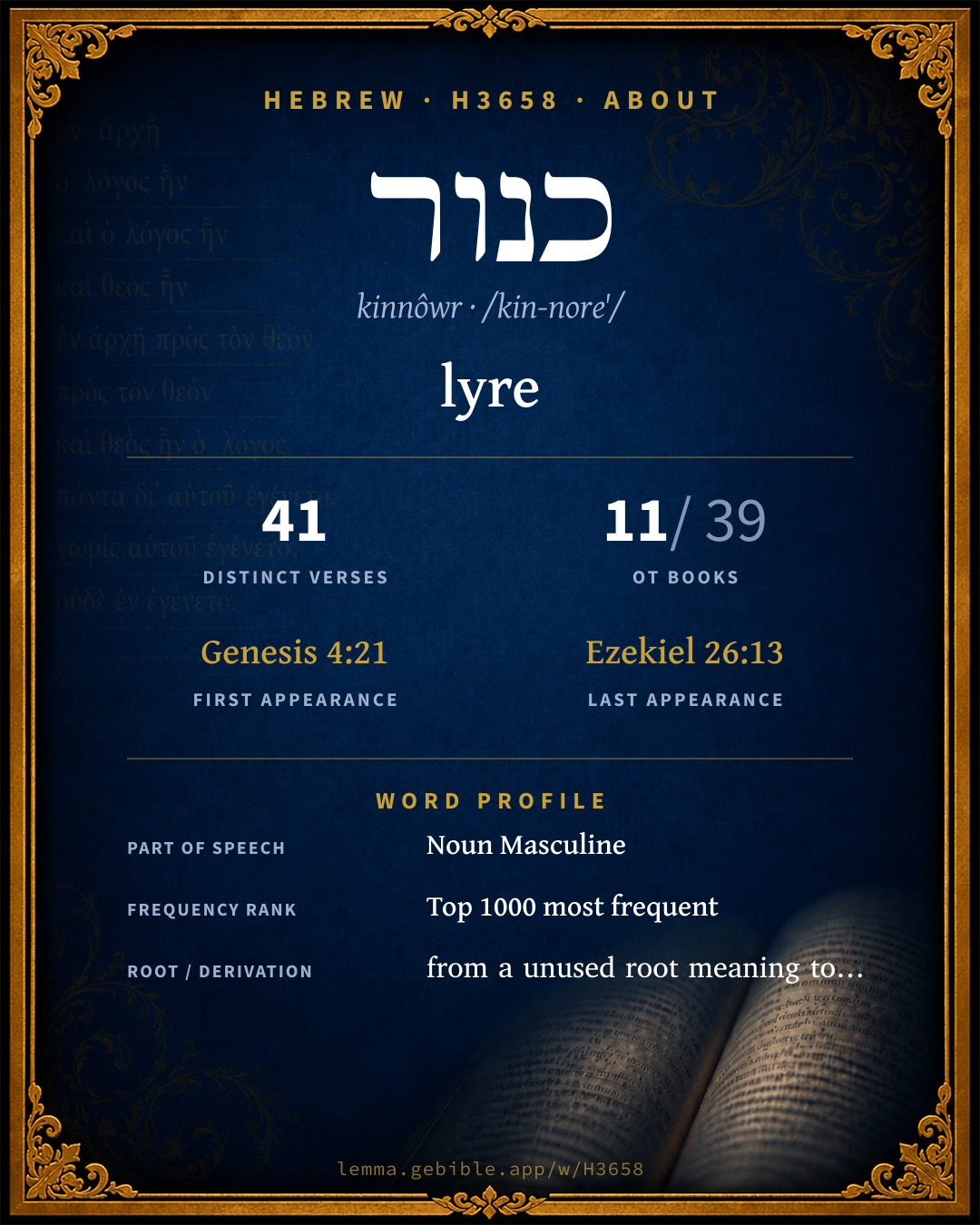
כִּנּוֹר
lyre
Full lexicon entry — Brown-Driver-Briggs (BDB)
From Brown-Driver-Briggs (BDB)
Where this word appears
See every Absolute-state word in the Hebrew Bible →
Grammar key — what these labels mean
Part of speech
- Noun
- A naming word — a person, place, thing, or idea.
Noun type
- Common
- A common noun — a general class of person, place, or thing (“king,” “city,” “water”), not a specific name.
State
- Absolute
- The independent form of a noun, not bound to a following word.
- Construct
- A noun bound to a following noun in a possessive / “of” relationship (the construct chain).
Gender
- Masculine
- Grammatically masculine.
Number
- Singular
- One.
- Plural
- More than one (in Hebrew, generally three or more).
Grammatical forms
- Noun, Common, Masculine, Singular, Absolute 24 times (57%)
- Noun, Common, Masculine, Plural, Absolute 15 times (36%)
- Noun, Common, Masculine, Plural, Construct 2 times (5%)
- Noun, Common, Masculine, Singular, Construct 1 time (2%)
Parsed forms decoded from the imported morphology (morphhb / Westminster Leningrad Codex — WLC text public domain, morphhb tagging CC BY 4.0), counted across 42 parsed occurrences — not distinct verses.
Every verse where H3658 appears — 41 distinct verses across 11 books. Click any verse to open its interlinear word-by-word view. Verse text shown in the World English Bible for context — . Each verse’s Hebrew form is shown with its reference; the English is not keyword-highlighted, since the data carries no word-level English alignment. Use “Compare translations” on any verse to read it across multiple English versions. This concordance covers the Hebrew Bible; Septuagint (Greek Old Testament) occurrences are not indexed here.
Genesis 2 verses
- Genesis 4:21 כִּנּ֖וֹר n c ms His brother's name was Jubal, who was the father of all who handle the harp and pipe.
- Genesis 31:27 וּ/בְ/כִנּֽוֹר conj + prep + n c ms Why did you flee secretly, and deceive me, and didn't tell me, that I might have sent you away with mirth and with songs, with tambourine and with harp;
1 Samuel 3 verses
- 1 Samuel 10:5 וְ/כִנּ֔וֹר conj + n c ms After that you shall come to the hill of God, where is the garrison of the Philistines: and it shall happen, when you are come there to the city, that you shall meet a band of prophets coming down from the high place with a psaltery, and a tambourine, and a pipe, and a harp, before them; and they will be prophesying:
- 1 Samuel 16:16 בַּ/כִּנּ֑וֹר prep det + n c ms Let our lord now command your servants who are before you, to seek out a man who is a skillful player on the harp: and it shall happen, when the evil spirit from God is on you, that he shall play with his hand, and you shall be well.
- 1 Samuel 16:23 הַ/כִּנּ֖וֹר ptcl def.art + n c ms It happened, when the [evil] spirit from God was on Saul, that David took the harp, and played with his hand: so Saul was refreshed, and was well, and the evil spirit departed from him.
2 Samuel 1 verse
1 Kings 1 verse
1 Chronicles 8 verses
- 1 Chronicles 13:8 וּ/בְ/כִנֹּרוֹת֙ conj + prep + n c mp David and all Israel played before God with all their might, even with songs, and with harps, and with psalteries, and with tambourines, and with cymbals, and with trumpets.
- 1 Chronicles 15:16 וְ/כִנֹּר֖וֹת conj + n c mp David spoke to the chief of the Levites to appoint their brothers the singers, with instruments of music, psalteries and harps and cymbals, sounding aloud and lifting up the voice with joy.
- 1 Chronicles 15:21 בְּ/כִנֹּר֥וֹת prep + n c mp and Mattithiah, and Eliphelehu, and Mikneiah, and Obed-edom, and Jeiel, and Azaziah, with harps tuned to the eight-stringed lyre, to lead.
- 1 Chronicles 15:28 וְ/כִנֹּרֽוֹת conj + n c mp Thus all Israel brought up the ark of the covenant of Yahweh with shouting, and with sound of the cornet, and with trumpets, and with cymbals, sounding aloud with psalteries and harps.
- 1 Chronicles 16:5 וּ/בְ/כִנֹּר֔וֹת conj + prep + n c mp Asaph the chief, and second to him Zechariah, Jeiel, and Shemiramoth, and Jehiel, and Mattithiah, and Eliab, and Benaiah, and Obed-edom, and Jeiel, with psalteries and with harps; and Asaph with cymbals, sounding aloud;
- 1 Chronicles 25:1 בְּ/כִנֹּר֥וֹת prep + n c mp Moreover, David and the captains of the host set apart for the service certain of the sons of Asaph, and of Heman, and of Jeduthun, who should prophesy with harps, with psalteries, and with cymbals: and the number of those who did the work according to their service was:
- 1 Chronicles 25:3 בַּ/כִּנּ֔וֹר prep det + n c ms Of Jeduthun; the sons of Jeduthun: Gedaliah, and Zeri, and Jeshaiah, Hashabiah, and Mattithiah, six, under the hands of their father Jeduthun with the harp, who prophesied in giving thanks and praising Yahweh.
- 1 Chronicles 25:6 וְ/כִנֹּר֔וֹת conj + n c mp All these were under the hands of their father for song in the house of Yahweh, with cymbals, psalteries, and harps, for the service of the house of God; Asaph, Jeduthun, and Heman being under the order of the king.
2 Chronicles 4 verses
- 2 Chronicles 5:12 וְ/כִנֹּר֔וֹת conj + n c mp also the Levites who were the singers, all of them, even Asaph, Heman, Jeduthun, and their sons and their brothers, arrayed in fine linen, with cymbals and psalteries and harps, stood at the east end of the altar, and with them one hundred twenty priests sounding with trumpets;)
- 2 Chronicles 9:11 וְ/כִנֹּר֥וֹת conj + n c mp The king made of the algum trees terraces for the house of Yahweh, and for the king's house, and harps and psalteries for the singers: and there were none such seen before in the land of Judah.
- 2 Chronicles 20:28 וּ/בְ/כִנֹּר֖וֹת conj + prep + n c mp They came to Jerusalem with psalteries and harps and trumpets to the house of Yahweh.
- 2 Chronicles 29:25 וּ/בְ/כִנֹּר֔וֹת conj + prep + n c mp He set the Levites in the house of Yahweh with cymbals, with psalteries, and with harps, according to the commandment of David, and of Gad the king's seer, and Nathan the prophet; for the commandment was of Yahweh by his prophets.
Nehemiah 1 verse
Job 2 verses
Psalms 13 verses
- Psalms 33:2 בְּ/כִנּ֑וֹר prep + n c ms Give thanks to Yahweh with the lyre. Sing praises to him with the harp of ten strings.
- Psalms 43:4 בְ/כִנּ֗וֹר prep + n c ms Then I will go to the altar of God, To God, my exceeding joy. I will praise you on the harp, God, my God.
- Psalms 49:4 בְּ֝/כִנּ֗וֹר prep + n c ms I will incline my ear to a proverb. I will open my riddle on the harp.
- Psalms 57:8 וְ/כִנּ֗וֹר conj + n c ms Wake up, my glory! Wake up, psaltery and harp! I will wake up the dawn.
- Psalms 71:22 בְ/כִנּ֑וֹר prep + n c ms I will also praise you with the harp for your faithfulness, my God. I sing praises to you with the lyre, Holy One of Israel.
- Psalms 81:2 כִּנּ֖וֹר n c ms Raise a song, and bring here the tambourine, The pleasant lyre with the harp.
- Psalms 92:3 בְּ/כִנּֽוֹר prep + n c ms With the ten-stringed lute, with the harp, And with the melody of the lyre.
- Psalms 98:5 בְּ/כִנּ֑וֹר בְּ֝/כִנּ֗וֹר prep + n c ms prep + n c ms Sing praises to Yahweh with the harp, With the harp and the voice of melody.
- Psalms 108:2 וְ/כִנּ֗וֹר conj + n c ms Wake up, harp and lyre! I will wake up the dawn.
- Psalms 137:2 כִּנֹּרוֹתֵֽי/נוּ n c mp cs + sfx pers 1cp On the willows in the midst of it, We hung up our harps.
- Psalms 147:7 בְ/כִנּֽוֹר prep + n c ms Sing to Yahweh with thanksgiving. Sing praises on the harp to our God,
- Psalms 149:3 וְ֝/כִנּ֗וֹר conj + n c ms Let them praise his name in the dance! Let them sing praises to him with tambourine and harp!
- Psalms 150:3 וְ/כִנּֽוֹר conj + n c ms Praise him with the sounding of the trumpet! Praise him with harp and lyre!
Isaiah 5 verses
- Isaiah 5:12 כִנּ֜וֹר n c ms The harp, lyre, tambourine, and flute, with wine, are at their feasts; But they don't regard the work of Yahweh, Neither have they considered the operation of his hands.
- Isaiah 16:11 כַּ/כִּנּ֖וֹר prep det + n c ms Why my heart sounds like a harp for Moab, and my inward parts for Kir Heres.
- Isaiah 23:16 כִנּ֛וֹר n c ms Take a harp, go about the city, you prostitute that has been forgotten; make sweet melody, sing many songs, that you may be remembered.
- Isaiah 24:8 כִּנּֽוֹר n c ms The mirth of tambourines ceases, the noise of those who rejoice ends, the joy of the harp ceases.
- Isaiah 30:32 וּ/בְ/כִנֹּר֑וֹת conj + prep + n c mp Every stroke of the appointed staff, which Yahweh shall lay on him, shall be with [the sound of] tambourines and harps; and in battles with the brandishing [of his arm] will he fight with them.
Ezekiel 1 verse
About this entry
At a glance — auto-summarized from this page’s data, not written by a person. Every figure links to its source below. This summary describes the numbers; it doesn’t interpret them.
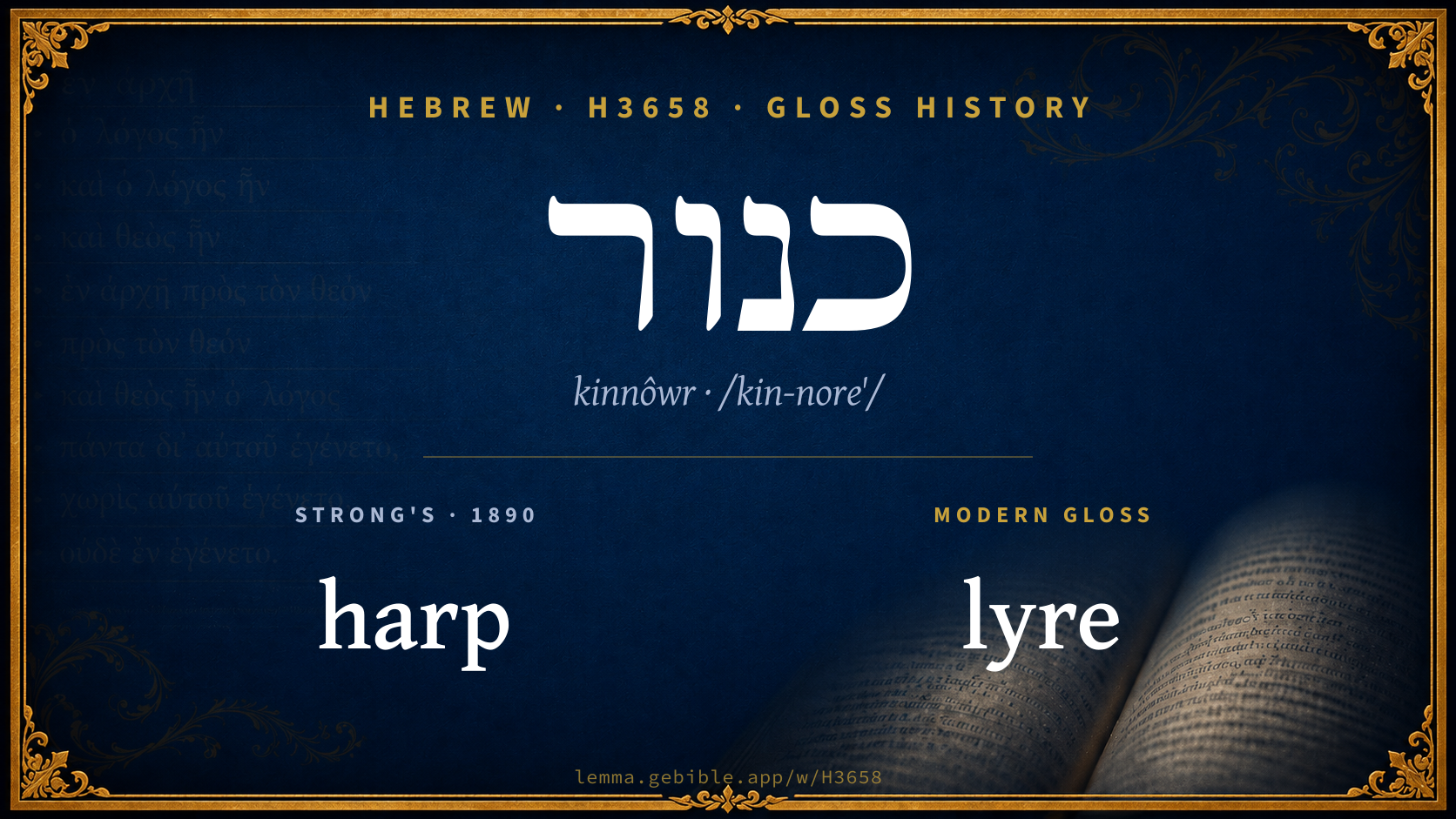
At its core, כנור (kinnôwr) means “lyre.” Older and newer Bibles part ways — “harp” in the King James Version, “lyres” (Berean Standard Bible) in modern versions. See the renderings breakdown. It turns up in 41 verses across 11 books, a moderately common footprint. The word gravitates to Psalms (32%), then 1 Chronicles and Isaiah. Scripture first uses it in Genesis 4:21. Dig into 41-verse concordance and the renderings breakdown below.
Gloss history
Strong's 1890 vs modern scholarship
About this word
Strong's H3658 catalogs a Hebrew word from the Hebrew Old Testament.
These counts are not copied from any lexicon or concordance. They are computed here, from the morphology-tagged Hebrew Old Testament. What Lemma adds →
- 41
- distinct verses
- The word appears in 41 distinct verses.
- 11 / 39
- OT books
- The word appears in 11 of 39 Old Testament books.
- #864
- by frequency
- Top 1000 most frequent Hebrew words (rank 864 of 8,640 Hebrew words by occurrence).
View all 41 occurrences in the concordance →
Most concentrated in
- Psalms 13 verses 32%
- 1 Chronicles 8 verses 20%
- Isaiah 5 verses 12%
By section of the Old Testament
By traditional corpus
Conventional, traditional groupings — biblical authorship is debated, so this is a traditional corpus grouping, not an authorship claim. Each share is this word’s portion of its verses in that division of the Hebrew canon. Each figure is a share of the word’s 41 distinct verses.
- Writings (Ketuvim) 28 verses · 68%
- Prophets (Nevi'im) 11 verses · 27%
- Torah (Pentateuch) 2 verses · 5%
How translations render this word
Counts come from each version’s own published word-to-Strong’s tagging or interlinear alignment — an approximate guide to how each version renders this word, not a word-level alignment the data otherwise carries. Because each total is that version’s own tagged count, the per-version totals vary from one another and need not match the appearance or distinct-verse counts above. These counts may also differ from a printed concordance because Lemma counts each distinctly tagged rendering and does not collapse phrase taggings into a single head-word total. This is a fixed set of word-tagged versions (KJV, ASV, BSB, ULT) and does not change with the reading translation you choose elsewhere. Each version’s license is shown beside its name below (and on Sources).
- King James Version: Harp 23×, Harps 17×
- American Standard Version: Harp 21×, Harps 15×
- Berean Standard Bible: Lyres 14×, Harp 12×, Lyre 8×
- unfoldingWord Literal Text: Harp 18×, Harps 10×, Lyres 7×
King James Version Public Domain
Renders H3658 across 42 tagged occurrences — most commonly:
Plus 2 renderings that appear only once — usually multi-word phrases or single function words the recovered tagging swept in, not distinct renderings.
American Standard Version Public Domain
Renders H3658 across 41 tagged occurrences — most commonly:
Plus 5 renderings that appear only once — usually multi-word phrases or single function words the recovered tagging swept in, not distinct renderings.
Berean Standard Bible Public Domain
Renders H3658 across 42 tagged occurrences — most commonly:
Plus 4 renderings that appear only once — usually multi-word phrases or single function words the recovered tagging swept in, not distinct renderings.
unfoldingWord Literal Text CC BY-SA 4.0
Renders H3658 across 44 tagged occurrences — most commonly:
Plus 5 renderings that appear only once — usually multi-word phrases or single function words the recovered tagging swept in, not distinct renderings.
Senses in BDB
The 1 sense BDB distinguishes for this word, in lexicon order (not ranked by frequency or importance). The full entry — with sub-senses — is in the Lexicon Entry tab.
- lyre, harp
Word origin
n.m. ψ 81:3 lyre (on formation cf. LagBN 89, Anm.; NH id.; Aramaic כִּנָּרָא, ܟܶܢܳܪܳܐ; Mand. כינאר(א) NöM § 104 (who questions Shemitic origin); Arabic كِنَارٌ, كَنَّارَةٌ; as loan-word in Hellen. Gk. κινύρα (𝔊 and Joseph); in Egyptian kn-an-aul according to Bondi79)—abs. כ׳ Gn 4:21 +; sf. כִּנֹּרִי Jb 30:31; pl. כִּנֹּרוֹת 1 K 10:12 +; sf. כִּנּוֹרַיִךְ Ez 26:13, כִּנֹּרוֹתֵינוּ ψ 137:2;—lyre, stringed instrument used for popular as well as sacred music (cf. BenzArch. 273 ff. NowArch. i. 273 ff.);—כ׳ וְעוּגָב Gn 4:21, בְּתֹף וּבְכ׳ 31:27; אִישׁ יֹדֵעַ מְנַגֵּן בַּכּ׳ 1 S 16:16 a man skilled in playing on the lyre, cf. v 23 (וִנִגֵּן בְּיָדוֹ); at banquets Is 5:12 (+ נֶבֶל, תֹּף, חָלִיל), token of merriment 24:8 (+ תֻּפִּים), Ez 26:13, cf. וַיְהִי לְאֵבֶל כִּנֹּרִ֑י וְעֻגָבִי לְקוֹל בֹּכִים Jb 30:31, יִשְׂאוּ כְתֹף וְכ׳ וְיִשְׂמְחוּ לְקוֹל עוּגָב Jb 21:12; carried by a loose woman Is 23:16 (fig. of Tyre); in sim. Is 16:11 (of murmuring sound of bowels = heart, in pity); used also in praising י׳, usually as accompainment of song (cf. 1 Ch 15:16) נֵבֶל וְתֹף וְחָלִיל וְכ׳ 1 S 10:5; Is 30:32 (‖ תֻּפִּים); especially before the ark 2 S 6:5 (+ נְבָלִים, תֻּפִּים, etc.) ‖ 1 Ch 13:8, and in sanctuary (usually + נֵבֶל, etc.) 1 K 10:12, but especially Chr ψψ:—1 Ch 13:8 (pl., and so chiefly in Chr), 15:16, 21, 28; 16:5; 25:1, 3, 6 2 Ch 5:12; 9:11; 20:28; 29:25 Ne 12:27; ψ 33:2 (sg., and so chiefly in ψψ), 43:4; 49:5; 57:9; 71:22; 81:3; 92:4; 98:5(×2); 108:3; 147:7; 149:3; 150:3; cf. כִּנֹּרוֹתֵינוּ ψ 137:2.—Vbs. used with כ׳ are:—תָּפַשׂ Gn 4:21, נִגֵּן בְּ 1 S 16:16, מְשַׂחֵק בְּ 2 S 6:5 = 1 Ch 13:8, מְשֹׁרֲרִים בּ 1 Ch 15:16, מַשְׁמִיעִים בְּ v 28, נִבָּא בְּ 25:1, 3, הוֹדָה בְּ ψ 33:2; 42:4, זמּר בְּ ψ 71:22; 98:5; 147:7; 149:3, הַלֲלוּהוּ בְּ 150:3.—On ancient lyres v. reff. ap. Dr Amos, p. 236 f.
— Brown-Driver-Briggs (Oxford 1906, public domain), digitized via Sefaria, supplemented by the OpenScriptures HebrewLexicon (CC BY 4.0). See Sources.
Origin: from a unused root meaning to twang
Jastrow Dictionary
A second Hebrew/Aramaic lexicon for comparison, covering Aramaic and post-biblical (Talmudic, Targumic, Midrashic) usage that the biblical-Hebrew BDB does not. Matched by lemma rather than by Strong’s number, so a lemma may carry more than one Jastrow headword (shown separately below), and the entries cover usage well beyond the Bible.
כִּנּוֹר
- lute, cithern. Arakh. 13ᵇ כ׳ של מקדש וכ׳ the kinnor of the Temple was seven-stringed. Ber. 3ᵇ; Y. ib. I, 2ᵈ כ׳ היה תלוי וכ׳ David had a lute suspended &c. Snh. 101ᵃ עשאוני בניך ככ׳ וכ׳ thy children made me (the Law) like an instrument upon which the scorners play; a. fr.—Pl. כִּנּוֹרוֹת, כִּנּוֹרִים, כִּי׳. Arakh. II, 5. Shebu. 15ᵇ. Kinnim III, 6 בני מעיו לכ׳ its small bowels are used for strings for the cithern; Ab. Zar. 47ᵃ מהו לכ׳ Ms. M. (ed. לפארות). Pesik. R. s. 26; a. e.
A Dictionary of the Targumim, the Talmud Babli and Yerushalmi, and the Midrashic Literature (Marcus Jastrow; London, Luzac, 1903) — Public Domain. Digitized via Sefaria. Digitized via Sefaria. Full attribution on Sources.
Forms in the corpus
The 34 distinct written forms H3658 takes in the Hebrew Bible, most frequent first — each parse links to that state’s occurrences in the concordance. Hebrew forms include their vowel points and cantillation, so a single lemma takes many written forms.
Same root — word family
Other BDB entries built from the same root as H3658, grouped by Strong’s listed origin. These share a root / origin per the lexicon — not necessarily a shared meaning. Each links to that word’s own entry.
Proper names from this root
People and places named from this root — a name, not an additional meaning of the word.
Compare all same-root words → 1 of the same-root words is a proper name (a person or place). They share a root, not necessarily a meaning.
Septuagint verse parallels
This word appears in 39 verses that also exist in the Greek Old Testament (Septuagint), out of the 41 Hebrew verses it occurs in. You can read those verses in Greek by switching the Old Testament edition to the Septuagint.
Read these verses in the Septuagint
- Genesis 4:21
- 1 Samuel 10:5
- 2 Samuel 6:5
- 1 Kings 10:12
- 1 Chronicles 13:8
- 2 Chronicles 5:12
- Job 21:12
- Psalms 33:2
- Isaiah 5:12
- Ezekiel 26:13
This is a verse-level parallel only — the same verses exist in both the Hebrew and Greek Old Testaments. No word-level Hebrew↔Greek correspondence is claimed: the data carries no such alignment, so no Greek word is shown as this Hebrew word’s translation. Coverage is not total — the Septuagint omits the deuterocanon and renumbers the Psalms, so some Hebrew verses have no direct Greek parallel.