1 Chronicles 15:21

Hebrew (Westminster Leningrad Codex) 1 Chronicles 15:21 appears in the Hebrew Old Testament. The text above is from the Westminster Leningrad Codex. Each word links to its Strong’s number, a concise gloss, and parsing drawn from the Open Scriptures Hebrew Bible morphology. Click any word for its full Brown-Driver-Briggs (BDB) entry.
Download image
Cite this verse

1 Chronicles 15:21 (World English Bible). Public Domain. Lemma interlinear Bible study tool, https://lemma.gebible.app/v/1-chronicles/15/21.

Show BibTeX & RIS
BibTeX
RIS
English Translation
and Mattithiah, and Eliphelehu, and Mikneiah, and Obed-edom, and Jeiel, and Azaziah, with harps tuned to the eight-stringed lyre, to lead.
World English Bible · Public Domain
Highlights
  • 3 first appearances in the Hebrew Bible
Full analysis ↓
Download a study sheet

One document with this verse’s original text, its word-by-word gloss line, the meaning frame, cross-references with their text, attributed commentary, and full source and license credits — printable, and it pastes into notes with its structure intact.

This verse Autodidact and up

Study sheet (.html) Plain text (.txt)

A passage Seminary Student

Up to 50 verses in one chapter. A passage sheet keeps up to 6 commentary sources and 12 cross-references per verse, in the order this page ranks them, and says so on the sheet whenever that leaves anything out. Ask for a single verse and you get the Autodidact verse sheet above.

Everything on this page stays free to read, with no account — the sheet is a download of what is already on screen, not access to it.

Want to remove ads? Support Godless Engineer
Compare translations 3

The same verse in 3 English versions, stacked beneath the original-language interlinear above. Click any original word for its lexicon entry.

Each is an independent rendering of the whole verse — the interlinear is not word-aligned to these translations.

Highlighted words mark where these versions differ — a whole-verse word diff, not a word-by-word alignment.

  • World English Bible Public Domain
    and Mattithiah, and Eliphelehu, and Mikneiah, and Obed-edom, and Jeiel, and Azaziah, with harps tuned to the eight-stringed lyre, to lead.
  • King James Version Public Domain
    And Mattithiah, and Elipheleh, and Mikneiah, and Obededom, and Jeiel, and Azaziah, with harps on the Sheminith to excel.
  • unfoldingWord Literal Text CC BY-SA 4.0
    And Mattithiah and Eliphelehu and Mikneiah,and Obed Edom and Jeiel and Azaziah with lyres, to lead according to Sheminith.

unfoldingWord Literal Text — © unfoldingWord, licensed CC BY-SA 4.0. Word-aligned USFM3 via Door43 (git.door43.org/unfoldingWord/en_ult).

Versions to compare (up to 4)

3 of 4 selected

Show all 18 translations

Every available English version of this verse, each an independent rendering of the whole verse.

  • World English Bible Public Domain
    and Mattithiah, and Eliphelehu, and Mikneiah, and Obed-edom, and Jeiel, and Azaziah, with harps tuned to the eight-stringed lyre, to lead.
  • Berean Standard Bible Public Domain
    And Mattithiah, Eliphelehu, Mikneiah, Obed-edom, Jeiel, and Azaziah were to lead the music with lyres according to Sheminith.
  • Majority Standard Bible Public Domain
    And Mattithiah, Eliphelehu, Mikneiah, Obed-edom, Jeiel, and Azaziah were to lead the music with lyres according to Sheminith.
  • King James Version Public Domain
    And Mattithiah, and Elipheleh, and Mikneiah, and Obededom, and Jeiel, and Azaziah, with harps on the Sheminith to excel.
  • American Standard Version (1901) Public Domain
    and Mattithiah, and Eliphelehu, and Mikneiah, and Obed-edom, and Jeiel, and Azaziah, with harps set to the Sheminith, to lead.
  • Revised Version (1885) Public Domain
    and Mattithiah, and Eliphelehu, and Mikneiah, and Obed-edom, and Jeiel, and Azaziah, with harps set to the Sheminith, to lead.
  • Geneva Bible (1599) Public Domain
    And Mattithiah, and Elipheleh, and Mikneah, and Obed Edom, and Ieiel, and Azaziah, with harpes vpon Sheminith Ienazzeah.
  • Douay-Rheims (1899) Public Domain
    And Mathathias, and Eliphalu, and Macenias and Obededom, and Jehiel and Ozaziu, sung a song of victory for the octave upon harps.
  • Young's Literal Translation Public Domain
    and Mattithiah, and Elipheleh, and Mikneiah, and Obed-Edom, and Jeiel, and Azaziah, with harps, on the octave, to oversee.
  • Literal Standard Version CC BY-SA 4.0
    and Mattithiah, and Elipheleh, and Mikneiah, and Obed-Edom, and Jeiel, and Azaziah, to oversee with harps on the eighth.
  • Unlocked Literal Bible CC BY-SA 4.0
    Mattithiah, Eliphelehu, Mikneiah, Obed Edom, Jeiel, and Azaziah led the way with harps set to the Sheminith.
  • unfoldingWord Literal Text CC BY-SA 4.0
    And Mattithiah and Eliphelehu and Mikneiah,and Obed Edom and Jeiel and Azaziah with lyres, to lead according to Sheminith.
  • Darby Bible Public Domain
    and Mattithiah, and Elipheleh, and Mikneiah, and Obed-Edom and Jeiel, and Azaziah, with harps on the Sheminith to lead [the singing].
  • World Messianic Bible Public Domain
    and Mattithiah, Eliphelehu, Mikneiah, Obed-Edom, Jeiel, and Azaziah, with harps tuned to the eight-stringed lyre, to lead.
  • Webster's Bible Public Domain
    And Mattithiah, and Elipheleh, and Mikneiah, and Obed-edom, and Jeiel, and Azaziah, with harps on the Sheminith to excel.
  • Free Bible Version CC BY-SA 4.0
    while Mattithiah, Eliphelehu, Mikneiah, Obed-edom, Jeiel, and Azaziah were to lead the music with lyres “according to sheminith.”
  • Bible in Basic English Public Domain
    And Mattithiah and Eliphelehu and Mikneiah and Obed-edom and Jeiel and Azaziah, with corded instruments on the octave, to give the first note of the song.
  • JPS Tanakh (1917) Public Domain
    and Mattithiah, and Eliphalehu, and Mikneiahu, and Obed-edom, and Jeiel, and Azaziah, with harps on the Sheminith, to lead.

Literal Standard Version (2020), Covenant Press — licensed CC BY-SA 4.0. Text via the HelloAO Bible API (eBible.org). Unlocked Literal Bible (unfoldingWord) — licensed CC BY-SA 4.0. Text via the HelloAO Bible API (eBible.org). unfoldingWord Literal Text — © unfoldingWord, licensed CC BY-SA 4.0. Word-aligned USFM3 via Door43 (git.door43.org/unfoldingWord/en_ult). Free Bible Version, Dr. Jonathan Gallagher — licensed CC BY-SA 4.0. Text via the HelloAO Bible API (eBible.org).

Word by word

More ways to search: Search by grammar → Find every occurrence → Compare this word →

Practice this passage: Drill this verse → Learn its vocabulary →

וֶאֱלִֽיפְלֵ֗הוּ
ʼĔlîyphᵉlêhûw
H466
“and · Elipheleh”
Conjunction + Noun, Proper
Part of Speech
Conjunction + Noun
Type
Proper
Full BDB Definition

Origin: from H410 and H6395

TWOT: None

Elipheleh = "my God sets him apart" or " my God distinguishes him" - a Levite gatekeeper and musician for David
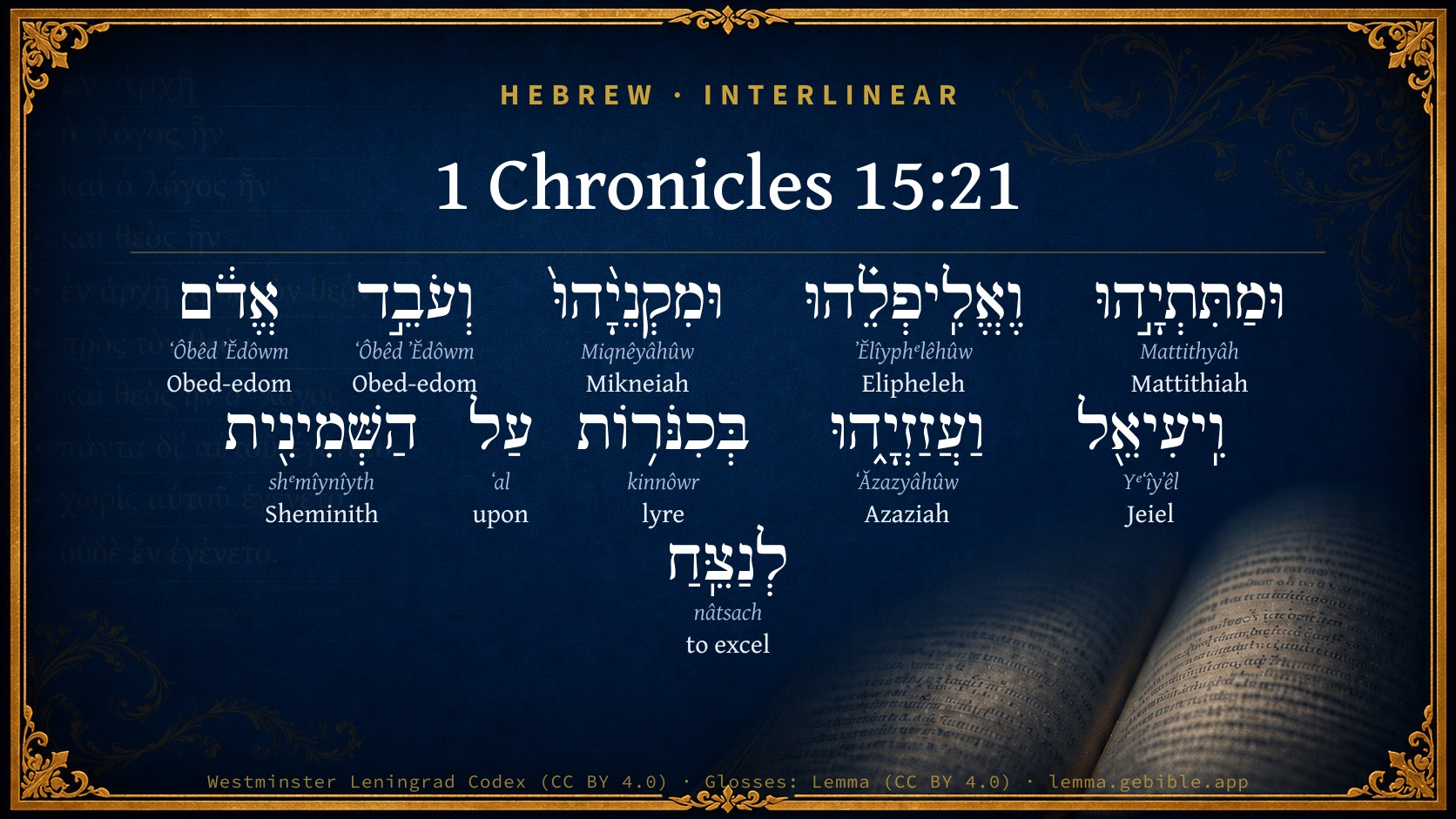
  1. וּמַתִּתְיָ֣הוּ Mattithyâh H4993 “and · Mattithiah” Conjunction + Noun, Proper
  2. וּמִקְנֵיָ֨הוּ֙ Miqnêyâhûw H4737 “and · Mikneiah” Conjunction + Noun, Proper
  3. וְעֹבֵ֣ד ʻÔbêd ʼĔdôwm H5654 “and · Obed-edom” Conjunction + Noun, Proper
  4. אֱדֹ֔ם ʻÔbêd ʼĔdôwm H5654 “Obed-edom” Noun, Proper
  5. וִֽיעִיאֵ֖ל Yᵉʻîyʼêl H3273 “and · Jeiel” Conjunction + Noun, Proper
  6. וַעֲזַזְיָ֑הוּ ʻĂzazyâhûw H5812 “and · Azaziah” Conjunction + Noun, Proper
  7. בְּכִנֹּר֥וֹת kinnôwr H3658 “in/at · lyres” Preposition + Noun, Common, Masculine, Plural, Absolute
  8. עַל ʻal H5921 “upon” Preposition
  9. הַשְּׁמִינִ֖ית shᵉmîynîyth H8067 “the · Sheminith” Particle, Definite Article + Adjective, Ordinal number, Feminine, Singular, Absolute
  10. לְנַצֵּֽחַ nâtsach H5329 “to excel” Preposition + Verb, Piel, Infinitive Construct

About this verse

These counts appear in no published source. They are computed here, from the morphology-tagged text and Lemma’s own curated glosses. What Lemma adds →

11
words
10
distinct lemmas
Historical
section

Notable vocabulary

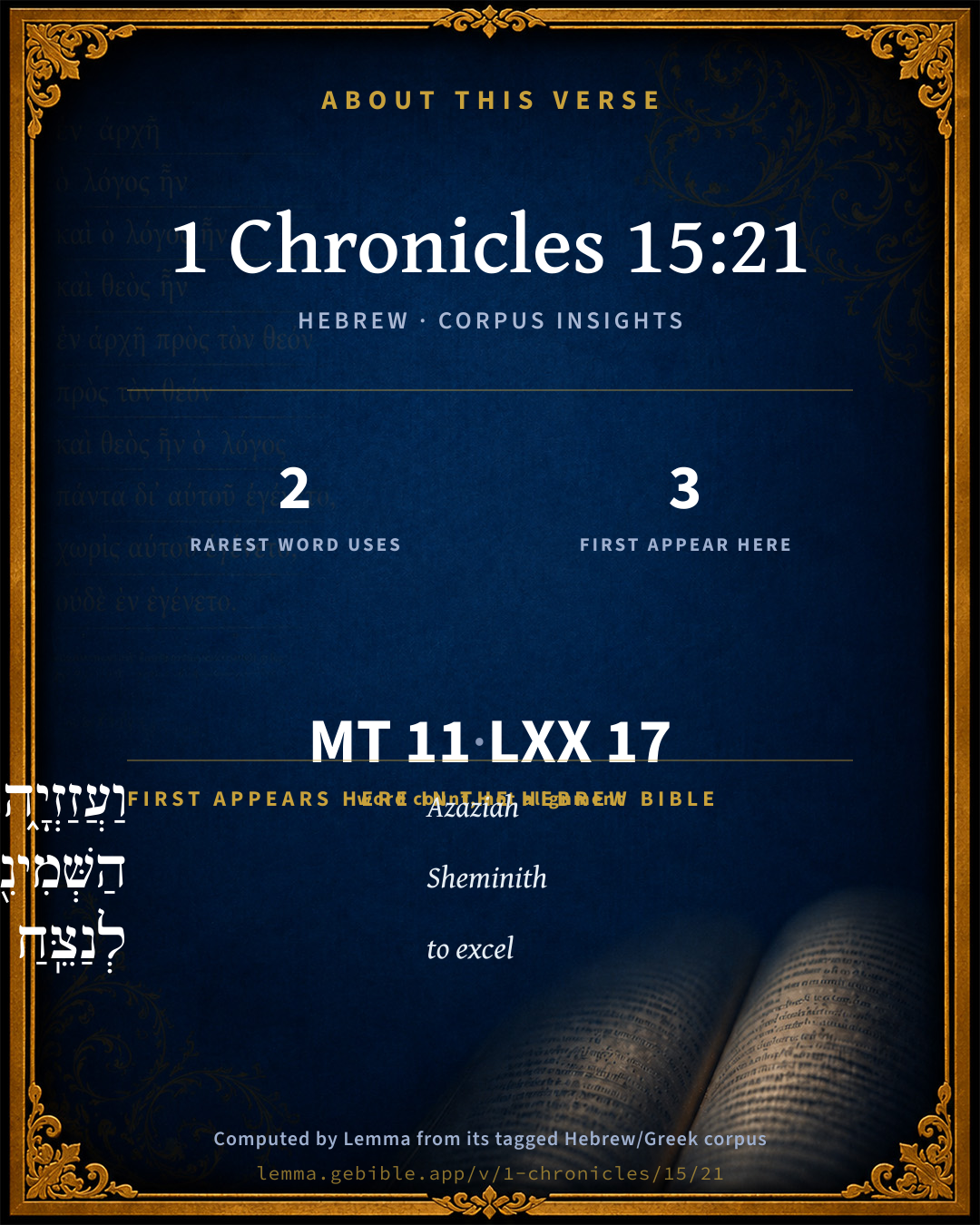
The rarest word here is וֶאֱלִֽיפְלֵ֗הוּ Elipheleh H466 — appearing just 2 times in the whole Hebrew Bible.

First appearance in Scripture

These words make their first canonical appearance in the Hebrew Bible here:

  • וַעֲזַזְיָ֑הוּ Azaziah H5812
  • הַשְּׁמִינִ֖ית Sheminith H8067
  • לְנַצֵּֽחַ to excel H5329

Shared distinctive vocabulary

וֶאֱלִֽיפְלֵ֗הוּ Elipheleh H466 occurs in 2 verses of the Hebrew Bible. Also found in:

Grammatical profile

  • 1 verb
  • 8 nouns
  • 1 adjective
  • 1 preposition

Verb forms

  • לְנַצֵּֽחַ Piel · Infinitive Construct

Repetition

A word recurs within this verse — often emphatic in Hebrew:

  • וְעֹבֵ֣ד Obed-edom H5654 ×2

Hebrew & Septuagint length

In English translation the verse runs 21 words from the Hebrew and 21 from the Septuagint (LXX English) — the same length.

A rough comparison of the two English renderings, which tokenize alike — not a word-level alignment.

Word counts can differ between the Hebrew and the Greek without any difference in meaning — e.g. the Hebrew direct-object marker אֵת has no separate Greek word, and Greek often adds the article ὁ.

In the original languages it is 11 Hebrew tokens and 17 Greek tokens — but the two are counted differently (Hebrew bundles its prefixes and suffixes into one token; the Greek is in lemma form), so that isn’t a like-for-like length.

Cross-references

10

Topical passages linked to 1 Chronicles 15:21 in the Treasury of Scripture Knowledge — connected by theme and wording, ordered by reader-vote popularity; previews shown in the World English Bible.

  • 1 Samuel 10:5 After that you shall come to the hill of God, where is the garrison of the Philistines: and it shall happen, when you are come there to the city, that you shall meet a band of prophets coming down from the high place with a psaltery, and a tambourine, and a pipe, and a harp, before them; and they will be prophesying:
  • 1 Chronicles 15:18 and with them their brothers of the second degree, Zechariah, Ben, and Jaaziel, and Shemiramoth, and Jehiel, and Unni, Eliab, and Benaiah, and Maaseiah, and Mattithiah, and Eliphelehu, and Mikneiah, and Obed-edom, and Jeiel, the doorkeepers.
  • 1 Chronicles 16:5 Asaph the chief, and second to him Zechariah, Jeiel, and Shemiramoth, and Jehiel, and Mattithiah, and Eliab, and Benaiah, and Obed-edom, and Jeiel, with psalteries and with harps; and Asaph with cymbals, sounding aloud;
  • 1 Chronicles 25:6–7 All these were under the hands of their father for song in the house of Yahweh, with cymbals, psalteries, and harps, for the service of the house of God; Asaph, Jeduthun, and Heman being under the order of the king.
  • Psalms 6:1–10 Yahweh, don't rebuke me in your anger, Neither discipline me in your wrath.
  • Psalms 12:1 Help, Yahweh; for the godly man ceases. For the faithful fail from among the children of men.
  • Psalms 33:2 Give thanks to Yahweh with the lyre. Sing praises to him with the harp of ten strings.
  • Psalms 81:1–2 Sing aloud to God, our strength! Make a joyful shout to the God of Jacob!
  • Psalms 92:3 With the ten-stringed lute, with the harp, And with the melody of the lyre.
  • Psalms 150:3 Praise him with the sounding of the trumpet! Praise him with harp and lyre!

Cross-references courtesy of OpenBible.info (CC BY 4.0).

Hebrew and Greek witnesses Masoretic Hebrew ↔ Greek Septuagint

The same verse in the two great witnesses to the Old Testament, shown verse-for-verse.

These are two independent witnesses, not word-aligned to each other, and the Septuagint is shown in lemma (dictionary) form.

Hebrew 1 Chronicles 15:21 Masoretic · Westminster Leningrad Codex

וּמַתִּתְיָ֣הוּ וֶאֱלִֽיפְלֵ֗הוּ וּמִקְנֵיָ֨הוּ֙ וְעֹבֵ֣ד אֱדֹ֔ם וִֽיעִיאֵ֖ל וַעֲזַזְיָ֑הוּ בְּכִנֹּר֥וֹת עַל הַשְּׁמִינִ֖ית לְנַצֵּֽחַ

and Mattithiah, and Eliphelehu, and Mikneiah, and Obed-edom, and Jeiel, and Azaziah, with harps tuned to the eight-stringed lyre, to lead.

World English Bible · Public Domain

Greek LXX 1 Chronicles 15:21 Septuagint · lemma form

καί ματταθιας καί ελιφαλιας καί μακενιας καί αβδεδομ καί ιιηλ καί οζιας ἐν κινύρα αμασενιθ ὁ ἐνἰσχύω

And Mattathias, and Eliphalu, and Makenia, and Abdedom, and Jeiel, and Ozias, with harps of Amasenith, to make a loud noise.

LXX2012 (modern English Septuagint) · Public Domain

On this verse, Haydock's Catholic Bible Commentary discusses the Septuagint’s reading. Read the note in Commentary ↓

Hebrew: Westminster Leningrad Codex (CC BY 4.0). Greek: Septuagint (public domain); English from LXX2012 (modern English Septuagint) (Public Domain). How the Septuagint differs from the Hebrew →

Commentary

Notes on 1 Chronicles 15:21 from classic Christian and Jewish commentators (each source and its license shown beneath its notes). The classic Christian expositions comment on the surrounding passage and are grouped to its opening verse, so a note may address several verses; the Jewish commentaries on the Tanakh (Rashi and others) are per-verse, so they appear only where the commentator wrote on this verse.

Lemma curates 59 commentaries, every one of them public domain or Creative Commons licensed, each selected and text-cleaned for this edition rather than reprinted as found. About our sources →

Trapp's Complete Commentary

John Trapp

1Ch 15:21 And Mattithiah, and Elipheleh, and Mikneiah, and Obededom, and Jeiel, and Azaziah, with harps on the Sheminith to excel.

Ver. 21. Upon Sheminith.] {See Trapp on "Psa 6:1" Title}

John Trapp, A Commentary or Exposition upon All the Books of the Old and New Testament (1647–1656) — public domain. Text from a community e-Sword module.

Joseph Benson's Commentary

1Ch 15:21. With harps on Sheminith — Some think Sheminith signifies a harp with eight strings. But perhaps, as was said of Alamoth, it might be the name of a tune, or note, or part in music. Or it might be the beginning of some psalm much used. Its signification is very doubtful, nor is it necessary to know it. To excel — The original word לנצח, lenatzeach, being derived from נצח, natzach, to overcome, is thought by Strigelius to signify an extension or elevation of the voice above all the rest.

Joseph Benson's Commentary on the Old and New Testaments (1811–1818) — public domain. Text from a community e-Sword module.

Tyndale Open Study Notes

Tyndale Open Resources

15:21 lyres: Hebrew adds according to the Sheminith. Sheminith might be related to a term meaning “octave,” suggesting a lower vocal range.

Tyndale Open Study Notes — © Tyndale Open Resources, licensed CC BY-SA 4.0. Text via the HelloAO Bible API.

Geneva Bible (1599)

Geneva Bible translators

Which was the eighth tune, over the which he that was most excellent had charge.

Geneva Bible (1599) marginal notes — public domain. Text via Bolls.life.

Adam Clarke's Commentary

Verse 21. On the Sheminith] According to the Targum, this signifies an instrument that sounded an octave, or, according to others, an instrument with eight strings. The Syriac and Arabic have it, instruments to sing with daily, at the third, sixth, and ninth hour; the Vulgate, an octave, for a song of victory: some think the eighth band of the musicians is intended, who had the strongest and most sonorous voices; and that it is in this sense that shelomith and lenatstseach should be understood.

Adam Clarke's Commentary on the Bible (1810–1826) — public domain. Text from a community e-Sword/MySword module.

Ellicott's Commentary for English Readers

(21) The six lute-players.

With harps on the Sheminith.—“With lutes (or lyres) in the bass.” Literally, after the mode of the eighth—i.e., an octave below the tenor—al ottava bassa.

To excel.—To lead the orchestra, to precent. (Comp. Psalms 6, heading.)

A Bible Commentary for English Readers, edited by Charles John Ellicott (1878–1897) — public domain. Text from a community e-Sword module.

The Cambridge Bible for Schools and Colleges

gen. ed. J. J. S. Perowne

21. Azaziah] a name not found in 1Ch_15:18.

on the Sheminith to excel) R.V. set to the Sheminith to lead. Cp. Psalms 6 (title, R.V. mg.).

The Cambridge Bible for Schools and Colleges (gen. ed. J. J. S. Perowne; Cambridge University Press, 1878–1918) — public domain. Text from a community e-Sword module.

John Gill's Exposition

And Mattithiah, and Elipheleh, and Mikneiah, and Obededom, and Jeiel, and Azaziah,.... These six were appointed to sound:

with harps on the Sheminith to excel; which Sheminith some take to be an harp with eight strings, or the beginning of a song, or a musical tone, the bass; see the title of Psa 6:1.

John Gill's Exposition of the Whole Bible (1746–1763) — public domain (CC PDM 1.0). Text via the HelloAO Bible API.

Albert Barnes' Notes on the Bible

Harps on the Sheminith - “Sheminith” properly means “the eighth,” and has been compared with the modern musical term “octave.” Further, “Sheminith” and “Alamoth” are regarded as contrasted, and the harps of Mattithiah and his companions are supposed to have been pitched an octave below the psalteries of Zechariah and his brethren.

The word translated “to excel,” is taken as meaning “to lead,” and Mattithiah, etc., as leaders of the singers.

Albert Barnes' Notes on the Bible (1834–1885) — public domain. Text from a community e-Sword/MySword module.

Haydock's Catholic Bible Commentary

Ozaziu does not occur before. Septuagint have Ozias both here and [in] ver. 18, after Jehiel. (Haydock) --- Of victory, such as was customary on the like occasions. --- For the octave. Hebrew hasheminith, according to the Jews, means an instrument of eight strings; so when ten is mentioned, the Septuagint frequently supply "strings," Psalm xxxii. 2. (Menochius) --- Hebrew, "they had guitars, and presided over the eighth band to intone. All the bands formed four choirs, distinguished by their instruments, the cymbal, nable, cinnor, (or guitar) and trumpets. (Calmet)

George Leo Haydock (1774–1849), Haydock's Catholic Family Bible and Commentary, 1859 edition — public domain. Excludes Psalms (Douay-Rheims chapter numbering differs from Protestant) and Deuterocanonical books (Catholic canon only).

Matthew Poole's English Annotations

See Poole "1Ch 15:20".

To excel: the word may be here added to note the excellency of that instrument, or note, or part of music; or that there was a greater extension or elevation of the voice than in the former.

Matthew Poole's English Annotations on the Holy Bible (1683–1685) — public domain. Text from a community e-Sword/MySword module.

John Wesley's Explanatory Notes

To excel - Which word may be added to note the excellency of that instrument, or part of musick; or that there was a greater extension or elevation of the voice than in the former. This way of praising God by musical instruments, had not hitherto been in use. But David instituted it by divine direction, and added it to the other ordinances of that dispensation.

John Wesley, Explanatory Notes Upon the Whole Bible (1754–1765) — public domain. Text via the GEBible commentary corpus.

Keil & Delitzsch

C. F. Keil & F. Delitzsch

And Mattithiah, and Elipheleh, and Mikneiah, and Obededom, and Jeiel, and Azaziah,.... These six were appointed to sound:

with harps on the Sheminith to excel; which Sheminith some take to be an harp with eight strings, or the beginning of a song, or a musical tone, the bass; see the title of Psa 6:1.

Keil & Delitzsch — Biblical Commentary on the Old Testament (1861–1891) — public domain (CC PDM 1.0). Text via the HelloAO Bible API. (Old Testament only.)

Rashi

Rabbi Shlomo Yitzchaki (Rashi)

And Mattithiah and Eliphelehu, etc. with harps on the sheminith to conduct those musical instruments upon which they play the psalms entitled: “For the conductor, on the sheminith.”

Rashi on the Tanakh — English translations: “The Judaica Press complete Tanach with Rashi, translated by A. J. Rosenberg” (CC BY 4.0); “Pentateuch with Rashi's commentary by M. Rosenbaum and A.M. Silbermann, 1929-1934” (public domain); “The Metsudah Tanach series, Lakewood, N.J” (CC BY 4.0); and “The Book of Joshua, Metsudah Publications, 1997” (CC BY 4.0). Text via Sefaria.

Lesson kit

Teaching starters — assembled from the data on this page, not authored interpretation. Every prompt links to the verse data it draws on. Edit before teaching.

1 Chronicles, in the Historical, opens this verse with 11 words (10 distinct Hebrew lemmas). Its most distinctive word is ʼĔlîyphᵉlêhûw (“Elipheleh”). A historical commentator’s framing appears above. Read the whole chapter for the surrounding context.

Discussion questions

  1. How does “Elipheleh” (ʼĔlîyphᵉlêhûw) shape what this verse is saying?
  2. 3 words here appear for the first time in Scripture. What is being introduced at this debut?
  3. 1 Chronicles 15:18 shares the word «Elipheleh» with this verse. How do the two illuminate each other?
  4. “Obed-edom” occurs 2× in this one verse. What is the effect of the repetition?
  5. The translations on this page render this verse differently — a whole-verse word diff, not a word-by-word alignment. What might account for the different wordings?
  6. The verb «לְנַצֵּֽחַ» is Piel Infinitive Construct. How does its form color the action?
  7. Reading how Trapp's Complete Commentary and Joseph Benson's Commentary read this verse, where do the two commentators agree and where do they part?

Things to notice

Reading settings

Reading text

Shown beneath each verse's original-language words.

Old Testament
Old Testament edition

Read the OT as the Masoretic Hebrew (MT) or the Greek Septuagint (LXX).

English shown for the Greek Septuagint (in the Hebrew ↔ Greek comparison).

Comparing translations? Open the Compare panel on any verse page to stack up to four side by side.