
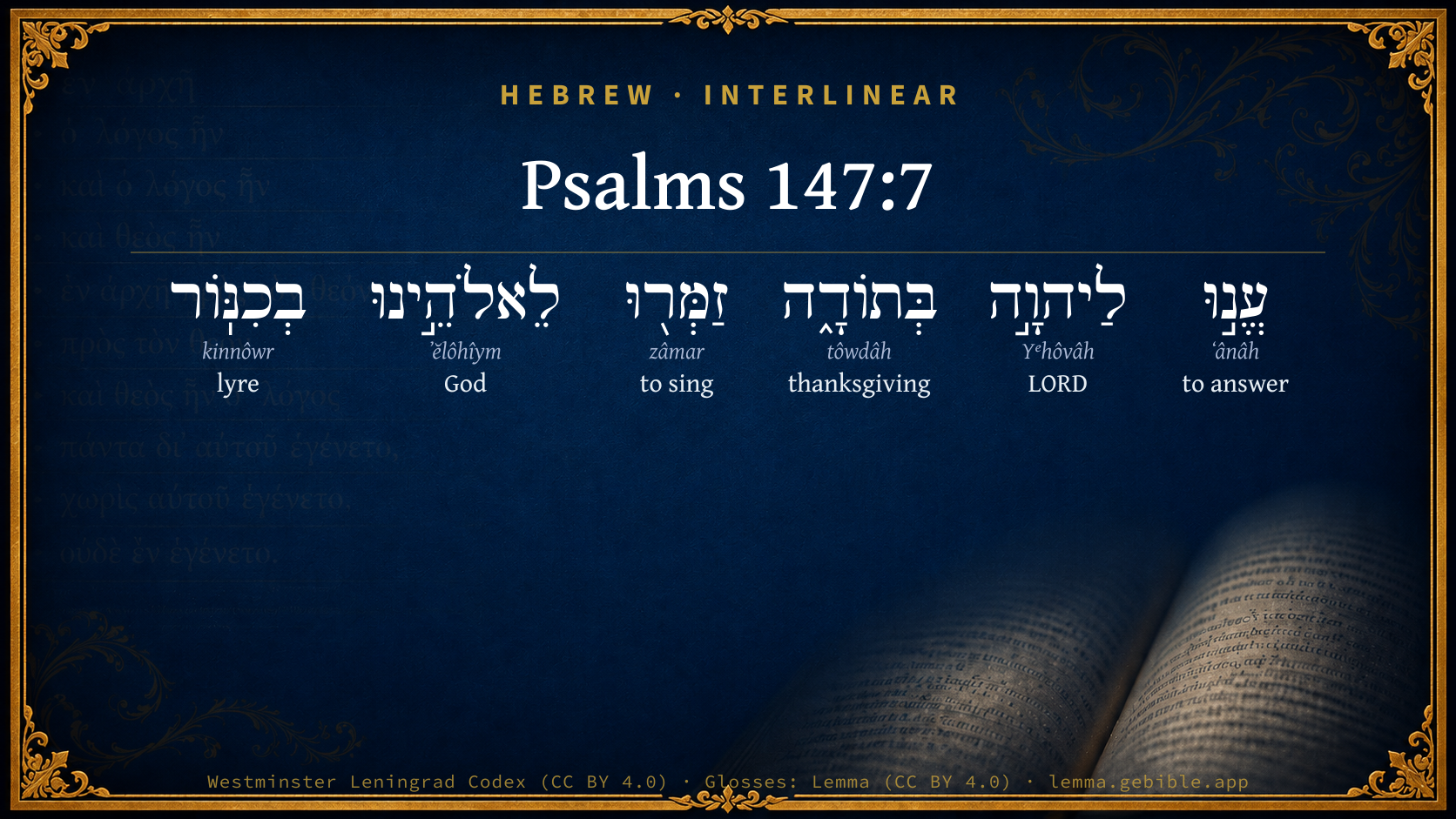
Psalms 147:7

Hebrew (Westminster Leningrad Codex) Psalms 147:7 appears in the Hebrew Old Testament. The text above is from the Westminster Leningrad Codex. Each word links to its Strong’s number, a concise gloss, and parsing drawn from the Open Scriptures Hebrew Bible morphology. Click any word for its full Brown-Driver-Briggs (BDB) entry.
Download image
Cite this verse

Psalms 147:7 (World English Bible). Public Domain. Lemma interlinear Bible study tool, https://lemma.gebible.app/v/psalms/147/7.

Show BibTeX & RIS
BibTeX
RIS
English Translation
Sing to Yahweh with thanksgiving. Sing praises on the harp to our God,
World English Bible · Public Domain
Download a study sheet

One document with this verse’s original text, its word-by-word gloss line, the meaning frame, cross-references with their text, attributed commentary, and full source and license credits — printable, and it pastes into notes with its structure intact.

This verse Autodidact and up

Study sheet (.html) Plain text (.txt)

A passage Seminary Student

Up to 50 verses in one chapter. A passage sheet keeps up to 6 commentary sources and 12 cross-references per verse, in the order this page ranks them, and says so on the sheet whenever that leaves anything out. Ask for a single verse and you get the Autodidact verse sheet above.

Everything on this page stays free to read, with no account — the sheet is a download of what is already on screen, not access to it.

Want to remove ads? Support Godless Engineer
Compare translations 3

The same verse in 3 English versions, stacked beneath the original-language interlinear above. Click any original word for its lexicon entry.

Each is an independent rendering of the whole verse — the interlinear is not word-aligned to these translations.

Highlighted words mark where these versions differ — a whole-verse word diff, not a word-by-word alignment.

  • World English Bible Public Domain
    Sing to Yahweh with thanksgiving. Sing praises on the harp to our God,
  • King James Version Public Domain
    Sing unto the LORD with thanksgiving; sing praise upon the harp unto our God:
  • unfoldingWord Literal Text CC BY-SA 4.0
    Sing to Yahweh with thanksgiving; make music to our God with the harp,

unfoldingWord Literal Text — © unfoldingWord, licensed CC BY-SA 4.0. Word-aligned USFM3 via Door43 (git.door43.org/unfoldingWord/en_ult).

Versions to compare (up to 4)

3 of 4 selected

Show all 18 translations

Every available English version of this verse, each an independent rendering of the whole verse.

  • World English Bible Public Domain
    Sing to Yahweh with thanksgiving. Sing praises on the harp to our God,
  • Berean Standard Bible Public Domain
    Sing to the LORD with thanksgiving; make music on the harp to our God,
  • Majority Standard Bible Public Domain
    Sing to the LORD with thanksgiving; make music on the harp to our God,
  • King James Version Public Domain
    Sing unto the LORD with thanksgiving; sing praise upon the harp unto our God:
  • American Standard Version (1901) Public Domain
    Sing unto Jehovah with thanksgiving; Sing praises upon the harp unto our God,
  • Revised Version (1885) Public Domain
    Sing unto the LORD with thanksgiving; sing praises upon the harp unto our God:
  • Geneva Bible (1599) Public Domain
    Sing vnto the Lord with prayse: sing vpon the harpe vnto our God,
  • Douay-Rheims (1899) Public Domain
    Who keepeth truth for ever: who executeth judgment for them that suffer wrong: who giveth food to the hungry. The Lord looseth them that are fettered:
  • Young's Literal Translation Public Domain
    Answer ye to Jehovah with thanksgiving, Sing ye to our God with a harp.
  • Literal Standard Version CC BY-SA 4.0
    Answer to YHWH with thanksgiving, || Sing to our God with a harp.
  • Unlocked Literal Bible CC BY-SA 4.0
    Sing to Yahweh with thanksgiving, sing praises to our God with a harp.
  • unfoldingWord Literal Text CC BY-SA 4.0
    Sing to Yahweh with thanksgiving; make music to our God with the harp,
  • Darby Bible Public Domain
    Sing unto Jehovah with thanksgiving; sing psalms upon the harp unto our God:
  • World Messianic Bible Public Domain
    Sing to the LORD with thanksgiving. Sing praises on the harp to our God,
  • Webster's Bible Public Domain
    Sing to the LORD with thanksgiving; sing praise upon the harp to our God:
  • Free Bible Version CC BY-SA 4.0
    Sing thanks to the Lord! Sing praises to our God with a harp!
  • Bible in Basic English Public Domain
    Make songs of praise to the Lord; make melody to our God with instruments of music.
  • JPS Tanakh (1917) Public Domain
    Sing unto the LORD with thanksgiving, sing praises upon the harp unto our God;

Literal Standard Version (2020), Covenant Press — licensed CC BY-SA 4.0. Text via the HelloAO Bible API (eBible.org). Unlocked Literal Bible (unfoldingWord) — licensed CC BY-SA 4.0. Text via the HelloAO Bible API (eBible.org). unfoldingWord Literal Text — © unfoldingWord, licensed CC BY-SA 4.0. Word-aligned USFM3 via Door43 (git.door43.org/unfoldingWord/en_ult). Free Bible Version, Dr. Jonathan Gallagher — licensed CC BY-SA 4.0. Text via the HelloAO Bible API (eBible.org).

Word by word

More ways to search: Search by grammar → Find every occurrence → Compare this word →

Practice this passage: Drill this verse → Learn its vocabulary →

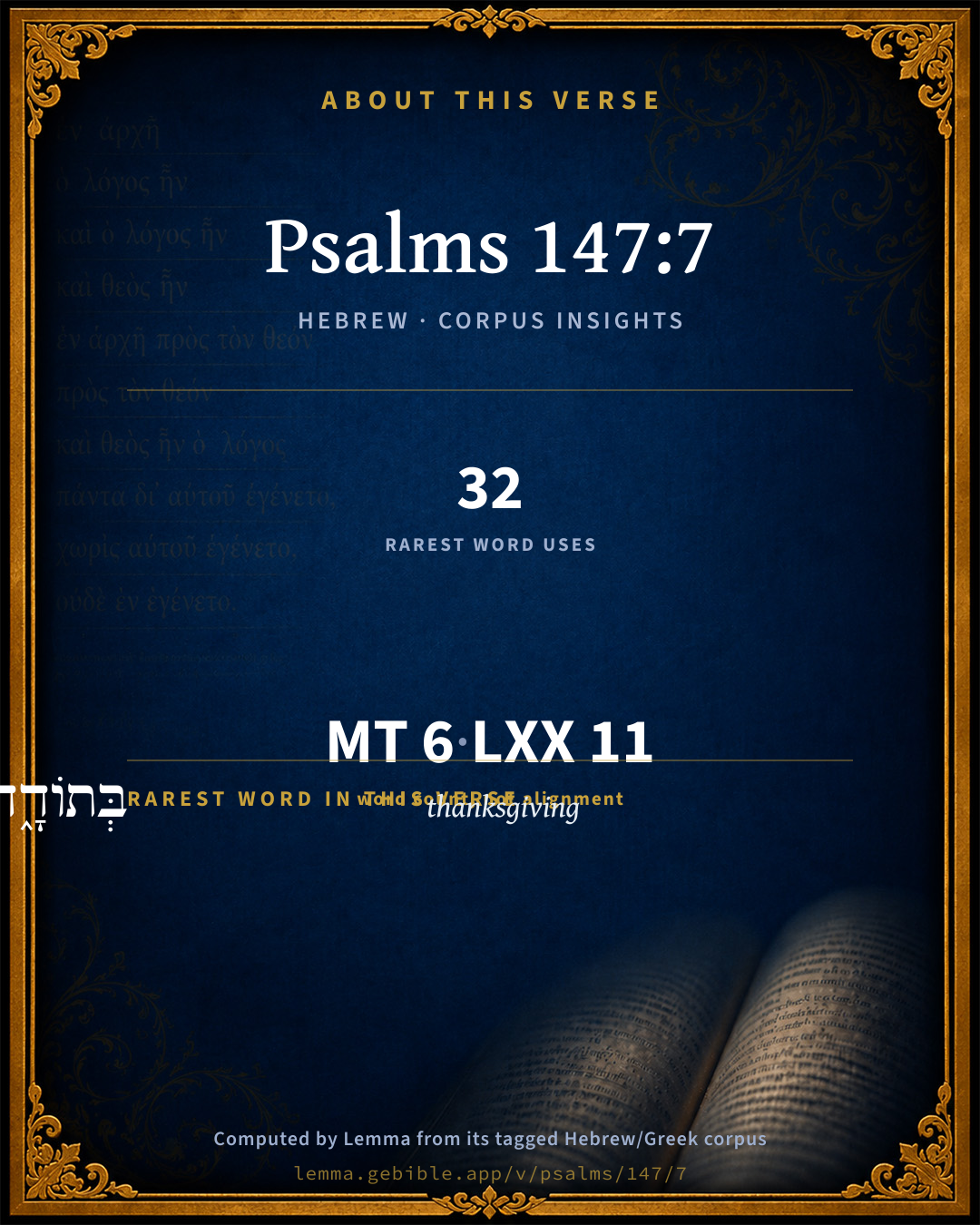
About this verse

These counts appear in no published source. They are computed here, from the morphology-tagged text and Lemma’s own curated glosses. What Lemma adds →

6
words
6
distinct lemmas
Wisdom
section

Shared distinctive vocabulary

בְּתוֹדָ֑ה thanksgiving H8426 occurs in 30 verses of the Hebrew Bible. Also found in:

Grammatical profile

  • 2 verbs
  • 4 nouns

Verb forms

  • עֱנ֣וּ Qal · Imperative
  • זַמְּר֖וּ Piel · Imperative

Hebrew & Septuagint length

In English translation the verse runs 13 words from the Hebrew and 16 from the Septuagint (LXX English) — closely comparable.

A rough comparison of the two English renderings, which tokenize alike — not a word-level alignment.

Word counts can differ between the Hebrew and the Greek without any difference in meaning — e.g. the Hebrew direct-object marker אֵת has no separate Greek word, and Greek often adds the article ὁ.

In the original languages it is 6 Hebrew tokens and 11 Greek tokens — but the two are counted differently (Hebrew bundles its prefixes and suffixes into one token; the Greek is in lemma form), so that isn’t a like-for-like length.

Cross-references

7

Topical passages linked to Psalms 147:7 in the Treasury of Scripture Knowledge — connected by theme and wording, ordered by reader-vote popularity; previews shown in the World English Bible.

  • Psalms 95:1–2 Oh come, let's sing to Yahweh. Let's shout aloud to the rock of our salvation!
  • Psalms 47:6–7 Sing praise to God, sing praises. Sing praises to our King, sing praises.
  • Psalms 68:32 Sing to God, you kingdoms of the earth! Sing praises to the Lord! Selah.
  • Psalms 92:1–3 It is a good thing to give thanks to Yahweh, To sing praises to your name, Most High;
  • Psalms 107:21–22 Let them praise Yahweh for his loving kindness, For his wonderful works to the children of men!
  • Revelation 5:8–10 Now when he had taken the book, the four living creatures and the twenty-four elders fell down before the Lamb, each one having a harp, and golden bowls full of incense, which are the prayers of the saints.
  • Exodus 15:20–21 Miriam the prophetess, the sister of Aaron, took a tambourine in her hand; and all the women went out after her with tambourines and with dances.

Cross-references courtesy of OpenBible.info (CC BY 4.0).

Hebrew and Greek witnesses Masoretic Hebrew ↔ Greek Septuagint

The same verse in the two great witnesses to the Old Testament, shown verse-for-verse.

You’re reading Greek Psalm 146 (Hebrew Psalm 147). The Septuagint counts the superscription, so verse numbers can differ from the Hebrew — chapter-level alignment, not verse-by-verse. Numbering follows Rahlfs.

These are two independent witnesses, not word-aligned to each other, and the Septuagint is shown in lemma (dictionary) form.

Hebrew Psalms 147:7 Masoretic · Westminster Leningrad Codex

עֱנ֣וּ לַיהוָ֣ה בְּתוֹדָ֑ה זַמְּר֖וּ לֵאלֹהֵ֣ינוּ בְכִנּֽוֹר

Sing to Yahweh with thanksgiving. Sing praises on the harp to our God,

World English Bible · Public Domain

Greek LXX Greek Psalm 146:7 Septuagint · lemma form

ἐκἄρχω ὁ κύριος ἐν ἐξομολόγησις ψάλλω ὁ θεός ἐγώ ἐν κιθάρα

Begin the song with thanksgiving to the Lord; sing praises on the harp to our God:

LXX2012 (modern English Septuagint) · Public Domain

Hebrew: Westminster Leningrad Codex (CC BY 4.0). Greek: Septuagint (public domain); English from LXX2012 (modern English Septuagint) (Public Domain). How the Septuagint differs from the Hebrew →

Commentary

Notes on Psalms 147:7 from classic Christian and Jewish commentators (each source and its license shown beneath its notes). The classic Christian expositions comment on the surrounding passage and are grouped to its opening verse, so a note may address several verses; the Jewish commentaries on the Tanakh (Rashi and others) are per-verse, so they appear only where the commentator wrote on this verse.

Lemma curates 59 commentaries, every one of them public domain or Creative Commons licensed, each selected and text-cleaned for this edition rather than reprinted as found. About our sources →

Trapp's Complete Commentary

John Trapp

Psa 147:7 Sing unto the LORD with thanksgiving; sing praise upon the harp unto our God:

Ver. 7. Sing unto the Lord] Heb. answer, that is, sing by turns, as Hos 2:15 Deu 31:21. Or, answer God’s goodness by thankfulness and obedience.

John Trapp, A Commentary or Exposition upon All the Books of the Old and New Testament (1647–1656) — public domain. Text from a community e-Sword module.

Joseph Benson's Commentary

Psa 147:7-9. Sing unto the Lord with thanksgiving — Hebrew, ענו ליהוה בתודה, literally, answer to the Lord in praise. “Sing alternately,” which may fairly be supposed to be the sense intended by the psalmist, as it was the ancient practice to sing alternately. Celebrate in this way, with your thankful songs, the infinite power, wisdom, and goodness of God. Sing praise upon the harp — Let instruments of music accompany your voices, and exert your utmost ability in his praise. Who covereth the heaven with clouds — Which, though they darken the air, and intercept the beams of the sun, yet contain and distil those refreshing dews and showers which are necessary to render the earth fruitful. Who — By the rain which descends on them; maketh grass to grow upon the mountains — Even the high mountains, which man neither takes care of, nor could water; and gives that grass to the wild beasts that inhabit them, for which man neither does nor can make any provision. And feeds the young ravens which cry — Which, in their way, call upon him for sustenance. And surely this watchful care of the Divine Providence over all creatures, speaks the same language to us which God made use of to Joshua, and which the apostle hath applied to Christians; I will never leave thee nor forsake thee, Jos 1:5; Heb 13:5. For “He who provides food for the wild beasts, will never leave the lambs of his flock destitute; and he who feeds the young of the unclean ravens when they cry, and, as it were, ask a supply of their wants from him, will not, in the day of dearth and calamity, forsake the meek and harmless dove that mourns continually in prayer before him.” — Horne.

Joseph Benson's Commentary on the Old and New Testaments (1811–1818) — public domain. Text from a community e-Sword module.

J. A. Alexander on Psalms

Joseph Addison Alexander

7. (Psa 147:7) Respond to Jehovah with thanksgiving; make music to our God with a harp. The first verb has its proper sense of answering or responding, as in Psa 119:172. It may be doubted whether it ever has that of simply singing. Respond, i.e. to his manifold favours.

Joseph Addison Alexander, The Psalms Translated and Explained (1850) — public domain. Text from a community e-Sword module.

Tyndale Open Study Notes

Tyndale Open Resources

147:7-11 Human achievements fail to impress the God who commands nature; rather, he takes pleasure in those who fear him.

Tyndale Open Study Notes — © Tyndale Open Resources, licensed CC BY-SA 4.0. Text via the HelloAO Bible API.

Jamieson, Fausset & Brown

Robert Jamieson, A. R. Fausset & David Brown

His providence supplies bountifully the wild animals in their mountain homes.

Sing . . . Lord--literally, "Answer the Lord," that is, in grateful praise to His goodness, thus declared in His acts.

Jamieson, Fausset & Brown — Commentary Critical and Explanatory on the Whole Bible (1871) — public domain (CC PDM 1.0). Text via the HelloAO Bible API.

Adam Clarke's Commentary

Verse 7. Sing unto the Lord] ענו enu, sing a responsive song, sing in parts, answer one another.

Adam Clarke's Commentary on the Bible (1810–1826) — public domain. Text from a community e-Sword/MySword module.

John Calvin's Commentaries

7. Sing to Jehovah in thanksgiving Again he exhorts to sing the praises of God, intimating at the same time that abundant matter was not wanting, since new proofs still meet our eyes of his power, goodness, and wisdom. First he tells us that he covers the heavens with clouds, and this change would awaken our attention, were we not chargeable with so much thoughtlessness. Various as are the marvels to be seen in the heavens above us, were the same serenity always to continue, we would not have so wonderful a display of his power as when he suddenly veils them with clouds, withdrawing the light of the sun, and setting a new face as it were upon the world. He afterwards hints that in this way provision is made for all living creatures, for thus the herbs germinate, and the earth is supplied with the moisture which makes it fertile. Thus in connection with the proofs of his power God sets before our eyes those of his mercy and fatherly consideration for the human family; nay, he shows that he does not overlook even the wild beasts and cattle. Philosophers discover the origin of rain in the elements, and it is not denied that clouds are formed from the gross vapors which are exhaled from the earth and sea, but second causes should not prevent us from recognizing the providence of God in furnishing the earth with the moisture needed for fructification. As the earth chapped with heat shows its thirst by opening its mouth, so God on his part in sending rain distills drink for it. He might in other ways of a more secret kind give it strength to preserve it from failing, but this irrigation is something which passes before our eyes to image forth the continual care which he has over us.

John Calvin's Commentaries (1540-1563) — public domain. Text from the Calvin Translation Society English edition (1840s-50s) via the Christian Classics Ethereal Library (ccel.org). Calvin's coverage is partial (roughly two-thirds of the Bible); uncommented books and verses are honest gaps, never fabricated. The 19th-century editor's footnotes and remarks are omitted so the notes are faithfully Calvin's own voice.

Ellicott's Commentary for English Readers

(7) Sing.—Literally, answer, which some think suggests an antiphonal arrangement. Though the strophic arrangement is only loosely marked, the psalm takes a new departure here, with a fresh invocation to praise, going on to fresh proofs from nature of the Almighty Power.

A Bible Commentary for English Readers, edited by Charles John Ellicott (1878–1897) — public domain. Text from a community e-Sword module.

The Cambridge Bible for Schools and Colleges

gen. ed. J. J. S. Perowne

7. sing praise] Make melody unto our God with harp, as Psa_98:5 a.

7–11. A renewed call to praise Jehovah for His beneficence, and to recognise the conditions of His favour.

The Cambridge Bible for Schools and Colleges (gen. ed. J. J. S. Perowne; Cambridge University Press, 1878–1918) — public domain. Text from a community e-Sword module.

John Gill's Exposition

Sing unto the Lord with thanksgiving,.... These are the words of the psalmist unto the Israelites, according to Aben Ezra and Kimchi; but may be an exhortation to all men, especially good men; who are capable of observing the following things concerning providential goodness and special grace, on account of which they are called upon to "sing unto the Lord": or to "answer" (q); to sing alternately, or by responses; the word is used for singing, Hos 2:15; see Exo 15:21; and intends vocal singing, as the next clause instrumental singing, as Kimchi observes. However, the Lord is the object of it, to whom praise is to be sung for all the great and good things done by him, and that "with thanksgiving" to God for them; which, though a distinct thing from singing, and may be done without it, as in prayer; yet singing ought never to be without that; see Eph 5:19;

sing praise upon the harp unto our God; an instrument of music used in the times of the Old Testament; an emblem of the heart, and of making melody in it to the Lord: the hearts of believers are the harps of God, on and with which they sing unto him, when they sing aright, and these are in proper tune.

(q) "respondete", Montanus, Cocceius; "alternis canite", Tigurine version, Piscator, Michaelis.

John Gill's Exposition of the Whole Bible (1746–1763) — public domain (CC PDM 1.0). Text via the HelloAO Bible API.

Albert Barnes' Notes on the Bible

Sing unto the Lord with thanksgiving - Accompany the praise of God - the expression of worship - with a grateful remembrance of the past. The one will aid the other, and the two will constitute acceptable and proper worship. The first word here means properly to answer, or respond; and the idea would seem to be, that we are to make a suitable response or answer to the manifold layouts which we have received at the hand of God.

Sing praise upon the harp unto our God - On the word harp, see the notes at Isa 5:12. The harp was an instrument commonly employed in divine worship. See the notes at Psa 33:2 : “Praise the Lord with harp.” Compare Psa 43:4; Psa 49:4; Psa 57:8; Psa 71:22.

Albert Barnes' Notes on the Bible (1834–1885) — public domain. Text from a community e-Sword/MySword module.

The Treasury of David

Charles H. Spurgeon

Ver. 7. In this paragraph the contrast announced in the former section is enlarged upon from another point of view, namely, as it is seen in nature and in providence.

Sing unto the LORD with, thanksgiving; or rather, "respond to Jehovah." He speaks to us in his works, let us answer him with our thanks. All that he does is gracious, every movement of Iris hand is goodness; therefore let our hearts reply with gratitude, and our lips with song. Our lives should be responses to divine love. Jehovah is ever engaged in giving, let us respond with thanksgiving.

Sing praise upon the harp unto our God. Blend music with song. Under a dispensation of ritual the use of music was most commendable, and suitable in the great congregation: those of us who judge it to be less desirable for public worship, under a spiritual economy, because it has led to so many abuses, nevertheless rejoice in it in our privacy, and are by no means insensible to its charms. It seems profanation that choice minstrelsy should so often be devoted to unworthy themes: the sweetest harmonies should be consecrated to the honour of the Lord. He is our God, and this fact is one choice joy of the sing. We have chosen him because he has chosen us; and we see in him peculiarities which distinguish him from all the pretended deities of those among whom we dwell. He is our God in covenant relationship for ever and ever, and to him be praise in every possible form.

Ver. 7-9. God creates, and then fails not to supply. Analogically, the Lord buildeth Jerusalem, and provides for the wants of the inhabitants; by spiritual inference, the saints argue that Christ establishes his church and gives all the gracious gifts which are needed in that institution. John Lorinus.

Ver. 7. The use and benefit of singing.

Psalms 147:8*

Charles H. Spurgeon's The Treasury of David (1869–1885) — public domain. Psalms only. Text from a community e-Sword/MySword module.

Whedon's Commentary on the Bible

Daniel D. Whedon

7. Sing—The exiles are not only happy in their return, but they see mercy and goodness in the prospect of rain from heaven and fruitful seasons—of future food and gladness.

Daniel D. Whedon (gen. ed.), Commentary on the Old and New Testaments (1874–1909) — public domain. Text from a community e-Sword module.

The Pulpit Commentary

Sing unto the Lord with thanksgiving. God is not only to be praised for his greatness (ver. 5), but also to be thanked for his loving-kindness (vers. 2, 3, 8, 9). Sing praise upon the harp unto our God. The glad sound of the harp should accompany his praises.

Vers. 7-11. God worthy of praise.

"A fresh burst of praise because of God"s Fatherly care, as shown in his provision for the wants of the cattle and the fowls of the air. And as he feeds the ravens, which have neither storehouse nor barn, but only cry to him for their food, so amongst men his delight is not in those who trust in their own strength and swiftness, but in those who look to him, and put their trust in his goodness." God is to be praised

I BECAUSE HE PROVIDES FOR THE FERTILITY OF THE MATERIAL WORLD. Clouds temper the heat of the sun as well as pour forth rain to fertilize the earth, and make it productive of food for man and beast. The chain of connection between God and man bountifully set forth in Hos_2:21, Hos_2:22, "I will hear the heavens," etc.

II BECAUSE OF HIS BOUNTY TOWARDS ALL ORDERS OF THE ANIMAL CREATION. Grass upon the mountains where the herds and flocks feed, and which the plough and labors of man cannot reach. God is the Shepherd of all inferior as well as superior life. The young ravens, which are forsaken and cast off by their mothers very early, unconsciously cry to him for food, and are fed. The great and the small equally provided for by his bountiful, universal care.

III THOUGH GOD IS THE SOURCE OF ALL STRENGTH, HE HAS ONLY AN INFERIOR PLEASURE IN PHYSICAL STRENGTH. (Ver. 10) "The strength of the hills is his also;" "Strong in power; not one faileth." He must delight in power of all kinds, intellectual and moral, as we do. But neither for himself nor for man is mere strength his chief delight.

IV GOD"S GLORY IS IN DISPENSING HELP TO THOSE WHO TRUST AND HOPE IN HIM. His delight is in goodness. Gives confidence and courage to those who fear him. Gives strength and riches to those who hope for his loving-kindness. Gives to them his mercy. S.

The Pulpit Commentary (1880–1919), ed. H.D.M. Spence-Jones & Joseph S. Exell — public domain. Text from a community e-Sword module.

Lesson kit

Teaching starters — assembled from the data on this page, not authored interpretation. Every prompt links to the verse data it draws on. Edit before teaching.

Psalms, in the Wisdom, opens this verse with 6 words (6 distinct Hebrew lemmas). Its most distinctive word is tôwdâh (“thanksgiving”). A historical commentator’s framing appears above. Read the whole chapter for the surrounding context.

Discussion questions

  1. What does “thanksgiving” (tôwdâh) contribute to the verse as a whole?
  2. How does Leviticus 7:12, which shares the word «thanksgiving», read alongside this verse?
  3. These translations render this verse differently. What is at stake in choosing one wording over another?
  4. «עֱנ֣וּ» is a Qal Imperative verb. How does that grammatical form shape the action described?
  5. Compare how Trapp's Complete Commentary and Joseph Benson's Commentary read this verse. Where do they agree or differ?

Things to notice

Reading settings

Reading text

Shown beneath each verse's original-language words.

Old Testament
Old Testament edition

Read the OT as the Masoretic Hebrew (MT) or the Greek Septuagint (LXX).

English shown for the Greek Septuagint (in the Hebrew ↔ Greek comparison).

Comparing translations? Open the Compare panel on any verse page to stack up to four side by side.