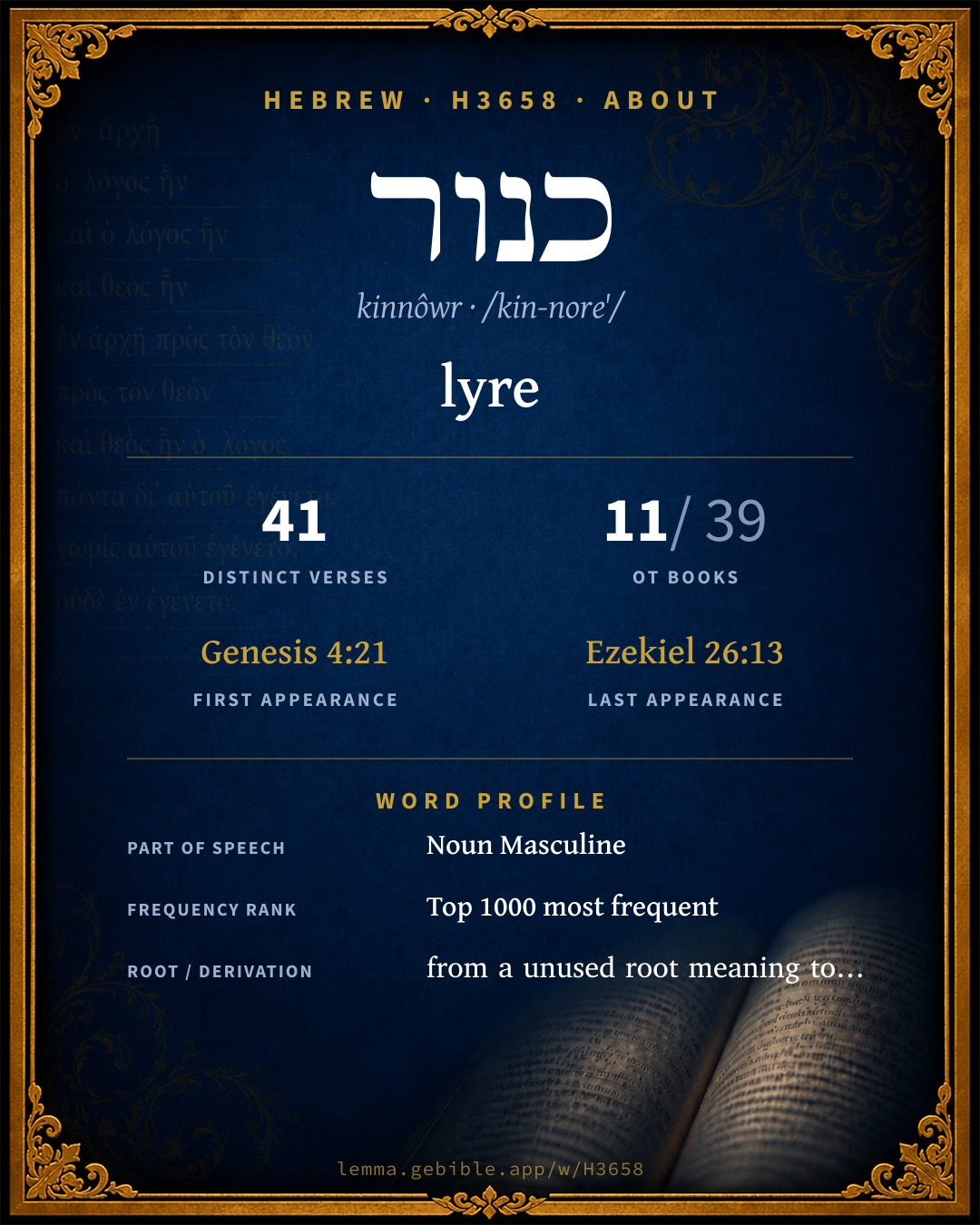
כִּנּוֹר
lyre
Full lexicon entry — Brown-Driver-Briggs (BDB)
From Brown-Driver-Briggs (BDB)
Where this word appears
Grammar key — what these labels mean
Part of speech
- Noun
- A naming word — a person, place, thing, or idea.
Noun type
- Common
- A common noun — a general class of person, place, or thing (“king,” “city,” “water”), not a specific name.
State
- Absolute
- The independent form of a noun, not bound to a following word.
- Construct
- A noun bound to a following noun in a possessive / “of” relationship (the construct chain).
Gender
- Masculine
- Grammatically masculine.
Number
- Singular
- One.
- Plural
- More than one (in Hebrew, generally three or more).
Every verse where H3658 appears in the Book of Nehemiah — 1 distinct verse. Click any verse to open its interlinear word-by-word view. Verse text shown in the World English Bible for context — . Each verse’s Hebrew form is shown with its reference; the English is not keyword-highlighted, since the data carries no word-level English alignment. Use “Compare translations” on any verse to read it across multiple English versions. This concordance covers the Hebrew Bible; Septuagint (Greek Old Testament) occurrences are not indexed here.
Nehemiah
About this entry
At a glance — auto-summarized from this page’s data, not written by a person. Every figure links to its source below. This summary describes the numbers; it doesn’t interpret them.
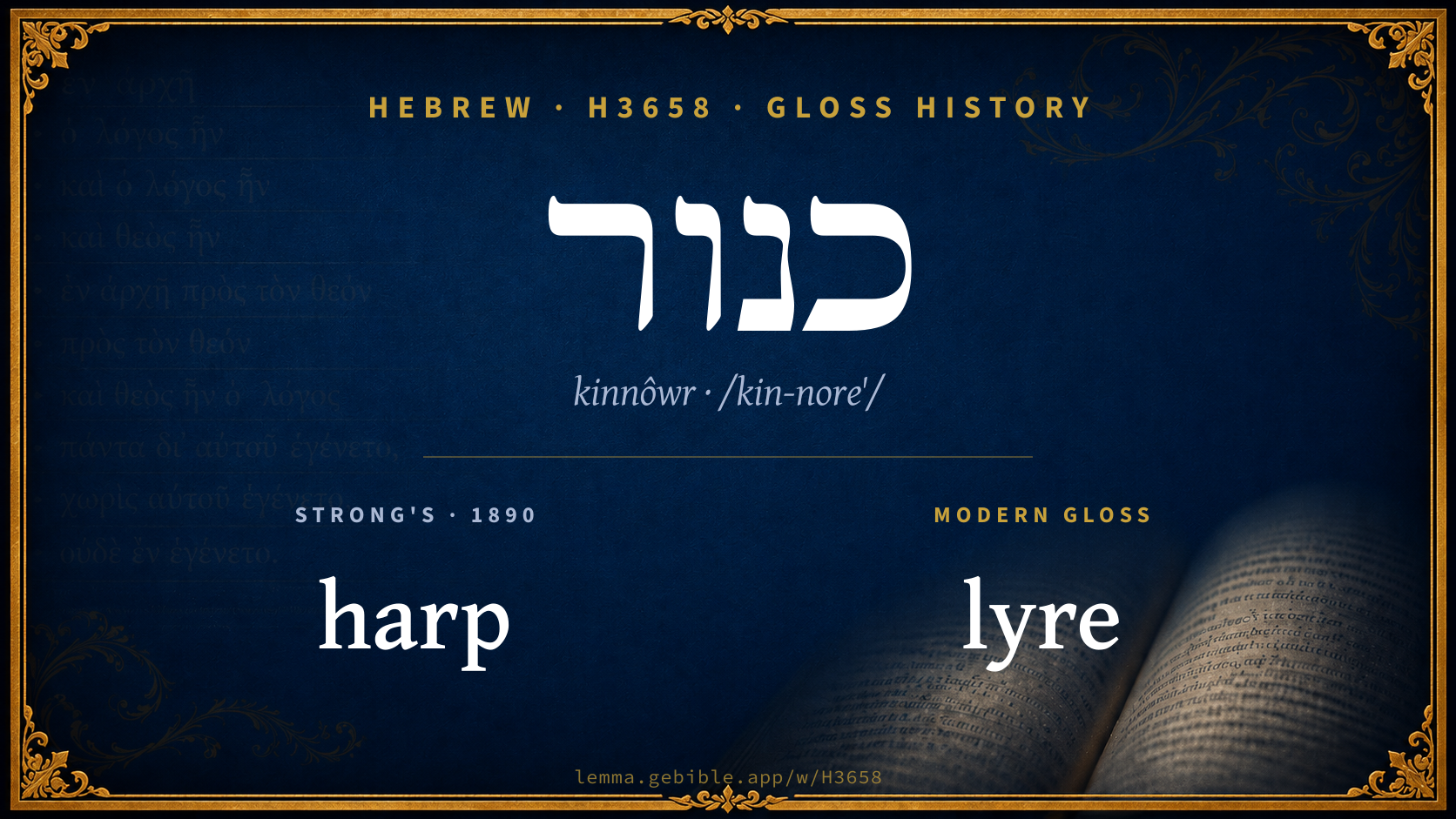
At its core, כנור (kinnôwr) means “lyre.” Older and newer Bibles part ways — “harp” in the King James Version, “lyres” (Berean Standard Bible) in modern versions. See the renderings breakdown. It turns up in 41 verses across 11 books, a moderately common footprint. The word gravitates to Psalms (32%), then 1 Chronicles and Isaiah. Scripture first uses it in Genesis 4:21. Dig into 41-verse concordance and the renderings breakdown below.
Gloss history
Strong's 1890 vs modern scholarship
About this word
Strong's H3658 catalogs a Hebrew word from the Hebrew Old Testament.
These counts are not copied from any lexicon or concordance. They are computed here, from the morphology-tagged Hebrew Old Testament. What Lemma adds →
- 41
- distinct verses
- The word appears in 41 distinct verses.
- 11 / 39
- OT books
- The word appears in 11 of 39 Old Testament books.
- #864
- by frequency
- Top 1000 most frequent Hebrew words (rank 864 of 8,640 Hebrew words by occurrence).
View all 41 occurrences in the concordance →
Most concentrated in
- Psalms 13 verses 32%
- 1 Chronicles 8 verses 20%
- Isaiah 5 verses 12%
By section of the Old Testament
By traditional corpus
Conventional, traditional groupings — biblical authorship is debated, so this is a traditional corpus grouping, not an authorship claim. Each share is this word’s portion of its verses in that division of the Hebrew canon. Each figure is a share of the word’s 41 distinct verses.
- Writings (Ketuvim) 28 verses · 68%
- Prophets (Nevi'im) 11 verses · 27%
- Torah (Pentateuch) 2 verses · 5%
How translations render this word
Counts come from each version’s own published word-to-Strong’s tagging or interlinear alignment — an approximate guide to how each version renders this word, not a word-level alignment the data otherwise carries. Because each total is that version’s own tagged count, the per-version totals vary from one another and need not match the appearance or distinct-verse counts above. These counts may also differ from a printed concordance because Lemma counts each distinctly tagged rendering and does not collapse phrase taggings into a single head-word total. This is a fixed set of word-tagged versions (KJV, ASV, BSB, ULT) and does not change with the reading translation you choose elsewhere. Each version’s license is shown beside its name below (and on Sources).
- King James Version: Harp 23×, Harps 17×
- American Standard Version: Harp 21×, Harps 15×
- Berean Standard Bible: Lyres 14×, Harp 12×, Lyre 8×
- unfoldingWord Literal Text: Harp 18×, Harps 10×, Lyres 7×
King James Version Public Domain
Renders H3658 across 42 tagged occurrences — most commonly:
Plus 2 renderings that appear only once — usually multi-word phrases or single function words the recovered tagging swept in, not distinct renderings.
American Standard Version Public Domain
Renders H3658 across 41 tagged occurrences — most commonly:
Plus 5 renderings that appear only once — usually multi-word phrases or single function words the recovered tagging swept in, not distinct renderings.
Berean Standard Bible Public Domain
Renders H3658 across 42 tagged occurrences — most commonly:
Plus 4 renderings that appear only once — usually multi-word phrases or single function words the recovered tagging swept in, not distinct renderings.
unfoldingWord Literal Text CC BY-SA 4.0
Renders H3658 across 44 tagged occurrences — most commonly:
Plus 5 renderings that appear only once — usually multi-word phrases or single function words the recovered tagging swept in, not distinct renderings.
Senses in BDB
The 1 sense BDB distinguishes for this word, in lexicon order (not ranked by frequency or importance). The full entry — with sub-senses — is in the Lexicon Entry tab.
- lyre, harp
Word origin
n.m. ψ 81:3 lyre (on formation cf. LagBN 89, Anm.; NH id.; Aramaic כִּנָּרָא, ܟܶܢܳܪܳܐ; Mand. כינאר(א) NöM § 104 (who questions Shemitic origin); Arabic كِنَارٌ, كَنَّارَةٌ; as loan-word in Hellen. Gk. κινύρα (𝔊 and Joseph); in Egyptian kn-an-aul according to Bondi79)—abs. כ׳ Gn 4:21 +; sf. כִּנֹּרִי Jb 30:31; pl. כִּנֹּרוֹת 1 K 10:12 +; sf. כִּנּוֹרַיִךְ Ez 26:13, כִּנֹּרוֹתֵינוּ ψ 137:2;—lyre, stringed instrument used for popular as well as sacred music (cf. BenzArch. 273 ff. NowArch. i. 273 ff.);—כ׳ וְעוּגָב Gn 4:21, בְּתֹף וּבְכ׳ 31:27; אִישׁ יֹדֵעַ מְנַגֵּן בַּכּ׳ 1 S 16:16 a man skilled in playing on the lyre, cf. v 23 (וִנִגֵּן בְּיָדוֹ); at banquets Is 5:12 (+ נֶבֶל, תֹּף, חָלִיל), token of merriment 24:8 (+ תֻּפִּים), Ez 26:13, cf. וַיְהִי לְאֵבֶל כִּנֹּרִ֑י וְעֻגָבִי לְקוֹל בֹּכִים Jb 30:31, יִשְׂאוּ כְתֹף וְכ׳ וְיִשְׂמְחוּ לְקוֹל עוּגָב Jb 21:12; carried by a loose woman Is 23:16 (fig. of Tyre); in sim. Is 16:11 (of murmuring sound of bowels = heart, in pity); used also in praising י׳, usually as accompainment of song (cf. 1 Ch 15:16) נֵבֶל וְתֹף וְחָלִיל וְכ׳ 1 S 10:5; Is 30:32 (‖ תֻּפִּים); especially before the ark 2 S 6:5 (+ נְבָלִים, תֻּפִּים, etc.) ‖ 1 Ch 13:8, and in sanctuary (usually + נֵבֶל, etc.) 1 K 10:12, but especially Chr ψψ:—1 Ch 13:8 (pl., and so chiefly in Chr), 15:16, 21, 28; 16:5; 25:1, 3, 6 2 Ch 5:12; 9:11; 20:28; 29:25 Ne 12:27; ψ 33:2 (sg., and so chiefly in ψψ), 43:4; 49:5; 57:9; 71:22; 81:3; 92:4; 98:5(×2); 108:3; 147:7; 149:3; 150:3; cf. כִּנֹּרוֹתֵינוּ ψ 137:2.—Vbs. used with כ׳ are:—תָּפַשׂ Gn 4:21, נִגֵּן בְּ 1 S 16:16, מְשַׂחֵק בְּ 2 S 6:5 = 1 Ch 13:8, מְשֹׁרֲרִים בּ 1 Ch 15:16, מַשְׁמִיעִים בְּ v 28, נִבָּא בְּ 25:1, 3, הוֹדָה בְּ ψ 33:2; 42:4, זמּר בְּ ψ 71:22; 98:5; 147:7; 149:3, הַלֲלוּהוּ בְּ 150:3.—On ancient lyres v. reff. ap. Dr Amos, p. 236 f.
— Brown-Driver-Briggs (Oxford 1906, public domain), digitized via Sefaria, supplemented by the OpenScriptures HebrewLexicon (CC BY 4.0). See Sources.
Origin: from a unused root meaning to twang
Jastrow Dictionary
A second Hebrew/Aramaic lexicon for comparison, covering Aramaic and post-biblical (Talmudic, Targumic, Midrashic) usage that the biblical-Hebrew BDB does not. Matched by lemma rather than by Strong’s number, so a lemma may carry more than one Jastrow headword (shown separately below), and the entries cover usage well beyond the Bible.
כִּנּוֹר
- lute, cithern. Arakh. 13ᵇ כ׳ של מקדש וכ׳ the kinnor of the Temple was seven-stringed. Ber. 3ᵇ; Y. ib. I, 2ᵈ כ׳ היה תלוי וכ׳ David had a lute suspended &c. Snh. 101ᵃ עשאוני בניך ככ׳ וכ׳ thy children made me (the Law) like an instrument upon which the scorners play; a. fr.—Pl. כִּנּוֹרוֹת, כִּנּוֹרִים, כִּי׳. Arakh. II, 5. Shebu. 15ᵇ. Kinnim III, 6 בני מעיו לכ׳ its small bowels are used for strings for the cithern; Ab. Zar. 47ᵃ מהו לכ׳ Ms. M. (ed. לפארות). Pesik. R. s. 26; a. e.
A Dictionary of the Targumim, the Talmud Babli and Yerushalmi, and the Midrashic Literature (Marcus Jastrow; London, Luzac, 1903) — Public Domain. Digitized via Sefaria. Digitized via Sefaria. Full attribution on Sources.
Forms in the corpus
The 34 distinct written forms H3658 takes in the Hebrew Bible, most frequent first — each parse links to that state’s occurrences in the concordance. Hebrew forms include their vowel points and cantillation, so a single lemma takes many written forms.
Same root — word family
Other BDB entries built from the same root as H3658, grouped by Strong’s listed origin. These share a root / origin per the lexicon — not necessarily a shared meaning. Each links to that word’s own entry.
Proper names from this root
People and places named from this root — a name, not an additional meaning of the word.
Compare all same-root words → 1 of the same-root words is a proper name (a person or place). They share a root, not necessarily a meaning.
Septuagint verse parallels
This word appears in 39 verses that also exist in the Greek Old Testament (Septuagint), out of the 41 Hebrew verses it occurs in. You can read those verses in Greek by switching the Old Testament edition to the Septuagint.
Read these verses in the Septuagint
- Genesis 4:21
- 1 Samuel 10:5
- 2 Samuel 6:5
- 1 Kings 10:12
- 1 Chronicles 13:8
- 2 Chronicles 5:12
- Job 21:12
- Psalms 33:2
- Isaiah 5:12
- Ezekiel 26:13
This is a verse-level parallel only — the same verses exist in both the Hebrew and Greek Old Testaments. No word-level Hebrew↔Greek correspondence is claimed: the data carries no such alignment, so no Greek word is shown as this Hebrew word’s translation. Coverage is not total — the Septuagint omits the deuterocanon and renumbers the Psalms, so some Hebrew verses have no direct Greek parallel.