
Psalms 98:5

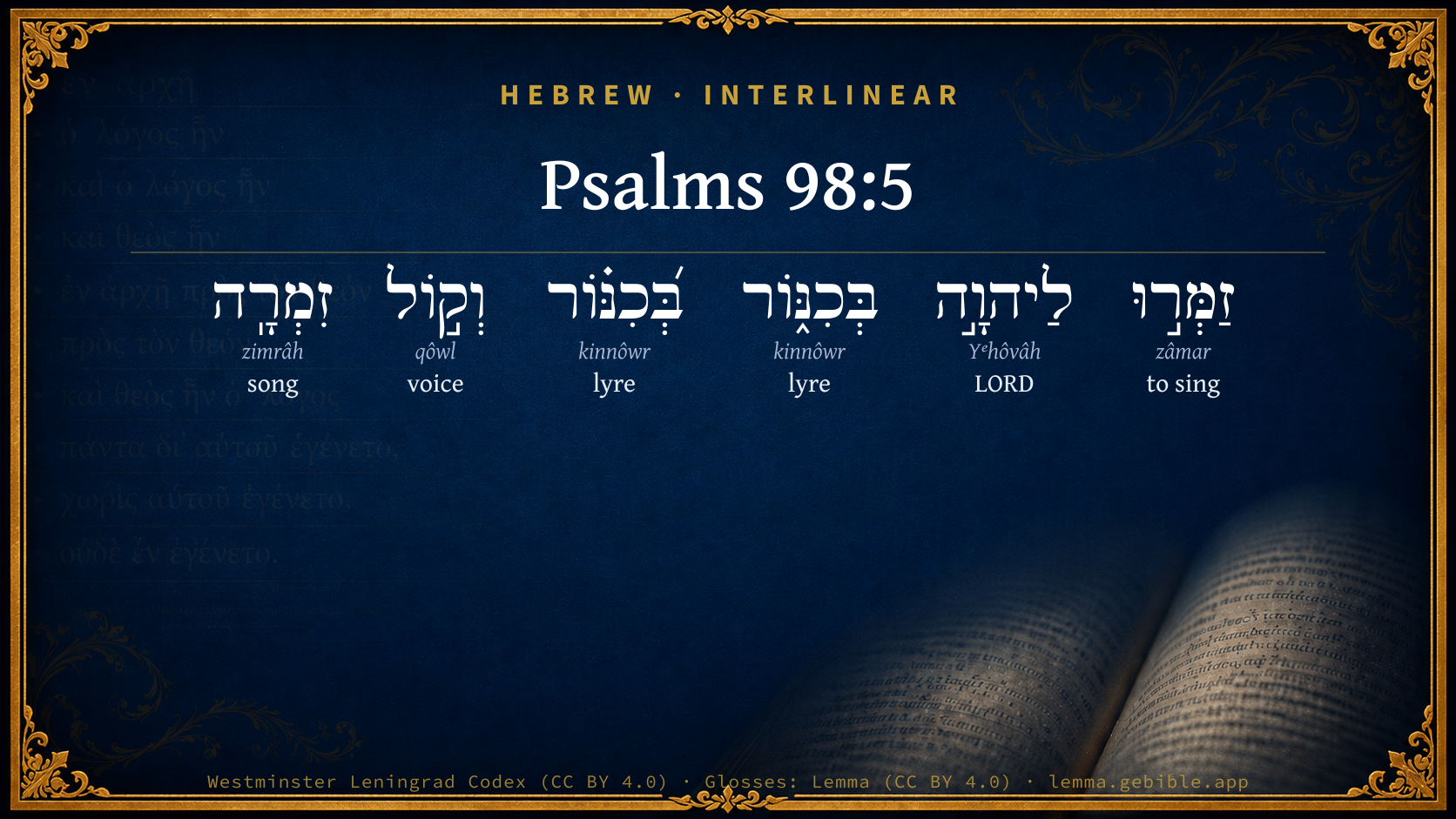
Hebrew (Westminster Leningrad Codex) Psalms 98:5 appears in the Hebrew Old Testament. The text above is from the Westminster Leningrad Codex. Each word links to its Strong’s number, a concise gloss, and parsing drawn from the Open Scriptures Hebrew Bible morphology. Click any word for its full Brown-Driver-Briggs (BDB) entry.
Download image
Cite this verse

Psalms 98:5 (World English Bible). Public Domain. Lemma interlinear Bible study tool, https://lemma.gebible.app/v/psalms/98/5.

Show BibTeX & RIS
BibTeX
RIS
English Translation
Sing praises to Yahweh with the harp, With the harp and the voice of melody.
World English Bible · Public Domain
Download a study sheet

One document with this verse’s original text, its word-by-word gloss line, the meaning frame, cross-references with their text, attributed commentary, and full source and license credits — printable, and it pastes into notes with its structure intact.

This verse Autodidact and up

Study sheet (.html) Plain text (.txt)

A passage Seminary Student

Up to 50 verses in one chapter. A passage sheet keeps up to 6 commentary sources and 12 cross-references per verse, in the order this page ranks them, and says so on the sheet whenever that leaves anything out. Ask for a single verse and you get the Autodidact verse sheet above.

Everything on this page stays free to read, with no account — the sheet is a download of what is already on screen, not access to it.

Want to remove ads? Support Godless Engineer
Compare translations 3

The same verse in 3 English versions, stacked beneath the original-language interlinear above. Click any original word for its lexicon entry.

Each is an independent rendering of the whole verse — the interlinear is not word-aligned to these translations.

Highlighted words mark where these versions differ — a whole-verse word diff, not a word-by-word alignment.

  • World English Bible Public Domain
    Sing praises to Yahweh with the harp, With the harp and the voice of melody.
  • King James Version Public Domain
    Sing unto the LORD with the harp; with the harp, and the voice of a psalm.
  • unfoldingWord Literal Text CC BY-SA 4.0
    Make music to Yahweh with the harp, with the harp and the voice of a song.

unfoldingWord Literal Text — © unfoldingWord, licensed CC BY-SA 4.0. Word-aligned USFM3 via Door43 (git.door43.org/unfoldingWord/en_ult).

Versions to compare (up to 4)

3 of 4 selected

Show all 18 translations

Every available English version of this verse, each an independent rendering of the whole verse.

  • World English Bible Public Domain
    Sing praises to Yahweh with the harp, With the harp and the voice of melody.
  • Berean Standard Bible Public Domain
    Sing praises to the LORD with the lyre, in melodious song with the harp.
  • Majority Standard Bible Public Domain
    Sing praises to the LORD with the lyre, in melodious song with the harp.
  • King James Version Public Domain
    Sing unto the LORD with the harp; with the harp, and the voice of a psalm.
  • American Standard Version (1901) Public Domain
    Sing praises unto Jehovah with the harp; With the harp and the voice of melody.
  • Revised Version (1885) Public Domain
    Sing praises unto the LORD with the harp; with the harp and the voice of melody:
  • Geneva Bible (1599) Public Domain
    Sing prayse to the Lord vpon the harpe, euen vpon the harpe with a singing voyce.
  • Douay-Rheims (1899) Public Domain
    Sing praise to the Lord on the harp, on the harp, and with the voice of a psalm:
  • Young's Literal Translation Public Domain
    Sing to Jehovah with harp, With harp, and voice of praise,
  • Literal Standard Version CC BY-SA 4.0
    Sing to YHWH with harp, || With harp, and voice of praise,
  • Unlocked Literal Bible CC BY-SA 4.0
    Sing praises to Yahweh with the harp, with the harp and melodious song.
  • unfoldingWord Literal Text CC BY-SA 4.0
    Make music to Yahweh with the harp, with the harp and the voice of a song.
  • Darby Bible Public Domain
    Sing psalms unto Jehovah with the harp: with the harp, and the voice of a song;
  • World Messianic Bible Public Domain
    Sing praises to the LORD with the harp, with the harp and the voice of melody.
  • Webster's Bible Public Domain
    Sing to the LORD with the harp; with the harp, and the voice of a psalm.
  • Free Bible Version CC BY-SA 4.0
    Sing praises to the Lord with the harp, with the harp and melodious voices;
  • Bible in Basic English Public Domain
    Make melody to the Lord with instruments of music; with a corded instrument and the voice of song.
  • JPS Tanakh (1917) Public Domain
    Sing praises unto the LORD with the harp; with the harp and the voice of melody.

Literal Standard Version (2020), Covenant Press — licensed CC BY-SA 4.0. Text via the HelloAO Bible API (eBible.org). Unlocked Literal Bible (unfoldingWord) — licensed CC BY-SA 4.0. Text via the HelloAO Bible API (eBible.org). unfoldingWord Literal Text — © unfoldingWord, licensed CC BY-SA 4.0. Word-aligned USFM3 via Door43 (git.door43.org/unfoldingWord/en_ult). Free Bible Version, Dr. Jonathan Gallagher — licensed CC BY-SA 4.0. Text via the HelloAO Bible API (eBible.org).

Word by word

More ways to search: Search by grammar → Find every occurrence → Compare this word →

Practice this passage: Drill this verse → Learn its vocabulary →

About this verse

These counts appear in no published source. They are computed here, from the morphology-tagged text and Lemma’s own curated glosses. What Lemma adds →

6
words
5
distinct lemmas
Wisdom
section

Notable vocabulary

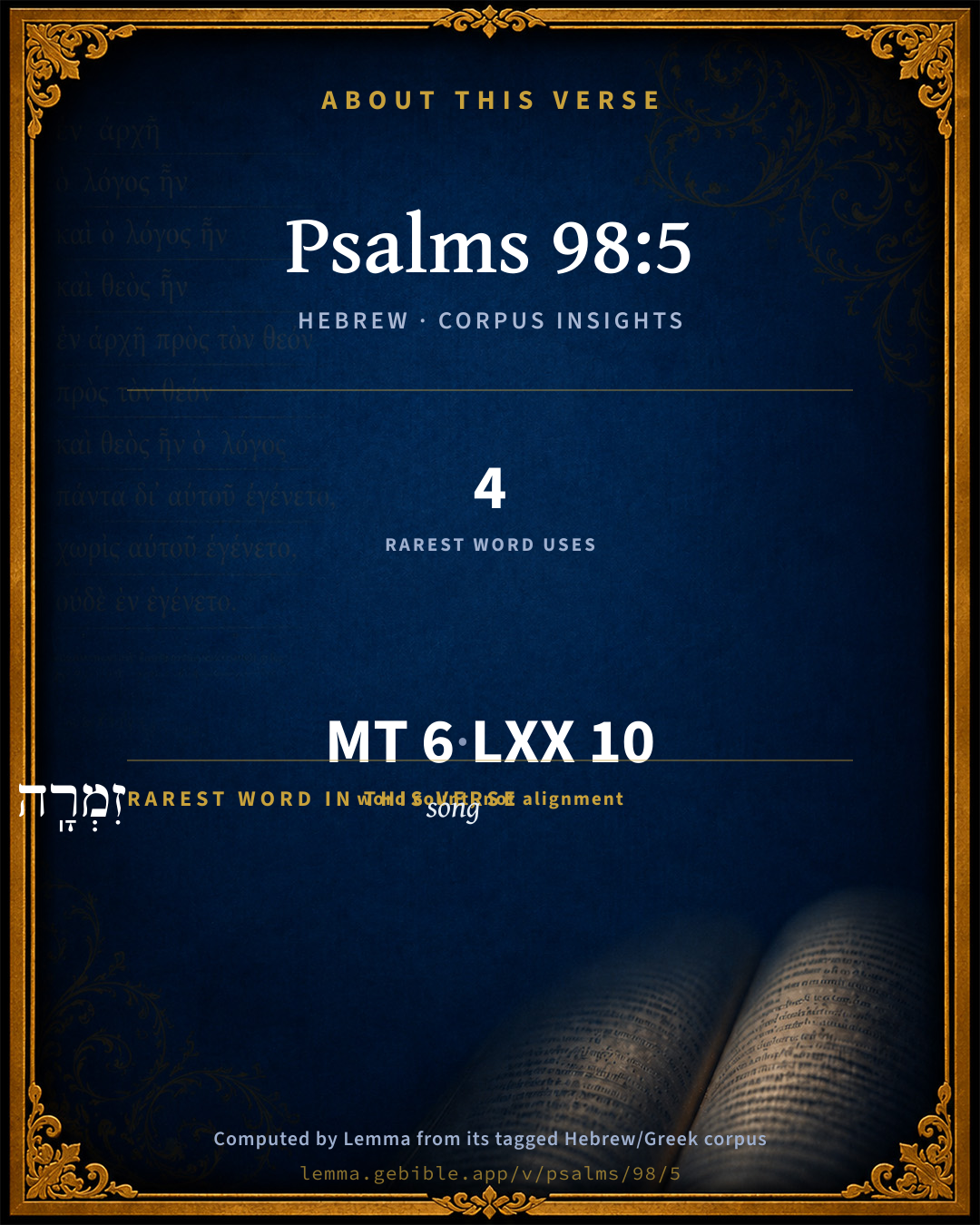
The rarest word here is זִמְרָֽה song H2172 — appearing just 4 times in the whole Hebrew Bible.

Shared distinctive vocabulary

זִמְרָֽה song H2172 occurs in 4 verses of the Hebrew Bible. Also found in:

Grammatical profile

  • 1 verb
  • 5 nouns

Verb forms

  • זַמְּר֣וּ Piel · Imperative

Repetition

A word recurs within this verse — often emphatic in Hebrew:

  • בְּכִנּ֑וֹר lyre H3658 ×2

Hebrew & Septuagint length

In English translation the verse runs 15 words from the Hebrew and 16 from the Septuagint (LXX English) — closely comparable.

A rough comparison of the two English renderings, which tokenize alike — not a word-level alignment.

Word counts can differ between the Hebrew and the Greek without any difference in meaning — e.g. the Hebrew direct-object marker אֵת has no separate Greek word, and Greek often adds the article ὁ.

In the original languages it is 6 Hebrew tokens and 10 Greek tokens — but the two are counted differently (Hebrew bundles its prefixes and suffixes into one token; the Greek is in lemma form), so that isn’t a like-for-like length.

Cross-references

8

Topical passages linked to Psalms 98:5 in the Treasury of Scripture Knowledge — connected by theme and wording, ordered by reader-vote popularity; previews shown in the World English Bible.

  • Psalms 33:2 Give thanks to Yahweh with the lyre. Sing praises to him with the harp of ten strings.
  • Isaiah 51:3 For Yahweh has comforted Zion; he has comforted all her waste places, and has made her wilderness like Eden, and her desert like the garden of Yahweh; joy and gladness shall be found therein, thanksgiving, and the voice of melody.
  • Revelation 5:8 Now when he had taken the book, the four living creatures and the twenty-four elders fell down before the Lamb, each one having a harp, and golden bowls full of incense, which are the prayers of the saints.
  • 1 Chronicles 25:1–6 Moreover, David and the captains of the host set apart for the service certain of the sons of Asaph, and of Heman, and of Jeduthun, who should prophesy with harps, with psalteries, and with cymbals: and the number of those who did the work according to their service was:
  • 2 Chronicles 29:25 He set the Levites in the house of Yahweh with cymbals, with psalteries, and with harps, according to the commandment of David, and of Gad the king's seer, and Nathan the prophet; for the commandment was of Yahweh by his prophets.
  • Psalms 92:3–4 With the ten-stringed lute, with the harp, And with the melody of the lyre.
  • Revelation 14:2–3 I heard a sound from heaven, like the sound of many waters, and like the sound of a great thunder. The sound which I heard was like that of harpists playing on their harps.
  • 1 Chronicles 15:16 David spoke to the chief of the Levites to appoint their brothers the singers, with instruments of music, psalteries and harps and cymbals, sounding aloud and lifting up the voice with joy.

Cross-references courtesy of OpenBible.info (CC BY 4.0).

Hebrew and Greek witnesses Masoretic Hebrew ↔ Greek Septuagint

The same verse in the two great witnesses to the Old Testament, shown verse-for-verse.

You’re reading Greek Psalm 97 (Hebrew Psalm 98). The Septuagint counts the superscription, so verse numbers can differ from the Hebrew — chapter-level alignment, not verse-by-verse. Numbering follows Rahlfs.

These are two independent witnesses, not word-aligned to each other, and the Septuagint is shown in lemma (dictionary) form.

Hebrew Psalms 98:5 Masoretic · Westminster Leningrad Codex

זַמְּר֣וּ לַיהוָ֣ה בְּכִנּ֑וֹר בְּ֝כִנּ֗וֹר וְק֣וֹל זִמְרָֽה

Sing praises to Yahweh with the harp, With the harp and the voice of melody.

World English Bible · Public Domain

Greek LXX Greek Psalm 97:5 Septuagint · lemma form

ψάλλω ὁ κύριος ἐν κιθάρα ἐν κιθάρα καί φωνή ψαλμός

Sing to the Lord with a harp, with a harp, and the voice of a psalm.

LXX2012 (modern English Septuagint) · Public Domain

Hebrew: Westminster Leningrad Codex (CC BY 4.0). Greek: Septuagint (public domain); English from LXX2012 (modern English Septuagint) (Public Domain). How the Septuagint differs from the Hebrew →

Commentary

Notes on Psalms 98:5 from classic Christian and Jewish commentators (each source and its license shown beneath its notes). The classic Christian expositions comment on the surrounding passage and are grouped to its opening verse, so a note may address several verses; the Jewish commentaries on the Tanakh (Rashi and others) are per-verse, so they appear only where the commentator wrote on this verse.

Lemma curates 59 commentaries, every one of them public domain or Creative Commons licensed, each selected and text-cleaned for this edition rather than reprinted as found. About our sources →

Trapp's Complete Commentary

John Trapp

Psa 98:5 Sing unto the LORD with the harp; with the harp, and the voice of a psalm.

Ver. 5. Sing unto the Lord with the harp] Tum cithararum tum vocum mutuis vicibus; do your utmost in the most superlative manner you can devise.

John Trapp, A Commentary or Exposition upon All the Books of the Old and New Testament (1647–1656) — public domain. Text from a community e-Sword module.

Adam Clarke's Commentary

Verse 5. With - the voice of a Psalm.] I think זמרה zimrah, which we translate Psalm, means either a musical instrument, or a species of ode modulated by different voices.

Adam Clarke's Commentary on the Bible (1810–1826) — public domain. Text from a community e-Sword/MySword module.

Ellicott's Commentary for English Readers

(5) Sing . . .—Rather, Play to Jehovah on a harp. on a harp, and with melodious sound of music.

A Bible Commentary for English Readers, edited by Charles John Ellicott (1878–1897) — public domain. Text from a community e-Sword module.

The Cambridge Bible for Schools and Colleges

gen. ed. J. J. S. Perowne

5. Make melody unto Jehovah with the harp:

With the harp and the sound of melody.

Cp. Isa_51:3.

The Cambridge Bible for Schools and Colleges (gen. ed. J. J. S. Perowne; Cambridge University Press, 1878–1918) — public domain. Text from a community e-Sword module.

John Gill's Exposition

Sing unto the Lord with the harp,.... Playing upon that at the same time: here and in the following verse is an allusion to Old Testament worship, and the manner of performing that; not that this should be done in New Testament times, only New Testament worship is expressed in Old Testament language, which is no unusual thing; hence in Gospel times, and Gospel churches, the saints, especially when singing the new song of redeeming grace, are said to have harps in their hands, expressive only of their spiritual melody in their hearts, Rev 5:8,

with the harp, and the voice of the psalm; with the harp alone first, as Aben Ezra and Kimchi interpret it, and then with the harp, and together with the words of a psalm, sung in a psalm tune. Gospel churches are to sing psalms, hymns, and spiritual songs, Eph 5:19.

John Gill's Exposition of the Whole Bible (1746–1763) — public domain (CC PDM 1.0). Text via the HelloAO Bible API.

Albert Barnes' Notes on the Bible

Sing unto the Lord with the harp - A song or psalm accompanied by the harp. On the harp. See the notes at Isa 5:12.

And the voice of a psalm - The voice in singing; a musical voice. Let it not be mere instrumental music, but let that be accompanied with the voice uttering intelligible sounds or words. The only proper use of instrumental music in the worship of God is to deepen the impression which the words are adapted to make; to secure a better influence of truth on the heart.

Albert Barnes' Notes on the Bible (1834–1885) — public domain. Text from a community e-Sword/MySword module.

Matthew Poole's English Annotations

The worship of the New Testament is here described in phrases taken from the rites of the old, as Psa 92:3, and oft elsewhere.

Matthew Poole's English Annotations on the Holy Bible (1683–1685) — public domain. Text from a community e-Sword/MySword module.

The Treasury of David

Charles H. Spurgeon

Ver. 5. With the harp, with the harp. The repetition made use of is emphatic, and implies that the most ardent attempts men might make to celebrate the great work of the world's redemption would fall short of the riches of the grace of God. John Calvin.

Ver. 5. The voice of a psalm. The sound of the Zimrah, hrmz, here, as in Ps 81:2, is certainly the name of some musical instrument. But what the particular instrument might be, which went by that name, is quite uncertain. Samuel Horsley.

Ver. 5. The voice of a Psalm. With psalms Jehoshaphat and Hezekiah celebrated their victories. Psalms made glad the heart of the exiles who returned from Babylon. Psalms gave courage and strength to the Maccabees

Ver. 5. Sing unto the LORD with the harp. Skill in music should not be desecrated to the world's evil mirth, it should aid the private devotions of the saint, and then, like George Herbert, he will sing,

"My God, my God,

My music shall find thee,

And every string

Shall have his attribute to sing."

Martin Luther was thus wont to praise the Lord, whom he loved so well. God's praises should be performed in the best possible manner, but their sweetness mainly lies in spiritual qualities. The concords of faith and repentance, the harmonies of obedience and love are true music in the ear of the Most High, and better please him than "heaving bellows taught to blow, "though managed by the noblest master of human minstrelsy.

With the harp. A very sweet instrument of music, and capable of great expression. The repetition of the word is highly poetical, and shows that the daintiest expressions of poetry are none too rich for the praise of God. His worship should be plain, but not uncouth, if we can compass elegancies of expression there are occasions upon which they will be most appropriate; God, who accepts the unlettered ditty of a ploughman, does not reject the smooth verse of a Cowper, or the sublime strains of a Milton. All repetitions are not vain repetitions, in sacred song there should be graceful repeats, they render the sense emphatic, and help to fire the soul; even preachers do not amiss when they dwell on a word and sound it out again and again, till dull ears feel its emphasis.

And the voice of a Psalm, or with a musical voice, as distinguished from common speech. Our voice has in it many modulations; there is the voice of conversation, the voice of complaint, the voice of pleading, the voice of command, and there ought to be with each of us the voice of a Psalm. Man's voice is at its best when it sings the best words in the best spirit to the best of Beings. Love and war must not monopolise the lyric muse; the love of God and the conquests of Immanuel should win to themselves man's sweetest strains. Do we sing enough unto the Lord? May not the birds of the air rebuke our sullen and ungrateful silence?

in their brave struggles to achieve their country's independence, and were the repeated expression of their thanksgivings. The Lord of Psalmists and the Son of David, by the words of a Psalm proved himself to be higher than David; and sang Psalms with his apostles on the night before he suffered, when he instituted the holy supper of his love. With Psalms Paul and Silas praised God in the prison at midnight when their feet were made fast in the stocks, and sang so loud that the prisoners heard them. And after his own example the apostle exhorts the Christians at Ephesus and Colossae to teach and admonish one another with Psalms anti hymns and spiritual songs. Jerome tells us that in his day the Psalms were to be heard in the fields and vineyards of Palestine, and that they fell sweetly on the ear, mingling with the songs of birds, and the scent of flowers in spring. The ploughman as he guided his plough chanted the hallelujah, and the reaper, the vine dresser, and the shepherd sang the songs of David. "These, "he says, "are our love songs, these the instruments of our agriculture." Sidonins Apollinaris makes his boatmen, as they urge their heavily laden barge up stream, sing Psalms, till the river banks echo again with the hallelujah, and beautifully applies the custom, in a figure, to the voyage of the Christian life. J.J.S. Perowne.

Ver. 5. The voice of a Psalm. In D'Israeli's "Curiosities of Literature" there is a very curious piece upon Psalm singing, in which he mentions the spread of the singing of Psalms in France, which was first started among the Romanists by the version of Clement Marot, the favoured bard of Francis the First. In Marot's dedication occur the following lines:

"Thrice happy they, who may behold,

And listen in that age of gold!

As by the plough the labourer strays,

And carman 'mid the public ways,

And tradesman in his shop shall swell

Their voice in Psalm or canticle,

Singing to solace toil; again

From woods shall come a sweeter strain!

Shepherd and shepherdess shall vie

In many a tender Psalmody;

And the Creator's name prolong,

As rock and stream return their song!

Begin then, ladies fair! begin

The age renew'd that knows no sin!

And with light heart, that wants no wing,

Sing! from this holy songbook, sing!"

The singing of these Psalms became so popular that D'lsraeli suggests that "it first conveyed to the sullen fancy of the austere Calvin the project" of introducing the singing of Psalms into his Genevan discipline. "This infectious frenzy of Psalm singing, "as Warton almost blasphemously describes it, rapidly propagated itself through Germany as well as France, and passed over to England. D'Israeli says, with a sneer, that in the time of the Commonwealth, "Psalms were now sung at Lord Mayor's dinners and city feasts; soldiers sang them on their march and at parade; and few houses which had windows fronting the streets, but had their evening Psalms." We can only add, would to God it were so again. C.H.S.

Ver. 5-6. These were, literally, the instruments most in use among the Jews, and a spiritual signification has been attached to each instrument. They seem to me to represent the cardinal virtues, the harp implying prudence; the psaltery, justice; the trumpet, fortitude; and the cornet, temperance. Bellarmine.

Ver. 5-6. It is evident that the Psalmist here expresses the vehement and ardent affection which the faithful ought to have in praising God, when he enjoins musical instruments to be employed for this purpose. He would have nothing omitted by believers which tends to animate the minds and feelings of men in singing God's praises. The name of God, no doubt, can, properly speaking, be celebrated only by the articulate voice; but it is not without reason that David adds to this those aids by which believers were wont to stimulate themselves the more to this exercise; especially considering that he was speaking to God's ancient people. There is a distinction, however, to be observed here, that we may not indiscriminately consider as applicable to ourselves everything which was formerly enjoined upon the Jews. I have no doubt that playing upon cymbals, touching the harp and the viol, and all that kind of music which is so frequently mentioned in the Psalms, was a part of the education; that is to say, the puerile instruction of the law: I speak of the stated service of the temple. For even now, if believers choose to cheer themselves with musical instruments, they should, I think, make it their object not to dissever their cheerfulness from the praises of God. But when they frequent their sacred assemblies, musical instruments in celebrating the praises of God would be no more suitable than the burning of incense, the lighting up of lamps, and the restoration of the other shadows of the law. The Papists, therefore, have foolishly borrowed this, as well as many other things from the Jews. Men who are fond of outward pomp may delight in that noise; but the simplicity which God recommends to us by the apostle is far more pleasing to him. Paul allows us to bless God in the public assembly of the saints only in a known tongue, 1Co 14:16. The voice of man, although not understood by the generality, assuredly excels all inanimate instruments of music; and yet we see what Paul determines concerning speaking in an unknown tongue. What shall we then say of chanting, which fills the ears with nothing but an empty sound? Does any one object that music is very useful for awakening the minds of men and moving their hearts?, I own it; but we should always take care that no corruption creep in, which might both defile the pure worship of God and involve men in superstition. Moreover, since the Holy Spirit expressly warns us of this danger by the mouth of Paul, to proceed beyond what we are there warranted by him, is not only, I must say, unadvised zeal, but wicked and perverse obstinacy. John Calvin.

Ver. 5-6. The song and the stringed instruments belonged to the Levites, and the trumpets to the priests alone. Kitto says the trumpets did not join in the concert, but were sounded during certain regulated pauses in the vocal and instrumental music. The harps and voices made the sweetness, while the trumpets and horns added the strength; melody and energy should combine in the worship of God. C.H.S.

Psalms 98:6*

Charles H. Spurgeon's The Treasury of David (1869–1885) — public domain. Psalms only. Text from a community e-Sword/MySword module.

The Pulpit Commentary

Sing unto the Lord with the harp; i.e. "with a harp accompaniment." It is fitting that in the praises of God instrumental music should be joined with vocal melody. (comp. Exo_15:20 2Sa_6:15 1Ch_15:16, 28 16:6 2Ch_5:12, 13 Ezr_3:10 Neh_12:27, etc.) With the harp, and the voice of a psalm; or, the voice of melody (Revised Version).

Vers. 5-7. Showing our joy in God.

It must strike every reader of the Psalms that the call to give expression to the joy felt in God is very frequent. We are constantly made to feel that the people did not readily come up to the psalmist"s standpoint. Emotionally he could not raise them to his level, and their flagging and dragging seems sometimes to worry him. But the intensely earnest man, the man of cultured spiritual feeling, the pious poet soul, always has this trouble, and is always in danger of misapprehending his fellows because they seem unable adequately to respond to him. He does not realize that he may be no better standard, since he is above average, than they are who are below average. The man in advance does us all good by lifting us all higher, if he fails to lift us to his own level. If we cannot sing and praise as the psalmist does, we can all sing and praise better because the psalmist chants so nobly. Illustrate this point by referring to David, the royal psalmist, actually beginning in the tabernacle a service of song. No doubt some were heartily with him from the first, but many must have given him trouble. Some were tiresomely indifferent. They would not come, but they would give no reasons for not coming. Some opposed, and we can well imagine some of the grounds of their opposition. So it always is and always will be. We may qualify the trouble this may cause us by remembering that the signs and expressions of religious feeling greatly differ, and we cannot reasonably expect all persons to express themselves as we do. What we may look for, and work for, is some expression of what is in men"s hearts toward the Lord. Let them break out into songs and music, if that will best utter their hearts. Let them abound in good works, if they like that voice for their souls better. The main thing is this if a man has any joy in God in his soul, let him find out how to give it voice, so that God and men may know of it. R.T.

The Pulpit Commentary (1880–1919), ed. H.D.M. Spence-Jones & Joseph S. Exell — public domain. Text from a community e-Sword module.

unfoldingWord translationNotes

Door43 World Missions Community

melodious

delightful or pleasing musical sound

the horn

an animal horn used as a musical instrument

make a joyful noise

"raise a shout." See how "shout" is translated in Psalms 47:1.

translationWords

harp

trumpet

joy

king

unfoldingWord translationNotes — © Distant Shores Media and the Door43 World Missions Community, licensed CC BY-SA 4.0. Source: git.door43.org/Door43/en_tn.

Lesson kit

Teaching starters — assembled from the data on this page, not authored interpretation. Every prompt links to the verse data it draws on. Edit before teaching.

Psalms, in the Wisdom, opens this verse with 6 words (5 distinct Hebrew lemmas). Its most distinctive word is zimrâh (“song”). A historical commentator’s framing appears above. Read the whole chapter for the surrounding context.

Discussion questions

  1. The word zimrâh carries the sense “song.” How does it shape the verse?
  2. Psalms 81:2 shares the word «song» with this verse. How do the two illuminate each other?
  3. “lyre” occurs 2× in this one verse. What is the effect of the repetition?
  4. These translations render this verse differently. What is at stake in choosing one wording over another?
  5. The verb «זַמְּר֣וּ» is Piel Imperative. How does its form color the action?
  6. Reading how Trapp's Complete Commentary and Adam Clarke's Commentary read this verse, where do the two commentators agree and where do they part?

Things to notice

Reading settings

Reading text

Shown beneath each verse's original-language words.

Old Testament
Old Testament edition

Read the OT as the Masoretic Hebrew (MT) or the Greek Septuagint (LXX).

English shown for the Greek Septuagint (in the Hebrew ↔ Greek comparison).

Comparing translations? Open the Compare panel on any verse page to stack up to four side by side.