Isaiah 37:13

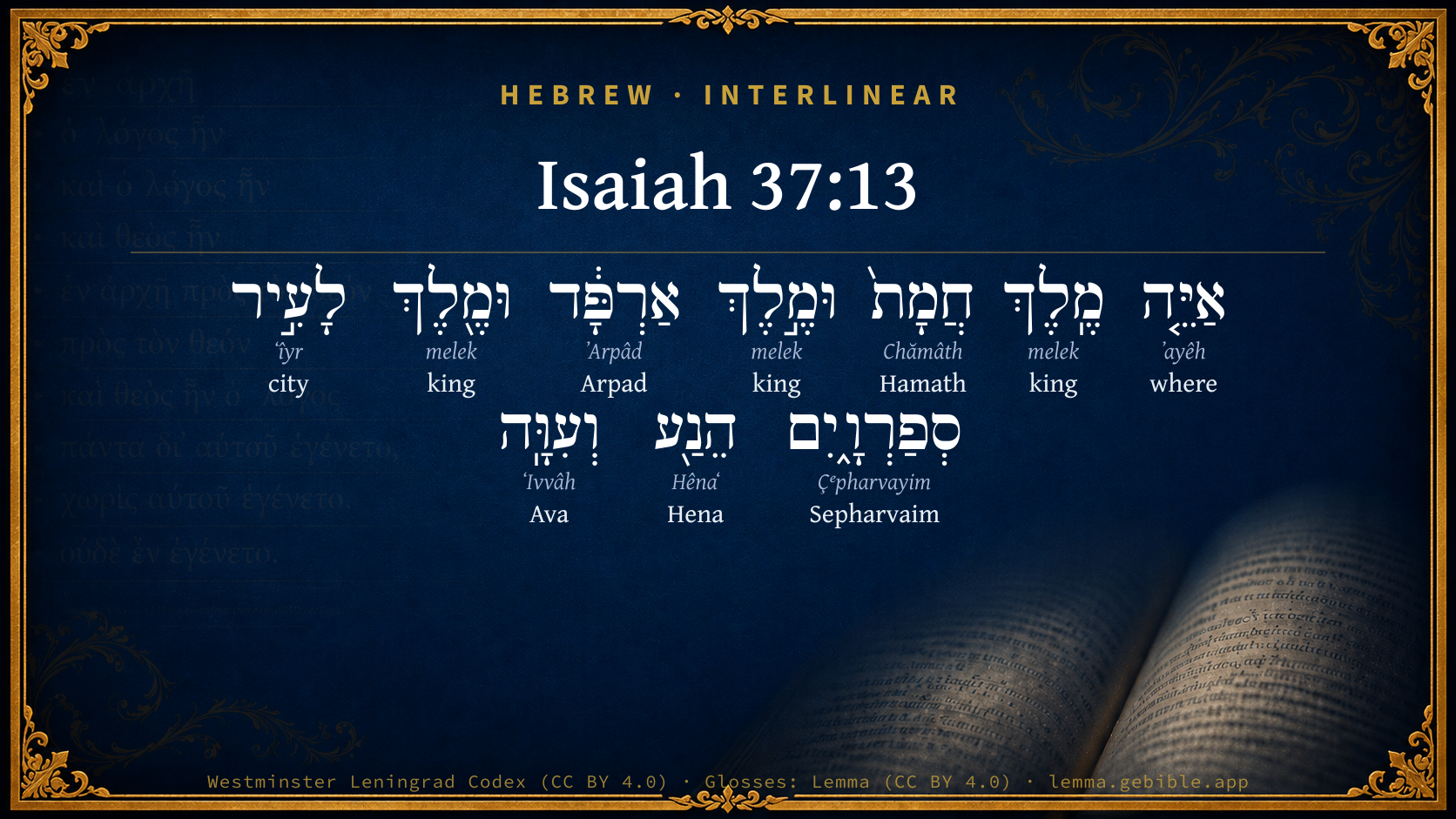
Hebrew (Westminster Leningrad Codex) Isaiah 37:13 appears in the Hebrew Old Testament. The text above is from the Westminster Leningrad Codex. Each word links to its Strong’s number, a concise gloss, and parsing drawn from the Open Scriptures Hebrew Bible morphology. Click any word for its full Brown-Driver-Briggs (BDB) entry.
Download image
Cite this verse

Isaiah 37:13 (World English Bible). Public Domain. Lemma interlinear Bible study tool, https://lemma.gebible.app/v/isaiah/37/13.

Show BibTeX & RIS
BibTeX
RIS
English Translation
Where is the king of Hamath, and the king of Arpad, and the king of the city of Sepharvaim, of Hena, and Ivvah?
World English Bible · Public Domain
Download a study sheet

One document with this verse’s original text, its word-by-word gloss line, the meaning frame, cross-references with their text, attributed commentary, and full source and license credits — printable, and it pastes into notes with its structure intact.

This verse Autodidact and up

Study sheet (.html) Plain text (.txt)

A passage Seminary Student

Up to 50 verses in one chapter. A passage sheet keeps up to 6 commentary sources and 12 cross-references per verse, in the order this page ranks them, and says so on the sheet whenever that leaves anything out. Ask for a single verse and you get the Autodidact verse sheet above.

Everything on this page stays free to read, with no account — the sheet is a download of what is already on screen, not access to it.

Want to remove ads? Support Godless Engineer
Compare translations 3

The same verse in 3 English versions, stacked beneath the original-language interlinear above. Click any original word for its lexicon entry.

Each is an independent rendering of the whole verse — the interlinear is not word-aligned to these translations.

Highlighted words mark where these versions differ — a whole-verse word diff, not a word-by-word alignment.

  • World English Bible Public Domain
    Where is the king of Hamath, and the king of Arpad, and the king of the city of Sepharvaim, of Hena, and Ivvah?
  • King James Version Public Domain
    Where is the king of Hamath, and the king of Arphad, and the king of the city of Sepharvaim, Hena, and Ivah?
  • unfoldingWord Literal Text CC BY-SA 4.0
    Where the king of Hamath or the king of Arpad or the king of the city of Sepharvaim, Hena, or Ivvah?’”

unfoldingWord Literal Text — © unfoldingWord, licensed CC BY-SA 4.0. Word-aligned USFM3 via Door43 (git.door43.org/unfoldingWord/en_ult).

Versions to compare (up to 4)

3 of 4 selected

Show all 18 translations

Every available English version of this verse, each an independent rendering of the whole verse.

  • World English Bible Public Domain
    Where is the king of Hamath, and the king of Arpad, and the king of the city of Sepharvaim, of Hena, and Ivvah?
  • Berean Standard Bible Public Domain
    Where are the kings of Hamath, Arpad, Sepharvaim, Hena, and Ivvah?’”
  • Majority Standard Bible Public Domain
    Where are the kings of Hamath, Arpad, Sepharvaim, Hena, and Ivvah?’”
  • King James Version Public Domain
    Where is the king of Hamath, and the king of Arphad, and the king of the city of Sepharvaim, Hena, and Ivah?
  • American Standard Version (1901) Public Domain
    Where is the king of Hamath, and the king of Arpad, and the king of the city of Sepharvaim, of Hena, and Ivvah?
  • Revised Version (1885) Public Domain
    Where is the king of Hamath, and the king of Arpad, and the king of the city of Sepharvaim, of Hena, and Ivvah?
  • Geneva Bible (1599) Public Domain
    Where is the King of Hamath, and the King of Arpad, and the King of the citie of Sepharuaim, Hena and Iuah?
  • Douay-Rheims (1899) Public Domain
    Where is the king of Emath, and the king of Arphad, and the king of the city of Sepharvaim, of Ana, and of Ava?
  • Young's Literal Translation Public Domain
    Where `is' the king of Hamath, and the king of Arpad, and the king of the city of Sepharvaim, Hena, and Ivvah?'
  • Literal Standard Version CC BY-SA 4.0
    Where [is] the king of Hamath, and the king of Arpad, and the king of the city of Sepharvaim, Hena, and Ivvah?”
  • Unlocked Literal Bible CC BY-SA 4.0
    Where is the king of Hamath, the king of Arpad, the king of the cities of Sepharvaim, of Hena, and Ivvah?'”
  • unfoldingWord Literal Text CC BY-SA 4.0
    Where the king of Hamath or the king of Arpad or the king of the city of Sepharvaim, Hena, or Ivvah?’”
  • Darby Bible Public Domain
    Where is the king of Hamath, and the king of Arpad, and the king of the city of Sepharvaim, of Hena, and Ivvah?
  • World Messianic Bible Public Domain
    Where is the king of Hamath, and the king of Arpad, and the king of the city of Sepharvaim, of Hena, and Ivvah?’”
  • Webster's Bible Public Domain
    Where is the king of Hamath, and the king of Arpad, and the king of the city of Sepharvaim, Hena, and Ivah?
  • Free Bible Version CC BY-SA 4.0
    Where today is the king of Hamath, the king of Arpad, the king of the city of Sepharvaim, the king of Hena, or the king of Ivvah?’”
  • Bible in Basic English Public Domain
    Where is the king of Hamath, and the king of Arpad, and the king of the town of Sepharvaim, of Hena, and Ivva?
  • JPS Tanakh (1917) Public Domain
    Where is the king of Hamath, and the king of Arpad, and the king of the city of Sepharvaim, of Hena, and Ivvah?'

Literal Standard Version (2020), Covenant Press — licensed CC BY-SA 4.0. Text via the HelloAO Bible API (eBible.org). Unlocked Literal Bible (unfoldingWord) — licensed CC BY-SA 4.0. Text via the HelloAO Bible API (eBible.org). unfoldingWord Literal Text — © unfoldingWord, licensed CC BY-SA 4.0. Word-aligned USFM3 via Door43 (git.door43.org/unfoldingWord/en_ult). Free Bible Version, Dr. Jonathan Gallagher — licensed CC BY-SA 4.0. Text via the HelloAO Bible API (eBible.org).

Word by word

More ways to search: Search by grammar → Find every occurrence → Compare this word →

Practice this passage: Drill this verse → Learn its vocabulary →

About this verse

These counts appear in no published source. They are computed here, from the morphology-tagged text and Lemma’s own curated glosses. What Lemma adds →

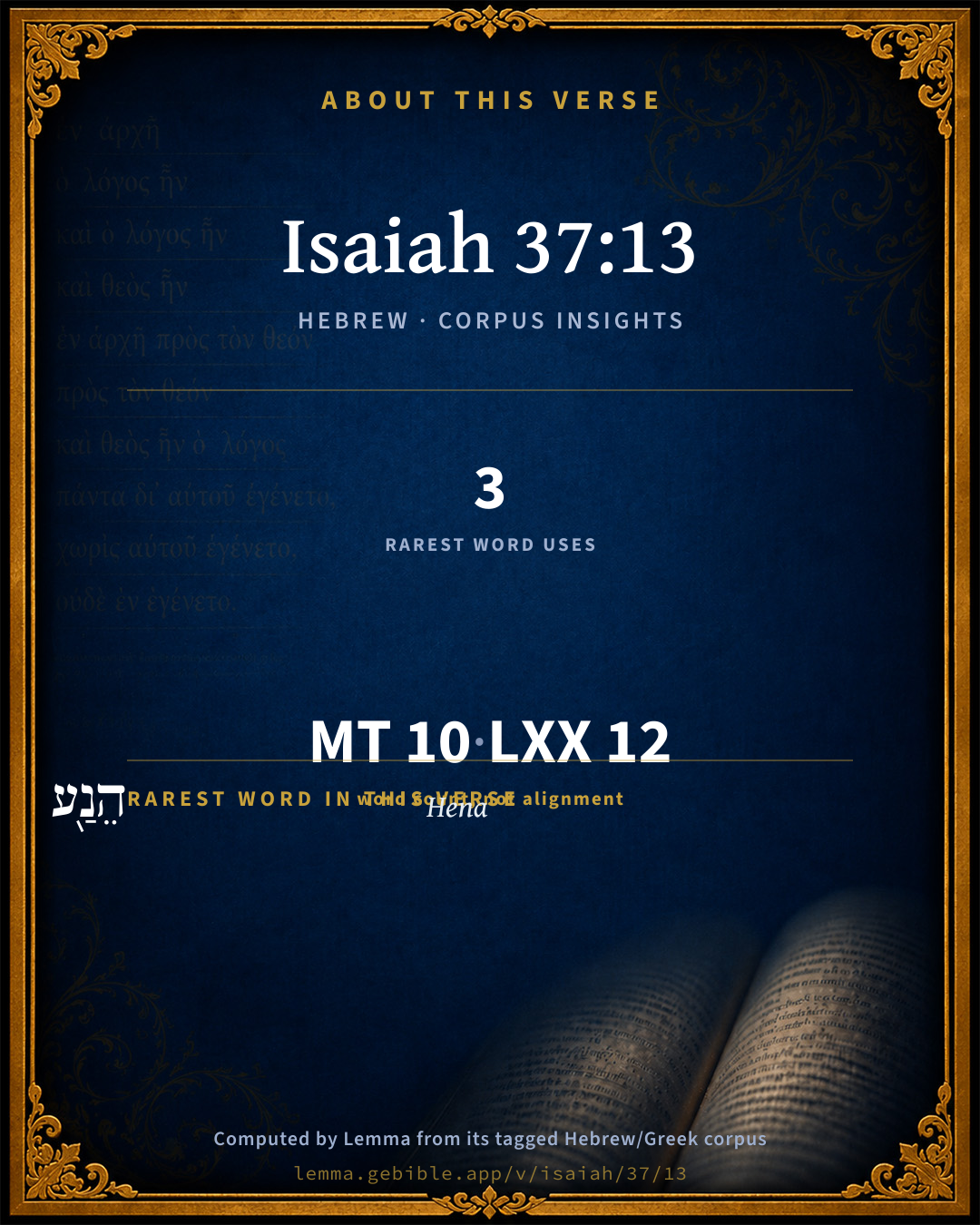
10
words
8
distinct lemmas
Prophets
section

Notable vocabulary

The rarest word here is הֵנַ֖ע Hena H2012 — appearing just 3 times in the whole Hebrew Bible.

Shared distinctive vocabulary

הֵנַ֖ע Hena H2012 occurs in 3 verses of the Hebrew Bible. Also found in:

Grammatical profile

  • 9 nouns
  • 1 particle

Repetition

A word recurs within this verse — often emphatic in Hebrew:

  • מֶֽלֶךְ king H4428 ×3

Hebrew & Septuagint length

In English translation the verse runs 23 words from the Hebrew and 26 from the Septuagint (LXX English) — closely comparable.

A rough comparison of the two English renderings, which tokenize alike — not a word-level alignment.

Word counts can differ between the Hebrew and the Greek without any difference in meaning — e.g. the Hebrew direct-object marker אֵת has no separate Greek word, and Greek often adds the article ὁ.

In the original languages it is 10 Hebrew tokens and 12 Greek tokens — but the two are counted differently (Hebrew bundles its prefixes and suffixes into one token; the Greek is in lemma form), so that isn’t a like-for-like length.

Cross-references

7

Topical passages linked to Isaiah 37:13 in the Treasury of Scripture Knowledge — connected by theme and wording, ordered by reader-vote popularity; previews shown in the World English Bible.

  • 2 Kings 17:24 The king of Assyria brought men from Babylon, and from Cuthah, and from Avva, and from Hamath and Sepharvaim, and placed them in the cities of Samaria instead of the children of Israel; and they possessed Samaria, and lived in the cities of it.
  • 2 Kings 17:30–31 The men of Babylon made Succoth-benoth, and the men of Cuth made Nergal, and the men of Hamath made Ashima,
  • 2 Kings 18:34 Where are the gods of Hamath, and of Arpad? where are the gods of Sepharvaim, of Hena, and Ivvah? have they delivered Samaria out of my hand?
  • 2 Kings 19:13 Where is the king of Hamath, and the king of Arpad, and the king of the city of Sepharvaim, of Hena, and Ivvah?
  • Isaiah 10:9 Isn't Calno as Carchemish? Isn't Hamath as Arpad? Isn't Samaria as Damascus?
  • Isaiah 36:19 Where are the gods of Hamath and Arpad? where are the gods of Sepharvaim? and have they delivered Samaria out of my hand?
  • Jeremiah 49:23 Of Damascus. Hamath is confounded, and Arpad; for they have heard evil news, they are melted away: there is sorrow on the sea; it can't be quiet.

Cross-references courtesy of OpenBible.info (CC BY 4.0).

Hebrew and Greek witnesses Masoretic Hebrew ↔ Greek Septuagint

The same verse in the two great witnesses to the Old Testament, shown verse-for-verse.

These are two independent witnesses, not word-aligned to each other, and the Septuagint is shown in lemma (dictionary) form.

Hebrew Isaiah 37:13 Masoretic · Westminster Leningrad Codex

אַיֵּ֤ה מֶֽלֶךְ חֲמָת֙ וּמֶ֣לֶךְ אַרְפָּ֔ד וּמֶ֖לֶךְ לָעִ֣יר סְפַרְוָ֑יִם הֵנַ֖ע וְעִוָּֽה

Where is the king of Hamath, and the king of Arpad, and the king of the city of Sepharvaim, of Hena, and Ivvah?

World English Bible · Public Domain

Greek LXX Isaiah 37:13 Septuagint · lemma form

ποῦ εἰμί ὁ βασιλεύς αιμαθ καί αρφαθ καί πόλις σεπφαριμ αναγ ουγαυα

Where are the kings of Emath? and where is the king of Arphath? and where is the king of the city of Eppharuaim, and of Anagugana?

LXX2012 (modern English Septuagint) · Public Domain

Hebrew: Westminster Leningrad Codex (CC BY 4.0). Greek: Septuagint (public domain); English from LXX2012 (modern English Septuagint) (Public Domain). How the Septuagint differs from the Hebrew →

Targum (Aramaic paraphrase)

1

The Targum is the ancient Jewish Aramaic paraphrase of the Hebrew Scriptures — an interpretive translation, not the Hebrew text itself. Onkelos (literal) and Pseudo-Jonathan (expansive) render the Torah, and Jonathan the Prophets. Coverage is partial: where no permissively-licensed English translation exists for a verse, only the Aramaic is shown. This is verse-level text, not a word-by-word alignment to the Hebrew.

  1. Targum Jonathan Prophets (Joshua–Malachi)
    אָן מַלְכָּא דַחֲמָת וּמַלְכָּא דְאַרְפָּד וּמַלְכָּא דִלְקַרְתָּא סְפַרְוָיִם הֲלָא טַלְטְלִינוּן וְאַגְלִיאִינוּן:

    Where is the king of Hamath, and the king of Arphad, and the king of the city of Sepharvaim? hath he not removed them, and carried them captive?

    Targum Jonathan — Aramaic: “Mikraot Gedolot” (public domain). English: “Sefaria Community Translation” (CC0 1.0 (public-domain dedication)); “London "Chaldee Paraphrase," 1871” (public domain). Text via Sefaria.

Commentary

Notes on Isaiah 37:13 from classic Christian and Jewish commentators (each source and its license shown beneath its notes). The classic Christian expositions comment on the surrounding passage and are grouped to its opening verse, so a note may address several verses; the Jewish commentaries on the Tanakh (Rashi and others) are per-verse, so they appear only where the commentator wrote on this verse.

Lemma curates 59 commentaries, every one of them public domain or Creative Commons licensed, each selected and text-cleaned for this edition rather than reprinted as found. About our sources →

Jamieson, Fausset & Brown

Robert Jamieson, A. R. Fausset & David Brown

Hena . . . Ivah--in Babylonia. From Ava colonists had been brought to Samaria (Kg2 17:24).

Jamieson, Fausset & Brown — Commentary Critical and Explanatory on the Whole Bible (1871) — public domain (CC PDM 1.0). Text via the HelloAO Bible API.

Ellicott's Commentary for English Readers

(13) Where is the king of Hamath . . .—The question which had been asked in Isa_36:19 as to the gods of the cities named is now asked of their kings, and the implied answer is that they are in the dungeons of Nineveh.

Hena, and Ivah.—The sites have not been identified, but Anah is found as the name of a city on the Euphrates, and Ivah may be the same as the Ava of 2Ki_17:24.

A Bible Commentary for English Readers, edited by Charles John Ellicott (1878–1897) — public domain. Text from a community e-Sword module.

The Cambridge Bible for Schools and Colleges

gen. ed. J. J. S. Perowne

13. Hamath … Arphad … Sepharvaim] See ch. Isa_36:19. Hena and Ivah (R.V. more correctly, Ivvah) are not known. The latter is probably the same as Ava or Avva (2Ki_17:24).

The Cambridge Bible for Schools and Colleges (gen. ed. J. J. S. Perowne; Cambridge University Press, 1878–1918) — public domain. Text from a community e-Sword module.

John Gill's Exposition

And Hezekiah received the letter from the hand of the messengers, and read it,.... Or books (k), in which the above things were written; and everyone of these he read, as Kimchi interprets it; though the Targum is,

"he took the letters from the hand of the messengers, and read one of them;''

that is, as Kimchi's father explains it, in which was the blasphemy against God; this he read over carefully to himself, observed the contents of it, and then did with it as follows:

and Hezekiah went up unto the house of God; the temple, the outward court of it, further than that he could not go:

and spread it before the Lord; not to read it, as he had done, or to acquaint him with the contents of it, which he fully knew; but, as it chiefly regarded him, and affected his honour and glory, he laid it before him, that he might take notice of it, and vindicate himself, and avenge his own cause; he brought it as a proof of what he had to say to him in prayer, and to support him in his allegations, and as a means to quicken himself in the discharge of that duty.

(k) "libros", V. L.

John Gill's Exposition of the Whole Bible (1746–1763) — public domain (CC PDM 1.0). Text via the HelloAO Bible API.

Albert Barnes' Notes on the Bible

The king of Hamath - (See the note at Isa 36:19).

Hena and Ivah - Hena is mentioned in 2Ki 18:34; 2Ki 19:13. It was evidently in Mesopotamia, and was probably the same which was afterward called Ana, situated near a ford of the Euphrates. The situation of Ivah is not certainly known. It was under the Assyrian dominion, and was one of the places from which colonists were brought to Samaria 2Ki 17:24, 2Ki 17:31. Michaelis supposes that it was between Berytus and Tripoli, but was under the dominion of the Assyrians.

Albert Barnes' Notes on the Bible (1834–1885) — public domain. Text from a community e-Sword/MySword module.

The Pulpit Commentary

Hamath... Arphad... Sepharvaim. (See the comment upon Isa_36:19)

The Pulpit Commentary (1880–1919), ed. H.D.M. Spence-Jones & Joseph S. Exell — public domain. Text from a community e-Sword module.

J. A. Alexander on Isaiah

Joseph Addison Alexander

“Where is the king of Hamath, and the king of Arpad, and the king of the city Sepharvaim, Hena and Ivvah?” The question implies that they were nowhere, or had ceased to be. The first three names occur in the same order in Rabshakeh’s speech (Isa 36:19), and the remaining two also in the parallel passage (2Ki 18:34). Of Hena nothing whatever is known, and of Ivvah only that it may be identical with the Ivvah of 2Ki 17:24, from which Assyrian colonists were transferred to Samaria. It has been suggested that they are the names of the deities worshipped at Hamath, Arpad, and Sepharvaim. In favor of this exposition, besides the fact that the names, as names of places, occur nowhere else, it may be urged that it agrees not only with the context in this place, but also with 2Ki 18:34.

Joseph Addison Alexander, The Prophecies of Isaiah (1846–1847; New York: Scribner, 1870–1878) — public domain. Text from a community e-Sword module.

Rashi

Rabbi Shlomo Yitzchaki (Rashi)

He exiled [them] and twisted [them] (וְעִוָּה הֵנַע) The king of Assyria exiled him and twisted him; he destroyed them and exiled them from their place.

Rashi on the Tanakh — English translations: “The Judaica Press complete Tanach with Rashi, translated by A. J. Rosenberg” (CC BY 4.0); “Pentateuch with Rashi's commentary by M. Rosenbaum and A.M. Silbermann, 1929-1934” (public domain); “The Metsudah Tanach series, Lakewood, N.J” (CC BY 4.0); and “The Book of Joshua, Metsudah Publications, 1997” (CC BY 4.0). Text via Sefaria.

Lesson kit

Teaching starters — assembled from the data on this page, not authored interpretation. Every prompt links to the verse data it draws on. Edit before teaching.

Isaiah, in the Prophets, opens this verse with 10 words (8 distinct Hebrew lemmas). Its most distinctive word is Hênaʻ (“Hena”). A historical commentator’s framing appears above. Read the whole chapter for the surrounding context.

Discussion questions

  1. The word Hênaʻ carries the sense “Hena.” How does it shape the verse?
  2. How does 2 Kings 18:34, which shares the word «Hena», read alongside this verse?
  3. What does the repetition of “king” (3× in this one verse) do in this verse?
  4. These translations render this verse differently; the difference is in the English rendering, not the original. What questions does that raise?
  5. Compare how Jamieson, Fausset & Brown and Ellicott's Commentary for English Readers read this verse. Where do they agree or differ?

Things to notice

Reading settings

Reading text

Shown beneath each verse's original-language words.

Old Testament
Old Testament edition

Read the OT as the Masoretic Hebrew (MT) or the Greek Septuagint (LXX).

English shown for the Greek Septuagint (in the Hebrew ↔ Greek comparison).

Comparing translations? Open the Compare panel on any verse page to stack up to four side by side.