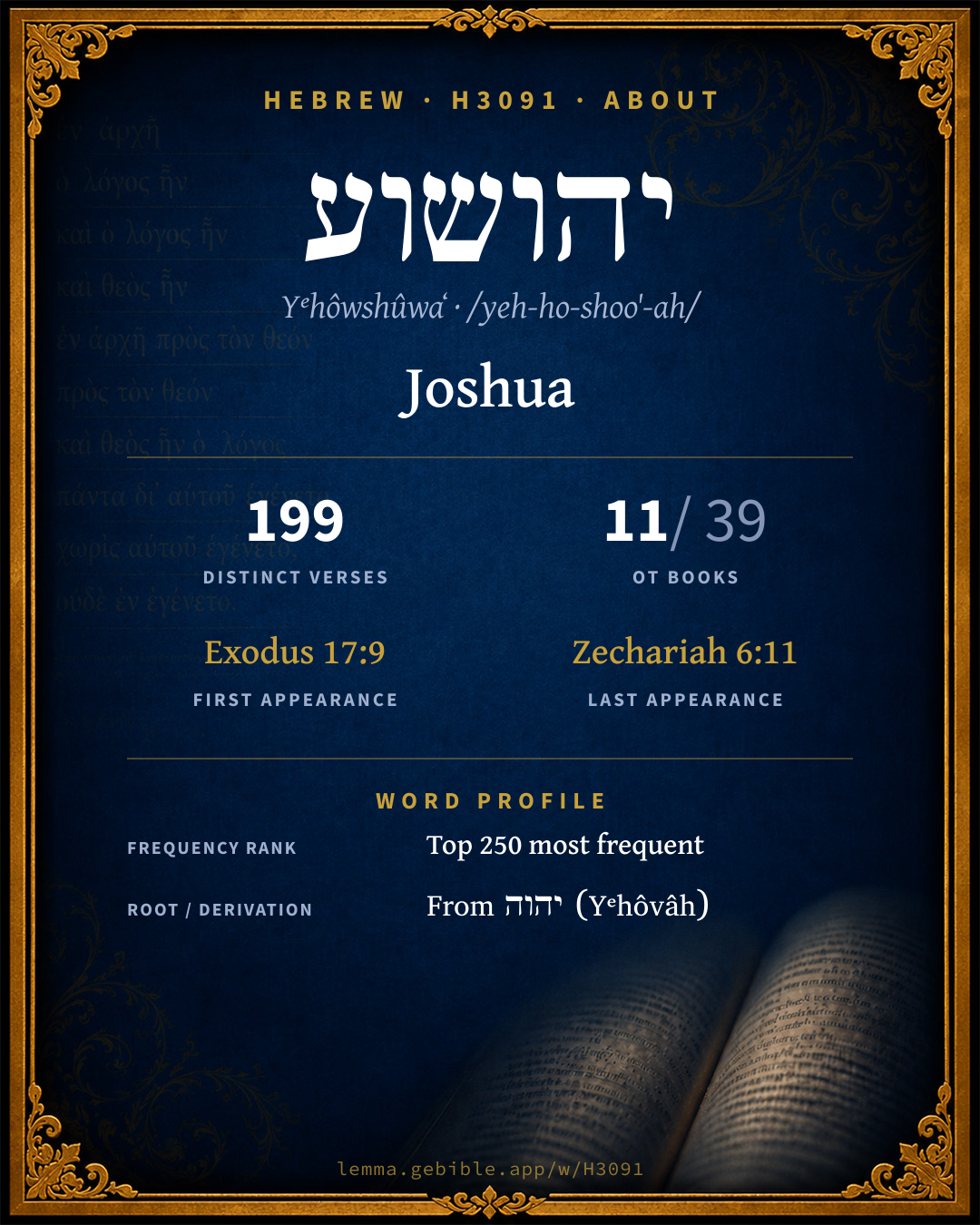
יְהוֹשׁוּעַ
Joshua
BDB lists 5 entries for ‘Joshua’ fuller range ↓
Full lexicon entry — Brown-Driver-Briggs (BDB)
From Brown-Driver-Briggs (BDB)
Where this word appears
Grammar key — what these labels mean
Part of speech
- Noun
- A naming word — a person, place, thing, or idea.
Noun type
- Proper
- A name of a specific person, place, or people (e.g. Abraham, Zion, Israel).
Every verse where H3091 appears in the Book of 1 Chronicles — 1 distinct verse. Click any verse to open its interlinear word-by-word view. Verse text shown in the World English Bible for context — . Each verse’s Hebrew form is shown with its reference; the English is not keyword-highlighted, since the data carries no word-level English alignment. Use “Compare translations” on any verse to read it across multiple English versions. This concordance covers the Hebrew Bible; Septuagint (Greek Old Testament) occurrences are not indexed here.
1 Chronicles
About this entry
At a glance — auto-summarized from this page’s data, not written by a person. Every figure links to its source below. This summary describes the numbers; it doesn’t interpret them.
“Joshua” is the headline sense of the Hebrew name יהושוע (Yᵉhôwshûwaʻ). It clusters heavily in Joshua, which alone accounts for 76% of its uses. It turns up in 199 verses across 11 books, a common footprint. Its earliest occurrence is Exodus 17:9. The sections below give every occurrence and version rendering.
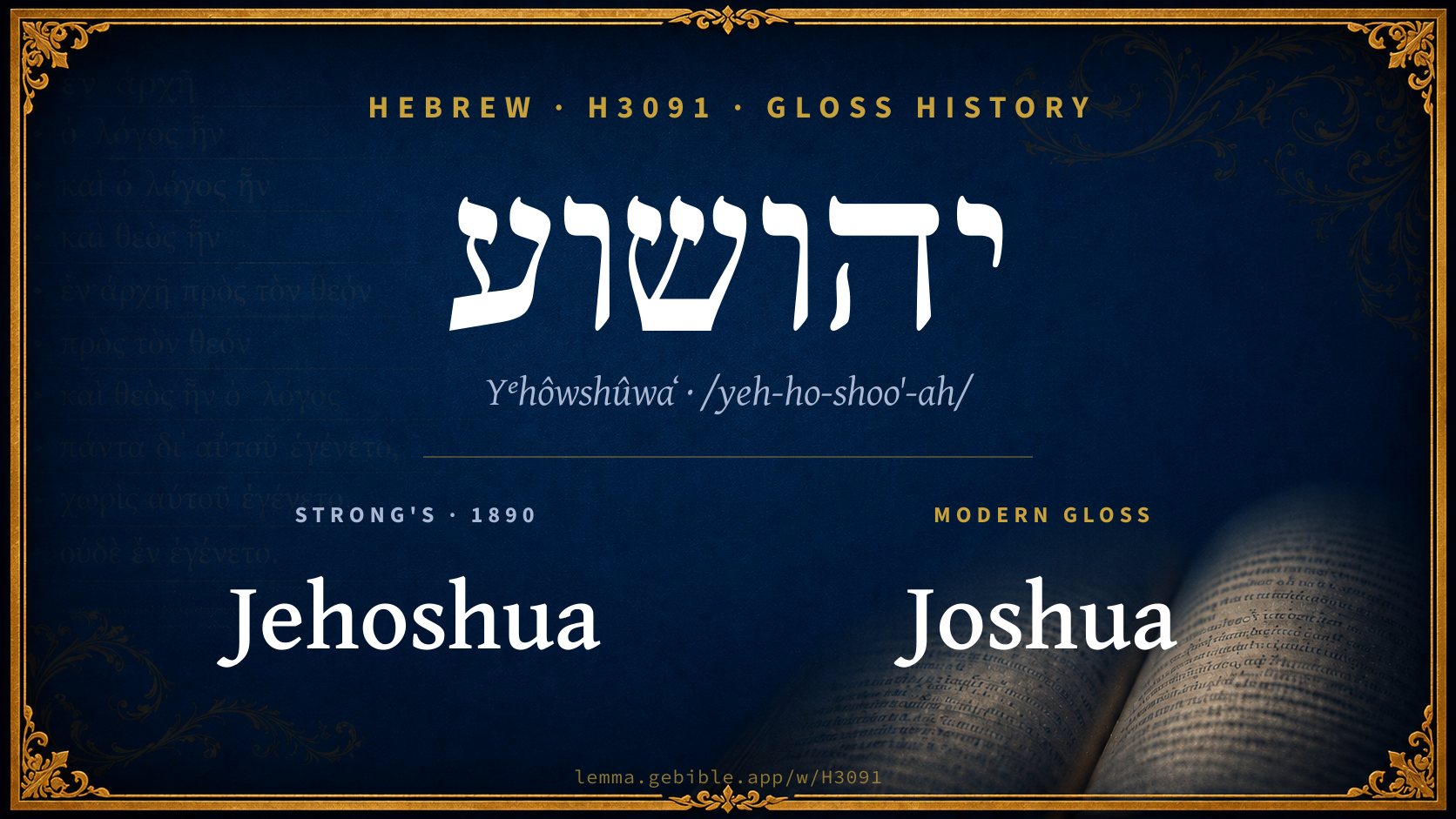
Gloss history
Strong's 1890 vs modern scholarship
About this word
Strong's H3091 catalogs a Hebrew word from the Hebrew Old Testament.
These counts are not copied from any lexicon or concordance. They are computed here, from the morphology-tagged Hebrew Old Testament. What Lemma adds →
- 199
- distinct verses
- The word appears in 199 distinct verses.
- 11 / 39
- OT books
- The word appears in 11 of 39 Old Testament books.
- #217
- by frequency
- Top 250 most frequent Hebrew words (rank 217 of 8,640 Hebrew words by occurrence).
View all 199 occurrences in the concordance →
Most concentrated in
- Joshua 151 verses 76%
- Numbers 11 verses 6%
- Deuteronomy 8 verses 4%
By section of the Old Testament
By traditional corpus
Conventional, traditional groupings — biblical authorship is debated, so this is a traditional corpus grouping, not an authorship claim. Each share is this word’s portion of its verses in that division of the Hebrew canon. Each figure is a share of the word’s 199 distinct verses.
- Prophets (Nevi'im) 172 verses · 86%
- Torah (Pentateuch) 26 verses · 13%
- Writings (Ketuvim) 1 verse · 1%
How translations render this word
Counts come from each version’s own published word-to-Strong’s tagging or interlinear alignment — an approximate guide to how each version renders this word, not a word-level alignment the data otherwise carries. Because each total is that version’s own tagged count, the per-version totals vary from one another and need not match the appearance or distinct-verse counts above. These counts may also differ from a printed concordance because Lemma counts each distinctly tagged rendering and does not collapse phrase taggings into a single head-word total. This is a fixed set of word-tagged versions (KJV, ASV, BSB, ULT) and does not change with the reading translation you choose elsewhere. Each version’s license is shown beside its name below (and on Sources).
BDB lists this Strong’s number as 2 distinct words (homographs). Each count above pools all of them and is not split by sense — see the Senses section below. A low-frequency rendering may belong to a different one of those words, not the primary meaning.
- King James Version†: Joshua 200×, Came to pass when joshua 3×, Did joshua 3×
- American Standard Version†: Joshua 193×, Came to pass 2×, Did joshua 2×
- Berean Standard Bible†: Joshua 191×, He 3×, Now joshua 3×
- unfoldingWord Literal Text†: Joshua 217×
King James Version Public Domain
Renders H3091 across 218† tagged occurrences — most commonly:
Plus 8 renderings that appear only once — usually multi-word phrases or single function words the recovered tagging swept in, not distinct renderings.
American Standard Version Public Domain
Renders H3091 across 214† tagged occurrences — most commonly:
Plus 15 renderings that appear only once — usually multi-word phrases or single function words the recovered tagging swept in, not distinct renderings. Not rendered by a distinct English word in 4 further occurrences.
Berean Standard Bible Public Domain
Renders H3091 across 209† tagged occurrences — most commonly:
Plus 8 renderings that appear only once — usually multi-word phrases or single function words the recovered tagging swept in, not distinct renderings. Not rendered by a distinct English word in 9 further occurrences.
unfoldingWord Literal Text CC BY-SA 4.0
Renders H3091 across 219† tagged occurrences — most commonly:
Plus 2 renderings that appear only once — usually multi-word phrases or single function words the recovered tagging swept in, not distinct renderings.
11 senses and sub-senses in the full BDB
What do BDB’s symbols mean?
BDB uses these scholarly abbreviations:
| Symbol | Meaning |
|---|---|
| 𝔊 | the Septuagint (the ancient Greek translation, LXX) |
| 𝔙 | the Vulgate (the Latin translation) |
| 𝔖 | the Syriac version (the Peshitta) |
| 𝔗 | the Targum (the Aramaic translation) |
| ψ | the Psalms |
| √ | root (the underlying root or stem) |
| ‖ | parallel passage (a synonymous or contrasted parallel) |
| † | the dagger: every passage where the word occurs is cited |
The 11 senses and sub-senses the full Brown-Driver-Briggs lexicon distinguishes for this word, in lexicon order (not ranked by frequency), with BDB’s own verbatim wording and sub-sense lettering. Shown in Hebrew script with BDB’s own scholarly abbreviations. The condensed entry is in the Lexicon Entry tab. See also the Forms in the corpus table below.
יהושוע I
- 1. Moses’ successor, son of Nun, (𝔊 Ἰησοῦς) יְהוֹשׁוּעַ Dt 3:21 Ju 2:7; = יְהוֹשֻׁעַ Ex 17:9, 10, 13, 14; 24:13; 32:17; 33:11 Nu 11:28; 13:16; 14:6, 30, 38; 26:65; 27:18, 22; 32:12, 28; 34:17 Dt 1:38; 3:28; 31:3, 7, 14(×2), 23; 34:9 Jos 1:1 + 167 times Jos; Ju 1:1; 2:6, 7, 8, 21, 23; 1 K 16:34; 1 Ch 7:27; = יֵשׁוּעַ Ne 8:17 (𝔊 Ἰησοῦς); according to P, name changed by Moses from הוֹשֵׁעַ q.v. Nu 13:8, 16 (𝔊 Αὑση) Dt 32:44 (𝔊 Ἰησοῦς). e.g. Deuteronomy 3:21
- 2. יְהוֹשֻׁעַ a Bethshemite 1 S 6:14, 18 (𝔊 Ὡσηε, A Ἰησοῦς, 𝔊L Ἰωσηε). e.g. 1 Samuel 6:14
- 3. h.p. after the restoration, son of Jehozadak יְהוֹשֻׁעַ (𝔊 Ἰησοῦς) Hg 1:1, 12, 14; 2:2, 4; Zc 3:1, 3, 6, 8, 9; 6:11; = יֵשׁוּעַ (𝔊 Ἰησοῦς) Ezr 2:2; 3:2, 8; 4:3; 5:2; 10:18; Ne 7:7; 12:1, 7, 10, 26. e.g. Haggai 1:1
- 4. יְהוֹשֻׁעַ governor of Jerusalem under Josiah 2 K 23:8 (𝔊 Ἰησοῦς, 𝔊L Ἰωσηε). e.g. 2 Kings 23:8
- 5. יֵשׁוּעַ (𝔊 Ἰησοῦς) head of one of the classes of priests 1 Ch 24:11, possibly also Ezr 2:36 = Ne 7:39. e.g. 1 Chronicles 24:11
- 6. יֵשׁוּעַ (𝔊 Ἰησοῦς, etc.), a Levitical family-name of frequent occurrence:
- a. Ezr 2:40; 3:9 = Ne 7:43; 8:7; 9:4, 5; 10:10; 12:8. e.g. Ezra 2:40
- b. 2 Ch 31:15; Ezr 8:33; Ne 12:24. e.g. 2 Chronicles 31:15
- 7. יֵשׁוּעַ (𝔊 id.), father of a builder at the wall Ne 3:19, perhaps = e.g. Nehemiah 3:19
- 8. a Judaite family-name (𝔊 id.), Ezr 2:6 = Ne 7:11 (cf. SmListen 12). e.g. Ezra 2:6
- 9. n.pr.loc. in south of Judah Ne 11:26 בְּיֵשׁוּעַ (𝔊 ἐν Ἰησού, 𝔊L ἐν Σουα). e.g. Nehemiah 11:26
יהושוע II , see p. 221.
Senses from the full Brown-Driver-Briggs lexicon (Brown, Driver, Briggs; Oxford 1906 — public domain), digitized via Sefaria, supplemented by the OpenScriptures HebrewLexicon (CC BY 4.0). Full attribution on Sources.
Word origin
and (later יֵשׁוּעַ, n.pr.m. (& loc., v. 9 infr.) (י׳ is salvation, or י׳ is opulence, cf. אֱלִישָׁע, אֱלִישׁוּעַ, אֲבִישׁוּעַ, & NesSK 1892, 573 f.; in any case it came to be associated with ישׁע, cf. Mat 1:21; on יֵשׁוּעַ v. especially FräVOJ iv, 1890, 332 f. MüllSK 1892, 177 f. who cite analog. for change of וֹ to later—ֵ, & Nesl.c.)—
— Brown-Driver-Briggs (Oxford 1906, public domain), digitized via Sefaria, supplemented by the OpenScriptures HebrewLexicon (CC BY 4.0). See Sources.
Derived from יהוה (Yᵉhôvâh) (H3068) — LORD.
Jastrow Dictionary
A second Hebrew/Aramaic lexicon for comparison, covering Aramaic and post-biblical (Talmudic, Targumic, Midrashic) usage that the biblical-Hebrew BDB does not. Matched by lemma rather than by Strong’s number, so a lemma may carry more than one Jastrow headword (shown separately below), and the entries cover usage well beyond the Bible.
יְהוֹשׁוּעַ
- (b. h.) pr. n. m. Joshua,
- 1. J. bin Nun, the successor of Moses. Ab. I, 1. Ber. 4ᵃ bot. B. Kam. 80ᵇ, sq. עשרה … התנה י׳ וכ׳ J., on conquering the promised land, laid down ten conditions (regulations) &c.; Erub. 17ᵃ; a. v. fr.—Meg. I, 1, a. fr. מומות י׳ בן נון dating from the days of the conquest or before
- 2. the high-priest of the returning Babylonian exiles. Snh. 93ᵃ; a. e.—3) name of several Tannaim; a) J.; a. e.
- 3. name of several Tannaim; a) J. b. Praḥya. Ab. I, 6; a. fr.—b) R. J. b. Ḥǎnania, mostly quoted as R. J. only. Maas. Sh. V, 9. Erub. IV, 1; 2. Ḥag. 5ᵇ; a. v. fr.; and others (v. Fr. Darkhé pp. 97; 134; 178; 189).
- 4. name of several Amoraim, esp. R. J. b. Levi. Ber. 3ᵇ; a. v. fr.—R. J. of Sikhnin. Y. ib. IV, 7ᵇ bot.; a. fr.; and others (v. Fr. M’bo p. 91ᵃ, sq.).—(ספר) י׳ the Book of Joshua. B. Bath. 14ᵇ; a. e.
A Dictionary of the Targumim, the Talmud Babli and Yerushalmi, and the Midrashic Literature (Marcus Jastrow; London, Luzac, 1903) — Public Domain. Digitized via Sefaria. Digitized via Sefaria. Full attribution on Sources.
Forms in the corpus
The 33 distinct written forms H3091 takes in the Hebrew Bible, most frequent first — each parse links to that state’s occurrences in the concordance. Hebrew forms include their vowel points and cantillation, so a single lemma takes many written forms.
| Form | Parsing | Example | Uses |
|---|---|---|---|
| יְהוֹשֻׁ֖עַ | Noun, Proper | Deuteronomy 3:28 | 27 |
| יְהוֹשֻׁ֔עַ | Noun, Proper | Joshua 1:10 | 26 |
| יְהוֹשֻׁ֨עַ֙ | Noun, Proper | Exodus 17:9 | 23 |
| יְהוֹשֻׁ֜עַ | Noun, Proper | Joshua 6:10 | 21 |
| יְהוֹשֻׁ֛עַ | Noun, Proper | Exodus 17:13 | 18 |
| יְהוֹשֻׁ֑עַ | Noun, Proper | Exodus 17:14 | 12 |
| יְהוֹשֻׁ֣עַ | Noun, Proper | Deuteronomy 31:23 | 12 |
| יְהוֹשֻׁ֗עַ | Noun, Proper | Deuteronomy 31:3 | 11 |
| יְהוֹשֻׁ֤עַ | Noun, Proper | Deuteronomy 1:38 | 9 |
| יְהוֹשֻׁ֥עַ | Noun, Proper | Haggai 2:2 | 7 |
| וִ/יהוֹשֻׁ֣עַ | Noun, Proper | Haggai 1:12 | 6 |
| יְהוֹשֻֽׁעַ | Noun, Proper | Joshua 8:23 | 6 |
| וִ/יהוֹשֻׁ֖עַ | Noun, Proper | Exodus 24:13 | 5 |
| יְ֠הוֹשֻׁעַ | Noun, Proper | Joshua 8:3 | 5 |
| יְהוֹשֻׁ֧עַ | Noun, Proper | Haggai 1:1 | 4 |
| יְהוֹשֻׁ֨עַ | Noun, Proper | Joshua 3:1 | 4 |
| יְהוֹשֻׁעַ֮ | Noun, Proper | Joshua 4:9 | 4 |
| יְהוֹשֻׁ֡עַ | Noun, Proper | Joshua 11:7 | 2 |
| יְהוֹשֻׁעַ֒ | Noun, Proper | Joshua 4:8 | 2 |
| בִּ/יהוֹשֻׁ֖עַ | Noun, Proper | Zechariah 3:6 | 1 |
| וִ/יהוֹשֻׁ֕עַ | Noun, Proper | Zechariah 3:3 | 1 |
| וִ/יהוֹשֻׁ֨עַ | Noun, Proper | Joshua 8:21 | 1 |
| וִ/יהוֹשֻׁ֨עַ֙ | Noun, Proper | Joshua 8:26 | 1 |
| וִ/יהוֹשֻׁ֪עַ | Noun, Proper | Joshua 19:51 | 1 |
| וִֽ/יהוֹשֻׁ֔עַ | Noun, Proper | Deuteronomy 31:14 | 1 |
| וִֽ/יהוֹשֻׁ֣עַ | Noun, Proper | Deuteronomy 34:9 | 1 |
| יְהוֹשׁ֔וּעַ | Noun, Proper | Judges 2:7 | 1 |
| יְהוֹשׁ֣וּעַ | Noun, Proper | Deuteronomy 3:21 | 1 |
| יְהוֹשֻׁעַ֙ | Noun, Proper | Joshua 10:12 | 1 |
| לִ/יהוֹשֻׁ֣עַ | Noun, Proper | Joshua 10:17 | 1 |
| לִ/יהוֹשֻׁ֥עַ | Noun, Proper | Joshua 19:49 | 1 |
| לִֽ/יהוֹשֻׁ֑עַ | Noun, Proper | Joshua 15:13 | 1 |
| לִֽ/יהוֹשֻׁ֗עַ | Noun, Proper | Deuteronomy 31:7 | 1 |
Same root — word family
Other BDB entries built from the same root as H3091, grouped by Strong’s listed origin. These share a root / origin per the lexicon — not necessarily a shared meaning. Each links to that word’s own entry.
Derives from
Proper names from this root
People and places named from this root — a name, not an additional meaning of the word.
- הושמע Hôwshâmâʻ H1953 Hoshama
- יה Yâhh H3050 Jah
- יהוא Yêhûwʼ H3058 Jehu
- יהואחז Yᵉhôwʼâchâz H3059 Jehoahaz
- יהואש Yᵉhôwʼâsh H3060 Jehoash
- יהוה Yᵉhôvih H3069 LORD
- יהוה יראה Yᵉhôvâh yirʼeh H3070 Jehovah-jireh
- יהוה נסי Yᵉhôvâh niççîy H3071 Jehovah-nissi
- יהוה צדקנו Yᵉhôvâh tsidqênûw H3072 a sacred name symbolically applied to
- יהוה שלום Yᵉhôvâh shâlôwm H3073 Jehovah-shalom
- יהוה שמה Yᵉhôvâh shâmmâh H3074 Jehovahshammah
- יהוזבד Yᵉhôwzâbâd H3075 Jehozabad
- יהוחנן Yᵉhôwchânân H3076 Jehohanan
- יהוידע Yᵉhôwyâdâʻ H3077 Jehoiada
- יהויכין Yᵉhôwyâkîyn H3078 Jehoiachin
- יהויקים Yᵉhôwyâqîym H3079 Jehoiakim
- יהויריב Yᵉhôwyârîyb H3080 Jehoiarib
- יהונדב Yᵉhôwnâdâb H3082 Jehonadab
- יהונתן Yᵉhôwnâthân H3083 Jonathan
- יהועדה Yᵉhôwʻaddâh H3085 Jehoadah
- יהועדין Yᵉhôwʻaddîyn H3086 Jehoaddan
- יהוצדק Yᵉhôwtsâdâq H3087 Jehozadak
- יהורם Yᵉhôwrâm H3088 Jehoram
- יהושבע Yᵉhôwshebaʻ H3089 Jehosheba
- Ιησους Iēsoûs G2424 Jesus
- ישוע Yêshûwaʻ H3442 Jeshua
+11 more proper names from this root (not shown).
Compare all same-root words → Showing 4 of 39 — not the complete family. 38 of the same-root words are proper names (people or places). They share a root, not necessarily a meaning.
Bible dictionary
Public-domain dictionary articles matched to this entry by name (Joshua). A biblical name can be shared by more than one person or place, so an article may treat several.
Easton's Bible Dictionary · M. G. Easton, 1897
Jehovah is his help, or Jehovah the Saviour. The son of Nun, of the tribe of Ephraim, the successor of Moses as the leader of Israel. He is called Jehoshua in Num. 13:16 (A.V.), and Jesus in Acts 7:45 and Heb. 4:8 (R.V., Joshua).
He was born in Egypt, and was probably of the age of Caleb, with whom he is generally associated. He shared in all the events of the Exodus, and held the place of commander of the host of the Israelites at their great battle against the Amalekites in Rephidim (Ex. 17:8-16). He became Moses' minister or servant, and accompanied him part of the way when he ascended Mount Sinai to receive the two tables (Ex. 32:17). He was also one of the twelve who were sent on by Moses to explore the land of Canaan (Num. 13:16, 17), and only he and Caleb gave an encouraging report. Under the direction of God, Moses, before his death, invested Joshua in a public and solemn manner with authority over the people as his successor (Deut. 31:23). The people were encamped at Shittim when he assumed the command (Josh. 1:1); and crossing the Jordan, they encamped at Gilgal, where, having circumcised the people, he kept the Passover, and was visited by the Captain of the Lord's host, who spoke to him encouraging words (1:1-9).
Now began the wars of conquest which Joshua carried on for many years, the record of which is in the book which bears his name. Six nations and thirty-one kings were conquered by him (Josh. 11:18-23; 12:24). Having thus subdued the Canaanites, Joshua divided the land among the tribes, Timnath-serah in Mount Ephraim being assigned to himself as his own inheritance. (See SHILOH; PRIEST.)
His work being done, he died, at the age of one hundred and ten years, twenty-five years after having crossed the Jordan. He was buried in his own city of Timnath-serah (Josh. 24); and "the light of Israel for the time faded away."
Joshua has been regarded as a type of Christ (Heb. 4:8) in the following particulars: (1) In the name common to both; (2) Joshua brings the people into the possession of the Promised Land, as Jesus brings his people to the heavenly Canaan; and (3) as Joshua succeeded Moses, so the Gospel succeeds the Law.
The character of Joshua is thus well sketched by Edersheim:, "Born a slave in Egypt, he must have been about forty years old at the time of the Exodus. Attached to the person of Moses, he led Israel in the first decisive battle against Amalek (Ex. 17:9, 13), while Moses in the prayer of faith held up to heaven the God-given rod.' It was no doubt on that occasion that his name was changed from Oshea, help,' to Jehoshua, Jehovah is help' (Num. 13:16). And this name is the key to his life and work. Alike in bringing the people into Canaan, in his wars, and in the distribution of the land among the tribes, from the miraculous crossing of Jordan and taking of Jericho to his last address, he was the embodiment of his new name, Jehovah is help.' To this outward calling his character also corresponded. It is marked by singleness of purpose, directness, and decision...He sets an object before him, and unswervingly follows it" (Bible Hist., iii. 103)
Smith's Bible Dictionary · William Smith, 1863
(saviour, or whose help is Jehovah). His name appears in the various forms of HosheaHOshea, Oshea, Jehoshua, Jeshua and Jesus.
+ The son of Nun, of the tribe of Ephraim. (1 Chronicles 7:27) (B.C. 1530-1420.) He was nearly forty years old when he shared in the hurried triumph of the exodus. He is mentioned first in connection with the fight against Amalek at Rephidim, when he was chosen by Moses to lead the Israelites. (Exodus 17:9) Soon afterward he was one of the twelve chiefs who were sent, (Numbers 13:17) to explore the land of Canaan, and one of the two, ch. (Numbers 14:6) who gave an encouraging report of their journey. Moses, shortly before his death, was directed, (Numbers 27:18) to invest Joshua with authority over the people. God himself gave Joshua a charge by the mouth of the dying lawgiver. (31:14,23) Under the direction of God again renewed, (Joshua 1:1) Joshua assumed the command of the people at Shittim, sent spies into Jericho, crossed the Jordan, fortified a camp at Gilgal, circumcised the people, kept the passover, and was visited by the Captain of the Lord's host. A miracle made the fall of Jericho more terrible to the Canaanites. In the great battle of Beth-horon the Amorites were signally routed, and the south country was open to the Israelites. Joshua returned to the camp at Gilgal, master of half of Palestine. He defeated the Canaanites under Jabin king of Hazor. In six years, six tribes, with thirty-one petty chiefs, were conquered. Joshua, now stricken in years, proceeded to make the division of the conquered land. Timnath-serah in Mount Ephraim was assigned as Joshua's peculiar inheritance. After an interval of rest, Joshua convoked an assembly from all Israel. He delivered two solemn addresses, recorded in (Joshua 23:24) He died at the age of 110 years, and was buried in his own city, Timnath-serah. + An inhabitant of Beth-shemesh, in whose land was the stone at which the milch-kine stopped when they drew the ark of God with the offerings of the Philistines from Ekron to Beth-shemesh. (1 Samuel 6:14,18) (B.C. 1124.) + A governor of the city who gave his name to a gate of Jerusalem. (2 Kings 23:8) (In the reign of Josiah, B.C. 628.) + Jeshua the son of Jozadak. (Haggai 1:14; 2:12; Zechariah 3:1) etc.
Hitchcock's Bible Names Dictionary · Roswell D. Hitchcock, 1869
a savior; a deliverer
Classic public-domain reference works; full attribution on Sources.
Septuagint verse parallels
This word appears in 193 verses that also exist in the Greek Old Testament (Septuagint), out of the 199 Hebrew verses it occurs in. You can read those verses in Greek by switching the Old Testament edition to the Septuagint.
Read these verses in the Septuagint
- Exodus 17:9
- Numbers 11:28
- Deuteronomy 1:38
- Joshua 1:1
- Judges 1:1
- 1 Samuel 6:14
- 1 Kings 16:34
- 2 Kings 23:8
- 1 Chronicles 7:27
- Haggai 1:1
- Zechariah 3:1
This is a verse-level parallel only — the same verses exist in both the Hebrew and Greek Old Testaments. No word-level Hebrew↔Greek correspondence is claimed: the data carries no such alignment, so no Greek word is shown as this Hebrew word’s translation. Coverage is not total — the Septuagint omits the deuterocanon and renumbers the Psalms, so some Hebrew verses have no direct Greek parallel.