
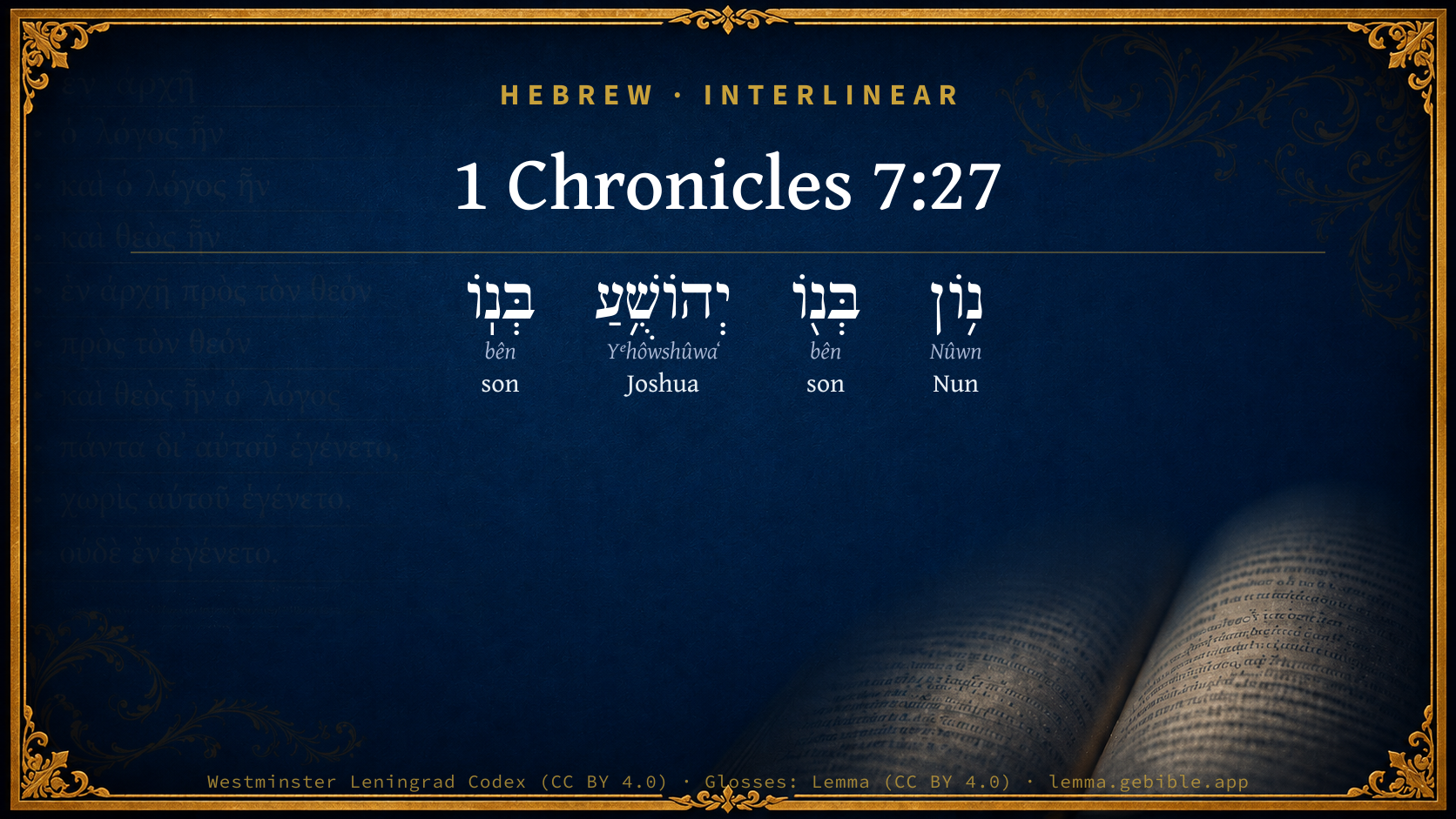
1 Chronicles 7:27

Hebrew (Westminster Leningrad Codex) 1 Chronicles 7:27 appears in the Hebrew Old Testament. The text above is from the Westminster Leningrad Codex. Each word links to its Strong’s number, a concise gloss, and parsing drawn from the Open Scriptures Hebrew Bible morphology. Click any word for its full Brown-Driver-Briggs (BDB) entry.
Download image
Cite this verse

1 Chronicles 7:27 (World English Bible). Public Domain. Lemma interlinear Bible study tool, https://lemma.gebible.app/v/1-chronicles/7/27.

Show BibTeX & RIS
BibTeX
RIS
English Translation
Nun his son, Joshua his son.
World English Bible · Public Domain
Download a study sheet

One document with this verse’s original text, its word-by-word gloss line, the meaning frame, cross-references with their text, attributed commentary, and full source and license credits — printable, and it pastes into notes with its structure intact.

This verse Autodidact and up

Study sheet (.html) Plain text (.txt)

A passage Seminary Student

Up to 50 verses in one chapter. A passage sheet keeps up to 6 commentary sources and 12 cross-references per verse, in the order this page ranks them, and says so on the sheet whenever that leaves anything out. Ask for a single verse and you get the Autodidact verse sheet above.

Everything on this page stays free to read, with no account — the sheet is a download of what is already on screen, not access to it.

Want to remove ads? Support Godless Engineer
Compare translations 3

The same verse in 3 English versions, stacked beneath the original-language interlinear above. Click any original word for its lexicon entry.

Each is an independent rendering of the whole verse — the interlinear is not word-aligned to these translations.

Highlighted words mark where these versions differ — a whole-verse word diff, not a word-by-word alignment.

  • World English Bible Public Domain
    Nun his son, Joshua his son.
  • King James Version Public Domain
    Non his son, Jehoshuah his son.
  • unfoldingWord Literal Text CC BY-SA 4.0
    Non, his son, Joshua, his son.

unfoldingWord Literal Text — © unfoldingWord, licensed CC BY-SA 4.0. Word-aligned USFM3 via Door43 (git.door43.org/unfoldingWord/en_ult).

Versions to compare (up to 4)

3 of 4 selected

Show all 18 translations

Every available English version of this verse, each an independent rendering of the whole verse.

  • World English Bible Public Domain
    Nun his son, Joshua his son.
  • Berean Standard Bible Public Domain
    Nun his son, and Joshua his son.
  • Majority Standard Bible Public Domain
    Nun his son, and Joshua his son.
  • King James Version Public Domain
    Non his son, Jehoshuah his son.
  • American Standard Version (1901) Public Domain
    Nun his son, Joshua his son.
  • Revised Version (1885) Public Domain
    Nun his son, Joshua his son.
  • Geneva Bible (1599) Public Domain
    Non his sonne, Iehoshua his sonne.
  • Douay-Rheims (1899) Public Domain
    Of whom was born Nun, who had Josue for his son.
  • Young's Literal Translation Public Domain
    Non his son, Jehoshua his son.
  • Literal Standard Version CC BY-SA 4.0
    Nun his son, Joshua his son.
  • Unlocked Literal Bible CC BY-SA 4.0
    Elishama's son was Nun. Nun's son was Joshua.
  • unfoldingWord Literal Text CC BY-SA 4.0
    Non, his son, Joshua, his son.
  • Darby Bible Public Domain
    Nun his son, Joshua his son.
  • World Messianic Bible Public Domain
    Nun his son, and Joshua his son.
  • Webster's Bible Public Domain
    Non his son, Jehoshua his son.
  • Free Bible Version CC BY-SA 4.0
    Nun his son and Joshua his son.
  • Bible in Basic English Public Domain
    Nun his son, Joshua his son.
  • JPS Tanakh (1917) Public Domain
    Nun his son, Joshua his son.

Literal Standard Version (2020), Covenant Press — licensed CC BY-SA 4.0. Text via the HelloAO Bible API (eBible.org). Unlocked Literal Bible (unfoldingWord) — licensed CC BY-SA 4.0. Text via the HelloAO Bible API (eBible.org). unfoldingWord Literal Text — © unfoldingWord, licensed CC BY-SA 4.0. Word-aligned USFM3 via Door43 (git.door43.org/unfoldingWord/en_ult). Free Bible Version, Dr. Jonathan Gallagher — licensed CC BY-SA 4.0. Text via the HelloAO Bible API (eBible.org).

Word by word

More ways to search: Search by grammar → Find every occurrence → Compare this word →

Practice this passage: Drill this verse → Learn its vocabulary →

About this verse

These counts appear in no published source. They are computed here, from the morphology-tagged text and Lemma’s own curated glosses. What Lemma adds →

4
words
3
distinct lemmas
Historical
section

Shared distinctive vocabulary

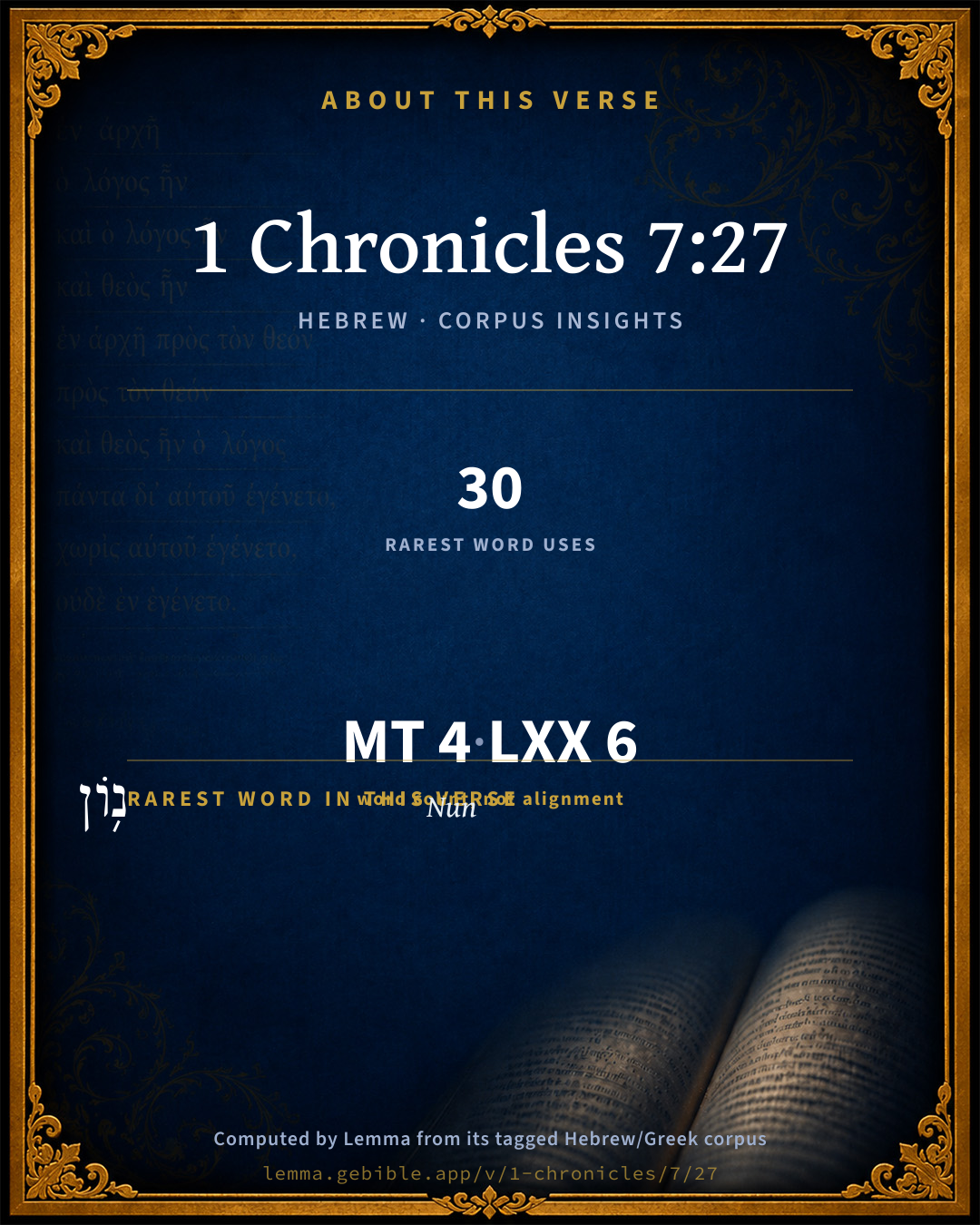
נ֥וֹן Nun H5126 occurs in 30 verses of the Hebrew Bible. Also found in:

Grammatical profile

  • 4 nouns

Repetition

A word recurs within this verse — often emphatic in Hebrew:

  • בְּנ֖וֹ son H1121 ×2

Hebrew & Septuagint length

In English translation the verse runs 6 words from the Hebrew and 8 from the Septuagint (LXX English) — closely comparable.

A rough comparison of the two English renderings, which tokenize alike — not a word-level alignment.

Word counts can differ between the Hebrew and the Greek without any difference in meaning — e.g. the Hebrew direct-object marker אֵת has no separate Greek word, and Greek often adds the article ὁ.

In the original languages it is 4 Hebrew tokens and 6 Greek tokens — but the two are counted differently (Hebrew bundles its prefixes and suffixes into one token; the Greek is in lemma form), so that isn’t a like-for-like length.

Cross-references

11

Topical passages linked to 1 Chronicles 7:27 in the Treasury of Scripture Knowledge — connected by theme and wording, ordered by reader-vote popularity; previews shown in the World English Bible.

  • Numbers 13:16 These are the names of the men who Moses sent to spy out the land. Moses called Hoshea the son of Nun Joshua.
  • Deuteronomy 31:23 He gave Joshua the son of Nun a charge, and said, Be strong and of good courage; for you shall bring the children of Israel into the land which I swore to them: and I will be with you.
  • Numbers 27:18 Yahweh said to Moses, Take Joshua the son of Nun, a man in whom is the Spirit, and lay your hand on him;
  • Exodus 17:9–14 Moses said to Joshua, "Choose men for us, and go out, fight with Amalek. Tomorrow I will stand on the top of the hill with God's rod in my hand."
  • Exodus 24:13 Moses rose up with Joshua, his servant, and Moses went up onto God's Mountain.
  • Numbers 13:8 Of the tribe of Ephraim, Hoshea the son of Nun.
  • Exodus 32:17 When Joshua heard the noise of the people as they shouted, he said to Moses, "There is the noise of war in the camp."
  • Numbers 11:28 Joshua the son of Nun, the minister of Moses, one of his chosen men, answered, My lord Moses, forbid them.
  • Numbers 14:6 Joshua the son of Nun and Caleb the son of Jephunneh, who were of those who spied out the land, tore their clothes:
  • Acts 7:45 which also our fathers, in their turn, brought in with Joshua when they entered into the possession of the nations, whom God drove out before the face of our fathers, to the days of David,
  • Hebrews 4:8 For if Joshua had given them rest, he would not have spoken afterward of another day.

Cross-references courtesy of OpenBible.info (CC BY 4.0).

Hebrew and Greek witnesses Masoretic Hebrew ↔ Greek Septuagint

The same verse in the two great witnesses to the Old Testament, shown verse-for-verse.

These are two independent witnesses, not word-aligned to each other, and the Septuagint is shown in lemma (dictionary) form.

Hebrew 1 Chronicles 7:27 Masoretic · Westminster Leningrad Codex

נ֥וֹן בְּנ֖וֹ יְהוֹשֻׁ֥עַ בְּנֽוֹ

Nun his son, Joshua his son.

World English Bible · Public Domain

Greek LXX 1 Chronicles 7:27 Septuagint · lemma form

νουμ υἱός αὐτός ιησουε υἱός αὐτός

Nun, his son Jesue, these were his sons.

LXX2012 (modern English Septuagint) · Public Domain

Hebrew: Westminster Leningrad Codex (CC BY 4.0). Greek: Septuagint (public domain); English from LXX2012 (modern English Septuagint) (Public Domain). How the Septuagint differs from the Hebrew →

Commentary

Notes on 1 Chronicles 7:27 from classic Christian and Jewish commentators (each source and its license shown beneath its notes). The classic Christian expositions comment on the surrounding passage and are grouped to its opening verse, so a note may address several verses; the Jewish commentaries on the Tanakh (Rashi and others) are per-verse, so they appear only where the commentator wrote on this verse.

Lemma curates 59 commentaries, every one of them public domain or Creative Commons licensed, each selected and text-cleaned for this edition rather than reprinted as found. About our sources →

Ellicott's Commentary for English Readers

(27) Non.—Everywhere else Nun, the father of Joshua the servant and successor of Moses. 1Ch_7:25-27 trace his ancestry, as it would seem, through seven or eight generations to Rephah, son of Beriah or Ephraim. At 1Ch_6:1-3 only two names are given between Levi, uncle of Ephraim, and Moses, Joshua’s elder contemporary. But abundant reason has already been shown for not interpreting these genealogies in a slavishly literal spirit, and without regard to their own contrary indications. It is obvious to common sense that when it is said that Moses was “son of Amram, son of Kohath, son of Levi,” the meaning cannot be that only two generations intervened between the tribal patriarch and the age of Moses. Moreover, it is, to say the least, doubtful that the names in 1Ch_7:25 represent a lineal descent of individuals, and not a group of variously connected clans. “Telah” looks like a fragment of Shuthelah (1Ch_7:20); and perhaps the true reading of 1Ch_7:25 is, “And Rephah his son, and Shuthelah his son, and Tahan his son,” we-Reshef, we-The-lah being a possible distortion of we-Shuthelah.

A Bible Commentary for English Readers, edited by Charles John Ellicott (1878–1897) — public domain. Text from a community e-Sword module.

The Cambridge Bible for Schools and Colleges

gen. ed. J. J. S. Perowne

27. Non … Jehoshua] R.V. gives the familiar form of these names, Nun … Joshua.

The Cambridge Bible for Schools and Colleges (gen. ed. J. J. S. Perowne; Cambridge University Press, 1878–1918) — public domain. Text from a community e-Sword module.

The Pulpit Commentary

Non. The same as Nun (Num_13:8, Num_13:16)

Joshua and Jesus: resemblance and contrast.

The identity of the names the one being the Greek form of the other has led the Church to look on the Hebrew Captain as a type of the Saviour of the world. (For confirmation, see Heb_4:8) There are certain resemblances, though the contrasts are as striking if not as numerous.

I RESEMBLANCES BETWEEN JOSHUA AND JESUS.

1. They both bore the same name.

2. They both brought to the people of God deliverance from the enemies ofGod.

3. They were both obedient to "him that sent them," and wrought out thework which he gave them to do.

4. They both led (or, lead) the people of God into the promised land.

5. They both began their earthly life in obscurity, and rose (or, have risen)to the highest point of human honour.

II CONTRASTS BETWEEN THE HUMAN CAPTAIN AND THE DIVINE DELIVERER.

1. Joshua was engaged in the work of his life for (at least) thirty years; theLord for (at most) three.

2. Joshua fought with carnal weapons, and won victories with sword ofsteel; Christ fought only with spiritual weapons, and his conquest is the triumph of truth and grace.

3. Joshua had good reason to fear that by his death his life-work would beundone; the Saviour had the best reason to know that by his death his lifework would be sealed and crowned.

4. Joshua led a nation into a land which would prove a temporaryinheritance; the redeeming Lord leads the human race "into everlasting habitations," into the one city which is eternal. Better the humblest post amongst the followers of Jesus than the proudest place in the ranks of Joshua. C.

The Pulpit Commentary (1880–1919), ed. H.D.M. Spence-Jones & Joseph S. Exell — public domain. Text from a community e-Sword module.

Lesson kit

Teaching starters — assembled from the data on this page, not authored interpretation. Every prompt links to the verse data it draws on. Edit before teaching.

1 Chronicles, in the Historical, opens this verse with 4 words (3 distinct Hebrew lemmas). Its most distinctive word is Nûwn (“Nun”). A historical commentator’s framing appears above. Read the whole chapter for the surrounding context.

Discussion questions

  1. How does “Nun” (Nûwn) shape what this verse is saying?
  2. How does Exodus 33:11, which shares the word «Nun», read alongside this verse?
  3. What does the repetition of “son” (2× in this one verse) do in this verse?
  4. These translations render this verse differently. What is at stake in choosing one wording over another?
  5. Compare how Ellicott's Commentary for English Readers and The Cambridge Bible for Schools and Colleges read this verse. Where do they agree or differ?

Things to notice

Reading settings

Reading text

Shown beneath each verse's original-language words.

Old Testament
Old Testament edition

Read the OT as the Masoretic Hebrew (MT) or the Greek Septuagint (LXX).

English shown for the Greek Septuagint (in the Hebrew ↔ Greek comparison).

Comparing translations? Open the Compare panel on any verse page to stack up to four side by side.