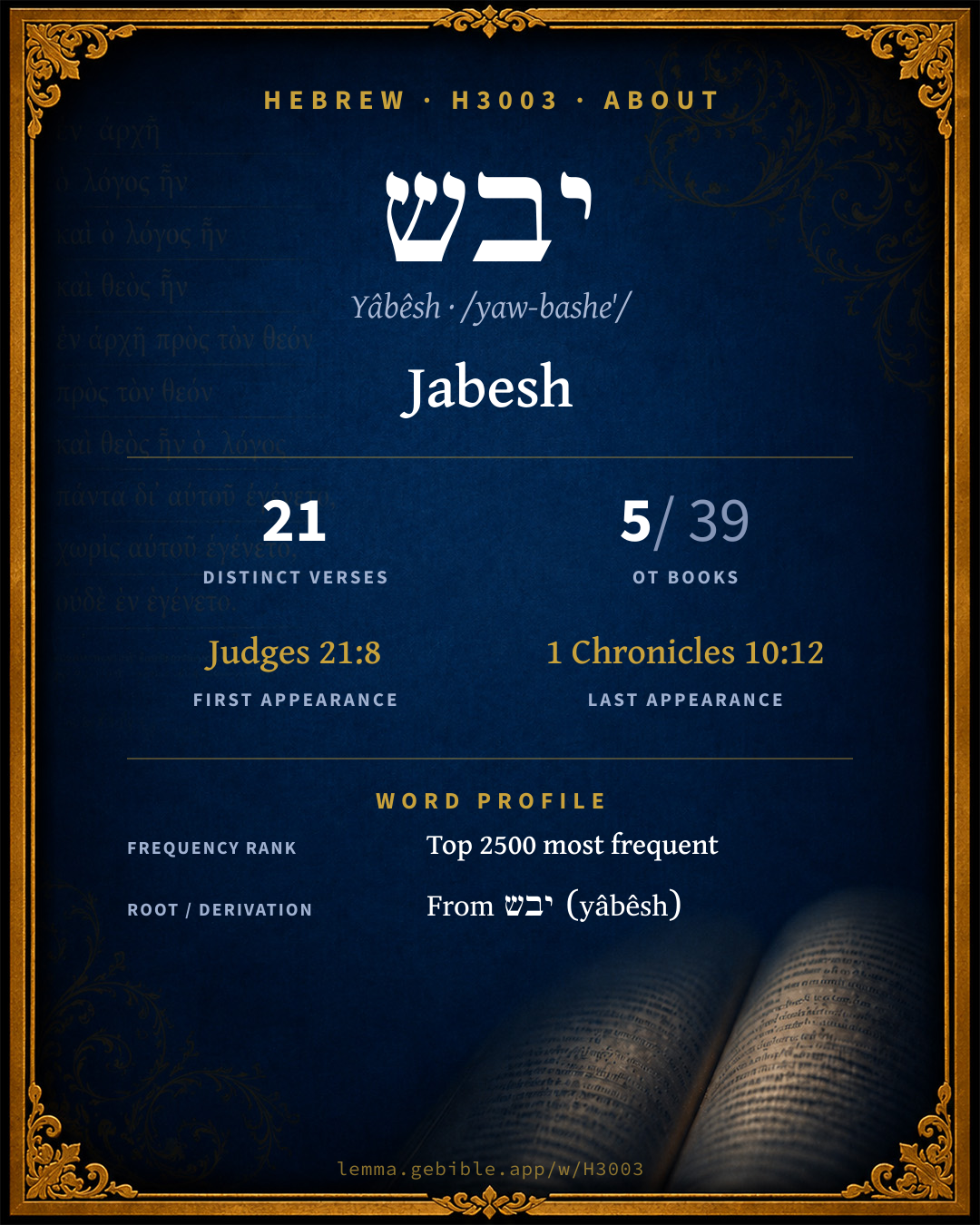
יָבֵשׁ
Jabesh
BDB lists 3 entries for ‘Jabesh’ fuller range ↓
Full lexicon entry — Brown-Driver-Briggs (BDB)
From Brown-Driver-Briggs (BDB)
Where this word appears
Grammar key — what these labels mean
Part of speech
- Noun
- A naming word — a person, place, thing, or idea.
Noun type
- Proper
- A name of a specific person, place, or people (e.g. Abraham, Zion, Israel).
Every verse where H3003 appears — 21 distinct verses across 5 books. Click any verse to open its interlinear word-by-word view. Verse text shown in the World English Bible for context — . Each verse’s Hebrew form is shown with its reference; the English is not keyword-highlighted, since the data carries no word-level English alignment. Use “Compare translations” on any verse to read it across multiple English versions. This concordance covers the Hebrew Bible; Septuagint (Greek Old Testament) occurrences are not indexed here.
Judges 5 verses
- Judges 21:8 מִ/יָּבֵ֥ישׁ prep + n Proper They said, What one is there of the tribes of Israel who didn't come up to Yahweh to Mizpah? Behold, there came none to the camp from Jabesh Gilead to the assembly.
- Judges 21:9 יָבֵ֥שׁ n Proper For when the people were numbered, behold, there were none of the inhabitants of Jabesh Gilead there.
- Judges 21:10 יָבֵ֤שׁ n Proper The congregation sent there twelve thousand men of the most valiant, and commanded them, saying, Go and strike the inhabitants of Jabesh Gilead with the edge of the sword, with the women and the little ones.
- Judges 21:12 יָבֵ֣ישׁ n Proper They found among the inhabitants of Jabesh Gilead four hundred young virgins, who had not known man by lying with him; and they brought them to the camp to Shiloh, which is in the land of Canaan.
- Judges 21:14 יָבֵ֣שׁ n Proper Benjamin returned at that time; and they gave them the women whom they had saved alive of the women of Jabesh Gilead: and yet so they weren't enough for them.
1 Samuel 8 verses
- 1 Samuel 11:1 יָבֵ֣שׁ יָבֵישׁ֙ n Proper n Proper Then Nahash the Ammonite came up, and encamped against Jabesh Gilead: and all the men of Jabesh said to Nahash, Make a covenant with us, and we will serve you.
- 1 Samuel 11:3 יָבֵ֗ישׁ n Proper The elders of Jabesh said to him, Give us seven days' respite, that we may send messengers to all the borders of Israel; and then, if there be none to save us, we will come out to you.
- 1 Samuel 11:5 יָבֵֽישׁ n Proper Behold, Saul came following the oxen out of the field; and Saul said, What ails the people that they weep? They told him the words of the men of Jabesh.
- 1 Samuel 11:9 יָבֵ֣ישׁ יָבֵ֖ישׁ n Proper n Proper They said to the messengers who came, Thus shall you tell the men of Jabesh Gilead, Tomorrow, by the time the sun is hot, you shall have deliverance. The messengers came and told the men of Jabesh; and they were glad.
- 1 Samuel 11:10 יָבֵ֔ישׁ n Proper Therefore the men of Jabesh said, Tomorrow we will come out to you, and you shall do with us all that seems good to you.
- 1 Samuel 31:11 יָבֵ֣ישׁ n Proper When the inhabitants of Jabesh Gilead heard concerning him that which the Philistines had done to Saul,
- 1 Samuel 31:12 יָבֵ֔שָׁ/ה n Proper + sfx dem all the valiant men arose, and went all night, and took the body of Saul and the bodies of his sons from the wall of Beth-shan; and they came to Jabesh, and burnt them there.
- 1 Samuel 31:13 בְּ/יָבֵ֑שָׁ/ה prep + n Proper + sfx dem They took their bones, and buried them under the tamarisk tree in Jabesh, and fasted seven days.
2 Samuel 3 verses
- 2 Samuel 2:4 יָבֵ֣ישׁ n Proper The men of Judah came, and there they anointed David king over the house of Judah. They told David, saying, The men of Jabesh Gilead were those who buried Saul.
- 2 Samuel 2:5 יָבֵ֣ישׁ n Proper David sent messengers to the men of Jabesh Gilead, and said to them, Blessed be you of Yahweh, that you have shown this kindness to your lord, even to Saul, and have buried him.
- 2 Samuel 21:12 יָבֵ֣ישׁ n Proper David went and took the bones of Saul and the bones of Jonathan his son from the men of Jabesh Gilead, who had stolen them from the street of Beth-shan, where the Philistines had hanged them, in the day that the Philistines killed Saul in Gilboa;
2 Kings 3 verses
- 2 Kings 15:10 יָבֵ֔שׁ n Proper Shallum the son of Jabesh conspired against him, and struck him before the people, and killed him, and reigned in his place.
- 2 Kings 15:13 יָבֵישׁ֙ n Proper Shallum the son of Jabesh began to reign in the nine and thirtieth year of Uzziah king of Judah; and he reigned the space of a month in Samaria.
- 2 Kings 15:14 יָבֵ֖ישׁ n Proper Menahem the son of Gadi went up from Tirzah, and came to Samaria, and struck Shallum the son of Jabesh in Samaria, and killed him, and reigned in his place.
1 Chronicles 2 verses
- 1 Chronicles 10:11 יָבֵ֣ישׁ n Proper When all Jabesh Gilead heard all that the Philistines had done to Saul,
- 1 Chronicles 10:12 יָבֵ֑ישָׁ/ה בְּ/יָבֵ֔שׁ n Proper + sfx dem prep + n Proper all the valiant men arose, and took away the body of Saul, and the bodies of his sons, and brought them to Jabesh, and buried their bones under the oak in Jabesh, and fasted seven days.
About this entry
At a glance — auto-summarized from this page’s data, not written by a person. Every figure links to its source below. This summary describes the numbers; it doesn’t interpret them.
At its core, יבש (Yâbêsh) means “Jabesh.” It first appears in Judges 21:8. Spanning 21 verses in 5 books, it ranks among the uncommon words of the Hebrew Bible. Its uses concentrate in 1 Samuel (38% of all occurrences). Dig into 21-verse concordance and the renderings breakdown below.
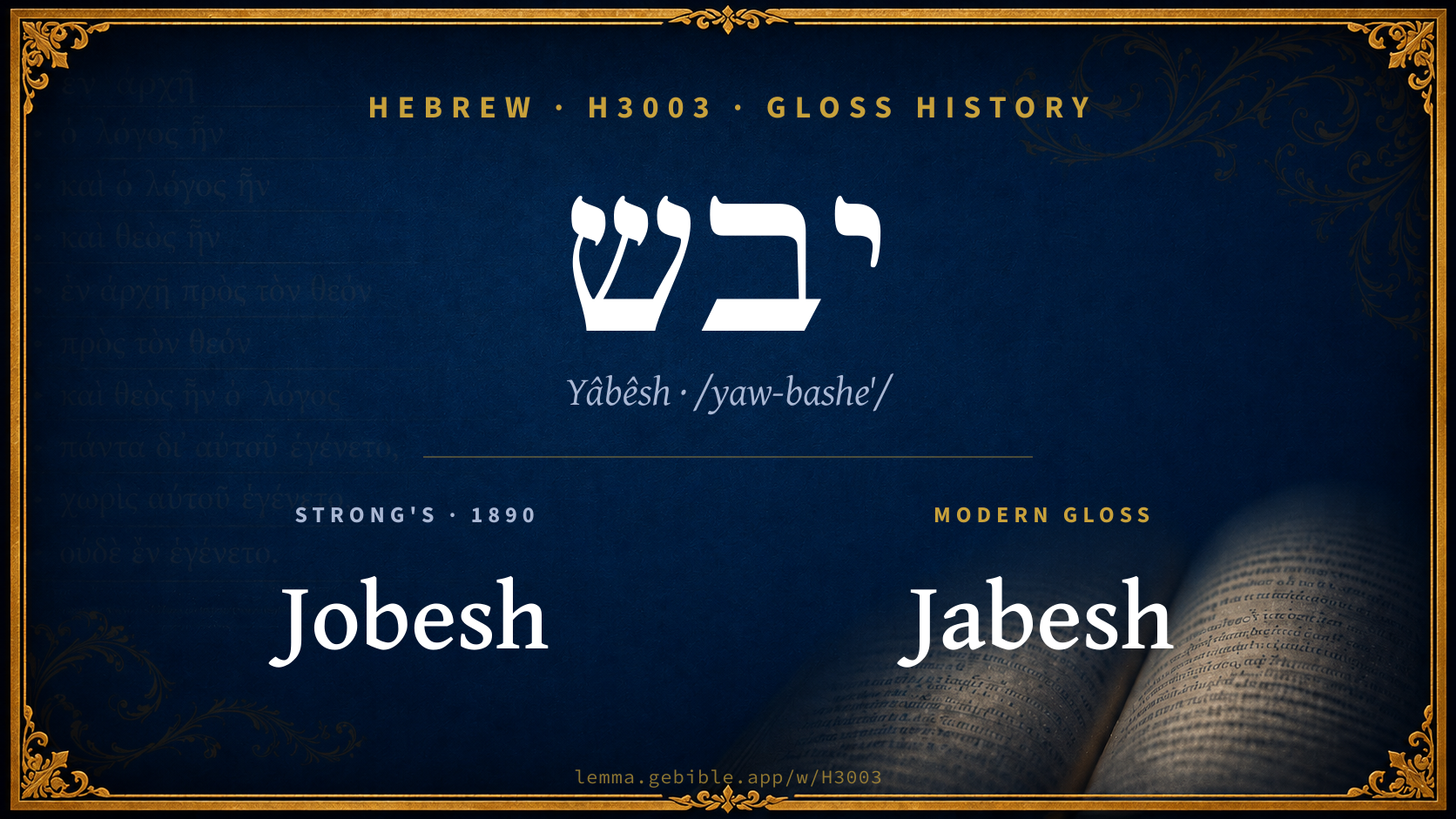
Gloss history
Strong's 1890 vs modern scholarship
About this word
Strong's H3003 catalogs a Hebrew word from the Hebrew Old Testament.
These counts are not copied from any lexicon or concordance. They are computed here, from the morphology-tagged Hebrew Old Testament. What Lemma adds →
- 21
- distinct verses
- The word appears in 21 distinct verses.
- 5 / 39
- OT books
- The word appears in 5 of 39 Old Testament books.
- #1,327
- by frequency
- Top 2500 most frequent Hebrew words (rank 1,327 of 8,640 Hebrew words by occurrence).
View all 21 occurrences in the concordance →
By section of the Old Testament
By traditional corpus
Conventional, traditional groupings — biblical authorship is debated, so this is a traditional corpus grouping, not an authorship claim. Each share is this word’s portion of its verses in that division of the Hebrew canon. Each figure is a share of the word’s 21 distinct verses.
- Prophets (Nevi'im) 19 verses · 90%
- Writings (Ketuvim) 2 verses · 10%
How translations render this word
Counts come from each version’s own published word-to-Strong’s tagging or interlinear alignment — an approximate guide to how each version renders this word, not a word-level alignment the data otherwise carries. Because each total is that version’s own tagged count, the per-version totals vary from one another and need not match the appearance or distinct-verse counts above. These counts may also differ from a printed concordance because Lemma counts each distinctly tagged rendering and does not collapse phrase taggings into a single head-word total. This is a fixed set of word-tagged versions (KJV, ASV, BSB, ULT) and does not change with the reading translation you choose elsewhere. Each version’s license is shown beside its name below (and on Sources).
BDB lists this Strong’s number as 3 distinct words (homographs). Each count above pools all of them and is not split by sense — see the Senses section below. A low-frequency rendering may belong to a different one of those words, not the primary meaning.
- King James Version†: Jabesh 12×, Jabeshgilead 10×
- American Standard Version†: Jabesh 12×, Jabesh-gilead 10×
- Berean Standard Bible†: Jabesh 12×, Jabesh-gilead 12×
- unfoldingWord Literal Text†: Jabesh 18×, Jabesh gilead 6×
King James Version Public Domain
Renders H3003 across 24† tagged occurrences — most commonly:
Plus 2 renderings that appear only once — usually multi-word phrases or single function words the recovered tagging swept in, not distinct renderings.
American Standard Version Public Domain
Renders H3003 across 24† tagged occurrences — most commonly:
Plus 2 renderings that appear only once — usually multi-word phrases or single function words the recovered tagging swept in, not distinct renderings.
Berean Standard Bible Public Domain
Renders H3003 across 24† tagged occurrences — most commonly:
unfoldingWord Literal Text CC BY-SA 4.0
Renders H3003 across 24† tagged occurrences — most commonly:
17 senses and sub-senses in the full BDB
Hebrew verbs can shift meaning by stem (binyan): Qal is the basic action, Niphal is often passive or reflexive, Piel often intensifies or makes it factitive, and Hiphil is typically causative. The senses below are grouped under the stem BDB assigns to each.
What do BDB’s symbols mean?
BDB uses these scholarly abbreviations:
| Symbol | Meaning |
|---|---|
| 𝔊 | the Septuagint (the ancient Greek translation, LXX) |
| 𝔙 | the Vulgate (the Latin translation) |
| 𝔖 | the Syriac version (the Peshitta) |
| 𝔗 | the Targum (the Aramaic translation) |
| ψ | the Psalms |
| √ | root (the underlying root or stem) |
| ‖ | parallel passage (a synonymous or contrasted parallel) |
| † | the dagger: every passage where the word occurs is cited |
The 17 senses and sub-senses the full Brown-Driver-Briggs lexicon distinguishes for this word, in lexicon order (not ranked by frequency), with BDB’s own verbatim wording and sub-sense lettering. Shown in Hebrew script with BDB’s own scholarly abbreviations. The condensed entry is in the Lexicon Entry tab. See also the Forms in the corpus table below.
יבש I be dry, dried up, withered (NH id. (rare), 𝔗 יְבֵישׁ, chiefly Pa. Ithp., Syriac ܢܺܒܶܫ
Qal
- Pf. 2 ms. יָבֵשׁ Jos 9:5 + 8 times; וְיָבֵשׁ consec. Is 19:5 + 4 times; 3 fs. יָֽבְשָׁה Gn 8:14; 3 pl. יָֽבְשׁוּ Je 23:10 + 2 times; יָבֵ֑שׁוּ 50:38 + 2 times; Impf. 3 ms. יִבַשׁ Is 19:7; יִיבָ֑שׁ Je 12:4 Jb 8:12; וַיִּיבַשׁ 1 K 17:7; וַיִּיבָ֑שׁ Jon 4:7; 3 fs. תִּיבַשׁ Ez 17:10; תִּיבָ֑שׁ v 10 + 3 times, etc.; Inf. cstr. (בִּ)יבשׁ Is 27:11; יְבשֶׁת Gn 8:7; abs. יָבוֹשׁ Zc 11:17; יָבשׁ Ez 17:10;— e.g. Joshua 9:5
- 1. be dry, dried up without moisture:
- a. of bread Jos 9:5, 12 (JE). e.g. Joshua 9:5
- b. of ground lacking rain Am 4:7, cf. Am 1:2 (of Carmel at utterance of י׳’s voice), Je 23:10. e.g. Amos 4:7
- c. of earth after the flood Gn 8:14 (P), cf. חָרֵב. e.g. Genesis 8:14
- d. of grass, herbage, trees and crops (already implied in b) = wither Is 15:6; 19:7; 27:11 Je 12:4 Jb 8:12 Jo 1:12 Jon 4:7; in sim. of shortness of life ψ 90:6; 102:12; 129:6, v. also Is 40:7, 8 (in these two ‖ נָבֵל); of heart under fig. of grass ψ 102:5; of Judah under fig. of vine Ez 17:9(×2), 10(×3), cf. 19:12; of princes under fig. of tree Is 40:24; of roots of Ephr. under fig. of tree Ho 9:16, so of roots of wicked Jb 18:16. e.g. Isaiah 15:6
- e. of hand, arm, dry up, wither, as judgment from י׳, 1 K 13:4 Zc 11:17(×2); in distress יָבֵשׁ כַּחֶרֶשׁ כֹּחִי ψ 22:16 my strength is dried up like the potsherd; of skin La 4:8, and (fig.) of bones Ez 37:11. e.g. 1 Kings 13:4
- 2. be dried up: of water Gn 8:7 (J), Is 19:5 1 K 17:7 Je 50:38 Jo 1:20 Jb 12:15; 14:11. e.g. Genesis 8:7
Piel
- make dry, dry up, only Impf. 3 ms. sf. וַיַּבְּשֵׁהוּ Na 1:4 and hath made it dry (י׳, the sea); 3 fs. תְּיַבֵּשׁ Jb 15:30 the flame shall dry up his branches (fig. of wicked); fig. תְּיַבֶּשׁ־נָּ֑רֶם Pr 17:22 a broken spirit maketh dry (the) bones. e.g. Nahum 1:4
Hiphil
- Pf. 3 ms. הוֹבִישׁ Jos 2:10 + 3 times + Jo 1:10 (v. infr.); חֹבִישׁ Ez 19:12 + 2 times Jo (v. infr.); 3 fs. הוֹבִישָׁה Jo 1:12 (v. infr.); 2 ms. הוֹבַשְׁתָּ ψ 74:15; 1 s. הוֹבַשְׁתִּי Ez 17:24; וְהוֹבַשְׁתִּ֫י Je 51:36; 3 pl. וְהֹבִישׁוּ consec. Zc 10:11; Impf. 1 s. אוֹבִישׁ Is 42:15(×2); 44:27;—dry up, make dry: e.g. Joshua 2:10
- 1. dry up water, י׳ subj., Jos 2:10; 4:23(×2); 5:1 (all D), Je 51:36 (‖ הֶחֱרִיב), Is 42:15; 44:27 (חֳרָבִי in ‖ cl.), ψ 74:15. e.g. Joshua 2:10
- 2. make dry, wither: herbage, trees, crops, etc., of י׳, Is 42:15 (‖ החריב); obj. Babylon under fig. of tree Ez 17:24; of east wind’s drying up Judah’s fruit Ez 19:12. e.g. Isaiah 42:15
- 3. exhibit dryness: of river-deeps laid bare Zc 10:11.—In like manner might be taken Jo 1:10, 12(×2), 17, if from יבשׁ; but the sense would be difficult, especially in v 10, 12, and הֹבִישׁוּ v 11 must be from בּוֹשׁ, to which all these cases in Jo may be consistently assigned; v. בּוֹשׁ. e.g. Zechariah 10:11
יבש II verb. or pt. dry, dried, so, ms. abs. Na 1
- 1. dried, lit. only עֲנָבִים יְבֵשִׁים Nu 6:3 dried grapes (P; opp. ע׳ לַחִים); fig. נַפְשֵׁנוּ יְבֵשָׁה 11:6 (JE) our soul (i.e. our appetite) is dried up, viz. for want of fresh, juicy meat. e.g. Numbers 6:3
- 2. dry, of chaff, קַשׁ Na 1:10 in sim. of Ninevites under impending judgment; cf. in fig. of Job, Jb 13:25; of tree Ez 17:24 (fig. of Davidic house; opp. עֵץ לָ֑ה), 21:3 (in prediction of Judah’s devastation by Babylon, opp. id.); Is 56:3 fig. of eunuch; of the bones in Ezek.’s vision Ez 37:2, 4. e.g. Nahum 1:10
יבש III loc. et pers.
- 1. n.pr.loc. יָבֵשׁ גִּלְעָד Jabesh of Gilead, 𝔊 Ιαβ(ε)ις Γαλααδ, exact site uknown, Ju 21:8, 9, 10, 12, 14 2 S 21:12; 1 Ch 10:11 (𝔊L Ιαβις τῆς Γαλααδ); יָבֵישׁ גִּלְעָד 1 S 11:1, 9; 31:11 2 S 2:4, 5 (in these three 𝔊L Ιαβις τῆς Γαλαατίδιτος); יָבֵישׁ 1 S 11:1, 3, 5, 9, 10; יָבֵשׁ 1 Ch 10:12; יָבֵ֑ישָׁה v 12; ‖ יָבֵ֫שָׁה 1 S 31:12, 13. e.g. Judges 21:8
- 2. n.pr.m. יָבֵשׁ father of Shallum 2 K 15:10, 13, 14. e.g. 2 Kings 15:10
Senses from the full Brown-Driver-Briggs lexicon (Brown, Driver, Briggs; Oxford 1906 — public domain), digitized via Sefaria, supplemented by the OpenScriptures HebrewLexicon (CC BY 4.0). Full attribution on Sources.
Word origin
I. vb. be dry, dried up, withered (NH id. (rare), 𝔗 יְבֵישׁ, chiefly Pa. Ithp., Syriac ܢܺܒܶܫ; Sab. Palm. deriv.; Arabic يَبِسَ; Ethiopic የብሰ )—
II. adj.verb. or pt. dry, dried, so, ms. abs. Na 1:10 + 4 times; fs. יְבֵשָׁה Nu 11:6; mpl. (וִ)יבֵשִׁים Nu 6:3; fpl. יְבֵשׁוֹת Ez 37:2, 4;—
— Brown-Driver-Briggs (Oxford 1906, public domain), digitized via Sefaria, supplemented by the OpenScriptures HebrewLexicon (CC BY 4.0). See Sources.
Derived from יבש (yâbêsh) (H3002) — dry.
Jastrow Dictionary
A second Hebrew/Aramaic lexicon for comparison, covering Aramaic and post-biblical (Talmudic, Targumic, Midrashic) usage that the biblical-Hebrew BDB does not. Matched by lemma rather than by Strong’s number, so a lemma may carry more than one Jastrow headword (shown separately below), and the entries cover usage well beyond the Bible.
יָבֵשׁ I
- parched, dry, withered, opp. לח moist, green. Dem. II, 3 לח וי׳ fresh or dried fruits. Ib. 5 בי׳ שלשת קבין wholesale dealing in dried fruits means three Kab. Y. ib. II, end, 23ᵃ נתנו שיעור לי׳ for dried fruit they make quantity the standard; a. fr.—Pl. יְבֵשִׁים, יְבֵשִׁין; יְבֵי׳. Sabb. IV, 1. Pes. II, 6; a. fr.—Fem. יְבֵשָׁה, יְבֵי׳. Ukts. I, 2; a. fr.—Tosef. Ter. VII, 16 נעשית י׳ the date became dry (so as to be called יְבֵּישָׁה).—Pl. יְבֵשׁוֹת, יְבֵי׳. T’bul Yom III, 6 תמרים י׳, opp. רטובות; a. fr.
יָבֵשׁ
- Targ. Josh. IX, 5; 12. Targ. Job. XIII, 25 (ed. Wil. יְבֵשׁ); a. e.—Pl. יְבֵשִׁין, יְבֵשַׁיָּא, יְבֵי׳. Targ. Ez. XXXVII, 2; 4.—Fem. יְבֶשְׁתָּא, יְבֶישְׁ׳. Gitt. 69ᵇ. Bets. 33ᵃ; a. e.—[V. יַבַּשְׁתָּא.]
יָבֵשׁ II
- preced.) to be dry, to wither. Bets. 26ᵇ מוקצה שי׳ stored fruits (v. מוקצה) which were dry (on Friday), though the owner did not find it out until the Sabbath day; Y. ib. I, beg. 60ᵃ
- to dry up. Gen. R. s. 33 עתיד … וליַיבֵּשׁ וכ׳ in the future a righteous man (Elijah) will come and lay the world dry (through want of rain).
יְבֵשׁ
- Targ. O. Gen. VIII, 14 יְבֵישַׁת ed. Berl. (oth. ed. יַבִּישַׁת).—Y. Taan. III, 66ᵈ יַבְשַׁת ידיה his hand withered. Gitt. 69ᵇ כי היכי דיביש הדא ידא וכ׳ (read דיְבִישַׁת) as this hand (of the dead man) is withered, so may the milt of … dry (shrink to its normal size); a. e.
- to dry. Targ. Josh. II, 10.—Targ. Prov. XVII, 22; a. e.—Gitt. l. c. ונְיַיבְּשִׁינְהוּ בטולא and let him dry them (the leeches) in the shade; a. e.
- to be dried up, withered. Targ. Ps. CII, 5 Ms. (missing in ed.). Targ. Y. Gen. VIII, 14; a. e.—Targ. Job XXXVIII, 11 Ms. (ed. תשוי).—Gitt. l. c. נִיַּיבֵּשׁ ההיא טוחלא, v. supra.
A Dictionary of the Targumim, the Talmud Babli and Yerushalmi, and the Midrashic Literature (Marcus Jastrow; London, Luzac, 1903) — Public Domain. Digitized via Sefaria. Digitized via Sefaria. Full attribution on Sources.
Forms in the corpus
The 15 distinct written forms H3003 takes in the Hebrew Bible, most frequent first — each parse links to that state’s occurrences in the concordance. Hebrew forms include their vowel points and cantillation, so a single lemma takes many written forms.
| Form | Parsing | Example | Uses |
|---|---|---|---|
| יָבֵ֣ישׁ | Noun, Proper | 1 Chronicles 10:11 | 7 |
| יָבֵ֖ישׁ | Noun, Proper | 1 Samuel 11:9 | 2 |
| יָבֵ֣שׁ | Noun, Proper | 1 Samuel 11:1 | 2 |
| יָבֵישׁ֙ | Noun, Proper | 1 Samuel 11:1 | 2 |
| בְּ/יָבֵ֑שָׁ/ה | Noun, Proper | 1 Samuel 31:13 | 1 |
| בְּ/יָבֵ֔שׁ | Noun, Proper | 1 Chronicles 10:12 | 1 |
| יָבֵ֑ישָׁ/ה | Noun, Proper | 1 Chronicles 10:12 | 1 |
| יָבֵ֔ישׁ | Noun, Proper | 1 Samuel 11:10 | 1 |
| יָבֵ֔שׁ | Noun, Proper | 2 Kings 15:10 | 1 |
| יָבֵ֔שָׁ/ה | Noun, Proper | 1 Samuel 31:12 | 1 |
| יָבֵ֗ישׁ | Noun, Proper | 1 Samuel 11:3 | 1 |
| יָבֵ֤שׁ | Noun, Proper | Judges 21:10 | 1 |
| יָבֵ֥שׁ | Noun, Proper | Judges 21:9 | 1 |
| יָבֵֽישׁ | Noun, Proper | 1 Samuel 11:5 | 1 |
| מִ/יָּבֵ֥ישׁ | Noun, Proper | Judges 21:8 | 1 |
Bible dictionary
Public-domain dictionary articles matched to this entry by name (Jabesh). A biblical name can be shared by more than one person or place, so an article may treat several.
Easton's Bible Dictionary · M. G. Easton, 1897
Dry. (1.) For Jabesh-Gilead (1 Sam. 11:3, 9, 10).
(2.) The father of Shallum (2 Kings 15:10, 13, 14), who usurped the throne of Israel on the death of Zachariah.
Smith's Bible Dictionary · William Smith, 1863
(dry).
+ Father of Shallum, the fifteenth king of Israel. (2 Kings 15:10,13,14) + Jabesh-gilead, or Jabesh in the territory of Gilead. In its widest sense Gilead included the half tribe of Manasseh, (1 Chronicles 27:21) as well as the tribes of Gad and Reuben, (Numbers 32:1-42) east of the Jordan; and of the cities of Gilead, Jabesh was the chief. It is first mentioned in (Judges 21:8-14) Being attacked subsequently by Nahash the Ammonite, it gave Saul an opportunity of displaying his prowess in its defence. (1 Samuel 11:1-15) Eusebius places it beyond the Jordan, six miles from Pella on the mountain road to Gerasa; where its name is probably preserved in the Wady Yabes.
Hitchcock's Bible Names Dictionary · Roswell D. Hitchcock, 1869
dryness; confusion; shame
Classic public-domain reference works; full attribution on Sources.
Septuagint verse parallels
This word appears in 21 verses that also exist in the Greek Old Testament (Septuagint), out of the 21 Hebrew verses it occurs in. You can read those verses in Greek by switching the Old Testament edition to the Septuagint.
Read these verses in the Septuagint
This is a verse-level parallel only — the same verses exist in both the Hebrew and Greek Old Testaments. No word-level Hebrew↔Greek correspondence is claimed: the data carries no such alignment, so no Greek word is shown as this Hebrew word’s translation. Coverage is not total — the Septuagint omits the deuterocanon and renumbers the Psalms, so some Hebrew verses have no direct Greek parallel.