1 Samuel 31:11

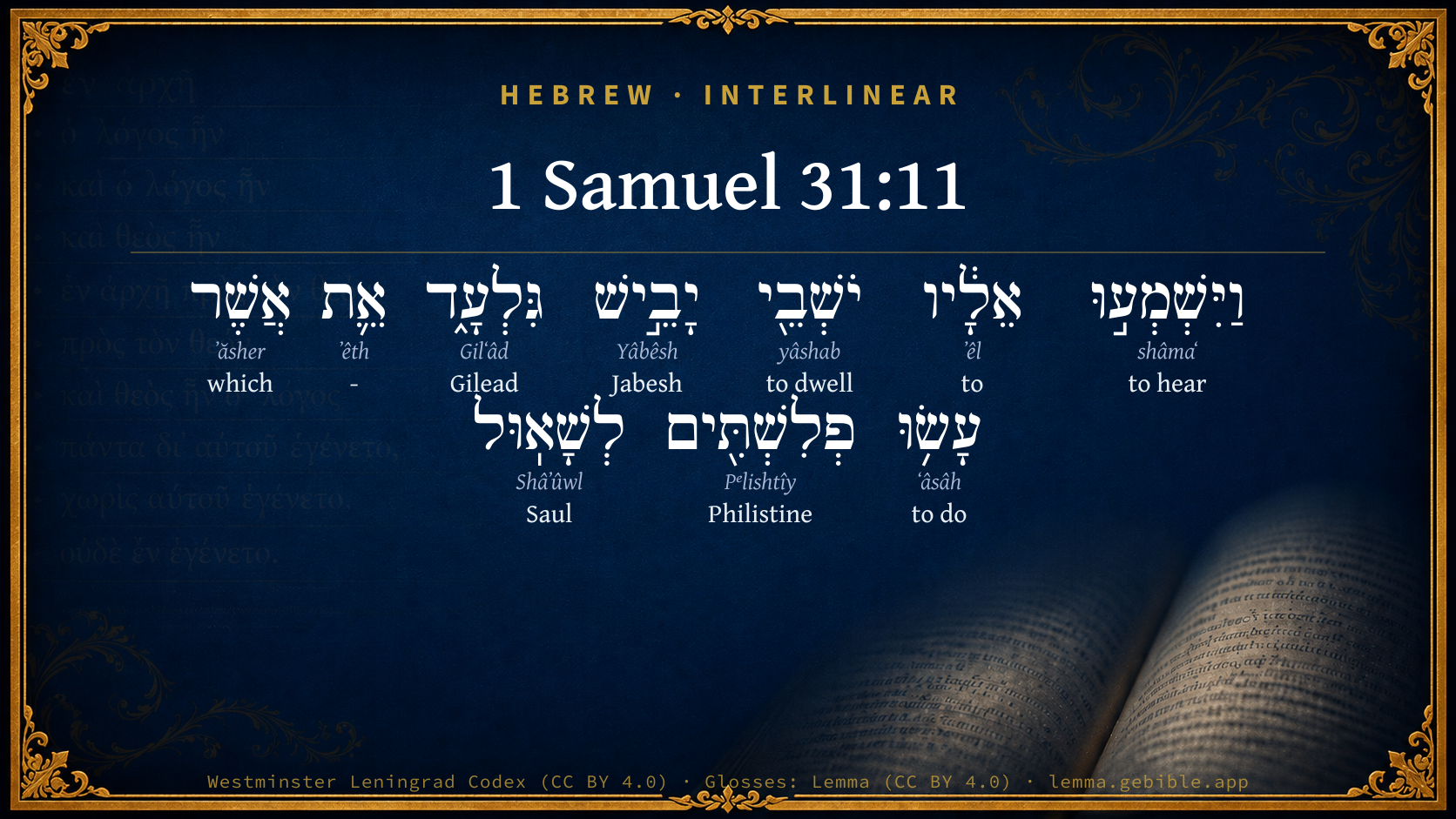
Hebrew (Westminster Leningrad Codex) 1 Samuel 31:11 appears in the Hebrew Old Testament. The text above is from the Westminster Leningrad Codex. Each word links to its Strong’s number, a concise gloss, and parsing drawn from the Open Scriptures Hebrew Bible morphology. Click any word for its full Brown-Driver-Briggs (BDB) entry.
Download image
Cite this verse

1 Samuel 31:11 (World English Bible). Public Domain. Lemma interlinear Bible study tool, https://lemma.gebible.app/v/1-samuel/31/11.

Show BibTeX & RIS
BibTeX
RIS
English Translation
When the inhabitants of Jabesh Gilead heard concerning him that which the Philistines had done to Saul,
World English Bible · Public Domain
Download a study sheet

One document with this verse’s original text, its word-by-word gloss line, the meaning frame, cross-references with their text, attributed commentary, and full source and license credits — printable, and it pastes into notes with its structure intact.

This verse Autodidact and up

Study sheet (.html) Plain text (.txt)

A passage Seminary Student

Up to 50 verses in one chapter. A passage sheet keeps up to 6 commentary sources and 12 cross-references per verse, in the order this page ranks them, and says so on the sheet whenever that leaves anything out. Ask for a single verse and you get the Autodidact verse sheet above.

Everything on this page stays free to read, with no account — the sheet is a download of what is already on screen, not access to it.

Want to remove ads? Support Godless Engineer
Compare translations 3

The same verse in 3 English versions, stacked beneath the original-language interlinear above. Click any original word for its lexicon entry.

Each is an independent rendering of the whole verse — the interlinear is not word-aligned to these translations.

Highlighted words mark where these versions differ — a whole-verse word diff, not a word-by-word alignment.

  • World English Bible Public Domain
    When the inhabitants of Jabesh Gilead heard concerning him that which the Philistines had done to Saul,
  • King James Version Public Domain
    And when the inhabitants of Jabeshgilead heard of that which the Philistines had done to Saul;
  • unfoldingWord Literal Text CC BY-SA 4.0
    And the dwellers of Jabesh Gilead heard about it, what the Philistines had done to Saul.

unfoldingWord Literal Text — © unfoldingWord, licensed CC BY-SA 4.0. Word-aligned USFM3 via Door43 (git.door43.org/unfoldingWord/en_ult).

Versions to compare (up to 4)

3 of 4 selected

Show all 18 translations

Every available English version of this verse, each an independent rendering of the whole verse.

  • World English Bible Public Domain
    When the inhabitants of Jabesh Gilead heard concerning him that which the Philistines had done to Saul,
  • Berean Standard Bible Public Domain
    When the people of Jabesh-gilead heard what the Philistines had done to Saul,
  • Majority Standard Bible Public Domain
    When the people of Jabesh-gilead heard what the Philistines had done to Saul,
  • King James Version Public Domain
    And when the inhabitants of Jabeshgilead heard of that which the Philistines had done to Saul;
  • American Standard Version (1901) Public Domain
    And when the inhabitants of Jabesh-gilead heard concerning him that which the Philistines had done to Saul,
  • Revised Version (1885) Public Domain
    And when the inhabitants of Jabesh-gilead heard concerning him that which the Philistines had done to Saul,
  • Geneva Bible (1599) Public Domain
    When the inhabitants of Iabesh Gilead heard, what the Philistims had done to Saul,
  • Douay-Rheims (1899) Public Domain
    Now when the inhabitants of Jabes Galaad had heard all that the Philistines had done to Saul,
  • Young's Literal Translation Public Domain
    And they hear regarding it -- the inhabitants of Jabesh-Gilead -- that which the Philistines have done to Saul,
  • Literal Standard Version CC BY-SA 4.0
    And they hear regarding it—the inhabitants of Jabesh-Gilead—that which the Philistines have done to Saul,
  • Unlocked Literal Bible CC BY-SA 4.0
    When the inhabitants of Jabesh Gilead heard of what the Philistines had done to Saul,
  • unfoldingWord Literal Text CC BY-SA 4.0
    And the dwellers of Jabesh Gilead heard about it, what the Philistines had done to Saul.
  • Darby Bible Public Domain
    And when the inhabitants of Jabesh-Gilead heard of what the Philistines had done to Saul,
  • World Messianic Bible Public Domain
    When the inhabitants of Jabesh Gilead heard what the Philistines had done to Saul,
  • Webster's Bible Public Domain
    And when the inhabitants of Jabesh-gilead heard of that which the Philistines had done to Saul,
  • Free Bible Version CC BY-SA 4.0
    However, when the people of Jabesh-gilead heard what the Philistines had done to Saul,
  • Bible in Basic English Public Domain
    And when the people of Jabesh-gilead had news of what the Philistines had done to Saul,
  • JPS Tanakh (1917) Public Domain
    And when the inhabitants of Jabesh-gilead heard concerning him that which the Philistines had done to Saul,

Literal Standard Version (2020), Covenant Press — licensed CC BY-SA 4.0. Text via the HelloAO Bible API (eBible.org). Unlocked Literal Bible (unfoldingWord) — licensed CC BY-SA 4.0. Text via the HelloAO Bible API (eBible.org). unfoldingWord Literal Text — © unfoldingWord, licensed CC BY-SA 4.0. Word-aligned USFM3 via Door43 (git.door43.org/unfoldingWord/en_ult). Free Bible Version, Dr. Jonathan Gallagher — licensed CC BY-SA 4.0. Text via the HelloAO Bible API (eBible.org).

Word by word

More ways to search: Search by grammar → Find every occurrence → Compare this word →

Practice this passage: Drill this verse → Learn its vocabulary →

יָבֵ֣ישׁ
Yâbêsh
H3003
“Jabesh”
Noun, Proper
Part of Speech
Noun
Type
Proper
Full BDB Definition

Origin: the same as H3002 (also Yabeysh yaw-bashe')

TWOT: None

Jabesh = "dry" - a town in the territory of Gilead; according to Eusebius, it is beyond the Jordan, 6 miles (10 kilometers) from Pella, on the mountain road to Gerasa; site unknown but may be modern 'Wadi Yabes' (noun proper locative) - father of Shallum, the 15th king of the northern kingdom (noun proper masculine)
  1. וַיִּשְׁמְע֣וּ shâmaʻ H8085 “and · to hear” Conjunction + Verb, Qal, Sequential Imperfect, 3rd Person, Masculine, Plural
  2. אֵלָ֔יו ʼêl H413 “to · him” Preposition + Suffix, Personal, 3rd Person, Masculine, Singular
  3. יֹשְׁבֵ֖י yâshab H3427 “dwelling” Verb, Qal, Participle Active, Masculine, Plural, Construct
  4. גִּלְעָ֑ד Gilʻâd H1568 “Gilead” Noun, Proper
  5. אֵ֛ת ʼêth H853 “-” Particle, Direct Object
  6. אֲשֶׁר ʼăsher H834 “which” Particle, Relative
  7. עָשׂ֥וּ ʻâsâh H6213 “to do” Verb, Qal, Perfect, 3rd Person, Common, Plural
  8. פְלִשְׁתִּ֖ים Pᵉlishtîy H6430 “Philistines” Noun, Gentilic, Masculine, Plural, Absolute
  9. לְשָׁאֽוּל Shâʼûwl H7586 “to/for · Saul” Preposition + Noun, Proper

About this verse

These counts appear in no published source. They are computed here, from the morphology-tagged text and Lemma’s own curated glosses. What Lemma adds →

10
words
10
distinct lemmas
Historical
section

Notable vocabulary

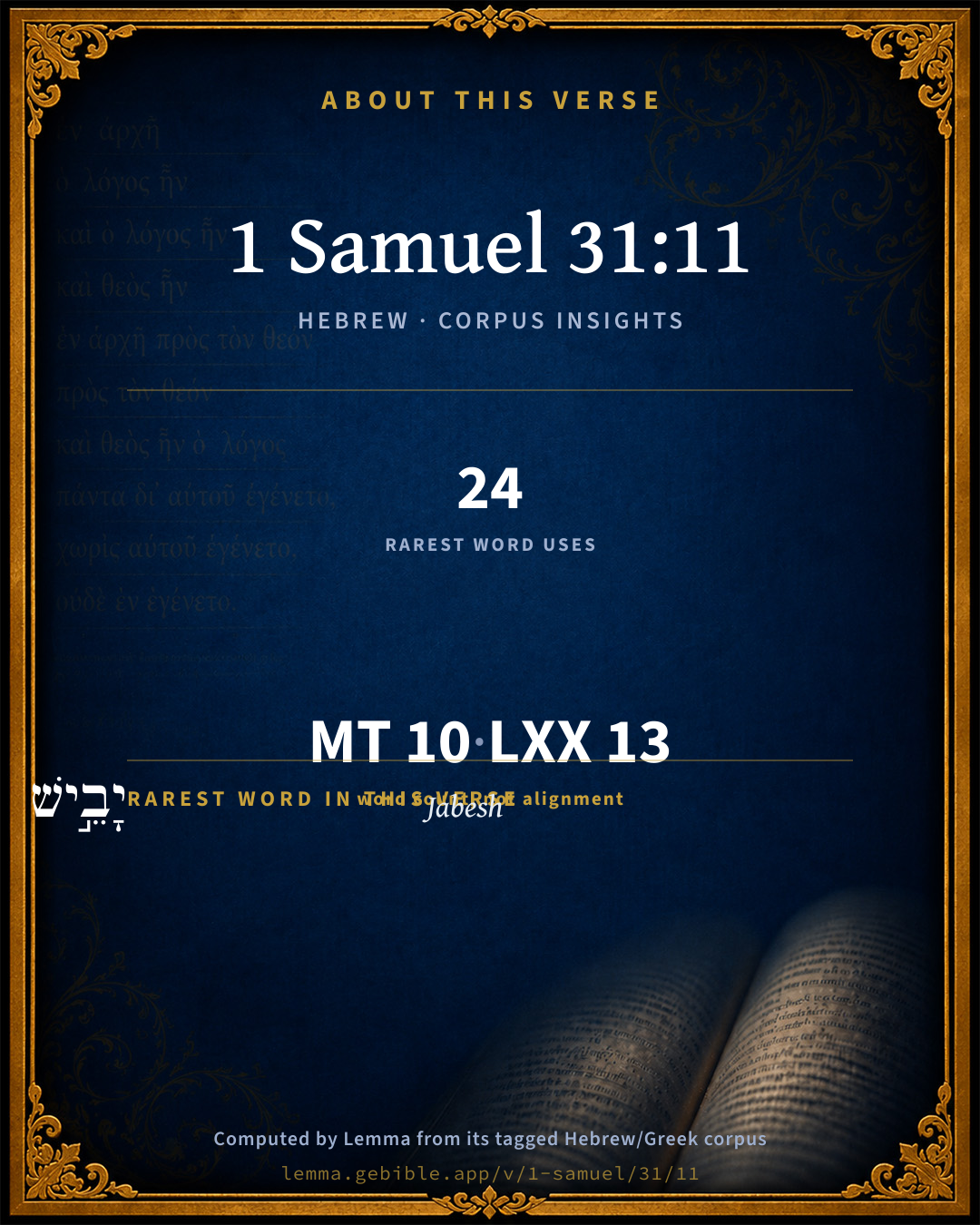
The rarest word here is יָבֵ֣ישׁ Jabesh H3003 — appearing just 24 times in the whole Hebrew Bible.

Shared distinctive vocabulary

יָבֵ֣ישׁ Jabesh H3003 occurs in 21 verses of the Hebrew Bible. Also found in:

Grammatical profile

  • 3 verbs
  • 4 nouns
  • 1 preposition
  • 2 particles

Verb forms

  • וַיִּשְׁמְע֣וּ Qal · Sequential Imperfect
  • יֹשְׁבֵ֖י Qal · Participle Active
  • עָשׂ֥וּ Qal · Perfect

Hebrew & Septuagint length

In English translation the verse runs 17 words from the Hebrew and 13 from the Septuagint (LXX English) — closely comparable.

A rough comparison of the two English renderings, which tokenize alike — not a word-level alignment.

Word counts can differ between the Hebrew and the Greek without any difference in meaning — e.g. the Hebrew direct-object marker אֵת has no separate Greek word, and Greek often adds the article ὁ.

In the original languages it is 10 Hebrew tokens and 13 Greek tokens — but the two are counted differently (Hebrew bundles its prefixes and suffixes into one token; the Greek is in lemma form), so that isn’t a like-for-like length.

Cross-references

2

Topical passages linked to 1 Samuel 31:11 in the Treasury of Scripture Knowledge — connected by theme and wording, ordered by reader-vote popularity; previews shown in the World English Bible.

  • 1 Samuel 11:1–11 Then Nahash the Ammonite came up, and encamped against Jabesh Gilead: and all the men of Jabesh said to Nahash, Make a covenant with us, and we will serve you.
  • 2 Samuel 2:4 The men of Judah came, and there they anointed David king over the house of Judah. They told David, saying, The men of Jabesh Gilead were those who buried Saul.

Cross-references courtesy of OpenBible.info (CC BY 4.0).

Hebrew and Greek witnesses Masoretic Hebrew ↔ Greek Septuagint

The same verse in the two great witnesses to the Old Testament, shown verse-for-verse.

These are two independent witnesses, not word-aligned to each other, and the Septuagint is shown in lemma (dictionary) form.

Hebrew 1 Samuel 31:11 Masoretic · Westminster Leningrad Codex

וַיִּשְׁמְע֣וּ אֵלָ֔יו יֹשְׁבֵ֖י יָבֵ֣ישׁ גִּלְעָ֑ד אֵ֛ת אֲשֶׁר עָשׂ֥וּ פְלִשְׁתִּ֖ים לְשָׁאֽוּל

When the inhabitants of Jabesh Gilead heard concerning him that which the Philistines had done to Saul,

World English Bible · Public Domain

Greek LXX 1 Samuel 31:11 Septuagint · lemma form

καί ἀκούω ὁ καταοἰκέω ιαβις ὁ γαλααδίτις ὅς ποιέω ὁ ἀλλόφυλος ὁ σαούλ

And the inhabitants of Jabis Galaad hear what the Philistines did to Saul.

LXX2012 (modern English Septuagint) · Public Domain

Hebrew: Westminster Leningrad Codex (CC BY 4.0). Greek: Septuagint (public domain); English from LXX2012 (modern English Septuagint) (Public Domain). How the Septuagint differs from the Hebrew →

Targum (Aramaic paraphrase)

1

The Targum is the ancient Jewish Aramaic paraphrase of the Hebrew Scriptures — an interpretive translation, not the Hebrew text itself. Onkelos (literal) and Pseudo-Jonathan (expansive) render the Torah, and Jonathan the Prophets. Coverage is partial: where no permissively-licensed English translation exists for a verse, only the Aramaic is shown. This is verse-level text, not a word-by-word alignment to the Hebrew.

  1. Targum Jonathan Prophets (Joshua–Malachi)
    וּשְׁמָעוּ עֲלוֹהִי יַתְבֵי יָבֵשׁ גִלְעָד יַת דַעֲבַדוּ פְּלִשְׁתָּאֵי לְשָׁאוּל:

    (no public-domain English translation for this verse)

    Targum Jonathan — Aramaic: “Mikraot Gedolot” (public domain). English: “Sefaria Community Translation” (CC0 1.0 (public-domain dedication)); “London "Chaldee Paraphrase," 1871” (public domain). Text via Sefaria.

Commentary

Notes on 1 Samuel 31:11 from classic Christian and Jewish commentators (each source and its license shown beneath its notes). The classic Christian expositions comment on the surrounding passage and are grouped to its opening verse, so a note may address several verses; the Jewish commentaries on the Tanakh (Rashi and others) are per-verse, so they appear only where the commentator wrote on this verse.

Lemma curates 59 commentaries, every one of them public domain or Creative Commons licensed, each selected and text-cleaned for this edition rather than reprinted as found. About our sources →

Jamieson, Fausset & Brown

Robert Jamieson, A. R. Fausset & David Brown

THE MEN OF JABESH-GILEAD RECOVER THE BODIES AND BURY THEM AT JABESH. (Sa1 31:11-13)

the inhabitants of Jabesh-gilead heard of that which the Philistines had done--Mindful of the important and timely services Saul had rendered them, they gratefully and heroically resolved not to suffer such indignities to be inflicted on the remains of the royal family.

Jamieson, Fausset & Brown — Commentary Critical and Explanatory on the Whole Bible (1871) — public domain (CC PDM 1.0). Text via the HelloAO Bible API.

Trapp's Complete Commentary

John Trapp

1Sa 31:11 And when the inhabitants of Jabeshgilead heard of that which the Philistines had done to Saul;

Ver. 11. And when the inhabitants of Jabeshgilead.] Memores beneficii a Saule accepti, they remembered what a good turn Saul had once done them, {1Sa 11:11} and hence make this bold adventure, Perraro grati reperiuntur; the memory of a good turn should never wax old; hence the Graces were painted as young virgins, &c. See Alciat’s "Emblems," p. 565. Trebius the Roman, for his kindness to that people, was carried forth, when he died, on their shoulders; and put into the funeral bonfire. {a}

{a} Plin.

John Trapp, A Commentary or Exposition upon All the Books of the Old and New Testament (1647–1656) — public domain. Text from a community e-Sword module.

Joseph Benson's Commentary

1Sa 31:11-12. The inhabitants of Jabesh-gilead — They lived on the other side of Jordan; for the people on this side were fled. All the valiant men arose, and went all night — To avoid discovery. And took the body of Saul, &c. — They had been delivered by Saul in the beginning of his reign from the Ammonites, when they were in danger of losing their lives, chap. 11.; and therefore they now showed their gratitude toward him by not suffering his corpse to want the honour of burial. And came to Jabesh and burnt them there — It was not the custom of the Hebrews to burn their dead, but to bury them; but perhaps they burned these bodies for fear, if they buried them, the Philistines might take them up again to fasten them in the same ignominious manner to their walls.

Joseph Benson's Commentary on the Old and New Testaments (1811–1818) — public domain. Text from a community e-Sword module.

Keil & Delitzsch

C. F. Keil & F. Delitzsch

When the inhabitants of Jabesh in Gilead heard this, all the brave men of the town set out to Beth-shean, took down the bodies of Saul and his sons from the wall, brought them to Jabesh, and burned them there. "But their bones they buried under the tamarisk at Jabesh, and fasted seven days," to mourn for the king their former deliverer (see Sa1 11:1-15). These statements are given in a very condensed form in the Chronicles (Sa1 31:11, Sa1 31:12). Not only is the fact that "they went the whole night" omitted, as being of no essential importance to the general history; but the removal of the bodies from the town-wall is also passed over, because their being fastened there had not been mentioned, and also the burning of the bodies. The reason for the last omission is not to be sought for in the fact that the author of the Chronicles regarded burning as ignominious, according to Lev 20:14; Lev 21:9, but because he did not see how to reconcile the burning of the bodies with the burial of the bones. It was not the custom in Israel to burn the corpse, but to bury it in the ground. The former was restricted to the worst criminals (see at Lev 20:14). Consequently the Chaldee interpreted the word "burnt" as relating to the burning of spices, a custom which we meet with afterwards as a special honour shown to certain of the kings of Judah on the occasion of their burial (Ch2 16:14; Ch2 21:19; Jer 34:5). But this is expressed by שׂרפה לו שׂרף, "to make a burning for him," whereas here it is stated distinctly that "they burnt them." The reason for the burning of the bodies in the case of Saul and his sons is to be sought for in the peculiarity of the circumstances; viz., partly in the fact that the bodies were mutilated by the removal of the heads, and therefore a regular burial of the dead was impossible, and partly in their anxiety lest, if the Philistines followed up their victory and came to Jabesh, they should desecrate the bodies still further. But even this was not a complete burning to ashes, but merely a burning of the skin and flesh; so that the bones still remained, and they were buried in the ground under a shady tree. Instead of "under the (well-known) tamarisk" (eshel), we have האלה תּחת (under the strong tree) in Ch1 10:11. David afterwards had them fetched away and buried in Saul's family grave at Zela, in the land of Benjamin (Sa2 21:11.). The seven days' fast kept by the Jabeshites was a sign of public and general mourning on the part of the inhabitants of that town at the death of the king, who had once rescued them from the most abominable slavery.

In this ignominious fate of Saul there was manifested the righteous judgment of God in consequence of the hardening of his heart. But the love which the citizens of Jabesh displayed in their treatment of the corpses of Saul and his sons, had reference not to the king as rejected by God, but to the king as anointed with the Spirit of Jehovah, and was a practical condemnation, not of the divine judgment which had fallen upon Saul, but of the cruelty of the enemies of Israel and its anointed. For although Saul had waged war almost incessantly against the Philistines, it is not known that in any one of his victories he had ever been guilty of such cruelties towards the conquered and slaughtered foe as could justify this barbarous revenge on the part of the uncircumcised upon his lifeless corpse.

Keil & Delitzsch — Biblical Commentary on the Old Testament (1861–1891) — public domain (CC PDM 1.0). Text via the HelloAO Bible API. (Old Testament only.)

Tyndale Open Study Notes

Tyndale Open Resources

31:11 The people of Jabesh-gilead were returning the favor Saul had done for them when he saved them from the Ammonites and their king Nahash (11:1-13). Jabesh-gilead was about twelve miles southeast of Beth-shan and across the Jordan River.

Tyndale Open Study Notes — © Tyndale Open Resources, licensed CC BY-SA 4.0. Text via the HelloAO Bible API.

Geneva Bible (1599)

Geneva Bible translators

Whom he had delivered from their enemies, 1 Sam. 11:11.

Geneva Bible (1599) marginal notes — public domain. Text via Bolls.life.

Adam Clarke's Commentary

Verse 11. When the inhabitants of Jabesh-gilead heard] This act of the men of Jabesh-gilead was an act of gratitude due to Saul, who, at the very commencement of his reign, rescued them from Nahash, king of the Ammonites, (see 1Sa 11:1, &c.,) and by his timely succours saved them from the deepest degradation and the most oppressive tyranny. This heroic act, with the seven days' fast, showed that they retained a due sense of their obligation to this unfortunate monarch.

Adam Clarke's Commentary on the Bible (1810–1826) — public domain. Text from a community e-Sword/MySword module.

Ellicott's Commentary for English Readers

(11) The inhabitants of Jabesh-Gilead.—The memory of the splendid feat of arms of their young king Saul, when he gallantly rescued their city (1Sa_11:1-11) years before, when they were threatened with deadly peril by the Ammonites, was still fresh in the city of Jabesh-Gilead, and they burned to rescue the body of their hero from shame. It was singular how that first deed of splendid patriotism, done in the early fervour of his consecration, bore fruit after so many long years.

“Good deeds immortal are—they cannot die;

Unscathed by envious blight, or withering frost,

They live, and bud and bloom, and men partake

Still of their freshness, and are strong thereby.”

AYTOUN.

Jabesh-Gilead, a city of Manasseh, on the further side of Jordan, on the road from Pella to Gerasa. perhaps about fourteen miles from Beth-shan (see Jdg_21:8, and following). Its name still survives in the Wady Yabez, running down to the east bank of Jordan, near the head of which are still visible some ruins named El Deir, which Robinson has identified with Jabesh-Gilead.

A Bible Commentary for English Readers, edited by Charles John Ellicott (1878–1897) — public domain. Text from a community e-Sword module.

The Cambridge Bible for Schools and Colleges

gen. ed. J. J. S. Perowne

11. the inhabitants of Jabesh-Gilead] Mindful of the debt of gratitude they owed to Saul for rescuing them from Nahash (ch. 11). The isolated round-topped hill on the south side of the Wady Yâbis, which has been conjecturally fixed upon as the site of Jabesh, is in full view of Beth-shan (Tristram, Land of Israel, p. 556). The distance over the hills, down into the Jordan valley, and up the Wady Jâlûd is not much under twenty miles.

The Cambridge Bible for Schools and Colleges (gen. ed. J. J. S. Perowne; Cambridge University Press, 1878–1918) — public domain. Text from a community e-Sword module.

John Gill's Exposition

And the inhabitants of Jabeshgilead,.... Who lived on the other side Jordan, about eight miles from Bethshan, according to Fuller (p):

heard of that which the Philistines had done to Saul; not only that they had got the victory over him, and routed his army, but had abused his body, and hung it up by way of reproach and ignominy; which they could not bear to hear of, remembering with gratitude the kindness he had shown to them, in delivering them out of the hands of Nahash the Ammonite, Sa1 11:1.

(p) Pisgah-Sight of Palestine, b. 2. ch. 2. p. 82.

John Gill's Exposition of the Whole Bible (1746–1763) — public domain (CC PDM 1.0). Text via the HelloAO Bible API.

Albert Barnes' Notes on the Bible

When the inhabitants of Jabesh-Gilead heard ... - See 1Sa 11:1-15. This is a touching and rare example of national gratitude.

Albert Barnes' Notes on the Bible (1834–1885) — public domain. Text from a community e-Sword/MySword module.

Haydock's Catholic Bible Commentary

Jabes, in gratitude for the deliverance which he had procured for them, chap. xi. 11. (Calmet) --- They are also deserving of praise for shewing mercy to the dead, as well as for their bravery. (Worthington)

George Leo Haydock (1774–1849), Haydock's Catholic Family Bible and Commentary, 1859 edition — public domain. Excludes Psalms (Douay-Rheims chapter numbering differs from Protestant) and Deuterocanonical books (Catholic canon only).

Matthew Poole's English Annotations

Jabesh-gilead, which was beyond Jordan; for the people on this side Jordan were fled from their cities, as was now said.

Matthew Poole's English Annotations on the Holy Bible (1683–1685) — public domain. Text from a community e-Sword/MySword module.

Whedon's Commentary on the Bible

Daniel D. Whedon

11. The inhabitants of Jabesh-gilead — Who ever preserved a tender and grateful remembrance of what they owed to the heroism of Saul. See chap. 11.

Daniel D. Whedon (gen. ed.), Commentary on the Old and New Testaments (1874–1909) — public domain. Text from a community e-Sword module.

The Pulpit Commentary

RECOVERY OF THE BODIES OF SAUL AND HIS SONS (vers. 11-13).

Jabesh-Gilead. Eusebius describes this place as situated on the road from Pella to Gerasa, and therefore it would be much nearer the Jordan than Mahanaim, and probably was not more than twelve or fourteen miles distant from Beth-shan. The people there had not forgotten how bravely Saul had saved them, and now showed their gratitude by rescuing his remains from disgrace.

Vers. 11-13. (BETHSHAN, JABESH-GILEAD.)

Gratitude.

The first victory of Saul (ch. 11.) is connected with his death by the noble exploit of the men of Jabesh. It was due partly to loyalty and patriotism; chiefly to gratitude for benefits formerly conferred upon them. It is seldom that any one closes his earthly course without some token of grateful remembrance. Of one of the worst tyrants that ever held the reins of power in Rome (Nero), it is recorded that on the morning after he was buried amidst general execration fresh flowers were found strewn by an unknown hand upon his grave. Saul had done many generous deeds, and they were not forgotten. The gratitude of the men of Jabesh was marked by many admirable features. It was

1. Unexpected. Who would have thought that the city which was sofaithless and cowardly as to say to Nahash, "Make a covenant with us, and we will serve thee," could have furnished such an instance of devotion? The noblest qualities sometimes appear in association with the meanest, and where men expect to find no good thing. Let us not despise our nature, nor think that at its worst it is wholly incapable of generous acts.

1. Long cherished. It was many years previously that Jabesh had been saved by Saul; but its grateful feeling had not (as is sometimes the case)

2. grown cold with the lapse of time. When a philosopher was asked, "what doth soonest grow cold?" he replied, "Thanks.

3. Spontaneous. No special appeal was made to them; but perceiving that they could do something to testify their gratitude to their benefactor by rescuing his remains from the indignity to which they were subjected, "all the valiant men arose" of their own accord, "and went all night" (a distance of ten miles, across the Jordan) and accomplished it. Gratitude loses its proper character and ceases to be gratitude when it requires to be solicited and urged.

4. Disinterested. Saul and his sons were dead, and no reward for their daring effort might be expected. It was performed in somewhat of the same spirit as that with which Saul himself formerly acted; what was best in his life was remembered and admired by them (as it was by David, (2Sa_1:23) and it served to stir them to similar excellence. Disinterested conduct begets its like.

Good deeds immortal are they cannot die; Unscathed by envious blight or withering frost, They live, and bud, and bloom; and men partake Still of their freshness, and are strong thereby". (Aytoun)

5. Heroic and self-sacrificing; exhibited practically and at the risk of life, and displaying great energy and valour. "The pillars of fire of genuine human heroism are the noble lights of history, which make us feel at ease while sojourning among spectres, and horrors, and graves" (Lange).

6 . Complete. It did not stop short of doing its best. "They took their bones, and buried them under the tamarisk at Jabesh, and fasted seven days". (ver. 2Sa_21:14) They could do no more; and what they did was done tenderly, mournfully, reverently, and in fulfilment of a sacred custom and religious duty.

Exhortation:

1. Endeavour so to live that when you are gone you may be remembered with gratitude, and leave behind the recollection of good deeds which may incite others to the like.

1. Fail not to render gratitude to every one who has conferred a benefitupon you in the best way you can; be thankful, especially to God, for all his

2. benefits towards you. "Nothing more detestable, does the earth produce than an ungrateful man" (Ausonius).

3. Seek above all things to obtain in life and death the honour that comesfrom God. "This Book began with Samuel"s birth, and now ends with Saul"s burial, the comparing of which together will teach us to prefer the honour which comes from God before any honours of which this world pretends to dispose" (M. Henry). D.

The Pulpit Commentary (1880–1919), ed. H.D.M. Spence-Jones & Joseph S. Exell — public domain. Text from a community e-Sword module.

unfoldingWord translationNotes

Door43 World Missions Community

Jabesh

the name of a town. See how you translated this in 1 Samuel 11:1. (See: How to Translate Names)

what the Philistines had done to Saul

"how the Philistines had dishonored Saul"

all night

"throughout the whole night"

a tamarisk tree

This is a type of tree. See how you translated this in 1 Samuel 22:6. AT: "a large shade tree" (See: Translate Unknowns)

translationWords

Gilead

Philistines

Saul (OT)

bury

fast

unfoldingWord translationNotes — © Distant Shores Media and the Door43 World Missions Community, licensed CC BY-SA 4.0. Source: git.door43.org/Door43/en_tn.

Rashi

Rabbi Shlomo Yitzchaki (Rashi)

About him. Meaning the same as עָלָיו [about him], i.e., about Shaul.

Rashi on the Tanakh — English translations: “The Judaica Press complete Tanach with Rashi, translated by A. J. Rosenberg” (CC BY 4.0); “Pentateuch with Rashi's commentary by M. Rosenbaum and A.M. Silbermann, 1929-1934” (public domain); “The Metsudah Tanach series, Lakewood, N.J” (CC BY 4.0); and “The Book of Joshua, Metsudah Publications, 1997” (CC BY 4.0). Text via Sefaria.

Lesson kit

Teaching starters — assembled from the data on this page, not authored interpretation. Every prompt links to the verse data it draws on. Edit before teaching.

1 Samuel, in the Historical, opens this verse with 10 words (10 distinct Hebrew lemmas). Its most distinctive word is Yâbêsh (“Jabesh”). A historical commentator’s framing appears above. Read the whole chapter for the surrounding context.

Discussion questions

  1. How does “Jabesh” (Yâbêsh) shape what this verse is saying?
  2. Judges 21:8 shares the word «Jabesh» with this verse. How do the two illuminate each other?
  3. These translations render this verse differently. What is at stake in choosing one wording over another?
  4. The verb «וַיִּשְׁמְע֣וּ» is Qal Sequential Imperfect. How does its form color the action?
  5. Reading how Jamieson, Fausset & Brown and Trapp's Complete Commentary read this verse, where do the two commentators agree and where do they part?

Things to notice

Reading settings

Reading text

Shown beneath each verse's original-language words.

Old Testament
Old Testament edition

Read the OT as the Masoretic Hebrew (MT) or the Greek Septuagint (LXX).

English shown for the Greek Septuagint (in the Hebrew ↔ Greek comparison).

Comparing translations? Open the Compare panel on any verse page to stack up to four side by side.