
1 Chronicles 20:5

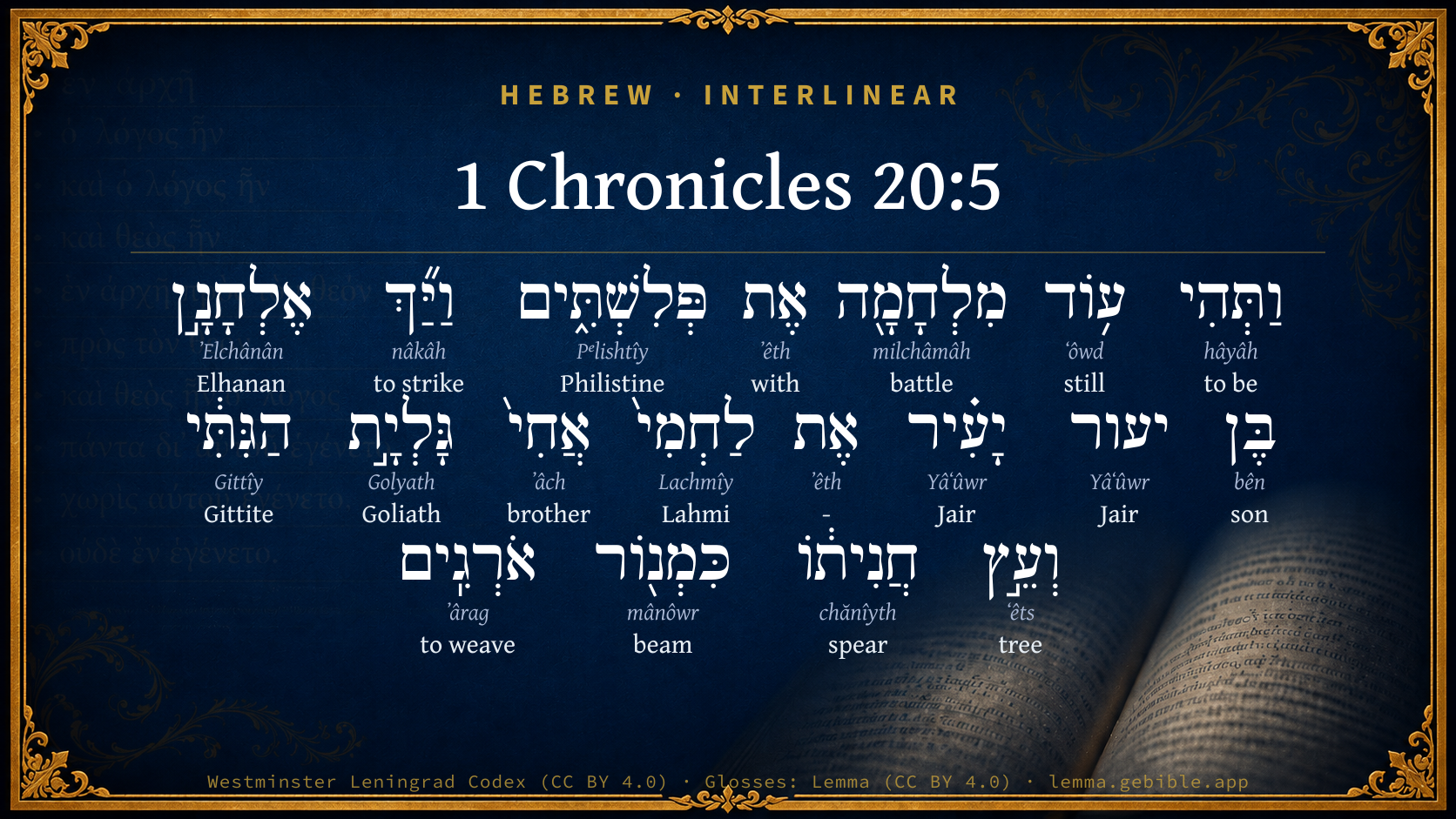
Hebrew (Westminster Leningrad Codex) 1 Chronicles 20:5 appears in the Hebrew Old Testament. The text above is from the Westminster Leningrad Codex. Each word links to its Strong’s number, a concise gloss, and parsing drawn from the Open Scriptures Hebrew Bible morphology. Click any word for its full Brown-Driver-Briggs (BDB) entry.
Download image
Cite this verse

1 Chronicles 20:5 (World English Bible). Public Domain. Lemma interlinear Bible study tool, https://lemma.gebible.app/v/1-chronicles/20/5.

Show BibTeX & RIS
BibTeX
RIS
English Translation
There was again war with the Philistines; and Elhanan the son of Jair killed Lahmi the brother of Goliath the Gittite, the staff of whose spear was like a weaver's beam.
World English Bible · Public Domain
Highlights
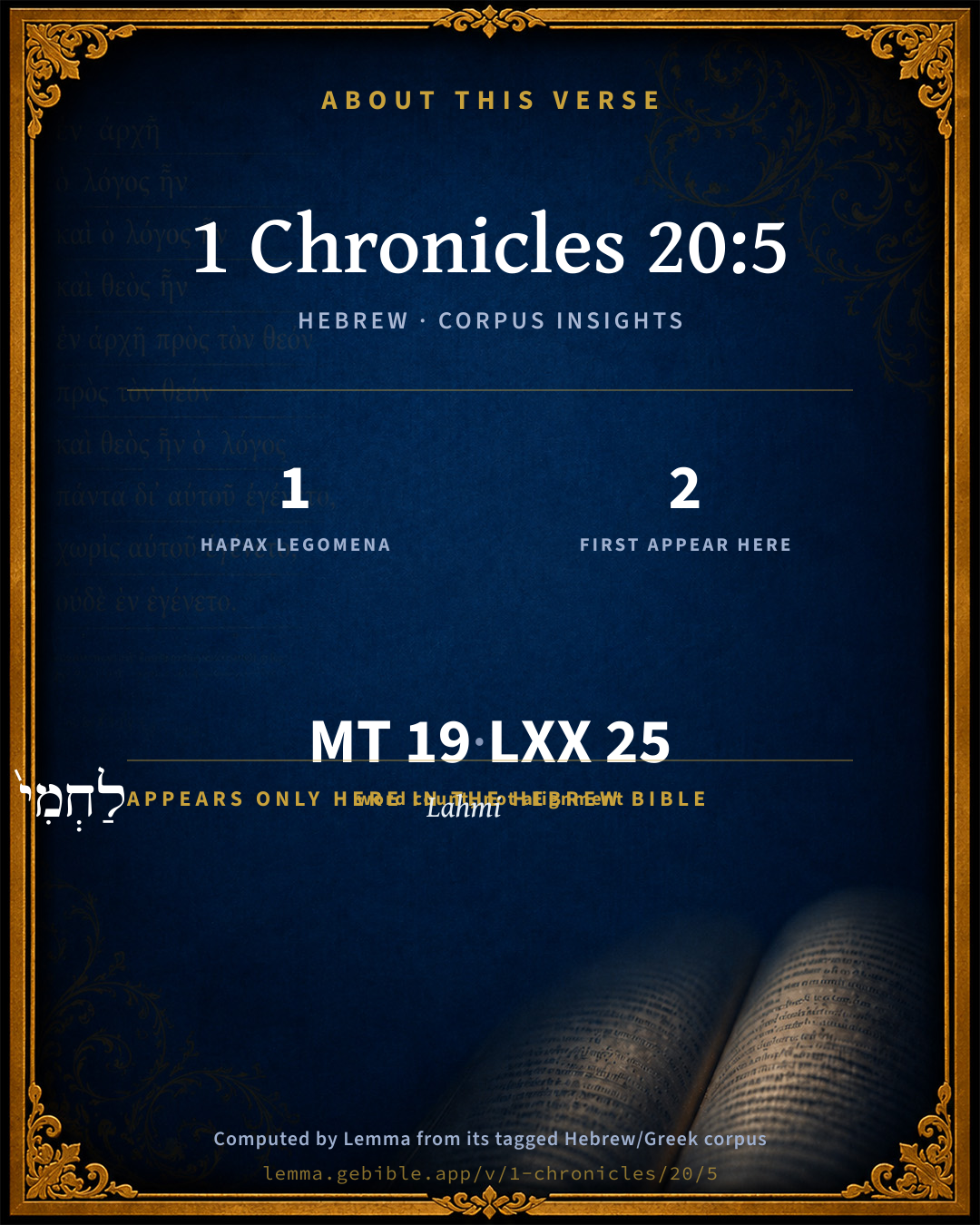
  • 1 hapax legomenon — only here in the Hebrew Bible
  • 2 first appearances in the Hebrew Bible
Full analysis ↓
Download a study sheet

One document with this verse’s original text, its word-by-word gloss line, the meaning frame, cross-references with their text, attributed commentary, and full source and license credits — printable, and it pastes into notes with its structure intact.

This verse Autodidact and up

Study sheet (.html) Plain text (.txt)

A passage Seminary Student

Up to 50 verses in one chapter. A passage sheet keeps up to 6 commentary sources and 12 cross-references per verse, in the order this page ranks them, and says so on the sheet whenever that leaves anything out. Ask for a single verse and you get the Autodidact verse sheet above.

Everything on this page stays free to read, with no account — the sheet is a download of what is already on screen, not access to it.

Want to remove ads? Support Godless Engineer
Compare translations 3

The same verse in 3 English versions, stacked beneath the original-language interlinear above. Click any original word for its lexicon entry.

Each is an independent rendering of the whole verse — the interlinear is not word-aligned to these translations.

Highlighted words mark where these versions differ — a whole-verse word diff, not a word-by-word alignment.

  • World English Bible Public Domain
    There was again war with the Philistines; and Elhanan the son of Jair killed Lahmi the brother of Goliath the Gittite, the staff of whose spear was like a weaver's beam.
  • King James Version Public Domain
    And there was war again with the Philistines; and Elhanan the son of Jair slew Lahmi the brother of Goliath the Gittite, whose spear staff was like a weaver's beam.
  • unfoldingWord Literal Text CC BY-SA 4.0
    And there was battle again with the Philistines. And Elhanan, the son of Jair, struck Lahmi, the brother of Goliath the Gittite, and the wood of his spear was like a beam of weavers.

unfoldingWord Literal Text — © unfoldingWord, licensed CC BY-SA 4.0. Word-aligned USFM3 via Door43 (git.door43.org/unfoldingWord/en_ult).

Versions to compare (up to 4)

3 of 4 selected

Show all 18 translations

Every available English version of this verse, each an independent rendering of the whole verse.

  • World English Bible Public Domain
    There was again war with the Philistines; and Elhanan the son of Jair killed Lahmi the brother of Goliath the Gittite, the staff of whose spear was like a weaver's beam.
  • Berean Standard Bible Public Domain
    Once again there was a battle with the Philistines, and Elhanan son of Jair killed Lahmi the brother of Goliath the Gittite, the shaft of whose spear was like a weaver’s beam.
  • Majority Standard Bible Public Domain
    Once again there was a battle with the Philistines, and Elhanan son of Jair killed Lahmi the brother of Goliath the Gittite, the shaft of whose spear was like a weaver’s beam.
  • King James Version Public Domain
    And there was war again with the Philistines; and Elhanan the son of Jair slew Lahmi the brother of Goliath the Gittite, whose spear staff was like a weaver's beam.
  • American Standard Version (1901) Public Domain
    And there was again war with the Philistines; and Elhanan the son of Jair slew Lahmi the brother of Goliath the Gittite, the staff of whose spear was like a weaver's beam.
  • Revised Version (1885) Public Domain
    And there was again war with the Philistines; and Elhanan the son of Jair slew Lahmi the brother of Goliath the Gittite, the staff of whose spear was like a weaver’s beam.
  • Geneva Bible (1599) Public Domain
    And there was yet another battell with the Philistims: and Elhanan the sonne of Iair slewe Lahmi, the brother of Goliath the Gittite, whose spearestaffe was like a weauers beame.
  • Douay-Rheims (1899) Public Domain
    Another battle also was fought against the Philistines, in which Adeodatus the son of Saltus a Bethlehemite slew the brother of Goliath the Gethite, the staff of whose spear was like a weaver's beam.
  • Young's Literal Translation Public Domain
    And there is again war with the Philistines, and Elhanan son of Jair smiteth Lahmi, brother of Goliath the Gittite, the wood of whose spear `is' like a beam of weavers.
  • Literal Standard Version CC BY-SA 4.0
    And there is war with the Philistines again, and Elhanan son of Jair strikes Lahmi, brother of Goliath the Gittite, the wood of whose spear [is] like a weavers’ beam.
  • Unlocked Literal Bible CC BY-SA 4.0
    It came about again in a battle with the Philistines at Gob, that Elhanan son of Jair the Bethlehemite killed Lahmi brother of Goliath the Gittite, the staff of whose spear was like a weaver's beam.
  • unfoldingWord Literal Text CC BY-SA 4.0
    And there was battle again with the Philistines. And Elhanan, the son of Jair, struck Lahmi, the brother of Goliath the Gittite, and the wood of his spear was like a beam of weavers.
  • Darby Bible Public Domain
    And there was again a battle with the Philistines; and Elhanan the son of Jair smote Lahmi the brother of Goliath the Gittite; now the shaft of his spear was like a weaver's beam.
  • World Messianic Bible Public Domain
    Again there was war with the Philistines; and Elhanan the son of Jair killed Lahmi the brother of Goliath the Gittite, the staff of whose spear was like a weaver’s beam.
  • Webster's Bible Public Domain
    And there was war again with the Philistines; and Elhanan the son of Jair slew Lahmi the brother of Goliath the Gittite, whose spear-staff was like a weaver's beam.
  • Free Bible Version CC BY-SA 4.0
    In another battle with the Philistines, Elhanan, son of Jair, killed Lahmi, the brother of Goliath the Gittite. The shaft of his spear was as thick as a weaver's rod.
  • Bible in Basic English Public Domain
    And again there was war with the Philistines; and Elhanan, the son of Jair, put to death Lahmi, the brother of Goliath the Gittite, the stem of whose spear was like a cloth-worker's rod.
  • JPS Tanakh (1917) Public Domain
    And there was again war with the Philistines; and Elhanan the son of Jair slew Lahmi the brother of Goliath the Gittite, the staff of whose spear was like a weaver's beam.

Literal Standard Version (2020), Covenant Press — licensed CC BY-SA 4.0. Text via the HelloAO Bible API (eBible.org). Unlocked Literal Bible (unfoldingWord) — licensed CC BY-SA 4.0. Text via the HelloAO Bible API (eBible.org). unfoldingWord Literal Text — © unfoldingWord, licensed CC BY-SA 4.0. Word-aligned USFM3 via Door43 (git.door43.org/unfoldingWord/en_ult). Free Bible Version, Dr. Jonathan Gallagher — licensed CC BY-SA 4.0. Text via the HelloAO Bible API (eBible.org).

Word by word

More ways to search: Search by grammar → Find every occurrence → Compare this word →

Practice this passage: Drill this verse → Learn its vocabulary →

לַחְמִי֙
Lachmîy
H3902
“Lahmi”
Noun, Proper
Part of Speech
Noun
Type
Proper
Full BDB Definition

Origin: from H3899

TWOT: None

Lahmi = "my bread" - brother of Goliath the Gittite and slain by Elhanan the son of Zair
  1. וַתְּהִי hâyâh H1961 “and · to be” Conjunction + Verb, Qal, Sequential Imperfect, 3rd Person, Feminine, Singular
  2. ע֥וֹד ʻôwd H5750 “still” Adverb
  3. מִלְחָמָ֖ה milchâmâh H4421 “battle” Noun, Common, Feminine, Singular, Absolute
  4. אֶת ʼêth H854 “with” Preposition
  5. פְּלִשְׁתִּ֑ים Pᵉlishtîy H6430 “Philistines” Noun, Gentilic, Masculine, Plural, Absolute
  6. וַיַּ֞ךְ nâkâh H5221 “and · to strike” Conjunction + Verb, Hiphil, Sequential Imperfect, 3rd Person, Masculine, Singular
  7. אֶלְחָנָ֣ן ʼElchânân H445 “Elhanan” Noun, Proper
  8. בֶּן bên H1121 “son of” Noun, Common, Masculine, Singular, Construct
  9. יעור Yâʻûwr H3265 “Jair” Noun, Proper
  10. יָעִ֗יר Yâʻûwr H3265 “Jair” Noun, Proper
  11. אֶת ʼêth H853 “-” Particle, Direct Object
  12. אֲחִי֙ ʼâch H251 “brother of” Noun, Common, Masculine, Singular, Construct
  13. גָּלְיָ֣ת Golyath H1555 “Goliath” Noun, Proper
  14. הַגִּתִּ֔י Gittîy H1663 “the · Gittite” Particle, Definite Article + Noun, Gentilic, Masculine, Singular, Absolute
  15. וְעֵ֣ץ ʻêts H6086 “and · tree of” Conjunction + Noun, Common, Masculine, Singular, Construct
  16. חֲנִית֔וֹ chănîyth H2595 “spear · his” Noun, Common, Feminine, Singular, Construct + Suffix, Personal, 3rd Person, Masculine, Singular
  17. כִּמְנ֖וֹר mânôwr H4500 “like/as · beam of” Preposition + Noun, Common, Masculine, Singular, Construct
  18. אֹרְגִֽים ʼârag H707 “weaving” Verb, Qal, Participle Active, Masculine, Plural, Absolute

About this verse

These counts appear in no published source. They are computed here, from the morphology-tagged text and Lemma’s own curated glosses. What Lemma adds →

19
words
18
distinct lemmas
Historical
section

Notable vocabulary

1 hapax legomenon — a word that appears only here in the entire Hebrew Bible:

  • לַחְמִי֙ Lahmi H3902

First appearance in Scripture

These words make their first canonical appearance in the Hebrew Bible here:

Grammatical profile

  • 3 verbs
  • 13 nouns
  • 1 preposition
  • 1 adverb
  • 1 particle

Verb forms

  • וַתְּהִי Qal · Sequential Imperfect
  • וַיַּ֞ךְ Hiphil · Sequential Imperfect
  • אֹרְגִֽים Qal · Participle Active

Repetition

A word recurs within this verse — often emphatic in Hebrew:

  • יעור Jair H3265 ×2

Hebrew & Septuagint length

In English translation the verse runs 31 words from the Hebrew and 33 from the Septuagint (LXX English) — closely comparable.

A rough comparison of the two English renderings, which tokenize alike — not a word-level alignment.

Word counts can differ between the Hebrew and the Greek without any difference in meaning — e.g. the Hebrew direct-object marker אֵת has no separate Greek word, and Greek often adds the article ὁ.

In the original languages it is 19 Hebrew tokens and 25 Greek tokens — but the two are counted differently (Hebrew bundles its prefixes and suffixes into one token; the Greek is in lemma form), so that isn’t a like-for-like length.

Cross-references

5

Topical passages linked to 1 Chronicles 20:5 in the Treasury of Scripture Knowledge — connected by theme and wording, ordered by reader-vote popularity; previews shown in the World English Bible.

  • 2 Samuel 21:19 There was again war with the Philistines at Gob; and Elhanan the son of Jaareoregim the Bethlehemite killed Goliath the Gittite's brother, the staff of whose spear was like a weaver's beam.
  • 1 Samuel 17:4 There went out a champion out of the camp of the Philistines, named Goliath, of Gath, whose height was six cubits and a span.
  • 1 Samuel 17:7 The staff of his spear was like a weaver's beam; and his spear's head [weighed] six hundred shekels of iron: and his shield-bearer went before him.
  • 1 Samuel 21:9 The priest said, The sword of Goliath the Philistine, whom you killed in the valley of Elah, behold, it is here wrapped in a cloth behind the ephod: if you will take that, take it; for there is no other except that here. David said, There is none like that; give it me.
  • 1 Samuel 22:10 He inquired of Yahweh for him, and gave him food, and gave him the sword of Goliath the Philistine.

Cross-references courtesy of OpenBible.info (CC BY 4.0).

Hebrew and Greek witnesses Masoretic Hebrew ↔ Greek Septuagint

The same verse in the two great witnesses to the Old Testament, shown verse-for-verse.

These are two independent witnesses, not word-aligned to each other, and the Septuagint is shown in lemma (dictionary) form.

Hebrew 1 Chronicles 20:5 Masoretic · Westminster Leningrad Codex

וַתְּהִי ע֥וֹד מִלְחָמָ֖ה אֶת פְּלִשְׁתִּ֑ים וַיַּ֞ךְ אֶלְחָנָ֣ן בֶּן יעור יָעִ֗יר אֶת לַחְמִי֙ אֲחִי֙ גָּלְיָ֣ת הַגִּתִּ֔י וְעֵ֣ץ חֲנִית֔וֹ כִּמְנ֖וֹר אֹרְגִֽים

There was again war with the Philistines; and Elhanan the son of Jair killed Lahmi the brother of Goliath the Gittite, the staff of whose spear was like a weaver's beam.

World English Bible · Public Domain

Greek LXX 1 Chronicles 20:5 Septuagint · lemma form

καί γίγνομαι ἔτι πόλεμος μετά ὁ ἀλλόφυλος καί πατάσσω ελλαναν υἱός ιαϊρ ὁ λεεμι ἀδελφός γολιαθ ὁ γεθθαῖος καί ξύλον δόρυ αὐτός ὡς ἀντίον ὑφαίνω

And there was war again with the Philistines; and Eleanan the son of Jair struck Lachmi the brother of Goliath the Gittite, and the wood of his spear was as a weavers' beam.

LXX2012 (modern English Septuagint) · Public Domain

On this verse, Ellicott's Commentary for English Readers discusses the Septuagint’s reading. Read the note in Commentary ↓

Hebrew: Westminster Leningrad Codex (CC BY 4.0). Greek: Septuagint (public domain); English from LXX2012 (modern English Septuagint) (Public Domain). How the Septuagint differs from the Hebrew →

Commentary

Notes on 1 Chronicles 20:5 from classic Christian and Jewish commentators (each source and its license shown beneath its notes). The classic Christian expositions comment on the surrounding passage and are grouped to its opening verse, so a note may address several verses; the Jewish commentaries on the Tanakh (Rashi and others) are per-verse, so they appear only where the commentator wrote on this verse.

Lemma curates 59 commentaries, every one of them public domain or Creative Commons licensed, each selected and text-cleaned for this edition rather than reprinted as found. About our sources →

Geneva Bible (1599)

Geneva Bible translators

Read 2 Sam. 21:19.

Geneva Bible (1599) marginal notes — public domain. Text via Bolls.life.

Adam Clarke's Commentary

Verse 5. Elhanan the son of Jair] 2Sa 21:19. The Targum says, "David, the son of Jesse, a pious man, who rose at midnight to sing praises to God, slew Lachmi, the brother of Goliath, the same day on which he slew Goliath the Gittite, whose spear-staff was like a weaver's beam."

Adam Clarke's Commentary on the Bible (1810–1826) — public domain. Text from a community e-Sword/MySword module.

Ellicott's Commentary for English Readers

(5) There was war again.—Samuel adds, “in Gob.” The proper name is probably a transcriber’s repetition; the Syriac and Arabic there are without it.

Elhanan the son of Jair slew Lahmi the brother of Goliath the Gittite.—The Hebrew text and LXX. of Samuel have the very different statement: “And Elhanan son of Jaare-oregim the Bethlehemite slew Goliath the Gittite.” There are good critics who maintain that we must recognise here a proof that popular traditions fluctuated between David and the less famous hero Elhanan as slayer of Goliath: an uncertainty, supposed to be faithfully reflected in the two accounts preserved by the compiler of Samuel (1 Samuel 17; 2Sa_21:19). Other not less competent scholars believe that the text of Samuel should be corrected from the Chronicles. As regards the name Jaarê-oregim (forests of weavers—an absurdity), this is plausible. Whether we proceed further in the same direction must depend on the general view we take of the chronicler’s relation to the Books of Samuel. It is easy, but hardly satisfactory, to allege that he felt the difficulty, which every modern reader must feel, and altered the text accordingly. The real question is whether he has done this arbitrarily, or upon the evidence of another document than his MS. of Samuel. Now, it is fair to say that (1) hitherto we have observed no signs of arbitrary alteration; (2) we have had abundant proof that the chronicler actually possessed other sources besides Samuel. There is no apparent reason why “Lahmi” (i.e., Lahmijah) should not be a nomen individui. (Comp. Assyrian Lahmû, the name of a god, Tablet I., Creation Series.) It is, however, quite possible that Elhanan is another, and, in fact, the original name of David. The appellative David. “the beloved” (comp. Dido), may have gradually supplanted the old Elhanan in the popular memory. Solomon we know was at first named Jodidiah, and it is highly probable that the true designation of the first king of Israel has been lost, the name Saul (“the asked”) having been given in allusion to the fact that the people had ashed for a king. We may compare, besides, the double names Jehoahaz-Shallum, Mattaniah-Zedekiah, and perhaps Uzziah-Azariah. The Targum on Samuel partly supports this suggestion (see the Note there). I would add that Jaare in Hebrew writing is an easy corruption of Jesse; so that the original reading of 2Sa_21:19 may have been, “And Elhanan the son of Jesse the Bethlehemite, slew Goliath,” &c. In that case, the reading of Chronicles must be considered an unsuccessful emendation, due probably to the compiler whose work the chronicler followed.

A Bible Commentary for English Readers, edited by Charles John Ellicott (1878–1897) — public domain. Text from a community e-Sword module.

The Cambridge Bible for Schools and Colleges

gen. ed. J. J. S. Perowne

5. Elhanan … slew Lahmi the brother of Goliath] In 2Sa_21:19 Elhanan … the Beth-lehemite slew Goliath (R.V.). The difference between the two sentences in Heb. is very small, and the Chronicler, or any copyist, might feel that he was making a certain emendation in substituting the brother of Goliath for Goliath himself, who, according to 1 Samuel 17, was slain by David before he became king. But it is not certain that there is a discrepancy between 2 Samuel 21 and 1 Samuel 17, for Goliath may be, not a personal name, but a descriptive title of some kind; e.g. “Goliath the Gittite” might mean “the Gittite champion.” “Tartan,” “Rabsaris” and “Rabshakeh” (2Ki_18:17) were once taken as proper names, but are now known to be descriptions of Assyrian officers.

whose spear staff) R.V. the staff of whose spear.

The Cambridge Bible for Schools and Colleges (gen. ed. J. J. S. Perowne; Cambridge University Press, 1878–1918) — public domain. Text from a community e-Sword module.

Haydock's Catholic Bible Commentary

Adeodatus. Hebrew, "Elchanan, the son of Jair, of Lehem;" or, "slew Lechemi, brother of Goliath;" or equal to him in strength. (Calmet) --- Brother is here supplied, as it is wanting, 2 Kings. (Du Hamel)

George Leo Haydock (1774–1849), Haydock's Catholic Family Bible and Commentary, 1859 edition — public domain. Excludes Psalms (Douay-Rheims chapter numbering differs from Protestant) and Deuterocanonical books (Catholic canon only).

The Pulpit Commentary

Elhanan the son of Jair. In Samuel Jair appears as Jaare. This Elhanan is probably different from him of 1Ch_11:26. There is a strange confusion in the reading of this and its parallel verse. If our present verse is to stand corrected by accepting from its parallel "the Bethlehemite" in place of our Lamhi, then either we have no name given for the brother of Goliath, the Gittite; or, if we drop the word "brother" (changing the yja of Chronicles into the tae of Samuel), and make Goliath the Gittite the man slain by Elhanan, then of such a Goliath we know nothing, and it is a most unlikely coincidence of name with the conquered of David"s sling.. Kennicott"s seventy-eighth dissertation is occupied, and ably, with the pros and cons of this question; and the curiosities of Jerome on the passage may be found in his "Quaestiones Hebraicae." There seems no sufficient reason to depart from our reading here, to which it were preferable to adjust the reading in the parallel place, which exhibits almost certainly a glaring corruption of text in another respect.

The Pulpit Commentary (1880–1919), ed. H.D.M. Spence-Jones & Joseph S. Exell — public domain. Text from a community e-Sword module.

Rashi

Rabbi Shlomo Yitzchaki (Rashi)

And Elhanan the son of Jair smote He was one of David’s mighty men.

Lahmi, the brother of Goliath the Gittite, and the staff of his spear was as [thick as] a weavers’ beam like the round stick about which they wrap the cloth while weaving. Jonathan translated that verse in Samuel: And David the son of Jesse, the weaver of the dividing curtain of the Temple, slew. He interprets Jair (יָעִיר) as being similar to the Lebanon forest (יַעַר). He was paid in kind: Let David, whose mother wove the dividing curtain for the Temple with a weavers’ beam, slay Goliath, whose spear staff was as thick as a weavers’ beam. Now why does Scripture call him Elhanan? Because God favored him (ה' חֲנָנוֹ). I believe that Goliath the Gittite is not identical with Goliath the Philistine. One reason is that there [I Sam. 17:23] he called him Goliath the Philistine. Another reason is that above it is written: “... then Sibbecai the Hushathite smote Sippai of the sons of Rapha,” and also below it is written: “and he too was born to Raphah.” Since he does not mention that Goliath the Gittite was a son of Rapha, it proves that he [Goliath the Gittite] was not her son

Rashi on the Tanakh — English translations: “The Judaica Press complete Tanach with Rashi, translated by A. J. Rosenberg” (CC BY 4.0); “Pentateuch with Rashi's commentary by M. Rosenbaum and A.M. Silbermann, 1929-1934” (public domain); “The Metsudah Tanach series, Lakewood, N.J” (CC BY 4.0); and “The Book of Joshua, Metsudah Publications, 1997” (CC BY 4.0). Text via Sefaria.

Lesson kit

Teaching starters — assembled from the data on this page, not authored interpretation. Every prompt links to the verse data it draws on. Edit before teaching.

1 Chronicles, in the Historical, opens this verse with 19 words (18 distinct Hebrew lemmas). Its most distinctive word is Lachmîy (“Lahmi”). A historical commentator’s framing appears above. Read the whole chapter for the surrounding context.

Discussion questions

  1. The word Lachmîy carries the sense “Lahmi.” How does it shape the verse?
  2. This verse holds 1 word here found nowhere else in the Hebrew Bible. What might the rare word draw attention to?
  3. 2 words here appear for the first time in Scripture. What is being introduced at this debut?
  4. 2 Samuel 21:19 shares this passage’s theme. How do the two illuminate each other?
  5. “Jair” occurs 2× in this one verse. What is the effect of the repetition?
  6. These translations render this verse differently. What is at stake in choosing one wording over another?
  7. The verb «וַתְּהִי» is Qal Sequential Imperfect. How does its form color the action?
  8. Reading how Geneva Bible (1599) and Adam Clarke's Commentary read this verse, where do the two commentators agree and where do they part?

Things to notice

  • 1 word in this verse appears nowhere else in the Hebrew Bible.
  • 2 words make their first canonical appearance in Scripture here.
  • This verse counts 19 Hebrew ↔ 25 Greek words.
  • These translations choose different wording for 10 words in this verse.
  • “Jair” occurs 2× in this single verse.

Reading settings

Reading text

Shown beneath each verse's original-language words.

Old Testament
Old Testament edition

Read the OT as the Masoretic Hebrew (MT) or the Greek Septuagint (LXX).

English shown for the Greek Septuagint (in the Hebrew ↔ Greek comparison).

Comparing translations? Open the Compare panel on any verse page to stack up to four side by side.