
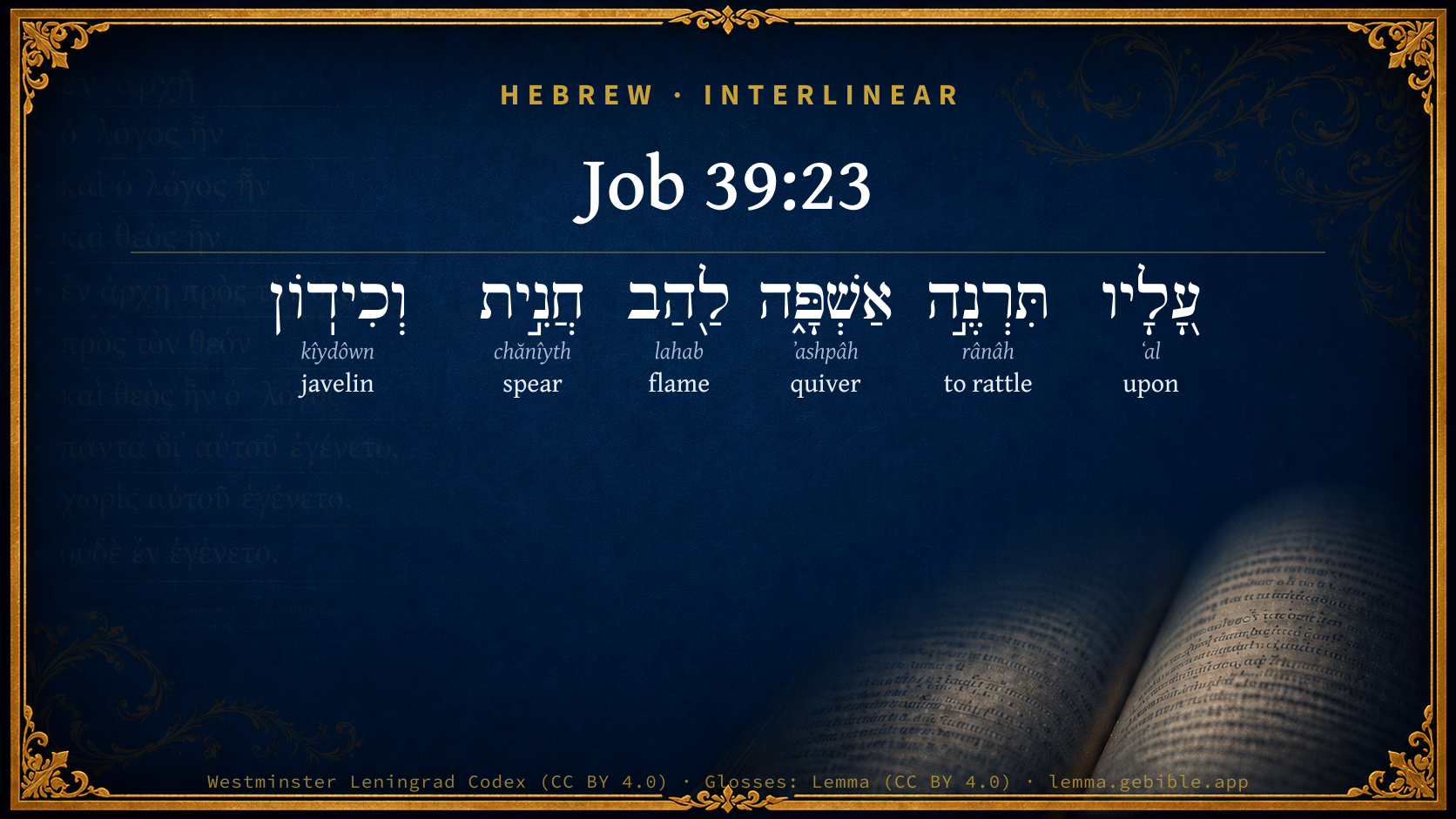
Job 39:23

Hebrew (Westminster Leningrad Codex) Job 39:23 appears in the Hebrew Old Testament. The text above is from the Westminster Leningrad Codex. Each word links to its Strong’s number, a concise gloss, and parsing drawn from the Open Scriptures Hebrew Bible morphology. Click any word for its full Brown-Driver-Briggs (BDB) entry.
Download image
Cite this verse

Job 39:23 (World English Bible). Public Domain. Lemma interlinear Bible study tool, https://lemma.gebible.app/v/job/39/23.

Show BibTeX & RIS
BibTeX
RIS
English Translation
The quiver rattles against him, The flashing spear and the javelin.
World English Bible · Public Domain
Highlights
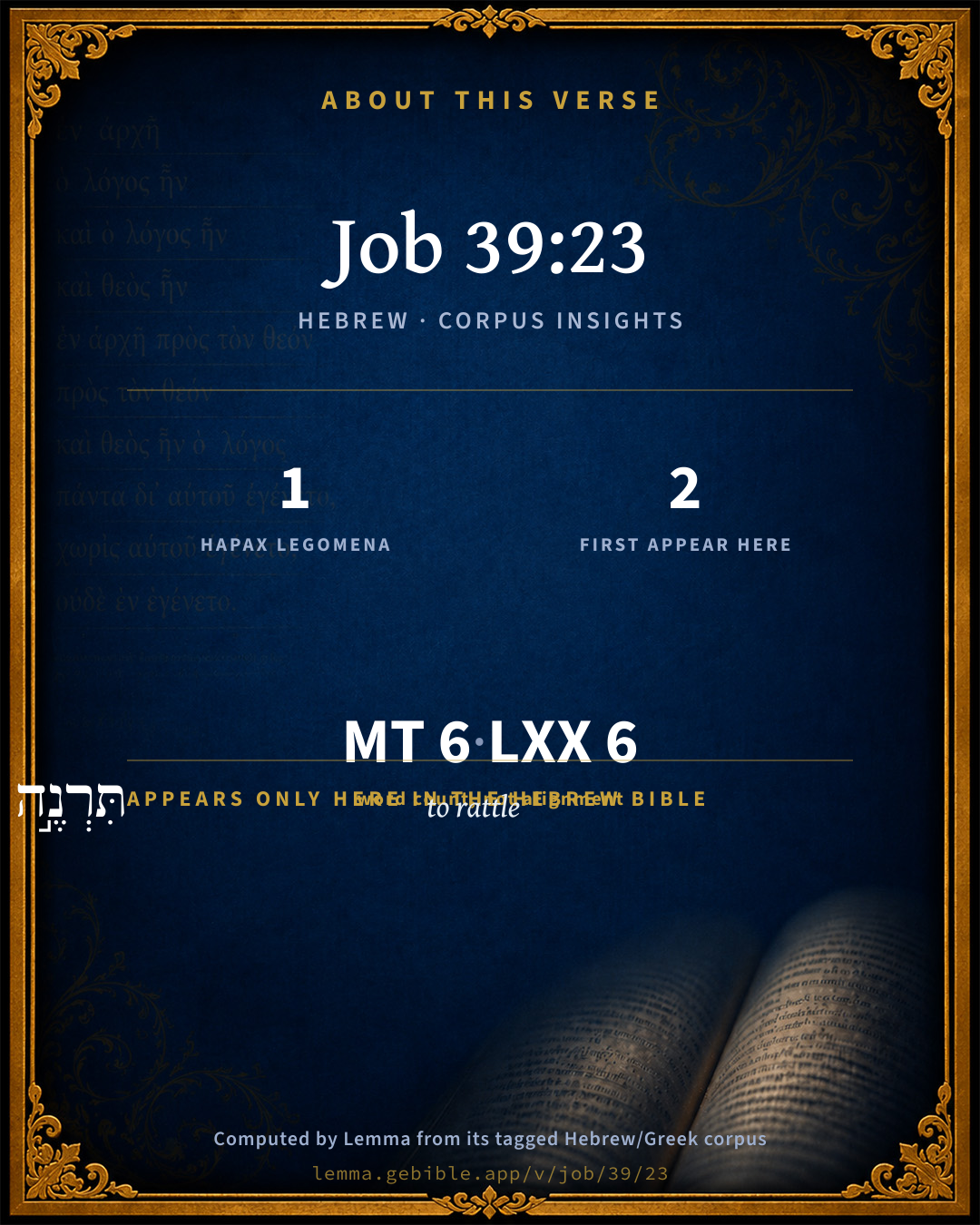
  • 1 hapax legomenon — only here in the Hebrew Bible
  • 2 first appearances in the Hebrew Bible
Full analysis ↓
Download a study sheet

One document with this verse’s original text, its word-by-word gloss line, the meaning frame, cross-references with their text, attributed commentary, and full source and license credits — printable, and it pastes into notes with its structure intact.

This verse Autodidact and up

Study sheet (.html) Plain text (.txt)

A passage Seminary Student

Up to 50 verses in one chapter. A passage sheet keeps up to 6 commentary sources and 12 cross-references per verse, in the order this page ranks them, and says so on the sheet whenever that leaves anything out. Ask for a single verse and you get the Autodidact verse sheet above.

Everything on this page stays free to read, with no account — the sheet is a download of what is already on screen, not access to it.

Want to remove ads? Support Godless Engineer
Compare translations 3

The same verse in 3 English versions, stacked beneath the original-language interlinear above. Click any original word for its lexicon entry.

Each is an independent rendering of the whole verse — the interlinear is not word-aligned to these translations.

Highlighted words mark where these versions differ — a whole-verse word diff, not a word-by-word alignment.

  • World English Bible Public Domain
    The quiver rattles against him, The flashing spear and the javelin.
  • King James Version Public Domain
    The quiver rattleth against him, the glittering spear and the shield.
  • unfoldingWord Literal Text CC BY-SA 4.0
    The quiver rattles upon him, the flashing of the spear and the javelin.

unfoldingWord Literal Text — © unfoldingWord, licensed CC BY-SA 4.0. Word-aligned USFM3 via Door43 (git.door43.org/unfoldingWord/en_ult).

Versions to compare (up to 4)

3 of 4 selected

Show all 18 translations

Every available English version of this verse, each an independent rendering of the whole verse.

  • World English Bible Public Domain
    The quiver rattles against him, The flashing spear and the javelin.
  • Berean Standard Bible Public Domain
    A quiver rattles at his side, along with a flashing spear and lance.
  • Majority Standard Bible Public Domain
    A quiver rattles at his side, along with a flashing spear and lance.
  • King James Version Public Domain
    The quiver rattleth against him, the glittering spear and the shield.
  • American Standard Version (1901) Public Domain
    The quiver rattleth against him, The flashing spear and the javelin.
  • Revised Version (1885) Public Domain
    The quiver rattleth against him, the flashing spear and the javelin.
  • Geneva Bible (1599) Public Domain
    Hast thou made him afraid as the grashopper? his strong neying is fearefull.
  • Douay-Rheims (1899) Public Domain
    Above him shall the quiver rattle, the spear and shield shall glitter.
  • Young's Literal Translation Public Domain
    Against him rattle doth quiver, The flame of a spear, and a halbert.
  • Literal Standard Version CC BY-SA 4.0
    Quiver rattles against him, || The flame of a spear, and a javelin.
  • Unlocked Literal Bible CC BY-SA 4.0
    The quiver rattles against his flank, along with the flashing spear and the javelin.
  • unfoldingWord Literal Text CC BY-SA 4.0
    The quiver rattles upon him, the flashing of the spear and the javelin.
  • Darby Bible Public Domain
    The quiver rattleth upon him, the glittering spear and the javelin.
  • World Messianic Bible Public Domain
    The quiver rattles against him, the flashing spear and the javelin.
  • Webster's Bible Public Domain
    \\39:20\\Canst thou make him afraid as a grasshopper? the glory of his nostrils is terrible.
  • Free Bible Version CC BY-SA 4.0
    The quiver full of arrows rattles against it; the spear and the javelin flash in the sunlight.
  • Bible in Basic English Public Domain
    Is it through you that he is shaking like a locust, in the pride of his loud-sounding breath?
  • JPS Tanakh (1917) Public Domain
    The quiver rattleth upon him, the glittering spear and the javelin.

Literal Standard Version (2020), Covenant Press — licensed CC BY-SA 4.0. Text via the HelloAO Bible API (eBible.org). Unlocked Literal Bible (unfoldingWord) — licensed CC BY-SA 4.0. Text via the HelloAO Bible API (eBible.org). unfoldingWord Literal Text — © unfoldingWord, licensed CC BY-SA 4.0. Word-aligned USFM3 via Door43 (git.door43.org/unfoldingWord/en_ult). Free Bible Version, Dr. Jonathan Gallagher — licensed CC BY-SA 4.0. Text via the HelloAO Bible API (eBible.org).

Word by word

More ways to search: Search by grammar → Find every occurrence → Compare this word →

Practice this passage: Drill this verse → Learn its vocabulary →

About this verse

These counts appear in no published source. They are computed here, from the morphology-tagged text and Lemma’s own curated glosses. What Lemma adds →

6
words
6
distinct lemmas
Wisdom
section

Notable vocabulary

1 hapax legomenon — a word that appears only here in the entire Hebrew Bible:

  • תִּרְנֶ֣ה to rattle H7439

First appearance in Scripture

These words make their first canonical appearance in the Hebrew Bible here:

  • תִּרְנֶ֣ה to rattle H7439
  • אַשְׁפָּ֑ה quiver H827

Shared distinctive vocabulary

אַשְׁפָּ֑ה quiver H827 occurs in 6 verses of the Hebrew Bible. Also found in:

Grammatical profile

  • 1 verb
  • 4 nouns
  • 1 preposition

Verb forms

  • תִּרְנֶ֣ה Qal · Imperfect

Hebrew & Septuagint length

In English translation the verse runs 11 words from the Hebrew and 15 from the Septuagint (LXX English) — closely comparable.

A rough comparison of the two English renderings, which tokenize alike — not a word-level alignment.

Word counts can differ between the Hebrew and the Greek without any difference in meaning — e.g. the Hebrew direct-object marker אֵת has no separate Greek word, and Greek often adds the article ὁ.

In the original languages it is 6 Hebrew tokens and 6 Greek tokens — but the two are counted differently (Hebrew bundles its prefixes and suffixes into one token; the Greek is in lemma form), so that isn’t a like-for-like length.

Cross-references

1

Topical passages linked to Job 39:23 in the Treasury of Scripture Knowledge — connected by theme and wording, ordered by reader-vote popularity; previews shown in the World English Bible.

  • Job 41:26–29 If one lay at him with the sword, it can't avail; Nor the spear, the dart, nor the pointed shaft.

Cross-references courtesy of OpenBible.info (CC BY 4.0).

Hebrew and Greek witnesses Masoretic Hebrew ↔ Greek Septuagint

The same verse in the two great witnesses to the Old Testament, shown verse-for-verse.

These are two independent witnesses, not word-aligned to each other, and the Septuagint is shown in lemma (dictionary) form.

Hebrew Job 39:23 Masoretic · Westminster Leningrad Codex

עָ֭לָיו תִּרְנֶ֣ה אַשְׁפָּ֑ה לַ֖הַב חֲנִ֣ית וְכִידֽוֹן

The quiver rattles against him, The flashing spear and the javelin.

World English Bible · Public Domain

Greek LXX Job 39:23 Septuagint · lemma form

ἐπί αὐτός γαυριάω τόξον καί μάχαιρα

The bow and sword resound against him; and his rage will swallow up the ground:

LXX2012 (modern English Septuagint) · Public Domain

Hebrew: Westminster Leningrad Codex (CC BY 4.0). Greek: Septuagint (public domain); English from LXX2012 (modern English Septuagint) (Public Domain). How the Septuagint differs from the Hebrew →

Commentary

Notes on Job 39:23 from classic Christian and Jewish commentators (each source and its license shown beneath its notes). The classic Christian expositions comment on the surrounding passage and are grouped to its opening verse, so a note may address several verses; the Jewish commentaries on the Tanakh (Rashi and others) are per-verse, so they appear only where the commentator wrote on this verse.

Lemma curates 59 commentaries, every one of them public domain or Creative Commons licensed, each selected and text-cleaned for this edition rather than reprinted as found. About our sources →

The Cambridge Bible for Schools and Colleges

gen. ed. J. J. S. Perowne

23. rattleth against him] Rather perhaps, upon him. The quiver is that of his rider, the clang of which excites him.

the shield] Rather, the javelin, or, lance. The Poet does not seek to describe the actual conflict; it is a picture of the horse that he gives, and the moment before the conflict is that at which the animal’s extraordinary attributes are most strongly exhibited. “Although docile as a lamb, and requiring no other guide than the halter, when the Arab mare hears the war-cry of the tribe (cf. Job_39:25), and sees the quivering spear of her rider (cf. Job_39:23), her eyes glitter with fire, her blood-red nostrils open wide, her neck is nobly arched, and her tail and mane are raised and spread out to the wind (cf. Job_39:19). A Bedouin proverb says, that a high-bred mare when at full speed should hide her rider between her neck and her tail” (Layard, Discoveries, p. 330).

The Cambridge Bible for Schools and Colleges (gen. ed. J. J. S. Perowne; Cambridge University Press, 1878–1918) — public domain. Text from a community e-Sword module.

Trapp's Complete Commentary

John Trapp

Job 39:23 The quiver rattleth against him, the glittering spear and the shield.

Ver. 23. The quiver rattleth against him] The arrow; those messengers of death come whisking and singing about his ears (so the bullets now in so much use), but he is unappalled by this.

The glittering spear] Heb. The flaming spear, as Gen 3:24, that is, bright and clear, shining like a flame of fire, which must needs be terrible; but not at all to the war horse.

And the shield] Or rather javelin, lance, or the like; he feareth not a wood of pikeman set in array against him.

John Trapp, A Commentary or Exposition upon All the Books of the Old and New Testament (1647–1656) — public domain. Text from a community e-Sword module.

Jamieson, Fausset & Brown

Robert Jamieson, A. R. Fausset & David Brown

quiver--for the arrows, which they contain, and which are directed "against him."

glittering spear--literally, "glittering of the spear," like "lightning of the spear" (Hab 3:11).

shield--rather, "lance."

Jamieson, Fausset & Brown — Commentary Critical and Explanatory on the Whole Bible (1871) — public domain (CC PDM 1.0). Text via the HelloAO Bible API.

John Gill's Exposition

The quiver rattleth against him,.... The quiver is what arrows are put into and carried in, and seems here to be put for arrows, which being shot by the enemy come whizzing about him, but do not intimidate him; unless this is to be understood of arrows rattling in the quiver when carried by the rider "upon him", so some render the last word; and thus Homer (w) and Virgil (x) speak of the rattling quiver and sounding arrows in it, as carried on the back or shoulder; but the first sense seems best, in which another poet uses it (y);

the glittering spear and the shield; the lance or javelin, as Mr. Broughton renders it, and others; that is, he does not turn back from these, nor is he frightened at them when they are pointed to him or flung at him; so Aelianus (z) speaks of the Persians training their horses and getting them used to noises, that in battle they might not be frightened at the clashing of arms, of swords and shields against each other; in like manner as our war horses are trained, not to start at the firing of a gun, or the explosion of a cannon.

(w) Iliad. 1. v. 4. (x) "Pharetramqne sonantem". Aeneid. 9. v. 666. (y) "----audito sonitu per inane pharetrae". Ovid. Metamorph. l. 6. v. 230. (z) De Animal. l. 16. c. 25.

John Gill's Exposition of the Whole Bible (1746–1763) — public domain (CC PDM 1.0). Text via the HelloAO Bible API.

Albert Barnes' Notes on the Bible

The quiver rattleth against him - The quiver was a case made for containing arrows. It was usually slung over the shoulder, so that it could be easily reached to draw out an arrow. Warriors on horseback, as well as on foot, fought with bows and arrows, as well as with swords and spears; and the idea here is, that the war-horse bore upon himself these instruments of war. The rattling of the quiver was caused by the fact that the arrows were thrown somewhat loosely into the case or the quiver, and that in the rapid motion of the warrior they were shaken against each other. Thus, Virgil, Aeneid ix. 660:

- pharetramque fuga sensere sonantem.

Silius, L. 12:

Plena tenet et resonante pharetra.

And again:

Turba ruunt stridentque sagittiferi coryti.

So Homer (“Iliad, a.”), when speaking of Apollo:

Τόξ ὤμοισιν ἔχων, ἀμφηρεφέα τε φαρέτρην

Ἔκλαγξαν δ ̓ ἄῤ ὀΐστοὶ ἐπ ̓ ὤμων χωομένοιο.

Tox́ ōmoisin echōn, amfērefea te faretrēn

Eklangxan d' aŕ oistoi ep' ōmōn chōmenoio.

See Seheutzer’s “Phys. Sac., in loc.”

Albert Barnes' Notes on the Bible (1834–1885) — public domain. Text from a community e-Sword/MySword module.

Haydock's Catholic Bible Commentary

Shield, or lance, Josue viii. 18. (Calmet) --- The din of armour does not disturb the horse, which has been inured to such things. (Haydock) --- It is of singular courage. (Worthington)

George Leo Haydock (1774–1849), Haydock's Catholic Family Bible and Commentary, 1859 edition — public domain. Excludes Psalms (Douay-Rheims chapter numbering differs from Protestant) and Deuterocanonical books (Catholic canon only).

Matthew Poole's English Annotations

The quiver; or although the quiver &c. So this comes in as an aggravation of his courage, notwithstanding the just causes of fear which are mentioned in this verse. And the quiver is here put for the arrows contained in it, by a metonymy, very usual in this very case, and in all sorts of authors, which being shot against the horse and rider, make this rattling noise here mentioned.

The glittering spear and the shield; or rather, the lance or javelin. For that this was not a defensive, but an offensive weapon, seems plain, both from this place, where it is mentioned among such, and as an object of fear, which the shield is not, and from Jos 8:18; 1Sa 17:45, where it is so used.

Matthew Poole's English Annotations on the Holy Bible (1683–1685) — public domain. Text from a community e-Sword/MySword module.

Whedon's Commentary on the Bible

Daniel D. Whedon

23. The quiver — Used metaphorically for its contents — the arrows.

The glittering spear — Literally, the flame of a spear.

Shield — Hebrews, kidhon. More properly “javelin,” or “spear.” See note Job_41:29. Arrows and gleaming spears hurtle against him, and he turns not back.

Daniel D. Whedon (gen. ed.), Commentary on the Old and New Testaments (1874–1909) — public domain. Text from a community e-Sword module.

The Pulpit Commentary

The quiver rattleth against him. In the Aasyrian sculptures the quiver of mounted archers is often hung at the side, instead of at the back. In this position it would rattle against the neck of the war-horse (see "Ancient Monarchies," vol. 2 p. 25). The glittering spear and the shield would occasionally strike against his neck or his shoulders.

The Pulpit Commentary (1880–1919), ed. H.D.M. Spence-Jones & Joseph S. Exell — public domain. Text from a community e-Sword module.

John Wesley's Explanatory Notes

Quiver - The quiver is here put for the arrows contained in it, which being shot against the horse and rider, make a rattling noise.

John Wesley, Explanatory Notes Upon the Whole Bible (1754–1765) — public domain. Text via the GEBible commentary corpus.

Rashi

Rabbi Shlomo Yitzchaki (Rashi)

The quiver...rattles [i.e., the quiver that is] full of arrows, and they knock against each other so that their sound is heard.

the blade of the spear An iron utensil (and an iron spear) is called לַהַב, as in (Jud. 3:22), “and the haft also went in after the blade (הלהב).”

Rashi on the Tanakh — English translations: “The Judaica Press complete Tanach with Rashi, translated by A. J. Rosenberg” (CC BY 4.0); “Pentateuch with Rashi's commentary by M. Rosenbaum and A.M. Silbermann, 1929-1934” (public domain); “The Metsudah Tanach series, Lakewood, N.J” (CC BY 4.0); and “The Book of Joshua, Metsudah Publications, 1997” (CC BY 4.0). Text via Sefaria.

Lesson kit

Teaching starters — assembled from the data on this page, not authored interpretation. Every prompt links to the verse data it draws on. Edit before teaching.

Job, in the Wisdom, opens this verse with 6 words (6 distinct Hebrew lemmas). Its most distinctive word is rânâh (“to rattle”). A historical commentator’s framing appears above. Read the whole chapter for the surrounding context.

Discussion questions

  1. How does “to rattle” (rânâh) shape what this verse is saying?
  2. This verse holds 1 word here found nowhere else in the Hebrew Bible. What might the rare word draw attention to?
  3. 2 words here appear for the first time in Scripture. What is being introduced at this debut?
  4. Psalms 127:5 shares the word «quiver» with this verse. How do the two illuminate each other?
  5. The translations on this page render this verse differently — a whole-verse word diff, not a word-by-word alignment. What might account for the different wordings?
  6. The verb «תִּרְנֶ֣ה» is Qal Imperfect. How does its form color the action?
  7. Reading how The Cambridge Bible for Schools and Colleges and Trapp's Complete Commentary read this verse, where do the two commentators agree and where do they part?

Things to notice

Reading settings

Reading text

Shown beneath each verse's original-language words.

Old Testament
Old Testament edition

Read the OT as the Masoretic Hebrew (MT) or the Greek Septuagint (LXX).

English shown for the Greek Septuagint (in the Hebrew ↔ Greek comparison).

Comparing translations? Open the Compare panel on any verse page to stack up to four side by side.