2 Kings 11:10

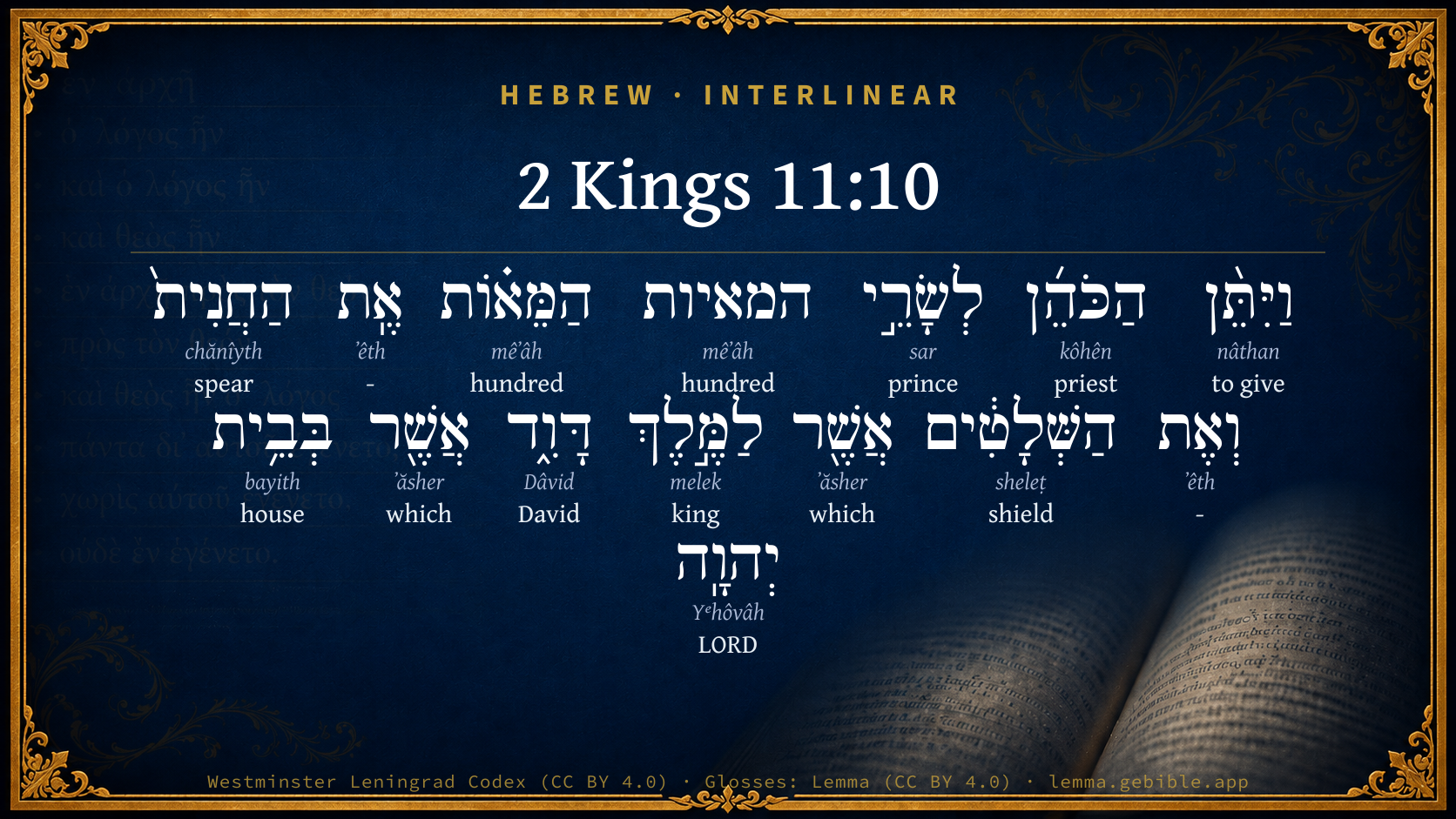
Hebrew (Westminster Leningrad Codex) 2 Kings 11:10 appears in the Hebrew Old Testament. The text above is from the Westminster Leningrad Codex. Each word links to its Strong’s number, a concise gloss, and parsing drawn from the Open Scriptures Hebrew Bible morphology. Click any word for its full Brown-Driver-Briggs (BDB) entry.
Download image
Cite this verse

2 Kings 11:10 (World English Bible). Public Domain. Lemma interlinear Bible study tool, https://lemma.gebible.app/v/2-kings/11/10.

Show BibTeX & RIS
BibTeX
RIS
English Translation
The priest delivered to the captains over hundreds the spears and shields that had been king David's, which were in the house of Yahweh.
World English Bible · Public Domain
Download a study sheet

One document with this verse’s original text, its word-by-word gloss line, the meaning frame, cross-references with their text, attributed commentary, and full source and license credits — printable, and it pastes into notes with its structure intact.

This verse Autodidact and up

Study sheet (.html) Plain text (.txt)

A passage Seminary Student

Up to 50 verses in one chapter. A passage sheet keeps up to 6 commentary sources and 12 cross-references per verse, in the order this page ranks them, and says so on the sheet whenever that leaves anything out. Ask for a single verse and you get the Autodidact verse sheet above.

Everything on this page stays free to read, with no account — the sheet is a download of what is already on screen, not access to it.

Want to remove ads? Support Godless Engineer
Compare translations 3

The same verse in 3 English versions, stacked beneath the original-language interlinear above. Click any original word for its lexicon entry.

Each is an independent rendering of the whole verse — the interlinear is not word-aligned to these translations.

Highlighted words mark where these versions differ — a whole-verse word diff, not a word-by-word alignment.

  • World English Bible Public Domain
    The priest delivered to the captains over hundreds the spears and shields that had been king David's, which were in the house of Yahweh.
  • King James Version Public Domain
    And to the captains over hundreds did the priest give king David's spears and shields, that were in the temple of the LORD.
  • unfoldingWord Literal Text CC BY-SA 4.0
    And the priest gave to the captains of the hundreds the spears and the shields that to King David that in the house of Yahweh.

unfoldingWord Literal Text — © unfoldingWord, licensed CC BY-SA 4.0. Word-aligned USFM3 via Door43 (git.door43.org/unfoldingWord/en_ult).

Versions to compare (up to 4)

3 of 4 selected

Show all 18 translations

Every available English version of this verse, each an independent rendering of the whole verse.

  • World English Bible Public Domain
    The priest delivered to the captains over hundreds the spears and shields that had been king David's, which were in the house of Yahweh.
  • Berean Standard Bible Public Domain
    Then the priest gave to the commanders of hundreds the spears and shields of King David from the house of the LORD.
  • Majority Standard Bible Public Domain
    Then the priest gave to the commanders of hundreds the spears and shields of King David from the house of the LORD.
  • King James Version Public Domain
    And to the captains over hundreds did the priest give king David's spears and shields, that were in the temple of the LORD.
  • American Standard Version (1901) Public Domain
    And the priest delivered to the captains over hundreds the spears and shields that had been king David's, which were in the house of Jehovah.
  • Revised Version (1885) Public Domain
    And the priest delivered to the captains over hundreds the spears and shields that had been king David’s, which were in the house of the LORD.
  • Geneva Bible (1599) Public Domain
    And the Priest gaue to the captaines of hundreths the speares and the shieldes that were King Dauids, and were in the house of the Lord.
  • Douay-Rheims (1899) Public Domain
    And he gave them the spears, and the arms of king David, which were in the house of the Lord.
  • Young's Literal Translation Public Domain
    and the priest giveth to the heads of the hundreds the spears and the shields that king David had, that `are' in the house of Jehovah.
  • Literal Standard Version CC BY-SA 4.0
    and the priest gives to the heads of the hundreds the spears and the shields that King David had, that [are] in the house of YHWH.
  • Unlocked Literal Bible CC BY-SA 4.0
    Then Jehoiada the priest gave the commanders of hundreds the spears and shields that belonged to King David and that were in the house of Yahweh.
  • unfoldingWord Literal Text CC BY-SA 4.0
    And the priest gave to the captains of the hundreds the spears and the shields that to King David that in the house of Yahweh.
  • Darby Bible Public Domain
    And the priest gave to the captains of the hundreds king David's spears and shields which were in the house of Jehovah.
  • World Messianic Bible Public Domain
    The priest delivered to the captains over hundreds the spears and shields that had been King David’s, which were in the LORD’s house.
  • Webster's Bible Public Domain
    And to the captains over hundreds the priest gave king David's spears and shields, that were in the temple of the LORD.
  • Free Bible Version CC BY-SA 4.0
    Then the priest handed over to the commanders of hundreds the spears and shields that had belonged to King David which were kept in the Lord's Temple.
  • Bible in Basic English Public Domain
    And the priest gave to the captains of hundreds the spears and body-covers which had been King David's, and which were kept in the house of the Lord.
  • JPS Tanakh (1917) Public Domain
    And the priest delivered to the captains over hundreds the spear and shields that had been king David's, which were in the house of the LORD.

Literal Standard Version (2020), Covenant Press — licensed CC BY-SA 4.0. Text via the HelloAO Bible API (eBible.org). Unlocked Literal Bible (unfoldingWord) — licensed CC BY-SA 4.0. Text via the HelloAO Bible API (eBible.org). unfoldingWord Literal Text — © unfoldingWord, licensed CC BY-SA 4.0. Word-aligned USFM3 via Door43 (git.door43.org/unfoldingWord/en_ult). Free Bible Version, Dr. Jonathan Gallagher — licensed CC BY-SA 4.0. Text via the HelloAO Bible API (eBible.org).

Word by word

More ways to search: Search by grammar → Find every occurrence → Compare this word →

Practice this passage: Drill this verse → Learn its vocabulary →

הַשְּׁלָטִ֔ים
sheleṭ
H7982
“the · shields”
Particle, Definite Article + Noun, Common, Masculine, Plural, Absolute
Part of Speech
Particle + Noun
Type
Common
Gender
Masculine
Number
Plural
State
Absolute
Full BDB Definition

Origin: from H7980

TWOT: 2397a

shield
  1. וַיִּתֵּ֨ן nâthan H5414 “and · to give” Conjunction + Verb, Qal, Sequential Imperfect, 3rd Person, Masculine, Singular
  2. הַכֹּהֵ֜ן kôhên H3548 “the · priest” Particle, Definite Article + Noun, Common, Masculine, Singular, Absolute
  3. לְשָׂרֵ֣י sar H8269 “to/for · princes of” Preposition + Noun, Common, Masculine, Plural, Construct
  4. המאיות mêʼâh H3967 “the · hundred” Particle, Definite Article + Adjective, Cardinal number, Both, Plural, Absolute
  5. הַמֵּא֗וֹת mêʼâh H3967 “the · hundred” Particle, Definite Article + Adjective, Cardinal number, Both, Plural, Absolute
  6. אֶֽת ʼêth H853 “-” Particle, Direct Object
  7. הַחֲנִית֙ chănîyth H2595 “the · spear” Particle, Definite Article + Noun, Common, Feminine, Singular, Absolute
  8. וְאֶת ʼêth H853 “and · -” Conjunction + Particle, Direct Object
  9. אֲשֶׁ֖ר ʼăsher H834 “which” Particle, Relative
  10. לַמֶּ֣לֶךְ melek H4428 “to/for the · king” Preposition, Determined + Noun, Common, Masculine, Singular, Absolute
  11. דָּוִ֑ד Dâvid H1732 “David” Noun, Proper
  12. אֲשֶׁ֖ר ʼăsher H834 “which” Particle, Relative
  13. בְּבֵ֥ית bayith H1004 “in/at · house of” Preposition + Noun, Common, Masculine, Singular, Construct
  14. יְהוָֽה Yᵉhôvâh H3068 “LORD” Noun, Proper

About this verse

These counts appear in no published source. They are computed here, from the morphology-tagged text and Lemma’s own curated glosses. What Lemma adds →

15
words
12
distinct lemmas
Historical
section

Notable vocabulary

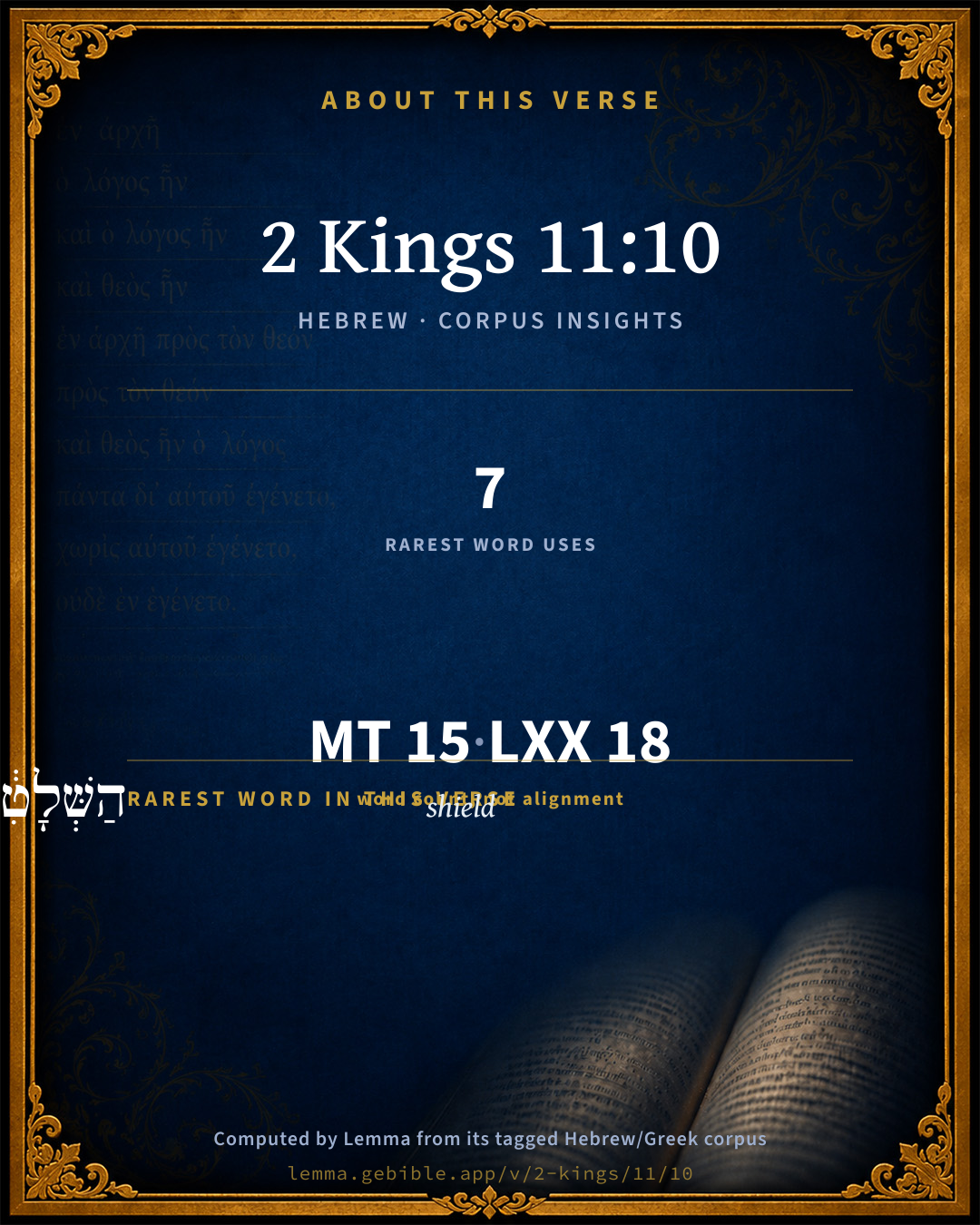
The rarest word here is הַשְּׁלָטִ֔ים shield H7982 — appearing just 7 times in the whole Hebrew Bible.

Shared distinctive vocabulary

הַשְּׁלָטִ֔ים shield H7982 occurs in 7 verses of the Hebrew Bible. Also found in:

Grammatical profile

  • 1 verb
  • 8 nouns
  • 2 adjectives
  • 4 particles

Verb forms

  • וַיִּתֵּ֨ן Qal · Sequential Imperfect

Repetition

Words recur within this verse — often emphatic in Hebrew:

  • המאיות hundred H3967 ×2
  • אֲשֶׁ֖ר which H834 ×2

Hebrew & Septuagint length

In English translation the verse runs 24 words from the Hebrew and 24 from the Septuagint (LXX English) — the same length.

A rough comparison of the two English renderings, which tokenize alike — not a word-level alignment.

Word counts can differ between the Hebrew and the Greek without any difference in meaning — e.g. the Hebrew direct-object marker אֵת has no separate Greek word, and Greek often adds the article ὁ.

In the original languages it is 15 Hebrew tokens and 18 Greek tokens — but the two are counted differently (Hebrew bundles its prefixes and suffixes into one token; the Greek is in lemma form), so that isn’t a like-for-like length.

Cross-references

6

Topical passages linked to 2 Kings 11:10 in the Treasury of Scripture Knowledge — connected by theme and wording, ordered by reader-vote popularity; previews shown in the World English Bible.

  • 2 Samuel 8:7 David took the shields of gold that were on the servants of Hadadezer, and brought them to Jerusalem.
  • 1 Chronicles 18:7 David took the shields of gold that were on the servants of Hadarezer, and brought them to Jerusalem.
  • 1 Samuel 21:9 The priest said, The sword of Goliath the Philistine, whom you killed in the valley of Elah, behold, it is here wrapped in a cloth behind the ephod: if you will take that, take it; for there is no other except that here. David said, There is none like that; give it me.
  • 1 Chronicles 26:26–27 This Shelomoth and his brothers were over all the treasures of the dedicated things, which David the king, and the heads of the fathers' [houses], the captains over thousands and hundreds, and the captains of the host, had dedicated.
  • 2 Chronicles 5:1 Thus all the work that Solomon did for the house of Yahweh was finished. Solomon brought in the things that David his father had dedicated, even the silver, and the gold, and all the vessels, and put them in the treasuries of the house of God.
  • 2 Chronicles 23:9–10 Jehoiada the priest delivered to the captains of hundreds the spears, and bucklers, and shields, that had been king David's, which were in the house of God.

Cross-references courtesy of OpenBible.info (CC BY 4.0).

Hebrew and Greek witnesses Masoretic Hebrew ↔ Greek Septuagint

The same verse in the two great witnesses to the Old Testament, shown verse-for-verse.

These are two independent witnesses, not word-aligned to each other, and the Septuagint is shown in lemma (dictionary) form.

Hebrew 2 Kings 11:10 Masoretic · Westminster Leningrad Codex

וַיִּתֵּ֨ן הַכֹּהֵ֜ן לְשָׂרֵ֣י המאיות הַמֵּא֗וֹת אֶֽת הַחֲנִית֙ וְאֶת הַשְּׁלָטִ֔ים אֲשֶׁ֖ר לַמֶּ֣לֶךְ דָּוִ֑ד אֲשֶׁ֖ר בְּבֵ֥ית יְהוָֽה

The priest delivered to the captains over hundreds the spears and shields that had been king David's, which were in the house of Yahweh.

World English Bible · Public Domain

Greek LXX 2 Kings 11:10 Septuagint · lemma form

καί δίδωμι ὁ ἱερεύς ὁ ἑκατοντάρχης ὁ σειρομάστης καί ὁ τρισσός ὁ βασιλεύς δαυίδ ὁ ἐν οἶκος κύριος

And the priest gave to the captains of hundreds the swords and spears of king David that were in the house of the Lord.

LXX2012 (modern English Septuagint) · Public Domain

Hebrew: Westminster Leningrad Codex (CC BY 4.0). Greek: Septuagint (public domain); English from LXX2012 (modern English Septuagint) (Public Domain). How the Septuagint differs from the Hebrew →

Targum (Aramaic paraphrase)

1

The Targum is the ancient Jewish Aramaic paraphrase of the Hebrew Scriptures — an interpretive translation, not the Hebrew text itself. Onkelos (literal) and Pseudo-Jonathan (expansive) render the Torah, and Jonathan the Prophets. Coverage is partial: where no permissively-licensed English translation exists for a verse, only the Aramaic is shown. This is verse-level text, not a word-by-word alignment to the Hebrew.

  1. Targum Jonathan Prophets (Joshua–Malachi)
    וִיהַב יְהוֹיָדָע כַּהֲנָא לְרַבָּנֵי מַאֲוָתָא יַת מוּרְנִיתָא וְיַת שְׁלָטַיָא דִי לְמַלְכָּא דָוִד דִי בְּבֵית מַקְדְשָׁא דַיָי:

    (no public-domain English translation for this verse)

    Targum Jonathan — Aramaic: “Mikraot Gedolot” (public domain). English: “Sefaria Community Translation” (CC0 1.0 (public-domain dedication)); “London "Chaldee Paraphrase," 1871” (public domain). Text via Sefaria.

Commentary

Notes on 2 Kings 11:10 from classic Christian and Jewish commentators (each source and its license shown beneath its notes). The classic Christian expositions comment on the surrounding passage and are grouped to its opening verse, so a note may address several verses; the Jewish commentaries on the Tanakh (Rashi and others) are per-verse, so they appear only where the commentator wrote on this verse.

Lemma curates 59 commentaries, every one of them public domain or Creative Commons licensed, each selected and text-cleaned for this edition rather than reprinted as found. About our sources →

Trapp's Complete Commentary

John Trapp

2Ki 11:10 And to the captains over hundreds did the priest give king David’s spears and shields, that [were] in the temple of the LORD.

Ver. 10. King David’s spears and shields.] Kept in the temple for trophies and tokens of thanksgiving: such as were Goliath’s sword, {1Sa 21:9} and the Syrians’ shields. {2Sa 8:7; 2Sa 8:11}

John Trapp, A Commentary or Exposition upon All the Books of the Old and New Testament (1647–1656) — public domain. Text from a community e-Sword module.

The Biblical Illustrator

Joseph S. Exell

2Ki_11:10

King Davids spears and shields, that were in the temple of the Lord.

New use for old trophies

When David had fought with an adversary, and overcome him, he took away his armour and his weapons, and as other victorious heroes were wont to do, he bore them home as mementoes of his prowess, the trophies of the battle. These were placed in the house of the Lord. Perhaps David at the same time dedicated in like manner the shield and the sword which he had himself used in battle. After Solomon had built the temple, these trophies, which seem to have been very numerous, were hung up there. So they adorned the wails. So they illustrated the valour of noble sires. So they served to kindle emulation, I doubt not, in the breasts of true.hearted sons. Thus it was while generations sprung up and passed away; till at length other days dawned, darker scenes transpired, and sadder things filled up the chronicles of the nation.

I. It is well for us to hang all our trophies in the House of the Lord. We, too, are warriors. Every genuine Christian has to fight. Every inch of the way between here and heaven we shall have to fight, for as hitherto every single step o our pilgrimage has been one prolonged conflict. Sometimes we have victories, a presage of that final victory, that perfect triumph we shall enjoy with our Great Captain for ever. When we have these victories it behoves us to be especially careful that in all good conscience we hang up the trophies thereof in the house of the Lord. The reason for this lies here: it is to the Lord that we owe any success we have ever achieved. We have been defeated when we have gone in our own strength; but when we have been victorious it has always been because the strength of the Lord was put forth for our deliverance. You never fought with a sin, with a temptation, or with a doubt, and overthrew it, except by the Spirits aid. This will save us from pride and self-sufficiency. Scarcely can God trust us with a victory, lest we begin fingering it with our own hands, as if our own ingenuity, our own wisdom, or our own strength had done marvels.

II. These trophies may come in useful at such times as we cannot foresee, and under such circumstances as we wot not of. Little could David have thought when he gave Abiathar the sword of Goliath, that he would ever go to the priests of Gad and ask them to lend him a sword, and that they should say, We have no sword here, save the sword of Goliath, the Philistine whom thou slewest in the Valley of Elah, behold it is wrapped in a cloth behind the ephod. He gave it to God, but he did not think that he would ever have it back again with a priestly blessing on it, so that he should be able to say, There is none like that: give it me. And when, in after years, he hung up the swords and shields which he had taken away from Philistine heroes, he did not surmise that one of his descendants, of the seed royal, would find the need to employ his own, his grandsires, or, further back, from himself--his forefathers trophies--in order to establish himself on the throne. We never know, when we praise God for mercies, hut what the very praises might come back into our bosoms, and the offerings we make to God in the way of thankfulness may be our own enrichment in the days to come. Did you ever have a personal, mental, moral conflict with some great dragon of besetting sin? If so be you have been enabled to smite it valiantly, and slay it utterly, I know you have gained trophies to hang up in the house of God. To do so will be of no small advantage to yourselves, because you can take them down and use them in future; and you will find they are footholds of your strength to fight with the next sin that comes upon you. The strength which God has educated and fostered in the last struggle will greatly assist you in the next. The man who gives way to one sin will very readily give way to another, but a man who through Gods grace has won a very high vantage ground by mastering one sin, will be very likely to win another. The spoils taken from the last Philistine will help us to go forth and win more, and in the name of God we shall get the victory. Now it is a fine, a noble thing, when you have had a conflict in your own soul with some plausible heresy, some seductive perversion of the truth, and have put it to flight with the sword of the Spirit, which is the Word of God; it is a noble feat, I say, to capture the arms of your assailant and to use the very weapons of the adversary against him. You have detected his sophistry, you have found out devices, and now for the future you will not be so readily carried away with every wind of doctrine. This time,you are too old to be taken with his chaff. You were deceived once, but by Gods grace you are not willing any longer to lend a ready ear to the fair speech which casts a mist over plain facts, hut you henceforth resolve to prove the spirits whether they be of God. So from the spoils of past conflicts you are made strong to win present victories.

III. Ancient weapons are good for present use. I should like to show you this by taking you on to a battle-field. We will go to it. It is not Sadowa or Sedan, it is a grander arena far--the old seventy-seventh. Turn to the seventy-seventh Psalm, and you have a battle-field there. Should you ever have to fight the same battle, by looking through this Psalm, you will see Davids shields and spears, and you will soon learn how to screen yourself with the one, and how to do exploits with the other. Here is David fighting with despondency. I daresay some of you are afflicted with it. But observe how he fought with it. The first weapon he drew out of the scabbard was the weapon of all-prayer. And how grandly he used it! I cried unto God with my voice, even unto God with my voice. Despondency soon flies when a man knows how to ply this all-conquering and ever-useful weapon of petition to the Most High. Then note how he used this weapon continually. My hand was stretched out all night, saith he, according to the marginal reading of the second verse. If the first prayer did not help him, he prayed again. When he had used the weapon of prayer, what did he do next? Be took out another spear. It was that of remembering God. He had long enough pored in thought over himself and his present sinfulness and weakness, and now he remembered Gods mercy, Gods faithfulness, Gods loving kindness, Gods power, Gods covenant, God in the person of Christ. Oh! this is indeed to prepare a salvo against the enemy, and to fortify ones own position with fresh succours. He can win the battle that knows how to use this artillery of remembering God. Going on with the strategy of war, what next? Why, in the fifth verse we read how he maintained his courage and his constancy--I considered the days of old. He enquired of hoary fathers, and looked back upon the inspired traditions, if I may be allowed the expression, of the early Church. He turned to see whether God ever did forsake any of His people. But now he used another weapon. He looked to his own experience--see the sixth verse. I called to remembrance my song in the night. Past experience acknowledged gratefully, and taken as the index of what the future will be--this is another of Davids shields and spears.

IV. Did not David herein prefigure Him that was to come--Davids son and Davids Lord? Jesus Christ, our King, has hung up many shields and spears in the house of the Lord. Sin--Christ has borne it in himself, endured its penalty and overcome it; He has hung up the handwriting of ordinances that was against us as a trophy in the house of the Lord. He has nailed it to the cross. Satan--our great foe--He met him foot to foot in the wilderness and discomfited him--met him in the garden--overcame him on the cross. Now hell, too, is vanquished--Christ is Lord. The prince of the power of the air is but his servant. The King of kings hath led captivity captive, and all the crowns of this prince of the power of the air are hung up as trophies. Broken are their spears: their shields all battered and vilely cast away, hang up as memorials of what Christ has done. Death, too, the last enemy, Christ hath taken spoils from him when He rose again himself from His prison house, and ascended on high, leading captivity captive. And the enmity of the human heart. When we look round the temple and see the shields and spears hung up, we say Who did those shields and spears belong to? One says, Why, that is the shield and spear of John Newton, the old blasphemer! Glory be to God, Christ conquered him. Whose shield and spears are those? Why, that is the shield and spear of John Bunyan, the blasphemer on the village green. Gods mercy conquered him. What will heaven be when all of us shall be trophies of His power to save, and when our bodies shall be there as well as our Souls! O death, where is thy sting? O grave, where is thy victory?--when not only souls, but bodies shall be in heaven too, all trophies of what Christ has done when He plucked His people from the jaws of the grave and delivered them from the grasp of the sepulchre. (C. H. Spurgeon.)

.

The Biblical Illustrator, edited by Joseph S. Exell (c. 1880s–1900s) — public domain. Text from a community e-Sword module.

Joseph Benson's Commentary

2Ki 11:10. To the captains did the priest give King David’s spears and shields — Offensive and defensive weapons, both for themselves and for all their soldiers; for they had all come into the temple unarmed, to prevent suspicion. These are called David’s, either because they were such as he had taken from his enemies, and had dedicated to God, and laid up in the temple as monuments of God’s goodness to him; or because he had made a sacred armory in the temple, whence arms might be taken upon extraordinary occasions, for the defence of the temple or city of God.

Joseph Benson's Commentary on the Old and New Testaments (1811–1818) — public domain. Text from a community e-Sword module.

Geneva Bible (1599)

Geneva Bible translators

To wit, Jehoiada.

Geneva Bible (1599) marginal notes — public domain. Text via Bolls.life.

Adam Clarke's Commentary

Verse 10. King David's spears and shields] Josephus expressly says that David had provided an arsenal for the temple, out of which Jehoiada took those arms. His words are; Ανοιξας δε Ιωαδος την εν τῳ ἱερῳ ὁπλοθηκην, ἡν Δαβιδης κατεσκευασε, διεμερισε τοις ἑκατονταρχαις ἁμα και ἱεροισι και Λευιταις ἁπανθ' ὁσα εὑρεν εν αυτῃ δορατα τε και φαρετρας, και ει τι ἑτερον ειδος ὁπλου κατελαβε. "And Jehoiada having opened the arsenal in the temple, which David had prepared, he divided among the centurions, priests, and Levites, the spears, (arrows,) and quivers, and all other kinds of weapons which he found there." - Ant. lib. ix., c. 7, s. 8.

Adam Clarke's Commentary on the Bible (1810–1826) — public domain. Text from a community e-Sword/MySword module.

Ellicott's Commentary for English Readers

(10) King David’s spears and shields.—The Hebrew has spear, but Chronicles has the plural, which appears correct. “Shields” should perhaps be arms. (Comp. 2Sa_8:7; 2Ch_23:9.) The arms which David had laid up in the Temple as spoils of war were now to be used, appropriately enough, for the restoration of David’s heir to the throne. Possibly, as Bähr suggests, the guards who came off duty at the palace had left their weapons there.

A Bible Commentary for English Readers, edited by Charles John Ellicott (1878–1897) — public domain. Text from a community e-Sword module.

The Cambridge Bible for Schools and Colleges

gen. ed. J. J. S. Perowne

10. And to the captains over hundreds did the priest give] R.V. And the priest delivered to the captains over hundreds. Thus the English is made to correspond to the Hebrew order more closely, and to the translation in 2 Chron. It is to be observed that both accounts agree about the weapons being delivered to the soldiery by Jehoiada, thus making clear that to both compilers it was known that the whole undertaking was controlled by the guard and not by the priests and Levites, though, as his manner is, the writer of Chronicles puts them in the forefront as much as he can.

king David’s stears and shields] R.V. the spears and shields that had been king David’s. This is the form in 2 Chronicles, except that there ‘bucklers’ are mentioned between ‘spears’ and ‘shields’. These weapons were those which David in his wars had taken from his enemies, and stored probably in the chambers round the temple. For the practice of so devoting the weapons of the conquered cf. the sword of Goliath laid up in store with Ahimelech at Nob (1Sa_21:9), and the shields which David took from the servants of Hadadezer (2Sa_13:7) and carried to Jerusalem.

that were in the temple [R.V. house] of the Lord] It is the same word which is rendered ‘house’ frequently in this chapter. Of course it means ‘temple’, but the English reader might suppose that the original had here a different word. The same change has to be made in the next verse, three times over; and in the parallel verse in 2 Chron.

The Cambridge Bible for Schools and Colleges (gen. ed. J. J. S. Perowne; Cambridge University Press, 1878–1918) — public domain. Text from a community e-Sword module.

John Gill's Exposition

And to the captains over hundreds did the priest give King David's spears and shields, that were in the temple of the Lord. Such as he had taken in war from his enemies, and had dedicated for the service of the temple, to defend it on occasion, and laid up there; those the priests gave to the captains, to arm their men with, who came unarmed, and so unsuspected, and in this way might be armed without being seen and known.

And to the captains over hundreds did the priest give King David's spears and shields, that were in the temple of the Lord. Such as he had taken in war from his enemies, and had dedicated for the service of the temple, to defend it on occasion, and laid up there; those the priests gave to the captains, to arm their men with, who came unarmed, and so unsuspected, and in this way might be armed without being seen and known.

2 Kings 11:11

kg2 11:11

kg2 11:11

kg2 11:11And the guard stood, every man with his weapons in his hand, round about the king,.... As ordered, Kg2 11:8.

from the right corner of the temple to the left corner of the temple from the northeast to the southeast:

along by the altar and the temple: the altar of burnt offering, which stood in the court.

John Gill's Exposition of the Whole Bible (1746–1763) — public domain (CC PDM 1.0). Text via the HelloAO Bible API.

Haydock's Catholic Bible Commentary

David. There was a sort of arsenal in the temple, containing arms consecrated to the Lord by David and his valiant men, in memory of their victories, 2 Kings viii. 11., and 1 Paralipomenon xviii. 11. The usual band of Levites had proper arms, but more were employed on this occasion. (Calmet)

George Leo Haydock (1774–1849), Haydock's Catholic Family Bible and Commentary, 1859 edition — public domain. Excludes Psalms (Douay-Rheims chapter numbering differs from Protestant) and Deuterocanonical books (Catholic canon only).

Matthew Poole's English Annotations

Spears and shields; offensive and defensive weapons, which he gave to the captains, both for themselves, and for all their soldiers; for they all came into the temple unarmed, to prevent suspicion. These are called

David’s, either because they were such as he had taken from his enemies which he had dedicated to God, and laid up in the temple as monuments of God’s goodness to him; see 1Sa 21:9; 2Sa 8:7,11; 1Ki 7:51; or because David had made a sacred armory in the temple, whence arms might be taken upon extraordinary occasions, for the defence of the temple or city of God.

Matthew Poole's English Annotations on the Holy Bible (1683–1685) — public domain. Text from a community e-Sword/MySword module.

Whedon's Commentary on the Bible

Daniel D. Whedon

10. King David’s spears and shields — The trophies and relics of David’s many wars. These had been preserved as treasures in the temple. It would have excited suspicion if the captains and the Levites had entered the temple armed; hence they were supplied with the arms that were kept in the temple.

Daniel D. Whedon (gen. ed.), Commentary on the Old and New Testaments (1874–1909) — public domain. Text from a community e-Sword module.

The Pulpit Commentary

And to the captains over hundreds did the priest give King David"s spears and shields, that were in the temple of the Lord.

We hear of David carrying with him to Jerusalem the "shields of gold," i.e. shields ornamented with gold, which he took from the servants of Hadadezer; (2Sa_8:7) but otherwise we are not told of his establishing an armory. Solomon made six hundred shields of solid gold, and laid them up in the house of the forest of Lebanon; (1Ki_10:17) but these were carried off by Sheshonk, when he invaded Judaea in the reign of Rehoboam. (1Ki_14:26) Rehoboam, in their place, made three hundred brazen shields, (1Ki_14:27) which, however, were deposited in the guard-chamber of the royal palace. Of spears collected by David, and laid up in the temple, we know nothing beyond the present passage. There can be little doubt that the weapons were brought forth from their receptacle with the view (as Ewald says) of "consecrating the work of the restoration of the Davidic house with the sacred arms of the great founder himself" (see "History of Israel," vol. 4. p. 136) not, however, with arms that he had worn, but with some which he had collected and laid up.

The Pulpit Commentary (1880–1919), ed. H.D.M. Spence-Jones & Joseph S. Exell — public domain. Text from a community e-Sword module.

Lesson kit

Teaching starters — assembled from the data on this page, not authored interpretation. Every prompt links to the verse data it draws on. Edit before teaching.

2 Kings, in the Historical, opens this verse with 15 words (12 distinct Hebrew lemmas). Its most distinctive word is sheleṭ (“shield”). A historical commentator’s framing appears above. Read the whole chapter for the surrounding context.

Discussion questions

  1. How does “shield” (sheleṭ) shape what this verse is saying?
  2. How does 2 Samuel 8:7, which shares the word «shield», read alongside this verse?
  3. What does the repetition of “hundred” (2× in this one verse) do in this verse?
  4. These translations render this verse differently. What is at stake in choosing one wording over another?
  5. «וַיִּתֵּ֨ן» is a Qal Sequential Imperfect verb. How does that grammatical form shape the action described?
  6. Compare how Trapp's Complete Commentary and The Biblical Illustrator read this verse. Where do they agree or differ?

Things to notice

Reading settings

Reading text

Shown beneath each verse's original-language words.

Old Testament
Old Testament edition

Read the OT as the Masoretic Hebrew (MT) or the Greek Septuagint (LXX).

English shown for the Greek Septuagint (in the Hebrew ↔ Greek comparison).

Comparing translations? Open the Compare panel on any verse page to stack up to four side by side.