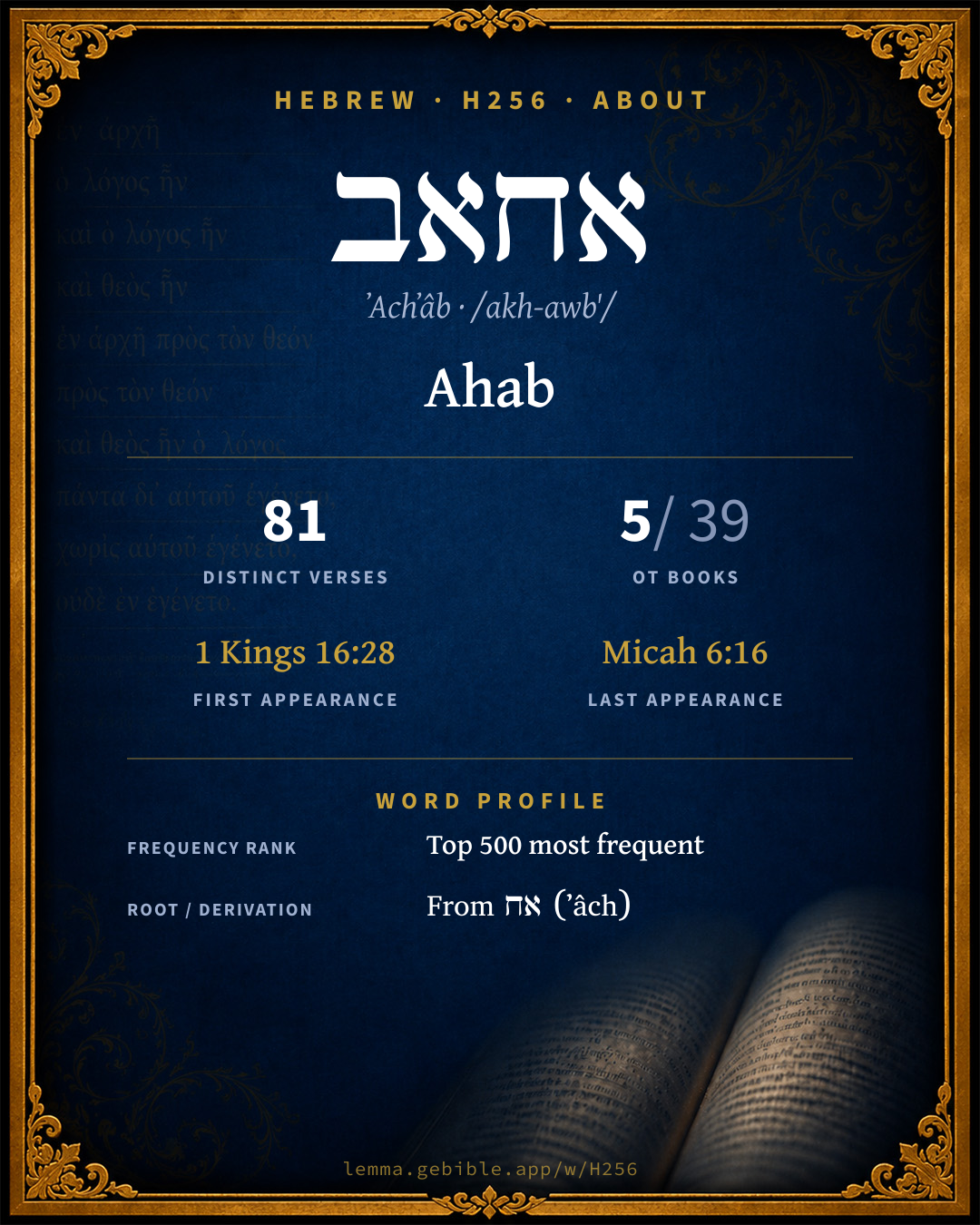
אַחְאָב
Ahab
BDB lists 3 entries for ‘Ahab’ fuller range ↓
Full lexicon entry — Brown-Driver-Briggs (BDB)
From Brown-Driver-Briggs (BDB)
Where this word appears
Grammar key — what these labels mean
Part of speech
- Noun
- A naming word — a person, place, thing, or idea.
Noun type
- Proper
- A name of a specific person, place, or people (e.g. Abraham, Zion, Israel).
Every verse where H256 appears in the Book of 2 Kings — 22 distinct verses. Click any verse to open its interlinear word-by-word view. Verse text shown in the World English Bible for context — . Each verse’s Hebrew form is shown with its reference; the English is not keyword-highlighted, since the data carries no word-level English alignment. Use “Compare translations” on any verse to read it across multiple English versions. This concordance covers the Hebrew Bible; Septuagint (Greek Old Testament) occurrences are not indexed here.
2 Kings
- 2 Kings 1:1 אַחְאָֽב n Proper Moab rebelled against Israel after the death of Ahab.
- 2 Kings 3:1 אַחְאָ֗ב n Proper Now Jehoram the son of Ahab began to reign over Israel in Samaria in the eighteenth year of Jehoshaphat king of Judah, and reigned twelve years.
- 2 Kings 3:5 אַחְאָ֑ב n Proper But it happened, when Ahab was dead, that the king of Moab rebelled against the king of Israel.
- 2 Kings 8:16 אַחְאָב֙ n Proper In the fifth year of Joram the son of Ahab king of Israel, Jehoshaphat being then king of Judah, Jehoram the son of Jehoshaphat king of Judah began to reign.
- 2 Kings 8:18 אַחְאָ֔ב אַחְאָ֔ב n Proper n Proper He walked in the way of the kings of Israel, as did the house of Ahab: for he had the daughter of Ahab as wife; and he did that which was evil in the sight of Yahweh.
- 2 Kings 8:25 אַחְאָ֖ב n Proper In the twelfth year of Joram the son of Ahab king of Israel did Ahaziah the son of Jehoram king of Judah begin to reign.
- 2 Kings 8:27 אַחְאָ֔ב אַחְאָ֑ב אַחְאָ֖ב n Proper n Proper n Proper He walked in the way of the house of Ahab, and did that which was evil in the sight of Yahweh, as did the house of Ahab; for he was the son-in-law of the house of Ahab.
- 2 Kings 8:28 אַחְאָ֗ב n Proper He went with Joram the son of Ahab to war against Hazael king of Syria at Ramoth-gilead: and the Syrians wounded Joram.
- 2 Kings 8:29 אַחְאָ֛ב n Proper King Joram returned to be healed in Jezreel of the wounds which the Syrians had given him at Ramah, when he fought against Hazael king of Syria. Ahaziah the son of Jehoram king of Judah went down to see Joram the son of Ahab in Jezreel, because he was sick.
- 2 Kings 9:7 אַחְאָ֖ב n Proper You shall strike the house of Ahab your master, that I may avenge the blood of my servants the prophets, and the blood of all the servants of Yahweh, at the hand of Jezebel.
- 2 Kings 9:8 אַחְאָ֑ב לְ/אַחְאָב֙ n Proper prep + n Proper For the whole house of Ahab shall perish; and I will cut off from Ahab every man-child, and him who is shut up and him who is left at large in Israel.
- 2 Kings 9:9 אַחְאָ֔ב n Proper I will make the house of Ahab like the house of Jeroboam the son of Nebat, and like the house of Baasha the son of Ahijah.
- 2 Kings 9:25 אַחְאָ֣ב n Proper Then said [Jehu] to Bidkar his captain, Take up, and cast him in the portion of the field of Naboth the Jezreelite; for remember how that, when I and you rode together after Ahab his father, Yahweh laid this burden on him:
- 2 Kings 9:29 אַחְאָ֑ב n Proper In the eleventh year of Joram the son of Ahab began Ahaziah to reign over Judah.
- 2 Kings 10:1 וּ/לְ/אַחְאָ֛ב אַחְאָ֖ב conj + prep + n Proper n Proper Now Ahab had seventy sons in Samaria. Jehu wrote letters, and sent to Samaria, to the rulers of Jezreel, even the elders, and to those who brought up [the sons of] Ahab, saying,
- 2 Kings 10:10 אַחְאָ֑ב n Proper Know now that there shall fall to the earth nothing of the word of Yahweh, which Yahweh spoke concerning the house of Ahab: for Yahweh has done that which he spoke by his servant Elijah.
- 2 Kings 10:11 אַחְאָב֙ n Proper So Jehu struck all that remained of the house of Ahab in Jezreel, and all his great men, and his familiar friends, and his priests, until he left him none remaining.
- 2 Kings 10:17 לְ/אַחְאָ֛ב prep + n Proper When he came to Samaria, he struck all who remained to Ahab in Samaria, until he had destroyed him, according to the word of Yahweh, which he spoke to Elijah.
- 2 Kings 10:18 אַחְאָ֕ב n Proper Jehu gathered all the people together, and said to them, Ahab served Baal a little; but Jehu will serve him much.
- 2 Kings 10:30 אַחְאָ֑ב n Proper Yahweh said to Jehu, Because you have done well in executing that which is right in my eyes, [and] have done to the house of Ahab according to all that was in my heart, your sons of the fourth generation shall sit on the throne of Israel.
- 2 Kings 21:3 אַחְאָב֙ n Proper For he built again the high places which Hezekiah his father had destroyed; and he reared up altars for Baal, and made an Asherah, as did Ahab king of Israel, and worshiped all the host of the sky, and served them.
- 2 Kings 21:13 אַחְאָ֑ב n Proper I will stretch over Jerusalem the line of Samaria, and the plummet of the house of Ahab; and I will wipe Jerusalem as a man wipes a dish, wiping it and turning it upside down.
About this entry
At a glance — auto-summarized from this page’s data, not written by a person. Every figure links to its source below. This summary describes the numbers; it doesn’t interpret them.
אחאב (ʼAchʼâb) is a Hebrew name most often rendered “Ahab.” It clusters heavily in 1 Kings, which alone accounts for 54% of its uses. It turns up in 81 verses across 5 books, a moderately common footprint. It first appears in 1 Kings 16:28. The sections below give every occurrence and version rendering.
Gloss history
Strong's 1890 vs modern scholarship
About this word
Strong's H256 catalogs a Hebrew word from the Hebrew Old Testament.
These counts are not copied from any lexicon or concordance. They are computed here, from the morphology-tagged Hebrew Old Testament. What Lemma adds →
- 81
- distinct verses
- The word appears in 81 distinct verses.
- 5 / 39
- OT books
- The word appears in 5 of 39 Old Testament books.
- #446
- by frequency
- Top 500 most frequent Hebrew words (rank 446 of 8,640 Hebrew words by occurrence).
View all 81 occurrences in the concordance →
Most concentrated in
- 1 Kings 44 verses 54%
- 2 Kings 22 verses 27%
- 2 Chronicles 12 verses 15%
By section of the Old Testament
By traditional corpus
Conventional, traditional groupings — biblical authorship is debated, so this is a traditional corpus grouping, not an authorship claim. Each share is this word’s portion of its verses in that division of the Hebrew canon. Each figure is a share of the word’s 81 distinct verses.
- Prophets (Nevi'im) 69 verses · 85%
- Writings (Ketuvim) 12 verses · 15%
How translations render this word
Counts come from each version’s own published word-to-Strong’s tagging or interlinear alignment — an approximate guide to how each version renders this word, not a word-level alignment the data otherwise carries. Because each total is that version’s own tagged count, the per-version totals vary from one another and need not match the appearance or distinct-verse counts above. These counts may also differ from a printed concordance because Lemma counts each distinctly tagged rendering and does not collapse phrase taggings into a single head-word total. This is a fixed set of word-tagged versions (KJV, ASV, BSB, ULT) and does not change with the reading translation you choose elsewhere. Each version’s license is shown beside its name below (and on Sources).
BDB lists this Strong’s number as 2 distinct words (homographs). Each count above pools all of them and is not split by sense — see the Senses section below. A low-frequency rendering may belong to a different one of those words, not the primary meaning.
- King James Version†: Ahab 81×, Came to pass when ahab 4×, Ahab's 2×
- American Standard Version†: Ahab 76×, Came to pass 4×
- Berean Standard Bible†: Ahab 76×, Ahab’s 3×, Now ahab 2×
- unfoldingWord Literal Text†: Ahab 87×
King James Version Public Domain
Renders H256 across 93† tagged occurrences — most commonly:
Plus 6 renderings that appear only once — usually multi-word phrases or single function words the recovered tagging swept in, not distinct renderings.
American Standard Version Public Domain
Renders H256 across 93† tagged occurrences — most commonly:
Plus 13 renderings that appear only once — usually multi-word phrases or single function words the recovered tagging swept in, not distinct renderings.
Berean Standard Bible Public Domain
Renders H256 across 89† tagged occurrences — most commonly:
Plus 8 renderings that appear only once — usually multi-word phrases or single function words the recovered tagging swept in, not distinct renderings. Not rendered by a distinct English word in 4 further occurrences.
unfoldingWord Literal Text CC BY-SA 4.0
Renders H256 across 91† tagged occurrences — most commonly:
Plus 4 renderings that appear only once — usually multi-word phrases or single function words the recovered tagging swept in, not distinct renderings.
Senses in the full BDB
What do BDB’s symbols mean?
BDB uses these scholarly abbreviations:
| Symbol | Meaning |
|---|---|
| 𝔊 | the Septuagint (the ancient Greek translation, LXX) |
| 𝔙 | the Vulgate (the Latin translation) |
| 𝔖 | the Syriac version (the Peshitta) |
| 𝔗 | the Targum (the Aramaic translation) |
| ψ | the Psalms |
| √ | root (the underlying root or stem) |
| ‖ | parallel passage (a synonymous or contrasted parallel) |
| † | the dagger: every passage where the word occurs is cited |
The 2 senses and sub-senses the full Brown-Driver-Briggs lexicon distinguishes for this word, in lexicon order (not ranked by frequency), with BDB’s own verbatim wording and sub-sense lettering. Shown in Hebrew script with BDB’s own scholarly abbreviations. The condensed entry is in the Lexicon Entry tab. See also the Forms in the corpus table below.
- 1. son of Omri, king of Isr. 1 K 16:28, 29; 18:1, 2, 3; 20:2, 13, 14 + 41 times 1 K, 27 times 2 K, 14 times 2 Ch; Mi 6:16. e.g. 1 Kings 16:28
- 2. false prophet, time of Jerem. Je 29:21, 22. e.g. Jeremiah 29:21
Senses from the full Brown-Driver-Briggs lexicon (Brown, Driver, Briggs; Oxford 1906 — public domain), digitized via Sefaria, supplemented by the OpenScriptures HebrewLexicon (CC BY 4.0). Full attribution on Sources.
Word origin
n.pr.m. Ahab (father’s brother; = אחיאב NöZMG 1886, 172, Ἀχίαβος was a nephew of Herod.; cf. like name in Syriac, given ob maximum cum patre suo similitudinem, Bar HebræusChron. Ecclesiast. ii. 23 cf. LCB 1879, 1339. In many cases, however, the meaning of n.pr. comp. with אח is dub., & perfect consistency, especially in comparison with cpds. of אָב, seems impossible; cf. rem. sub אביאל, and further WeSkizzen, iii. 1 f, DlPr. cap. vi)—אַחְאָב 1 K 16:28 +; וּכְאֶחָב Je 29:22—
— Brown-Driver-Briggs (Oxford 1906, public domain), digitized via Sefaria, supplemented by the OpenScriptures HebrewLexicon (CC BY 4.0). See Sources.
Derived from אח (ʼâch) (H251) — brother.
Forms in the corpus
The 25 distinct written forms H256 takes in the Hebrew Bible, most frequent first — each parse links to that state’s occurrences in the concordance. Hebrew forms include their vowel points and cantillation, so a single lemma takes many written forms.
| Form | Parsing | Example | Uses |
|---|---|---|---|
| אַחְאָ֖ב | Noun, Proper | 1 Kings 16:33 | 15 |
| אַחְאָ֑ב | Noun, Proper | 1 Kings 18:2 | 13 |
| אַחְאָ֔ב | Noun, Proper | 1 Kings 18:1 | 13 |
| אַחְאָב֙ | Noun, Proper | 1 Kings 18:5 | 11 |
| אַחְאָ֗ב | Noun, Proper | 1 Kings 21:15 | 5 |
| אַחְאָ֜ב | Noun, Proper | 1 Kings 16:33 | 5 |
| אַחְאָ֣ב | Noun, Proper | 1 Kings 20:13 | 5 |
| אַחְאָ֥ב | Noun, Proper | 1 Kings 16:28 | 3 |
| לְ/אַחְאָב֙ | Noun, Proper | 1 Kings 21:21 | 3 |
| אַחְאָ֛ב | Noun, Proper | 2 Chronicles 22:6 | 2 |
| אַחְאָ֨ב | Noun, Proper | 1 Kings 16:29 | 2 |
| אַחְאָֽב | Noun, Proper | 2 Chronicles 22:7 | 2 |
| לְ/אַחְאָ֛ב | Noun, Proper | 1 Kings 18:12 | 2 |
| אַחְאָ֕ב | Noun, Proper | 2 Kings 10:18 | 1 |
| אַחְאָ֞ב | Noun, Proper | 1 Kings 18:6 | 1 |
| אַחְאָ֤ב | Noun, Proper | Jeremiah 29:21 | 1 |
| אַחְאָ֧ב | Noun, Proper | 1 Kings 16:30 | 1 |
| אַחְאָב֒ | Noun, Proper | 1 Kings 17:1 | 1 |
| וְ/אַחְאָ֣ב | Noun, Proper | 1 Kings 16:29 | 1 |
| וּ/כְ/אֶחָ֔ב | Noun, Proper | Jeremiah 29:22 | 1 |
| וּ/לְ/אַחְאָ֛ב | Noun, Proper | 2 Kings 10:1 | 1 |
| כְ/אַחְאָ֔ב | Noun, Proper | 1 Kings 21:25 | 1 |
| לְ/אַחְאָ֔ב | Noun, Proper | 1 Kings 18:41 | 1 |
| לְ/אַחְאָ֖ב | Noun, Proper | 1 Kings 22:41 | 1 |
| לְ/אַחְאָֽב | Noun, Proper | 2 Chronicles 18:1 | 1 |
Same root — word family
Other BDB entries built from the same root as H256, grouped by Strong’s listed origin. These share a root / origin per the lexicon — not necessarily a shared meaning. Each links to that word’s own entry.
Derives from
Shares the same root
Proper names from this root
People and places named from this root — a name, not an additional meaning of the word.
- אחבן ʼAchbân H257 Ahban
- אחוח ʼĂchôwach H265 Ahoah
- אחומי ʼĂchûwmay H267 Ahumai
- אחי ʼĂchîy H277 Ahi
- אחיאם ʼĂchîyʼâm H279 Ahiam
- אחיה ʼĂchîyâh H281 Ahijah
- אחיהוד ʼĂchîyhûwd H282 Ahihud
- אחיו ʼAchyôw H283 Ahio
- אחיחד ʼĂchîychud H284 Ahihud
- אחיטוב ʼĂchîyṭûwb H285 Ahitub
- אחילוד ʼĂchîylûwd H286 Ahilud
- אחימות ʼĂchîymôwth H287 Ahimoth
- אחימלך ʼĂchîymelek H288 Ahimelech
- אחימן ʼĂchîyman H289 Ahiman
- אחימעץ ʼĂchîymaʻats H290 Ahimaaz
- אחין ʼAchyân H291 Ahian
- אחינדב ʼĂchîynâdâb H292 Ahinadab
- אחינעם ʼĂchîynôʻam H293 Ahinoam
- אחיסמך ʼĂchîyçâmâk H294 Ahisamach
- אחיעזר ʼĂchîyʻezer H295 Ahiezer
- אחיקם ʼĂchîyqâm H296 Ahikam
- אחירם ʼĂchîyrâm H297 Ahiram
- אחירע ʼĂchîyraʻ H299 Ahira
- אחישחר ʼĂchîyshachar H300 Ahishahar
+2 more proper names from this root (not shown).
Compare all same-root words → Showing 4 of 31 — not the complete family. 26 of the same-root words are proper names (people or places). They share a root, not necessarily a meaning.
Bible dictionary
Public-domain dictionary articles matched to this entry by name (Ahab). A biblical name can be shared by more than one person or place, so an article may treat several.
Easton's Bible Dictionary · M. G. Easton, 1897
Father's brother. (1.) The son of Omri, whom he succeeded as the seventh king of Israel. His history is recorded in 1 Kings 16-22. His wife was Jezebel (q.v.), who exercised a very evil influence over him. To the calf-worship introduced by Jeroboam he added the worship of Baal. He was severely admonished by Elijah (q.v.) for his wickedness. His anger was on this account kindled against the prophet, and he sought to kill him. He undertook three campaigns against Ben-hadad II., king of Damascus. In the first two, which were defensive, he gained a complete victory over Ben-hadad, who fell into his hands, and was afterwards released on the condition of his restoring all the cities of Israel he then held, and granting certain other concessions to Ahab. After three years of peace, for some cause Ahab renewed war (1 Kings 22:3) with Ben-hadad by assaulting the city of Ramoth-gilead, although the prophet Micaiah warned him that he would not succeed, and that the 400 false prophets who encouraged him were only leading him to his ruin. Micaiah was imprisoned for thus venturing to dissuade Ahab from his purpose. Ahab went into the battle disguised, that he might if possible escape the notice of his enemies; but an arrow from a bow "drawn at a venture" pierced him, and though stayed up in his chariot for a time he died towards evening, and Elijah's prophecy (1 Kings 21:19) was fulfilled. He reigned twenty-three years. Because of his idolatry, lust, and covetousness, Ahab is referred to as pre-eminently the type of a wicked king (2 Kings 8:18; 2 Chr. 22:3; Micah 6:16).
(2.) A false prophet referred to by Jeremiah (Jer. 29:21), of whom nothing further is known.
Smith's Bible Dictionary · William Smith, 1863
(uncle).
+ Son of Omri, seventh king of Israel, reigned B.C. 919-896. He married Jezebel, daughter of Ethbaal king of Tyre; and in obedience to her wishes, caused temple to be built to Baal in Samaria itself; and an oracular grove to be consecrated to Astarte. See (1 Kings 18:19) One of Ahab's chief tastes was for splendid architecture which he showed by building an ivory house and several cities. Desiring to add to his pleasure-grounds at Jezreel the vineyard of his neighbor Naboth, he proposed to buy it or give land in exchange for it; and when this was refused by Naboth in accordance with the Levitical law, (Leviticus 25:23) a false accusation of blasphemy was brought against him, and he was murdered, and Ahab took possession of the coveted fields. (2 Kings 9:26) Thereupon Elijah declared that the entire extirpation of Ahab's house was the penalty appointed for his long course of wickedness. [Elijah] The execution, however, of the sentence was delayed in consequence of Ahab's deep repentance. (1 Kings 21:1) ... Ahab undertook three campaigns against Ben-hadad II. king of Damascus, two defensive and one offensive. In the first Ben-hadad laid siege to Samaria, but was repulsed with great loss. (1 Kings 20:1-21) Next year Ben-hadad again invaded Israel by way of Aphek, on the east of Jordan; yet Ahab's victory was so complete that Ben-hadad himself fell into his hands, but was released contrary to God's will, (1 Kings 20:22-34) on condition of restoring the cities of Israel, and admitting Hebrew commissioners into Damascus. After this great success Ahab enjoyed peace for three years, when he attacked Ramoth in Gilead, on the east of Jordan, in conjunction with Jehoshaphat king of Judah, which town he claimed as belonging to Israel. Being told by the prophet Micaiah that he would fall, he disguised himself, but was slain by "a certain man who drew a bow at a venture." When buried in Samaria, the dogs licked up his blood as a servant was washing his chariot; a partial fulfillment of Elijah's prediction, (1 Kings 21:19) which was more literally accomplished in the case of his son. (2 Kings 9:26) + A lying prophet, who deceived the captive Israelites in Babylon, and was burnt to death by Nebuchadnezzar. (Jeremiah 29:21)
Hitchcock's Bible Names Dictionary · Roswell D. Hitchcock, 1869
uncle, or father's brother
Classic public-domain reference works; full attribution on Sources.
Septuagint verse parallels
This word appears in 78 verses that also exist in the Greek Old Testament (Septuagint), out of the 81 Hebrew verses it occurs in. You can read those verses in Greek by switching the Old Testament edition to the Septuagint.
Read these verses in the Septuagint
This is a verse-level parallel only — the same verses exist in both the Hebrew and Greek Old Testaments. No word-level Hebrew↔Greek correspondence is claimed: the data carries no such alignment, so no Greek word is shown as this Hebrew word’s translation. Coverage is not total — the Septuagint omits the deuterocanon and renumbers the Psalms, so some Hebrew verses have no direct Greek parallel.