2 Kings 8:25

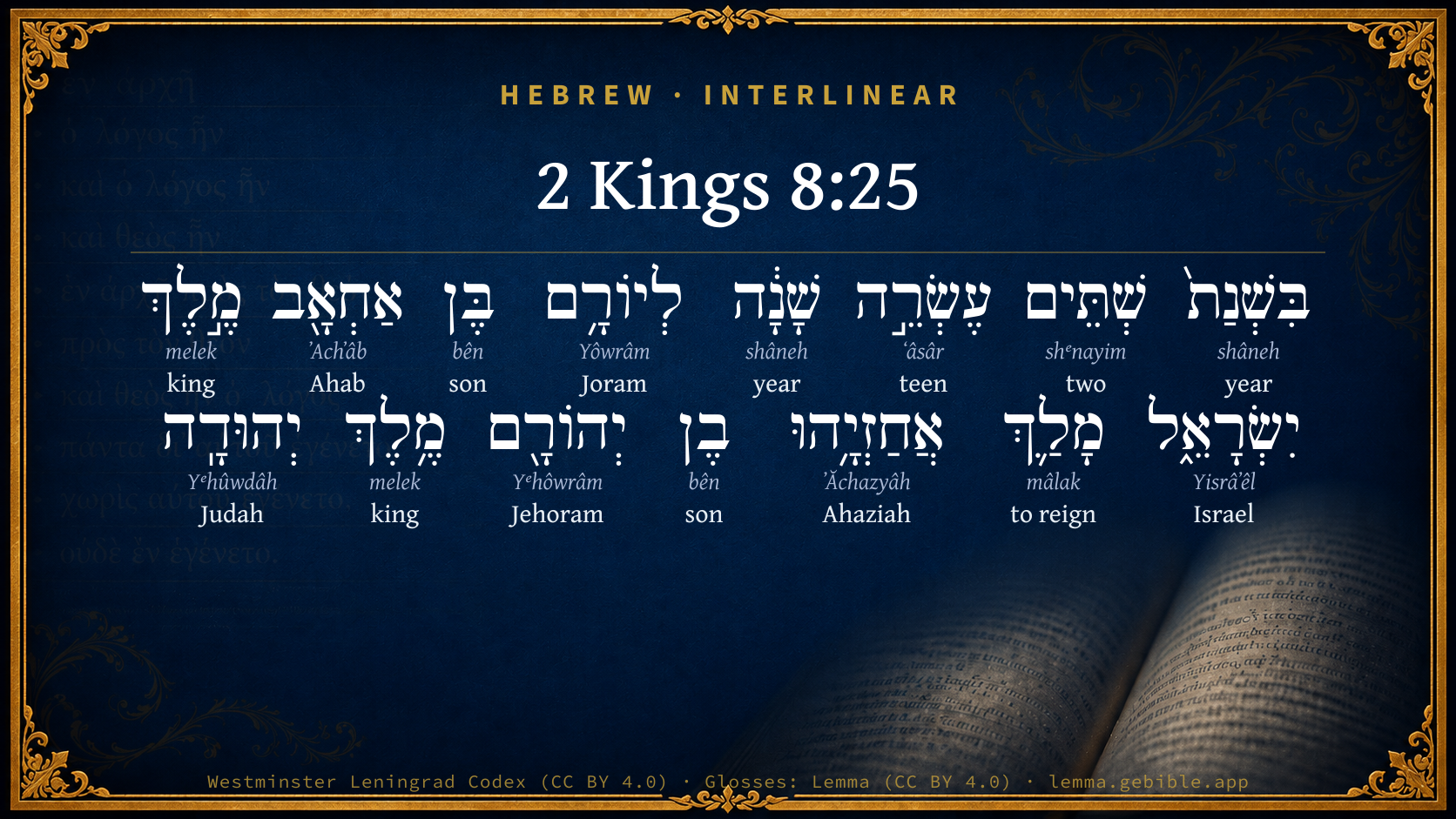
Hebrew (Westminster Leningrad Codex) 2 Kings 8:25 appears in the Hebrew Old Testament. The text above is from the Westminster Leningrad Codex. Each word links to its Strong’s number, a concise gloss, and parsing drawn from the Open Scriptures Hebrew Bible morphology. Click any word for its full Brown-Driver-Briggs (BDB) entry.
Download image
Cite this verse

2 Kings 8:25 (World English Bible). Public Domain. Lemma interlinear Bible study tool, https://lemma.gebible.app/v/2-kings/8/25.

Show BibTeX & RIS
BibTeX
RIS
English Translation
In the twelfth year of Joram the son of Ahab king of Israel did Ahaziah the son of Jehoram king of Judah begin to reign.
World English Bible · Public Domain
Download a study sheet

One document with this verse’s original text, its word-by-word gloss line, the meaning frame, cross-references with their text, attributed commentary, and full source and license credits — printable, and it pastes into notes with its structure intact.

This verse Autodidact and up

Study sheet (.html) Plain text (.txt)

A passage Seminary Student

Up to 50 verses in one chapter. A passage sheet keeps up to 6 commentary sources and 12 cross-references per verse, in the order this page ranks them, and says so on the sheet whenever that leaves anything out. Ask for a single verse and you get the Autodidact verse sheet above.

Everything on this page stays free to read, with no account — the sheet is a download of what is already on screen, not access to it.

Want to remove ads? Support Godless Engineer
Compare translations 3

The same verse in 3 English versions, stacked beneath the original-language interlinear above. Click any original word for its lexicon entry.

Each is an independent rendering of the whole verse — the interlinear is not word-aligned to these translations.

Highlighted words mark where these versions differ — a whole-verse word diff, not a word-by-word alignment.

  • World English Bible Public Domain
    In the twelfth year of Joram the son of Ahab king of Israel did Ahaziah the son of Jehoram king of Judah begin to reign.
  • King James Version Public Domain
    In the twelfth year of Joram the son of Ahab king of Israel did Ahaziah the son of Jehoram king of Judah begin to reign.
  • unfoldingWord Literal Text CC BY-SA 4.0
    In the year of 12, the year to Joram, the son of Ahab, the king of Israel, Ahaziah the son of Jehoram, the king of Judah, reigned.

unfoldingWord Literal Text — © unfoldingWord, licensed CC BY-SA 4.0. Word-aligned USFM3 via Door43 (git.door43.org/unfoldingWord/en_ult).

Versions to compare (up to 4)

3 of 4 selected

Show all 18 translations

Every available English version of this verse, each an independent rendering of the whole verse.

  • World English Bible Public Domain
    In the twelfth year of Joram the son of Ahab king of Israel did Ahaziah the son of Jehoram king of Judah begin to reign.
  • Berean Standard Bible Public Domain
    In the twelfth year of the reign of Joram son of Ahab over Israel, Ahaziah son of Jehoram became king of Judah.
  • Majority Standard Bible Public Domain
    In the twelfth year of the reign of Joram son of Ahab over Israel, Ahaziah son of Jehoram became king of Judah.
  • King James Version Public Domain
    In the twelfth year of Joram the son of Ahab king of Israel did Ahaziah the son of Jehoram king of Judah begin to reign.
  • American Standard Version (1901) Public Domain
    In the twelfth year of Joram the son of Ahab king of Israel did Ahaziah the son of Jehoram king of Judah begin to reign.
  • Revised Version (1885) Public Domain
    In the twelfth year of Joram the son of Ahab king of Israel did Ahaziah the son of Jehoram king of Judah begin to reign.
  • Geneva Bible (1599) Public Domain
    In the twelft yere of Ioram the sonne of Ahab King of Israel did Ahaziah the sonne of Iehoram King of Iudah begin to reigne.
  • Douay-Rheims (1899) Public Domain
    In the twelfth year of Joram son of Achab king of Israel, reigned Ochozias son of Joram king of Juda.
  • Young's Literal Translation Public Domain
    In the twelfth year of Joram son of Ahab king of Israel reigned hath Ahaziah son of Jehoram king of Judah;
  • Literal Standard Version CC BY-SA 4.0
    In the twelfth year of Joram son of Ahab, king of Israel, Ahaziah son of Jehoram, king of Judah, has reigned;
  • Unlocked Literal Bible CC BY-SA 4.0
    In the twelfth year of Joram son of Ahab, king of Israel, Ahaziah son of Jehoram, king of Judah, began to reign.
  • unfoldingWord Literal Text CC BY-SA 4.0
    In the year of 12, the year to Joram, the son of Ahab, the king of Israel, Ahaziah the son of Jehoram, the king of Judah, reigned.
  • Darby Bible Public Domain
    In the twelfth year of Joram the son of Ahab, king of Israel, Ahaziah the son of Jehoram, king of Judah, began to reign.
  • World Messianic Bible Public Domain
    In the twelfth year of Joram the son of Ahab king of Israel, Ahaziah the son of Jehoram king of Judah began to reign.
  • Webster's Bible Public Domain
    In the twelfth year of Joram the son of Ahab king of Israel did Ahaziah the son of Jehoram king of Judah begin to reign.
  • Free Bible Version CC BY-SA 4.0
    Ahaziah, son of Jehoram, became king of Judah in the twelfth year of the reign of Joram, son of Ahab, king of Israel.
  • Bible in Basic English Public Domain
    In the twelfth year that Joram, the son of Ahab, was king of Israel, Ahaziah, the son of Jehoram, king of Judah, became king;
  • JPS Tanakh (1917) Public Domain
    In the twelfth year of Joram the son of Ahab king of Israel did Ahaziah the son of Jehoram king of Judah begin to reign.

Literal Standard Version (2020), Covenant Press — licensed CC BY-SA 4.0. Text via the HelloAO Bible API (eBible.org). Unlocked Literal Bible (unfoldingWord) — licensed CC BY-SA 4.0. Text via the HelloAO Bible API (eBible.org). unfoldingWord Literal Text — © unfoldingWord, licensed CC BY-SA 4.0. Word-aligned USFM3 via Door43 (git.door43.org/unfoldingWord/en_ult). Free Bible Version, Dr. Jonathan Gallagher — licensed CC BY-SA 4.0. Text via the HelloAO Bible API (eBible.org).

Word by word

More ways to search: Search by grammar → Find every occurrence → Compare this word →

Practice this passage: Drill this verse → Learn its vocabulary →

לְיוֹרָ֥ם
Yôwrâm
H3141
“to/for · Joram”
Preposition + Noun, Proper
Part of Speech
Preposition + Noun
Type
Proper
Full BDB Definition

Origin: a form of H3088

TWOT: None

Joram = "Jehovah is exalted" - son of king Jehoshaphat of Judah and himself king of Judah for 8 years; his wife was the wicked Athaliah who was probably the instigator for his returning the nation of Judah to the worship of Baal - son of king Ahab of the northern kingdom of Israel and king of Israel himself for 12 years; he was murdered by Jehu on the plot of land for which his father had murdered Naboth thus fulfilling the prophecy of Elijah to the very letter - a Levite in the time of David and an ancestor of Shelomith - son of Toi, king of Hamath
  1. בִּשְׁנַת֙ shâneh H8141 “in/at · year of” Preposition + Noun, Common, Feminine, Singular, Construct
  2. שְׁתֵּים shᵉnayim H8147 “two” Adjective, Cardinal number, Feminine, Dual, Absolute
  3. עֶשְׂרֵ֣ה ʻâsâr H6240 “teen” Adjective, Cardinal number, Feminine, Singular, Absolute
  4. שָׁנָ֔ה shâneh H8141 “year” Noun, Common, Feminine, Singular, Absolute
  5. בֶּן bên H1121 “son of” Noun, Common, Masculine, Singular, Construct
  6. אַחְאָ֖ב ʼAchʼâb H256 “Ahab” Noun, Proper
  7. מֶ֣לֶךְ melek H4428 “king of” Noun, Common, Masculine, Singular, Construct
  8. יִשְׂרָאֵ֑ל Yisrâʼêl H3478 “Israel” Noun, Proper
  9. מָלַ֛ךְ mâlak H4427 “to reign” Verb, Qal, Perfect, 3rd Person, Masculine, Singular
  10. אֲחַזְיָ֥הוּ ʼĂchazyâh H274 “Ahaziah” Noun, Proper
  11. בֶן bên H1121 “son of” Noun, Common, Masculine, Singular, Construct
  12. יְהוֹרָ֖ם Yᵉhôwrâm H3088 “Jehoram” Noun, Proper
  13. מֶ֥לֶךְ melek H4428 “king of” Noun, Common, Masculine, Singular, Construct
  14. יְהוּדָֽה Yᵉhûwdâh H3063 “Judah” Noun, Proper

About this verse

These counts appear in no published source. They are computed here, from the morphology-tagged text and Lemma’s own curated glosses. What Lemma adds →

15
words
12
distinct lemmas
Historical
section

Notable vocabulary

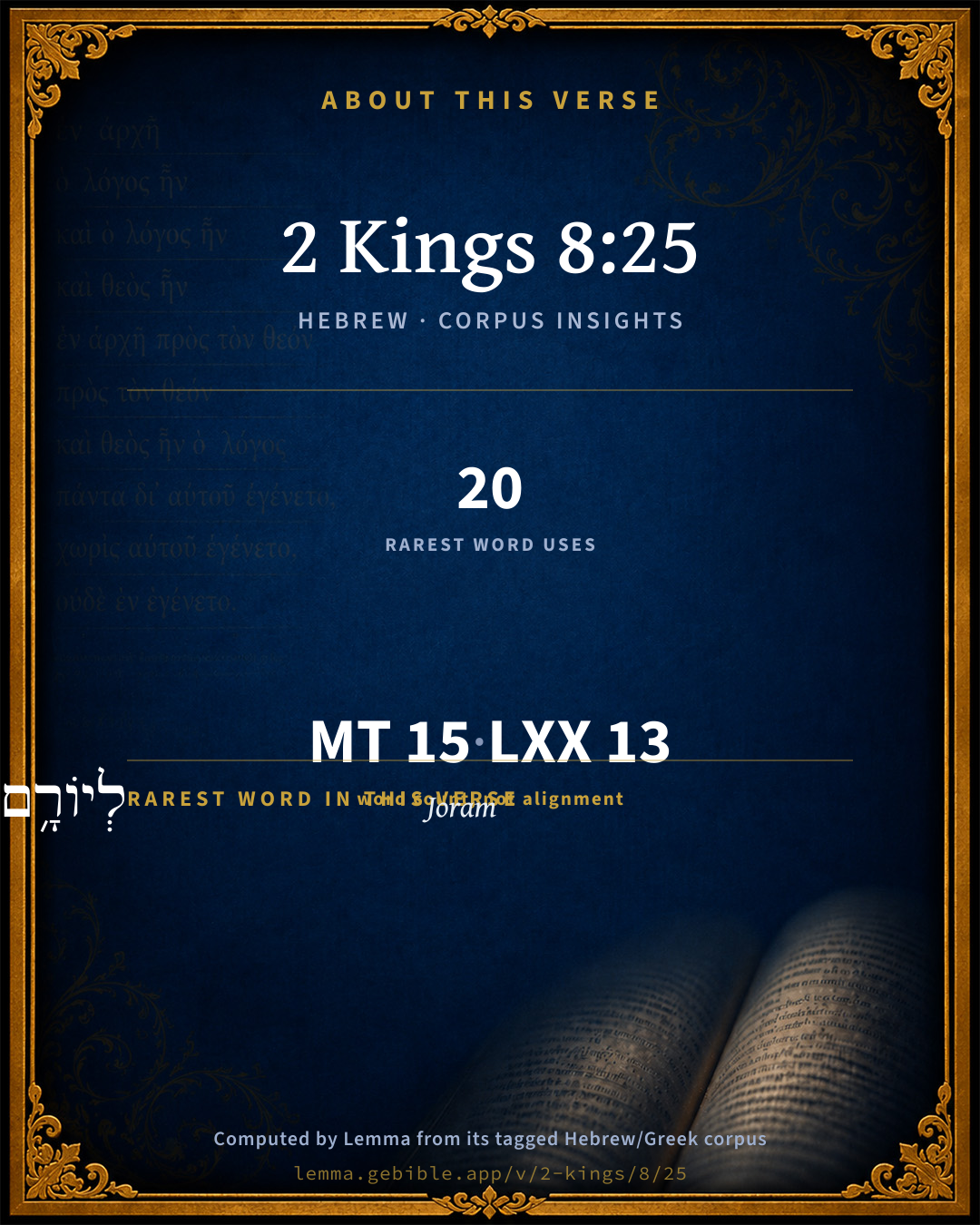
The rarest word here is לְיוֹרָ֥ם Joram H3141 — appearing just 20 times in the whole Hebrew Bible.

Shared distinctive vocabulary

לְיוֹרָ֥ם Joram H3141 occurs in 16 verses of the Hebrew Bible. Also found in:

Grammatical profile

  • 1 verb
  • 12 nouns
  • 2 adjectives

Verb forms

  • מָלַ֛ךְ Qal · Perfect

Repetition

Words recur within this verse — often emphatic in Hebrew:

  • בִּשְׁנַת֙ year H8141 ×2
  • בֶּן son H1121 ×2
  • מֶ֣לֶךְ king H4428 ×2

Hebrew & Septuagint length

In English translation the verse runs 25 words from the Hebrew and 19 from the Septuagint (LXX English) — closely comparable.

A rough comparison of the two English renderings, which tokenize alike — not a word-level alignment.

Word counts can differ between the Hebrew and the Greek without any difference in meaning — e.g. the Hebrew direct-object marker אֵת has no separate Greek word, and Greek often adds the article ὁ.

In the original languages it is 15 Hebrew tokens and 13 Greek tokens — but the two are counted differently (Hebrew bundles its prefixes and suffixes into one token; the Greek is in lemma form), so that isn’t a like-for-like length.

Cross-references

3

Topical passages linked to 2 Kings 8:25 in the Treasury of Scripture Knowledge — connected by theme and wording, ordered by reader-vote popularity; previews shown in the World English Bible.

  • 2 Kings 9:29 In the eleventh year of Joram the son of Ahab began Ahaziah to reign over Judah.
  • 2 Kings 8:16–17 In the fifth year of Joram the son of Ahab king of Israel, Jehoshaphat being then king of Judah, Jehoram the son of Jehoshaphat king of Judah began to reign.
  • 2 Chronicles 21:20–22:6 Thirty-two years old was he when he began to reign, and he reigned in Jerusalem eight years: and he departed without being desired; and they buried him in the city of David, but not in the tombs of the kings.

Cross-references courtesy of OpenBible.info (CC BY 4.0).

Hebrew and Greek witnesses Masoretic Hebrew ↔ Greek Septuagint

The same verse in the two great witnesses to the Old Testament, shown verse-for-verse.

These are two independent witnesses, not word-aligned to each other, and the Septuagint is shown in lemma (dictionary) form.

Hebrew 2 Kings 8:25 Masoretic · Westminster Leningrad Codex

בִּשְׁנַת֙ שְׁתֵּים עֶשְׂרֵ֣ה שָׁנָ֔ה לְיוֹרָ֥ם בֶּן אַחְאָ֖ב מֶ֣לֶךְ יִשְׂרָאֵ֑ל מָלַ֛ךְ אֲחַזְיָ֥הוּ בֶן יְהוֹרָ֖ם מֶ֥לֶךְ יְהוּדָֽה

In the twelfth year of Joram the son of Ahab king of Israel did Ahaziah the son of Jehoram king of Judah begin to reign.

World English Bible · Public Domain

Greek LXX 2 Kings 8:25 Septuagint · lemma form

ἐν ἔτος δωδέκατος ὁ ιωραμ υἱός αχααβ βασιλεύς ἰσραήλ βασιλεύω οχοζιας υἱός ιωραμ

In the twelfth year of Joram son of Achaab king of Israel, Ochozias son of Joram began to reign.

LXX2012 (modern English Septuagint) · Public Domain

Hebrew: Westminster Leningrad Codex (CC BY 4.0). Greek: Septuagint (public domain); English from LXX2012 (modern English Septuagint) (Public Domain). How the Septuagint differs from the Hebrew →

Targum (Aramaic paraphrase)

1

The Targum is the ancient Jewish Aramaic paraphrase of the Hebrew Scriptures — an interpretive translation, not the Hebrew text itself. Onkelos (literal) and Pseudo-Jonathan (expansive) render the Torah, and Jonathan the Prophets. Coverage is partial: where no permissively-licensed English translation exists for a verse, only the Aramaic is shown. This is verse-level text, not a word-by-word alignment to the Hebrew.

  1. Targum Jonathan Prophets (Joshua–Malachi)
    בִּשְׁנַת תַּרְתָא עַסְרֵי שְׁנִין לְיוֹרָם בַּר אַחְאָב מַלְכָּא דְיִשְׂרָאֵל מְלַךְ אֲחַזְיָהוּ בַּר יְהוֹרָם מֶלֶךְ שִׁבְטָא דְבֵית יְהוּדָה:

    (no public-domain English translation for this verse)

    Targum Jonathan — Aramaic: “Mikraot Gedolot” (public domain). English: “Sefaria Community Translation” (CC0 1.0 (public-domain dedication)); “London "Chaldee Paraphrase," 1871” (public domain). Text via Sefaria.

Commentary

Notes on 2 Kings 8:25 from classic Christian and Jewish commentators (each source and its license shown beneath its notes). The classic Christian expositions comment on the surrounding passage and are grouped to its opening verse, so a note may address several verses; the Jewish commentaries on the Tanakh (Rashi and others) are per-verse, so they appear only where the commentator wrote on this verse.

Lemma curates 59 commentaries, every one of them public domain or Creative Commons licensed, each selected and text-cleaned for this edition rather than reprinted as found. About our sources →

Trapp's Complete Commentary

John Trapp

2Ki 8:25 In the twelfth year of Joram the son of Ahab king of Israel did Ahaziah the son of Jehoram king of Judah begin to reign.

Ver. 25. In the twelfth year.] In the end of the eleventh, {2Ki 9:29} and beginning of the twelfth.

John Trapp, A Commentary or Exposition upon All the Books of the Old and New Testament (1647–1656) — public domain. Text from a community e-Sword module.

The Biblical Illustrator

Joseph S. Exell

2Ki_8:25-29

In the twelfth year of Joram.

Kinghood: the conventional and the true

Looking at King Ahaziah, as here sketched, two points strike our attention.

I. A king by physical heredity. This man came from the lineage of kings.

1. This arrangement is not Divine. All that can be said is that God permitted, not ordained their existence.

2. This arrangement is absurd. That a man should become a ruler because of his birth is an outrage on common sense. They only will be future kings who are royal in character, in intelligence, and philanthropy. The greatest man of the community will become its king. What is called loyalty is a debased and selfish flunkeyism, not a devout homage for the good. Are we not commanded to honour the king? Yes, but it is implied that he is honour-worthy. Are we to honour such men as Henry VIII., Charles II., and other such monarchical monsters, which, alas! abound in history? No; denounce them, hurl them from their thrones.

II. A monster by moral descent. He was the descendant of one of the most ruthless and most corrupt of that Hebrew people who were fast filling up the measure of their iniquities. This man, like the offspring of all wicked parents, would inherit the spirit, imbibe the principles, and imitate the example of his parents. (D. Thomas, D. D.)

.

The Biblical Illustrator, edited by Joseph S. Exell (c. 1880s–1900s) — public domain. Text from a community e-Sword module.

Whedon's Commentary on the Bible

Daniel D. Whedon

AHAZIAH’S REIGN, 2Ki_8:25-29.

25. Ahaziah the son of Jehoram — His youngest son, called also Jehoahaz (2 Chronicles 21:27) and Azariah, (2Ki_23:6.) All the older sons of Jehoram were carried off by the Philistines and Arabians.

Daniel D. Whedon (gen. ed.), Commentary on the Old and New Testaments (1874–1909) — public domain. Text from a community e-Sword module.

Tyndale Open Study Notes

Tyndale Open Resources

8:25 twelfth year of the reign of Joram: The year of Ahaziah’s accession to the throne of Judah (841 BC) was pivotal in ancient Near Eastern history. Before the year was out, both Joram and Ahaziah lay dead, Hazael was confirmed as king of Damascus, and Shalmaneser III of Assyria dominated the region.

Tyndale Open Study Notes — © Tyndale Open Resources, licensed CC BY-SA 4.0. Text via the HelloAO Bible API.

Matthew Henry's Commentary

As among common persons there are some that we call little men, who make no figure, are little regarded, as less valued, so among kings there are some whom, in comparison with others, we may call little kings. This Ahaziah was one of these; he looks mean in the history, and in God's account vile, because wicked. It is too plain an evidence of the affinity between Jehoshaphat and Ahab that they had the same names in their families at the same time, in which, we may suppose, they designed to compliment one another. Ahab had two sons, Ahaziah and Jehoram, who reigned successively; Jehoshaphat had a son and grandson names Jehoshaphat had a son and grandson names Jehoram and Ahaziah, who, in like manner, reigned successively. Names indeed do not make natures, but it was a bad omen to Jehoshaphat's family to borrow names from Ahab's; or, if he lent the names to that wretched family, he could not communicate with them the devotion of their significations, Ahaziah - Taking hold of the Lord, and Jehoram - The Lord exalted. Ahaziah king of Israel had reigned but two years, Ahaziah king of Judah reigned but one. We are here told that his relation to Ahab's family was the occasion, 1. Of his wickedness (Kg2 8:27): He walked in the way of the house of Ahab, that idolatrous bloody house; for his mother was Ahab's daughter (Kg2 8:26), so that he sucked in wickedness with his milk. Partus sequitur ventrem - The child may be expected to resemble the mother. When men choose wives for themselves they must remember they are choosing mothers for their children, and are concerned to choose accordingly. 2. Of his fall. Joram, his mother's brother, courted him to join with him for the recovery of Ramoth-Gilead, an attempt fatal to Ahab; so it was to Joram his son, for in that expedition he was wounded (Kg2 8:28), and returned to Jezreel to be cured, leaving his army there in possession of the place. Ahaziah likewise returned, but went to Jezreel to see how Jehoram did, Kg2 8:29. Providence so ordered it, that he who had been debauched by the house of Ahab might be cut off with them, when the measure of their iniquity was full, as we shall find in the next chapter. Those who partake with sinners in their sins must expect to partake with them in their plagues.

Matthew Henry's Commentary on the Whole Bible (1708–1710) — public domain (CC PDM 1.0). Text via the HelloAO Bible API.

Ellicott's Commentary for English Readers

(25-29) The reign of Ahaziah king of Judah. His expedition with Joram of Israel against Hazael at Ramoth-gilead. (Comp. 2Ch_22:1-6.)

Two-and-twenty years old.—He was Jehoram’a youngest son (2Ch_21:17; 2Ch_22:1), and, as his father died at the age of thirty-nine or forty (2Ki_8:17), he must have been begotten in Jehoram’s seventeenth or eighteenth year. There is no difficulty in this, nor even in the supposition that Jehoram had begotten sons before Ahaziah, as Thenius seems to imagine. He may have become a father at thirteen or fourteen, and Athaliah was certainly not his only wife.

A Bible Commentary for English Readers, edited by Charles John Ellicott (1878–1897) — public domain. Text from a community e-Sword module.

The Cambridge Bible for Schools and Colleges

gen. ed. J. J. S. Perowne

25–29. Reign of Ahaziah king of Judah. His war against Hazael king of Syria. Joram king of Israel helps Ahaziah and is wounded (2Ch_22:1-6)

25. Joram … Jehoram] To prevent confusion it will be convenient to adopt the orthography of this verse for these names, Joram king of Israel, and Jehoram king of Judah. They are but different forms of the same name, and given in the Bible narrative indiscriminately to each.

The Cambridge Bible for Schools and Colleges (gen. ed. J. J. S. Perowne; Cambridge University Press, 1878–1918) — public domain. Text from a community e-Sword module.

John Gill's Exposition

And he walked in the way of the house of Ahab, and did evil in the sight of the Lord, as did the house of Ahab,.... Worshipping the calves, and Baal also:

for he was the son in law of the house of Ahab; he was the son of Jehoram, who was son-in-law to Ahab, having married his daughter, which accounts for his being guilty of the same idolatrous practices.

John Gill's Exposition of the Whole Bible (1746–1763) — public domain (CC PDM 1.0). Text via the HelloAO Bible API.

Haydock's Catholic Bible Commentary

Twelfth, more correctly than "the eleventh," chap. ix. 29. (Houbigant)

George Leo Haydock (1774–1849), Haydock's Catholic Family Bible and Commentary, 1859 edition — public domain. Excludes Psalms (Douay-Rheims chapter numbering differs from Protestant) and Deuterocanonical books (Catholic canon only).

Matthew Poole's English Annotations

In the twelfth year of Joram.

Object. It was in the eleventh year of Joram, 2Ki 9:29.

Answ. Either, first, He began to reign in the confines of Joram’s eleventh and twelfth year, in the very end of his eleventh year, or towards the beginning of the twelfth, whence it is indifferently ascribed to the one or the other. Or, secondly, The one year of Ahaziah did concur with the latter half of Joram’s eleventh year, and the former half of his twelfth year: and if he could not be said to

begin to reign in both these years, yet he might unquestionably be said to reign in both of them; and the Hebrew word, both here and 2Ki 9:29, properly signifies he reigned, and not he began to reign, as it is translated. Or, thirdly, Ahaziah began to reign with his father, and during his life, according to the late examples both in Judah and Israel, there being also special occasion for it, by reason of Joram’s cruel and long sickness, 2Ch 21:18, &c.; and this was in Joram’s eleventh ear, and then his father died, and he began his single reign in Joram’s twelfth year.

Ahaziah, called also Jehoahaz, 2Ch 21:17, and Azariah, 2Ch 22:6.

Matthew Poole's English Annotations on the Holy Bible (1683–1685) — public domain. Text from a community e-Sword/MySword module.

The Pulpit Commentary

Vers. 25-29. THE WICKED REIGN OF AHAZIAH IN JUDAH. The writer continues the history of Judah through another reign a very short one-almost to its close. He describes the wickedness of Ahaziah, for the most part, in general terms, attributes it to his connection with the "house of Ahab," and notes his alliance with Joram of Israel against the Syrians, and his visit to his brother monarch at Samaria, which led on to his death.

In the twelfth year of Joram the son of Ahab King of Israel. in 2Ki_9:29 the year of Ahaziah"s accession is said to have been Joram"s eleventh year. It is conjectured that he began to reign as viceroy to his father during his severe illness in Joram"s eleventh year, and became sole king at his father"s death in the year following. Did Ahaziah the son of Jehoram King of Judah begin to reign; i.e. begin to be full king.

The Pulpit Commentary (1880–1919), ed. H.D.M. Spence-Jones & Joseph S. Exell — public domain. Text from a community e-Sword module.

Keil & Delitzsch

C. F. Keil & F. Delitzsch

Reign of Ahaziah of Judah (cf. Ch2 22:1-6). - Ahaziah, the youngest son of Joram, ascended the throne in the twenty-second year of his age. The statement in Ch2 22:2, that he was forty-two years old when he became king, rests upon a copyist's error, namely, a confusion of כ twenty with מ forty. Now, since his father became king at the age of thirty-two, and reigned eight years, Ahaziah must have been born in the nineteenth year of his age. Consequently it may appear strange that Ahaziah had brothers still older than himself (Ch2 21:17); but as early marriages are common in the East, and the royal princes had generally concubines along with their wife of the first rank, as is expressly stated of Joram in Ch2 21:17, he might have had some sons in his nineteenth year. His mother was called Athaliah, and was a daughter of the idolatrous Jezebel. In Kg2 8:26 and Ch2 22:2 she is called the daughter, i.e., grand-daughter, of Omri; for, according to Kg2 8:18, she was a daughter of Ahab. Omri, the grand-father, is mentioned in Kg2 8:26 as the founder of the dynasty which brought so much trouble upon Israel and Judah through its idolatry.

Keil & Delitzsch — Biblical Commentary on the Old Testament (1861–1891) — public domain (CC PDM 1.0). Text via the HelloAO Bible API. (Old Testament only.)

unfoldingWord translationNotes

Door43 World Missions Community

General Information:

Ahaziah becomes king of Judah.

In the twelfth year of Joram son of Ahab, king of Israel

This describes the time that Ahaziah began to reign as king of Judah by stating how long Joram, the current king of Israel, had reigned. AT: "in the twelfth year that Joram son of Ahab was king of Israel" (See: Assumed Knowledge and Implicit Information)

twelfth year

"12th year" (See: Ordinal Numbers)

twenty-two years

"22 years" (See: Numbers)

Athaliah ... Omri

Athaliah is the name of a woman. Omri is the name of a man. (See: How to Translate Names)

Ahaziah walked in the ways of

Here "walking" refers his behavior or the way in which he lived. AT: "Ahaziah lived the same way as the others in" (See: Idiom)

the house of Ahab

Here the "house" of Ahab refers to his family. AT: "the family of Ahab" (See: Metonymy)

what was evil in the sight of Yahweh

The sight of Yahweh represents Yahweh's judgment or evaluation. AT: "what was evil in Yahweh's judgment" or "what Yahweh considers to be evil" (See: Metaphor)

a son-in-law to the house of Ahab

This explains Ahaziah's family relationship to Ahab. Ahaziah's father was married to Ahab's daughter. The meaning of this can be made clear. AT: "the son of Ahab's son-in-law" or "a grandson of King Ahab" (See: Assumed Knowledge and Implicit Information)

translationWords

Joram

Ahab

kingdom of Israel

kingdom of Judah

reign

walk

house

unfoldingWord translationNotes — © Distant Shores Media and the Door43 World Missions Community, licensed CC BY-SA 4.0. Source: git.door43.org/Door43/en_tn.

Lesson kit

Teaching starters — assembled from the data on this page, not authored interpretation. Every prompt links to the verse data it draws on. Edit before teaching.

2 Kings, in the Historical, opens this verse with 15 words (12 distinct Hebrew lemmas). Its most distinctive word is Yôwrâm (“Joram”). A historical commentator’s framing appears above. Read the whole chapter for the surrounding context.

Discussion questions

  1. How does “Joram” (Yôwrâm) shape what this verse is saying?
  2. How does 2 Samuel 8:10, which shares the word «Joram», read alongside this verse?
  3. What does the repetition of “year” (2× in this one verse) do in this verse?
  4. The translations on this page render this verse differently — a whole-verse word diff, not a word-by-word alignment. What might account for the different wordings?
  5. «מָלַ֛ךְ» is a Qal Perfect verb. How does that grammatical form shape the action described?
  6. Compare how Trapp's Complete Commentary and The Biblical Illustrator read this verse. Where do they agree or differ?

Things to notice

Reading settings

Reading text

Shown beneath each verse's original-language words.

Old Testament
Old Testament edition

Read the OT as the Masoretic Hebrew (MT) or the Greek Septuagint (LXX).

English shown for the Greek Septuagint (in the Hebrew ↔ Greek comparison).

Comparing translations? Open the Compare panel on any verse page to stack up to four side by side.