
1 Kings 16:30

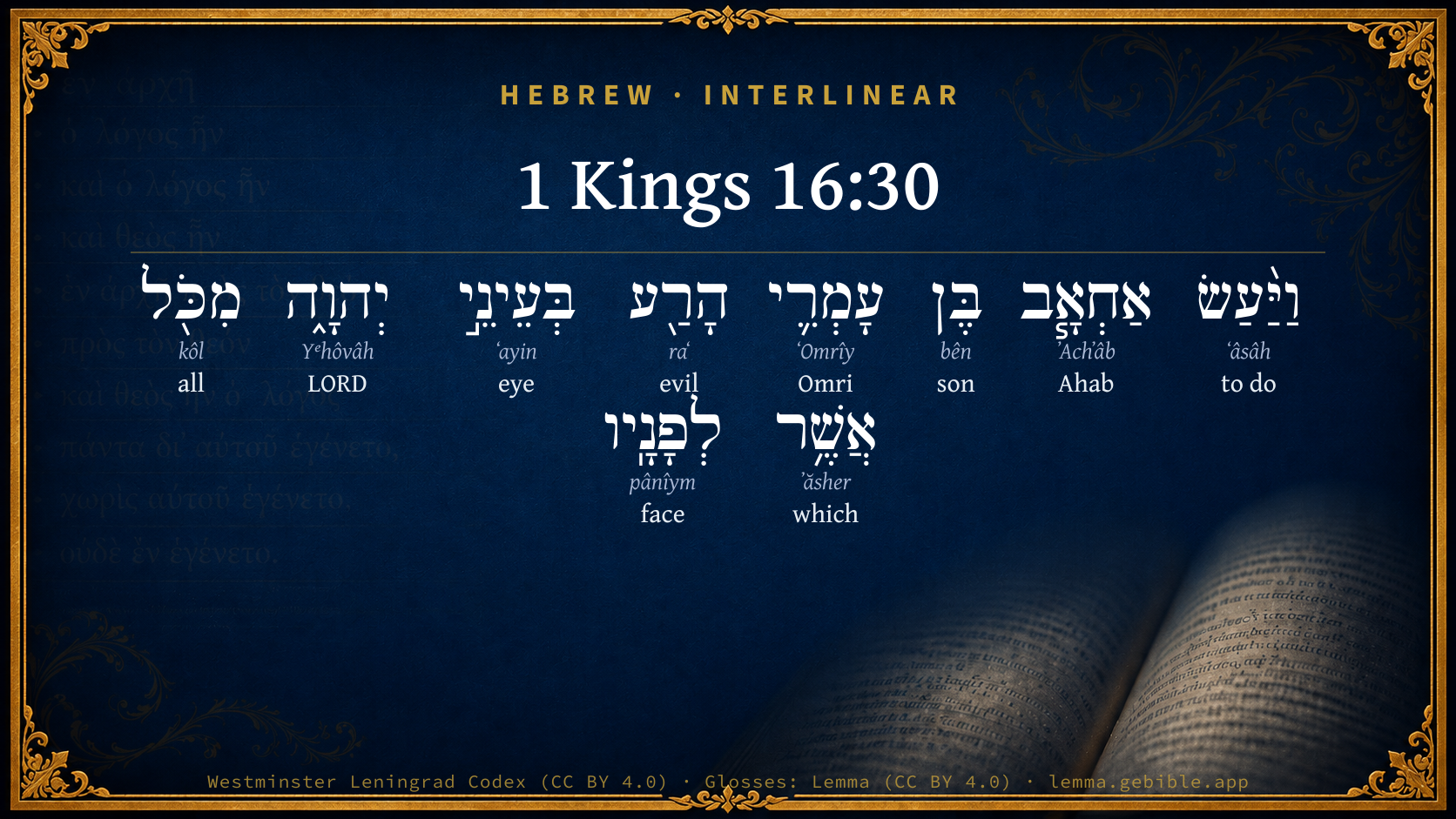
Hebrew (Westminster Leningrad Codex) 1 Kings 16:30 appears in the Hebrew Old Testament. The text above is from the Westminster Leningrad Codex. Each word links to its Strong’s number, a concise gloss, and parsing drawn from the Open Scriptures Hebrew Bible morphology. Click any word for its full Brown-Driver-Briggs (BDB) entry.
Download image
Cite this verse

1 Kings 16:30 (World English Bible). Public Domain. Lemma interlinear Bible study tool, https://lemma.gebible.app/v/1-kings/16/30.

Show BibTeX & RIS
BibTeX
RIS
English Translation
Ahab the son of Omri did that which was evil in the sight of Yahweh above all that were before him.
World English Bible · Public Domain
Download a study sheet

One document with this verse’s original text, its word-by-word gloss line, the meaning frame, cross-references with their text, attributed commentary, and full source and license credits — printable, and it pastes into notes with its structure intact.

This verse Autodidact and up

Study sheet (.html) Plain text (.txt)

A passage Seminary Student

Up to 50 verses in one chapter. A passage sheet keeps up to 6 commentary sources and 12 cross-references per verse, in the order this page ranks them, and says so on the sheet whenever that leaves anything out. Ask for a single verse and you get the Autodidact verse sheet above.

Everything on this page stays free to read, with no account — the sheet is a download of what is already on screen, not access to it.

Want to remove ads? Support Godless Engineer
Compare translations 3

The same verse in 3 English versions, stacked beneath the original-language interlinear above. Click any original word for its lexicon entry.

Each is an independent rendering of the whole verse — the interlinear is not word-aligned to these translations.

Highlighted words mark where these versions differ — a whole-verse word diff, not a word-by-word alignment.

  • World English Bible Public Domain
    Ahab the son of Omri did that which was evil in the sight of Yahweh above all that were before him.
  • King James Version Public Domain
    And Ahab the son of Omri did evil in the sight of the LORD above all that were before him.
  • unfoldingWord Literal Text CC BY-SA 4.0
    And Ahab, the son of Omri, did evil in the eyes of Yahweh, more than all who to his face.

unfoldingWord Literal Text — © unfoldingWord, licensed CC BY-SA 4.0. Word-aligned USFM3 via Door43 (git.door43.org/unfoldingWord/en_ult).

Versions to compare (up to 4)

3 of 4 selected

Show all 18 translations

Every available English version of this verse, each an independent rendering of the whole verse.

  • World English Bible Public Domain
    Ahab the son of Omri did that which was evil in the sight of Yahweh above all that were before him.
  • Berean Standard Bible Public Domain
    However, Ahab son of Omri did evil in the sight of the LORD, more than all who were before him.
  • Majority Standard Bible Public Domain
    However, Ahab son of Omri did evil in the sight of the LORD, more than all who were before him.
  • King James Version Public Domain
    And Ahab the son of Omri did evil in the sight of the LORD above all that were before him.
  • American Standard Version (1901) Public Domain
    And Ahab the son of Omri did that which was evil in the sight of Jehovah above all that were before him.
  • Revised Version (1885) Public Domain
    And Ahab the son of Omri did that which was evil in the sight of the LORD above all that were before him.
  • Geneva Bible (1599) Public Domain
    And Ahab the sonne of Omri did worse in ye sight of the Lord then al that were before him.
  • Douay-Rheims (1899) Public Domain
    And Achab the son of Amri did evil in the sight of the Lord above all that were before him.
  • Young's Literal Translation Public Domain
    and Ahab son of Omri doth the evil thing in the eyes of Jehovah above all who `are' before him.
  • Literal Standard Version CC BY-SA 4.0
    and Ahab son of Omri does evil in the eyes of YHWH above all who [are] before him.
  • Unlocked Literal Bible CC BY-SA 4.0
    Ahab son of Omri did what was evil in the sight of Yahweh, more than all those who were before him.
  • unfoldingWord Literal Text CC BY-SA 4.0
    And Ahab, the son of Omri, did evil in the eyes of Yahweh, more than all who to his face.
  • Darby Bible Public Domain
    And Ahab the son of Omri wrought evil in the sight of Jehovah more than all that were before him.
  • World Messianic Bible Public Domain
    Ahab the son of Omri did that which was evil in the LORD’s sight above all that were before him.
  • Webster's Bible Public Domain
    And Ahab the son of Omri did evil in the sight of the LORD above all that were before him.
  • Free Bible Version CC BY-SA 4.0
    Ahab, son of Omri, did evil in the Lord's sight, more than those who lived before him.
  • Bible in Basic English Public Domain
    And Ahab, the son of Omri, did evil in the eyes of the Lord, even worse than all who went before him.
  • JPS Tanakh (1917) Public Domain
    And Ahab the son of Omri did that which was evil in the sight of the LORD above all that were before him.

Literal Standard Version (2020), Covenant Press — licensed CC BY-SA 4.0. Text via the HelloAO Bible API (eBible.org). Unlocked Literal Bible (unfoldingWord) — licensed CC BY-SA 4.0. Text via the HelloAO Bible API (eBible.org). unfoldingWord Literal Text — © unfoldingWord, licensed CC BY-SA 4.0. Word-aligned USFM3 via Door43 (git.door43.org/unfoldingWord/en_ult). Free Bible Version, Dr. Jonathan Gallagher — licensed CC BY-SA 4.0. Text via the HelloAO Bible API (eBible.org).

Word by word

More ways to search: Search by grammar → Find every occurrence → Compare this word →

Practice this passage: Drill this verse → Learn its vocabulary →

עָמְרִ֛י
ʻOmrîy
H6018
“Omri”
Noun, Proper
Part of Speech
Noun
Type
Proper
Full BDB Definition

Origin: from H6014

TWOT: None

Omri = "pupil of Jehovah" - king of the northern kingdom of Israel, successor to king Elah for whom he was the captain of the army; ruled for 12 years and succeeded by his infamous son Ahab - one of the sons of Becher the son of Benjamin - a descendant of Pharez the son of Judah - son of Michael and chief of the tribe of Issachar in the time of David
  1. וַיַּ֨עַשׂ ʻâsâh H6213 “and · to do” Conjunction + Verb, Qal, Sequential Imperfect, 3rd Person, Masculine, Singular
  2. אַחְאָ֧ב ʼAchʼâb H256 “Ahab” Noun, Proper
  3. בֶּן bên H1121 “son of” Noun, Common, Masculine, Singular, Construct
  4. הָרַ֖ע raʻ H7451 “the · evil” Particle, Definite Article + Adjective, Adjective, Masculine, Singular, Absolute
  5. בְּעֵינֵ֣י ʻayin H5869 “in/at · eyes of” Preposition + Noun, Common, Both, Dual, Construct
  6. יְהוָ֑ה Yᵉhôvâh H3068 “LORD” Noun, Proper
  7. מִכֹּ֖ל kôl H3605 “from · all” Preposition + Noun, Common, Masculine, Singular, Absolute
  8. אֲשֶׁ֥ר ʼăsher H834 “which” Particle, Relative
  9. לְפָנָֽיו pânîym H6440 “to/for · face(s) · his” Preposition + Noun, Common, Both, Plural, Construct + Suffix, Personal, 3rd Person, Masculine, Singular

About this verse

These counts appear in no published source. They are computed here, from the morphology-tagged text and Lemma’s own curated glosses. What Lemma adds →

10
words
10
distinct lemmas
Historical
section

Notable vocabulary

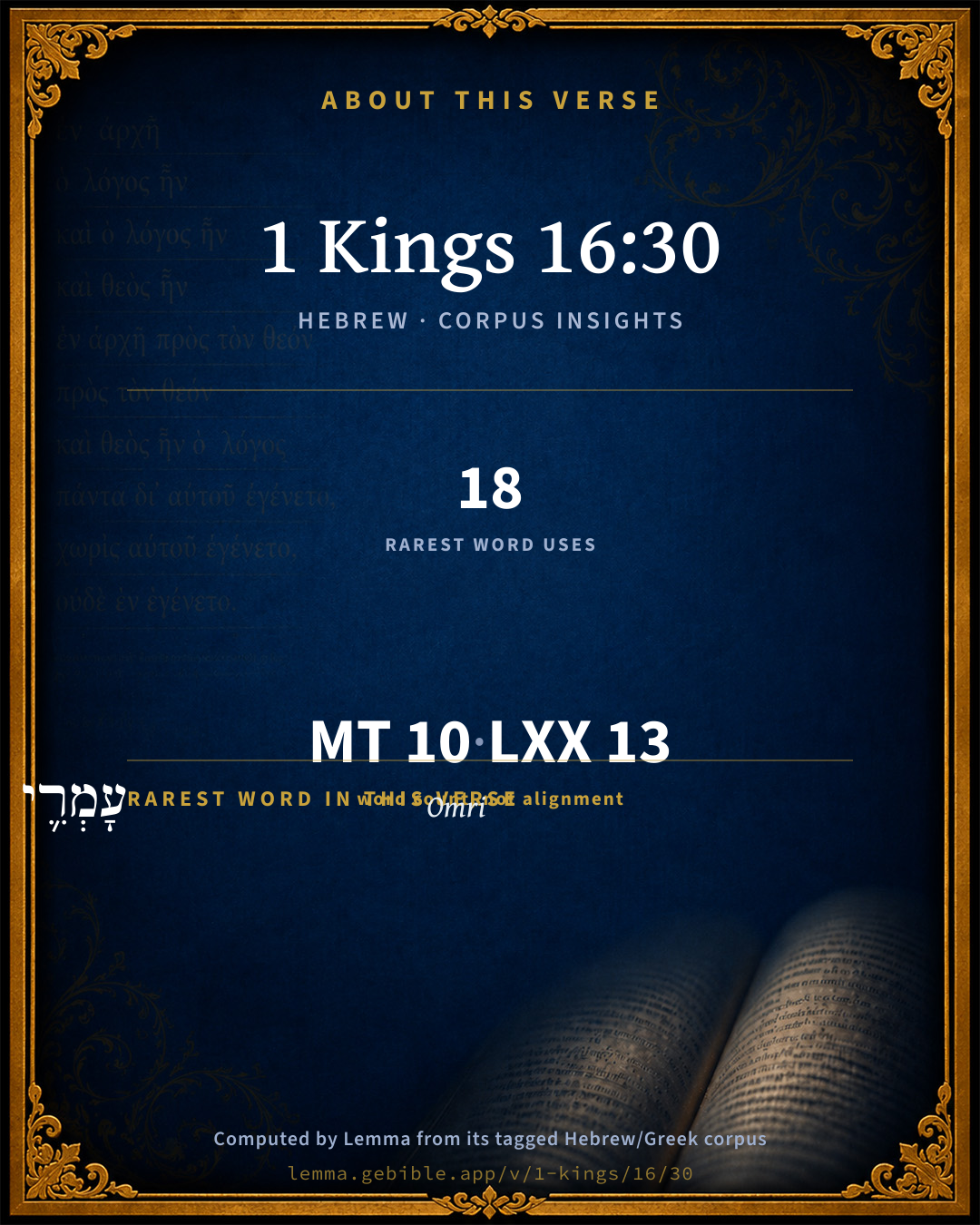
The rarest word here is עָמְרִ֛י Omri H6018 — appearing just 18 times in the whole Hebrew Bible.

Shared distinctive vocabulary

עָמְרִ֛י Omri H6018 occurs in 16 verses of the Hebrew Bible. Also found in:

Grammatical profile

  • 1 verb
  • 7 nouns
  • 1 adjective
  • 1 particle

Verb forms

  • וַיַּ֨עַשׂ Qal · Sequential Imperfect

Hebrew & Septuagint length

In English translation the verse runs 21 words from the Hebrew and 23 from the Septuagint (LXX English) — closely comparable.

A rough comparison of the two English renderings, which tokenize alike — not a word-level alignment.

Word counts can differ between the Hebrew and the Greek without any difference in meaning — e.g. the Hebrew direct-object marker אֵת has no separate Greek word, and Greek often adds the article ὁ.

In the original languages it is 10 Hebrew tokens and 13 Greek tokens — but the two are counted differently (Hebrew bundles its prefixes and suffixes into one token; the Greek is in lemma form), so that isn’t a like-for-like length.

Cross-references

6

Topical passages linked to 1 Kings 16:30 in the Treasury of Scripture Knowledge — connected by theme and wording, ordered by reader-vote popularity; previews shown in the World English Bible.

  • 1 Kings 16:25 Omri did that which was evil in the sight of Yahweh, and dealt wickedly above all who were before him.
  • 1 Kings 14:9 but have done evil above all who were before you, and have gone and made you other gods, and molten images, to provoke me to anger, and have cast me behind your back:
  • 1 Kings 21:25 (But there was none like Ahab, who did sell himself to do that which was evil in the sight of Yahweh, whom Jezebel his wife stirred up.
  • 2 Kings 3:2 He did that which was evil in the sight of Yahweh, but not like his father, and like his mother; for he put away the pillar of Baal that his father had made.
  • 1 Kings 16:31 It happened, as if it had been a light thing for him to walk in the sins of Jeroboam the son of Nebat, that he took as wife Jezebel the daughter of Ethbaal king of the Sidonians, and went and served Baal, and worshiped him.
  • 1 Kings 16:33 Ahab made the Asherah; and Ahab did yet more to provoke Yahweh, the God of Israel, to anger than all the kings of Israel who were before him.

Cross-references courtesy of OpenBible.info (CC BY 4.0).

Hebrew and Greek witnesses Masoretic Hebrew ↔ Greek Septuagint

The same verse in the two great witnesses to the Old Testament, shown verse-for-verse.

These are two independent witnesses, not word-aligned to each other, and the Septuagint is shown in lemma (dictionary) form.

Hebrew 1 Kings 16:30 Masoretic · Westminster Leningrad Codex

וַיַּ֨עַשׂ אַחְאָ֧ב בֶּן עָמְרִ֛י הָרַ֖ע בְּעֵינֵ֣י יְהוָ֑ה מִכֹּ֖ל אֲשֶׁ֥ר לְפָנָֽיו

Ahab the son of Omri did that which was evil in the sight of Yahweh above all that were before him.

World English Bible · Public Domain

Greek LXX 1 Kings 16:30 Septuagint · lemma form

καί ποιέω αχααβ ὁ πονηρός ἐνώπιον κύριος πονηρεύομαι ὑπέρ πᾶς ὁ ἔμπροσθεν αὐτός

And Achaab did that which was evil in the sight of the Lord, and did more wickedly than all that were before him.

LXX2012 (modern English Septuagint) · Public Domain

On this verse, The Pulpit Commentary discusses the Septuagint’s reading. Read the note in Commentary ↓

Hebrew: Westminster Leningrad Codex (CC BY 4.0). Greek: Septuagint (public domain); English from LXX2012 (modern English Septuagint) (Public Domain). How the Septuagint differs from the Hebrew →

Targum (Aramaic paraphrase)

1

The Targum is the ancient Jewish Aramaic paraphrase of the Hebrew Scriptures — an interpretive translation, not the Hebrew text itself. Onkelos (literal) and Pseudo-Jonathan (expansive) render the Torah, and Jonathan the Prophets. Coverage is partial: where no permissively-licensed English translation exists for a verse, only the Aramaic is shown. This is verse-level text, not a word-by-word alignment to the Hebrew.

  1. Targum Jonathan Prophets (Joshua–Malachi)
    וַעֲבַד אַחְאָב בַּר עָמְרִי דְבִישׁ קֳדָם יְיָ מִכֹּל דִי קֳדָמוֹהִי:

    (no public-domain English translation for this verse)

    Targum Jonathan — Aramaic: “Mikraot Gedolot” (public domain). English: “Sefaria Community Translation” (CC0 1.0 (public-domain dedication)); “London "Chaldee Paraphrase," 1871” (public domain). Text via Sefaria.

Commentary

Notes on 1 Kings 16:30 from classic Christian and Jewish commentators (each source and its license shown beneath its notes). The classic Christian expositions comment on the surrounding passage and are grouped to its opening verse, so a note may address several verses; the Jewish commentaries on the Tanakh (Rashi and others) are per-verse, so they appear only where the commentator wrote on this verse.

Lemma curates 59 commentaries, every one of them public domain or Creative Commons licensed, each selected and text-cleaned for this edition rather than reprinted as found. About our sources →

Trapp's Complete Commentary

John Trapp

1Ki 16:30 And Ahab the son of Omri did evil in the sight of the LORD above all that [were] before him.

Ver. 30. Above all that were.] He proved an arrant non-such. {a}

{a} Bipedum nequissimus.

John Trapp, A Commentary or Exposition upon All the Books of the Old and New Testament (1647–1656) — public domain. Text from a community e-Sword module.

Albert Barnes' Notes on the Bible

See 1Ki 16:33. The great sin of Ahab - that by which he differed from all his predecessors, and exceeded them in wickedness - was his introduction of the worship of Baal, consequent upon his marriage with Jezebel, and his formal establishment of this gross and palpable idolatry as the religion of the state.

Albert Barnes' Notes on the Bible (1834–1885) — public domain. Text from a community e-Sword/MySword module.

Whedon's Commentary on the Bible

Daniel D. Whedon

30. Above all that were before him — He even went beyond the hitherto unparalleled wickedness of Omri, his father.

Daniel D. Whedon (gen. ed.), Commentary on the Old and New Testaments (1874–1909) — public domain. Text from a community e-Sword module.

The Pulpit Commentary

And Ahab the son of Omri The repetition is noticeable. It is possible that the preceding verse has been revised by a chronologer. The LXX text is much more condensed did evil in the sight of the Lord aboveall that were before him. The same words are used of his father in ver. 25. It is not difficult to see in what way Ahab"s rule was worse even than Omri"s. The latter had gone beyond his predecessors in the matter of the calf worship. See note on ver. 25. But the calf worship, however it may have deteriorated in process of time and it is the tendency of such systems to wax worse and worse was nevertheless a cult, though a corrupt, and unauthorized, and illicit cultus, of the one true God. Under Ahab, however, positive idolatry was established and fostered the worship of foreign and shameful deities.

HOMILIES BY A. ROWLAND Vers. 30-33.

Moral Ruin through Moral Weakness.

This was the turning-point in the history of the kingdom of Israel. Till now the people had professedly worshipped Jehovah under the symbol of the calf. Now idolatry of a grosser kind was avowedly set up as the national religion, on a scale of great magnificence. The text, therefore, is worthy of our study as the record of an event of deep historic significance, but we propose to consider it as a suggestive example of the way in which a man of moral weakness may be betrayed into the worst depravity, to the undoing of himself and others. We learn the following lessons from Ahab s life, of which a summary is given here:

I THAT A FOOLISH CHOICE MAY RESULT IN LASTING DISHONOUR. Ahab"s marriage was the cause of his ruin. Jezebel, his wife, was the daughter of Ethbaal, who had Been the high priest of Astarte, but was led by his ambition and unscrupulousness to usurp his brother"s throne. Her parentage and her surroundings would have been a sufficient warning to a prudent king. But besides these Ahab had the Divine law before him, (Exo_34:16) which distinctly forbade union with the Canaanites. Such a marriage was unprecedented in the kingdom of Israel, and was the more fatal because of the character of the queen, the Lady Macbeth of Scripture. She was reckless and licentious, fanatical and cruel, with a temper as vindictive as her will was resolute. Her husband became a mere tool in her hands. He could not foresee all the issues of his choice, but he knew the choice was sinful. Show from this illustrating by example

1. How one wrong step leads to another. This marriage to the establishment of idolatry. Indicate the nature of the false religion set up.

2. How companionship influences character. The stronger moulding the weaker. "A companion of fools shall be destroyed.

3. How personal fascination may cause men to swerve from rectitude. Jezebel"s fascinating power was regarded as witchery and became proverbial. (Rev_2:20)

4. How young people should be warned against unholy alliances. Marriage makes or mars character, hope, and blessedness. (2Co_6:14) "Be ye net unequally yoked together with unbelievers.

II THAT EASY GOOD NATURE MAY PROVE THE SOURCE OF DEEP DEGRADATION. Ahab was not destitute of good feelings and right impulses. Had he been firm instead o! pliable, and resolutely refused to gratify the queen by the establishment of idolatry, he might, with God"s help, have neutralized the effect of the false step he had taken. But he was of a yielding nature, while she was resolute; and so, like Samson, he lost his kingliness. Point out the special dangers of those who are kindly and genial. Their unwillingness to disoblige, their wish to be popular, their dread of derision, their love of ease and pleasure, etc., may have fatal issues.

III THAT BRILLIANT TALENTS WILL NOT COMPENSATE FOR MORAL WEAKNESS. This king was gifted with military skill, with artistic taste, etc., but these could net help him in the hour of spiritual conflict. Give examples from history of the careers of clever but unprincipled men, their meteoric success, their future punishment, here or hereafter; e.g., Napoleon I Many men of genius have been ruined by drunkenness, and often high education has served only to alter the form and increase the influence of the sin. The clever forger is worse than the common thief; the viciousness of a leader of society does more injury than the licentiousness of an ignorant peasant.

IV THAT ARCHITECTURAL SPLENDOURS AND MILITARY VICTORIES ARE NOT PROOFS OF NATIONAL PROSPERITY. Describe Ahab"s magnificent buildings, his ivory house, his daring restoration and fortification of Jericho, his palace and park in Jezreel, which became to Samaria what Versailles once was to Paris. Show how often in history such costly expenditure has been a sign of decay.

Extravagance and luxuriousness are omens of ruin to a people. "The Decline and Fall" of the Roman Empire is an abiding illustration of this. Nor will successful wars give stability to a kingdom. Ahab"s victories were great military achievements, but of what avail to him and to his house? "The throne must be established in righteousness.

V THAT AMPLE POSSESSIONS DO NOT CONTENT AN UNQUIET HEART. In Jezreel, the perfection of taste, Ahab was wretched, because he wanted Naboth"s vineyard. (Read that story.) It is not in the power of earthly things to satisfy a hungering soul. The richest man is not content if he has only his riches, nor will any addition to them give him satisfaction. "Take heed, and beware of covetousness: for a man"s life consisteth not in the abundance of the things which he possesseth". (Luk_12:15) "Blessed are they that hunger and thirst after righteousness, for they shall be filled." God "satisfieth the longing soul, and filleth the hungry soul with goodness.

VI THAT PARTIAL REPENTANCE DOES NOT AVERT GOD"S PUNISHMENT OF SIN. Ahab "put sackcloth upon his flesh, and fasted, and lay in sackcloth, and went softly," when he heard Elijah"s final threat; but, though this first sign of penitence was graciously encouraged by a promise, the change went no further He dreaded punishment, but his heart did not turn from sin, and therefore, though he disguised himself in the battle, the arrow "shot at a venture" was winged by Divine retribution to his heart. God is our Judge, as well as our King. For the impenitent there will be no escape. In vain will they "call on mountains and rocks to fall on them, and hide them from the wrath of God." Now in this day of mercy, God calls on all to repent, and find pardon and hope in Him, who has come "to seek and to save that which was lost. A.R.

The Pulpit Commentary (1880–1919), ed. H.D.M. Spence-Jones & Joseph S. Exell — public domain. Text from a community e-Sword module.

Keil & Delitzsch

C. F. Keil & F. Delitzsch

Whereas the former kings of Israel had only perpetuated the sin of Jeroboam, i.e., the calf-worship. or worship of Jehovah under the image of an ox, which he had introduced, Ahab was not satisfied with this. לכתּו הנקל ויהי, "it came to pass, was it too little?" i.e., because it was too little (cf. Ewald, 362, a.) to walk in the sins of Jeroboam, that he took as his wife Jezebel, the daughter of Ethbaal the king of the Sidonians, and served Baal, and worshipped him. ויּלך before ויּעבד, "he went and served," is a pictorial description of what took place, to give greater prominence to the new turn of affairs. אתבּעל .sri (i.e., with Baal) is the Εἰθώβαλος (בּעל אתּו or Ἰθόβαλος: Jos. Ant. viii. 13, 1) mentioned by Menander in Josephus, c. Ap. i. 18, who was king of Tyre and Sidon, and priest of Astarte, and who usurped the throne after the murder of his brother, king Pheles, and reigned thirty-two years. Jezebel (איזבל, i.e., probably without cohabitation, cf. Gen 30:20, = untouched, chaste; not a contraction of אביזבל, as Ewald, 273, b., supposes) was therefore, as tyrant and murderess of the prophets, a worthy daughter of her father, the idolatrous priest and regicide. Baal (always הבּעל with the article, the Baal, i.e., Lord κατ ̓ ἐξοχήν) was the principal male deity of the Phoenicians and Canaanites, and generally of the western Asiatics, called by the Babylonians בּל = בּעל (Isa 46:1), Βῆλος, and as the sun-god was worshipped as the supporter and first principle of psychical life and of the generative and reproductive power of nature (see at Jdg 2:13). Ahab erected an altar to this deity הבּעל בּית, in the house (temple) of Baal, which he had built at Samaria. The worship of Baal had its principal seat in Tyre, where Hiram, the contemporary of David and Solomon, had built for it a splendid temple and placed a golden pillar (χρυσοῦν κίονα) therein, according to Dius and Menander, in Joseph. Ant. viii. 5, 3, and c. Ap. i. 18. Ahab also erected a similar pillar (מצּבה) to Baal in his temple at Samaria (vid., Kg2 3:2; Kg2 10:27). For statues of images of Baal are not met with in the earlier times; and the בּעלים are not statues of Baal, but different modifications of that deity. It was only in the later temple of Baal or Hercules at Tyre that there was, as Cicero observes (Verr. iv. 43), ex aere simulacrum ipsius Herculis, quo non facile quidquam dixerim me vidisse pulcrius.

Keil & Delitzsch — Biblical Commentary on the Old Testament (1861–1891) — public domain (CC PDM 1.0). Text via the HelloAO Bible API. (Old Testament only.)

Lesson kit

Teaching starters — assembled from the data on this page, not authored interpretation. Every prompt links to the verse data it draws on. Edit before teaching.

1 Kings, in the Historical, opens this verse with 10 words (10 distinct Hebrew lemmas). Its most distinctive word is ʻOmrîy (“Omri”). A historical commentator’s framing appears above. Read the whole chapter for the surrounding context.

Discussion questions

  1. The word ʻOmrîy carries the sense “Omri.” How does it shape the verse?
  2. How does 1 Kings 16:16, which shares the word «Omri», read alongside this verse?
  3. The translations on this page render this verse differently — a whole-verse word diff, not a word-by-word alignment. What might account for the different wordings?
  4. «וַיַּ֨עַשׂ» is a Qal Sequential Imperfect verb. How does that grammatical form shape the action described?
  5. Compare how Trapp's Complete Commentary and Albert Barnes' Notes on the Bible read this verse. Where do they agree or differ?

Things to notice

Reading settings

Reading text

Shown beneath each verse's original-language words.

Old Testament
Old Testament edition

Read the OT as the Masoretic Hebrew (MT) or the Greek Septuagint (LXX).

English shown for the Greek Septuagint (in the Hebrew ↔ Greek comparison).

Comparing translations? Open the Compare panel on any verse page to stack up to four side by side.