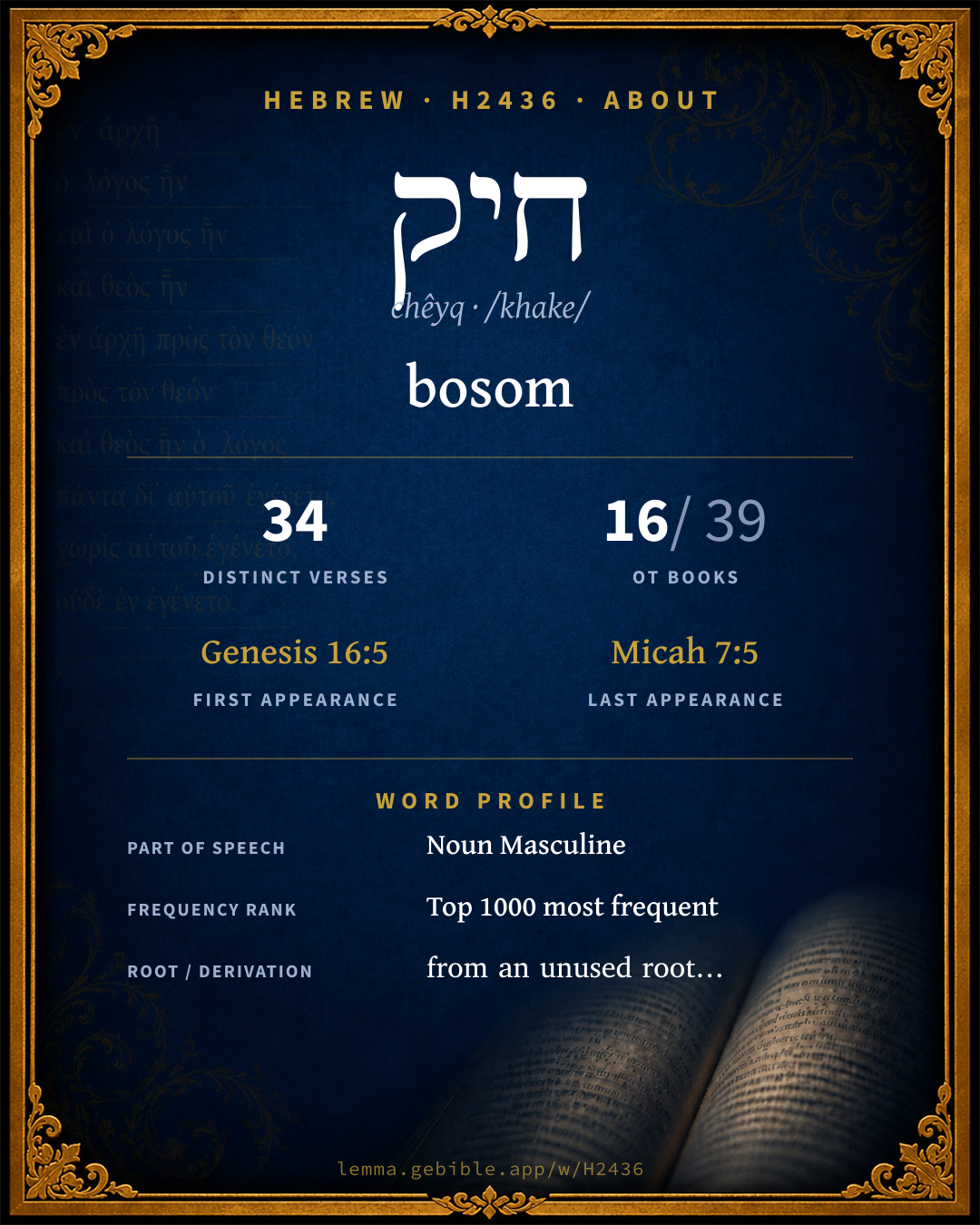
חֵיק
bosom
Full lexicon entry — Brown-Driver-Briggs (BDB)
From Brown-Driver-Briggs (BDB)
Where this word appears
See every Construct-state word in the Hebrew Bible →
Grammar key — what these labels mean
Part of speech
- Noun
- A naming word — a person, place, thing, or idea.
Noun type
- Common
- A common noun — a general class of person, place, or thing (“king,” “city,” “water”), not a specific name.
State
- Construct
- A noun bound to a following noun in a possessive / “of” relationship (the construct chain).
- Absolute
- The independent form of a noun, not bound to a following word.
Gender
- Masculine
- Grammatically masculine.
Number
- Singular
- One.
Grammatical forms
- Noun, Common, Masculine, Singular, Construct 35 times (92%)
- Noun, Common, Masculine, Singular, Absolute 3 times (8%)
Parsed forms decoded from the imported morphology (morphhb / Westminster Leningrad Codex — WLC text public domain, morphhb tagging CC BY 4.0), counted across 38 parsed occurrences — not distinct verses.
Every verse where H2436 appears — 34 distinct verses across 16 books. Click any verse to open its interlinear word-by-word view. Verse text shown in the World English Bible for context — . Each verse’s Hebrew form is shown with its reference; the English is not keyword-highlighted, since the data carries no word-level English alignment. Use “Compare translations” on any verse to read it across multiple English versions. This concordance covers the Hebrew Bible; Septuagint (Greek Old Testament) occurrences are not indexed here.
Genesis 1 verse
Exodus 2 verses
- Exodus 4:6 בְּ/חֵיקֶ֔/ךָ בְּ/חֵיק֑/וֹ prep + n c ms cs + sfx pers 2ms prep + n c ms cs + sfx pers 3ms Yahweh said furthermore to him, "Now put your hand inside your cloak." He put his hand inside his cloak, and when he took it out, behold, his hand was leprous, as white as snow.
- Exodus 4:7 חֵיקֶ֔/ךָ חֵיק֑/וֹ מֵֽ/חֵיק֔/וֹ n c ms cs + sfx pers 2ms n c ms cs + sfx pers 3ms prep + n c ms cs + sfx pers 3ms He said, "Put your hand inside your cloak again." He put his hand inside his cloak again, and when he took it out of his cloak, behold, it had turned again as his other flesh.
Numbers 1 verse
Deuteronomy 3 verses
- Deuteronomy 13:6 חֵיקֶ֗/ךָ n c ms cs + sfx pers 2ms If your brother, the son of your mother, or your son, or your daughter, or the wife of your bosom, or your friend, who is as your own soul, entice you secretly, saying, Let us go and serve other gods, which you have not known, you, nor your fathers;
- Deuteronomy 28:54 חֵיק֔/וֹ n c ms cs + sfx pers 3ms The man who is tender among you, and very delicate, his eye shall be evil toward his brother, and toward the wife of his bosom, and toward the remnant of his children whom he has remaining;
- Deuteronomy 28:56 חֵיקָ֔/הּ n c ms cs + sfx pers 3fs The tender and delicate woman among you, who would not adventure to set the sole of her foot on the ground for delicateness and tenderness, her eye shall be evil toward the husband of her bosom, and toward her son, and toward her daughter,
Ruth 1 verse
2 Samuel 2 verses
- 2 Samuel 12:3 וּ/בְ/חֵיק֣/וֹ conj + prep + n c ms cs + sfx pers 3ms but the poor man had nothing, except one little ewe lamb, which he had bought and raised. It grew up together with him, and with his children. It ate of his own food, drank of his own cup, and lay in his bosom, and was to him like a daughter.
- 2 Samuel 12:8 בְּ/חֵיקֶ֔/ךָ prep + n c ms cs + sfx pers 2ms I gave you your master's house, and your master's wives into your bosom, and gave you the house of Israel and of Judah; and if that would have been too little, I would have added to you many more such things.
1 Kings 4 verses
- 1 Kings 1:2 בְ/חֵיקֶ֔/ךָ prep + n c ms cs + sfx pers 2ms Therefore his servants said to him, Let there be sought for my lord the king a young virgin: and let her stand before the king, and cherish him; and let her lie in your bosom, that my lord the king may keep warm.
- 1 Kings 3:20 בְּ/חֵיקָ֑/הּ בְ/חֵיקִֽ/י prep + n c ms cs + sfx pers 3fs prep + n c ms cs + sfx pers 1cs She arose at midnight, and took my son from beside me, while your handmaid slept, and laid it in her bosom, and laid her dead child in my bosom.
- 1 Kings 17:19 מֵ/חֵיקָ֗/הּ prep + n c ms cs + sfx pers 3fs He said to her, Give me your son. He took him out of her bosom, and carried him up into the chamber, where he abode, and laid him on his own bed.
- 1 Kings 22:35 חֵ֥יק n c ms cs The battle increased that day: and the king was stayed up in his chariot against the Syrians, and died at even; and the blood ran out of the wound into the bottom of the chariot.
Job 1 verse
Psalms 4 verses
- Psalms 35:13 חֵיקִ֥/י n c ms cs + sfx pers 1cs But as for me, when they were sick, my clothing was sackcloth. I afflicted my soul with fasting. My prayer returned into my own bosom.
- Psalms 74:11 חֵֽיקְ/ךָ֣ n c ms cs + sfx pers 2ms Why do you draw back your hand, even your right hand? Take it out of your pocket and consume them!
- Psalms 79:12 חֵיקָ֑/ם n c ms cs + sfx pers 3mp Pay back to our neighbors seven times into their bosom Their reproach with which they have reproached you, Lord.
- Psalms 89:50 בְ֝/חֵיקִ֗/י prep + n c ms cs + sfx pers 1cs Remember, Lord, the reproach of your servants, How I bear in my heart the taunts of all the mighty peoples,
Proverbs 5 verses
- Proverbs 5:20 חֵ֣ק n c ms cs For why should you, my son, be captivated with an adulteress? Why embrace the bosom of another?
- Proverbs 6:27 בְּ/חֵיק֑/וֹ prep + n c ms cs + sfx pers 3ms Can a man scoop fire into his lap, And his clothes not be burned?
- Proverbs 16:33 בַּ֭/חֵיק prep det + n c ms The lot is cast into the lap, But its every decision is from Yahweh.
- Proverbs 17:23 מֵ֭/חֵיק prep + n c ms cs A wicked man receives a bribe in secret, To pervert the ways of justice.
- Proverbs 21:14 בַּ֝/חֵ֗ק prep det + n c ms A gift in secret pacifies anger; And a bribe in the cloak, strong wrath.
Ecclesiastes 1 verse
Isaiah 3 verses
- Isaiah 40:11 וּ/בְ/חֵיק֖/וֹ conj + prep + n c ms cs + sfx pers 3ms He will feed his flock like a shepherd, he will gather the lambs in his arm, and carry them in his bosom, [and] will gently lead those who have their young.
- Isaiah 65:6 חֵיקָֽ/ם n c ms cs + sfx pers 3mp Behold, it is written before me: I will not keep silence, but will recompense, yes, I will recompense into their bosom,
- Isaiah 65:7 חֵיקָֽ/ם n c ms cs + sfx pers 3mp your own iniquities, and the iniquities of your fathers together, says Yahweh, who have burned incense on the mountains, and blasphemed me on the hills; therefore will I first measure their work into their bosom.
Jeremiah 1 verse
Lamentations 1 verse
Ezekiel 3 verses
- Ezekiel 43:13 וְ/חֵ֨יק conj + n c ms cs These are the measures of the altar by cubits (the cubit is a cubit and a handbreadth): the bottom shall be a cubit, and the breadth a cubit, and the border of it by the edge of it round about a span; and this shall be the base of the altar.
- Ezekiel 43:14 וּ/מֵ/חֵ֨יק conj + prep + n c ms cs From the bottom on the ground to the lower ledge shall be two cubits, and the breadth one cubit; and from the lesser ledge to the greater ledge shall be four cubits, and the breadth a cubit.
- Ezekiel 43:17 וְ/הַֽ/חֵיק conj + ptcl def.art + n c ms The ledge shall be fourteen [cubits] long by fourteen broad in the four sides of it; and the border about it shall be half a cubit; and the bottom of it shall be a cubit round about; and the steps of it shall look toward the east.
Micah 1 verse
About this entry
At a glance — auto-summarized from this page’s data, not written by a person. Every figure links to its source below. This summary describes the numbers; it doesn’t interpret them.
חיק — transliterated chêyq — is a Hebrew noun carrying the sense “bosom.” The King James Version usually renders it “bosom,” while modern versions prefer “arms” (Berean Standard Bible) — see the renderings breakdown. With 34 verses in 16 books, it is a moderately common word in the Hebrew Bible. Debuting at Genesis 16:5, it then recurs through the corpus. See the sense tree, 34-verse concordance, and the renderings breakdown below.
Gloss history
Strong's 1890 vs modern scholarship
About this word
Strong's H2436 catalogs a Hebrew word from the Hebrew Old Testament.
These counts are not copied from any lexicon or concordance. They are computed here, from the morphology-tagged Hebrew Old Testament. What Lemma adds →
- 34
- distinct verses
- The word appears in 34 distinct verses.
- 16 / 39
- OT books
- The word appears in 16 of 39 Old Testament books.
- #947
- by frequency
- Top 1000 most frequent Hebrew words (rank 947 of 8,640 Hebrew words by occurrence).
View all 34 occurrences in the concordance →
By section of the Old Testament
By traditional corpus
Conventional, traditional groupings — biblical authorship is debated, so this is a traditional corpus grouping, not an authorship claim. Each share is this word’s portion of its verses in that division of the Hebrew canon. Each figure is a share of the word’s 34 distinct verses.
- Prophets (Nevi'im) 14 verses · 41%
- Writings (Ketuvim) 13 verses · 38%
- Torah (Pentateuch) 7 verses · 21%
How translations render this word
Counts come from each version’s own published word-to-Strong’s tagging or interlinear alignment — an approximate guide to how each version renders this word, not a word-level alignment the data otherwise carries. Because each total is that version’s own tagged count, the per-version totals vary from one another and need not match the appearance or distinct-verse counts above. These counts may also differ from a printed concordance because Lemma counts each distinctly tagged rendering and does not collapse phrase taggings into a single head-word total. This is a fixed set of word-tagged versions (KJV, ASV, BSB, ULT) and does not change with the reading translation you choose elsewhere. Each version’s license is shown beside its name below (and on Sources).
BDB lists this Strong’s number as 2 distinct words (homographs). Each count above pools all of them and is not split by sense — see the Senses section below. A low-frequency rendering may belong to a different one of those words, not the primary meaning.
- King James Version†: Bosom 31×, Bottom 3×
- American Standard Version†: Bosom 26×, Bottom 4×
- Berean Standard Bible†: Arms 6×, Bosom 4×, Laps 4×
- unfoldingWord Literal Text†: Bosom 19×, Lap 8×, And 2×
King James Version Public Domain
Renders H2436 across 38† tagged occurrences — most commonly:
Plus 4 renderings that appear only once — usually multi-word phrases or single function words the recovered tagging swept in, not distinct renderings. Not rendered by a distinct English word in 1 further occurrence.
American Standard Version Public Domain
Renders H2436 across 38† tagged occurrences — most commonly:
Plus 8 renderings that appear only once — usually multi-word phrases or single function words the recovered tagging swept in, not distinct renderings.
Berean Standard Bible Public Domain
Renders H2436 across 34† tagged occurrences — most commonly:
Plus 11 renderings that appear only once — usually multi-word phrases or single function words the recovered tagging swept in, not distinct renderings. Not rendered by a distinct English word in 3 further occurrences.
unfoldingWord Literal Text CC BY-SA 4.0
Renders H2436 across 40† tagged occurrences — most commonly:
Plus 9 renderings that appear only once — usually multi-word phrases or single function words the recovered tagging swept in, not distinct renderings.
Senses in the full BDB
What do BDB’s symbols mean?
BDB uses these scholarly abbreviations:
| Symbol | Meaning |
|---|---|
| 𝔊 | the Septuagint (the ancient Greek translation, LXX) |
| 𝔙 | the Vulgate (the Latin translation) |
| 𝔖 | the Syriac version (the Peshitta) |
| 𝔗 | the Targum (the Aramaic translation) |
| ψ | the Psalms |
| √ | root (the underlying root or stem) |
| ‖ | parallel passage (a synonymous or contrasted parallel) |
| † | the dagger: every passage where the word occurs is cited |
The 5 senses and sub-senses the full Brown-Driver-Briggs lexicon distinguishes for this word, in lexicon order (not ranked by frequency), with BDB’s own verbatim wording and sub-sense lettering. Shown in Hebrew script with BDB’s own scholarly abbreviations. The condensed entry is in the Lexicon Entry tab. See also the Forms in the corpus table below.
- 1. of fold of garment, at breast Ex 4:6(×2), 7(×3) (all J), Pr 6:27; 16:33, metaph. of י׳ ψ 74:11; שֹׁחַד בח׳ Pr 21:14 is a hidden reward (concealed in bosom; ‖ מַתָּן בַּסֵּתֶר); שֹׁחַד מֵחֵק 17:23 is a gift secretly given; fig., requite into bosom Is 65:6, 7; Je 32:18; cf. ψ 35:13; 79:12. e.g. Exodus 4:6
- 2. carry (נָשָׁא) in bosom, Moses the people Nu 11:12 (JE); Naomi, Ruth’s child Ru 4:16, cf. 1 K 3:20(×2); 17:19; ewe lamb 2 S 12:3 Is 40:11 (metaph.); La 2:12 of infants dying in their mothers’ arms; fig. of carrying insults in one’s bosom ψ 89:51 (read prob. כְּלִמַּת for כֹּל, v. Bi Che). e.g. Numbers 11:12
- 3. bosom as part of body:
- a. external, lie in bosom, of wife שׁכבת Mi 7:5, cf. 2 S 12:8; concubine Gn 16:5 (J) cf. 1 K 1:2; אֵשֶׁת חיק(ך) Dt 13:7; 28:54, cf. also Pr 5:20 תְּחַבֵּק חֵק נָכְרִיָּה; אִישׁ חֵיקָהּ Dt 28:56. e.g. Micah 7:5
- b. internal, anger resteth בח׳ כסילים Ec 7:9; כָּלוּ כִלְיֹתַי בְּחֵקִי Jb 19:27 my reins are consumed within me; Jb 23:12 (read בְּחֵקִי for מֵחֻקִּי, so 𝔊 𝔙 Ol Me Stu Di) in my breast have I hidden the words of his mouth (cf. בְּלִבִּי ψ 119:11); fig. of interior of chariot 1 K 22:35 ח׳ הרכב; of hollow bottom of altar Ez 43:13, 14, 17 (Sm Rinne; Co Grundeinfassung). e.g. Ecclesiastes 7:9
Senses from the full Brown-Driver-Briggs lexicon (Brown, Driver, Briggs; Oxford 1906 — public domain), digitized via Sefaria, supplemented by the OpenScriptures HebrewLexicon (CC BY 4.0). Full attribution on Sources.
Word origin
n.[m.] bosom (NH id.)—abs. חֵיק Ez 43:17 Pr 16:33 + Ez 43:13 (Co חיקו, cf. ZKW 1883, pp. 67 ff.; חֵיקֹה DrSm xxxi), חֵק Pr 21:14; cstr. חֵיק 1 K 22:35 + 3 times + Ez 43:14 (Co חיקו) חֵק Pr 5:20 (om. by accident in Baer, cf. Strad loc.) 17:23; sf. חֵיקִי 1 K 3:20 ψ 89:51; חֵקִי Jb 19:27 etc.; elsewhere always plene c. sf.; חוקך Kt ψ 74:11 (Qr חֵיקְךָ);—bosom, specif.
— Brown-Driver-Briggs (Oxford 1906, public domain), digitized via Sefaria, supplemented by the OpenScriptures HebrewLexicon (CC BY 4.0). See Sources.
Origin: from an unused root, apparently meaning to inclose
Jastrow Dictionary
A second Hebrew/Aramaic lexicon for comparison, covering Aramaic and post-biblical (Talmudic, Targumic, Midrashic) usage that the biblical-Hebrew BDB does not. Matched by lemma rather than by Strong’s number, so a lemma may carry more than one Jastrow headword (shown separately below), and the entries cover usage well beyond the Bible.
חֵיק
- 1. lap, bosom, embrace. M. Kat. 24ᵃ a child יוצא בח׳ is carried out in one’s arms (without a coffin); Kidd. 80ᵇ; Treat. S’maḥ. III, 2.—Y. M. Kat. III, beg. 81ᶜ הניח ה׳ אמו וכ׳ left his mother’s lap (Palestine). Tosef. Yeb. IX, 4 מח׳ בעלה directly from the embrace of her husband; a. e.
- 2. receptacle, cavity, bottom. Men. 97ᵇ; Erub. 4ᵃ (ref. to Ez. XLIII, 17), v. יְסוֹד. e.g. Ezekiel 43:17
A Dictionary of the Targumim, the Talmud Babli and Yerushalmi, and the Midrashic Literature (Marcus Jastrow; London, Luzac, 1903) — Public Domain. Digitized via Sefaria. Digitized via Sefaria. Full attribution on Sources.
Forms in the corpus
The 32 distinct written forms H2436 takes in the Hebrew Bible, most frequent first — each parse links to that state’s occurrences in the concordance. Hebrew forms include their vowel points and cantillation, so a single lemma takes many written forms.
Septuagint verse parallels
This word appears in 32 verses that also exist in the Greek Old Testament (Septuagint), out of the 34 Hebrew verses it occurs in. You can read those verses in Greek by switching the Old Testament edition to the Septuagint.
Read these verses in the Septuagint
- Genesis 16:5
- Exodus 4:6
- Numbers 11:12
- Deuteronomy 13:6
- Ruth 4:16
- 2 Samuel 12:3
- 1 Kings 1:2
- Job 19:27
- Psalms 35:13
- Proverbs 5:20
- Ecclesiastes 7:9
- Isaiah 40:11
This is a verse-level parallel only — the same verses exist in both the Hebrew and Greek Old Testaments. No word-level Hebrew↔Greek correspondence is claimed: the data carries no such alignment, so no Greek word is shown as this Hebrew word’s translation. Coverage is not total — the Septuagint omits the deuterocanon and renumbers the Psalms, so some Hebrew verses have no direct Greek parallel.