
Ezekiel 43:14

Hebrew (Westminster Leningrad Codex) Ezekiel 43:14 appears in the Hebrew Old Testament. The text above is from the Westminster Leningrad Codex. Each word links to its Strong’s number, a concise gloss, and parsing drawn from the Open Scriptures Hebrew Bible morphology. Click any word for its full Brown-Driver-Briggs (BDB) entry.
Download image
Cite this verse

Ezekiel 43:14 (World English Bible). Public Domain. Lemma interlinear Bible study tool, https://lemma.gebible.app/v/ezekiel/43/14.

Show BibTeX & RIS
BibTeX
RIS
English Translation
From the bottom on the ground to the lower ledge shall be two cubits, and the breadth one cubit; and from the lesser ledge to the greater ledge shall be four cubits, and the breadth a cubit.
World English Bible · Public Domain
Download a study sheet

One document with this verse’s original text, its word-by-word gloss line, the meaning frame, cross-references with their text, attributed commentary, and full source and license credits — printable, and it pastes into notes with its structure intact.

This verse Autodidact and up

Study sheet (.html) Plain text (.txt)

A passage Seminary Student

Up to 50 verses in one chapter. A passage sheet keeps up to 6 commentary sources and 12 cross-references per verse, in the order this page ranks them, and says so on the sheet whenever that leaves anything out. Ask for a single verse and you get the Autodidact verse sheet above.

Everything on this page stays free to read, with no account — the sheet is a download of what is already on screen, not access to it.

Want to remove ads? Support Godless Engineer
Compare translations 3

The same verse in 3 English versions, stacked beneath the original-language interlinear above. Click any original word for its lexicon entry.

Each is an independent rendering of the whole verse — the interlinear is not word-aligned to these translations.

Highlighted words mark where these versions differ — a whole-verse word diff, not a word-by-word alignment.

  • World English Bible Public Domain
    From the bottom on the ground to the lower ledge shall be two cubits, and the breadth one cubit; and from the lesser ledge to the greater ledge shall be four cubits, and the breadth a cubit.
  • King James Version Public Domain
    And from the bottom upon the ground even to the lower settle shall be two cubits, and the breadth one cubit; and from the lesser settle even to the greater settle shall be four cubits, and the breadth one cubit.
  • unfoldingWord Literal Text CC BY-SA 4.0
    From the gutter at the ground level up to the lower ledge of the altar is two cubits, and that ledge itself is one cubit in width. Then from the small ledge up to the large edge of the altar, it is four cubits, and the large edge is a cubit in width.

unfoldingWord Literal Text — © unfoldingWord, licensed CC BY-SA 4.0. Word-aligned USFM3 via Door43 (git.door43.org/unfoldingWord/en_ult).

Versions to compare (up to 4)

3 of 4 selected

Show all 18 translations

Every available English version of this verse, each an independent rendering of the whole verse.

  • World English Bible Public Domain
    From the bottom on the ground to the lower ledge shall be two cubits, and the breadth one cubit; and from the lesser ledge to the greater ledge shall be four cubits, and the breadth a cubit.
  • Berean Standard Bible Public Domain
    The space from the gutter on the ground to the lower ledge shall be two cubits, and the ledge one cubit wide. The space from the smaller ledge to the larger ledge shall be four cubits, and the ledge one cubit wide.
  • Majority Standard Bible Public Domain
    The space from the gutter on the ground to the lower ledge shall be two cubits, and the ledge one cubit wide. The space from the smaller ledge to the larger ledge shall be four cubits, and the ledge one cubit wide.
  • King James Version Public Domain
    And from the bottom upon the ground even to the lower settle shall be two cubits, and the breadth one cubit; and from the lesser settle even to the greater settle shall be four cubits, and the breadth one cubit.
  • American Standard Version (1901) Public Domain
    And from the bottom upon the ground to the lower ledge shall be two cubits, and the breadth one cubit; and from the lesser ledge to the greater ledge shall be four cubits, and the breadth a cubit.
  • Revised Version (1885) Public Domain
    And from the bottom upon the ground to the lower settle shall be two cubits, and the breadth one cubit; and from the lesser settle to the greater settle shall be four cubits, and the breadth a cubit.
  • Geneva Bible (1599) Public Domain
    And from the bottome which toucheth the ground to the lower piece shalbe two cubites: and the breadth one cubite, and from the litle piece to the great piece shalbe foure cubites, and the breadth one cubite.
  • Douay-Rheims (1899) Public Domain
    And these are the measures of the altar by the truest cubit, which is a cubit and a handbreadth: the bottom thereof was a cubit, and the breadth a cubit: and the border thereof unto its edge, and round about, one handbreadth: and this was the trench of the altar.
  • Young's Literal Translation Public Domain
    And from the centre of the ground unto the lower border `is' two cubits, and the breadth one cubit, and from the lesser border unto the greater border four cubits, and the breadth a cubit.
  • Literal Standard Version CC BY-SA 4.0
    And from the center of the ground to the lower border [is] two cubits, and the breadth—one cubit, and from the lesser border to the greater border—four cubits, and the breadth a cubit.
  • Unlocked Literal Bible CC BY-SA 4.0
    From the gutter at the ground level up to the lower ledge of the altar is two cubits, and that ledge itself is one cubit in width. Then from the small ledge up to the large edge of the altar, it is four cubits, and the large edge is a cubit in width.
  • unfoldingWord Literal Text CC BY-SA 4.0
    From the gutter at the ground level up to the lower ledge of the altar is two cubits, and that ledge itself is one cubit in width. Then from the small ledge up to the large edge of the altar, it is four cubits, and the large edge is a cubit in width.
  • Darby Bible Public Domain
    And from the bottom upon the ground to the lower settle was two cubits, and the breadth one cubit; and from the small settle to the great settle, four cubits, and the breadth a cubit.
  • World Messianic Bible Public Domain
    From the bottom on the ground to the lower ledge shall be two cubits, and the width one cubit; and from the lesser ledge to the greater ledge shall be four cubits, and the width a cubit.
  • Webster's Bible Public Domain
    And from the bottom upon the ground even to the lower settle shall be two cubits, and the breadth one cubit; and from the lesser settle even to the greater settle shall be four cubits, and the breadth one cubit.
  • Free Bible Version CC BY-SA 4.0
    measured from the gutter on the ground to the lower ledge is to be two cubits. The ledge will measure one cubit wide. The distance from the smaller ledge to the larger ledge is to be four cubits, and the ledge one cubit wide.
  • Bible in Basic English Public Domain
    And from the base on the earth level to the lower shelf, the altar is two cubits high and a cubit wide; and from the smaller shelf to the greater shelf it is four cubits high and a cubit wide.
  • JPS Tanakh (1917) Public Domain
    And from the bottom upon the ground to the lower settle shall be two cubits, and the breadth one cubit; and from the lesser settle to the greater settle shall be four cubits, and the breadth a cubit.

Literal Standard Version (2020), Covenant Press — licensed CC BY-SA 4.0. Text via the HelloAO Bible API (eBible.org). Unlocked Literal Bible (unfoldingWord) — licensed CC BY-SA 4.0. Text via the HelloAO Bible API (eBible.org). unfoldingWord Literal Text — © unfoldingWord, licensed CC BY-SA 4.0. Word-aligned USFM3 via Door43 (git.door43.org/unfoldingWord/en_ult). Free Bible Version, Dr. Jonathan Gallagher — licensed CC BY-SA 4.0. Text via the HelloAO Bible API (eBible.org).

Word by word

More ways to search: Search by grammar → Find every occurrence → Compare this word →

Practice this passage: Drill this verse → Learn its vocabulary →

הָעֲזָרָ֤ה
ʻăzârâh
H5835
“the · enclosure”
Particle, Definite Article + Noun, Common, Feminine, Singular, Absolute
Part of Speech
Particle + Noun
Type
Common
Gender
Feminine
Number
Singular
State
Absolute
Full BDB Definition

Origin: from H5826 in its original meaning of surrounding

TWOT: 1599a

enclosure - ledge (surrounding Ezekiel's altar) - court (outer one of temple)
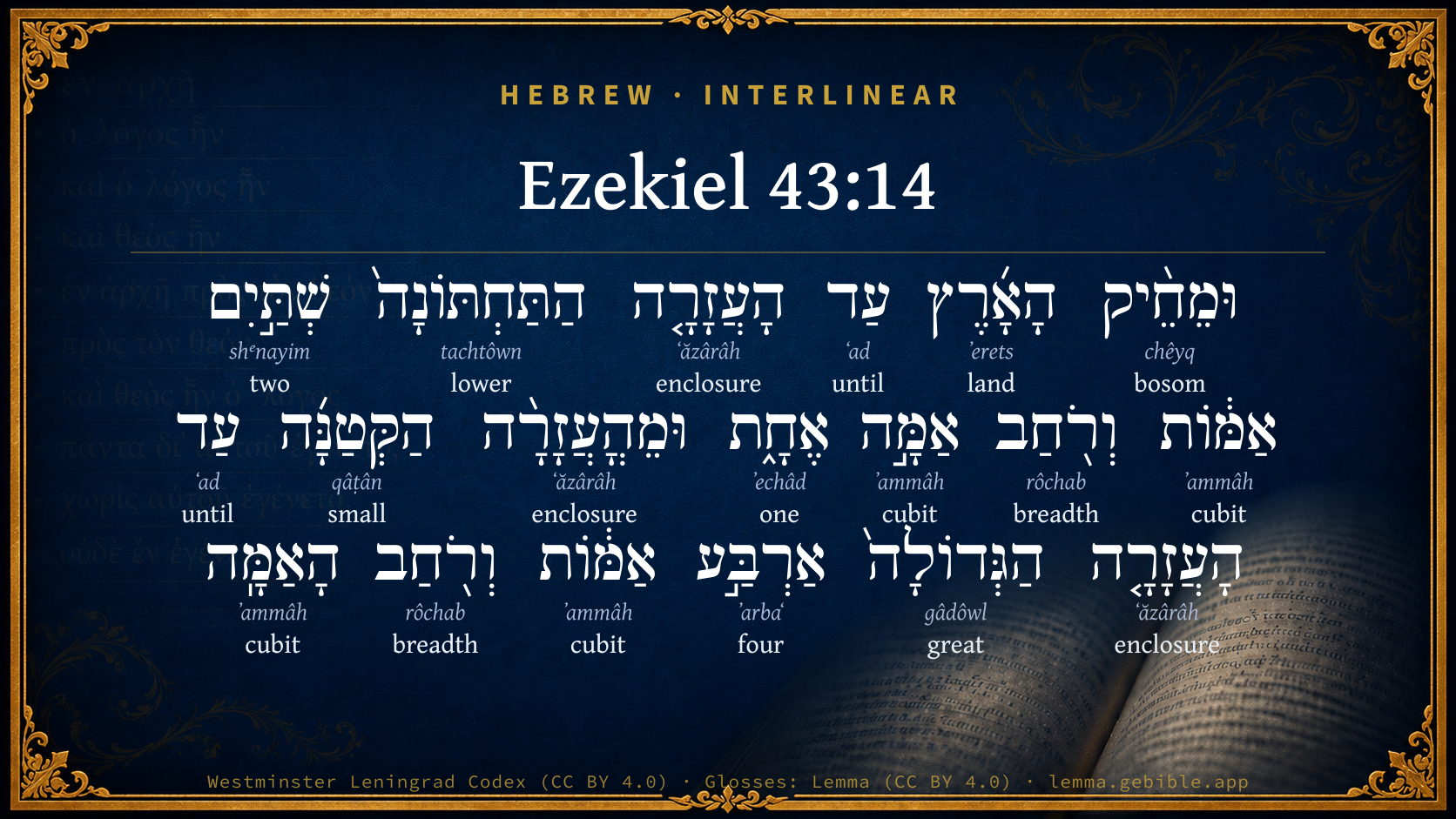
  1. וּמֵחֵ֨יק chêyq H2436 “and · from · bosom of” Conjunction + Preposition + Noun, Common, Masculine, Singular, Construct
  2. הָאָ֜רֶץ ʼerets H776 “the · land” Particle, Definite Article + Noun, Common, Both, Singular, Absolute
  3. עַד ʻad H5704 “until” Preposition
  4. הַתַּחְתּוֹנָה֙ tachtôwn H8481 “the · lower” Particle, Definite Article + Adjective, Adjective, Feminine, Singular, Absolute
  5. שְׁתַּ֣יִם shᵉnayim H8147 “two” Adjective, Cardinal number, Feminine, Dual, Absolute
  6. אַמּ֔וֹת ʼammâh H520 “cubits” Noun, Common, Feminine, Plural, Absolute
  7. וְרֹ֖חַב rôchab H7341 “and · breadth” Conjunction + Noun, Common, Masculine, Singular, Absolute
  8. אַמָּ֣ה ʼammâh H520 “cubit” Noun, Common, Feminine, Singular, Absolute
  9. אֶחָ֑ת ʼechâd H259 “one” Adjective, Cardinal number, Feminine, Singular, Absolute
  10. וּמֵהֳעֲזָרָ֨ה ʻăzârâh H5835 “and · from · the · enclosure” Conjunction + Preposition + Particle, Definite Article + Noun, Common, Feminine, Singular, Absolute
  11. הַקְּטַנָּ֜ה qâṭân H6996 “the · small” Particle, Definite Article + Adjective, Adjective, Feminine, Singular, Absolute
  12. עַד ʻad H5704 “until” Preposition
  13. הָעֲזָרָ֤ה ʻăzârâh H5835 “the · enclosure” Particle, Definite Article + Noun, Common, Feminine, Singular, Absolute
  14. הַגְּדוֹלָה֙ gâdôwl H1419 “the · great” Particle, Definite Article + Adjective, Adjective, Feminine, Singular, Absolute
  15. אַרְבַּ֣ע ʼarbaʻ H702 “four” Adjective, Cardinal number, Feminine, Singular, Absolute
  16. אַמּ֔וֹת ʼammâh H520 “cubits” Noun, Common, Feminine, Plural, Absolute
  17. וְרֹ֖חַב rôchab H7341 “and · breadth” Conjunction + Noun, Common, Masculine, Singular, Absolute
  18. הָאַמָּֽה ʼammâh H520 “the · cubit” Particle, Definite Article + Noun, Common, Feminine, Singular, Absolute

About this verse

These counts appear in no published source. They are computed here, from the morphology-tagged text and Lemma’s own curated glosses. What Lemma adds →

19
words
12
distinct lemmas
Prophets
section

Notable vocabulary

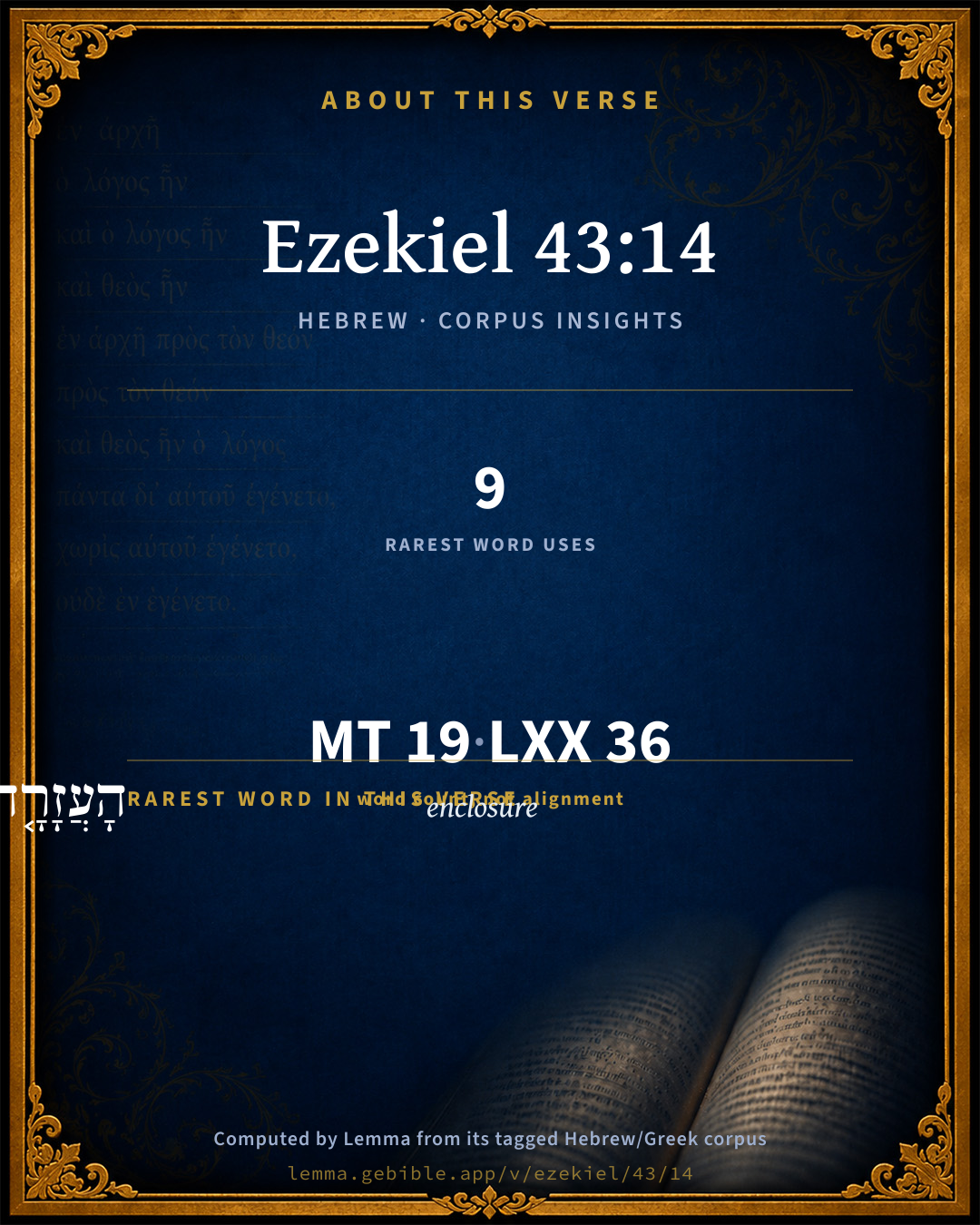
The rarest word here is הָעֲזָרָ֤ה enclosure H5835 — appearing just 9 times in the whole Hebrew Bible.

Shared distinctive vocabulary

הָעֲזָרָ֤ה enclosure H5835 occurs in 6 verses of the Hebrew Bible. Also found in:

Grammatical profile

  • 11 nouns
  • 6 adjectives
  • 2 prepositions

Repetition

Words recur within this verse — often emphatic in Hebrew:

  • אַמּ֔וֹת cubit H520 ×4
  • הָעֲזָרָ֤ה enclosure H5835 ×3
  • עַד until H5704 ×2
  • וְרֹ֖חַב breadth H7341 ×2

Hebrew & Septuagint length

In English translation the verse runs 37 words from the Hebrew and 42 from the Septuagint (LXX English) — closely comparable.

A rough comparison of the two English renderings, which tokenize alike — not a word-level alignment.

Word counts can differ between the Hebrew and the Greek without any difference in meaning — e.g. the Hebrew direct-object marker אֵת has no separate Greek word, and Greek often adds the article ὁ.

In the original languages it is 19 Hebrew tokens and 36 Greek tokens — but the two are counted differently (Hebrew bundles its prefixes and suffixes into one token; the Greek is in lemma form), so that isn’t a like-for-like length.

Hebrew and Greek witnesses Masoretic Hebrew ↔ Greek Septuagint

The same verse in the two great witnesses to the Old Testament, shown verse-for-verse.

These are two independent witnesses, not word-aligned to each other, and the Septuagint is shown in lemma (dictionary) form.

Hebrew Ezekiel 43:14 Masoretic · Westminster Leningrad Codex

וּמֵחֵ֨יק הָאָ֜רֶץ עַד הָעֲזָרָ֤ה הַתַּחְתּוֹנָה֙ שְׁתַּ֣יִם אַמּ֔וֹת וְרֹ֖חַב אַמָּ֣ה אֶחָ֑ת וּמֵהֳעֲזָרָ֨ה הַקְּטַנָּ֜ה עַד הָעֲזָרָ֤ה הַגְּדוֹלָה֙ אַרְבַּ֣ע אַמּ֔וֹת וְרֹ֖חַב הָאַמָּֽה

From the bottom on the ground to the lower ledge shall be two cubits, and the breadth one cubit; and from the lesser ledge to the greater ledge shall be four cubits, and the breadth a cubit.

World English Bible · Public Domain

Greek LXX Ezekiel 43:14 Septuagint · lemma form

ἐκ βάθος ὁ ἀρχή ὁ κοίλωμα αὐτός πρός ὁ ἱλαστήριον ὁ μέγας ὁ ὑποκάτωθεν πηχύς δύο καί ὁ εὖρος πῆχυς καί ἀπό ὁ ἱλαστήριον ὁ μικρός ἐπί ὁ ἱλαστήριον ὁ μέγας πῆχυς τέσσαρες καί εὖρος πῆχυς

from the bottom at the commencement of the hollow part to this great mercy-seat, from beneath was two cubits, and the breadth was a cubit; and from the little mercy-seat to the great mercy-seat, four cubits, and the breadth was a cubit.

LXX2012 (modern English Septuagint) · Public Domain

Hebrew: Westminster Leningrad Codex (CC BY 4.0). Greek: Septuagint (public domain); English from LXX2012 (modern English Septuagint) (Public Domain). How the Septuagint differs from the Hebrew →

Targum (Aramaic paraphrase)

1

The Targum is the ancient Jewish Aramaic paraphrase of the Hebrew Scriptures — an interpretive translation, not the Hebrew text itself. Onkelos (literal) and Pseudo-Jonathan (expansive) render the Torah, and Jonathan the Prophets. Coverage is partial: where no permissively-licensed English translation exists for a verse, only the Aramaic is shown. This is verse-level text, not a word-by-word alignment to the Hebrew.

  1. Targum Jonathan Prophets (Joshua–Malachi)
    וּמִתַּשְׁוֵית אַרְעָא עַד מְסַתִמְתָא אַרְעִיתָא תַּרְתֵּין אַמִין וּפוּתְיָא אַמְתָא חֲדָא וּמִמְסַמְתָּא זְעֶרְתָּא עַד מְסַמְתָא רַבְּתָא אַרְבַּע אַמִין וּפוּתְיָא אַמְתָא:

    (no public-domain English translation for this verse)

    Targum Jonathan — Aramaic: “Mikraot Gedolot” (public domain). English: “Sefaria Community Translation” (CC0 1.0 (public-domain dedication)); “London "Chaldee Paraphrase," 1871” (public domain). Text via Sefaria.

Commentary

Notes on Ezekiel 43:14 from classic Christian and Jewish commentators (each source and its license shown beneath its notes). The classic Christian expositions comment on the surrounding passage and are grouped to its opening verse, so a note may address several verses; the Jewish commentaries on the Tanakh (Rashi and others) are per-verse, so they appear only where the commentator wrote on this verse.

Lemma curates 59 commentaries, every one of them public domain or Creative Commons licensed, each selected and text-cleaned for this edition rather than reprinted as found. About our sources →

Trapp's Complete Commentary

John Trapp

Eze 43:14 And from the bottom [upon] the ground [even] to the lower settle [shall be] two cubits, and the breadth one cubit; and from the lesser settle [even] to the greater settle [shall be] four cubits, and the breadth [one] cubit.

Ver. 14. And from the bottom upon the ground.] This so exact measuring of the altar may import, saith Polanus, the faithful and perfect preaching of the gospel by the apostles, and all faithful ministers of God’s word after them. {2Co 10:13-18 1Co 4:1,2Ki 11:1}

John Trapp, A Commentary or Exposition upon All the Books of the Old and New Testament (1647–1656) — public domain. Text from a community e-Sword module.

The Cambridge Bible for Schools and Colleges

gen. ed. J. J. S. Perowne

14. Two cubits up from the basement the fabric underwent the first contraction, being let in a cubit. Thus a ledge of a cubit broad was formed running all round the altar. A.V. appears to call this bench or ledge a “settle.” The altar narrowed in dimension not gradually like an obelisk, but at two places. Cf. the similar way in which the wall of the house retreated, Eze_41:6.

At a height of four cubits above the first inlet came another, of the same breadth of a cubit, so that a second ledge of a cubit broad was formed round the altar on its four sides.

The Cambridge Bible for Schools and Colleges (gen. ed. J. J. S. Perowne; Cambridge University Press, 1878–1918) — public domain. Text from a community e-Sword module.

John Gill's Exposition

And from the bottom upon the ground, even to the lower settle,.... From the basis or foundation of the altar, as it stood upon the ground, to the lower settle or "court" (w), as it is called, where the priests stood; and in which they could walk round the altar, to do their business:

shall be two cubits, and the breadth one cubit; that is, two cubits high, and one broad:

and from the lesser settle or court, to the greater settle or court, shall be four cubits, and, the breadth one cubit; the lowermost settle is called the lesser, not in quantity, but in height, it being but two cubits high from the ground; but the upper settle was four cubits from that, and one broad, for the priests to walk on round about; in all six cubits from the bottom.

(w) "atrium auxilii", Montanus.

John Gill's Exposition of the Whole Bible (1746–1763) — public domain (CC PDM 1.0). Text via the HelloAO Bible API.

Albert Barnes' Notes on the Bible

The bottom - The basement just described is now called “the bottom upon the ground.” The altar (independently of the bottom) was composed of two stages called “settles,” the base of the “upper settle” (M) being less than that of the “lower” (L).

To the lower settle - That is, to the top of “the lower settle,” which was to be “two cubits high.”

From the lesser settle ... to the greater settle - i. e., from the top of the “lower settle” to the top of the “upper settle,” called “lesser” and “greater,” because the height of the lower is less than that of the “upper; The breadth” here is the part of the lower settle not covered by the upper settle, projecting one cubit on every side.

Albert Barnes' Notes on the Bible (1834–1885) — public domain. Text from a community e-Sword/MySword module.

Haydock's Catholic Bible Commentary

Cubit. they were each a cubit broad, but this greater means higher up. Some assert that the priests stood on this base to avoid treading on the altar, when they place the wood or victims. But it would be too low; and steps were made for that purpose. The altar was ten, or rather twelve cubits high, and as many broad. Solomon’s was ten high and twenty broad. Herod’s was a square of forty cubits, raised fifteen from the ground. (Calmet)

George Leo Haydock (1774–1849), Haydock's Catholic Family Bible and Commentary, 1859 edition — public domain. Excludes Psalms (Douay-Rheims chapter numbering differs from Protestant) and Deuterocanonical books (Catholic canon only).

Matthew Poole's English Annotations

From the bottom; from the superficies of the first ledge, which was a cubit broad and a cubit high from the ground.

To the lower settle; to the top of that square settle which is called lower, because another settle is raised upon it.

Two cubits in height.

The breadth one cubit on every square, as the first and bottom settle, which by this account was two cubits larger in each square or side than the middle settle.

From the lesser settle; from the highest edge of the uppermost settle, down to the cubit broad ledge about the lower settle. The prophet measures now downward.

The greater; so called, because it exceeded the upper settle a cubit in breadth on each side. Four cubits in the height thereof.

The breadth one cubit, as the two other were.

Matthew Poole's English Annotations on the Holy Bible (1683–1685) — public domain. Text from a community e-Sword/MySword module.

The Pulpit Commentary

The next measurements which are taken from the bottom upon the ground, i.e. from the qyhe, "base," or ground framework above described, to the lower settle, i.e. to the top of the undermost of the two "terraces," or enclosures," or "platforms," of which the altar consisted, are two cubits of height with one cubit of breadth; the measurements which follow, from the lesser settle, i.e. the undermost, to the greater settle, i.e. the uppermost, are four cubits of height with one cubit of breadth.

The Pulpit Commentary (1880–1919), ed. H.D.M. Spence-Jones & Joseph S. Exell — public domain. Text from a community e-Sword module.

John Wesley's Explanatory Notes

From the bottom - From the first ledge, which was a cubit broad, and a cubit high from the ground. To the lower - To the top of that square settle, which is called lower, because another settle is raised upon it. Two cubits - In height. The lesser - From the highest edge of the uppermost settle, down to the cubit broad ledge about the lower settle. The greater - So called, because it exceeded the upper settle a cubit in breadth. Four cubits - ln height.

John Wesley, Explanatory Notes Upon the Whole Bible (1754–1765) — public domain. Text via the GEBible commentary corpus.

Rashi

Rabbi Shlomo Yitzchaki (Rashi)

And from the base on the ground [Heb. וּמֵחֵיק הָאָרֶץ. From the “yesod,” from the floor of the earth.

to the lower ledge [Heb. הָעֲזָרָה, lit. court.] Until the top of the first frame.

two cubits It was not the same in the [Second] Temple, for there, we learned (Zeb. 54a): “They bring a frame of 32 [cubits] by 32 [cubits], whose height is a cubit,” whereas here its height is two cubits.

and the breadth one cubit when one places the second frame upon it. The second frame was thirty by thirty, the result being that it [the bottom, 32 by 32 cubit frame] had a recess around it a cubit wide which was the base. Jonathan renders: עֲזָרָה as מסְתַּמְתָא, a word for floor, [and it was called so] because one would fill the frame with smooth stones, pitch, lime, and molten lead, mix it and pour it out and smooth it out on top, and behold, it would be a kind of floor.

and from the smaller ledge to the greater ledge four cubits From the top of the lower frame until the top of the frame that was upon it was a height of four cubits.

and the breadth, one cubit This is the amount of the recess of the circuit. It went up four cubits and went in one cubit. [In the second Temple, it went up five cubits and went in one.] And this is the “circuit.” The lower one is called smaller because it is only two [cubits] high, whereas the upper one is four.

Rashi on the Tanakh — English translations: “The Judaica Press complete Tanach with Rashi, translated by A. J. Rosenberg” (CC BY 4.0); “Pentateuch with Rashi's commentary by M. Rosenbaum and A.M. Silbermann, 1929-1934” (public domain); “The Metsudah Tanach series, Lakewood, N.J” (CC BY 4.0); and “The Book of Joshua, Metsudah Publications, 1997” (CC BY 4.0). Text via Sefaria.

Lesson kit

Teaching starters — assembled from the data on this page, not authored interpretation. Every prompt links to the verse data it draws on. Edit before teaching.

Ezekiel, in the Prophets, opens this verse with 19 words (12 distinct Hebrew lemmas). Its most distinctive word is ʻăzârâh (“enclosure”). A historical commentator’s framing appears above. Read the whole chapter for the surrounding context.

Discussion questions

  1. The word ʻăzârâh carries the sense “enclosure.” How does it shape the verse?
  2. How does 2 Chronicles 4:9, which shares the word «enclosure», read alongside this verse?
  3. What does the repetition of “cubit” (4× in this one verse) do in this verse?
  4. These translations render this verse differently. What is at stake in choosing one wording over another?
  5. Compare how Trapp's Complete Commentary and The Cambridge Bible for Schools and Colleges read this verse. Where do they agree or differ?

Things to notice

Reading settings

Reading text

Shown beneath each verse's original-language words.

Old Testament
Old Testament edition

Read the OT as the Masoretic Hebrew (MT) or the Greek Septuagint (LXX).

English shown for the Greek Septuagint (in the Hebrew ↔ Greek comparison).

Comparing translations? Open the Compare panel on any verse page to stack up to four side by side.