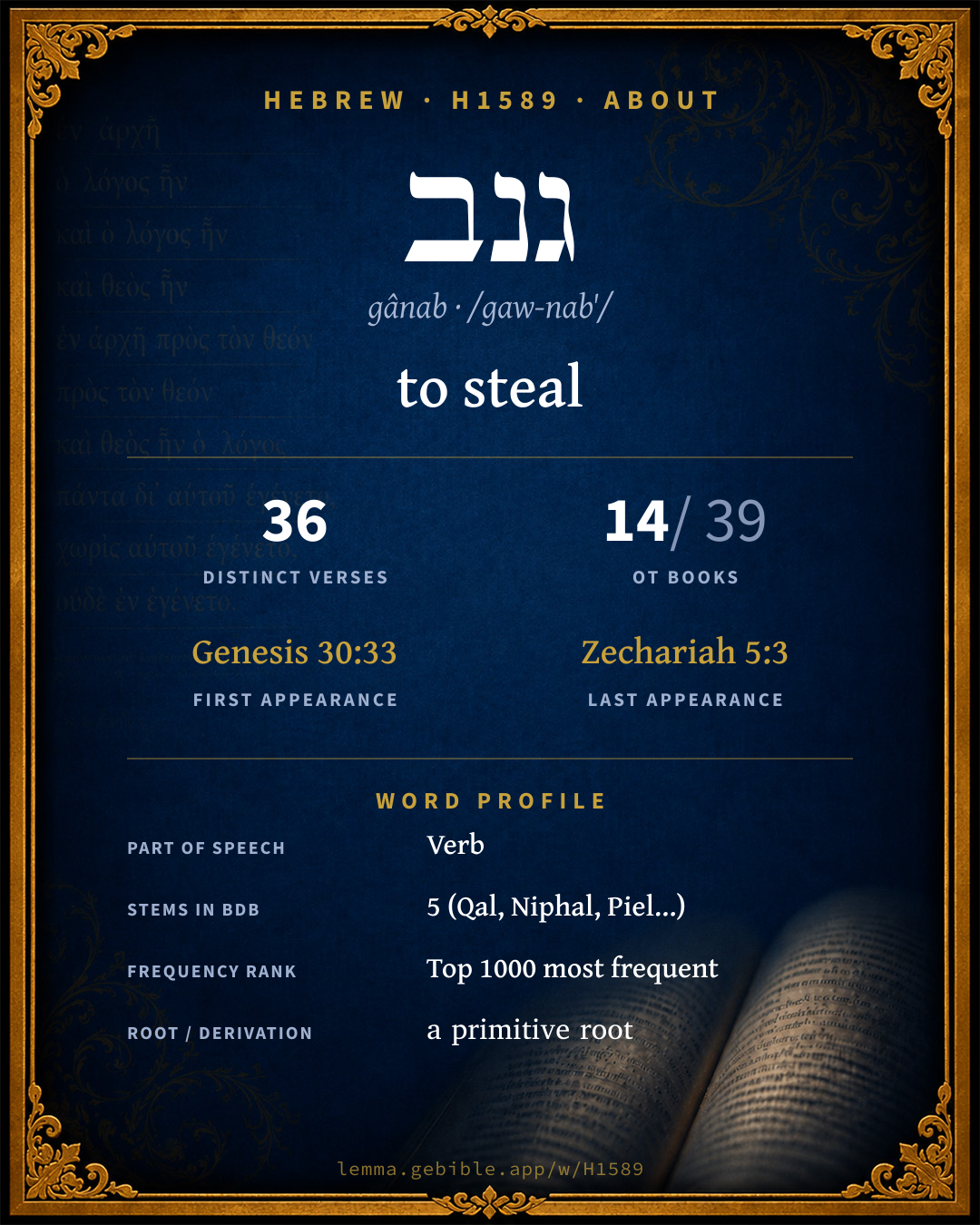
גָּנַב
to steal
also: steal away, carry away fuller range ↓
Full lexicon entry — Brown-Driver-Briggs (BDB)
From Brown-Driver-Briggs (BDB)
Where this word appears
See every Qal verb in the Hebrew Bible →
Grammar key — what these labels mean
Part of speech
- Verb
- An action or state-of-being word.
Stem
- Qal
- The basic, simple active stem — the plain form of the verb (“he wrote”).
- Pual
- The passive counterpart of the Piel. Here: ‘be stolen away subj. pers.’
- Piel
- An intensive or resultative active stem. Here: ‘steal away’
- Hithpael
- The reflexive or reciprocal stem (the subject acts on itself). Here: ‘go by stealth’
- Niphal
- Usually the simple passive or reflexive of the Qal (“he was written”). Here: ‘be stolen’
Form
- Sequential Imperfect
- An imperfect with prefixed waw — the standard past-narrative form (waw-consecutive imperfect).
- Imperfect
- An incomplete, ongoing, or future action (“he will / would write”).
- Perfect
- A completed action or state — Hebrew marks aspect (completeness) more than strict tense (“he wrote”).
- Sequential Perfect
- A perfect with prefixed waw continuing a preceding imperfect or command (waw-consecutive perfect).
- Infinitive Absolute
- An unbound verbal noun, often intensifying or standing in for a finite verb.
- Participle Active
- A verbal adjective expressing ongoing or characteristic action (“writing / one who writes”).
- Participle Passive
- A verbal adjective expressing action received (“written”).
State
- Absolute
- The independent form of a noun, not bound to a following word.
- Construct
- A noun bound to a following noun in a possessive / “of” relationship (the construct chain).
Person
- 3rd Person
- The one spoken about (“he / she / it / they”).
- 2nd Person
- The one addressed (“you”).
- 1st Person
- The speaker (“I / we”).
Gender
- Feminine
- Grammatically feminine.
- Masculine
- Grammatically masculine.
- Common
- Either gender — not distinguished for this form.
Number
- Singular
- One.
- Plural
- More than one (in Hebrew, generally three or more).
Grammatical forms 26 distinct
- Verb, Qal, Sequential Imperfect, 3rd Person, Feminine, Singular 3 times (8%)
- Verb, Qal, Perfect, 3rd Person, Common, Plural 3 times (8%)
- Verb, Qal, Perfect, 3rd Person, Feminine, Singular 3 times (8%)
- Verb, Qal, Infinitive Absolute 3 times (8%)
- Verb, Qal, Participle Active, Masculine, Singular, Absolute 3 times (8%)
- Verb, Qal, Sequential Imperfect, 2nd Person, Masculine, Singular 2 times (5%)
- Verb, Qal, Imperfect, 2nd Person, Masculine, Singular 2 times (5%)
- Verb, Qal, Imperfect, 3rd Person, Masculine, Singular 2 times (5%)
+18 more forms (19 occurrences)
Parsed forms decoded from the imported morphology (morphhb / Westminster Leningrad Codex — WLC text public domain, morphhb tagging CC BY 4.0), counted across 40 parsed occurrences — not distinct verses.
Every verse where H1589 appears — 36 distinct verses across 14 books. Click any verse to open its interlinear word-by-word view. Verse text shown in the World English Bible for context — . Each verse’s Hebrew form is shown with its reference; the English is not keyword-highlighted, since the data carries no word-level English alignment. Use “Compare translations” on any verse to read it across multiple English versions. This concordance covers the Hebrew Bible; Septuagint (Greek Old Testament) occurrences are not indexed here.
Genesis 10 verses
- Genesis 30:33 גָּנ֥וּב Qal ptcp.pass ms So my righteousness will answer for me hereafter, when you come concerning my hire that is before you. Everyone that is not speckled and spotted among the goats, and black among the sheep, that might be with me, will be counted stolen."
- Genesis 31:19 וַ/תִּגְנֹ֣ב conj + Qal wimpf 3fs Now Laban had gone to shear his sheep: and Rachel stole the teraphim that were her father's.
- Genesis 31:20 וַ/יִּגְנֹ֣ב conj + Qal wimpf 3ms Jacob deceived Laban the Syrian, in that he didn't tell him that he was running away.
- Genesis 31:26 וַ/תִּגְנֹ֖ב conj + Qal wimpf 2ms Laban said to Jacob, "What have you done, that you have deceived me, and carried away my daughters like captives of the sword?
- Genesis 31:27 וַ/תִּגְנֹ֖ב conj + Qal wimpf 2ms Why did you flee secretly, and deceive me, and didn't tell me, that I might have sent you away with mirth and with songs, with tambourine and with harp;
- Genesis 31:30 גָנַ֖בְתָּ Qal pf 2ms Now, you want to be gone, because you sore longed after your father's house, but why have you stolen my gods?"
- Genesis 31:32 גְּנָבָֽתַ/ם Qal pf 3fs + sfx pers 3mp With whoever you find your gods, he shall not live. Before our relatives, discern what is yours with me, and take it." For Jacob didn't know that Rachel had stolen them.
- Genesis 31:39 גְּנֻֽבְתִ֣י וּ/גְנֻֽבְתִ֖י Qal ptcp.pass fs cs conj + Qal ptcp.pass fs cs That which was torn of animals, I didn't bring to you. I bore the loss of it. Of my hand you required it, whether stolen by day or stolen by night.
- Genesis 40:15 גֻנֹּ֣ב גֻּנַּ֔בְתִּי Pual inf.abs Pual pf 1cs For indeed, I was stolen away out of the land of the Hebrews, and here also have I done nothing that they should put me into the dungeon."
- Genesis 44:8 נִגְנֹב֙ Qal impf 1cp Behold, the money, which we found in our sacks' mouths, we brought again to you out of the land of Canaan. How then should we steal silver or gold out of your lord's house?
Exodus 5 verses
- Exodus 20:15 תִּגְנֹֽב Qal impf 2ms "You shall not steal.
- Exodus 21:16 וְ/גֹנֵ֨ב conj + Qal ptcp.act ms "Anyone who kidnaps someone and sells him, or if he is found in his hand, he shall surely be put to death.
- Exodus 22:1 יִגְנֹֽב Qal impf 3ms "If a man steals an ox or a sheep, and kills it, or sells it; he shall pay five oxen for an ox, and four sheep for a sheep.
- Exodus 22:7 וְ/גֻנַּ֖ב conj + Pual wpf 3ms "If a man delivers to his neighbor money or stuff to keep, and it is stolen out of the man's house; if the thief is found, he shall pay double.
- Exodus 22:12 גָּנֹ֥ב יִגָּנֵ֖ב Qal inf.abs Niphal impf 3ms But if it is stolen from him, he shall make restitution to the owner of it.
Leviticus 1 verse
Deuteronomy 2 verses
- Deuteronomy 5:19 תִּגְנֹֽב Qal impf 2ms "Neither shall you steal.
- Deuteronomy 24:7 גֹּנֵ֨ב Qal ptcp.act ms If a man be found stealing any of his brothers of the children of Israel, and he deal with him as a slave, or sell him; then that thief shall die: so shall you put away the evil from the midst of you.
Joshua 1 verse
2 Samuel 4 verses
- 2 Samuel 15:6 וַ/יְגַנֵּב֙ conj + Piel wimpf 3ms In this manner Absalom did to all Israel who came to the king for judgment: so Absalom stole the hearts of the men of Israel.
- 2 Samuel 19:3 וַ/יִּתְגַּנֵּ֥ב יִתְגַּנֵּ֗ב conj + Hithpael wimpf 3ms Hithpael impf 3ms The people got them by stealth that day into the city, as people who are ashamed steal away when they flee in battle.
- 2 Samuel 19:41 גְּנָב֨וּ/ךָ Qal pf 3cp + sfx pers 2ms Behold, all the men of Israel came to the king, and said to the king, Why have our brothers the men of Judah stolen you away, and brought the king, and his household, over the Jordan, and all David's men with him?
- 2 Samuel 21:12 גָּנְב֨וּ Qal pf 3cp David went and took the bones of Saul and the bones of Jonathan his son from the men of Jabesh Gilead, who had stolen them from the street of Beth-shan, where the Philistines had hanged them, in the day that the Philistines killed Saul in Gilboa;
2 Kings 1 verse
2 Chronicles 1 verse
Job 3 verses
- Job 4:12 יְגֻנָּ֑ב Pual impf 3ms "Now a thing was secretly brought to me, My ear received a whisper of it.
- Job 21:18 גְּנָבַ֥תּ/וּ Qal pf 3fs + sfx pers 3ms That they are as stubble before the wind, As chaff that the storm carries away?
- Job 27:20 גְּנָבַ֥תּ/וּ Qal pf 3fs + sfx pers 3ms Terrors overtake him like waters; A tempest steals him away in the night.
Proverbs 3 verses
- Proverbs 6:30 יִגְנ֑וֹב Qal impf 3ms Men don't despise a thief, If he steals to satisfy himself when he is hungry:
- Proverbs 9:17 גְּנוּבִ֥ים Qal ptcp.pass mp "Stolen water is sweet. Food eaten in secret is pleasant."
- Proverbs 30:9 וְ/גָנַ֑בְתִּי conj + Qal wpf 1cs Lest I be full, deny you, and say, 'Who is Yahweh?' Or lest I be poor, and steal, And so dishonor the name of my God.
Jeremiah 2 verses
- Jeremiah 7:9 הֲ/גָנֹ֤ב ptcl inter + Qal inf.abs Will you steal, murder, and commit adultery, and swear falsely, and burn incense to Baal, and walk after other gods that you have not known,
- Jeremiah 23:30 מְגַנְּבֵ֣י Piel ptcp.act mp cs Therefore, behold, I am against the prophets, says Yahweh, who steal my words everyone from his neighbor.
Hosea 1 verse
Obadiah 1 verse
Zechariah 1 verse
About this entry
At a glance — auto-summarized from this page’s data, not written by a person. Every figure links to its source below. This summary describes the numbers; it doesn’t interpret them.
גנב — transliterated gânab — is a Hebrew verb carrying the sense “to steal.” Different stems carry different senses — BDB groups them under 5 stems, among them Qal and Niphal. The Hebrew Bible uses it across 36 verses — moderately common. More than a quarter of its appearances fall in Genesis. It first appears in Genesis 30:33. Each statement above links to its evidence; the full detail follows below.
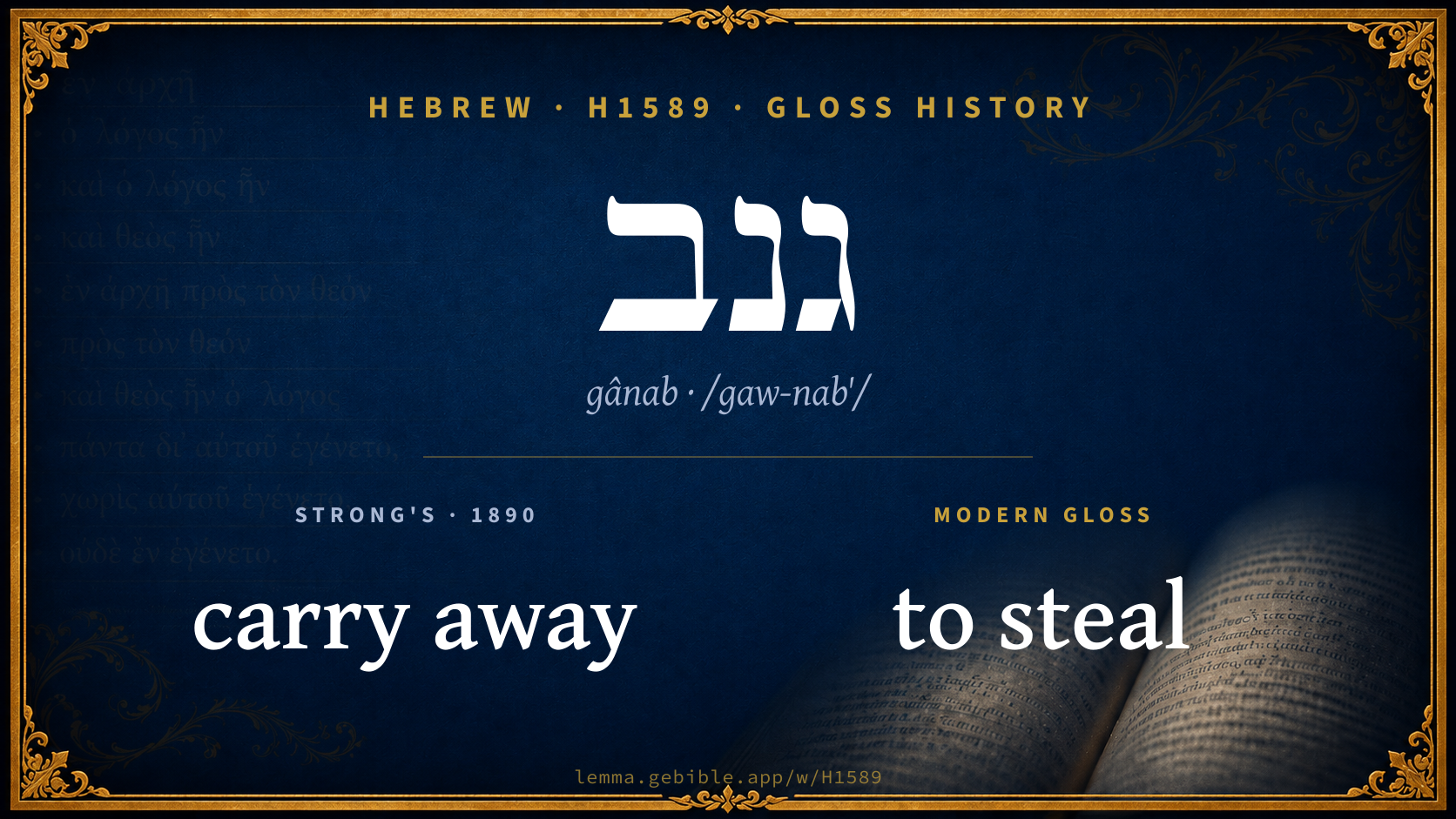
Gloss history
Strong's 1890 vs modern scholarship
About this word
Strong's H1589 catalogs a Hebrew word from the Hebrew Old Testament.
These counts are not copied from any lexicon or concordance. They are computed here, from the morphology-tagged Hebrew Old Testament. What Lemma adds →
- 36
- distinct verses
- The word appears in 36 distinct verses.
- 14 / 39
- OT books
- The word appears in 14 of 39 Old Testament books.
- #909
- by frequency
- Top 1000 most frequent Hebrew words (rank 909 of 8,640 Hebrew words by occurrence).
View all 36 occurrences in the concordance →
By section of the Old Testament
By traditional corpus
Conventional, traditional groupings — biblical authorship is debated, so this is a traditional corpus grouping, not an authorship claim. Each share is this word’s portion of its verses in that division of the Hebrew canon. Each figure is a share of the word’s 36 distinct verses.
- Torah (Pentateuch) 18 verses · 50%
- Prophets (Nevi'im) 11 verses · 31%
- Writings (Ketuvim) 7 verses · 19%
How translations render this word
Counts come from each version’s own published word-to-Strong’s tagging or interlinear alignment — an approximate guide to how each version renders this word, not a word-level alignment the data otherwise carries. Because each total is that version’s own tagged count, the per-version totals vary from one another and need not match the appearance or distinct-verse counts above. These counts may also differ from a printed concordance because Lemma counts each distinctly tagged rendering and does not collapse phrase taggings into a single head-word total. This is a fixed set of word-tagged versions (KJV, ASV, BSB, ULT) and does not change with the reading translation you choose elsewhere. Each version’s license is shown beside its name below (and on Sources).
- King James Version: Had stolen 3×, Stole 3×, Be stolen 2×
- American Standard Version: Stole 4×, Be stolen 2×, Steal 2×
- Berean Standard Bible: Steal 6×, Had stolen 2×, Stole 2×
- unfoldingWord Literal Text: Steal 5×, And 4×, Stole 3×
King James Version Public Domain
Renders H1589 across 38 tagged occurrences — most commonly:
Plus 24 renderings that appear only once — usually multi-word phrases or single function words the recovered tagging swept in, not distinct renderings. Not rendered by a distinct English word in 1 further occurrence.
American Standard Version Public Domain
Renders H1589 across 38 tagged occurrences — most commonly:
Plus 26 renderings that appear only once — usually multi-word phrases or single function words the recovered tagging swept in, not distinct renderings.
Berean Standard Bible Public Domain
Renders H1589 across 38 tagged occurrences — most commonly:
Plus 24 renderings that appear only once — usually multi-word phrases or single function words the recovered tagging swept in, not distinct renderings. Not rendered by a distinct English word in 2 further occurrences.
unfoldingWord Literal Text CC BY-SA 4.0
Renders H1589 across 55 tagged occurrences — most commonly:
Plus 32 renderings that appear only once — usually multi-word phrases or single function words the recovered tagging swept in, not distinct renderings.
Senses in the full BDB
Hebrew verbs can shift meaning by stem (binyan): Qal is the basic action, Niphal is often passive or reflexive, Piel often intensifies or makes it factitive, and Hiphil is typically causative. The senses below are grouped under the stem BDB assigns to each. This entry also uses Pual (the passive of Piel) and Hithpael (reflexive or reciprocal).
What do BDB’s symbols mean?
BDB uses these scholarly abbreviations:
| Symbol | Meaning |
|---|---|
| 𝔊 | the Septuagint (the ancient Greek translation, LXX) |
| 𝔙 | the Vulgate (the Latin translation) |
| 𝔖 | the Syriac version (the Peshitta) |
| 𝔗 | the Targum (the Aramaic translation) |
| ψ | the Psalms |
| √ | root (the underlying root or stem) |
| ‖ | parallel passage (a synonymous or contrasted parallel) |
| † | the dagger: every passage where the word occurs is cited |
The 5 senses and sub-senses the full Brown-Driver-Briggs lexicon distinguishes for this word, in lexicon order (not ranked by frequency), with BDB’s own verbatim wording and sub-sense lettering. Shown in Hebrew script with BDB’s own scholarly abbreviations. The condensed entry is in the Lexicon Entry tab. See also the Forms in the corpus table below.
Qal
- Pf. 3 fs. sf. גְּנָבַתּוּ Jb 21:18; 27:20, גְּנָבָ֫תַם Gn 31:32; 2 ms. גָּנַבְתָּ Gn 31:30; 1 s. וְגָנַ֑בְתִּי consec. Pr 30:9; גָּֽנְבוּ Jos 7:11 2 S 21:12; sf. גְּנַבוּךָ 2 S 19:42; Impf. יִגְּנֹֽב־ Ex 21:37, יִגְנוֹב Pr 6:30, וַיִּגְנֹב Gn 31:20; 3 fs. וַתִּגְנֹב Gn 31:19 + 2 times; 2 ms. תִּגְנֹב Ex 20:15; Dt 5:17, וַתִּגְנֹב Gn 31:26, 27; יִגְנְבוּ Ob 5, תִּגְנֹ֑בוּ Lv 19:11, נִגְנֹב Gn 44:8; Inf. abs. גָּנֹב Ex 22:11 + 2 times; Pt. גֹּנֵב Ex 21:16 + 2 times, גָּנוּב Gn 30:33; f. cstr. גְּנֻֽבְתִי Gn 31:39(×2); pl. גְּנוּבִים Pr 9:17; in Hexateuch always JED, except Lv 19:11 (H);—steal c. acc. rei Gn 31:19, 30, 32; 44:8 Ex 21:37 2 S 21:12 cf. pass. Gn 30:33; 31:39 Pr 9:17; c. obj. pers. Ex 21:16 Dt 24:7 2 S 19:42; = take by stealth (for good purpose) 2 K 11:2 = 2 Ch 22:11; abs. Ex 20:15 = Dt 5:17, Lv 19:11; Jos 7:11; Pr 6:30; 30:9; Ob 5; Zc 5:3, cf. inf. abs. Ho 4:2 Je 7:9 & (c. Niph.) Ex 22:11; גנב לֵב = deceive Gn 31:20, 26 cf. Di; ג׳ אֹתִי Gn 31:27 id.; of sudden sweeping off by storm, in simile Jb 21:18; fig. of destruction of wicked 27:20. e.g. Job 21:18
Niphal
- be stolen, subj. rei גָּנֹב יִגָּנֵב Ex 22:11. e.g. Exodus 22:11
Piel
- steal away (trans.) וַיְגַנֵּב אבשׁלום את־לֵב 2 S 15:6; מְגַנְּבֵי דְּבָרַי Je 23:30. e.g. 2 Samuel 15:6
Pual
- be stolen away subj. pers. גֻּנֹּב גֻּנַּבְתִּי Gn 40:15; subj. rei וְגֻנַּב consec. Ex 22:6; be brought by stealth Jb 4:12 יְגֻנָּ֑ב. e.g. Genesis 40:15
Hithpael
- go by stealth, steal away יִתְגַּנֵּב 2 S 19:4, וַיִּתְגַּנֵּב 2 S 19:4. (Syriac ܓܢܰܒ ܢܰܦܫܶܗ steal oneself away; so ܐܬܓܢܒ Gn 31:27.) e.g. 2 Samuel 19:4
Senses from the full Brown-Driver-Briggs lexicon (Brown, Driver, Briggs; Oxford 1906 — public domain), digitized via Sefaria, supplemented by the OpenScriptures HebrewLexicon (CC BY 4.0). Full attribution on Sources.
Word origin
vb. steal (NH id., Aramaic גְּנַב, ܓܢܰܒ; Arabic جَنَب is hurt the side, or put aside, den. from جَنْبٌ side)—
— Brown-Driver-Briggs (Oxford 1906, public domain), digitized via Sefaria, supplemented by the OpenScriptures HebrewLexicon (CC BY 4.0). See Sources.
Origin: a primitive root
Jastrow Dictionary
A second Hebrew/Aramaic lexicon for comparison, covering Aramaic and post-biblical (Talmudic, Targumic, Midrashic) usage that the biblical-Hebrew BDB does not. Matched by lemma rather than by Strong’s number, so a lemma may carry more than one Jastrow headword (shown separately below), and the entries cover usage well beyond the Bible.
גָּנַב
- (b. h.) [to put behind, aside,] to steal. Y. Snh. VIII, 26ᵇ top לא תִגְנוֹב את … גוֹנֵב do not carry off steathily thine own property from the thief, lest thou appear to be stealing.—Snh. 86ᵃ גונב נפש one who kidnaps a person. B. Kam. VII, 2 ג׳ על פי שנים if he is convicted of stealing through two witnesses; a. fr.—ג׳ דעת to deceive, to create a false impression. Ḥull. 94ᵃ אסור לִגְנוֹב דעת וכ׳ it is forbidden to create &c. (e.g. to make believe as if you opened a fresh barrel of wine as a special attention to your guest, while you would have had to do it at any rate). Shebu. 39ᵃ; a. fr.—ג׳ עין to deceive by a false impression on the eye, to delude. B. Mets. IV, 12.—Part. pass. גָּנוּב, f. גְּנוּבָה. Ab. Zar. 44ᵇ; Meïl. 7ᵇ תשובה ג׳ a fallacious reply; v. גְּנוּבְתָּא II.
- to keep behind. Ex. R. s. 5 היו מְגַנְּבִין את עצמן וכ׳ they kept themselves at a distance from Moses and then withdrew.
- 1. to be stolen, kidnapped. B. Mets. III, 1. Gen. R. s. 84; a. fr.
- 2. to be deceived (sub. דעת). Tosef. B. Kam. VII, 8 sq.; Mekh. Mishp. N’zikin, s. 13.
- to sneak in. Pesik. R. s. 21, היו מִתְגַּנְּבִים וכ׳ they used to have stealthy intercourse &c. Mekh. l. c. המִתְגַּנֵּב אחר וכ׳ who steals himself (into the college room) behind a neighbor.
גְּנַב
- Targ. Y. Gen. XXXI, 30. Ib. 20. Targ. O. Deut. XXIV, 7 גָּנֵיב (Y. גְּנִיב, corr. acc.); a. fr.—Part. pass. גְּנִיב. Targ. O. Gen. XL, 15 גְּנֵיבְנָא ed. Berl. I have been stolen.—Ruth R. introd. 3 (a trial before a Roman court) גְּנַבְתּוּן לא גְנַבְנוּן “Ye have stolen”.—‘We have not’ …; לא גָנַבְתְּ מאן ג׳ עמך “thou hast not stolen? Who has been stealing with thee?”; Gen. R. s. 37; s. 63. B. Kam. 65ᵇ תורא גַנְבִי מינך was it an ox I stole from thee?—Ib. 67ᵇ עד דגְנֵיב תרי (he is not bound to pay) unless he stole two animals; a. fr.
- 1. same. Targ. Jer. XXIII, 30.—2) same.
- to go round about. Keth. 19ᵃ גַנּוֹבָא גַּנּוּבֵי למה לך וכ׳ O thou cunning man, what is the use of thy going round about?; Yeb. 91ᵃ; B. Bath. 133ᵃ גַּנָּבָא גנובי Ms. R. (ed. גנבא גנבי, corr. acc.).—Part. pass. מְגַנַּב crooked. Targ. Jud. V, 6 אורחן מְגַנְּבָן (h. text עקלקל׳).
- 1. to be stolen. Targ. Ex. XXII, 11. Targ. Y. Gen. XL, 15; a. e.—B. Mets. 34ᵃ top מי יימר דמִיגַּנְּבָא who can say that it will be stolen? Ib. 24ᵃ אִגְּנִיב כסא וכ׳ a silver goblet was stolen from the inn; a. e.
- 2. to sneak away. Targ. II Sam. XIX, 4.
גַּנָּב
- (b. h.) thief. Y. Snh. VIII, 26ᵇ top גָּנַב בפני עדים גַּ׳ וכ׳ if one carries an object off in the sight of witnesses, he is a thief (amenable to the law Ex. XXI, 37), if in the owner’s presence, he is a robber. B. Kam. 57ᵃ since he keeps himself hidden ג׳ הוא he is a thief (not a robber). Ib., a. fr. טוען טענת ג׳ he pleads that a thief had stolen the object in his charge. Snh. 26ᵇ ג׳ ניסן וכ׳ a thief (a laborer or tenant who takes fruits) in Nisan or in Tishri is not a thief (to be considered unfit to testify in court); a. fr.—Pl. גַּנָּבִים, גַּנָּבִין. Tosef. B. Kam. VII, 8; Mekh. Mishp., N’zikin, s. 13; a. fr. e.g. Exodus 21:37
גַּנָּב ²
- 1. same. Targ. Ex. XXII, 1; a. e.—Ber. 5ᵇ (prov.) בתר ג׳ גנוב וכ׳ steal after the thief (take thine own stealthily from him), and thou hast a taste (of theft), v. גָּנַב. Snh. 22ᵃ (prov.) חסריה לג׳ נפשיה וכ׳ when strength fails the thief, he pretends to be honest.—Pl. גַּנָּבִין, גַּנָּבַיָּא, גַּנְּבֵי. Targ. Y. Ex. XX, 13; a. fr.—Ab. Zar. 70ᵃ. Snh. 109ᵃ, v. אַתְּ; a. fr.
- 2. cunning. B. Bath. 133ᵃ, v. גְּנַב Pa.
גָּנֵב
- m. = גְּנֵיבָה q. v.
A Dictionary of the Targumim, the Talmud Babli and Yerushalmi, and the Midrashic Literature (Marcus Jastrow; London, Luzac, 1903) — Public Domain. Digitized via Sefaria. Digitized via Sefaria. Full attribution on Sources.
Forms in the corpus
The 36 distinct written forms H1589 takes in the Hebrew Bible, most frequent first — each parse links to that stem’s occurrences in the concordance. Hebrew forms include their vowel points and cantillation, so a single lemma takes many written forms.
Same root — word family
Other BDB entries built from the same root as H1589, grouped by Strong’s listed origin. These share a root / origin per the lexicon — not necessarily a shared meaning. Each links to that word’s own entry.
Derived from this word
Proper names from this root
People and places named from this root — a name, not an additional meaning of the word.
Compare all same-root words → 1 of the same-root words is a proper name (a person or place). They share a root, not necessarily a meaning.
Septuagint verse parallels
This word appears in 36 verses that also exist in the Greek Old Testament (Septuagint), out of the 36 Hebrew verses it occurs in. You can read those verses in Greek by switching the Old Testament edition to the Septuagint.
Read these verses in the Septuagint
- Genesis 30:33
- Exodus 20:15
- Leviticus 19:11
- Deuteronomy 5:19
- Joshua 7:11
- 2 Samuel 15:6
- 2 Kings 11:2
- 2 Chronicles 22:11
- Job 4:12
- Proverbs 6:30
- Jeremiah 7:9
- Hosea 4:2
This is a verse-level parallel only — the same verses exist in both the Hebrew and Greek Old Testaments. No word-level Hebrew↔Greek correspondence is claimed: the data carries no such alignment, so no Greek word is shown as this Hebrew word’s translation. Coverage is not total — the Septuagint omits the deuterocanon and renumbers the Psalms, so some Hebrew verses have no direct Greek parallel.