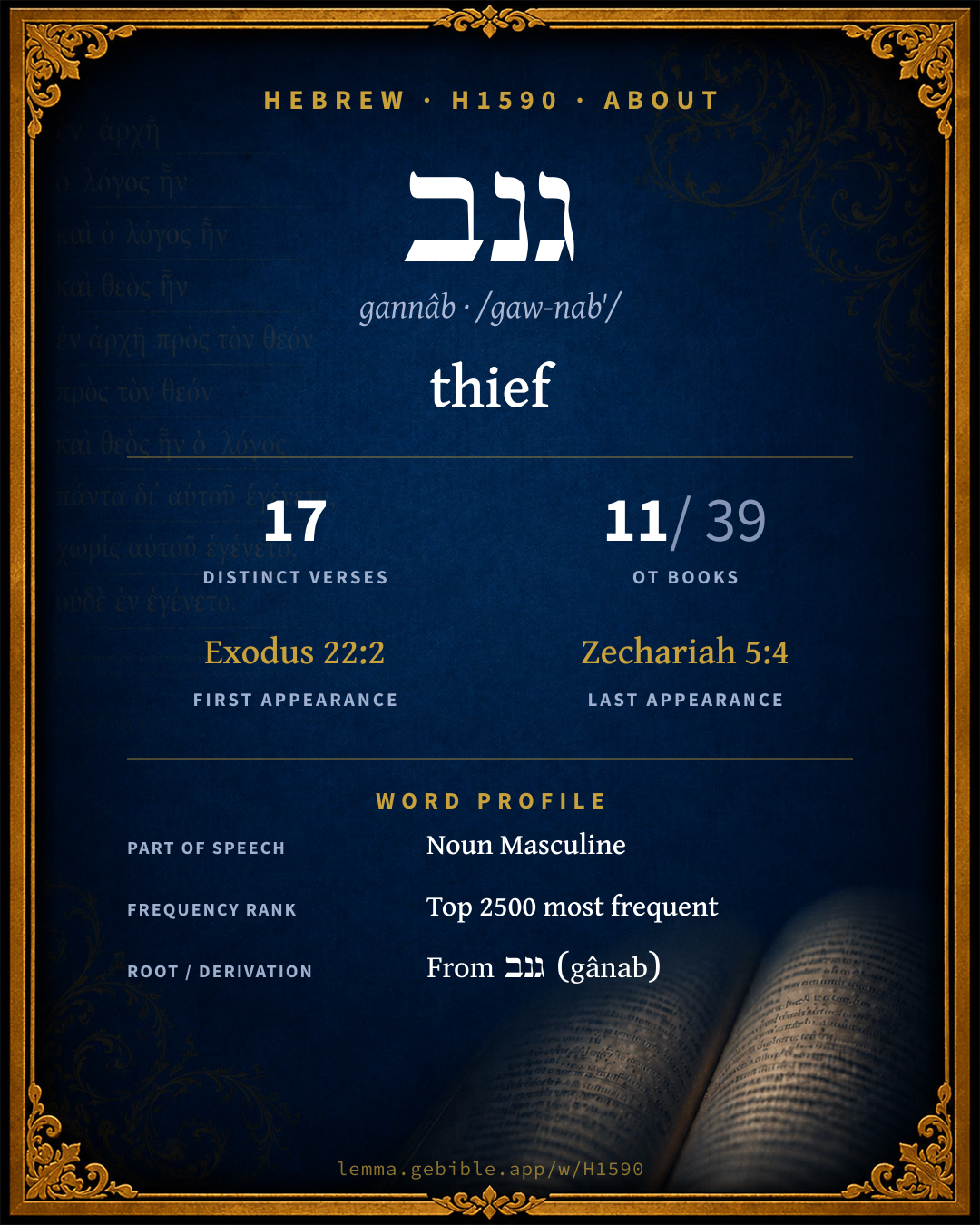
גַּנָּב
thief
Full lexicon entry — Brown-Driver-Briggs (BDB)
From Brown-Driver-Briggs (BDB)
Where this word appears
Grammar key — what these labels mean
Part of speech
- Noun
- A naming word — a person, place, thing, or idea.
Noun type
- Common
- A common noun — a general class of person, place, or thing (“king,” “city,” “water”), not a specific name.
State
- Absolute
- The independent form of a noun, not bound to a following word.
Gender
- Masculine
- Grammatically masculine.
Number
- Singular
- One.
- Plural
- More than one (in Hebrew, generally three or more).
Grammatical forms
- Noun, Common, Masculine, Singular, Absolute 13 times (76%)
- Noun, Common, Masculine, Plural, Absolute 4 times (24%)
Parsed forms decoded from the imported morphology (morphhb / Westminster Leningrad Codex — WLC text public domain, morphhb tagging CC BY 4.0), counted across 17 parsed occurrences — not distinct verses.
Every verse where H1590 appears — 17 distinct verses across 11 books. Click any verse to open its interlinear word-by-word view. Verse text shown in the World English Bible for context — . Each verse’s Hebrew form is shown with its reference; the English is not keyword-highlighted, since the data carries no word-level English alignment. Use “Compare translations” on any verse to read it across multiple English versions. This concordance covers the Hebrew Bible; Septuagint (Greek Old Testament) occurrences are not indexed here.
Exodus 3 verses
- Exodus 22:2 הַ/גַּנָּ֖ב ptcl def.art + n c ms If the thief is found breaking in, and is struck so that he dies, there shall be no guilt of bloodshed for him.
- Exodus 22:7 הַ/גַּנָּ֖ב ptcl def.art + n c ms "If a man delivers to his neighbor money or stuff to keep, and it is stolen out of the man's house; if the thief is found, he shall pay double.
- Exodus 22:8 הַ/גַּנָּ֔ב ptcl def.art + n c ms If the thief isn't found, then the master of the house shall come near to God, to find out if he hasn't put his hand to his neighbor's goods.
Deuteronomy 1 verse
Job 2 verses
Psalms 1 verse
Proverbs 2 verses
Isaiah 1 verse
Jeremiah 3 verses
- Jeremiah 2:26 גַּנָּב֙ n c ms As the thief is ashamed when he is found, so is the house of Israel ashamed; they, their kings, their princes, and their priests, and their prophets;
- Jeremiah 48:27 בְּ/גַנָּבִ֖ים prep + n c mp For wasn't Israel a derision to you? was he found among thieves? for as often as you speak of him, you wag the head.
- Jeremiah 49:9 גַּנָּבִ֥ים n c mp If grape-gatherers came to you, would they not leave some gleaning grapes? if thieves by night, wouldn't they destroy until they had enough?
Hosea 1 verse
Joel 1 verse
Obadiah 1 verse
Zechariah 1 verse
About this entry
At a glance — auto-summarized from this page’s data, not written by a person. Every figure links to its source below. This summary describes the numbers; it doesn’t interpret them.
גנב (gannâb) is a Hebrew noun most often rendered “thief.” Scripture first uses it in Exodus 22:2. It turns up in 17 verses across 11 books, an uncommon footprint. It clusters with גנב, גנבה and גנבת under a shared root. The sections below give every sense, occurrence, and version rendering.
Gloss history
Strong's 1890 vs modern scholarship

About this word
Strong's H1590 catalogs a Hebrew word from the Hebrew Old Testament.
These counts are not copied from any lexicon or concordance. They are computed here, from the morphology-tagged Hebrew Old Testament. What Lemma adds →
- 17
- distinct verses
- The word appears in 17 distinct verses.
- 11 / 39
- OT books
- The word appears in 11 of 39 Old Testament books.
- #1,671
- by frequency
- Top 2500 most frequent Hebrew words (rank 1,671 of 8,640 Hebrew words by occurrence).
View all 17 occurrences in the concordance →
By section of the Old Testament
By traditional corpus
Conventional, traditional groupings — biblical authorship is debated, so this is a traditional corpus grouping, not an authorship claim. Each share is this word’s portion of its verses in that division of the Hebrew canon. Each figure is a share of the word’s 17 distinct verses.
- Prophets (Nevi'im) 8 verses · 47%
- Writings (Ketuvim) 5 verses · 29%
- Torah (Pentateuch) 4 verses · 24%
How translations render this word
Counts come from each version’s own published word-to-Strong’s tagging or interlinear alignment — an approximate guide to how each version renders this word, not a word-level alignment the data otherwise carries. Because each total is that version’s own tagged count, the per-version totals vary from one another and need not match the appearance or distinct-verse counts above. These counts may also differ from a printed concordance because Lemma counts each distinctly tagged rendering and does not collapse phrase taggings into a single head-word total. This is a fixed set of word-tagged versions (KJV, ASV, BSB, ULT) and does not change with the reading translation you choose elsewhere. Each version’s license is shown beside its name below (and on Sources).
- King James Version: Thief 10×, Thieves 3×
- American Standard Version: Thief 9×, Thieves 3×
- Berean Standard Bible: Thief 8×, Thieves 3×, Like thieves 2×
- unfoldingWord Literal Text: Thief 10×, Thieves 2×
King James Version Public Domain
Renders H1590 across 17 tagged occurrences — most commonly:
Plus 4 renderings that appear only once — usually multi-word phrases or single function words the recovered tagging swept in, not distinct renderings.
American Standard Version Public Domain
Renders H1590 across 17 tagged occurrences — most commonly:
Plus 5 renderings that appear only once — usually multi-word phrases or single function words the recovered tagging swept in, not distinct renderings.
Berean Standard Bible Public Domain
Renders H1590 across 16 tagged occurrences — most commonly:
Plus 3 renderings that appear only once — usually multi-word phrases or single function words the recovered tagging swept in, not distinct renderings. Not rendered by a distinct English word in 1 further occurrence.
unfoldingWord Literal Text CC BY-SA 4.0
Renders H1590 across 16 tagged occurrences — most commonly:
Plus 4 renderings that appear only once — usually multi-word phrases or single function words the recovered tagging swept in, not distinct renderings.
Senses in BDB
The 1 sense BDB distinguishes for this word, in lexicon order (not ranked by frequency or importance). The full entry — with sub-senses — is in the Lexicon Entry tab.
- thief
Word origin
n.m. Ex 22:1 thief—גַּנָּב Ex 22:1 + 12 times; גַּנָּבִים Is 1:23 + 3 times—thief that breaks in Ex 22:1, 6, 7 (JE); by window Jo 2:9 (in simile); thief as one who steals Is 1:23 ψ 50:18 Pr 6:30; 29:24 Je 2:26; 48:27 Ho 7:1 (‖ גְּדוּד) Zc 5:4; coming by night Je 49:9 cf. Jb 24:14 (in simile), Ob 5 (‖ שׁוֹדֲדֵי לַיְלָה); Jb 30:5; stealer of men (slave-dealer) Dt 24:7.
— Brown-Driver-Briggs (Oxford 1906, public domain), digitized via Sefaria, supplemented by the OpenScriptures HebrewLexicon (CC BY 4.0). See Sources.
Derived from גנב (gânab) (H1589) — to steal.
Jastrow Dictionary
A second Hebrew/Aramaic lexicon for comparison, covering Aramaic and post-biblical (Talmudic, Targumic, Midrashic) usage that the biblical-Hebrew BDB does not. Matched by lemma rather than by Strong’s number, so a lemma may carry more than one Jastrow headword (shown separately below), and the entries cover usage well beyond the Bible.
גָּנַב
- (b. h.) [to put behind, aside,] to steal. Y. Snh. VIII, 26ᵇ top לא תִגְנוֹב את … גוֹנֵב do not carry off steathily thine own property from the thief, lest thou appear to be stealing.—Snh. 86ᵃ גונב נפש one who kidnaps a person. B. Kam. VII, 2 ג׳ על פי שנים if he is convicted of stealing through two witnesses; a. fr.—ג׳ דעת to deceive, to create a false impression. Ḥull. 94ᵃ אסור לִגְנוֹב דעת וכ׳ it is forbidden to create &c. (e.g. to make believe as if you opened a fresh barrel of wine as a special attention to your guest, while you would have had to do it at any rate). Shebu. 39ᵃ; a. fr.—ג׳ עין to deceive by a false impression on the eye, to delude. B. Mets. IV, 12.—Part. pass. גָּנוּב, f. גְּנוּבָה. Ab. Zar. 44ᵇ; Meïl. 7ᵇ תשובה ג׳ a fallacious reply; v. גְּנוּבְתָּא II.
- to keep behind. Ex. R. s. 5 היו מְגַנְּבִין את עצמן וכ׳ they kept themselves at a distance from Moses and then withdrew.
- 1. to be stolen, kidnapped. B. Mets. III, 1. Gen. R. s. 84; a. fr.
- 2. to be deceived (sub. דעת). Tosef. B. Kam. VII, 8 sq.; Mekh. Mishp. N’zikin, s. 13.
- to sneak in. Pesik. R. s. 21, היו מִתְגַּנְּבִים וכ׳ they used to have stealthy intercourse &c. Mekh. l. c. המִתְגַּנֵּב אחר וכ׳ who steals himself (into the college room) behind a neighbor.
גְּנַב
- Targ. Y. Gen. XXXI, 30. Ib. 20. Targ. O. Deut. XXIV, 7 גָּנֵיב (Y. גְּנִיב, corr. acc.); a. fr.—Part. pass. גְּנִיב. Targ. O. Gen. XL, 15 גְּנֵיבְנָא ed. Berl. I have been stolen.—Ruth R. introd. 3 (a trial before a Roman court) גְּנַבְתּוּן לא גְנַבְנוּן “Ye have stolen”.—‘We have not’ …; לא גָנַבְתְּ מאן ג׳ עמך “thou hast not stolen? Who has been stealing with thee?”; Gen. R. s. 37; s. 63. B. Kam. 65ᵇ תורא גַנְבִי מינך was it an ox I stole from thee?—Ib. 67ᵇ עד דגְנֵיב תרי (he is not bound to pay) unless he stole two animals; a. fr.
- 1. same. Targ. Jer. XXIII, 30.—2) same.
- to go round about. Keth. 19ᵃ גַנּוֹבָא גַּנּוּבֵי למה לך וכ׳ O thou cunning man, what is the use of thy going round about?; Yeb. 91ᵃ; B. Bath. 133ᵃ גַּנָּבָא גנובי Ms. R. (ed. גנבא גנבי, corr. acc.).—Part. pass. מְגַנַּב crooked. Targ. Jud. V, 6 אורחן מְגַנְּבָן (h. text עקלקל׳).
- 1. to be stolen. Targ. Ex. XXII, 11. Targ. Y. Gen. XL, 15; a. e.—B. Mets. 34ᵃ top מי יימר דמִיגַּנְּבָא who can say that it will be stolen? Ib. 24ᵃ אִגְּנִיב כסא וכ׳ a silver goblet was stolen from the inn; a. e.
- 2. to sneak away. Targ. II Sam. XIX, 4.
גַּנָּב
- (b. h.) thief. Y. Snh. VIII, 26ᵇ top גָּנַב בפני עדים גַּ׳ וכ׳ if one carries an object off in the sight of witnesses, he is a thief (amenable to the law Ex. XXI, 37), if in the owner’s presence, he is a robber. B. Kam. 57ᵃ since he keeps himself hidden ג׳ הוא he is a thief (not a robber). Ib., a. fr. טוען טענת ג׳ he pleads that a thief had stolen the object in his charge. Snh. 26ᵇ ג׳ ניסן וכ׳ a thief (a laborer or tenant who takes fruits) in Nisan or in Tishri is not a thief (to be considered unfit to testify in court); a. fr.—Pl. גַּנָּבִים, גַּנָּבִין. Tosef. B. Kam. VII, 8; Mekh. Mishp., N’zikin, s. 13; a. fr. e.g. Exodus 21:37
גַּנָּב ²
- 1. same. Targ. Ex. XXII, 1; a. e.—Ber. 5ᵇ (prov.) בתר ג׳ גנוב וכ׳ steal after the thief (take thine own stealthily from him), and thou hast a taste (of theft), v. גָּנַב. Snh. 22ᵃ (prov.) חסריה לג׳ נפשיה וכ׳ when strength fails the thief, he pretends to be honest.—Pl. גַּנָּבִין, גַּנָּבַיָּא, גַּנְּבֵי. Targ. Y. Ex. XX, 13; a. fr.—Ab. Zar. 70ᵃ. Snh. 109ᵃ, v. אַתְּ; a. fr.
- 2. cunning. B. Bath. 133ᵃ, v. גְּנַב Pa.
גָּנֵב
- m. = גְּנֵיבָה q. v.
A Dictionary of the Targumim, the Talmud Babli and Yerushalmi, and the Midrashic Literature (Marcus Jastrow; London, Luzac, 1903) — Public Domain. Digitized via Sefaria. Digitized via Sefaria. Full attribution on Sources.
Forms in the corpus
The 14 distinct written forms H1590 takes in the Hebrew Bible, most frequent first — each parse links to that state’s occurrences in the concordance. Hebrew forms include their vowel points and cantillation, so a single lemma takes many written forms.
| Form | Parsing | Example | Uses |
|---|---|---|---|
| הַ/גַּנָּ֔ב | Noun, Common, Masculine, Singular, Absolute | Exodus 22:8 | 2 |
| הַ/גַּנָּ֖ב | Noun, Common, Masculine, Singular, Absolute | Exodus 22:2 | 2 |
| כַּ/גַּנָּֽב | Noun, Common, Masculine, Singular, Absolute | Job 30:5 | 2 |
| בְּ/גַנָּבִ֖ים | Noun, Common, Masculine, Plural, Absolute | Jeremiah 48:27 | 1 |
| גַ֭נָּב | Noun, Common, Masculine, Singular, Absolute | Psalms 50:18 | 1 |
| גַּ֭נָּב | Noun, Common, Masculine, Singular, Absolute | Proverbs 29:24 | 1 |
| גַּנָּב֙ | Noun, Common, Masculine, Singular, Absolute | Jeremiah 2:26 | 1 |
| גַּנָּבִ֔ים | Noun, Common, Masculine, Plural, Absolute | Isaiah 1:23 | 1 |
| גַּנָּבִ֤ים | Noun, Common, Masculine, Plural, Absolute | Obadiah 1:5 | 1 |
| גַּנָּבִ֥ים | Noun, Common, Masculine, Plural, Absolute | Jeremiah 49:9 | 1 |
| הַ/גַּנָּ֣ב | Noun, Common, Masculine, Singular, Absolute | Deuteronomy 24:7 | 1 |
| וְ/גַנָּ֣ב | Noun, Common, Masculine, Singular, Absolute | Hosea 7:1 | 1 |
| כַ/גַּנָּֽב | Noun, Common, Masculine, Singular, Absolute | Job 24:14 | 1 |
| לַ֭/גַּנָּב | Noun, Common, Masculine, Singular, Absolute | Proverbs 6:30 | 1 |
Same root — word family
Other BDB entries built from the same root as H1590, grouped by Strong’s listed origin. These share a root / origin per the lexicon — not necessarily a shared meaning. Each links to that word’s own entry.
Derives from
Shares the same root
Proper names from this root
People and places named from this root — a name, not an additional meaning of the word.
Compare all same-root words → 1 of the same-root words is a proper name (a person or place). They share a root, not necessarily a meaning.
Septuagint verse parallels
This word appears in 16 verses that also exist in the Greek Old Testament (Septuagint), out of the 17 Hebrew verses it occurs in. You can read those verses in Greek by switching the Old Testament edition to the Septuagint.
Read these verses in the Septuagint
- Exodus 22:2
- Deuteronomy 24:7
- Job 24:14
- Psalms 50:18
- Proverbs 6:30
- Isaiah 1:23
- Jeremiah 2:26
- Hosea 7:1
- Joel 2:9
- Obadiah 1:5
- Zechariah 5:4
This is a verse-level parallel only — the same verses exist in both the Hebrew and Greek Old Testaments. No word-level Hebrew↔Greek correspondence is claimed: the data carries no such alignment, so no Greek word is shown as this Hebrew word’s translation. Coverage is not total — the Septuagint omits the deuterocanon and renumbers the Psalms, so some Hebrew verses have no direct Greek parallel.