
1 Chronicles 15:18

Hebrew (Westminster Leningrad Codex) 1 Chronicles 15:18 appears in the Hebrew Old Testament. The text above is from the Westminster Leningrad Codex. Each word links to its Strong’s number, a concise gloss, and parsing drawn from the Open Scriptures Hebrew Bible morphology. Click any word for its full Brown-Driver-Briggs (BDB) entry.
Download image
Cite this verse

1 Chronicles 15:18 (World English Bible). Public Domain. Lemma interlinear Bible study tool, https://lemma.gebible.app/v/1-chronicles/15/18.

Show BibTeX & RIS
BibTeX
RIS
English Translation
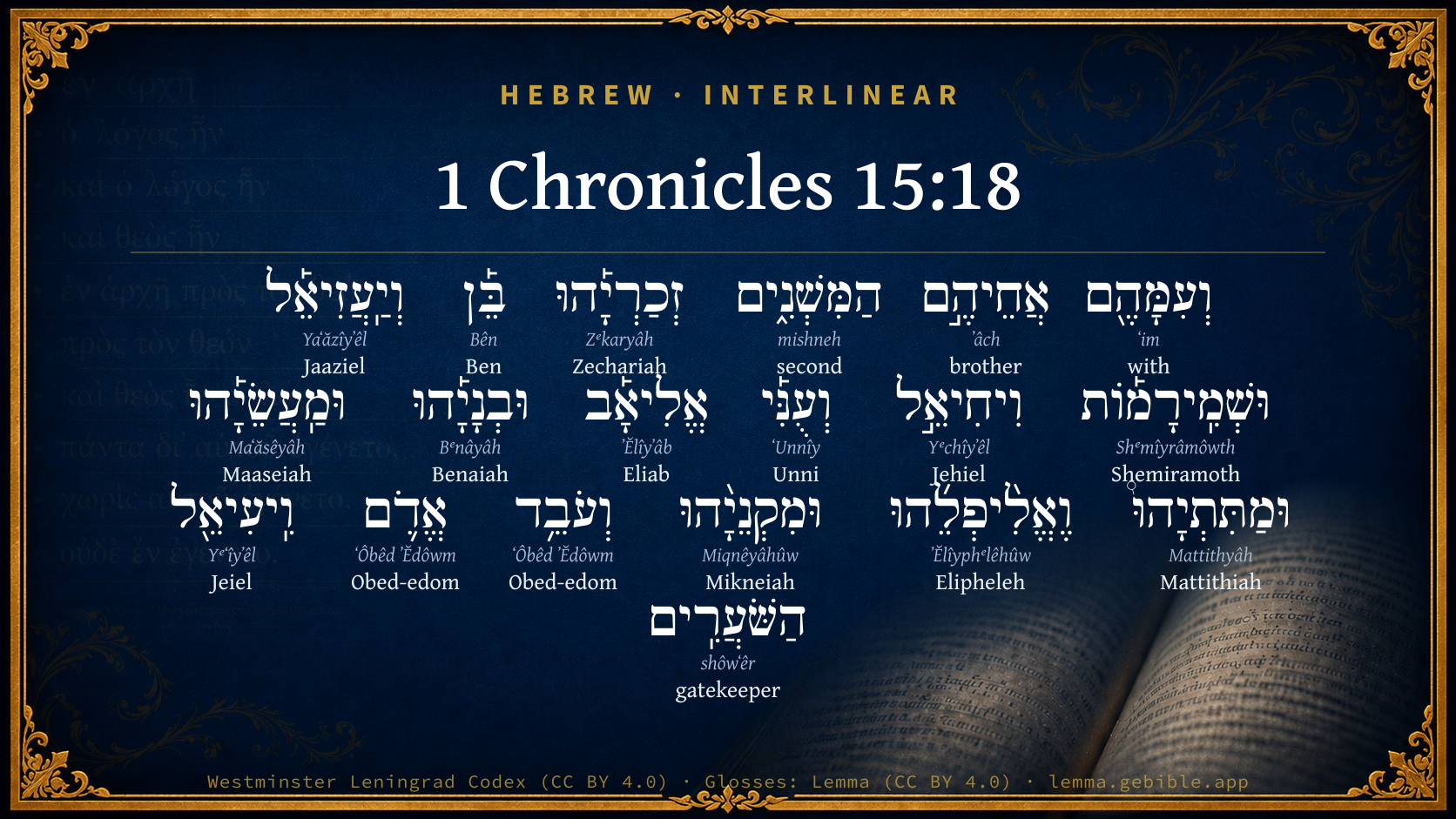
and with them their brothers of the second degree, Zechariah, Ben, and Jaaziel, and Shemiramoth, and Jehiel, and Unni, Eliab, and Benaiah, and Maaseiah, and Mattithiah, and Eliphelehu, and Mikneiah, and Obed-edom, and Jeiel, the doorkeepers.
World English Bible · Public Domain
Highlights
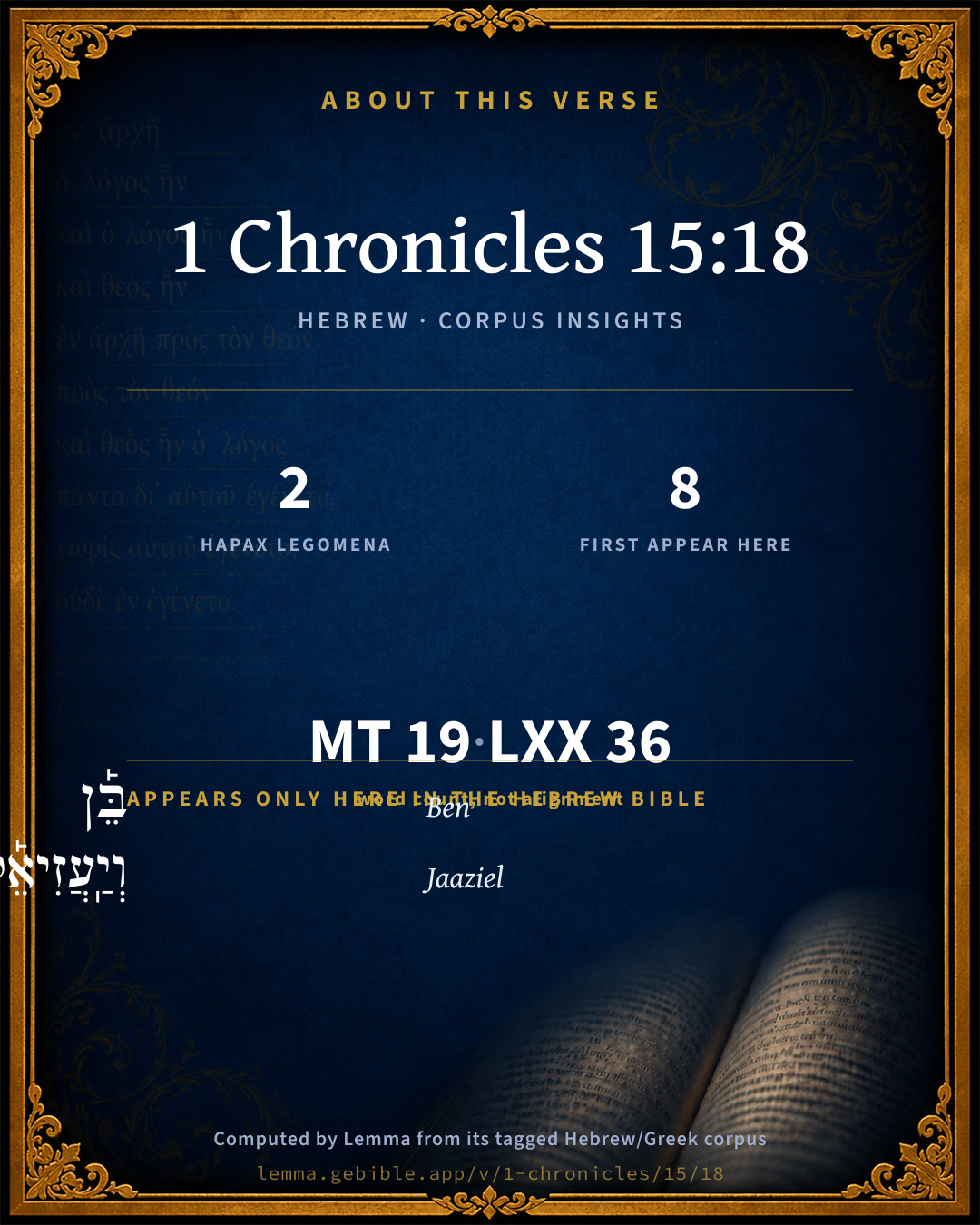
  • 2 hapax legomena — only here in the Hebrew Bible
  • 8 first appearances in the Hebrew Bible
Full analysis ↓
Download a study sheet

One document with this verse’s original text, its word-by-word gloss line, the meaning frame, cross-references with their text, attributed commentary, and full source and license credits — printable, and it pastes into notes with its structure intact.

This verse Autodidact and up

Study sheet (.html) Plain text (.txt)

A passage Seminary Student

Up to 50 verses in one chapter. A passage sheet keeps up to 6 commentary sources and 12 cross-references per verse, in the order this page ranks them, and says so on the sheet whenever that leaves anything out. Ask for a single verse and you get the Autodidact verse sheet above.

Everything on this page stays free to read, with no account — the sheet is a download of what is already on screen, not access to it.

Want to remove ads? Support Godless Engineer
Compare translations 3

The same verse in 3 English versions, stacked beneath the original-language interlinear above. Click any original word for its lexicon entry.

Each is an independent rendering of the whole verse — the interlinear is not word-aligned to these translations.

Highlighted words mark where these versions differ — a whole-verse word diff, not a word-by-word alignment.

  • World English Bible Public Domain
    and with them their brothers of the second degree, Zechariah, Ben, and Jaaziel, and Shemiramoth, and Jehiel, and Unni, Eliab, and Benaiah, and Maaseiah, and Mattithiah, and Eliphelehu, and Mikneiah, and Obed-edom, and Jeiel, the doorkeepers.
  • King James Version Public Domain
    And with them their brethren of the second degree, Zechariah, Ben, and Jaaziel, and Shemiramoth, and Jehiel, and Unni, Eliab, and Benaiah, and Maaseiah, and Mattithiah, and Elipheleh, and Mikneiah, and Obededom, and Jeiel, the porters.
  • unfoldingWord Literal Text CC BY-SA 4.0
    and with them, their brothers, the seconds: Zechariah, Ben and Jaaziel and Shemiramoth and Jehiel and Unni, Eliab and Benaiah and Maaseiah and Mattithiah and Eliphelehu and Mikneiah and Obed Edom and Jeiel, the gatekeepers.

unfoldingWord Literal Text — © unfoldingWord, licensed CC BY-SA 4.0. Word-aligned USFM3 via Door43 (git.door43.org/unfoldingWord/en_ult).

Versions to compare (up to 4)

3 of 4 selected

Show all 18 translations

Every available English version of this verse, each an independent rendering of the whole verse.

  • World English Bible Public Domain
    and with them their brothers of the second degree, Zechariah, Ben, and Jaaziel, and Shemiramoth, and Jehiel, and Unni, Eliab, and Benaiah, and Maaseiah, and Mattithiah, and Eliphelehu, and Mikneiah, and Obed-edom, and Jeiel, the doorkeepers.
  • Berean Standard Bible Public Domain
    and with them their brothers next in rank: Zechariah, Jaaziel, Shemiramoth, Jehiel, Unni, Eliab, Benaiah, Maaseiah, Mattithiah, Eliphelehu, Mikneiah, and the gatekeepers Obed-edom and Jeiel.
  • Majority Standard Bible Public Domain
    and with them their brothers next in rank: Zechariah, Jaaziel, Shemiramoth, Jehiel, Unni, Eliab, Benaiah, Maaseiah, Mattithiah, Eliphelehu, Mikneiah, and the gatekeepers Obed-edom and Jeiel.
  • King James Version Public Domain
    And with them their brethren of the second degree, Zechariah, Ben, and Jaaziel, and Shemiramoth, and Jehiel, and Unni, Eliab, and Benaiah, and Maaseiah, and Mattithiah, and Elipheleh, and Mikneiah, and Obededom, and Jeiel, the porters.
  • American Standard Version (1901) Public Domain
    and with them their brethren of the second degree, Zechariah, Ben, and Jaaziel, and Shemiramoth, and Jehiel, and Unni, Eliab, and Benaiah, and Maaseiah, and Mattithiah, and Eliphelehu, and Mikneiah, and Obed-edom, and Jeiel, the doorkeepers.
  • Revised Version (1885) Public Domain
    and with them their brethren of the second degree, Zechariah, Ben, and Jaaziel, and Shemiramoth, and Jehiel, and Unni, Eliab, and Benaiah, and Maaseiah, and Mattithiah, and Eliphelehu, and Mikneiah, and Obed-edom, and Jeiel, the doorkeepers.
  • Geneva Bible (1599) Public Domain
    And with them their brethren in the seconde degree, Zechariah, Ben, and Iaaziel, and Shemiramoth, and Iehiel, and Vnni, Eliab, and Benaiah, and Maaseiah, and Mattithiah, and Elipheleh, and Mikneah, and Obed Edom, and Ieiel the porters.
  • Douay-Rheims (1899) Public Domain
    And with them their brethren: in the second rank, Zacharias, and Ben, and Jaziel, and Semiramoth, and Jahiel, and Ani, and Eliab, and Banaias, and Maasias, and Mathathias, and Eliphalu, and Macenias, and Obededom, and Jehiel, the porters.
  • Young's Literal Translation Public Domain
    and with them their brethren, the seconds `in rank', Zechariah, Ben, and Jaaziel, and Shemiramoth, and Jehiel, and Unni, Eliab, and Benaiah, and Maaseiah, and Mattithiah, and Elipheleh, and Mikneiah; and Obed-Edom and Jeiel the gatekeepers;
  • Literal Standard Version CC BY-SA 4.0
    and with them their brothers, the seconds [in rank]: Zechariah, Ben, and Jaaziel, and Shemiramoth, and Jehiel, and Unni, Eliab, and Benaiah, and Maaseiah, and Mattithiah, and Elipheleh, and Mikneiah; and Obed-Edom and Jeiel the gatekeepers;
  • Unlocked Literal Bible CC BY-SA 4.0
    With them were their kinsmen of second rank: Zechariah, Jaaziel, Shemiramoth, Jehiel, Unni, Eliab, Benaiah, Maaseiah, Mattithiah, Eliphelehu, Mikneiah, Obed Edom, and Jeiel, the gatekeepers.
  • unfoldingWord Literal Text CC BY-SA 4.0
    and with them, their brothers, the seconds: Zechariah, Ben and Jaaziel and Shemiramoth and Jehiel and Unni, Eliab and Benaiah and Maaseiah and Mattithiah and Eliphelehu and Mikneiah and Obed Edom and Jeiel, the gatekeepers.
  • Darby Bible Public Domain
    and with them their brethren of the second [rank], Zechariah, Ben, and Jaaziel, and Shemiramoth, and Jehiel, and Unni, Eliab, and Benaiah, and Maaseiah, and Mattithiah, and Elipheleh, and Mikneiah, and Obed-Edom, and Jeiel, the doorkeepers;
  • World Messianic Bible Public Domain
    and with them their brothers of the second rank: Zechariah, Ben, Jaaziel, Shemiramoth, Jehiel, Unni, Eliab, Benaiah, Maaseiah, Mattithiah, Eliphelehu, Mikneiah, Obed-Edom, and Jeiel, the doorkeepers.
  • Webster's Bible Public Domain
    And with them their brethren of the second degree, Zechariah, Ben, and Jaaziel, and Shemiramoth, and Jehiel, and Unni, Eliab, and Benaiah, and Maaseiah, and Mattithiah, and Elipheleh, and Mikneiah, and Obed-edom, and Jeiel, the porters.
  • Free Bible Version CC BY-SA 4.0
    The second group of Levites consisted of Zechariah, Jaaziel, Shemiramoth, Jehiel, Unni, Eliab, Benaiah, Maaseiah, Mattithiah, Eliphelehu, and Mikneiah; and the gatekeepers Obed-edom and Jeiel.
  • Bible in Basic English Public Domain
    And with them their brothers of the second order, Zechariah, Bani and Jaaziel and Shemiramoth and Jehiel and Unni, Eliab and Benaiah and Maaseiah and Mattithiah and Eliphelehu and Mikneiah, and Obed-edom and Jeiel, the door-keepers.
  • JPS Tanakh (1917) Public Domain
    and with them their brethren of the second degree, Zechariah, Ben, and Jaaziel, and Shemiramoth, and Jehiel, and Unni, Eliab, and Benaiah, and Maaseiah, and Mattithiah, and Eliphalehu, and Mikneiah, and Obed-edom, and Jeiel, the doorkeepers.

Literal Standard Version (2020), Covenant Press — licensed CC BY-SA 4.0. Text via the HelloAO Bible API (eBible.org). Unlocked Literal Bible (unfoldingWord) — licensed CC BY-SA 4.0. Text via the HelloAO Bible API (eBible.org). unfoldingWord Literal Text — © unfoldingWord, licensed CC BY-SA 4.0. Word-aligned USFM3 via Door43 (git.door43.org/unfoldingWord/en_ult). Free Bible Version, Dr. Jonathan Gallagher — licensed CC BY-SA 4.0. Text via the HelloAO Bible API (eBible.org).

Word by word

More ways to search: Search by grammar → Find every occurrence → Compare this word →

Practice this passage: Drill this verse → Learn its vocabulary →

בֵּ֡ן
Bên
H1122
“Ben”
Noun, Proper
Part of Speech
Noun
Type
Proper
Full BDB Definition

Origin: the same as H1121

TWOT: None

Ben = "son" - a Levite, one of the porters appointed by David for the ark
  1. וְעִמָּהֶ֖ם ʻim H5973 “and · with · them” Conjunction + Preposition + Suffix, Personal, 3rd Person, Masculine, Plural
  2. אֲחֵיהֶ֣ם ʼâch H251 “brothers · their” Noun, Common, Masculine, Plural, Construct + Suffix, Personal, 3rd Person, Masculine, Plural
  3. הַמִּשְׁנִ֑ים mishneh H4932 “the · second rank” Particle, Definite Article + Noun, Common, Masculine, Plural, Absolute
  4. זְכַרְיָ֡הוּ Zᵉkaryâh H2148 “Zechariah” Noun, Proper
  5. וְיַֽעֲזִיאֵ֡ל Yaʻăzîyʼêl H3268 “and · Jaaziel” Conjunction + Noun, Proper
  6. וּשְׁמִֽירָמ֡וֹת Shᵉmîyrâmôwth H8070 “and · Shemiramoth” Conjunction + Noun, Proper
  7. וִיחִיאֵ֣ל Yᵉchîyʼêl H3171 “and · Jehiel” Conjunction + Noun, Proper
  8. וְעֻנִּ֡י ʻUnnîy H6042 “and · Unni” Conjunction + Noun, Proper
  9. אֱלִיאָ֡ב ʼĔlîyʼâb H446 “Eliab” Noun, Proper
  10. וּבְנָיָ֡הוּ Bᵉnâyâh H1141 “and · Benaiah” Conjunction + Noun, Proper
  11. וּמַֽעֲשֵׂיָ֡הוּ Maʻăsêyâh H4641 “and · Maaseiah” Conjunction + Noun, Proper
  12. וּמַתִּתְיָהוּ֩ Mattithyâh H4993 “and · Mattithiah” Conjunction + Noun, Proper
  13. וֶאֱלִ֨יפְלֵ֜הוּ ʼĔlîyphᵉlêhûw H466 “and · Elipheleh” Conjunction + Noun, Proper
  14. וּמִקְנֵיָ֨הוּ Miqnêyâhûw H4737 “and · Mikneiah” Conjunction + Noun, Proper
  15. וְעֹבֵ֥ד ʻÔbêd ʼĔdôwm H5654 “and · Obed-edom” Conjunction + Noun, Proper
  16. אֱדֹ֛ם ʻÔbêd ʼĔdôwm H5654 “Obed-edom” Noun, Proper
  17. וִֽיעִיאֵ֖ל Yᵉʻîyʼêl H3273 “and · Jeiel” Conjunction + Noun, Proper
  18. הַשֹּׁעֲרִֽים shôwʻêr H7778 “the · gatekeepers” Particle, Definite Article + Noun, Common, Masculine, Plural, Absolute

About this verse

These counts appear in no published source. They are computed here, from the morphology-tagged text and Lemma’s own curated glosses. What Lemma adds →

19
words
18
distinct lemmas
Historical
section

Notable vocabulary

2 hapax legomena — words that appear only here in the entire Hebrew Bible:

  • בֵּ֡ן Ben H1122
  • וְיַֽעֲזִיאֵ֡ל Jaaziel H3268

First appearance in Scripture

These words make their first canonical appearance in the Hebrew Bible here:

  • בֵּ֡ן Ben H1122
  • וְיַֽעֲזִיאֵ֡ל Jaaziel H3268
  • וּשְׁמִֽירָמ֡וֹת Shemiramoth H8070
  • וִיחִיאֵ֣ל Jehiel H3171
  • וְעֻנִּ֡י Unni H6042
  • וּמַֽעֲשֵׂיָ֡הוּ Maaseiah H4641
  • וֶאֱלִ֨יפְלֵ֜הוּ Elipheleh H466
  • וּמִקְנֵיָ֨הוּ Mikneiah H4737

Shared distinctive vocabulary

וֶאֱלִ֨יפְלֵ֜הוּ Elipheleh H466 occurs in 2 verses of the Hebrew Bible. Also found in:

Grammatical profile

  • 18 nouns
  • 1 preposition

Repetition

A word recurs within this verse — often emphatic in Hebrew:

  • וְעֹבֵ֥ד Obed-edom H5654 ×2

Hebrew & Septuagint length

In English translation the verse runs 36 words from the Hebrew and 38 from the Septuagint (LXX English) — closely comparable.

A rough comparison of the two English renderings, which tokenize alike — not a word-level alignment.

Word counts can differ between the Hebrew and the Greek without any difference in meaning — e.g. the Hebrew direct-object marker אֵת has no separate Greek word, and Greek often adds the article ὁ.

In the original languages it is 19 Hebrew tokens and 36 Greek tokens — but the two are counted differently (Hebrew bundles its prefixes and suffixes into one token; the Greek is in lemma form), so that isn’t a like-for-like length.

Cross-references

8

Topical passages linked to 1 Chronicles 15:18 in the Treasury of Scripture Knowledge — connected by theme and wording, ordered by reader-vote popularity; previews shown in the World English Bible.

  • 1 Chronicles 26:4 Obed-edom had sons: Shemaiah the firstborn, Jehozabad the second, Joah the third, and Sacar the fourth, and Nethanel the fifth,
  • 1 Chronicles 13:14 The ark of God remained with the family of Obed-edom in his house three months: and Yahweh blessed the house of Obed-edom, and all that he had.
  • 1 Chronicles 16:5–6 Asaph the chief, and second to him Zechariah, Jeiel, and Shemiramoth, and Jehiel, and Mattithiah, and Eliab, and Benaiah, and Obed-edom, and Jeiel, with psalteries and with harps; and Asaph with cymbals, sounding aloud;
  • 1 Chronicles 16:38 and Obed-edom with their brothers, sixty-eight; Obed-edom also the son of Jeduthun and Hosah to be doorkeepers;
  • 1 Chronicles 25:2–6 of the sons of Asaph: Zaccur, and Joseph, and Nethaniah, and Asharelah, the sons of Asaph, under the hand of Asaph, who prophesied after the order of the king.
  • 1 Chronicles 25:9–31 Now the first lot came forth for Asaph to Joseph: the second to Gedaliah; he and his brothers and sons were twelve:
  • 1 Chronicles 26:8 All these were of the sons of Obed-edom: they and their sons and their brothers, able men in strength for the service; sixty-two of Obed-edom.
  • 1 Chronicles 26:15 To Obed-edom southward; and to his sons the store-house.

Cross-references courtesy of OpenBible.info (CC BY 4.0).

Hebrew and Greek witnesses Masoretic Hebrew ↔ Greek Septuagint

The same verse in the two great witnesses to the Old Testament, shown verse-for-verse.

These are two independent witnesses, not word-aligned to each other, and the Septuagint is shown in lemma (dictionary) form.

Hebrew 1 Chronicles 15:18 Masoretic · Westminster Leningrad Codex

וְעִמָּהֶ֖ם אֲחֵיהֶ֣ם הַמִּשְׁנִ֑ים זְכַרְיָ֡הוּ בֵּ֡ן וְיַֽעֲזִיאֵ֡ל וּשְׁמִֽירָמ֡וֹת וִיחִיאֵ֣ל וְעֻנִּ֡י אֱלִיאָ֡ב וּבְנָיָ֡הוּ וּמַֽעֲשֵׂיָ֡הוּ וּמַתִּתְיָהוּ֩ וֶאֱלִ֨יפְלֵ֜הוּ וּמִקְנֵיָ֨הוּ וְעֹבֵ֥ד אֱדֹ֛ם וִֽיעִיאֵ֖ל הַשֹּׁעֲרִֽים

and with them their brothers of the second degree, Zechariah, Ben, and Jaaziel, and Shemiramoth, and Jehiel, and Unni, Eliab, and Benaiah, and Maaseiah, and Mattithiah, and Eliphelehu, and Mikneiah, and Obed-edom, and Jeiel, the doorkeepers.

World English Bible · Public Domain

Greek LXX 1 Chronicles 15:18 Septuagint · lemma form

καί μετά αὐτός ἀδελφός αὐτός ὁ δεύτερος ζαχαριας καί οζιηλ καί σεμιραμωθ καί ιιηλ καί ωνι καί ελιαβ καί βαναια καί μαασαια καί ματταθια καί ελιφαλια καί μακενια καί αβδεδομ καί ιιηλ καί οζιας ὁ πυλωρός

and with them their brethren of the second rank, Zacharias, and Oziel, and Semiramoth, and Jeiel, and Elioel, and Eliab, and Banaia, and Maasaia, and Matthathia, and Eliphena, and Makellia, and Abdedom, and Jeiel, and Ozias, the porters.

LXX2012 (modern English Septuagint) · Public Domain

On this verse, Ellicott's Commentary for English Readers discusses the Septuagint’s reading. Read the note in Commentary ↓

Hebrew: Westminster Leningrad Codex (CC BY 4.0). Greek: Septuagint (public domain); English from LXX2012 (modern English Septuagint) (Public Domain). How the Septuagint differs from the Hebrew →

Commentary

Notes on 1 Chronicles 15:18 from classic Christian and Jewish commentators (each source and its license shown beneath its notes). The classic Christian expositions comment on the surrounding passage and are grouped to its opening verse, so a note may address several verses; the Jewish commentaries on the Tanakh (Rashi and others) are per-verse, so they appear only where the commentator wrote on this verse.

Lemma curates 59 commentaries, every one of them public domain or Creative Commons licensed, each selected and text-cleaned for this edition rather than reprinted as found. About our sources →

Joseph Benson's Commentary

1Ch 15:18. Their brethren of the second degree — The first rank or degree of sacred musicians was that of those three famous persons, named 1Ch 15:17; the next consisted of these here mentioned. The porters — Who were to keep the doors of the tabernacle and courts, but withal were instructed in music, that when they were free from attendance upon their proper office, they might not be idle nor unprofitable in God’s house.

Joseph Benson's Commentary on the Old and New Testaments (1811–1818) — public domain. Text from a community e-Sword module.

Geneva Bible (1599)

Geneva Bible translators

Which were inferior in dignity.

Geneva Bible (1599) marginal notes — public domain. Text via Bolls.life.

Ellicott's Commentary for English Readers

(18) And with them their brethren of the second degree.—So 1Ch_16:5 : “Asaph the leader, and his second Zechariah.” Fourteen minstrels of the second rank—that is, subordinate to the first three—are named here.

Ben (son) is not a proper name. That of Zechariah’s father may have fallen out after it (comp. the Syriac and Arabic: “Zechariah son of Ne’ael”), or it may be due to a scribe’s inadvertence. The LXX. omits it.

Shemiramoth.—This peculiar name resembles the Assyrian Sammurramat, the classical Semiramis. Delitzsch suggests that it is a compound of sammîm (“spices”), and râ’imat (“loving”): a suitable name for a woman, and actually borne by a lady of the court of Rammân-nirâri (B.C. 812), king of Assyria.

Jaaziel.—Called Jeiel by mistake in 1Ch_16:5.

And Jeiel.—The LXX. adds, “and Azaziah” (Ozias). (Comp. 1Ch_15:21.) Perhaps this should be read, and “the porters” omitted. (See 1Ch_15:24.)

A Bible Commentary for English Readers, edited by Charles John Ellicott (1878–1897) — public domain. Text from a community e-Sword module.

The Cambridge Bible for Schools and Colleges

gen. ed. J. J. S. Perowne

18. their brethren] The names of these are repeated in 1Ch_15:20-21, where they are distributed according to musical instruments.

Ben] This word, which means “son,” seems to have slipped in by mistake.

the porters] R.V. the doorkeepers, the Heb. word being the same as in 1Ch_15:23-24. See the notes on 1Ch_9:17.

The Cambridge Bible for Schools and Colleges (gen. ed. J. J. S. Perowne; Cambridge University Press, 1878–1918) — public domain. Text from a community e-Sword module.

John Gill's Exposition

And with them their brethren of the second degree,.... Who were next unto them, both in office and skill in singing:

the fourteen following, Zechariah, Ben, and Jaaziel, and Shemiramoth, and Jehiel, and Unni, Eliab, and Benaiah, and Maaseiah, and Mattithiah, and Elipheleh, and Mikneiah, and Obededom, and Jeiel, the porters; who, when they were not employed in singing, were doorkeepers of the sanctuary; either they had been porters at the tabernacle in Gibeon, or were so after the ark was placed in the tabernacle David prepared for it.

John Gill's Exposition of the Whole Bible (1746–1763) — public domain (CC PDM 1.0). Text via the HelloAO Bible API.

Haydock's Catholic Bible Commentary

Ben. His name is omitted, ver. 20, and in the Septuagint. The Syriac, &c., have "the son of Jaziel:" but we find the 9th Psalm addressed "to Ben, chief of the hand of young women," who sung and played on nables, ver. 20. (Calmet) --- And Jaziel, called Oziel, ver. 20, as the Septuagint have here. (Haydock)

George Leo Haydock (1774–1849), Haydock's Catholic Family Bible and Commentary, 1859 edition — public domain. Excludes Psalms (Douay-Rheims chapter numbering differs from Protestant) and Deuterocanonical books (Catholic canon only).

Matthew Poole's English Annotations

Their brethren of the second degree; the first rank or degree of sacred musicians being those three famous persons named 1Ch 15:17, next unto whom were these here named.

The porters; who were to keep the doors of the tabernacle and courts but withal were instructed in music and singing, that when they were free from attendance upon their proper office, they might not be idle nor unprofitable persons in God’s house.

Matthew Poole's English Annotations on the Holy Bible (1683–1685) — public domain. Text from a community e-Sword/MySword module.

Whedon's Commentary on the Bible

Daniel D. Whedon

18. Their brethren of the second degree — Second in rank and dignity to the three chief musicians.

Daniel D. Whedon (gen. ed.), Commentary on the Old and New Testaments (1874–1909) — public domain. Text from a community e-Sword module.

The Pulpit Commentary

Ben. This word is either altogether an accidental interpolation, or a remnant of some statement of the patronymic character regarding Zechariah. Another indication of the state of the text in this verse is to be found in the probable omission of the name Azazgah of ver. 21, after Jeiel. It will be observed that no trace of this word Ben is found in the repeated list of ver. 20.

The Pulpit Commentary (1880–1919), ed. H.D.M. Spence-Jones & Joseph S. Exell — public domain. Text from a community e-Sword module.

John Wesley's Explanatory Notes

Second degree - The first rank of sacred musicians being those three famous persons named ver. 17, next to whom were these here named. Porters - who were to keep the doors of the tabernacle and courts, but with all were instructed in musick, that when these were free from attendance upon their proper office, they might not be idle nor unprofitable in God's house.

John Wesley, Explanatory Notes Upon the Whole Bible (1754–1765) — public domain. Text via the GEBible commentary corpus.

Keil & Delitzsch

C. F. Keil & F. Delitzsch

And with them their brethren of the second degree,.... Who were next unto them, both in office and skill in singing:

the fourteen following, Zechariah, Ben, and Jaaziel, and Shemiramoth, and Jehiel, and Unni, Eliab, and Benaiah, and Maaseiah, and Mattithiah, and Elipheleh, and Mikneiah, and Obededom, and Jeiel, the porters; who, when they were not employed in singing, were doorkeepers of the sanctuary; either they had been porters at the tabernacle in Gibeon, or were so after the ark was placed in the tabernacle David prepared for it.

Keil & Delitzsch — Biblical Commentary on the Old Testament (1861–1891) — public domain (CC PDM 1.0). Text via the HelloAO Bible API. (Old Testament only.)

Rashi

Rabbi Shlomo Yitzchaki (Rashi)

And with them, their brethren the second in rank second in rank to them as gate sentries.

Zechariah Ben That was his name; and all these singers and gate sentries [served] on the road by bringing the Ark. The singers and the gate sentries that David stationed after they placed the Ark into the tent that David had pitched for it and in the Tabernacle of Shiloh, were gate sentries, but they were not gate sentries while on the road, because not that many gate sentries were required. Therefore, they became singers, with the exception of two, Berechiah and Elkanah (verse 23). All this was on the road, but when the Ark rested, the singers became gate sentries.

Rashi on the Tanakh — English translations: “The Judaica Press complete Tanach with Rashi, translated by A. J. Rosenberg” (CC BY 4.0); “Pentateuch with Rashi's commentary by M. Rosenbaum and A.M. Silbermann, 1929-1934” (public domain); “The Metsudah Tanach series, Lakewood, N.J” (CC BY 4.0); and “The Book of Joshua, Metsudah Publications, 1997” (CC BY 4.0). Text via Sefaria.

Lesson kit

Teaching starters — assembled from the data on this page, not authored interpretation. Every prompt links to the verse data it draws on. Edit before teaching.

1 Chronicles, in the Historical, opens this verse with 19 words (18 distinct Hebrew lemmas). Its most distinctive word is Bên (“Ben”). A historical commentator’s framing appears above. Read the whole chapter for the surrounding context.

Discussion questions

  1. How does “Ben” (Bên) shape what this verse is saying?
  2. This verse holds 2 words here found nowhere else in the Hebrew Bible. What might the rare words draw attention to?
  3. 8 words here appear for the first time in Scripture. What is being introduced at this debut?
  4. 1 Chronicles 15:21 shares the word «Elipheleh» with this verse. How do the two illuminate each other?
  5. “Obed-edom” occurs 2× in this one verse. What is the effect of the repetition?
  6. These translations render this verse differently; the difference is in the English rendering, not the original. What questions does that raise?
  7. Reading how Joseph Benson's Commentary and Geneva Bible (1599) read this verse, where do the two commentators agree and where do they part?

Things to notice

  • 2 words in this verse appear nowhere else in the Hebrew Bible.
  • 8 words make their first canonical appearance in Scripture here.
  • This verse counts 19 Hebrew ↔ 36 Greek words.
  • These translations choose different wording for 14 words in this verse.
  • “Obed-edom” occurs 2× in this single verse.

Reading settings

Reading text

Shown beneath each verse's original-language words.

Old Testament
Old Testament edition

Read the OT as the Masoretic Hebrew (MT) or the Greek Septuagint (LXX).

English shown for the Greek Septuagint (in the Hebrew ↔ Greek comparison).

Comparing translations? Open the Compare panel on any verse page to stack up to four side by side.