
Jeremiah 52:17

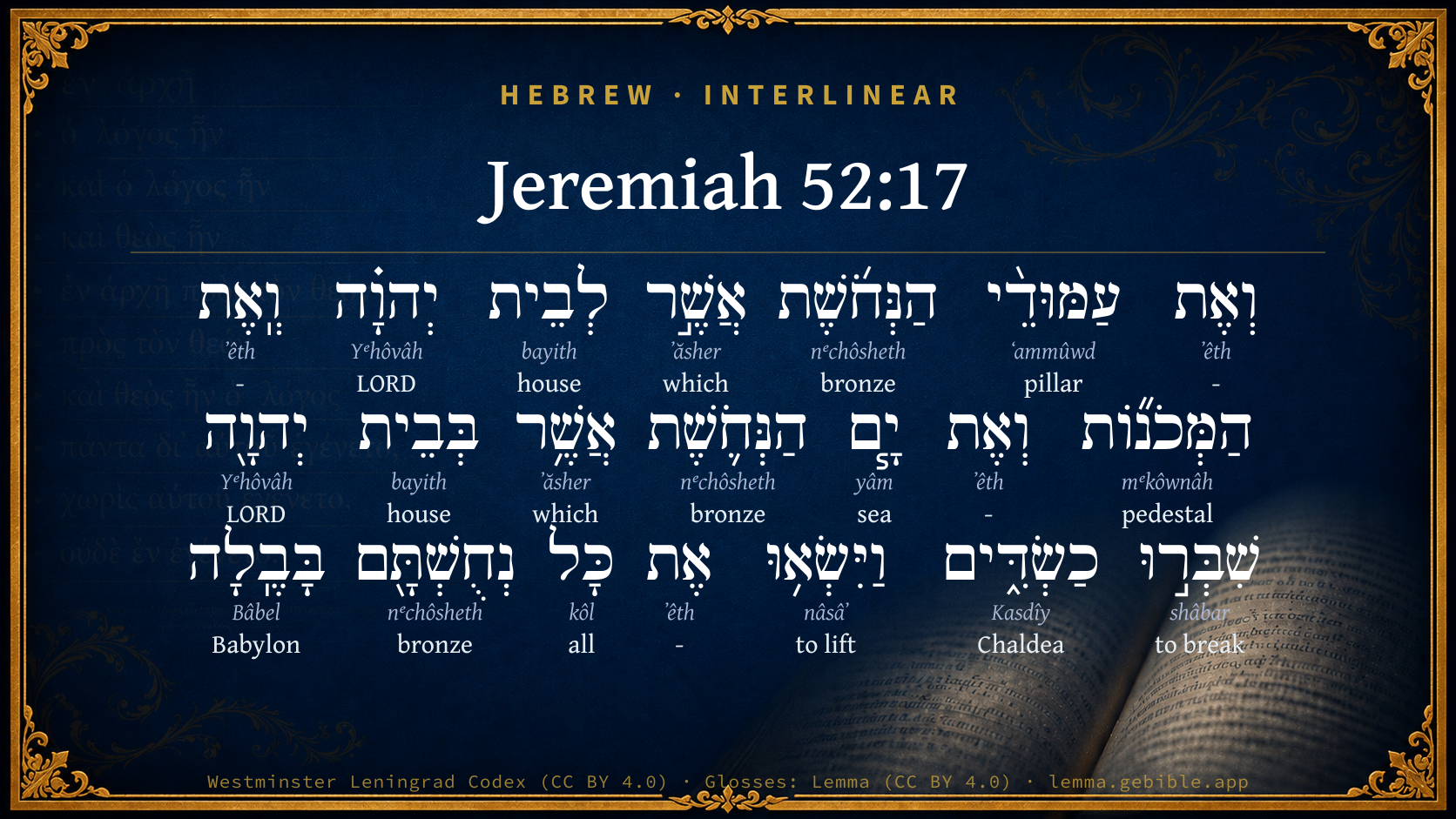
Hebrew (Westminster Leningrad Codex) Jeremiah 52:17 appears in the Hebrew Old Testament. The text above is from the Westminster Leningrad Codex. Each word links to its Strong’s number, a concise gloss, and parsing drawn from the Open Scriptures Hebrew Bible morphology. Click any word for its full Brown-Driver-Briggs (BDB) entry.
Download image
Cite this verse

Jeremiah 52:17 (World English Bible). Public Domain. Lemma interlinear Bible study tool, https://lemma.gebible.app/v/jeremiah/52/17.

Show BibTeX & RIS
BibTeX
RIS
English Translation
The pillars of brass that were in the house of Yahweh, and the bases and the brazen sea that were in the house of Yahweh, did the Chaldeans break in pieces, and carried all the brass of them to Babylon.
World English Bible · Public Domain
Download a study sheet

One document with this verse’s original text, its word-by-word gloss line, the meaning frame, cross-references with their text, attributed commentary, and full source and license credits — printable, and it pastes into notes with its structure intact.

This verse Autodidact and up

Study sheet (.html) Plain text (.txt)

A passage Seminary Student

Up to 50 verses in one chapter. A passage sheet keeps up to 6 commentary sources and 12 cross-references per verse, in the order this page ranks them, and says so on the sheet whenever that leaves anything out. Ask for a single verse and you get the Autodidact verse sheet above.

Everything on this page stays free to read, with no account — the sheet is a download of what is already on screen, not access to it.

Want to remove ads? Support Godless Engineer
Compare translations 3

The same verse in 3 English versions, stacked beneath the original-language interlinear above. Click any original word for its lexicon entry.

Each is an independent rendering of the whole verse — the interlinear is not word-aligned to these translations.

Highlighted words mark where these versions differ — a whole-verse word diff, not a word-by-word alignment.

  • World English Bible Public Domain
    The pillars of brass that were in the house of Yahweh, and the bases and the brazen sea that were in the house of Yahweh, did the Chaldeans break in pieces, and carried all the brass of them to Babylon.
  • King James Version Public Domain
    Also the pillars of brass that were in the house of the LORD, and the bases, and the brasen sea that was in the house of the LORD, the Chaldeans brake, and carried all the brass of them to Babylon.
  • unfoldingWord Literal Text CC BY-SA 4.0
    As for the bronze pillars that belonged to the house of Yahweh, and the stands, and the large bronze basin called “The Sea” that were in the house of Yahweh, the Chaldeans broke them into pieces and carried all the bronze back to Babylon.

unfoldingWord Literal Text — © unfoldingWord, licensed CC BY-SA 4.0. Word-aligned USFM3 via Door43 (git.door43.org/unfoldingWord/en_ult).

Versions to compare (up to 4)

3 of 4 selected

Show all 18 translations

Every available English version of this verse, each an independent rendering of the whole verse.

  • World English Bible Public Domain
    The pillars of brass that were in the house of Yahweh, and the bases and the brazen sea that were in the house of Yahweh, did the Chaldeans break in pieces, and carried all the brass of them to Babylon.
  • Berean Standard Bible Public Domain
    Moreover, the Chaldeans broke up the bronze pillars and stands and the bronze Sea in the house of the LORD, and they carried all the bronze to Babylon.
  • Majority Standard Bible Public Domain
    Moreover, the Chaldeans broke up the bronze pillars and stands and the bronze Sea in the house of the LORD, and they carried all the bronze to Babylon.
  • King James Version Public Domain
    Also the pillars of brass that were in the house of the LORD, and the bases, and the brasen sea that was in the house of the LORD, the Chaldeans brake, and carried all the brass of them to Babylon.
  • American Standard Version (1901) Public Domain
    And the pillars of brass that were in the house of Jehovah, and the bases and the brazen sea that were in the house of Jehovah, did the Chaldeans break in pieces, and carried all the brass of them to Babylon.
  • Revised Version (1885) Public Domain
    And the pillars of brass that were in the house of the LORD, and the bases and the brasen sea that were in the house of the LORD, did the Chaldeans break in pieces, and carried all the brass of them to Babylon.
  • Geneva Bible (1599) Public Domain
    Also the pillars of brasse that were in the House of the Lord, and the bases, and the brasen Sea, that was in the house of ye Lord, the Caldeans brake, and caried all the brasse of them to Babel.
  • Douay-Rheims (1899) Public Domain
    The Chaldeans also broke in pieces the brazen pillars that were in the house of the Lord, and the bases, and the sea of brass that was in the house of the Lord: and they carried all the brass of them to Babylon.
  • Young's Literal Translation Public Domain
    And the pillars of brass that `are' to the house of Jehovah, and the bases, and the brasen sea that `is' in the house of Jehovah, have the Chaldeans broken, and they bear away all the brass of them to Babylon;
  • Literal Standard Version CC BY-SA 4.0
    And the pillars of bronze that [are] in the house of YHWH, and the bases, and the bronze sea that [is] in the house of YHWH, the Chaldeans have broken, and they carry away all the bronze of them to Babylon;
  • Unlocked Literal Bible CC BY-SA 4.0
    As for the bronze pillars that belonged to the house of Yahweh, and the stands, and the large bronze basin called “The Sea” that were in the house of Yahweh, the Chaldeans broke them into pieces and carried all the bronze back to Babylon.
  • unfoldingWord Literal Text CC BY-SA 4.0
    As for the bronze pillars that belonged to the house of Yahweh, and the stands, and the large bronze basin called “The Sea” that were in the house of Yahweh, the Chaldeans broke them into pieces and carried all the bronze back to Babylon.
  • Darby Bible Public Domain
    And the brazen pillars that were in the house of Jehovah, and the bases, and the brazen sea that was in the house of Jehovah, the Chaldeans broke up, and carried all the brass thereof to Babylon.
  • World Messianic Bible Public Domain
    The Kasdim broke the pillars of bronze that were in the LORD’s house and the bases and the bronze sea that were in the LORD’s house in pieces, and carried all of their bronze to Babylon.
  • Webster's Bible Public Domain
    Also the pillars of brass that were in the house of the LORD, and the bases, and the brazen sea that was in the house of the LORD, the Chaldeans broke, and carried all the brass of them to Babylon.
  • Free Bible Version CC BY-SA 4.0
    The Babylonians broke into pieces the bronze pillars, the movable carts, and the bronze Sea that belonged to the Lord's Temple, and they took all the bronze to Babylon.
  • Bible in Basic English Public Domain
    And the brass pillars which were in the house of the Lord, and the wheeled bases and the great brass water-vessel in the house of the Lord, were broken up by the Chaldaeans, who took all the brass away to Babylon.
  • JPS Tanakh (1917) Public Domain
    And the pillars of brass that were in the house of the LORD, and the bases and the brazen sea that were in the house of the LORD, did the Chaldeans break in pieces, and carried all the brass of them to Babylon.

Literal Standard Version (2020), Covenant Press — licensed CC BY-SA 4.0. Text via the HelloAO Bible API (eBible.org). Unlocked Literal Bible (unfoldingWord) — licensed CC BY-SA 4.0. Text via the HelloAO Bible API (eBible.org). unfoldingWord Literal Text — © unfoldingWord, licensed CC BY-SA 4.0. Word-aligned USFM3 via Door43 (git.door43.org/unfoldingWord/en_ult). Free Bible Version, Dr. Jonathan Gallagher — licensed CC BY-SA 4.0. Text via the HelloAO Bible API (eBible.org).

Word by word

More ways to search: Search by grammar → Find every occurrence → Compare this word →

Practice this passage: Drill this verse → Learn its vocabulary →

הַמְּכֹנ֞וֹת
mᵉkôwnâh
H4350
“the · pedestals”
Particle, Definite Article + Noun, Common, Feminine, Plural, Absolute
Part of Speech
Particle + Noun
Type
Common
Gender
Feminine
Number
Plural
State
Absolute
Full BDB Definition

Origin: from H4349

TWOT: 964d

fixed resting place, base, pedestal
  1. וְאֶת ʼêth H853 “and · -” Conjunction + Particle, Direct Object
  2. עַמּוּדֵ֨י ʻammûwd H5982 “pillars of” Noun, Common, Masculine, Plural, Construct
  3. הַנְּחֹ֜שֶׁת nᵉchôsheth H5178 “the · bronze” Particle, Definite Article + Noun, Common, Feminine, Singular, Absolute
  4. אֲשֶׁ֣ר ʼăsher H834 “which” Particle, Relative
  5. לְבֵית bayith H1004 “to/for · house of” Preposition + Noun, Common, Masculine, Singular, Construct
  6. יְהוָ֗ה Yᵉhôvâh H3068 “LORD” Noun, Proper
  7. וְֽאֶת ʼêth H853 “and · -” Conjunction + Particle, Direct Object
  8. וְאֶת ʼêth H853 “and · -” Conjunction + Particle, Direct Object
  9. יָ֧ם yâm H3220 “sea of” Noun, Common, Masculine, Singular, Construct
  10. הַנְּחֹ֛שֶׁת nᵉchôsheth H5178 “the · bronze” Particle, Definite Article + Noun, Common, Feminine, Singular, Absolute
  11. אֲשֶׁ֥ר ʼăsher H834 “which” Particle, Relative
  12. בְּבֵית bayith H1004 “in/at · house of” Preposition + Noun, Common, Masculine, Singular, Construct
  13. יְהוָ֖ה Yᵉhôvâh H3068 “LORD” Noun, Proper
  14. שִׁבְּר֣וּ shâbar H7665 “to break” Verb, Piel, Perfect, 3rd Person, Common, Plural
  15. כַשְׂדִּ֑ים Kasdîy H3778 “Chaldea” Noun, Proper
  16. וַיִּשְׂא֥וּ nâsâʼ H5375 “and · to lift” Conjunction + Verb, Qal, Sequential Imperfect, 3rd Person, Masculine, Plural
  17. אֶת ʼêth H853 “-” Particle, Direct Object
  18. כָּל kôl H3605 “all of” Noun, Common, Masculine, Singular, Construct
  19. נְחֻשְׁתָּ֖ם nᵉchôsheth H5178 “bronze · their” Noun, Common, Feminine, Singular, Construct + Suffix, Personal, 3rd Person, Masculine, Plural
  20. בָּבֶֽלָה Bâbel H894 “Babylon · toward” Noun, Proper + Suffix, Demonstrative

About this verse

These counts appear in no published source. They are computed here, from the morphology-tagged text and Lemma’s own curated glosses. What Lemma adds →

21
words
13
distinct lemmas
Prophets
section

Notable vocabulary

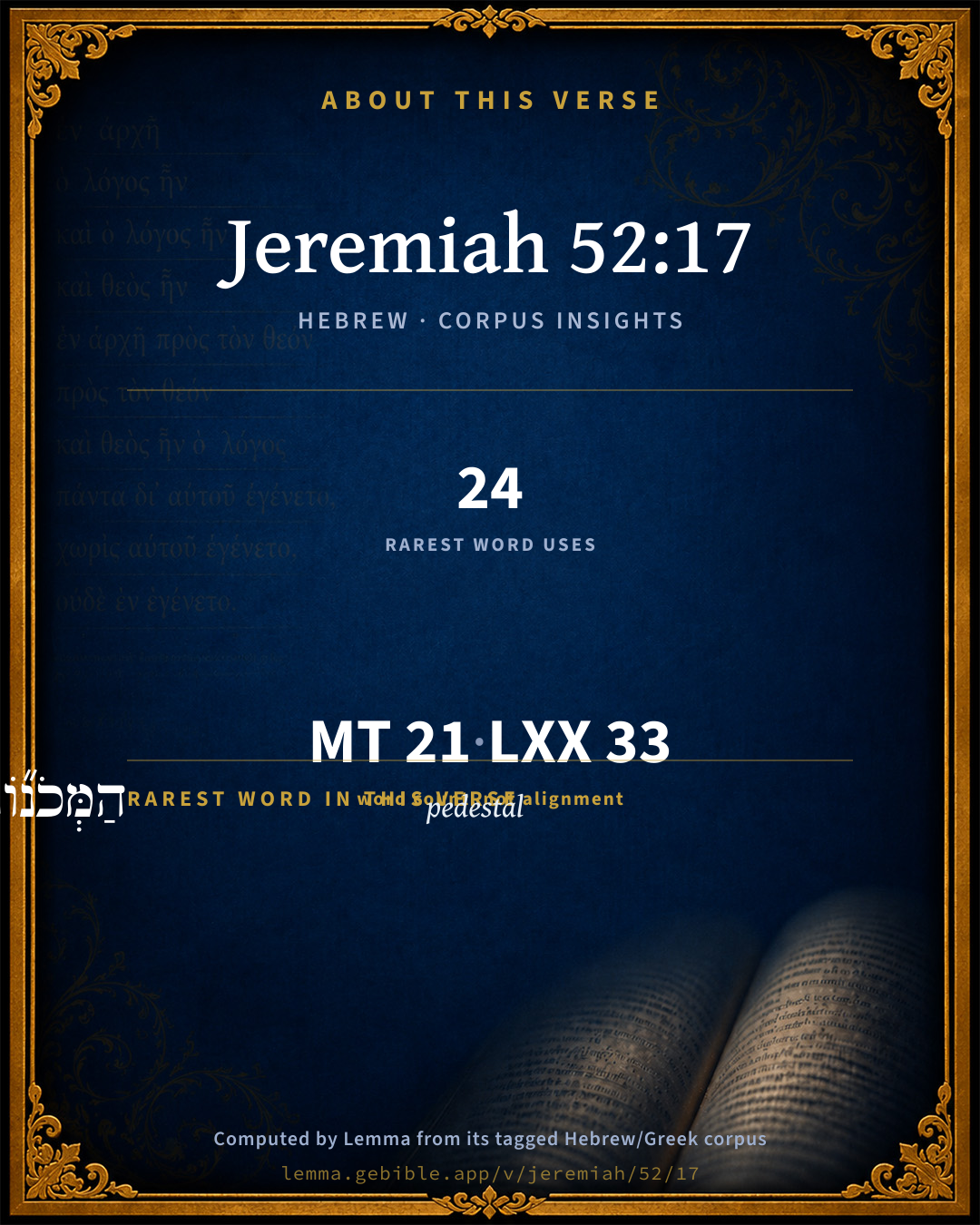
The rarest word here is הַמְּכֹנ֞וֹת pedestal H4350 — appearing just 24 times in the whole Hebrew Bible.

Shared distinctive vocabulary

הַמְּכֹנ֞וֹת pedestal H4350 occurs in 18 verses of the Hebrew Bible. Also found in:

Grammatical profile

  • 2 verbs
  • 13 nouns
  • 6 particles

Verb forms

  • שִׁבְּר֣וּ Piel · Perfect
  • וַיִּשְׂא֥וּ Qal · Sequential Imperfect

Repetition

Words recur within this verse — often emphatic in Hebrew:

  • הַנְּחֹ֜שֶׁת bronze H5178 ×3
  • לְבֵית house H1004 ×2
  • יְהוָ֗ה LORD H3068 ×2
  • אֲשֶׁ֣ר which H834 ×2

Hebrew & Septuagint length

In the original languages it is 21 Hebrew tokens and 33 Greek tokens — but the two are counted differently (Hebrew bundles its prefixes and suffixes into one token; the Greek is in lemma form), so that isn’t a like-for-like length.

Cross-references

9

Topical passages linked to Jeremiah 52:17 in the Treasury of Scripture Knowledge — connected by theme and wording, ordered by reader-vote popularity; previews shown in the World English Bible.

  • Jeremiah 27:19–22 For thus says Yahweh of Hosts concerning the pillars, and concerning the sea, and concerning the bases, and concerning the residue of the vessels that are left in this city,
  • 2 Chronicles 4:12–15 the two pillars, and the bowls, and the two capitals which were on the top of the pillars, and the two networks to cover the two bowls of the capitals that were on the top of the pillars,
  • Jeremiah 52:21–23 As for the pillars, the height of the one pillar was eighteen cubits; and a line of twelve cubits did compass it; and the thickness of it was four fingers: it was hollow.
  • 1 Kings 7:15–37 For he fashioned the two pillars of brass, eighteen cubits high apiece: and a line of twelve cubits compassed either of them about.
  • 1 Kings 7:50 and the cups, and the snuffers, and the basins, and the spoons, and the fire pans, of pure gold; and the hinges, both for the doors of the inner house, the most holy place, and for the doors of the house, [to wit], of the temple, of gold.
  • 2 Kings 25:13–17 The pillars of brass that were in the house of Yahweh, and the bases and the brazen sea that were in the house of Yahweh, did the Chaldeans break in pieces, and carried the brass of them to Babylon.
  • 2 Chronicles 36:18 All the vessels of the house of God, great and small, and the treasures of the house of Yahweh, and the treasures of the king, and of his princes, all these he brought to Babylon.
  • Lamentations 1:10 The adversary has spread out his hand on all her pleasant things: For she has seen that the nations are entered into her sanctuary, Concerning whom you did command that they should not enter into your assembly.
  • Daniel 1:2 The Lord gave Jehoiakim king of Judah into his hand, with part of the vessels of the house of God; and he carried them into the land of Shinar to the house of his god: and he brought the vessels into the treasure-house of his god.

Cross-references courtesy of OpenBible.info (CC BY 4.0).

Hebrew and Greek witnesses Masoretic Hebrew ↔ Greek Septuagint

The same verse in the two great witnesses to the Old Testament, shown verse-for-verse.

These are two independent witnesses, not word-aligned to each other, and the Septuagint is shown in lemma (dictionary) form.

Hebrew Jeremiah 52:17 Masoretic · Westminster Leningrad Codex

וְאֶת עַמּוּדֵ֨י הַנְּחֹ֜שֶׁת אֲשֶׁ֣ר לְבֵית יְהוָ֗ה וְֽאֶת הַמְּכֹנ֞וֹת וְאֶת יָ֧ם הַנְּחֹ֛שֶׁת אֲשֶׁ֥ר בְּבֵית יְהוָ֖ה שִׁבְּר֣וּ כַשְׂדִּ֑ים וַיִּשְׂא֥וּ אֶת כָּל נְחֻשְׁתָּ֖ם בָּבֶֽלָה

The pillars of brass that were in the house of Yahweh, and the bases and the brazen sea that were in the house of Yahweh, did the Chaldeans break in pieces, and carried all the brass of them to Babylon.

World English Bible · Public Domain

Greek LXX Structure differs

In the Septuagint, Jeremiah is about an eighth shorter than the Hebrew and arranges its material differently — the Oracles Against the Nations (Hebrew chapters 46–51) appear in the middle of the Greek book, after 25:13. Because the chapter and verse boundaries do not line up, a verse-for-verse comparison with the Hebrew is not shown.

A verse-for-verse comparison isn’t shown here because the chapters and verses don’t line up. Switch to the LXX edition with the MT / LXX toggle above to read the Greek directly.

On this verse, Joseph Benson's Commentary discusses the Septuagint’s reading. Read the note in Commentary ↓

Hebrew: Westminster Leningrad Codex (CC BY 4.0). Greek: Septuagint (public domain); English from a public-domain English Septuagint. How the Septuagint differs from the Hebrew →

Targum (Aramaic paraphrase)

1

The Targum is the ancient Jewish Aramaic paraphrase of the Hebrew Scriptures — an interpretive translation, not the Hebrew text itself. Onkelos (literal) and Pseudo-Jonathan (expansive) render the Torah, and Jonathan the Prophets. Coverage is partial: where no permissively-licensed English translation exists for a verse, only the Aramaic is shown. This is verse-level text, not a word-by-word alignment to the Hebrew.

  1. Targum Jonathan Prophets (Joshua–Malachi)
    וְיַת עַמוּדֵי נְחָשָׁא דִי בְבֵית מַקְדְשָׁא דַייָ וְיַת בְּסִיסַיָא וְיַת יַמָא דִנְחָשָׁא דִי בְּבֵית מַקְדְשָׁא דַייָ תְּבַרוּ כַסְדָאֵי וְאוֹבִילוּ יַת כָּל נְחָשֵׁיהוֹן לְבָבֶל:

    (no public-domain English translation for this verse)

    Targum Jonathan — Aramaic: “Mikraot Gedolot” (public domain). English: “Sefaria Community Translation” (CC0 1.0 (public-domain dedication)); “London "Chaldee Paraphrase," 1871” (public domain). Text via Sefaria.

Commentary

Notes on Jeremiah 52:17 from classic Christian and Jewish commentators (each source and its license shown beneath its notes). The classic Christian expositions comment on the surrounding passage and are grouped to its opening verse, so a note may address several verses; the Jewish commentaries on the Tanakh (Rashi and others) are per-verse, so they appear only where the commentator wrote on this verse.

Lemma curates 59 commentaries, every one of them public domain or Creative Commons licensed, each selected and text-cleaned for this edition rather than reprinted as found. About our sources →

Joseph Benson's Commentary

Jer 52:17-20. Also the pillars of brass, &c., the Chaldeans brake — See note on 2Ki 25:13. The temple was rifled of its riches and furniture at several times. The first was when Nebuchadnezzar came up against Jehoiakim, Dan 1:2. The second time was at the captivity of Jechoniah, Jer 27:19; 2Ki 24:13; and now at the final destruction of the city and temple they made a clear riddance of all its ornaments. And twelve brazen bulls that were under the bases — Or rather, which were instead of bases, to support the brazen sea, (1Ki 7:25,) the Hebrew word תחת, in other places, signifying instead, or, in the place of another. So the LXX. understand it here.

Joseph Benson's Commentary on the Old and New Testaments (1811–1818) — public domain. Text from a community e-Sword module.

Lange's Commentary on the Holy Scriptures

3. THE CARRYING AWAY OF THE SACRED VESSELS

Jer_52:17-23

17Also the pillars of brass that were in [belonged to]11 the house of the Lord, and the bases, and the brazen sea that was in the house of the Lord [Jehovah] the 18Chaldeans brake, and carried all12 the brass of them to Babylon. The caldrons [pots] also, and the shovels, and the snuffers, and the bowls, and the spoons, and 19all the vessels of brass wherewith they ministered, took they away. And the basins,13 and the firepans,14 and the bowls, and the caldrons [pots], and the candlesticks, and the spoons, and the cups;15 that which was of gold in gold, and that which was of silver in silver [which were entirely of gold or silver]16 took the captain of 20the guard [halberdiers] away. The17 two pillars, one18 sea, and twelve brazen bulls that were under19 the bases, which king Solomon had made to [for] the house 21of the Lord [Jehovah]; the brass20 of all these vessels was without weight. And concerning the pillars, the height21 of one pillar was eighteen cubits; and a fillet of twelve cubits did compass it; and the thickness thereof was four fingers; it was 22hollow.22 And a chapiter of brass was upon it; and the height of one chapiter was five cubits, with network23 and pomegranates upon the chapiter, round about, all 23of brass. The second pillar also and the pomegranates24 were like unto these. And there were ninety and six pomegranates on a side; and all the pomegranates upon the network were a hundred round about [round about were a hundred].

EXEGETICAL AND CRITICAL

Jer_52:17-20. Also the pillars … weight. Concerning the brazen pillars of Solomon’s temple comp. 1Ki_7:15-22; 2Ch_3:15 sqq.; Winer, R.-W.-B., s. v. Jachin und Boas;Herzog, R.-Enc. VI. S. 366, 7. [ Wordsworth, ad loc., and Smith’sDict. s. v.].—The מְכֹנוֹת, bases (comp. 1Ki_7:27 sqq.), were pedestals or stands, four cubits long, four broad and three high, to serve as supports for the ten basins required in washing the flesh of the sacrifices (2Ch_4:6). Comp. Keil on the Books of Kings.—The brazen sea (comp. 1Ki_7:23-26; 1Ch_18:8; 2Ch_4:2-6) served for the priests’ washing (comp. Exo_30:18 sqq.). Winer, R.-W.-B. s. v.—Herz., R.-Enc. IX. S. 236 sqq. [Comp. Wordsworth and Smith’sDict.]—Of the smaller vessels are mentioned סירוֹת. pots for carrying away the ashes from the altar; יָעִים shovels for removing the ashes; מְזַמְּרוֹת, not to be confounded with מַזְמֵרוֹת, a vine-dresser’s knife, occurring in three places only besides this: 1Ki_7:50; 2Ki_12:14; 2Ch_4:22, and always with מִזְרָקוֹת, of uncertain meaning: Vulg., etc., psalteria; Luther, etc., knife; Gesenius, etc., scissors, lamp-scissors, at any rate an instrument so-called a carpendo;מִזְרָקוֹת, which is wanting in 2 Ki., probably that it might not occur twice, from זָרַק, sparsit, therefore vas unde spargitur, bowls, mentioned in Exo_27:3; Exo_38:3; Num_4:14 among the altar-utensils, therefore used for sprinkling the blood of the sacrifices, but comp. also Amos 6 : כַּפּוֹט likewise of uncertain meaning, LXX. κρεάγρα, flesh-fork, flesh-hook, the moderns—spoons, pans, bowls, on account of their resemblance to the bent hand. Comp. Keil on Kings. In Exo_25:29 these appear among the utensils of the table of shew-bread, comp. Num_7:14; Num_7:20; Num_7:26, etc.Winer, R.-W.-B. and Herz., Real-Enc. s. v. Schaubrodtisch. All these vessels were of brass [Henderson, copper]. In the following verse the golden and silver vessels are also enumerated, which the Chaldeans carried away. Hitzig has unjustly attacked Jer_52:19 as spurious, for it does not interrupt the connection, since evidently in Jer_52:18-19 all the smaller vessels are to be enumerated, the larger ones having been mentioned in Jer_52:17. These latter could, of course, be only of brass, but the total amount of the brass plundered was so great that it seemed to merit the special emphasis given to it in Jer_52:20. The golden and silver vessels are not there mentioned, because it was only the brazen ones which were of such immense weight. The pots, sprinkling cups and spoons are mentioned a second time in Jer_52:19, simply because there were such utensils both of brass and of gold and silver. Hitzig’sopinion that all the golden and silver vessels had already been carried away at Jehoiachin’s deportation, certainly finds some support in 2Ki_24:13 (“all the vessels of gold”). From the circumstance, however, that only golden vessels are spoken of, we may conclude that the cream only was then removed, i.e. the most valuable. The golden vessels of low value as well as all the silver remained for the thorough evacuation made by Nebuzar-adan.—The words and twelve brazen bulls which were under are rightly wanting in 2Ki_25:16. For they contain a double error: 1. the twelve bulls were not under the bases, but under the sea, according to 1Ki_7:25; 2Ki_16:17. 2. In 2Ki_16:17 it is expressly related that Ahaz had already taken away the twelve bulls and replaced them by a substructure of stone. Whither they went is not indeed stated, but no more is it recorded that they were restored to their original position. I therefore, in opposition to Keil (Comm. on Kings), agree with those who regard the words in question as the arbitrary addition of some one, whose mind was not clear about the “bases,” and who had forgotten the passage in 2Ki_16:17. [Comp. Wordsworth].

Jer_52:21-23. And the pillars … a hundred. Supplementary and more particular description of the pillars.—And the pillars is wanting in 2 Ki. The height is also stated at eighteen cubits in 1Ki_7:15. The description there given is in general the basis of this.—And a fillet, etc., to the end of the verse, is also wanting in 2 Ki.—If the pillars were twelve cubits in circumference, the diameter (comp. Winer, R.-W.-B. s. v. Jachin und Boas) was about four cubits, which gives a perfectly correct proportion. The thickness of the brass was four fingers. Thus the pillars were hollow, as indeed is remarked.—A chapiter. This is the capital, coronamentum of the pillar. Comp. 1Ki_7:16; 2Ch_4:12-13.—Instead of five cubits 2Ki_25:17 has three. The number five in the correct one according to 1Ki_7:16.—Of one is unnecessary, but not incorrect, since of course it is understood not of a second capital, but the capital of the second pillar. It is evidently based on 1Ki_7:16.—The pomegranates were also an ornamentation on the hem of the priest’s ephod, or surplice (Exo_28:33-34). A figure of it may be seen in Thenius, Comm. on Kings, Taf. III. Fig. 2 bb.

Jer_52:23 is entirely wanting in 2 Kings. Ninety-six pomegranates on each pillar were placed רוּחָהi.e. towards the wind, towards the four winds or sides [Henderson after Hitzig, towards the air, the outside of the capitals]. The expression is found here only. Comp. Eze_37:9. It is clear that this is the meaning from the statement that the entire number of the pomegranates attached to the network was a hundred. There must then have been also a pomegranate at each corner.

DOCTRINAL AND ETHICAL

1. “Docemur hoc capite, quod comminationes divinæ rum sint de pelvi fulgura, quodque Deus pro misericordia sua infinita calamitates a se immissas mitigare plerumque soleat, si seria interveniat pœnitentia.” Förster.

2. On Jer_52:1-3. “From this we see why God sometimes places ungodly rulers over a country, who cast it to destruction. It is done on account of the rulers’ and the people’s sins, that they may draw down the well merited punishment, as Sirach says. On account of violence, injustice and avarice, a kingdom passes from one nation to another (Jer_10:8). So also says king Solomon. Because of the sins of a nation occur many changes of rulers, but for the sake of the people who are intelligent and reasonable, the State is prolonged (Pro_28:2).” Wurtemb. Summarien.

3. On Jer_52:4. “God allows many slight and mild punishments to come as warnings, till at last comes the finishing stroke. This is a witness to the divine long-suffering (Rom_2:4).” Cramer.

4. On Jer_52:6. “The fact that in this siege compassionate women had to kill and eat their own children (Lam_4:10) is a reminder that by bodily hunger God would punish; 1. satiation and disgust towards His holy word and soul-food; 2. the terrible offering up of children to Moloch; 3. the loose discipline of children.” Cramer.

5. On Jer_52:7. “No fortress can protect the ungodly, even though they had their nest in the clouds.” Cramer.

6. On Jer_52:8. “An example of faithless, perjured men of war. But as Zedekiah broke his oath to the king at Babylon, he was paid back in the same coin.” Cramer. “His people forsook the poor king Zedekiah on his flight and he was captured, from which we see that great men cannot depend on their body-guard; these flee in time of need, and leave their masters in the lurch. The surest and best protection is when we have the holy angels for our guard … This angelic protection is, however, to be obtained and preserved by faith and godliness, but is lost by unbelief and ungodly conduct.” Wurtemb. Summ.

7. On Jer_52:9-11. The punishment of perjury. “Ubi monemur, quod fides hosti, etiam barbaro, qualis hodie Turca, a Christianis data, mimine violanda.” Förster.

8. On Jer_52:9. sqq. “God had shown Zedekiah by Jeremiah a way in which he could escape the calamity. But because he forsook the Lord and would not follow it, the others were only leaky cisterns (Jer_2:13). For woe to the rebellious who take counsel without the Lord (Isa_30:1). This is useful for an instance against the holy by works, who reject God’s way of escaping the Devil; when they devise other ways for themselves they are caught by the Chaldeans of hell.” Cramer.

9. On Jer_52:12 sqq. “Holy places, external ceremonies and opus operatum do not avail for hypocrites … If God punished His own institution so severely, how shall human institutions remain unpunished?” Cramer.

10. On Jer_52:12. “Quale fatum, ne et nostris obtingat templis … caveamus, ne profanemus templa ulterius tum externa vel materialia, tum interna vel spiritualia in cordibus nostris, de quibus 1Co_3:16 sqq.; Jer_6:19 sqq.” Förster.

11. On Jer_52:15. “It is another work of mercy that some of Judah were preserved. For God’s grace is always to be found in His punishments.” Cramer.

12. On Jer_52:15. “He who will not serve God and his neighbor at home and in quiet, must learn to do it in a strange land in affliction and distress.” Cramer.

13. On Jer_52:24 sqq. “As teachers are often to blame for their behaviour that sin gets the upper hand in a community, it is exceedingly just when God brings such for an example into great punitive judgment (1Sa_2:27-34).” Starke.

14. On Jer_52:24. “The priests are caught and slain; 1. because they could not believe the truth for themselves; 2. because they led others astray; 3. because they appealed to the temple of the Lord; 4. because they persecuted the true prophets; 5. because they troubled the whole church of God. But he who troubleth shall bear his judgment, whosoever he be (Gal_5:10).” Cramer.

15. On Jer_52:31 sqq. “Sane omnino verisimile videtur judicio Philippi Melanchthonis in Chron. part, I fol. 33 Evilmerodachum amplexum esse doctrinam Danielis de Vero Deo, quam et pater publico edic professus est, eamque ob causam clementiam exercuisse erga regem Jechoniam.” Förster.—“Narrant Hebræi hujusmodi fabulam: Evilmerodach, qui patre suo Nabuchodonosor vivente per septem annos inter bestias, ante regnaverat, postquam ille restitutus in regno est, usque ad mortem patris cum Joakim rege Judæ in vinculis fuit; quo mortuo, quum rursus in regnum succederet, et non susciperetur a principibus, qui metuebant, ne viveret qui dicebatur extinctus, ut fidem patris mortui faceret, aperuit sepulcrum et cadaver ejus unco et funibus traxit.” Jerome on Jer_14:18-19. Josephus speaks of it as follows: “Ἀβιλαμαρώδαχος εὐθὺς τὸν ‘Ιεχωνίαν τῶν δεσμῶν ἀφεὶς ἐν τοῖς ἀναγκαιοτάτοις φίλοις εἱχε … ‘Ο γὰρ πατὴρ αὐτοῦ τὴν πίστιν οὐκ ἐφύλαξε τῷ ’Ιεχωνία, παραδόντι μετὰ γυναικαῶν καὶ τέκνων καὶ τῆς συγγενείας ὅλης ἑκουσίως ἑαυτὸν ὑπὲρ τῆς πατρἰδος, ὡς ἄν μὴ κατασκαφείη ληφθεῖσα τῇ πολιορκίᾳ.” (Antiqq., X. 11, 21.)

16. On Jer_52:31 sqq. “Ceterum potest hoc exemplo, quod Jechonias rex dignitati suæ in exilio Babylonico restitutus, refutari exceptio Judæorum contra vaticinium Jacobi (Gen_49:10) de Messia jamdudum exhibito, postquam per Romanos sceptrum de Juda ablatum, id quod τεκμήριον Messiæ jamjam nascituri esse debuit.” Förster.

17. On Jer_52:31 sqq. “No one should despair in misfortune, for the right hand of the Highest can change all (Psa_77:10) and Christ rules even in the midst of His enemies (Psa_110:2). For His are the praise, the glory and the power from everlasting to everlasting. Amen.” Cramer.

HOMILETICAL AND PRACTICAL

1. On Jer_52:1-11. The truth of the word “What a man soweth, that shall he also reap,” exhibited in the example of the Jewish State under Zedekiah.1. The seed (Jer_52:2); 2. The crop (a) the siege, (b) the famine, (c) the capture of the city and flight of the king, (d) the punishment of the king and his princes, (e) the fate of the people (Jer_52:3).

2. On Jer_52:12-20. The rejection of Judah appears at first sight a contradiction. For Jerusalem is the holy city (Mat_4:5; Neh_11:1; Neh_11:18), the city of God (Psa_46:5; Psa_48:2; Psa_48:9; Psa_78:3); the temple is the house of Jehovah (Jer_7:2. etc.); God’s service rests on divine authority (Ex. chh. 25–27, 30, 31). But God cannot contradict Himself. We have, therefore, to show “the unity of the divine thoughts in the choice and rejection of Jerusalem.” 1. The rejection was a conditional one (Jer_7:3 sqq). Hence notwithstanding the election the rejection involved nothing contradictory, but was a necessary consequence of the unfulfilled condition.—2. The election remains (a) objectively notwithstanding the rejection; it is (b) subjectively brought to its realization by the rejection; the latter as a means of discipline operating to produce the disposition, from which alone thefulfillment of this condition can proceed. Comp. rems. on Jer_32:41, p. 288.

3. On Jer_52:24-27. “That great lords sometimes make an example of gross miscreants, promotes righteousness, only it must not be done on the innocent, or with such severity that there is no proportion between the crime and its punishment (Jos_7:25).” Starke.

4. On Jer_52:31-34. The deliverance of Jehoiachin. 1. It shows us that the Lord can help (a) out of great distress (grievous imprisonment of thirty-seven years), (b) in a glorious manner. 2. It admonishes us (a) to steadfast patience, (b) to believing hope, Psalms 13 [“It was a prelude and pledge of the liberation and exaltation of the Jewish Nation, when it had been humbled and purified by the discipline of suffering; and of its return to its own land; and a joyful pre-announcement of that far more glorious future restoration which the prophets in the Old Testament, and the Apostles in the New foretell—of Israel to God in Christ; to whom, with the Father and Holt Ghost, be ascribed all honor, glory, dominion, adoration and praise, now and forever. Amen.” Wordsworth.—S. R. A.].

Footnotes:

[11]Jer_52:17—Instead of אְַשֶׁר לְבֵית we read in 2Ki_25:13 אְַשֵׁר בֵּית. The latter=which were in the house of Jehovah, the former=which belonged to the house, etc.

[12]Jer_52:17.—In 2 Ki. כֹּל is wanting before נְחֻשְׁתָּם as in Jer_52:14 before חֹמוֹת.

[13]Jer_52:19.—סִפִים (1Ki_7:50; 2Ki_12:14, סִכּוֹת, 2Sa_17:28, סַפוֹת) from סַף, basin, bowl (Exo_12:22; Zec_12:2) not to be confounded with סַף, threshhold (Jer_52:24). סִפוֹת כֶסֶף are expressly mentioned in 2Ki_12:14.

[14]Jer_52:19.—מַחְתּוֹת (from חָתָה, to hold, seize, specially used of bringing fire, Isa_30:14; Pro_6:27) are vessels for carrying burning substances, whether coals (Lev_16:13) or lighted incense (Num_16:17 sqq.).

[15]Jer_52:19.—מְנַקּיוֹתּ are mentioned besides only in Exo_25:29; Exo_37:16; Num_4:7, and in all these places among the utensils of the shew-bread-table (comp. rems. on כַּכּוֹת, Jer_52:18) and as pertaining to libation, (אְַשֶׁר יֻסַךְ בַּהֵן). In Exo_25:29 these vessels are expressly designated as to be made of gold.

[16]Jer_52:19.—The double position of זָהָב and כֶּסֶף has the sense of “only” or “wholly” (massive). Comp. Naegelsb. Gr., § 22 b.—The words וְאֵת הַסִפִים and וְאֵת הַסִירוֹת to מְנַקּיוֹת are wanting in 2 Kings. It is noteworthy that thus (a) the repetition of סִירוֹת and כַּכּוֹת, and (b) the plural סִּפִּים, which occurs nowhere else in the sense of “basins” are avoided; (c) that the words following סִירוֹת and כַּפוֹת are also removed.

[17]Jer_52:20.—With respect to the construction of Jer_52:20 we are to regard the substantives set first absolutely as in the accusative; as to the pillars, etc., their brass was not to be weighed. The verse is to express that it was those large pieces which raised the weight of the brass to such a degree.

[18]Jer_52:20.—Instead of הָאֶחָד the Keri would have read (not in 2 Ki.) merely אֶחָד, probably because both numbers stand before and afterwards without the article. Grammatically both are possible. Comp. Naegelsb. Gr., § 73, 2 Anm.

[19]Jer_52:20—The explanation of תַּחַת in the sense of “instead” is as forced as the assumption that the text originally read וְחֵמִּכֹנוֹת is arbitrary.

[20]Jer_52:20.—Instead of לִנְחָשְׁתָּם (the suffix by anticipation, comp. Naegelsb. Gr., § 77, 2; Jer_51:56 and on Jer_48:44) we find in 2Ki_25:16 simply לּנְחשֶׁת.

[21]Jer_52:21.—The Keri קוֹמַת, with which the Chethibh in 2Ki_25:17 and 1Ki_7:14 accords, is unnecessary, for קוֹמָה may be regarded as the accusative of measure (comp. Naegelsb. Gr., § 70, g): eighteen cubits was a pillar as to height.

[22]Jer_52:21.—On the construction comp. Naegelsb. Gr., § 97, 2 a and Anm. 1.

[23]Ver 22.—שְבָכַה from שָבַךְ, nectere, plectere inus (comp. סָבַךְ Nah_1:10; Job_8:13; סְבָךְ, thicket, Gen_22:13, etc.), is opus reticulatum, network. Comp. 1Ki_7:17 sqq.; 2Ki_1:2; 2Ch_4:12-13; Job_18:8.

[24]Jer_52:22.—רִמֹנִים at the close of Jer_52:22 is wanting in 2Ki_25:17, and we find instead עַל־הַשְׂבָכָה. This makes the impression that this expression seemed unsuitable to the author of Jeremiah 52. (it must denote together with the network), both on account of the עַל and because the pomegranates were also named after the network, and that, in order besides the general וְכָאֵלֶּה to set forth a special part, he chose in preference the last mentioned, the רִמֹּנִים.

Lange's Commentary on the Holy Scriptures (Critical, Doctrinal, and Homiletical), ed. John Peter Lange, English translation edited by Philip Schaff (1864–1880) — public domain. Text from a community e-Sword module.

Tyndale Open Study Notes

Tyndale Open Resources

52:17-23 This section includes a more detailed list of Temple furnishings than in 1 Kgs 6:1-38.

Tyndale Open Study Notes — © Tyndale Open Resources, licensed CC BY-SA 4.0. Text via the HelloAO Bible API.

Geneva Bible (1599)

Geneva Bible translators

Of these pillars, read 1 Kings 7:15.

Geneva Bible (1599) marginal notes — public domain. Text via Bolls.life.

Jamieson, Fausset & Brown

Robert Jamieson, A. R. Fausset & David Brown

brake--that they might be more portable. Fulfilling the prophecy (Jer 27:19). See Kg1 7:15, Kg1 7:23, Kg1 7:27, Kg1 7:50. Nothing is so particularly related here as the carrying away of the articles in the temple. The remembrance of their beauty and preciousness heightens the bitterness of their loss and the evil of sin which caused it.

brass . . . brazen--rather "copper . . . of copper."

Jamieson, Fausset & Brown — Commentary Critical and Explanatory on the Whole Bible (1871) — public domain (CC PDM 1.0). Text via the HelloAO Bible API.

Adam Clarke's Commentary

Verse 17. Also the pillars] See Clarke on Jer 27:19.

Adam Clarke's Commentary on the Bible (1810–1826) — public domain. Text from a community e-Sword/MySword module.

The Cambridge Bible for Schools and Colleges

gen. ed. J. J. S. Perowne

17. This description of the fate of the Temple furniture is much fuller than that in the Kings passage, and has no parallel in ch. 39. For the vessels mentioned in this v., see on ch. Jer_27:19 with note. They were too large to be conveniently carried as they were, and so were broken and taken to Babylon for the sake of the material. For “brass” and “brasen” read bronze in this and the following vv.

The Cambridge Bible for Schools and Colleges (gen. ed. J. J. S. Perowne; Cambridge University Press, 1878–1918) — public domain. Text from a community e-Sword module.

John Gill's Exposition

The cauldrons also,.... Or "pots", as it is rendered, Kg2 25:14; which were made of bright brass, Kg1 7:45; these were used to boil the flesh of the sacrifices in:

and the shovels; used to remove the ashes from off the altar of burnt offerings, and were of brass also: the Targum renders them "besoms", whose handles perhaps were of brass:

and the snuffers; the Vulgate Latin translates it "psalteries"; and so Jarchi interprets it of musical instruments; some think "tongs" are meant:

and the bowls; or "basins"; either to drink out of, or to receive the blood of the sacrifice:

and the spoons: ladles, cups, or dishes, vessels used about the sacrifices:

and all the vessels of brass wherewith they ministered; that is, the priests in the temple:

took they away; the Chaldeans took them away.

John Gill's Exposition of the Whole Bible (1746–1763) — public domain (CC PDM 1.0). Text via the HelloAO Bible API.

Matthew Poole's English Annotations

The particular enumeration of the parts and utensils of the temple, mentioned in this and in the following verses, may be conceived to have been to justify the prophecy of Jeremiah, Jer 27:19, where there is a particular mention made of the pillars, the bases, and the sea, that they should all, with the residue of the vessels of the temple, be carried into Babylon. Of these pillars we read 1Ki 7:15; they were of brass, eighteen cubits high, they were in the porch of the temple, Jer 52:21; of the bases we read there also largely, 1Ki 7:27-37; they also were all of brass: and of the sea, Jer 52:23-26. These being all made of brass, were, for conveniency of carriage, broken by the Chaldeans.

Matthew Poole's English Annotations on the Holy Bible (1683–1685) — public domain. Text from a community e-Sword/MySword module.

Keil & Delitzsch

C. F. Keil & F. Delitzsch

The carrying away of the vessels of the temple is more fully stated than in Kg2 25:13-17. The large brazen articles, the two pillars at the porch (cf. Kg1 7:15.), the bases (Kg1 7:27.), and the brazen sea (Kg1 7:23.), which were too vast in their proportions to be easily carried away to Babylon, were broken to pieces by the Chaldeans, who carried off the brass of which they were made. אשׁר לבּית is more correct than אשׁר (Kings), and "all their brass" is more precise than simply "their brass" (Kings). In the enumeration of the smaller brazen vessels used for the temple service, Jer 52:18, there is omitted, in 2 Kings, ואת־המּזרקות, "and the bowls" (used in sacrifice); this omission is perhaps due merely to an error in transcription. The enumeration of the gold and silver vessels in Jer 52:19 has been much more abbreviated in Kg2 25:15, where only "the fire-pans and the bowls" are mentioned, while in the text here, besides these there are named "the basons," then "the pots (Eng. vers. caldrons), and the candlesticks, and the pans (Eng. vers. spoons), and the cups." For particulars regarding these different vessels, see on Kg1 7:40, Kg1 7:45, Kg1 7:50. In Jer 52:20, reference is made to the fact that the mass of metal in the vessels that were carried away was without weight. The same is stated in Kg2 25:16, where, however, there is no mention of the twelve brazen bulls; while in the text of Jeremiah, אשׁר תּחת המּכנות is faulty, and we must read instead, אשׁר תּחתּיו והמּכנות. The assertion of Graf, in his commentary on this verse, and of Thenius on Kg2 25:16, - that the notice regarding the twelve brazen bulls is incorrect, because these were then no longer in Jerusalem (27:19), but had previously been removed by Ahaz from under the brazen sea for Tiglath-pileser, - we have already, under Kg2 16:17, shown to be erroneous. The apposition of כּל־הכּלים to לנחשׁתּם explains the reference of the suffix. In Jer 52:21-23, the narrator, in order to call attention to the amount of art exhibited on the vessels destroyed by the Chaldeans, gives a brief description of the brazen pillars with their capitals. This description is much shortened in Kg2 25:17, and contains notices completing that which is given of these works of art in 1 Kings 7. For details, see the passage referred to.

Keil & Delitzsch — Biblical Commentary on the Old Testament (1861–1891) — public domain (CC PDM 1.0). Text via the HelloAO Bible API. (Old Testament only.)

unfoldingWord translationNotes

Door43 World Missions Community

The Sea

This is a basin of water used in the worship of Yahweh.

translationWords

bronze

column

Chaldea

priest

servant

temple

incense

lampstand

gold

silver

unfoldingWord translationNotes — © Distant Shores Media and the Door43 World Missions Community, licensed CC BY-SA 4.0. Source: git.door43.org/Door43/en_tn.

Lesson kit

Teaching starters — assembled from the data on this page, not authored interpretation. Every prompt links to the verse data it draws on. Edit before teaching.

Jeremiah, in the Prophets, opens this verse with 21 words (13 distinct Hebrew lemmas). Its most distinctive word is mᵉkôwnâh (“pedestal”). A historical commentator’s framing appears above. Read the whole chapter for the surrounding context.

Discussion questions

  1. What does “pedestal” (mᵉkôwnâh) contribute to the verse as a whole?
  2. 1 Kings 7:27 shares the word «pedestal» with this verse. How do the two illuminate each other?
  3. “bronze” occurs 3× in this one verse. What is the effect of the repetition?
  4. The translations on this page render this verse differently — a whole-verse word diff, not a word-by-word alignment. What might account for the different wordings?
  5. The verb «שִׁבְּר֣וּ» is Piel Perfect. How does its form color the action?
  6. Reading how Joseph Benson's Commentary and Lange's Commentary on the Holy Scriptures read this verse, where do the two commentators agree and where do they part?

Things to notice

Reading settings

Reading text

Shown beneath each verse's original-language words.

Old Testament
Old Testament edition

Read the OT as the Masoretic Hebrew (MT) or the Greek Septuagint (LXX).

English shown for the Greek Septuagint (in the Hebrew ↔ Greek comparison).

Comparing translations? Open the Compare panel on any verse page to stack up to four side by side.