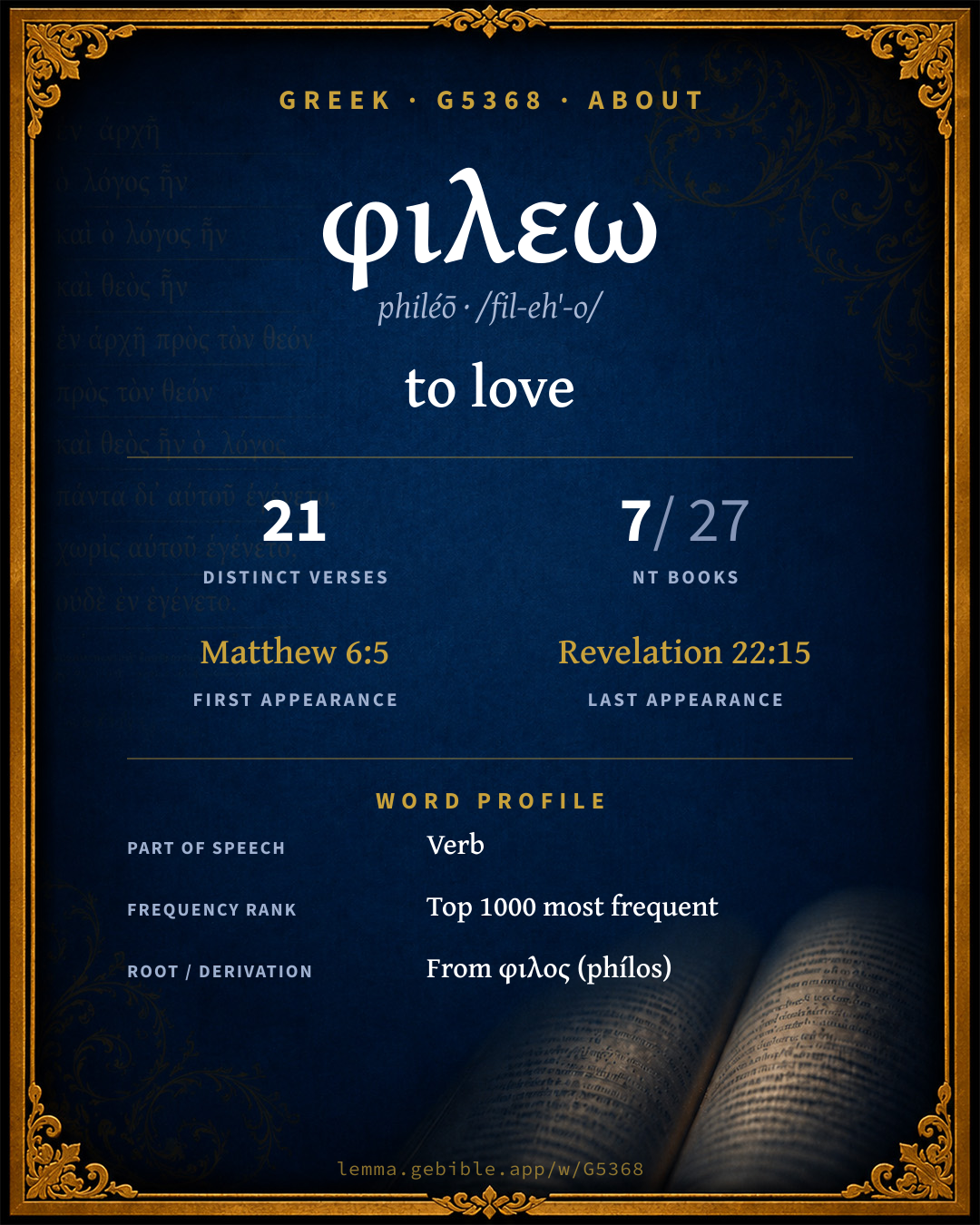
φιλέω
to love
‘to love’ is one of 6 main senses fuller range ↓
Full lexicon entry — Thayer's Greek Lexicon
From Thayer's Greek Lexicon
Where this word appears
See every Aorist-tense verb in the Greek New Testament →
Grammar key — what these labels mean
Part of speech
- Verb
- An action or state-of-being word.
Tense
- Present
- Ongoing or general action in present time (imperfective aspect).
- Imperfect
- Continuous or repeated action in past time (“was writing”).
- Aorist
- Action viewed as a simple whole, without regard to duration — often past (perfective aspect).
- Perfect
- A completed past action with continuing present results.
Voice
- Active
- The subject performs the action.
Mood
- Participle
- A verbal adjective (“writing,” “having written”).
- Indicative
- States a fact or asks a factual question (the mood of reality).
- Subjunctive
- Expresses probability, purpose, or possibility (the mood of contingency).
- Infinitive
- A verbal noun (“to write”), unmarked for person or number.
Case
- Nominative
- The case of the subject (and the predicate nominative).
- Accusative
- The case of the direct object and of extent.
- Genitive
- The case of source, possession, or “of” — answers “whose / from what.”
Person
- 3rd person
- The one spoken about (“he / she / it / they”).
- 1st person
- The speaker (“I / we”).
- 2nd person
- The one addressed (“you”).
Gender
- Masculine
- Grammatically masculine.
Number
- Singular
- One.
- Plural
- More than one.
Every verse where G5368 appears in the Book of Luke — 2 distinct verses. Click any verse to open its interlinear word-by-word view. Verse text shown in the World English Bible for context — . Each verse’s Greek form is shown with its reference; the English is not keyword-highlighted, since the data carries no word-level English alignment. Use “Compare translations” on any verse to read it across multiple English versions. This concordance covers the Greek New Testament; Septuagint (Greek Old Testament) occurrences of this word are not indexed here.
Luke
- Luke 20:46 φιλούντων pres act ptcp gen pl masc "Beware of the scribes, who like to walk in long robes, and love greetings in the marketplaces, the best seats in the synagogues, and the best places at feasts;
- Luke 22:47 φιλῆσαι aor act inf While he was still speaking, behold, a multitude, and he who was called Judas, one of the twelve, was leading them. He came near to Jesus to kiss him.
About this entry
At a glance — auto-summarized from this page’s data, not written by a person. Every figure links to its source below. This summary describes the numbers; it doesn’t interpret them.
φιλεω (philéō) is a Greek verb most often rendered “to love.” Translators differ — “love” in the King James Version, then “loves” (Berean Standard Bible) and “loving” (unfoldingWord Literal Text), as the renderings breakdown shows. It turns up in 21 verses across 7 books, an uncommon footprint. It concentrates in John, which alone accounts for 48% of its uses. Its lexical range runs to 6 senses. For the data behind this summary, explore the sense tree and the renderings breakdown below.
Gloss history
Strong's 1890 vs modern scholarship

About this word
Strong's G5368 catalogs a Greek word from the Greek New Testament.
These counts are not copied from any lexicon or concordance. They are computed here, from the morphology-tagged Greek New Testament. What Lemma adds →
- 21
- distinct verses
- The word appears in 21 distinct verses.
- 7 / 27
- NT books
- The word appears in 7 of 27 New Testament books.
- #530
- by frequency
- Top 1000 most frequent Greek words (rank 530 of 5,347 Greek words by occurrence).
View all 21 occurrences in the concordance →
By section of the New Testament
By traditional corpus
Conventional, traditional groupings — biblical authorship is debated, so this is a traditional corpus grouping, not an authorship claim. Some books belong to more than one corpus (Luke is in both the Gospels and the Lukan corpus, and so on), so these shares overlap and need not total 100%. Each figure is a share of the word’s 21 distinct verses.
- Gospels 17 verses · 81%
- Johannine 12 verses · 57%
- Lukan (Luke–Acts) 2 verses · 10%
- Pauline corpus 2 verses · 10%
- Revelation 2 verses · 10%
How translations render this word
Counts come from each version’s own published word-to-Strong’s tagging or interlinear alignment — an approximate guide to how each version renders this word, not a word-level alignment the data otherwise carries. Because each total is that version’s own tagged count, the per-version totals vary from one another and need not match the appearance or distinct-verse counts above. These counts may also differ from a printed concordance because Lemma counts each distinctly tagged rendering and does not collapse phrase taggings into a single head-word total. This is a fixed set of word-tagged versions (KJV, ASV, BSB, ULT) and does not change with the reading translation you choose elsewhere. Each version’s license is shown beside its name below (and on Sources).
- King James Version: Love 5×, I love 4×, He that loveth 3×
- American Standard Version: Love 4×, Loveth 4×, He that loveth 3×
- Berean Standard Bible: Loves 6×, I love 3×, Love 3×
- unfoldingWord Literal Text: Loving 6×, I love 4×, Do you love 2×
King James Version Public Domain
Renders G5368 across 25 tagged occurrences — most commonly:
Plus 8 renderings that appear only once — usually multi-word phrases or single function words the recovered tagging swept in, not distinct renderings.
American Standard Version Public Domain
Renders G5368 across 24 tagged occurrences — most commonly:
Plus 8 renderings that appear only once — usually multi-word phrases or single function words the recovered tagging swept in, not distinct renderings.
Berean Standard Bible Public Domain
Renders G5368 across 25 tagged occurrences — most commonly:
Plus 6 renderings that appear only once — usually multi-word phrases or single function words the recovered tagging swept in, not distinct renderings.
unfoldingWord Literal Text CC BY-SA 4.0
Renders G5368 across 26 tagged occurrences — most commonly:
Plus 8 renderings that appear only once — usually multi-word phrases or single function words the recovered tagging swept in, not distinct renderings.
Senses in Thayer's
The 6 senses Thayer's distinguishes for this word, in lexicon order (not ranked by frequency or importance). The full entry — with sub-senses — is in the Lexicon Entry tab.
- to approve of
- to like
- sanction
- to treat affectionately or kindly, to welcome, befriend
- to kiss
- be wont, use to do
Word origin
Derived from φιλος (phílos) (G5384) — friend.
From G5384 ; to be a friend to ( fond of [an individual or an object]) that is have affection for (denoting personal attachment as a matter of sentiment or feeling; while G25 is wider embracing especially the judgment and the deliberate assent of the will as a matter of principle duty and propriety : the two thus stand related very much as G2309 and G1014 or as G2372 and G3563 respectively; the former being chiefly of the heart and the latter of the head ); specifically to kiss (as a mark of tenderness): - kiss love.
— Strong’s Exhaustive Concordance (1890), public domain.
Forms in the corpus
The 11 distinct written forms G5368 takes in the Greek New Testament, most frequent first — each parse links to that tense’s occurrences in the concordance.
| Form | Parsing | Example | Uses |
|---|---|---|---|
| φιλῶ philō̂ | Verb, Present, Active, Indicative, 1st person, Singular | John 21:15 | 4 |
| φιλῶν philō̂n | Verb, Present, Active, Participle, Nominative, Singular, Masculine | Matthew 10:37 | 4 |
| φιλεῖ phileî | Verb, Present, Active, Indicative, 3rd person, Singular | John 5:20 | 3 |
| φιλεῖς phileîs | Verb, Present, Active, Indicative, 2nd person, Singular | John 11:3 | 3 |
| ἐφίλει ephílei | Verb, Imperfect, Active, Indicative, 3rd person, Singular | John 11:36 | 3 |
| φιλήσω philḗsō | Verb, Aorist, Active, Subjunctive, 1st person, Singular | Matthew 26:48 | 2 |
| φιλοῦσιν philoûsin | Verb, Present, Active, Indicative, 3rd person, Plural | Matthew 6:5 | 2 |
| πεφιλήκατε pephilḗkate | Verb, Perfect, Active, Indicative, 2nd person, Plural | John 16:27 | 1 |
| φιλούντων philoúntōn | Verb, Present, Active, Participle, Genitive, Plural, Masculine | Luke 20:46 | 1 |
| φιλοῦντας philoûntas | Verb, Present, Active, Participle, Accusative, Plural, Masculine | Titus 3:15 | 1 |
| φιλῆσαι philē̂sai | Verb, Aorist, Active, Infinitive | Luke 22:47 | 1 |
Same root — word family
Other Thayer's entries built from the same root as G5368, grouped by Strong’s listed origin. These share a root / origin per the lexicon — not necessarily a shared meaning. Each links to that word’s own entry.
Derives from
Shares the same root
- φιλαγαθος philágathos G5358 loving goodness
- φιλαδελφος philádelphos G5361 loving brother
- φιλανδρος phílandros G5362 loving husband
- φιλανθρωπως philanthrṓpōs G5364 humanely
- φιλαργυρος philárgyros G5366 money-loving
- φιλαυτος phílautos G5367 self-loving
- φιληδονος philḗdonos G5369 pleasure-loving
- φιλια philía G5373 friendship
- φιλονεικος philóneikos G5380 contentious
- φιλοξενος philóxenos G5382 hospitable
- φιλοπρωτευω philoprōteúō G5383 to desire first place
- φιλοσοφος philósophos G5386 philosopher
- φιλοστοργος philóstorgos G5387 affection
- φιλοτεκνος philóteknos G5388 loving children
- φιλοτιμεομαι philotiméomai G5389 to love honor
- φιλοφρων philóphrōn G5391 friendly
Derived from this word
Proper names from this root
People and places named from this root — a name, not an additional meaning of the word.
- Φιλιππος Phílippos G5376 Philip
- φιλοθεος philótheos G5377 God-loving
- Φιλολογος Philólogos G5378 Philologus
- Φιλημων Philḗmōn G5371 Philemon
Compare all same-root words → Showing 4 of 25 — not the complete family. 4 of the same-root words are proper names (people or places). They share a root, not necessarily a meaning.
Septuagint usage
The same Greek word φιλεω appears 27 times in the Greek Old Testament (Septuagint), across 27 verses in 12 books.
- 27
- LXX occurrences
- Tagged occurrences of this Greek word in the Septuagint.
- 27
- verses
- Distinct Septuagint verses containing this word.
- 12 / 39
- OT books
- The word appears in 12 of the 39 Old Testament books.
Sample Septuagint occurrences
- Genesis 27:4 φιλέω
- Exodus 18:7 φιλέω
- 1 Samuel 10:1 φιλέω
- Esther 10:3 φιλέω
- Job 31:27 φιλέω
- Proverbs 7:13 φιλέω
- Ecclesiastes 3:8 φιλέω
- Song of Solomon 1:2 φιλέω
- Isaiah 56:10 φιλέω
- Jeremiah 22:22 φιλέω
- Lamentations 1:2 φιλέω
- Hosea 3:1 φιλέω
Septuagint occurrences (same lexeme)
Every verse where the same Strong’s number (G5368) appears in the Greek Septuagint. Verse text shown in the World English Bible for context; the Greek form is the matched word — the English is not keyword-highlighted.
- Genesis 27:4 φιλέω Make me savory food, such as I love, and bring it to me, that I may eat, and that my soul may bless you before I die."
- Genesis 27:9 φιλέω Go now to the flock, and get me from there two good kids of the goats. I will make them savory food for your father, such as he loves.
- Genesis 27:14 φιλέω He went, and got them, and brought them to his mother. His mother made savory food, such as his father loved.
- Genesis 27:26 φιλέω His father Isaac said to him, "Come near now, and kiss me, my son."
- Genesis 27:27 φιλέω He came near, and kissed him. He smelled the smell of his clothing, and blessed him, and said, "Behold, the smell of my son Is as the smell of a field which Yahweh has blessed.
- Genesis 29:11 φιλέω Jacob kissed Rachel, and lifted up his voice, and wept.
- Genesis 29:13 φιλέω It happened, when Laban heard the news of Jacob, his sister's son, that he ran to meet Jacob, and embraced him, and kissed him, and brought him to his house. Jacob told Laban all these things.
- Genesis 33:4 φιλέω Esau ran to meet him, embraced him, fell on his neck, kissed him, and they wept.
- Genesis 37:4 φιλέω His brothers saw that their father loved him more than all his brothers, and they hated him, and couldn't speak peaceably to him.
- Genesis 48:10 φιλέω Now the eyes of Israel were dim for age, so that he couldn't see. He brought them near to him; and he kissed them, and embraced them.
- Genesis 50:1 φιλέω Joseph fell on his father's face, wept on him, and kissed him.
- Exodus 18:7 φιλέω Moses went out to meet his father-in-law, and bowed and kissed him. They asked each other of their welfare, and they came into the tent.
- 1 Samuel 10:1 φιλέω Then Samuel took the vial of oil, and poured it on his head, and kissed him, and said, Isn't it that Yahweh has anointed you to be prince over his inheritance?
- Esther 10:3 φιλέω For Mordecai the Jew was next to king Ahasuerus, and great among the Jews, and accepted of the multitude of his brothers, seeking the good of his people, and speaking peace to all his seed.
- Job 31:27 φιλέω And my heart has been secretly enticed, My hand threw a kiss from my mouth:
- Proverbs 7:13 φιλέω So she caught him, and kissed him. With an impudent face she said to him:
- Proverbs 8:17 φιλέω I love those who love me. Those who seek me diligently will find me.
- Proverbs 21:17 φιλέω He who loves pleasure shall be a poor man: He who loves wine and oil shall not be rich.
- Proverbs 24:26 φιλέω An honest answer Is like a kiss on the lips.
- Proverbs 29:3 φιλέω Whoever loves wisdom brings joy to his father; But a companion of prostitutes squanders his wealth.
- Ecclesiastes 3:8 φιλέω A time to love, And a time to hate; A time for war, And a time for peace.
- Song of Solomon 1:2 φιλέω Let him kiss me with the kisses of his mouth; For your love is better than wine.
- Song of Solomon 8:1 φιλέω Oh that you were like my brother, Who sucked the breasts of my mother! If I found you outside, I would kiss you; Yes, and no one would despise me.
- Isaiah 56:10 φιλέω His watchmen are blind, they are all without knowledge; they are all mute dogs, they can't bark; dreaming, lying down, loving to slumber.
- Jeremiah 22:22 φιλέω The wind shall feed all your shepherds, and your lovers shall go into captivity: surely then shall you be ashamed and confounded for all your wickedness.
- Lamentations 1:2 φιλέω She weeps sore in the night, and her tears are on her cheeks; Among all her lovers she has none to comfort her: All her friends have dealt treacherously with her; they are become her enemies.
- Hosea 3:1 φιλέω Yahweh said to me, "Go again, love a woman loved by another, and an adulteress, even as Yahweh loves the children of Israel, though they turn to other gods, and love cakes of raisins."
These are occurrences of the same Greek lexeme (G5368) in the Septuagint — not a translation of any one Hebrew word. The store carries no word-level Hebrew↔Greek alignment, so no Hebrew original is asserted here. Counts come from the recovered LXX Strong's tagging — high-frequency vocabulary is well covered, while rare or late forms may be untagged — so they reflect tagged occurrences and may slightly undercount.