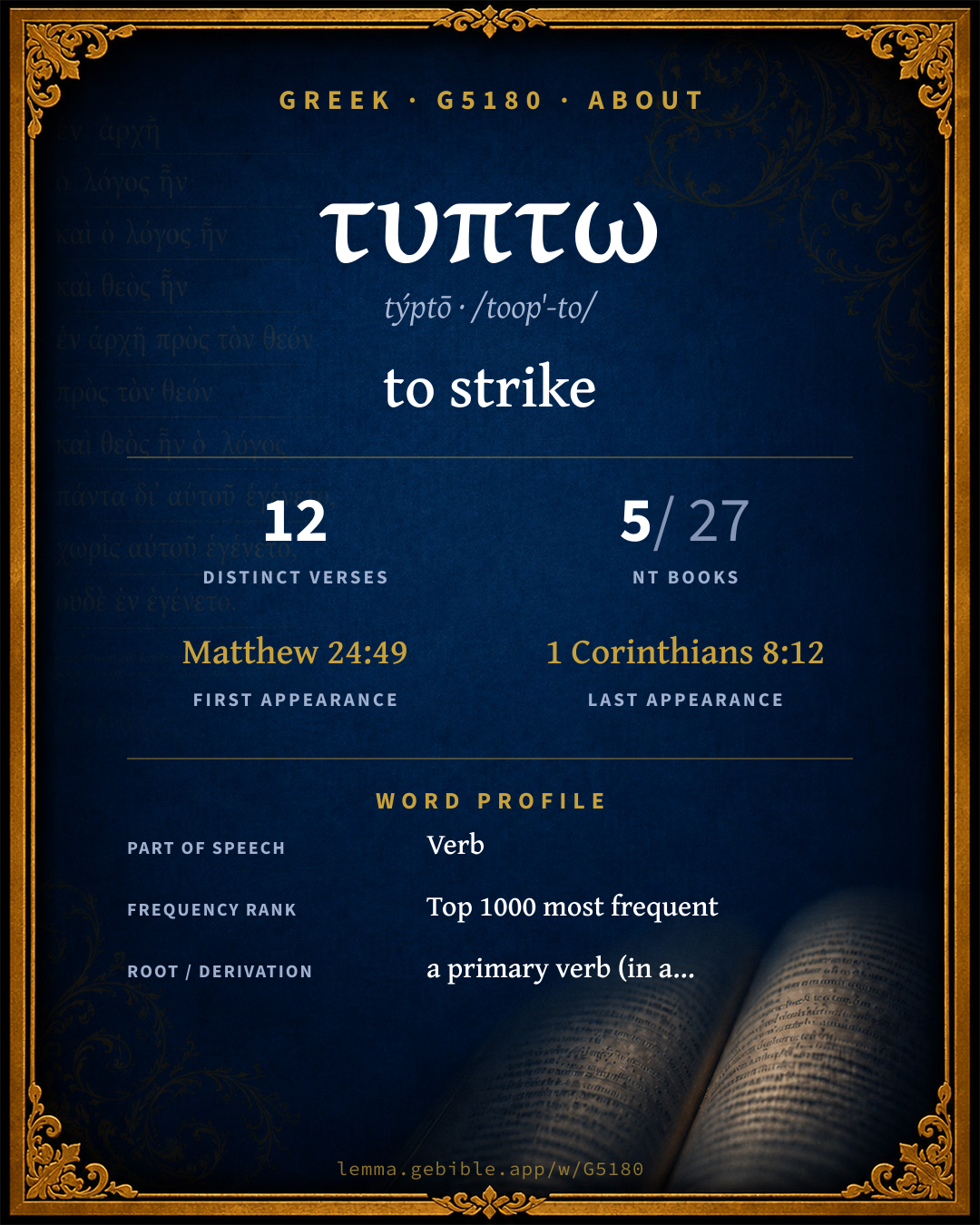
τύπτω
to strike
‘to strike’ is one of 4 main senses fuller range ↓
Full lexicon entry — Thayer's Greek Lexicon
From Thayer's Greek Lexicon
Where this word appears
See every Present-tense verb in the Greek New Testament →
Grammar key — what these labels mean
Part of speech
- Verb
- An action or state-of-being word.
Tense
- Present
- Ongoing or general action in present time (imperfective aspect).
- Imperfect
- Continuous or repeated action in past time (“was writing”).
Voice
- Active
- The subject performs the action.
- Passive
- The subject receives the action.
Mood
- Infinitive
- A verbal noun (“to write”), unmarked for person or number.
- Indicative
- States a fact or asks a factual question (the mood of reality).
- Participle
- A verbal adjective (“writing,” “having written”).
Case
- Nominative
- The case of the subject (and the predicate nominative).
- Dative
- The case of the indirect object, means, or location — “to / for / with / in.”
Person
- 3rd person
- The one spoken about (“he / she / it / they”).
Gender
- Masculine
- Grammatically masculine.
Number
- Plural
- More than one.
- Singular
- One.
Grammatical forms
- Verb, Present, Active, Infinitive 4 times (31%)
- Verb, Imperfect, Active, Indicative, 3rd person, Plural 3 times (23%)
- Verb, Present, Active, Participle, Nominative, Plural, Masculine 3 times (23%)
- Verb, Imperfect, Active, Indicative, 3rd person, Singular 1 time (8%)
- Verb, Present, Active, Participle, Dative, Singular, Masculine 1 time (8%)
- Verb, Present, Passive, Infinitive 1 time (8%)
Parsed forms decoded from the imported morphology (Robinson–Tischendorf, public domain), counted across 13 parsed occurrences — not distinct verses.
Every verse where G5180 appears — 12 distinct verses across 5 books. Click any verse to open its interlinear word-by-word view. Verse text shown in the World English Bible for context — . Each verse’s Greek form is shown with its reference; the English is not keyword-highlighted, since the data carries no word-level English alignment. Use “Compare translations” on any verse to read it across multiple English versions. This concordance covers the Greek New Testament; Septuagint (Greek Old Testament) occurrences of this word are not indexed here.
Matthew 2 verses
Mark 1 verse
Luke 4 verses
- Luke 6:29 τύπτοντί pres act ptcp dat sg masc To him who strikes you on the cheek, offer also the other; and from him who takes away your cloak, don't withhold your coat also.
- Luke 12:45 τύπτειν pres act inf But if that servant says in his heart, 'My lord delays his coming,' and begins to beat the menservants and the maidservants, and to eat and drink, and to be drunken,
- Luke 18:13 ἔτυπτεν impf act ind 3sg But the tax collector, standing far away, wouldn't even lift up his eyes to heaven, but beat his breast, saying, 'God, be merciful to me, a sinner!'
- Luke 23:48 τύπτοντες pres act ptcp nom pl masc All the multitudes that came together to see this, when they saw the things that were done, returned home beating their breasts.
Acts 4 verses
- Acts 18:17 ἔτυπτον impf act ind 3pl Then all the Greeks laid hold on Sosthenes, the ruler of the synagogue, and beat him before the judgment seat. Gallio didn't care about any of these things.
- Acts 21:32 τύπτοντες pres act ptcp nom pl masc Immediately he took soldiers and centurions, and ran down to them. They, when they saw the chief captain and the soldiers, stopped beating Paul.
- Acts 23:2 τύπτειν pres act inf The high priest, Ananias, commanded those who stood by him to strike him on the mouth.
- Acts 23:3 τύπτειν τύπτεσθαι pres act inf pres pass inf Then Paul said to him, "God will strike you, you whitewashed wall! Do you sit to judge me according to the law, and command me to be struck contrary to the law?"
1 Corinthians 1 verse
About this entry
At a glance — auto-summarized from this page’s data, not written by a person. Every figure links to its source below. This summary describes the numbers; it doesn’t interpret them.
τυπτω — transliterated týptō — is a Greek verb carrying the sense “to strike.” Thayer's distinguishes 4 senses for it. With 12 verses in 5 books, it is an uncommon word in the Greek New Testament. Its uses concentrate in Luke (33% of all occurrences). Debuting at Matthew 24:49, it then recurs through the corpus. See the sense tree, 12-verse concordance, and the renderings breakdown below.
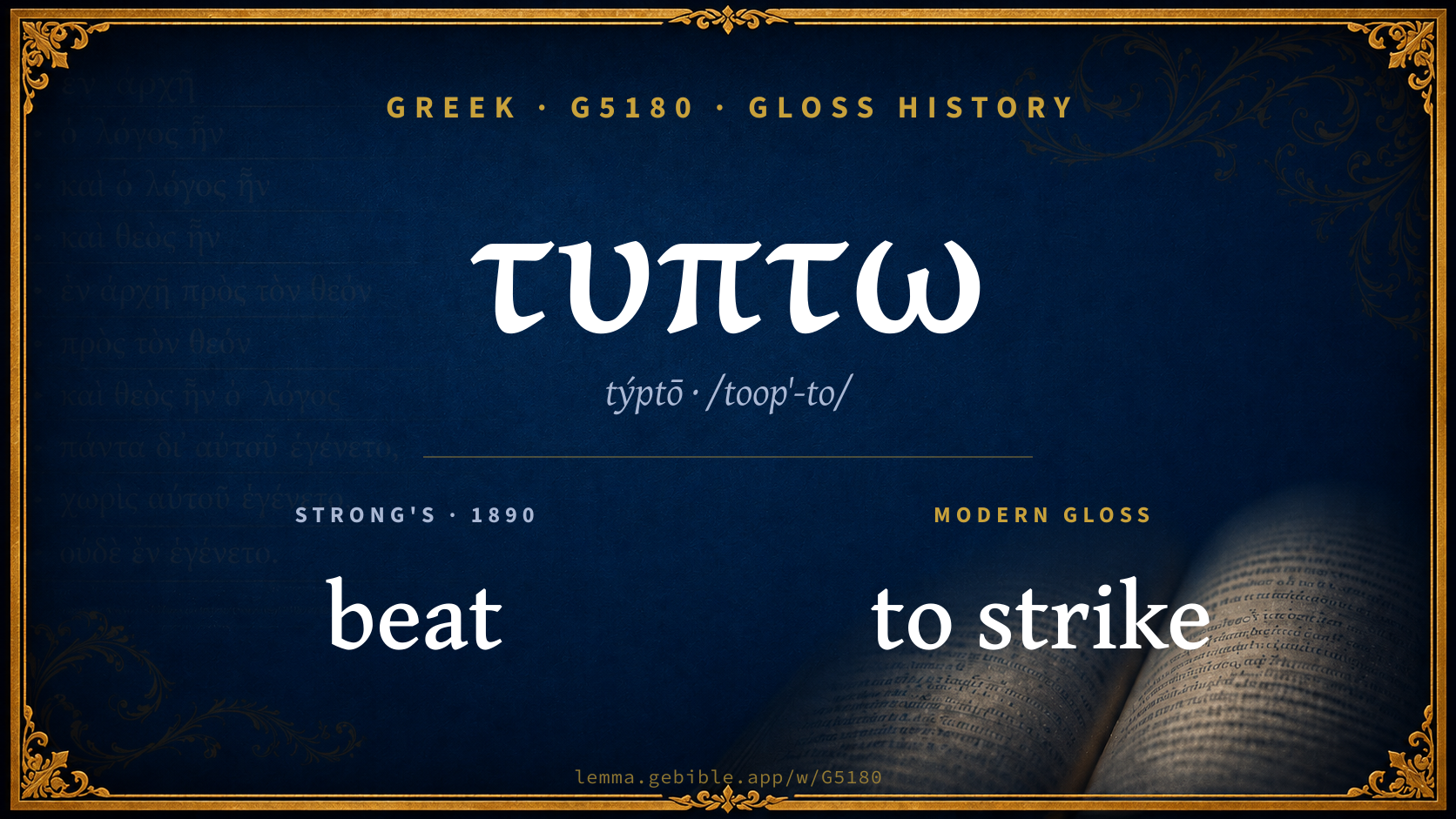
Gloss history
Strong's 1890 vs modern scholarship
About this word
Strong's G5180 catalogs a Greek word from the Greek New Testament.
These counts are not copied from any lexicon or concordance. They are computed here, from the morphology-tagged Greek New Testament. What Lemma adds →
- 12
- distinct verses
- The word appears in 12 distinct verses.
- 5 / 27
- NT books
- The word appears in 5 of 27 New Testament books.
- #863
- by frequency
- Top 1000 most frequent Greek words (rank 863 of 5,347 Greek words by occurrence).
View all 12 occurrences in the concordance →
By section of the New Testament
By traditional corpus
Conventional, traditional groupings — biblical authorship is debated, so this is a traditional corpus grouping, not an authorship claim. Some books belong to more than one corpus (Luke is in both the Gospels and the Lukan corpus, and so on), so these shares overlap and need not total 100%. Each figure is a share of the word’s 12 distinct verses.
- Lukan (Luke–Acts) 8 verses · 67%
- Gospels 7 verses · 58%
- Pauline corpus 1 verse · 8%
How translations render this word
Counts come from each version’s own published word-to-Strong’s tagging or interlinear alignment — an approximate guide to how each version renders this word, not a word-level alignment the data otherwise carries. Because each total is that version’s own tagged count, the per-version totals vary from one another and need not match the appearance or distinct-verse counts above. These counts may also differ from a printed concordance because Lemma counts each distinctly tagged rendering and does not collapse phrase taggings into a single head-word total. This is a fixed set of word-tagged versions (KJV, ASV, BSB, ULT) and does not change with the reading translation you choose elsewhere. Each version’s license is shown beside its name below (and on Sources).
- King James Version: Smite 3×, Smote 3×, Beat 2×
- American Standard Version: Beat 3×, Smite 2×
- Berean Standard Bible: Beat 3×, Beating 2×, Strike 2×
- unfoldingWord Literal Text: Beat 2×, Beating 2×, Strike 2×
King James Version Public Domain
Renders G5180 across 14 tagged occurrences — most commonly:
Plus 6 renderings that appear only once — usually multi-word phrases or single function words the recovered tagging swept in, not distinct renderings.
American Standard Version Public Domain
Renders G5180 across 14 tagged occurrences — most commonly:
Plus 9 renderings that appear only once — usually multi-word phrases or single function words the recovered tagging swept in, not distinct renderings.
Berean Standard Bible Public Domain
Renders G5180 across 13 tagged occurrences — most commonly:
Plus 6 renderings that appear only once — usually multi-word phrases or single function words the recovered tagging swept in, not distinct renderings.
unfoldingWord Literal Text CC BY-SA 4.0
Renders G5180 across 15 tagged occurrences — most commonly:
Plus 9 renderings that appear only once — usually multi-word phrases or single function words the recovered tagging swept in, not distinct renderings.
Senses in Thayer's
The 4 senses Thayer's distinguishes for this word, in lexicon order (not ranked by frequency or importance). The full entry — with sub-senses — is in the Lexicon Entry tab.
- with a staff, a whip, the fist, the hand
- of mourners, to smite their breast
- to smite one on whom he inflicts punitive evil
- metaph. i.e. to wound, disquiet one's conscience
Word origin
Origin: a primary verb (in a strengthened form)
A primary verb (in a strengthened form); to thump that is cudgel or pummel (properly with a stick or bastinado ) but in any case by repeated blows; thus differing from G3817 and G3960 which denote a [usually single] blow with the hand or any instrument or G4141 with the fist [or a hammer ] or G4474 with the palm ; as well as from G5177 an accidental collision); by implication to punish ; figuratively to offend (the conscience): - beat smite strike wound.
— Strong’s Exhaustive Concordance (1890), public domain.
Forms in the corpus
The 6 distinct written forms G5180 takes in the Greek New Testament, most frequent first — each parse links to that tense’s occurrences in the concordance.
| Form | Parsing | Example | Uses |
|---|---|---|---|
| τύπτειν týptein | Verb, Present, Active, Infinitive | Matthew 24:49 | 4 |
| τύπτοντες týptontes | Verb, Present, Active, Participle, Nominative, Plural, Masculine | Luke 23:48 | 3 |
| ἔτυπτον étypton | Verb, Imperfect, Active, Indicative, 3rd person, Plural | Matthew 27:30 | 3 |
| τύπτεσθαι týptesthai | Verb, Present, Passive, Infinitive | Acts 23:3 | 1 |
| τύπτοντί týptontí | Verb, Present, Active, Participle, Dative, Singular, Masculine | Luke 6:29 | 1 |
| ἔτυπτεν étypten | Verb, Imperfect, Active, Indicative, 3rd person, Singular | Luke 18:13 | 1 |
Same root — word family
Other Thayer's entries built from the same root as G5180, grouped by Strong’s listed origin. These share a root / origin per the lexicon — not necessarily a shared meaning. Each links to that word’s own entry.
Derived from this word
Compare all same-root words → They share a root, not necessarily a meaning.
Septuagint usage
The same Greek word τυπτω appears 32 times in the Greek Old Testament (Septuagint), across 32 verses in 13 books.
- 32
- LXX occurrences
- Tagged occurrences of this Greek word in the Septuagint.
- 32
- verses
- Distinct Septuagint verses containing this word.
- 13 / 39
- OT books
- The word appears in 13 of the 39 Old Testament books.
Sample Septuagint occurrences
- Exodus 2:11 τύπτω
- Numbers 22:27 τύπτω
- Deuteronomy 25:11 τύπτω
- 1 Samuel 1:8 τύπτω
- 2 Samuel 1:1 τύπτω
- 1 Kings 18:4 τύπτω
- 2 Kings 3:24 τύπτω
- 1 Chronicles 11:6 τύπτω
- 2 Chronicles 28:23 τύπτω
- Proverbs 10:13 τύπτω
- Isaiah 41:7 τύπτω
- Ezekiel 7:6 τύπτω
Septuagint occurrences (same lexeme)
Every verse where the same Strong’s number (G5180) appears in the Greek Septuagint. Verse text shown in the World English Bible for context; the Greek form is the matched word — the English is not keyword-highlighted.
- Exodus 2:11 τύπτω It happened in those days, when Moses had grown up, that he went out to his brothers, and looked at their burdens. He saw an Egyptian striking a Hebrew, one of his brothers.
- Exodus 2:13 τύπτω He went out the second day, and, behold, two men of the Hebrews were fighting with each other. He said to him who did the wrong, "Why do you strike your fellow?"
- Exodus 7:17 τύπτω Thus says Yahweh, "In this you shall know that I am Yahweh. Behold, I will strike with the rod that is in my hand on the waters which are in the river, and they shall be turned to blood.
- Exodus 7:27 τύπτω
- Exodus 21:15 τύπτω "Anyone who attacks his father or his mother shall be surely put to death.
- Numbers 22:27 τύπτω The donkey saw the angel of Yahweh, and she lay down under Balaam: and Balaam's anger was kindled, and he struck the donkey with his staff.
- Deuteronomy 25:11 τύπτω When men strive together one with another, and the wife of the one draws near to deliver her husband out of the hand of him who strikes him, and puts forth her hand, and takes him by the secrets;
- Deuteronomy 27:24 τύπτω Cursed be he who strikes his neighbor in secret. All the people shall say, Amen.
- 1 Samuel 1:8 τύπτω Elkanah her husband said to her, Hannah, why weep you? and why don't you eat? and why is your heart grieved? am I not better to you than ten sons?
- 1 Samuel 11:11 τύπτω It was so on the next day, that Saul put the people in three companies; and they came into the midst of the camp in the morning watch, and struck the Ammonites until the heat of the day: and it happened, that those who remained were scattered, so that no two of them were left together.
- 1 Samuel 17:16 τύπτω The Philistine drew near morning and evening, and presented himself forty days.
- 1 Samuel 27:9 τύπτω David struck the land, and saved neither man nor woman alive, and took away the sheep, and the oxen, and the donkeys, and the camels, and the clothing; and he returned, and came to Achish.
- 1 Samuel 31:2 τύπτω The Philistines followed hard on Saul and on his sons; and the Philistines killed Jonathan, and Abinadab, and Malchishua, the sons of Saul.
- 2 Samuel 1:1 τύπτω It happened after the death of Saul, when David was returned from the slaughter of the Amalekites, and David had abode two days in Ziklag;
- 2 Samuel 2:23 τύπτω However he refused to turn aside: therefore Abner with the hinder end of the spear struck him in the body, so that the spear came out behind him; and he fell down there, and died in the same place: and it happened, that as many as came to the place where Asahel fell down and died stood still.
- 2 Samuel 4:7 τύπτω Now when they came into the house, as he lay on his bed in his bedchamber, they struck him, and killed him, and beheaded him, and took his head, and went by the way of the Arabah all night.
- 2 Samuel 5:8 τύπτω David said on that day, Whoever strikes the Jebusites, let him get up to the watercourse, and [strike] the lame and the blind, who are hated of David's soul. Therefore they say, There are the blind and the lame; he can't come into the house.
- 2 Samuel 24:17 τύπτω David spoke to Yahweh when he saw the angel who struck the people, and said, Behold, I have sinned, and I have done perversely; but these sheep, what have they done? Please let your hand be against me, and against my father's house.
- 1 Kings 18:4 τύπτω for it was so, when Jezebel cut off the prophets of Yahweh, that Obadiah took one hundred prophets, and hid them by fifty in a cave, and fed them with bread and water.)
- 2 Kings 3:24 τύπτω When they came to the camp of Israel, the Israelites rose up and struck the Moabites, so that they fled before them; and they went forward into the land smiting the Moabites.
- 2 Kings 6:22 τύπτω He answered, You shall not strike them: would you strike those whom you have taken captive with your sword and with your bow? set bread and water before them, that they may eat and drink, and go to their master.
- 2 Kings 14:10 τύπτω You have indeed struck Edom, and your heart has lifted you up: glory of it, and abide at home; for why should you meddle to [your] hurt, that you should fall, even you, and Judah with you?
- 1 Chronicles 11:6 τύπτω David said, Whoever strikes the Jebusites first shall be chief and captain. Joab the son of Zeruiah went up first, and was made chief.
- 2 Chronicles 28:23 τύπτω For he sacrificed to the gods of Damascus, which struck him; and he said, Because the gods of the kings of Syria helped them, [therefore] will I sacrifice to them, that they may help me. But they were the ruin of him, and of all Israel.
- Proverbs 10:13 τύπτω Wisdom is found on the lips of him who has discernment, But a rod is for the back of him who is void of understanding.
- Proverbs 23:35 τύπτω "They hit me, and I was not hurt; They beat me, and I don't feel it! When will I wake up? I can do it again. I can find another."
- Proverbs 25:4 τύπτω Take away the dross from the silver, And material comes out for the refiner;
- Proverbs 26:22 τύπτω The words of a whisperer are as dainty morsels, They go down into the innermost parts.
- Isaiah 41:7 τύπτω So the carpenter encourages the goldsmith, [and] he who smoothes with the hammer him who strikes the anvil, saying of the soldering, It is good; and he fastens it with nails, that is should not be moved.
- Isaiah 58:4 τύπτω Behold, you fast for strife and contention, and to strike with the fist of wickedness: you don't fast this day so as to make your voice to be heard on high.
- Ezekiel 7:6 τύπτω An end is come, the end is come; it awakes against you; behold, it comes.
- Daniel 11:20 τύπτω Then shall stand up in his place one who shall cause a tax collector to pass through the kingdom to maintain its glory; but within few days he shall be destroyed, neither in anger, nor in battle.
These are occurrences of the same Greek lexeme (G5180) in the Septuagint — not a translation of any one Hebrew word. The store carries no word-level Hebrew↔Greek alignment, so no Hebrew original is asserted here. Counts come from the recovered LXX Strong's tagging — high-frequency vocabulary is well covered, while rare or late forms may be untagged — so they reflect tagged occurrences and may slightly undercount.