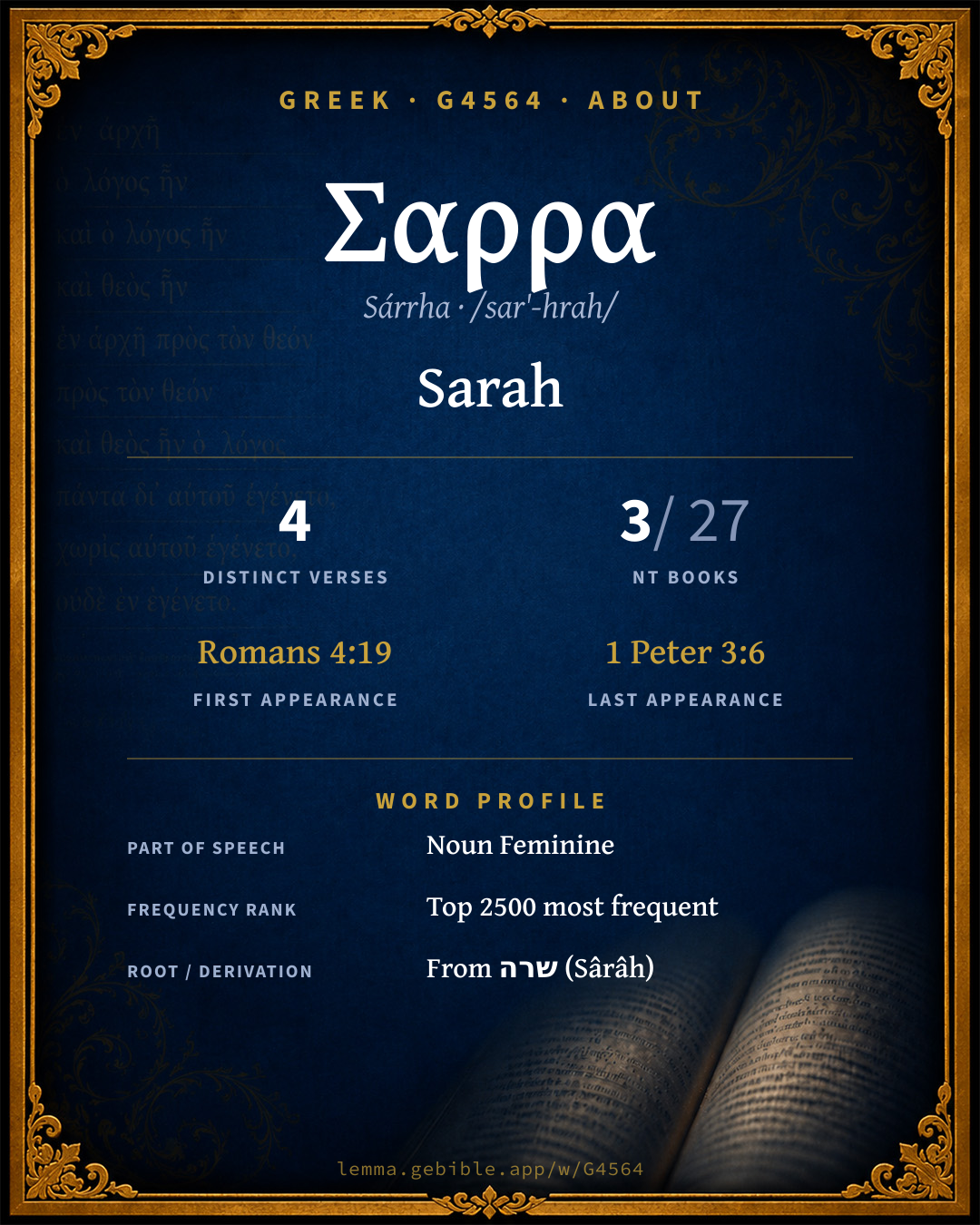
Σάῤῥα
Sarah
Thayer's lists 2 entries for ‘Sarah’ fuller range ↓
Full lexicon entry — Thayer's Greek Lexicon
From Thayer's Greek Lexicon
Where this word appears
See every Nominative-case word in the Greek New Testament →
Grammar key — what these labels mean
Part of speech
- Noun
- A naming word — a person, place, thing, or idea.
Case
- Nominative
- The case of the subject (and the predicate nominative).
- Dative
- The case of the indirect object, means, or location — “to / for / with / in.”
- Genitive
- The case of source, possession, or “of” — answers “whose / from what.”
Gender
- Feminine
- Grammatically feminine.
Number
- Singular
- One.
1 distinct verse where G4564 appears in the Dative case, across 1 book. Filtered view — show all forms. Click any verse to open its interlinear word-by-word view. Verse text shown in the World English Bible for context — . Each verse’s Greek form is shown with its reference; the English is not keyword-highlighted, since the data carries no word-level English alignment. Use “Compare translations” on any verse to read it across multiple English versions. This concordance covers the Greek New Testament; Septuagint (Greek Old Testament) occurrences of this word are not indexed here.
Romans 1 verse
About this entry
At a glance — auto-summarized from this page’s data, not written by a person. Every figure links to its source below. This summary describes the numbers; it doesn’t interpret them.
Σαρρα — transliterated Sárrha — is a Greek name carrying the sense “Sarah.” It occurs a mere 4 verses across Scripture. Its uses cluster heavily in Romans (50% of all occurrences). Debuting at Romans 4:19, it then recurs through the corpus. Each statement above links to its evidence; the full detail follows below.
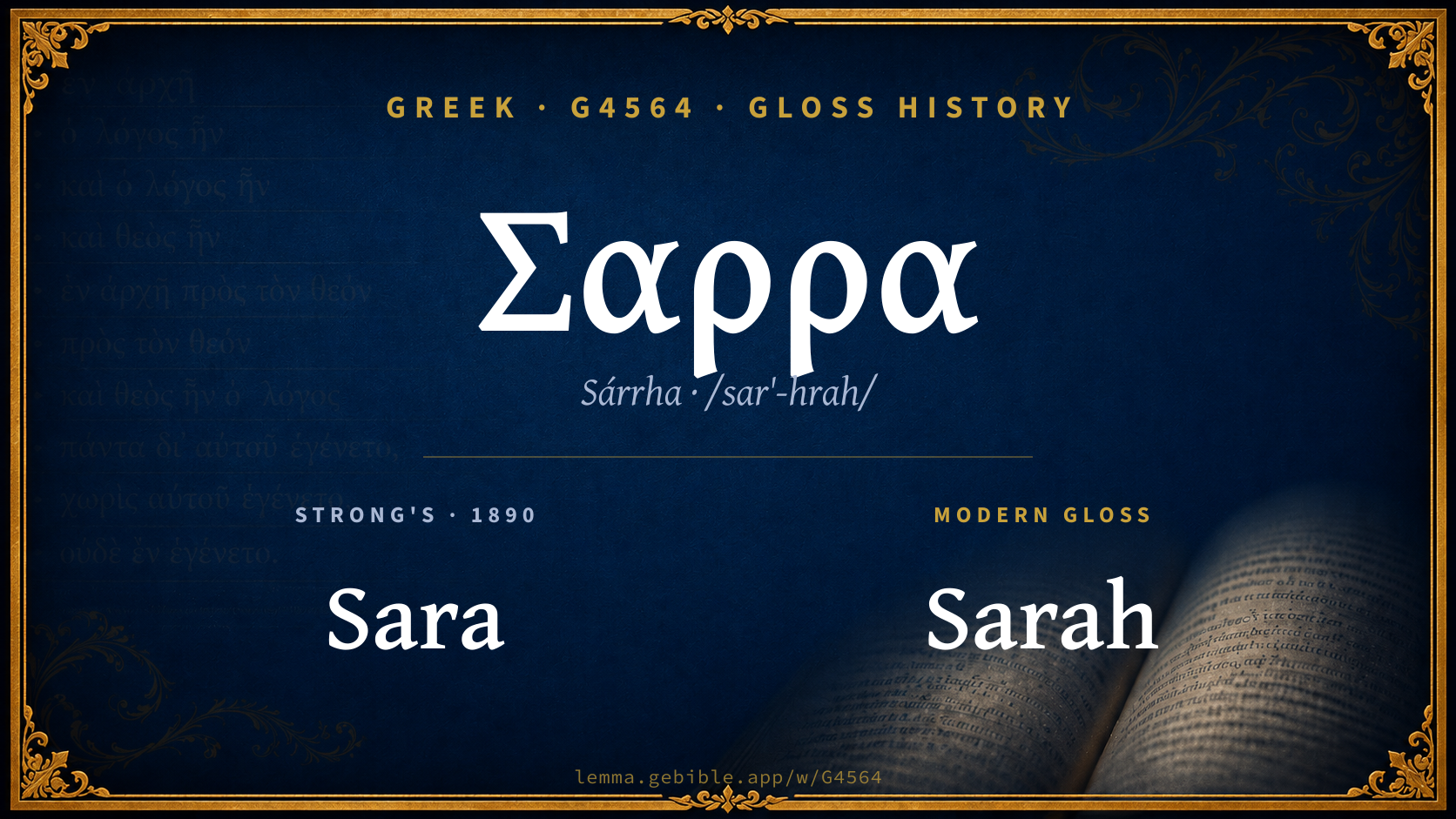
Gloss history
Strong's 1890 vs modern scholarship
About this word
Strong's G4564 catalogs a Greek word from the Greek New Testament.
These counts are not copied from any lexicon or concordance. They are computed here, from the morphology-tagged Greek New Testament. What Lemma adds →
- 4
- distinct verses
- The word appears in 4 distinct verses.
- 3 / 27
- NT books
- The word appears in 3 of 27 New Testament books.
- #1,877
- by frequency
- Top 2500 most frequent Greek words (rank 1,877 of 5,347 Greek words by occurrence).
View all 4 occurrences in the concordance →
By section of the New Testament
By traditional corpus
Conventional, traditional groupings — biblical authorship is debated, so this is a traditional corpus grouping, not an authorship claim. Some books belong to more than one corpus (Luke is in both the Gospels and the Lukan corpus, and so on), so these shares overlap and need not total 100%. Each figure is a share of the word’s 4 distinct verses.
- Pauline corpus 2 verses · 50%
- Hebrews 1 verse · 25%
- General (Catholic) Epistles 1 verse · 25%
How translations render this word
Counts come from each version’s own published word-to-Strong’s tagging or interlinear alignment — an approximate guide to how each version renders this word, not a word-level alignment the data otherwise carries. Because each total is that version’s own tagged count, the per-version totals vary from one another and need not match the appearance or distinct-verse counts above. These counts may also differ from a printed concordance because Lemma counts each distinctly tagged rendering and does not collapse phrase taggings into a single head-word total. This is a fixed set of word-tagged versions (KJV, ASV, BSB, ULT) and does not change with the reading translation you choose elsewhere. Each version’s license is shown beside its name below (and on Sources).
- King James Version: Sarah 2×
- American Standard Version: Sarah 4×
- Berean Standard Bible: Sarah 3×
- unfoldingWord Literal Text: Sarah 4×
King James Version Public Domain
Renders G4564 across 4 tagged occurrences — most commonly:
Plus 2 renderings that appear only once — usually multi-word phrases or single function words the recovered tagging swept in, not distinct renderings.
American Standard Version Public Domain
Renders G4564 across 4 tagged occurrences — most commonly:
Berean Standard Bible Public Domain
Renders G4564 across 4 tagged occurrences — most commonly:
Plus 1 rendering that appears only once — usually multi-word phrases or single function words the recovered tagging swept in, not distinct renderings.
unfoldingWord Literal Text CC BY-SA 4.0
Renders G4564 across 4 tagged occurrences — most commonly:
Senses in Thayer's
The 2 senses Thayer's distinguishes for this word, in lexicon order (not ranked by frequency or importance). The full entry — with sub-senses — is in the Lexicon Entry tab.
- Sarah = "princess"
- the wife of Abraham
Word origin
Derived from שרה (Sârâh) (H8283) — Sarah.
Of hebrew origin [ H8283 ]; Sarra (that is Sarah ) the wife of Abraham : - Sara Sarah.
— Strong’s Exhaustive Concordance (1890), public domain.
Forms in the corpus
The 3 distinct written forms G4564 takes in the Greek New Testament, most frequent first — each parse links to that case’s occurrences in the concordance.
| Form | Parsing | Example | Uses |
|---|---|---|---|
| Σάρρα Sárra | Noun, Nominative, Singular, Feminine | Hebrews 11:11 | 2 |
| Σάρρας Sárras | Noun, Genitive, Singular, Feminine | Romans 4:19 | 1 |
| Σάρρᾳ Sárra | Noun, Dative, Singular, Feminine | Romans 9:9 | 1 |
Bible dictionary
Public-domain dictionary articles matched to this entry by name (Sarah). A biblical name can be shared by more than one person or place, so an article may treat several.
Easton's Bible Dictionary · M. G. Easton, 1897
Princess, the wife and at the same time the half-sister of Abraham (Gen. 11:29; 20:12). This name was given to her at the time that it was announced to Abraham that she should be the mother of the promised child. Her story is from her marriage identified with that of the patriarch till the time of her death. Her death, at the age of one hundred and twenty-seven years (the only instance in Scripture where the age of a woman is recorded), was the occasion of Abraham's purchasing the cave of Machpelah as a family burying-place.
In the allegory of Gal. 4:22-31 she is the type of the "Jerusalem which is above." She is also mentioned as Sara in Heb. 11:11 among the Old Testament worthies, who "all died in faith." (See ABRAHAM.)
Smith's Bible Dictionary · William Smith, 1863
(princess).
+ The wife and half-sister, (Genesis 20:12) of Abraham, and mother of Isaac. Her name is first introduced in (Genesis 11:29) as Sarai. The change of her name from Sarai, my princess (i.e. Abraham's), to Sarah, princess (for all the race), was made at the same time that Abram's name was changed to Abraham,--on the establishment of the covenant of circumcision between him and God. Sarah's history is of course that of Abraham. [Abraham] She died at Hebron at the age of 127 years, 28 years before her husband and was buried by him in the cave of (B.C. 1860.) She is referred to in the New Testament as a type of conjugal obedience in (1 Peter 3:6) and as one of the types of faith in (Hebrews 11:11) + Sarah, the daughter of Asher. (Numbers 26:46)
Hitchcock's Bible Names Dictionary · Roswell D. Hitchcock, 1869
lady; princess; princess of the multitude
Classic public-domain reference works; full attribution on Sources.
Septuagint usage
The same Greek word Σαρρα appears 37 times in the Greek Old Testament (Septuagint), across 32 verses in 2 books.
- 37
- LXX occurrences
- Tagged occurrences of this Greek word in the Septuagint.
- 32
- verses
- Distinct Septuagint verses containing this word.
- 2 / 39
- OT books
- The word appears in 2 of the 39 Old Testament books.
Sample Septuagint occurrences
- Genesis 17:15 σαρρα
- Isaiah 51:2 σαρρα
Septuagint occurrences (same lexeme)
Every verse where the same Strong’s number (G4564) appears in the Greek Septuagint. Verse text shown in the World English Bible for context; the Greek form is the matched word — the English is not keyword-highlighted.
- Genesis 17:15 σαρρα God said to Abraham, "As for Sarai your wife, you shall not call her name Sarai, but her name will be Sarah.
- Genesis 17:17 σαρρα Then Abraham fell on his face, and laughed, and said in his heart, "Will a child be born to him who is one hundred years old? Will Sarah, who is ninety years old, give birth?"
- Genesis 17:19 σαρρα God said, "No, but Sarah, your wife, will bear you a son. You shall call his name Isaac. I will establish my covenant with him for an everlasting covenant for his seed after him.
- Genesis 17:21 σαρρα But my covenant I establish with Isaac, whom Sarah will bear to you at this set time in the next year."
- Genesis 18:6 σαρρα Abraham hurried into the tent to Sarah, and said, "Quickly make ready three measures of fine meal, knead it, and make cakes."
- Genesis 18:9 σαρρα They said to him, "Where is Sarah, your wife? He said, "See, in the tent."
- Genesis 18:10 σαρρα He said, "I will certainly return to you when the season comes round. Behold, Sarah your wife will have a son." Sarah heard in the tent door, which was behind him.
- Genesis 18:11 σαρρα Now Abraham and Sarah were old, well advanced in age. It had ceased to be with Sarah after the manner of women.
- Genesis 18:12 σαρρα Sarah laughed within herself, saying, "After I have grown old will I have pleasure, my lord being old also?"
- Genesis 18:13 σαρρα Yahweh said to Abraham, "Why did Sarah laugh, saying, 'Will I really bear a child, yet I am old?'
- Genesis 18:14 σαρρα Is anything too hard for Yahweh? At the set time I will return to you, when the season comes round, and Sarah will have a son."
- Genesis 18:15 σαρρα Then Sarah denied, saying, "I didn't laugh," for she was afraid." He said, "No, but you did laugh."
- Genesis 20:2 σαρρα Abraham said about Sarah his wife, "She is my sister." Abimelech king of Gerar sent, and took Sarah.
- Genesis 20:14 σαρρα Abimelech took sheep and oxen, men-servants and women-servants, and gave them to Abraham, and restored Sarah, his wife to him.
- Genesis 20:16 σαρρα To Sarah he said, "Behold, I have given your brother a thousand pieces of silver. Behold, it is for you a covering of the eyes to all that are with you. In front of all you are vindicated."
- Genesis 20:18 σαρρα For Yahweh had closed up tight all the wombs of the house of Abimelech, because of Sarah, Abraham's wife.
- Genesis 21:1 σαρρα Yahweh visited Sarah as he had said, and Yahweh did to Sarah as he had spoken.
- Genesis 21:2 σαρρα Sarah conceived, and bore Abraham a son in his old age, at the set time of which God had spoken to him.
- Genesis 21:3 σαρρα Abraham called his son who was born to him, whom Sarah bare to him, Isaac.
- Genesis 21:6 σαρρα Sarah said, "God has made me laugh. Everyone who hears will laugh with me."
- Genesis 21:7 σαρρα She said, "Who would have said to Abraham, that Sarah would nurse children? For I have borne him a son in his old age."
- Genesis 21:9 σαρρα Sarah saw the son of Hagar the Egyptian, whom she had borne to Abraham, mocking.
- Genesis 21:12 σαρρα God said to Abraham, "Don't let it be grievous in your sight because of the boy, and because of your handmaid. In all that Sarah says to you, listen to her voice. For from Isaac will your seed be called.
- Genesis 23:1 σαρρα Sarah lived one hundred twenty-seven years. These were the years of Sarah's life.
- Genesis 23:2 σαρρα Sarah died in Kiriath Arba (the same is Hebron), in the land of Canaan. Abraham came to mourn for Sarah, and to weep for her.
- Genesis 23:19 σαρρα After this, Abraham buried Sarah his wife in the cave of the field of Machpelah before Mamre (the same is Hebron), in the land of Canaan.
- Genesis 24:36 σαρρα Sarah, my master's wife, bore a son to my master when she was old. He has given all that he has to him.
- Genesis 24:67 σαρρα Isaac brought her into his mother Sarah's tent, and took Rebekah, and she became his wife. He loved her. Isaac was comforted after his mother's death.
- Genesis 25:10 σαρρα the field which Abraham purchased of the children of Heth. There was Abraham buried, with Sarah his wife.
- Genesis 25:12 σαρρα Now this is the history of the generations of Ishmael, Abraham's son, whom Hagar the Egyptian, Sarah's handmaid, bore to Abraham.
- Genesis 49:31 σαρρα There they buried Abraham and Sarah, his wife. There they buried Isaac and Rebekah, his wife, and there I buried Leah:
- Isaiah 51:2 σαρρα Look to Abraham your father, and to Sarah who bore you; for when he was but one I called him, and I blessed him, and made him many.
These are occurrences of the same Greek lexeme (G4564) in the Septuagint — not a translation of any one Hebrew word. The store carries no word-level Hebrew↔Greek alignment, so no Hebrew original is asserted here. Counts come from the recovered LXX Strong's tagging — high-frequency vocabulary is well covered, while rare or late forms may be untagged — so they reflect tagged occurrences and may slightly undercount.