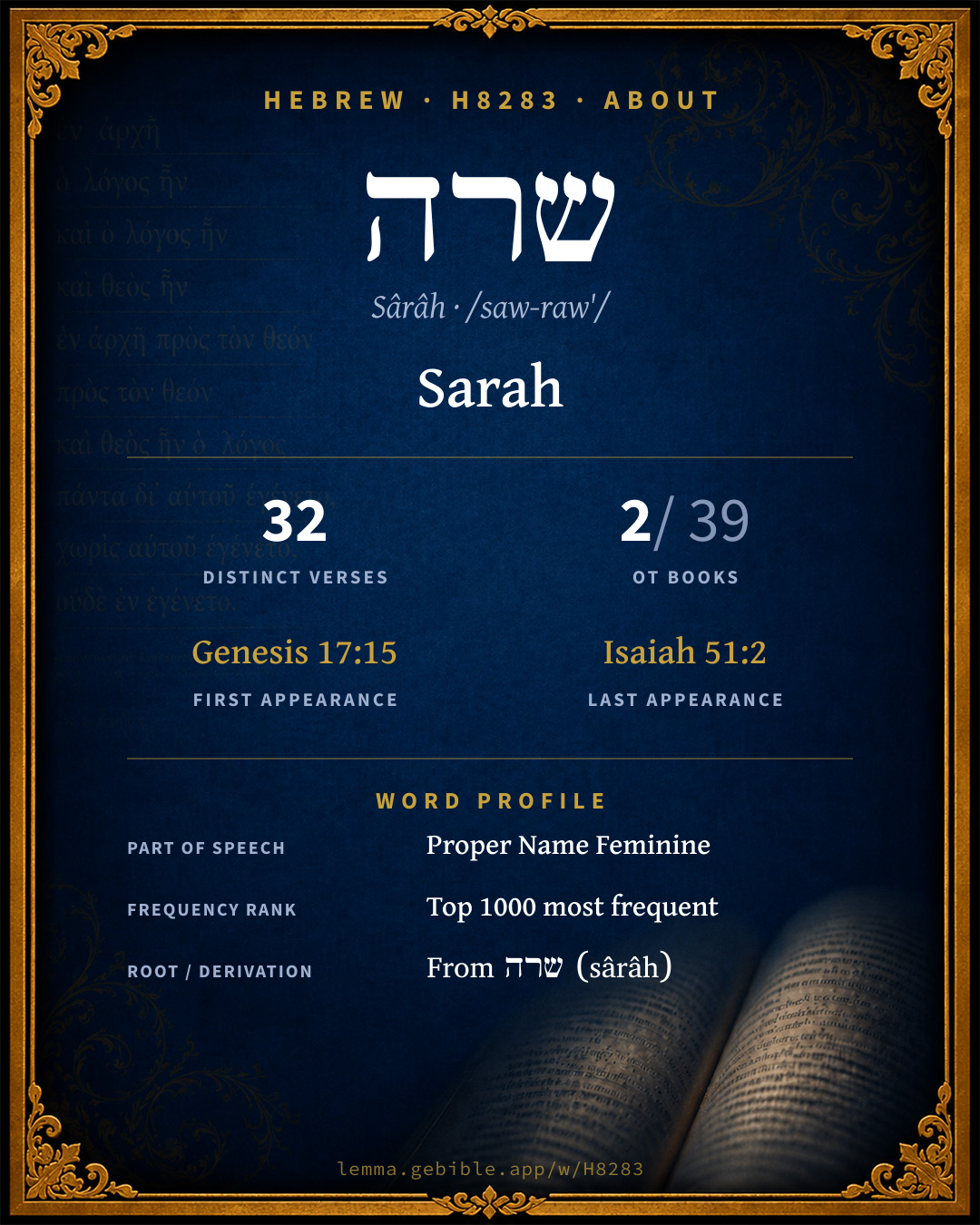
שָׂרָה
Sarah
BDB lists 2 entries for ‘Sarah’ fuller range ↓
Full lexicon entry — Brown-Driver-Briggs (BDB)
From Brown-Driver-Briggs (BDB)
Where this word appears
Grammar key — what these labels mean
Part of speech
- Noun
- A naming word — a person, place, thing, or idea.
Noun type
- Proper
- A name of a specific person, place, or people (e.g. Abraham, Zion, Israel).
Every verse where H8283 appears — 32 distinct verses across 2 books. Click any verse to open its interlinear word-by-word view. Verse text shown in the World English Bible for context — . Each verse’s Hebrew form is shown with its reference; the English is not keyword-highlighted, since the data carries no word-level English alignment. Use “Compare translations” on any verse to read it across multiple English versions. This concordance covers the Hebrew Bible; Septuagint (Greek Old Testament) occurrences are not indexed here.
Genesis 31 verses
- Genesis 17:15 שָׂרָ֖ה n Proper God said to Abraham, "As for Sarai your wife, you shall not call her name Sarai, but her name will be Sarah.
- Genesis 17:17 שָׂרָ֔ה n Proper Then Abraham fell on his face, and laughed, and said in his heart, "Will a child be born to him who is one hundred years old? Will Sarah, who is ninety years old, give birth?"
- Genesis 17:19 שָׂרָ֣ה n Proper God said, "No, but Sarah, your wife, will bear you a son. You shall call his name Isaac. I will establish my covenant with him for an everlasting covenant for his seed after him.
- Genesis 17:21 שָׂרָה֙ n Proper But my covenant I establish with Isaac, whom Sarah will bear to you at this set time in the next year."
- Genesis 18:6 שָׂרָ֑ה n Proper Abraham hurried into the tent to Sarah, and said, "Quickly make ready three measures of fine meal, knead it, and make cakes."
- Genesis 18:9 שָׂרָ֣ה n Proper They said to him, "Where is Sarah, your wife? He said, "See, in the tent."
- Genesis 18:10 לְ/שָׂרָ֣ה וְ/שָׂרָ֥ה prep + n Proper conj + n Proper He said, "I will certainly return to you when the season comes round. Behold, Sarah your wife will have a son." Sarah heard in the tent door, which was behind him.
- Genesis 18:11 וְ/שָׂרָה֙ לְ/שָׂרָ֔ה conj + n Proper prep + n Proper Now Abraham and Sarah were old, well advanced in age. It had ceased to be with Sarah after the manner of women.
- Genesis 18:12 שָׂרָ֖ה n Proper Sarah laughed within herself, saying, "After I have grown old will I have pleasure, my lord being old also?"
- Genesis 18:13 שָׂרָ֜ה n Proper Yahweh said to Abraham, "Why did Sarah laugh, saying, 'Will I really bear a child, yet I am old?'
- Genesis 18:14 וּ/לְ/שָׂרָ֥ה conj + prep + n Proper Is anything too hard for Yahweh? At the set time I will return to you, when the season comes round, and Sarah will have a son."
- Genesis 18:15 שָׂרָ֧ה n Proper Then Sarah denied, saying, "I didn't laugh," for she was afraid." He said, "No, but you did laugh."
- Genesis 20:2 שָׂרָ֥ה שָׂרָֽה n Proper n Proper Abraham said about Sarah his wife, "She is my sister." Abimelech king of Gerar sent, and took Sarah.
- Genesis 20:14 שָׂרָ֥ה n Proper Abimelech took sheep and oxen, men-servants and women-servants, and gave them to Abraham, and restored Sarah, his wife to him.
- Genesis 20:16 וּ/לְ/שָׂרָ֣ה conj + prep + n Proper To Sarah he said, "Behold, I have given your brother a thousand pieces of silver. Behold, it is for you a covering of the eyes to all that are with you. In front of all you are vindicated."
- Genesis 20:18 שָׂרָ֖ה n Proper For Yahweh had closed up tight all the wombs of the house of Abimelech, because of Sarah, Abraham's wife.
- Genesis 21:1 שָׂרָ֖ה לְ/שָׂרָ֖ה n Proper prep + n Proper Yahweh visited Sarah as he had said, and Yahweh did to Sarah as he had spoken.
- Genesis 21:2 שָׂרָ֧ה n Proper Sarah conceived, and bore Abraham a son in his old age, at the set time of which God had spoken to him.
- Genesis 21:3 שָׂרָ֖ה n Proper Abraham called his son who was born to him, whom Sarah bare to him, Isaac.
- Genesis 21:6 שָׂרָ֔ה n Proper Sarah said, "God has made me laugh. Everyone who hears will laugh with me."
- Genesis 21:7 שָׂרָ֑ה n Proper She said, "Who would have said to Abraham, that Sarah would nurse children? For I have borne him a son in his old age."
- Genesis 21:9 שָׂרָ֜ה n Proper Sarah saw the son of Hagar the Egyptian, whom she had borne to Abraham, mocking.
- Genesis 21:12 שָׂרָ֖ה n Proper God said to Abraham, "Don't let it be grievous in your sight because of the boy, and because of your handmaid. In all that Sarah says to you, listen to her voice. For from Isaac will your seed be called.
- Genesis 23:1 שָׂרָ֔ה שָׂרָֽה n Proper n Proper Sarah lived one hundred twenty-seven years. These were the years of Sarah's life.
- Genesis 23:2 שָׂרָ֗ה לְ/שָׂרָ֖ה n Proper prep + n Proper Sarah died in Kiriath Arba (the same is Hebron), in the land of Canaan. Abraham came to mourn for Sarah, and to weep for her.
- Genesis 23:19 שָׂרָ֣ה n Proper After this, Abraham buried Sarah his wife in the cave of the field of Machpelah before Mamre (the same is Hebron), in the land of Canaan.
- Genesis 24:36 שָׂרָה֩ n Proper Sarah, my master's wife, bore a son to my master when she was old. He has given all that he has to him.
- Genesis 24:67 שָׂרָ֣ה n Proper Isaac brought her into his mother Sarah's tent, and took Rebekah, and she became his wife. He loved her. Isaac was comforted after his mother's death.
- Genesis 25:10 וְ/שָׂרָ֥ה conj + n Proper the field which Abraham purchased of the children of Heth. There was Abraham buried, with Sarah his wife.
- Genesis 25:12 שָׂרָ֖ה n Proper Now this is the history of the generations of Ishmael, Abraham's son, whom Hagar the Egyptian, Sarah's handmaid, bore to Abraham.
- Genesis 49:31 שָׂרָ֣ה n Proper There they buried Abraham and Sarah, his wife. There they buried Isaac and Rebekah, his wife, and there I buried Leah:
Isaiah 1 verse
About this entry
At a glance — auto-summarized from this page’s data, not written by a person. Every figure links to its source below. This summary describes the numbers; it doesn’t interpret them.
The Hebrew name שרה centers on the idea of “Sarah.” Genesis dominates its distribution — 31 of 32 verses. Spanning 32 verses in 2 books, it ranks among the moderately common words of the Hebrew Bible. Debuting at Genesis 17:15, it then recurs through the corpus. Dig into 32-verse concordance and the renderings breakdown below.
Gloss history
Strong's 1890 vs modern scholarship
About this word
Strong's H8283 catalogs a Hebrew word from the Hebrew Old Testament.
These counts are not copied from any lexicon or concordance. They are computed here, from the morphology-tagged Hebrew Old Testament. What Lemma adds →
- 32
- distinct verses
- The word appears in 32 distinct verses.
- 2 / 39
- OT books
- The word appears in 2 of 39 Old Testament books.
- #947
- by frequency
- Top 1000 most frequent Hebrew words (rank 947 of 8,640 Hebrew words by occurrence).
View all 32 occurrences in the concordance →
By traditional corpus
Conventional, traditional groupings — biblical authorship is debated, so this is a traditional corpus grouping, not an authorship claim. Each share is this word’s portion of its verses in that division of the Hebrew canon. Each figure is a share of the word’s 32 distinct verses.
- Torah (Pentateuch) 31 verses · 97%
- Prophets (Nevi'im) 1 verse · 3%
How translations render this word
Counts come from each version’s own published word-to-Strong’s tagging or interlinear alignment — an approximate guide to how each version renders this word, not a word-level alignment the data otherwise carries. Because each total is that version’s own tagged count, the per-version totals vary from one another and need not match the appearance or distinct-verse counts above. These counts may also differ from a printed concordance because Lemma counts each distinctly tagged rendering and does not collapse phrase taggings into a single head-word total. This is a fixed set of word-tagged versions (KJV, ASV, BSB, ULT) and does not change with the reading translation you choose elsewhere. Each version’s license is shown beside its name below (and on Sources).
BDB lists this Strong’s number as 4 distinct words (homographs). Each count above pools all of them and is not split by sense — see the Senses section below. A low-frequency rendering may belong to a different one of those words, not the primary meaning.
- King James Version†: Sarah 29×, Sarah's 2×
- American Standard Version†: Sarah 29×
- Berean Standard Bible†: Sarah 29×
- unfoldingWord Literal Text†: Sarah 37×
King James Version Public Domain
Renders H8283 across 38† tagged occurrences — most commonly:
Plus 7 renderings that appear only once — usually multi-word phrases or single function words the recovered tagging swept in, not distinct renderings.
American Standard Version Public Domain
Renders H8283 across 38† tagged occurrences — most commonly:
Plus 9 renderings that appear only once — usually multi-word phrases or single function words the recovered tagging swept in, not distinct renderings.
Berean Standard Bible Public Domain
Renders H8283 across 36† tagged occurrences — most commonly:
Plus 7 renderings that appear only once — usually multi-word phrases or single function words the recovered tagging swept in, not distinct renderings. Not rendered by a distinct English word in 2 further occurrences.
unfoldingWord Literal Text CC BY-SA 4.0
Renders H8283 across 39† tagged occurrences — most commonly:
Plus 2 renderings that appear only once — usually multi-word phrases or single function words the recovered tagging swept in, not distinct renderings.
Senses in the full BDB
What do BDB’s symbols mean?
BDB uses these scholarly abbreviations:
| Symbol | Meaning |
|---|---|
| 𝔊 | the Septuagint (the ancient Greek translation, LXX) |
| 𝔙 | the Vulgate (the Latin translation) |
| 𝔖 | the Syriac version (the Peshitta) |
| 𝔗 | the Targum (the Aramaic translation) |
| ψ | the Psalms |
| √ | root (the underlying root or stem) |
| ‖ | parallel passage (a synonymous or contrasted parallel) |
| † | the dagger: every passage where the word occurs is cited |
The 1 sense the full Brown-Driver-Briggs lexicon distinguishes for this word, in lexicon order (not ranked by frequency), with BDB’s own verbatim wording and sub-sense lettering. Shown in Hebrew script with BDB’s own scholarly abbreviations. The condensed entry is in the Lexicon Entry tab. See also the Forms in the corpus table below.
שרה I persist, exert oneself, persevere (Arabic شَرِىَ persist, persevere)
Qal
- Pf. 3 ms. שׂ׳ אֶת־א׳ Ho 12:4 he persevered with God; 2 ms. שָׂרִיתָ עִם־א׳ וְעִם אֲנָשִׁים Gn 32:29 (J).—Ho 12:5 has Impf. וַיָּ֫שַׂר in same meaning, as if from a (non-existent) שׂוּר; וַיִּ֫שֶׂר (apoc. from וַיִּשְׂרֶה).—שׂוֹרָה Is 28:25 v. supra, p. 965a. e.g. Hosea 12:4
שרה II incess, noble lady
שרה III f. wife of Abraham (princess)
Senses from the full Brown-Driver-Briggs lexicon (Brown, Driver, Briggs; Oxford 1906 — public domain), digitized via Sefaria, supplemented by the OpenScriptures HebrewLexicon (CC BY 4.0). Full attribution on Sources.
Word origin
I. n.f. et pr. v. sub שׂרר.
II. vb. persist, exert oneself, persevere (Arabic شَرِىَ persist, persevere);—
III. n.f. princess, noble lady;—cstr. שָׂרָ֫תִי (Ges§ 90 l) La 1:1; pl. שָׂרוֹת 1 K 11:3, cstr. id. Est 1:18; sf. שָׂרוֹתֶיהָ Ju 5:29, -תֵיהֶם Is 49:23;—princesses attending Sisera’s mother Ju 5:29; of Sol.’s wives 1 K 11:3, other queens Is 49:23 (‖ מְלָכִים); wives of nobles Est 1:18; fig. of Jerus. La 1:1.
IV. n.pr.f. wife of Abraham (princess);—Σαρρα: Gn 17:15 (where formal change from שָׂרַי), v 17, 19, 21; 21:1b, 3; 23:1(×2), 2(×2), 19; 25:10, 12; 49:31 (all P), 18:6 + 9 times 18, 21:1a, 2a; 24:36, 67 (all J), 20:2(×2), 14, 16, 18; 21:6, 7, 9, 12 (all E); an ancestress of Hebrews Is 51:2.
— Brown-Driver-Briggs (Oxford 1906, public domain), digitized via Sefaria, supplemented by the OpenScriptures HebrewLexicon (CC BY 4.0). See Sources.
Derived from שרה (sârâh) (H8282) — princess.
Jastrow Dictionary
A second Hebrew/Aramaic lexicon for comparison, covering Aramaic and post-biblical (Talmudic, Targumic, Midrashic) usage that the biblical-Hebrew BDB does not. Matched by lemma rather than by Strong’s number, so a lemma may carry more than one Jastrow headword (shown separately below), and the entries cover usage well beyond the Bible.
שָׂרָא
- Y. Snh. VII, 25ᵈ גזר … על שרה דימא וכ׳ R. J. commanded the chief of the sea, and he swallowed them up. Lev. R. s. 5 שידא שָׂרֵיהוֹן וכ׳, v. רוּחָא; a. e.
שָׂרָה
- m. ch., v. שָׂרָא
שָׂרָה ²
- (b. h.)
- 1. princess, v. שַׂר.
- 2. pr. n. f. Sarah, a) wife of Abraham. Ber. 13ᵃ ש׳ היא שרי Sarah and Sarai have the same meaning. Snh. 39ᵇ עדין … יופי של ש׳ she had not yet attained to half the beauty of Sarah. Gen. R. s. 39 אברהם … וש׳ וכ׳ Abraham convented the men, and Sarah the women; a. v. fr.—b) Gitt. 34ᵇ ופורתא ש׳, v. פֹּורְתָּא.
שָׁרָה
- , v. שרי
שרי
- to dissolve, soak, steep. Naz. VI, 1 ש׳ פתו ביין וכ׳ if he (the Nazirite) steeped his bread in wine, and there is enough in both together to make up the size of an olive; Pes. 44ᵇ. Naz. 37ᵃ אם ש׳ ענביו במים וכ׳ if he steeped grapes in water, and a taste of wine remained in it. Pes. II, 7 אין שׁוֹרִין וכ׳ you dare not soak bran for chickens (on the Passover); ib. האשה לא תִשְׁרֶה וכ׳ a woman must not soak bran to take with her to the bathhouse. Sabb. I, 5 אין שורין … כדי שיִשּׁוֹרוּ וכ׳ you must not lay in ink-materials or dyes …, unless they can be dissolved (or soaked through) before the Sabbath sets in. Eduy. I, 8; a. fr.
- to be soaked, dissolved. Y. Ber. IX, 13ᵈ bot. כדי שתִּשָּׁרֶה וכ׳, v. מְגוּפָה; Y. Taan. I, 64ᵇ top שתשרף (corr. acc.). Gen. R. s. 17, end אדם … מיד היא נִשְׁרֵית … אינו נִשְׁרֶה man is made out of earth, when you put a drop of water on it, it is at once dissolved (soft), but woman is made of a bone, which is not dissolved, even if you let it lie in water for many days. Y. Sabb. XIV, 14ᶜ top כל … והיא נשרית … ושאינה נשרית וכ׳ when you put salt in, and it dissolves, it is called salt water, but when it is not dissolved, it is called halmé; a. e.—Sabb. I, 5 יִשּׁוֹרוּ (fr. שור or נשר), v. supra.
A Dictionary of the Targumim, the Talmud Babli and Yerushalmi, and the Midrashic Literature (Marcus Jastrow; London, Luzac, 1903) — Public Domain. Digitized via Sefaria. Digitized via Sefaria. Full attribution on Sources.
Forms in the corpus
The 18 distinct written forms H8283 takes in the Hebrew Bible, most frequent first — each parse links to that state’s occurrences in the concordance. Hebrew forms include their vowel points and cantillation, so a single lemma takes many written forms.
| Form | Parsing | Example | Uses |
|---|---|---|---|
| שָׂרָ֖ה | Noun, Proper | Genesis 17:15 | 8 |
| שָׂרָ֣ה | Noun, Proper | Genesis 17:19 | 5 |
| שָׂרָ֔ה | Noun, Proper | Genesis 17:17 | 3 |
| וְ/שָׂרָ֥ה | Noun, Proper | Genesis 18:10 | 2 |
| לְ/שָׂרָ֖ה | Noun, Proper | Genesis 21:1 | 2 |
| שָׂרָ֑ה | Noun, Proper | Genesis 18:6 | 2 |
| שָׂרָ֜ה | Noun, Proper | Genesis 18:13 | 2 |
| שָׂרָ֥ה | Noun, Proper | Genesis 20:2 | 2 |
| שָׂרָ֧ה | Noun, Proper | Genesis 18:15 | 2 |
| שָׂרָֽה | Noun, Proper | Genesis 20:2 | 2 |
| וְ/שָׂרָה֙ | Noun, Proper | Genesis 18:11 | 1 |
| וּ/לְ/שָׂרָ֣ה | Noun, Proper | Genesis 20:16 | 1 |
| וּ/לְ/שָׂרָ֥ה | Noun, Proper | Genesis 18:14 | 1 |
| לְ/שָׂרָ֔ה | Noun, Proper | Genesis 18:11 | 1 |
| לְ/שָׂרָ֣ה | Noun, Proper | Genesis 18:10 | 1 |
| שָׂרָ֗ה | Noun, Proper | Genesis 23:2 | 1 |
| שָׂרָה֙ | Noun, Proper | Genesis 17:21 | 1 |
| שָׂרָה֩ | Noun, Proper | Genesis 24:36 | 1 |
Same root — word family
Other BDB entries built from the same root as H8283, grouped by Strong’s listed origin. These share a root / origin per the lexicon — not necessarily a shared meaning. Each links to that word’s own entry.
Derives from
Proper names from this root
People and places named from this root — a name, not an additional meaning of the word.
Compare all same-root words → 1 of the same-root words is a proper name (a person or place). They share a root, not necessarily a meaning.
Bible dictionary
Public-domain dictionary articles matched to this entry by name (Sarah). A biblical name can be shared by more than one person or place, so an article may treat several.
Easton's Bible Dictionary · M. G. Easton, 1897
Princess, the wife and at the same time the half-sister of Abraham (Gen. 11:29; 20:12). This name was given to her at the time that it was announced to Abraham that she should be the mother of the promised child. Her story is from her marriage identified with that of the patriarch till the time of her death. Her death, at the age of one hundred and twenty-seven years (the only instance in Scripture where the age of a woman is recorded), was the occasion of Abraham's purchasing the cave of Machpelah as a family burying-place.
In the allegory of Gal. 4:22-31 she is the type of the "Jerusalem which is above." She is also mentioned as Sara in Heb. 11:11 among the Old Testament worthies, who "all died in faith." (See ABRAHAM.)
Smith's Bible Dictionary · William Smith, 1863
(princess).
+ The wife and half-sister, (Genesis 20:12) of Abraham, and mother of Isaac. Her name is first introduced in (Genesis 11:29) as Sarai. The change of her name from Sarai, my princess (i.e. Abraham's), to Sarah, princess (for all the race), was made at the same time that Abram's name was changed to Abraham,--on the establishment of the covenant of circumcision between him and God. Sarah's history is of course that of Abraham. [Abraham] She died at Hebron at the age of 127 years, 28 years before her husband and was buried by him in the cave of (B.C. 1860.) She is referred to in the New Testament as a type of conjugal obedience in (1 Peter 3:6) and as one of the types of faith in (Hebrews 11:11) + Sarah, the daughter of Asher. (Numbers 26:46)
Hitchcock's Bible Names Dictionary · Roswell D. Hitchcock, 1869
lady; princess; princess of the multitude
Classic public-domain reference works; full attribution on Sources.
Septuagint verse parallels
This word appears in 32 verses that also exist in the Greek Old Testament (Septuagint), out of the 32 Hebrew verses it occurs in. You can read those verses in Greek by switching the Old Testament edition to the Septuagint.
Read these verses in the Septuagint
This is a verse-level parallel only — the same verses exist in both the Hebrew and Greek Old Testaments. No word-level Hebrew↔Greek correspondence is claimed: the data carries no such alignment, so no Greek word is shown as this Hebrew word’s translation. Coverage is not total — the Septuagint omits the deuterocanon and renumbers the Psalms, so some Hebrew verses have no direct Greek parallel.