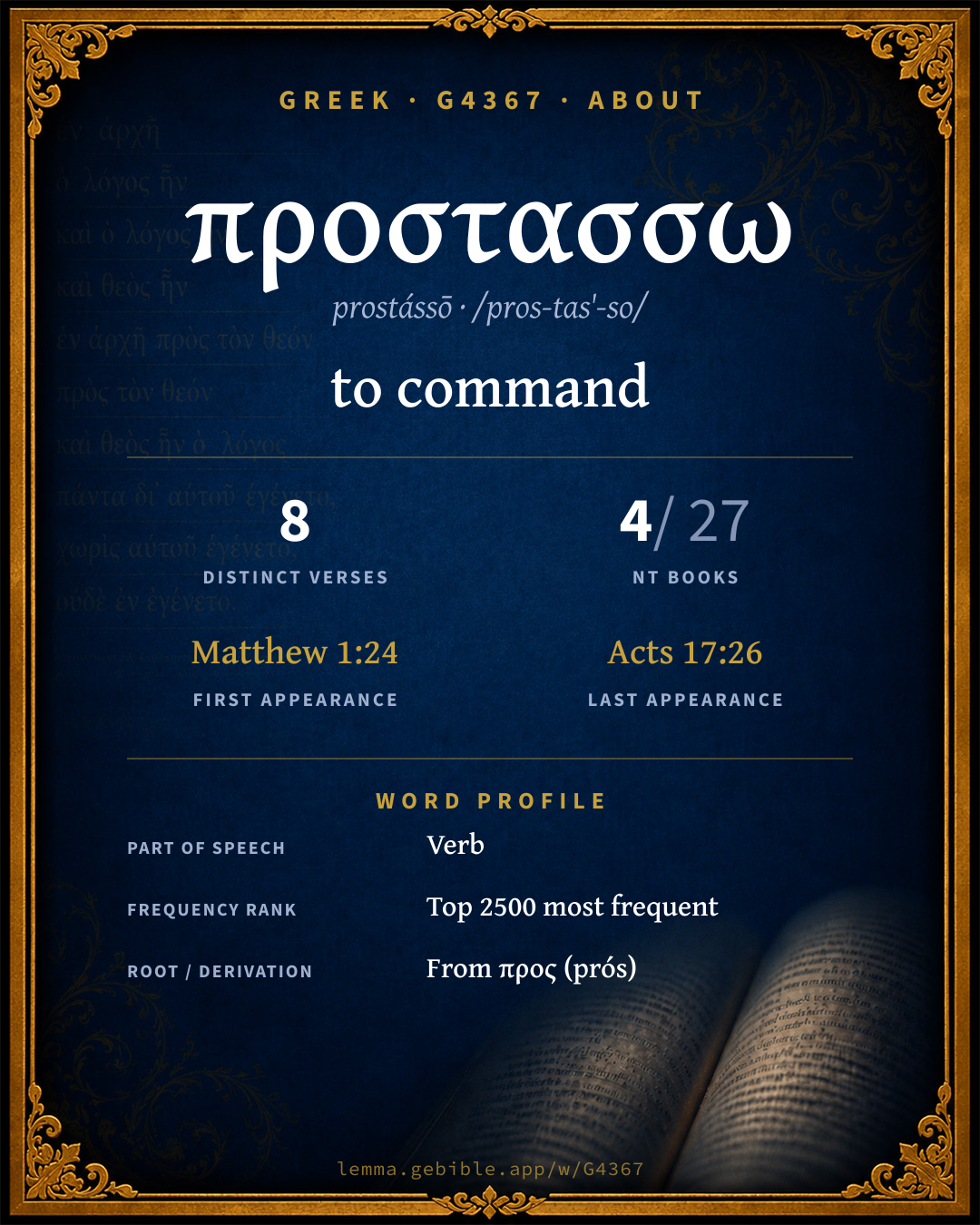
προστάσσω
to command
‘to command’ is one of 2 main senses fuller range ↓
Full lexicon entry — Thayer's Greek Lexicon
From Thayer's Greek Lexicon
Where this word appears
See every Perfect-tense verb in the Greek New Testament →
Grammar key — what these labels mean
Part of speech
- Verb
- An action or state-of-being word.
Tense
- Aorist
- Action viewed as a simple whole, without regard to duration — often past (perfective aspect).
- Perfect
- A completed past action with continuing present results.
Voice
- Active
- The subject performs the action.
- Passive
- The subject receives the action.
Mood
- Indicative
- States a fact or asks a factual question (the mood of reality).
- Participle
- A verbal adjective (“writing,” “having written”).
Case
- Accusative
- The case of the direct object and of extent.
Person
- 3rd person
- The one spoken about (“he / she / it / they”).
Gender
- Masculine
- Grammatically masculine.
- Neuter
- Grammatically neuter.
Number
- Singular
- One.
- Plural
- More than one.
1 verse where G4367 appears in the Aorist tense in the Book of Acts. Filtered view — show all forms. Click any verse to open its interlinear word-by-word view. Verse text shown in the World English Bible for context — . Each verse’s Greek form is shown with its reference; the English is not keyword-highlighted, since the data carries no word-level English alignment. Use “Compare translations” on any verse to read it across multiple English versions. This concordance covers the Greek New Testament; Septuagint (Greek Old Testament) occurrences of this word are not indexed here.
Acts
About this entry
At a glance — auto-summarized from this page’s data, not written by a person. Every figure links to its source below. This summary describes the numbers; it doesn’t interpret them.
At its core, προστασσω (prostássō) means “to command.” First canonically at Matthew 1:24, it enters the text early. It appears 8 verses across 4 books of the Greek New Testament, among its uncommon vocabulary. The word gravitates to Matthew (38%), then Acts and Mark. Catalogued under 2 senses, its meaning is not single-sense. Each statement above links to its evidence; the full detail follows below.
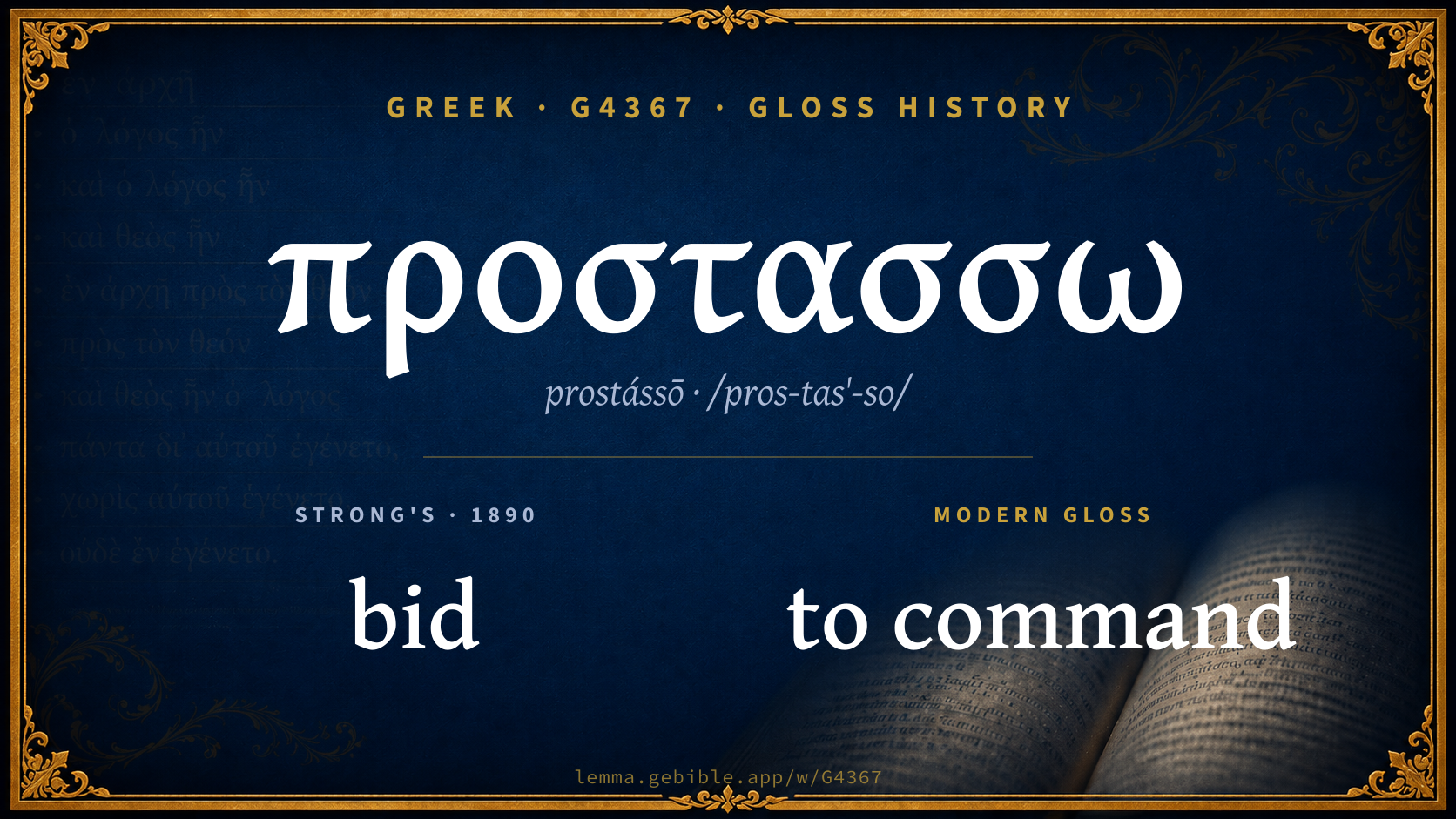
Gloss history
Strong's 1890 vs modern scholarship
About this word
Strong's G4367 catalogs a Greek word from the Greek New Testament.
These counts are not copied from any lexicon or concordance. They are computed here, from the morphology-tagged Greek New Testament. What Lemma adds →
- 8
- distinct verses
- The word appears in 8 distinct verses.
- 4 / 27
- NT books
- The word appears in 4 of 27 New Testament books.
- #1,240
- by frequency
- Top 2500 most frequent Greek words (rank 1,240 of 5,347 Greek words by occurrence).
View all 8 occurrences in the concordance →
By section of the New Testament
By traditional corpus
Conventional, traditional groupings — biblical authorship is debated, so this is a traditional corpus grouping, not an authorship claim. Some books belong to more than one corpus (Luke is in both the Gospels and the Lukan corpus, and so on), so these shares overlap and need not total 100%. Each figure is a share of the word’s 8 distinct verses.
- Gospels 5 verses · 63%
- Lukan (Luke–Acts) 4 verses · 50%
How translations render this word
Counts come from each version’s own published word-to-Strong’s tagging or interlinear alignment — an approximate guide to how each version renders this word, not a word-level alignment the data otherwise carries. Because each total is that version’s own tagged count, the per-version totals vary from one another and need not match the appearance or distinct-verse counts above. These counts may also differ from a printed concordance because Lemma counts each distinctly tagged rendering and does not collapse phrase taggings into a single head-word total. This is a fixed set of word-tagged versions (KJV, ASV, BSB, ULT) and does not change with the reading translation you choose elsewhere. Each version’s license is shown beside its name below (and on Sources).
- King James Version: Commanded 4×
- American Standard Version: Commanded 4×
- Berean Standard Bible: Prescribed 3×
- unfoldingWord Literal Text: Commanded 4×
King James Version Public Domain
Renders G4367 across 7 tagged occurrences — most commonly:
Plus 3 renderings that appear only once — usually multi-word phrases or single function words the recovered tagging swept in, not distinct renderings.
American Standard Version Public Domain
Renders G4367 across 7 tagged occurrences — most commonly:
Plus 3 renderings that appear only once — usually multi-word phrases or single function words the recovered tagging swept in, not distinct renderings.
Berean Standard Bible Public Domain
Renders G4367 across 7 tagged occurrences — most commonly:
Plus 4 renderings that appear only once — usually multi-word phrases or single function words the recovered tagging swept in, not distinct renderings.
unfoldingWord Literal Text CC BY-SA 4.0
Renders G4367 across 8 tagged occurrences — most commonly:
Plus 4 renderings that appear only once — usually multi-word phrases or single function words the recovered tagging swept in, not distinct renderings.
Senses in Thayer's
The 2 senses Thayer's distinguishes for this word, in lexicon order (not ranked by frequency or importance). The full entry — with sub-senses — is in the Lexicon Entry tab.
- to assign or ascribe to, join to
- to enjoin, order, prescribe, command
Word origin
Derived from προς (prós) (G4314).
Forms in the corpus
The 3 distinct written forms G4367 takes in the Greek New Testament, most frequent first — each parse links to that tense’s occurrences in the concordance.
| Form | Parsing | Example | Uses |
|---|---|---|---|
| προσέταξεν prosétaxen | Verb, Aorist, Active, Indicative, 3rd person, Singular | Matthew 1:24 | 6 |
| προστεταγμένα prostetagména | Verb, Perfect, Passive, Participle, Accusative, Plural, Neuter | Acts 10:33 | 1 |
| προστεταγμένους prostetagménous | Verb, Perfect, Passive, Participle, Accusative, Plural, Masculine | Acts 17:26 | 1 |
Same root — word family
Other Thayer's entries built from the same root as G4367, grouped by Strong’s listed origin. These share a root / origin per the lexicon — not necessarily a shared meaning. Each links to that word’s own entry.
Derives from
Shares the same root
- προσαγορευω prosagoreúō G4316 to address
- προσαγω proságō G4317 to bring
- προσαιτεω prosaitéō G4319 to ask alms
- προσαναβαινω prosanabaínō G4320 to go up higher
- προσαναλισκω prosanalískō G4321 to spend additionally
- προσαναπληροω prosanaplēróō G4322 to fill up
- προσανατιθημι prosanatíthēmi G4323 to lay upon
- προσαπειλεω prosapeiléō G4324 to threaten further
- προσδαπαναω prosdapanáō G4325 to spend besides
- προσδεομαι prosdéomai G4326 to need additionally
- προσδεχομαι prosdéchomai G4327 to receive to oneself
- προσδοκαω prosdokáō G4328 to expect
- προσεαω proseáō G4330 to permit approach
- προσεγγιζω prosengízō G4331 to approach
- προσεδρευω prosedreúō G4332 to sit near
- προσεργαζομαι prosergázomai G4333 to work besides
- προσερχομαι prosérchomai G4334 to draw near
- προσευχομαι proseúchomai G4336 to pray
- προσεχω proséchō G4337 to attend to
- προσηλοω prosēlóō G4338 to nail to
- προσκαιρος próskairos G4340 temporary
- προσκαλεομαι proskaléomai G4341 to call to
- προσκαρτερεω proskarteréō G4342 to adhere to
- προσκεφαλαιον proskephálaion G4344 pillow
+27 more words share this root (not shown).
Compare all same-root words → Showing 4 of 53 — not the complete family. They share a root, not necessarily a meaning.
Septuagint usage
The same Greek word προστασσω appears 34 times in the Greek Old Testament (Septuagint), across 34 verses in 11 books.
- 34
- LXX occurrences
- Tagged occurrences of this Greek word in the Septuagint.
- 34
- verses
- Distinct Septuagint verses containing this word.
- 11 / 39
- OT books
- The word appears in 11 of the 39 Old Testament books.
Sample Septuagint occurrences
- Genesis 47:11 προςτάσσω
- Exodus 36:6 προςτάσσω
- Leviticus 10:1 προςτάσσω
- Numbers 5:2 προςτάσσω
- Deuteronomy 17:3 προςτάσσω
- Joshua 5:14 προςτάσσω
- 2 Chronicles 31:5 προςτάσσω
- Esther 1:15 προςτάσσω
- Isaiah 36:21 προςτάσσω
- Daniel 2:8 προςτάσσω
- Jonah 2:1 προςτάσσω
Septuagint occurrences (same lexeme)
Every verse where the same Strong’s number (G4367) appears in the Greek Septuagint. Verse text shown in the World English Bible for context; the Greek form is the matched word — the English is not keyword-highlighted.
- Genesis 47:11 προςτάσσω Joseph placed his father and his brothers, and gave them a possession in the land of Egypt, in the best of the land, in the land of Rameses, as Pharaoh had commanded.
- Genesis 50:2 προςτάσσω Joseph commanded his servants, the physicians, to embalm his father; and the physicians embalmed Israel.
- Exodus 36:6 προςτάσσω Moses gave commandment, and they caused it to be proclaimed throughout the camp, saying, "Let neither man nor woman make anything else for the offering for the sanctuary." So the people were restrained from bringing.
- Leviticus 10:1 προςτάσσω Nadab and Abihu, the sons of Aaron, each took his censer, and put fire in it, and laid incense on it, and offered strange fire before Yahweh, which he had not commanded them.
- Leviticus 14:4 προςτάσσω then the priest shall command them to take for him who is to be cleansed two living clean birds, and cedar wood, and scarlet, and hyssop.
- Leviticus 14:5 προςτάσσω The priest shall command them to kill one of the birds in an earthen vessel over running water.
- Leviticus 14:36 προςτάσσω The priest shall command that they empty the house, before the priest goes in to examine the plague, that all that is in the house not be made unclean: and afterward the priest shall go in to inspect the house.
- Leviticus 14:40 προςτάσσω then the priest shall command that they take out the stones in which is the plague, and cast them into an unclean place outside of the city:
- Numbers 5:2 προςτάσσω "Command the children of Israel that they put out of the camp every leper, and everyone who has an issue, and whoever is unclean by the dead.
- Deuteronomy 17:3 προςτάσσω and has gone and served other gods, and worshiped them, or the sun, or the moon, or any of the host of the sky, which I have not commanded;
- Deuteronomy 18:20 προςτάσσω But the prophet, who shall speak a word presumptuously in my name, which I have not commanded him to speak, or who shall speak in the name of other gods, that same prophet shall die.
- Deuteronomy 27:1 προςτάσσω Moses and the elders of Israel commanded the people, saying, Keep all the commandment which I command you this day.
- Joshua 5:14 προςτάσσω He said, No; but [as] prince of the host of Yahweh am I now come. Joshua fell on his face to the earth, and did worship, and said to him, What says my lord to his servant?
- 2 Chronicles 31:5 προςτάσσω As soon as the commandment came abroad, the children of Israel gave in abundance the first fruits of grain, new wine, and oil, and honey, and of all the increase of the field; and the tithe of all things brought they in abundantly.
- 2 Chronicles 31:13 προςτάσσω Jehiel, and Azaziah, and Nahath, and Asahel, and Jerimoth, and Jozabad, and Eliel, and Ismachiah, and Mahath, and Benaiah, were overseers under the hand of Conaniah and Shimei his brother, by the appointment of Hezekiah the king, and Azariah the ruler of the house of God.
- Esther 1:15 προςτάσσω What shall we do to the queen Vashti according to law, because she has not done the bidding of the king Ahasuerus by the chamberlains?
- Esther 1:19 προςτάσσω If it please the king, let there go forth a royal commandment from him, and let it be written among the laws of the Persians and the Medes, that it not be altered, that Vashti come no more before king Ahasuerus; and let the king give her royal estate to another who is better than she.
- Esther 2:23 προςτάσσω When inquisition was made of the matter, and it was found to be so, they were both hanged on a tree: and it was written in the book of the chronicles before the king.
- Esther 3:2 προςτάσσω All the king's servants, who were in the king's gate, bowed down, and did reverence to Haman; for the king had so commanded concerning him. But Mordecai didn't bow down, nor did him reverence.
- Esther 3:14 προςτάσσω A copy of the writing, that the decree should be given out in every province, was published to all the peoples, that they should be ready against that day.
- Isaiah 36:21 προςτάσσω But they held their peace, and answered him not a word; for the king's commandment was, saying, Don't answer him.
- Isaiah 55:4 προςτάσσω Behold, I have given him for a witness to the peoples, a leader and commander to the peoples.
- Daniel 2:8 προςτάσσω The king answered, I know of a certainty that you would gain time, because you see the thing is gone from me.
- Daniel 2:12 προςτάσσω For this cause the king was angry and very furious, and commanded to destroy all the wise men of Babylon.
- Daniel 2:14 προςτάσσω Then Daniel returned answer with counsel and prudence to Arioch the captain of the king's guard, who was gone forth to kill the wise men of Babylon;
- Daniel 3:10 προςτάσσω You, O king, have made a decree, that every man that shall hear the sound of the horn, flute, zither, lyre, harp, pipe, and all kinds of music, shall fall down and worship the golden image;
- Daniel 3:13 προςτάσσω Then Nebuchadnezzar in [his] rage and fury commanded to bring Shadrach, Meshach, and Abednego. Then they brought these men before the king.
- Daniel 3:24 προςτάσσω Then Nebuchadnezzar the king was astonished, and rose up in haste: he spoke and said to his counselors, Didn't we cast three men bound into the midst of the fire? They answered the king, True, O king.
- Daniel 4:7 προςτάσσω Then came in the magicians, the enchanters, the Chaldeans, and the soothsayers; and I told the dream before them; but they did not make known to me the interpretation of it.
- Jonah 2:1 προςτάσσω Then Jonah prayed to Yahweh, his God, out of the fish's belly.
- Jonah 2:11 προςτάσσω
- Jonah 4:6 προςτάσσω Yahweh God prepared a vine, and made it to come up over Jonah, that it might be a shade over his head, to deliver him from his discomfort. So Jonah was exceedingly glad because of the vine.
- Jonah 4:7 προςτάσσω But God prepared a worm at dawn the next day, and it chewed on the vine, so that it withered.
- Jonah 4:8 προςτάσσω It happened, when the sun arose, that God prepared a sultry east wind; and the sun beat on Jonah's head, so that he fainted, and requested for himself that he might die, and said, "It is better for me to die than to live."
These are occurrences of the same Greek lexeme (G4367) in the Septuagint — not a translation of any one Hebrew word. The store carries no word-level Hebrew↔Greek alignment, so no Hebrew original is asserted here. Counts come from the recovered LXX Strong's tagging — high-frequency vocabulary is well covered, while rare or late forms may be untagged — so they reflect tagged occurrences and may slightly undercount.