
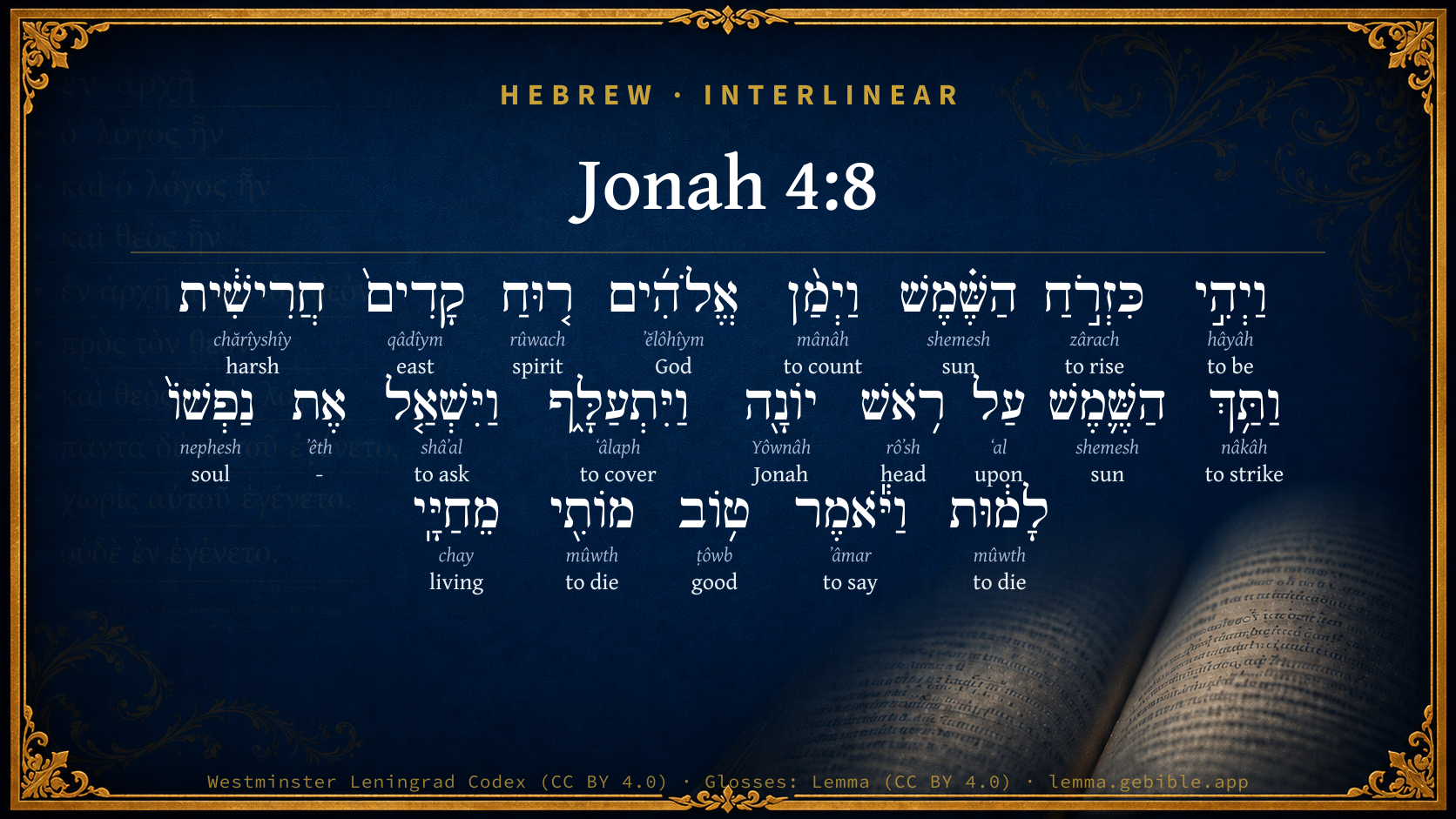
Jonah 4:8

Hebrew (Westminster Leningrad Codex) Jonah 4:8 appears in the Hebrew Old Testament. The text above is from the Westminster Leningrad Codex. Each word links to its Strong’s number, a concise gloss, and parsing drawn from the Open Scriptures Hebrew Bible morphology. Click any word for its full Brown-Driver-Briggs (BDB) entry.
Download image
Cite this verse

Jonah 4:8 (World English Bible). Public Domain. Lemma interlinear Bible study tool, https://lemma.gebible.app/v/jonah/4/8.

Show BibTeX & RIS
BibTeX
RIS
English Translation
It happened, when the sun arose, that God prepared a sultry east wind; and the sun beat on Jonah's head, so that he fainted, and requested for himself that he might die, and said, "It is better for me to die than to live."
World English Bible · Public Domain
Highlights
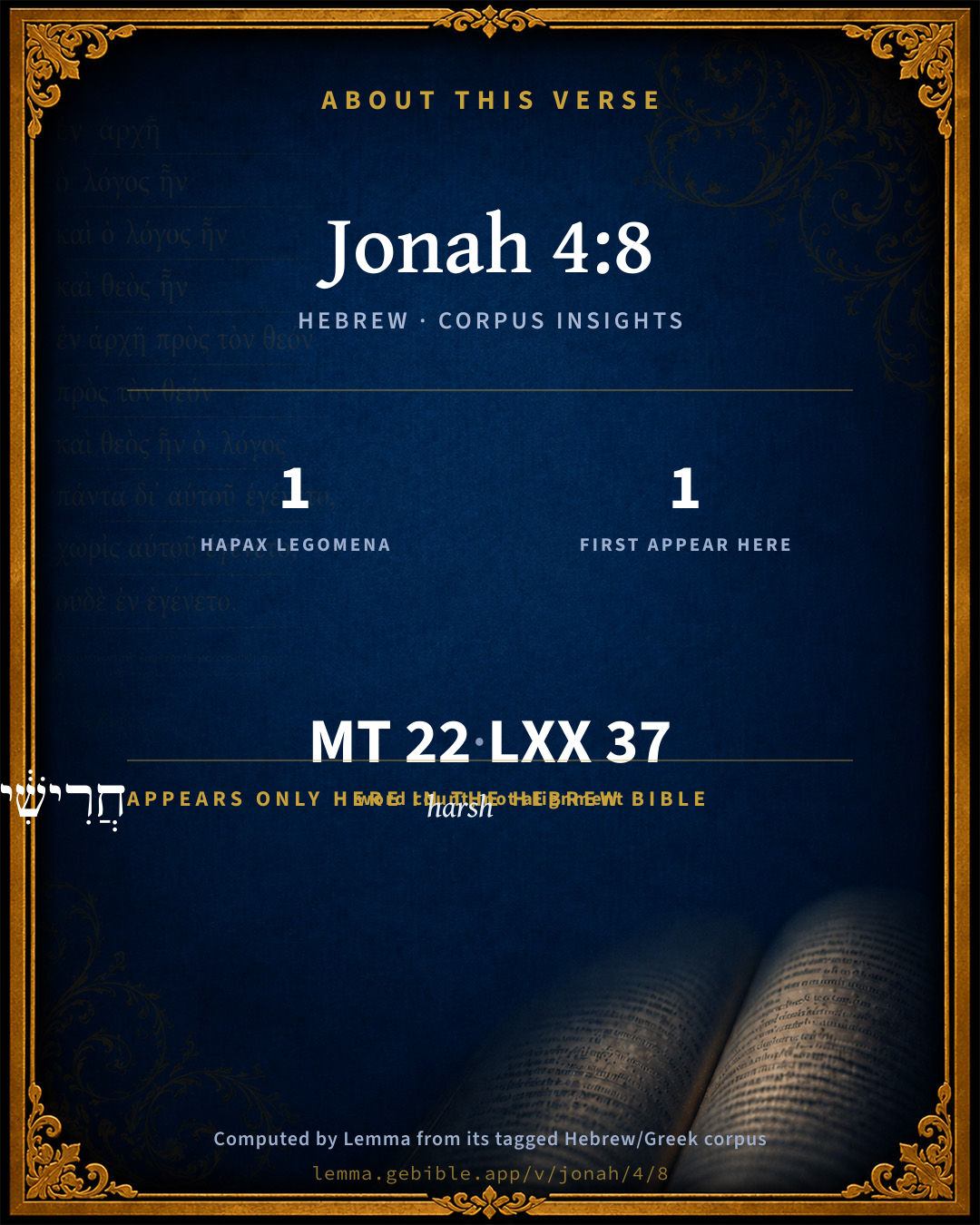
  • 1 hapax legomenon — only here in the Hebrew Bible
  • 1 first appearance in the Hebrew Bible
Full analysis ↓
Download a study sheet

One document with this verse’s original text, its word-by-word gloss line, the meaning frame, cross-references with their text, attributed commentary, and full source and license credits — printable, and it pastes into notes with its structure intact.

This verse Autodidact and up

Study sheet (.html) Plain text (.txt)

A passage Seminary Student

Up to 50 verses in one chapter. A passage sheet keeps up to 6 commentary sources and 12 cross-references per verse, in the order this page ranks them, and says so on the sheet whenever that leaves anything out. Ask for a single verse and you get the Autodidact verse sheet above.

Everything on this page stays free to read, with no account — the sheet is a download of what is already on screen, not access to it.

Want to remove ads? Support Godless Engineer
Compare translations 3

The same verse in 3 English versions, stacked beneath the original-language interlinear above. Click any original word for its lexicon entry.

Each is an independent rendering of the whole verse — the interlinear is not word-aligned to these translations.

Highlighted words mark where these versions differ — a whole-verse word diff, not a word-by-word alignment.

  • World English Bible Public Domain
    It happened, when the sun arose, that God prepared a sultry east wind; and the sun beat on Jonah's head, so that he fainted, and requested for himself that he might die, and said, "It is better for me to die than to live."
  • King James Version Public Domain
    And it came to pass, when the sun did arise, that God prepared a vehement east wind; and the sun beat upon the head of Jonah, that he fainted, and wished in himself to die, and said, It is better for me to die than to live.
  • unfoldingWord Literal Text CC BY-SA 4.0
    And as soon as the rising of the sun happened, then God appointed a hot east wind; and the sun beat on the head of Jonah, and he became faint. Then he asked his spirit to die and said, “My death is better than my life.”

unfoldingWord Literal Text — © unfoldingWord, licensed CC BY-SA 4.0. Word-aligned USFM3 via Door43 (git.door43.org/unfoldingWord/en_ult).

Versions to compare (up to 4)

3 of 4 selected

Show all 18 translations

Every available English version of this verse, each an independent rendering of the whole verse.

  • World English Bible Public Domain
    It happened, when the sun arose, that God prepared a sultry east wind; and the sun beat on Jonah's head, so that he fainted, and requested for himself that he might die, and said, "It is better for me to die than to live."
  • Berean Standard Bible Public Domain
    As the sun was rising, God appointed a scorching east wind, and the sun beat down on Jonah’s head so that he grew faint and wished to die, saying, “It is better for me to die than to live.”
  • Majority Standard Bible Public Domain
    As the sun was rising, God appointed a scorching east wind, and the sun beat down on Jonah’s head so that he grew faint and wished to die, saying, “It is better for me to die than to live.”
  • King James Version Public Domain
    And it came to pass, when the sun did arise, that God prepared a vehement east wind; and the sun beat upon the head of Jonah, that he fainted, and wished in himself to die, and said, It is better for me to die than to live.
  • American Standard Version (1901) Public Domain
    And it came to pass, when the sun arose, that God prepared a sultry east wind; and the sun beat upon the head of Jonah, that he fainted, and requested for himself that he might die, and said, It is better for me to die than to live.
  • Revised Version (1885) Public Domain
    And it came to pass, when the sun arose, that God prepared a sultry east wind; and the sun beat upon the head of Jonah, that he fainted, and requested for himself that he might die, and said, It is better for me to die than to live.
  • Geneva Bible (1599) Public Domain
    And when the sunne did arise, God prepared also a feruent East winde: and the sunne beat vpon the head of Ionah, that he fainted, and wished in his heart to die, and said, It is better for me to dye, then to liue.
  • Douay-Rheims (1899) Public Domain
    And when the sun was risen, the Lord commanded a hot and burning wind: and the sun beat upon the head of Jonas, and he broiled with the heat: and he desired for his soul that he might die, and said: It is better for me to die than to live.
  • Young's Literal Translation Public Domain
    And it cometh to pass, about the rising of the sun, that God appointeth a cutting east wind, and the sun smiteth on the head of Jonah, and he wrappeth himself up, and asketh his soul to die, and saith, `Better `is' my death than my life.'
  • Literal Standard Version CC BY-SA 4.0
    And it comes to pass, about the rising of the sun, that God appoints a cutting east wind, and the sun strikes on the head of Jonah, and he wraps himself up, and asks for his soul to die, and says, “Better [is] my death than my life.”
  • Unlocked Literal Bible CC BY-SA 4.0
    It came about that when the sun rose the next morning, God prepared a hot east wind. Also, the sun beat down on Jonah's head and he became faint. Then Jonah wished that he might die. He said to himself, “It is better for me to die than to live.”
  • unfoldingWord Literal Text CC BY-SA 4.0
    And as soon as the rising of the sun happened, then God appointed a hot east wind; and the sun beat on the head of Jonah, and he became faint. Then he asked his spirit to die and said, “My death is better than my life.”
  • Darby Bible Public Domain
    And it came to pass, when the sun arose, that God prepared a sultry east wind; and the sun beat upon the head of Jonah, so that he fainted; and he requested for himself that he might die, and said, It is better for me to die than to live.
  • World Messianic Bible Public Domain
    When the sun arose, God prepared a sultry east wind; and the sun beat on Jonah’s head, so that he was faint and requested for himself that he might die. He said, “It is better for me to die than to live.”
  • Webster's Bible Public Domain
    And it came to pass, when the sun rose that God prepared a vehement east wind; and the sun beat upon the head of Jonah, that he fainted, and wished in himself to die, and said, It is better for me to die than to live.
  • Free Bible Version CC BY-SA 4.0
    Then as the sun came up the Lord arranged for a scorching east wind to blow, and the sun beat down on Jonah's head so that he became faint and wanted to die. “I'd rather die than live!” he said.
  • Bible in Basic English Public Domain
    Then when the sun came up, God sent a burning east wind: and so great was the heat of the sun on his head that Jonah was overcome, and, requesting death for himself, said, Death is better for me than life.
  • JPS Tanakh (1917) Public Domain
    And it came to pass, when the sun arose, that God prepared a vehement east wind; and the sun beat upon the head of Jonah, that he fainted, and requested for himself that he might die, and said: 'It is better for me to die than to live.'

Literal Standard Version (2020), Covenant Press — licensed CC BY-SA 4.0. Text via the HelloAO Bible API (eBible.org). Unlocked Literal Bible (unfoldingWord) — licensed CC BY-SA 4.0. Text via the HelloAO Bible API (eBible.org). unfoldingWord Literal Text — © unfoldingWord, licensed CC BY-SA 4.0. Word-aligned USFM3 via Door43 (git.door43.org/unfoldingWord/en_ult). Free Bible Version, Dr. Jonathan Gallagher — licensed CC BY-SA 4.0. Text via the HelloAO Bible API (eBible.org).

Word by word

More ways to search: Search by grammar → Find every occurrence → Compare this word →

Practice this passage: Drill this verse → Learn its vocabulary →

חֲרִישִׁ֔ית
chărîyshîy
H2759
“harsh”
Adjective, Adjective, Feminine, Singular, Absolute
Part of Speech
Adjective
Type
Adjective
Gender
Feminine
Number
Singular
State
Absolute
Full BDB Definition

Origin: from H2790 in the sense of silence

TWOT: 760e

harsh, hot, sultry, silent (meaning uncertain)
  1. וַיְהִ֣י hâyâh H1961 “and · to be” Conjunction + Verb, Qal, Sequential Imperfect, 3rd Person, Masculine, Singular
  2. כִּזְרֹ֣חַ zârach H2224 “like/as · to rise” Preposition + Verb, Qal, Infinitive Construct
  3. הַשֶּׁ֗מֶשׁ shemesh H8121 “the · sun” Particle, Definite Article + Noun, Common, Both, Singular, Absolute
  4. וַיְמַ֨ן mânâh H4487 “and · to count” Conjunction + Verb, Piel, Sequential Imperfect, 3rd Person, Masculine, Singular
  5. אֱלֹהִ֜ים ʼĕlôhîym H430 “God(s)” Noun, Common, Masculine, Plural, Absolute
  6. ר֤וּחַ rûwach H7307 “spirit of” Noun, Common, Both, Singular, Construct
  7. קָדִים֙ qâdîym H6921 “east” Noun, Common, Masculine, Singular, Absolute
  8. וַתַּ֥ךְ nâkâh H5221 “and · to strike” Conjunction + Verb, Hiphil, Sequential Imperfect, 3rd Person, Masculine, Singular
  9. הַשֶּׁ֛מֶשׁ shemesh H8121 “the · sun” Particle, Definite Article + Noun, Common, Both, Singular, Absolute
  10. עַל ʻal H5921 “upon” Preposition
  11. רֹ֥אשׁ rôʼsh H7218 “head of” Noun, Common, Masculine, Singular, Construct
  12. יוֹנָ֖ה Yôwnâh H3124 “Jonah” Noun, Proper
  13. וַיִּתְעַלָּ֑ף ʻâlaph H5968 “and · to cover” Conjunction + Verb, Hithpael, Sequential Imperfect, 3rd Person, Masculine, Singular
  14. וַיִּשְׁאַ֤ל shâʼal H7592 “and · to ask” Conjunction + Verb, Qal, Sequential Imperfect, 3rd Person, Masculine, Singular
  15. אֶת ʼêth H853 “-” Particle, Direct Object
  16. נַפְשׁוֹ֙ nephesh H5315 “soul · his” Noun, Common, Both, Singular, Construct + Suffix, Personal, 3rd Person, Masculine, Singular
  17. לָמ֔וּת mûwth H4191 “to die” Preposition + Verb, Qal, Infinitive Construct
  18. וַיֹּ֕אמֶר ʼâmar H559 “and · to say” Conjunction + Verb, Qal, Sequential Imperfect, 3rd Person, Masculine, Singular
  19. ט֥וֹב ṭôwb H2896 “good” Adjective, Adjective, Masculine, Singular, Absolute
  20. מוֹתִ֖י mûwth H4191 “death · my” Noun, Common, Masculine, Singular, Construct + Suffix, Personal, 1st Person, Common, Singular
  21. מֵחַיָּֽי chay H2416 “from · living things · my” Preposition + Noun, Common, Masculine, Plural, Construct + Suffix, Personal, 1st Person, Common, Singular

About this verse

These counts appear in no published source. They are computed here, from the morphology-tagged text and Lemma’s own curated glosses. What Lemma adds →

22
words
20
distinct lemmas
Prophets
section

Notable vocabulary

1 hapax legomenon — a word that appears only here in the entire Hebrew Bible:

  • חֲרִישִׁ֔ית harsh H2759

First appearance in Scripture

This word makes its first canonical appearance in the Hebrew Bible here:

  • חֲרִישִׁ֔ית harsh H2759

Shared distinctive vocabulary

וַיִּתְעַלָּ֑ף to cover H5968 occurs in 5 verses of the Hebrew Bible. Also found in:

Grammatical profile

  • 8 verbs
  • 10 nouns
  • 2 adjectives
  • 1 preposition
  • 1 particle

Verb forms

  • וַיְהִ֣י Qal · Sequential Imperfect
  • כִּזְרֹ֣חַ Qal · Infinitive Construct
  • וַיְמַ֨ן Piel · Sequential Imperfect
  • וַתַּ֥ךְ Hiphil · Sequential Imperfect
  • וַיִּתְעַלָּ֑ף Hithpael · Sequential Imperfect
  • וַיִּשְׁאַ֤ל Qal · Sequential Imperfect
  • לָמ֔וּת Qal · Infinitive Construct
  • וַיֹּ֕אמֶר Qal · Sequential Imperfect

Repetition

Words recur within this verse — often emphatic in Hebrew:

  • הַשֶּׁ֗מֶשׁ sun H8121 ×2
  • לָמ֔וּת to die H4191 ×2

Hebrew & Septuagint length

In English translation the verse runs 44 words from the Hebrew and 47 from the Septuagint (LXX English) — closely comparable.

A rough comparison of the two English renderings, which tokenize alike — not a word-level alignment.

Word counts can differ between the Hebrew and the Greek without any difference in meaning — e.g. the Hebrew direct-object marker אֵת has no separate Greek word, and Greek often adds the article ὁ.

In the original languages it is 22 Hebrew tokens and 37 Greek tokens — but the two are counted differently (Hebrew bundles its prefixes and suffixes into one token; the Greek is in lemma form), so that isn’t a like-for-like length.

Cross-references

15

Topical passages linked to Jonah 4:8 in the Treasury of Scripture Knowledge — connected by theme and wording, ordered by reader-vote popularity; previews shown in the World English Bible.

  • Psalms 121:6 The sun will not harm you by day, Nor the moon by night.
  • Jonah 4:3 Therefore now, Yahweh, take, I beg you, my life from me; for it is better for me to die than to live."
  • Ezekiel 19:12 But it was plucked up in fury, it was cast down to the ground, and the east wind dried up its fruit: its strong rods were broken off and withered; the fire consumed them.
  • Isaiah 49:10 They shall not hunger nor thirst; neither shall the heat nor sun strike them: for he who has mercy on them will lead them, even by springs of water will he guide them.
  • Revelation 3:19 As many as I love, I reprove and chasten. Be zealous therefore, and repent.
  • Revelation 7:16 They will never be hungry, neither thirsty any more; neither will the sun beat on them, nor any heat;
  • Leviticus 10:3 Then Moses said to Aaron, "This is what Yahweh spoke of, saying, "'I will show myself holy to those who come near me, And before all the people I will be glorified.'" Aaron held his peace.
  • 1 Samuel 3:18 Samuel told him every whit, and hid nothing from him. He said, It is Yahweh: let him do what seems him good.
  • 2 Samuel 15:25–26 The king said to Zadok, Carry back the ark of God into the city: if I shall find favor in the eyes of Yahweh, he will bring me again, and show me both it, and his habitation:
  • Job 2:10 But he said to her, "You speak as one of the foolish women would speak. What? Shall we receive good at the hand of God, and shall we not receive evil?" In all this Job didn't sin with his lips.
  • Psalms 39:9 I was mute. I didn't open my mouth, Because you did it.
  • Song of Solomon 1:6 Don't stare at me because I am dark, Because the sun has scorched me. My mother's sons were angry with me. They made me keeper of the vineyards. I haven't kept my own vineyard.
  • Jonah 1:4 But Yahweh sent out a great wind on the sea, and there was a mighty tempest on the sea, so that the ship was likely to break up.
  • Jonah 1:17 Yahweh prepared a great fish to swallow up Jonah, and Jonah was in the belly of the fish three days and three nights.
  • Jonah 4:6–7 Yahweh God prepared a vine, and made it to come up over Jonah, that it might be a shade over his head, to deliver him from his discomfort. So Jonah was exceedingly glad because of the vine.

Cross-references courtesy of OpenBible.info (CC BY 4.0).

Hebrew and Greek witnesses Masoretic Hebrew ↔ Greek Septuagint

The same verse in the two great witnesses to the Old Testament, shown verse-for-verse.

These are two independent witnesses, not word-aligned to each other, and the Septuagint is shown in lemma (dictionary) form.

Hebrew Jonah 4:8 Masoretic · Westminster Leningrad Codex

וַיְהִ֣י כִּזְרֹ֣חַ הַשֶּׁ֗מֶשׁ וַיְמַ֨ן אֱלֹהִ֜ים ר֤וּחַ קָדִים֙ חֲרִישִׁ֔ית וַתַּ֥ךְ הַשֶּׁ֛מֶשׁ עַל רֹ֥אשׁ יוֹנָ֖ה וַיִּתְעַלָּ֑ף וַיִּשְׁאַ֤ל אֶת נַפְשׁוֹ֙ לָמ֔וּת וַיֹּ֕אמֶר ט֥וֹב מוֹתִ֖י מֵחַיָּֽי

It happened, when the sun arose, that God prepared a sultry east wind; and the sun beat on Jonah's head, so that he fainted, and requested for himself that he might die, and said, "It is better for me to die than to live."

World English Bible · Public Domain

Greek LXX Jonah 4:8 Septuagint · lemma form

καί γίγνομαι ἅμα ὁ ἀνατέλλω ὁ ἥλιος καί προςτάσσω ὁ θεός πνεῦμα καύσων συνκαίω καί πατάσσω ὁ ἥλιος ἐπί ὁ κεφαλή ιωνας καί ὀλιγοψύχω καί ἀπολέγω ὁ ψυχή αὐτός καί εἶπον καλός ἐγώ ἀποθνήσκω ἐγώ ἤ ζάω

And it came to pass at the rising of the sun, that God commanded a burning east wind; and the sun struck on the head of Jonas, and he fainted, and despaired of his life, and said, It is better for me to die than to live.

LXX2012 (modern English Septuagint) · Public Domain

On this verse, The Cambridge Bible for Schools and Colleges discusses the Septuagint’s reading. Read the note in Commentary ↓

Hebrew: Westminster Leningrad Codex (CC BY 4.0). Greek: Septuagint (public domain); English from LXX2012 (modern English Septuagint) (Public Domain). How the Septuagint differs from the Hebrew →

Targum (Aramaic paraphrase)

1

The Targum is the ancient Jewish Aramaic paraphrase of the Hebrew Scriptures — an interpretive translation, not the Hebrew text itself. Onkelos (literal) and Pseudo-Jonathan (expansive) render the Torah, and Jonathan the Prophets. Coverage is partial: where no permissively-licensed English translation exists for a verse, only the Aramaic is shown. This is verse-level text, not a word-by-word alignment to the Hebrew.

  1. Targum Jonathan Prophets (Joshua–Malachi)
    וַהֲוָה כְּמַדְנַח שִׁמְשָׁא וְזַמֵין יְיָ רוּחַ קִדוּמָא שְׁתִיקָא וּטְפָחַת שִׁמְשָׁא עַל רֵישָׁא דְיוֹנָה וְאִשְׁתַּלְהִי וּשְׁאֵיל יַת נַפְשֵׁיהּ לְמֵימַת וַאֲמַר טַב דַאֲמוּת מִדְאֵיחֵי:

    And when the sun was in the east, the LORD invited a silent east wind, and the sun spread out over Jonah’s head, and he was weakened and asked for his life to die, saying “Better I die than live.”

    Targum Jonathan — Aramaic: “Mikraot Gedolot” (public domain). English: “Sefaria Community Translation” (CC0 1.0 (public-domain dedication)); “London "Chaldee Paraphrase," 1871” (public domain). Text via Sefaria.

Commentary

Notes on Jonah 4:8 from classic Christian and Jewish commentators (each source and its license shown beneath its notes). The classic Christian expositions comment on the surrounding passage and are grouped to its opening verse, so a note may address several verses; the Jewish commentaries on the Tanakh (Rashi and others) are per-verse, so they appear only where the commentator wrote on this verse.

Lemma curates 59 commentaries, every one of them public domain or Creative Commons licensed, each selected and text-cleaned for this edition rather than reprinted as found. About our sources →

Trapp's Complete Commentary

John Trapp

Jon 4:8 And it came to pass, when the sun did arise, that God prepared a vehement east wind; and the sun beat upon the head of Jonah, that he fainted, and wished in himself to die, and said, [It is] better for me to die than to live.

Ver. 8. God prepared a vehement east wind] The winds then blow not where they list, at random I mean, and without rule; but are both raised and laid again by God at his pleasure. He prepared, and sent out of his treasure, Jer 10:13, this

Violent east wind] Heb. silent; so called either because it silenceth all other winds with its vehemence; or because when it blows men are made silent or deaf with its din, so that their tale cannot be heard. There are those who, by silent here, understand a still, low, gentle east wind, that cooled not the heat of the air inflamed by the sun, but rather added to it, and set it on; καυσωνα the Greeks interpret it; and this suits well with that which followeth.

And the sun beat upon the head of Jonah] Ussit et laesit, Psa 121:6. So the poet,

“ feriente cacumina Sole. ”

Chrysostom cannot but wonder, that whereas all fire naturally tendeth upwards, the sun should shoot his beams downwards, and affect these lower bodies with his light and heat. Whereby if he be troublesome to any Jonah, it is because God will have it so (for he is a servant, as his name שׁמשׁ in Hebrew importeth), without whom neither sun shineth nor rain falleth, Mat 5:45, and who by afflictions (set forth in Scripture by the heat of the sun) bringeth back his stragglers, Psa 119:75 Mat 13:6; Mat 13:21 Rev 7:16; Rev 16:8-9 1Pe 4:12.

That he fainted] Though the head of man hath a manifold guard upon it, as being overlaid first with hair, skin, and flesh, like the threefold covering of the tabernacle; and then encompassed with a skull of bones like boards of cedar; and afterwards with diverse skins like silken curtains; and lastly enclosed with the yellow skin which Solomon calleth the golden bowl. Ecc 12:6

Yet Jonah fainted and wished in himself to die] Ita ut ab animo suo peteret mori, he required of his soul to go out of his body, Obtectus fuit maerore, ολιγοψυχησε (Sept.) Egredere o anima mea, as Hilarian said, but in a better sense he called for death, as his due; being, belike, of Seneca’s mind, that nature hath bestowed this benefit on men, that they may bereave themselves of life, whensoever they please, not considering that God is Lord of life and death, neither may any one lay down his life but when he calleth for it, as a soldier may not leave his station but at the command of his captain.

It is better for me to die than to live] Not so, Jonah, unless you were in a better mind. You should rather say, as Martinus on his sick bed did, Domino, si adhuc populotuo sum necessarius, Lord, if I may yet be serviceable to thee, and useful to thy people, I refuse not life and labour. Or as Mr Bolton on his death bed, desirous to be dissolved, when he was told by some bystanders, that though it was better for him to die than to live, yet the Church of God would miss him: he thus sweetly replied with David, 2Sa 15:25-26, "If I shall find favour in the eyes of the Lord, he will bring me again, but, if otherwise, lo here I am, let him do what seemeth good in his eyes" (Mr Bagshaw in the Life of Mr Bolton). A good man is born for the benefit of many, as Bucer’s physicians said to him (Melchior Adam), Non sibi se, sed multorum utilitati esse natum, neither may he desire to die out of discontent, as Jonah did for a trifle, wherein he was crossed; and rather than which to have been deprived of, Nineveh, that great city, by his consent should have been destroyed. That he never after this would return to his own country, but was so sick of the fret that he died of the sullens, as some Hebrews say, I cannot believe. {See Trapp on "Jon 4:3"}

John Trapp, A Commentary or Exposition upon All the Books of the Old and New Testament (1647–1656) — public domain. Text from a community e-Sword module.

The Biblical Illustrator

Joseph S. Exell

Jon_4:8-11

He fainted and wished in himself to die.

Jonahs woe

It would be difficult to say whether the tokens of Gods holy justice, or of His abounding mercy, be the more numerous in the Scriptures. But all doubt is dispelled the moment that we understand the Gospel of our salvation. We can no longer question the loving-kindness of the Lord, when we see what has been done that sinners might have hope. But Gods mercy had strangely distempered the mind of the prophet. He complained like one defrauded of his due. And that complaint led only to misery. What made others happy only fomented Jonahs grief. Sunrise brought no joy to him; the wind parched him, and withered the gourd; he was smitten with faintness by the eastern sun; he became weary of existence; he prayed that he might die.

1. The longer a sinner continues in his sin, the more wretched does he become. Jonah was obviously sinking deeper from hour to hour.

2. Suffering and sin are inseparably linked by the appointment of the holy God. It is the sinner himself who brings sorrow on the sinner.

3. God in holy sovereignty may punish sin by sin. When His creatures go astray His restraining grace is sometimes withheld, and then sin follows sin in rapid succession, until the wanderer at last perhaps stands appalled at his own iniquity, or else is proved to be hopelessly degenerate. See in Jonahs case how transgression followed transgression, lie is offended at the mercy of God to Nineveh. He refuses to acknowledge his waywardness,--he would rather die. Then he withdraws from all intercourse with those whom God had in mercy spared; their proximity was a source of pain to Jonah. Then he pines for death; then he tries to justify his waywardness, and comes at last to declare that he did right in sinning. It is thus that sin deludes the very conscience, darkens the understanding, and enslaves the will. Blinded by passion, resolute in self-defence, determined to acknowledge no fault, but to vindicate all that he had done, Jonah makes a confession which justifies the ways of God with Nineveh. If the prophet lamented the loss of the gourd, and pitied it when it perished, surely much more might the compassionate One pity the city which had repented. (W. K. Tweedie.)

Impatience under trials

Afflictions produce a twofold effect: either making us more submissive to God, or rendering us impatient, irritable, and rebellious. They had the latter effect on Jonah.

1. His impatient grief was inconsiderate. It was passion, not reason, which dictated the prayer that he might die. No sooner were his wishes crossed than he broke out into discontented complainings. In our own case, reflection would silence many of our complaints. We should especially beware of expressing weariness of life in such cases.

2. His impatient grief was rebellious. He was not willing to have his Makers will done.

3. It was extremely selfish. The saving of so many thousands gave him no pleasure unless his word was honoured.

4. It was unbelieving. Could he not trust God to take care of his reputation? And which of us can say that he is not often impatient and repining? The habit of re cognising the hand of God in little things that try our temper would repress many a peevish exclamation. (W. H. Lewis, D. D.)

Jonahs passion, and Gods forbearance

1. The first element in Jonahs character was moral cowardice. In what lay his sin? Simply in his unwillingness to discharge a plain positive duty. Learn--

(1) When you are called to discharge a painful duty, the quicker you set about it the better.

(2) The discharge of duty is always less difficult than we anticipate.

(3) Neglected duty, if you are a Christian, will always follow you till it is performed.

2. The next element was, imperfect views of the Divine character and government.

(1) Jonah had discharged his duty in proclaiming the burden of the Lord concerning Nineveh.

(2) Jonah, having discharged his duty, thought that God ought to take the same view of things as he did.

(3) Notice the practical but gracious manner which God took to reveal His mind to Jonah.

(4) Observe the ominous silence of the sacred Scriptures concerning the end of Jonah. God will justify His own mercy and love. (W. G. Barrett.)

The weariness of life

This was the desire of Jonah when the Lord smote the gourd so that it died. In the disappointment of his soul he wept over it, and in the trouble of his spirit his prayer was for death. It is so with not a few selfish people. When sorrow touches anything that is theirs they are overwhelmed. They seem to feel, think, and act as if all the agencies of life and providence were in motion but for them, and as if all were out of order when they suffer inconvenience, and all rightly going when they are in comfort. This estimate of ill-being or well-being, in its relation to self, is extremely low; and yet it often takes a religious form of expression. Why should we regard calamities as in any way peculiar or severe because they come near to us? This distinction you will ever observe through life--the selfish make little of the sufferings which their neighbours have to bear, however great, while they are loud about their own, however small. The sufferings of the selfish render them more selfish, the sufferings of the generous make them more generous. There are, however, many instances in which the weariness of Jonah may fall upon the spirit without his bitterness, and without his misanthropy. Many a one, with a sincerer despondency, is ready to exclaim with him, It is better for me to die than to live. How often is this the sentiment under severe physical pain, whether it is uttered or concealed. How natural, in the tossings of convulsive irritation, to fix the mind upon the quiet grave! If the love of life is stronger in age, the consciousness of life is stronger in youth. This very strength of consciousness may, and sometimes does, turn into a disgust of life. Having not deeply entered into the moral purposes of life, anything which cuts off the young from its sparkling felicities cleaves them almost to despair. The loss of this worlds goods may fall heavy on the spirit, but the wound, though deep, is seldom incurable,--there is a worm more destructive than that which consumes our health and property. It is the worm of insatiable passion. This turns life into an irritable, discontented dream, with waking starts of more than ordinary loathing, in which the desire often obtrudes on the sickened mind, to be well rid of such an existence. Desire that once passes the moderation of nature is disease; it is worse than any ordinary illness, because it is in the mind. It becomes an inward and rooted malady. A man is thus a victim to his own best advantages. Many, whose circumstances and constitution place them much nearer to nature, are not always wholly saved from this temper. With all that is substantially needful for a good and enjoyable life, they become weary and sullen, and fret, and make others and themselves most unhappy; they are not content, because their wishes are not sound. I can conceive of one to whom life is worn out, and whose wish to leave it we can scarcely censure. It is one who has survived his kindred and his companions, and remains alone in the desert of adversity and the world. Many that are scorned elsewhere have an asylum from contempt among their kindred. They are nothing, or worse than nothing, to those who have only remotely seen them, and yet everything to those who have lived near them and with them. Much of dissatisfaction with life arises from a doubly false estimate of life. We underrate our own position in it; we overrate the positions of others. Out of this doubly false estimate spring correspondent false contrasts and desires. Take a certain level of comfortable existence to begin with, and life from that is equal in all essentials. All poetry, song, drama, fiction, and religion imply this. The passions are the same; the same in their experience, the same in their results. All that makes the essence of life is equal; and the proof may be put into one short sentence:--the grief or the enjoyment that reaches life makes nothing of station. But if it were not even so, yet complaint against life would be against wisdom, virtue, and religion. Where is the wisdom of that man who murmurs at that which he could not avoid, or could not have changed? There are those who say that they have lost all interest in life. It is to them and not to life that poverty comes; for life is ever rich in interest. Life is rich for the senses; for the affections; for the moral sentiments; for sympathy. If a man has clear views of God and of His providence, if he has a trustful and patient spirit, he will be grateful for his enjoyments, and he will meekly bear his griefs. He will try to extract from his circumstances all the good which they yield him, and he will not darken his position with imaginary calamities, Experience will convince him that he might be more unhappy, and humility will suggest that he has, on the whole, more pleasure than he merits. In the worst trials faith will teach him that earth is not his rest, that his afflictions here, light and enduring but for a moment, working for him an eternal weight of glory, are but as hasty April showers that usher in an everlasting summer. The day of life spent in honest and benevolent labour comes in hope to an evening calm and lovely. Earth, to each of us, is but as the gourd of Jonah. Happy for each if at the close of it he can say, not in a querulous discontent, but in believing trust, It is better for me to die than to live; or rather, if he can say with the tranquil joyfulness of old Simeon, Lord, now lettest Thou Thy servant depart in peace. (Henry Giles.)

The Biblical Illustrator, edited by Joseph S. Exell (c. 1880s–1900s) — public domain. Text from a community e-Sword module.

Jamieson, Fausset & Brown

Robert Jamieson, A. R. Fausset & David Brown

vehement--rather, "scorching"; the Margin, "silent," expressing sultry stillness, not vehemence.

Jamieson, Fausset & Brown — Commentary Critical and Explanatory on the Whole Bible (1871) — public domain (CC PDM 1.0). Text via the HelloAO Bible API.

Adam Clarke's Commentary

Verse 8. A vehement east wind] Which was of itself of a parching, withering nature; and the sun, in addition, made it intolerable. These winds are both scorching and suffocating in the East, for deserts of burning sand lay to the east or south-east; and the easterly winds often brought such a multitude of minute particles of sand on their wings, as to add greatly to the mischief. I believe these, and the sands they carry, are the cause of the ophthalmia which prevails so much both in Egypt and India.

Adam Clarke's Commentary on the Bible (1810–1826) — public domain. Text from a community e-Sword/MySword module.

John Calvin's Commentaries

It is now added, that when the sun arose the day following, a wind was prepared. We here learn the same thing, — that winds do not of themselves rise, or by chance, but are stirred up by a Divine power. There may indeed be found causes in nature why now the air is tranquil, and then it is disturbed by winds; but God’s purpose regulates all these intermediate causes; so that this is ever true — that nature is not some blind impulse, but a law settled by the will of God. God then ever regulates by his own counsel and hand whatever happens. The only difference is, that his works which flow in the usual course have the name of nature; and they are miracles and retain not the name of nature, when God changes their wonted course; but yet they all proceed from God as their author. Therefore with regard to this wind, we must understand that it was not usual or common; and yet that winds are daily no less stirred up by God’s providence than this wind of which Jonah speaks. But God wrought then, so to speak, beyond the usual course of nature, though he daily preserves the regular order of nature itself.

Let us now see why this whole narrative has been set down. Jonah confesses that he rejoiced with great joy, when he was sheltered from the extreme heat of the sun: but when the shrub withered, he was touched with so much grief that he wished to die. There is nothing superfluous here; for Jonah shows, with regard to his joy and his grief, how tender he was and how susceptible of both. Jonah here confesses his own sensibility, first by saying that he greatly rejoiced, and then by saying that he was so much grieved for the withered shrub, that through weariness of life he instantly desired death. There is then here an ingenuous confession of weakness; for Jonah in a very simple manner has mentioned both his joy and his grief. But he has distinctly expressed the vehemence of both feelings, that we might know that he was led away by his strong emotions, so that in the least things he was either inflamed with anger, or elated with joy beyond any bounds. This then was the case with him in his grief as well as in his joy. But he does not say that he prayed as before; but he adopts the word שאל, shal, which signifies to desire or wish. He desired, it is said, for his soul that he might die. It is hence probable that Jonah was so overwhelmed with grief that he did not lift up his heart to God; and yet we see that he was not neglected by God: for it immediately follows —

John Calvin's Commentaries (1540-1563) — public domain. Text from the Calvin Translation Society English edition (1840s-50s) via the Christian Classics Ethereal Library (ccel.org). Calvin's coverage is partial (roughly two-thirds of the Bible); uncommented books and verses are honest gaps, never fabricated. The 19th-century editor's footnotes and remarks are omitted so the notes are faithfully Calvin's own voice.

Ellicott's Commentary for English Readers

(8) Vehement east wind.—The derivation from a root meaning silent (see margin) points to what travellers describe as the “quiet kind of sirocco,” which is often more overpowering than the more boisterous kind. (See Thomson, The Land and the ‘Book, pp. 536, 537.) Ewald, however, derives differently, and makes it a rough, scrapy, stingy wind.

Fainted.—See Jon_2:7. Here the effect of sunstroke, in Amo_8:13 of thirst

Wished in himself to die.—Literally, wished his soul to die. (Comp. 1Ki_19:4.)

It is better.—The italics are unnecessary, and weaken the passage, Better my death than my life. Physical suffering was now added to the prophet’s chagrin, and, as usual, added to the moral depression. It seemed much worse that the logical consistency of Jonah’s teaching should go for nothing now that he was so uncomfortable.

A Bible Commentary for English Readers, edited by Charles John Ellicott (1878–1897) — public domain. Text from a community e-Sword module.

The Cambridge Bible for Schools and Colleges

gen. ed. J. J. S. Perowne

8. a vehement east wind] Margin, silent. This, or sultry, R.V., is probably the true meaning of the word. “We have two kinds of sirocco,” writes Dr Thomson, “one accompanied with vehement wind which fills the air with dust and fine sand … The sirocco to-day is of the quiet kind, and they are often more overpowering than the others. I encountered one a year ago on my way from Lydd to Jerusalem. There is no living thing abroad to make a noise. The birds hide in thickest shades; the fowls pant under the walls with open mouth and drooping wings; the flocks and herds take shelter in caves and under great rocks; the labourers retire from the fields, and close the windows and doors of their houses; and travellers hasten, as I did, to take shelter in the first cool place they can find. No one has energy enough to make a noise, and the very air is too weak and languid to stir the pendent leaves of the tall poplars.” Land and Book, pp. 536, 537. The occurrence of this wind at sunrise is referred to as a usual thing by St James, Jas_1:11, where the same Greek word (καύσων) is used for “burning heat” as is used by the LXX. here.

fainted] It is the same word as occurs in Gen_38:14, “covered her with a veil,” veiled herself, the reference being either to the film that comes over the eyes in fainting and exhaustion, or to the clouding of the mental powers from the same cause. This word is used again of fainting from thirst in Amo_8:13, and a similar word in the same metaphorical sense in ch. Jon_2:7 of this book, where see note.

wished in himself to die] Lit. asked for his life to die. Exactly the same expression occurs with reference to Elijah when he was fleeing from the wrath of Jezebel, 1Ki_19:4. The meaning of the phrase seems to be that the prophet, both in the one case and in the other, recognizing that his life was not his own, but God’s, asked for it of Him as a gift or boon, that he might do with it what he pleased. Then the object with which he asked for it, the way in which he would have it disposed of, is expressed by the word “to die,” or “for death.” Hezekiah might have asked for his life, as indeed he did, in his grievous sickness, but it was not “to die,” but “to live.” The example of Elijah may perhaps have been in Jonah’s mind when he penned these words, or even when he gave vent to his impatient desire to die. If the Jewish tradition that Jonah was the son of the widow of Zarephath and the “servant” whom he left at Beersheba, 1Ki_19:3, could be accepted, this would be the more probable. The cases of the two prophets were however in reality very different. Both were weary of life. Both desired to die. Both gave expression to their desire in the same words. But here the resemblance ends. Elijah’s was a noble disappointment. “On Carmel the great object for which Elijah had lived seemed on the point of being realised. Baal’s prophets were slain, Jehovah acknowledged with one voice: false worship put down. Elijah’s life aim—the transformation of Israel into a kingdom of God—was all but accomplished. In a single day all this bright picture was annihilated.” (Robertson.) But Jonah’s was a far less worthy grief. It was not that God’s kingdom was overthrown in Israel, but that it was extended to the heathen world, that made him weary of his life. Elijah grieved because he had failed in his efforts to convert and save Israel; Jonah because he had succeeded in converting and saving Nineveh.

It is better &c.] The words “It is” which, as the italics in A.V. show, are not in the original, are better omitted: “And said, Better for me to die than to live.”

The excess of Jonah’s joy and grief over the bestowal and loss of the gourd was partly due to his sanguine and impulsive character. But the influence here ascribed to physical circumstances over the mind, especially when it is burdened with a great grief, is very true to nature. “We would fain believe that the mind has power over the body, but it is just as true that the body rules the mind. Causes apparently the most trivial: a heated room—want of exercise—a sunless day—a northern aspect—will make all the difference between happiness and unhappiness, between faith and doubt, between courage and indecision.” (Robertson.)

The Cambridge Bible for Schools and Colleges (gen. ed. J. J. S. Perowne; Cambridge University Press, 1878–1918) — public domain. Text from a community e-Sword module.

John Gill's Exposition

And it came to pass when the sun did arise,.... After that the gourd was smitten and withered; when it was not only risen, but shone out with great force and heat:

that God prepared a vehement east wind; or, "a deafening east wind" (u); which blew so strong, and so loud, as R. Marinus in Aben Ezra and Kimchi say, made people deaf that heard it: or, "a silencing east wind"; which when it blew, all other winds were silent, as Jarchi: or it made men silent, not being to be heard for it: or, "a silent" (w), that is, a still quiet wind, as the Targum; which blew so gently and slowly, that it increased the heat, instead of lessening it: or rather "a ploughing east wind" (x); such as are frequent (y) in the eastern countries, which plough up the dry land, cause the sand to arise and cover men and camels, and bury them in it. Of these winds Monsieur Thevenot (z) speaks more than once; in sandy deserts, between Cairo and Suez, he says,

"it blew so furiously, that I thought all the tents would have been carried away with the wind; which drove before it such clouds of sand, that we were almost buried under it; for seeing nobody could stay outside, without having mouth and eyes immediately filled with sand, we lay under the tents, where the wind drove in the sand above a foot deep round about us;''

and in another place he observes (a).

"from Suez to Cairo, for a day's time or more, we had so hot a wind, that we were forced to turn our backs to it, to take a little breath, and so soon as we opened our mouths they were full of sand;''

such an one was here raised, which blew the sand and dust into the face of Jonah, and almost suffocated him; which, with the heat of the sun, was very afflictive to him:

and the sun beat upon the head of Jonah, that he fainted; the boughs of trees, of which the booth was made, being withered, and his gourd, or whatever plant it was, also, he had nothing to shelter him from the heat of the sun; but the beams of it darted directly upon him, so that he was not able to sustain them; they quite overwhelmed him, and caused him to faint, and just ready to die away:

and wished in himself to die; or, "desired his soul might die" (b); not his rational soul, which was immortal; by this animal or sensitive soul, which he had in common with animals; he wished his animal life might be taken from him, because the distress through the wind and sun was intolerable to him:

and said, it is better for me to die than to live; in so much pain and misery; see Jon 4:3.

(u) "surdefacientem", Munster; "ex surdentem", Montanus; "surdum", Drusius. (w) "Silentem", Junius & Tremellius, Piscator, Mercerus, Grotius, Tarnovius; so Stockius, p. 397. and Burkius. (x) "Aratorium", Hyde. (y) Via. Petitsol. Itinera Mundi, p. 146. & Hyde, Not. in ib. (z) Travels, par. 1. B. 2. p. 162. (a) Travels, par. 1. B. 2. ch. 34. p. 177. (b) "animae suae", V. L. Pagninus, Montanus, Cocceius; "animam suam", Burkius.

John Gill's Exposition of the Whole Bible (1746–1763) — public domain (CC PDM 1.0). Text via the HelloAO Bible API.

Albert Barnes' Notes on the Bible

God prepared a vehement - o (The English margin following the Chaldee, “silent,” i. e., “sultry”).

East wind - The winds in the East, blowing over the sand-deserts, intensely increase the distress of the heat. A sojourner describes on two occasions an Assyrian summer . “The change to summer had been as rapid as that which ushered in the spring. The verdure of the plain had perished almost in a day. Hot winds, coming from the desert, had burned up and carried away the shrubs. The heat was now almost intolerable. Violent whirl-winds occasionally swept over the face of the country.” “The spring was now fast passing away; the heat became daily greater; the grain was cut; and the plains and hills put on their summer clothing of dull parched yellow. “The pasture is withered, the herbage faileth; the green grass is not.” It was the season too of the Sherghis, or burning winds from the south, which occasionally swept over the face of the country, driving in their short-lived fury everything before them.

We all went below (ground) soon after the sun had risen, and remained there (in the tunnels) without again seeking the open air until it was far down in the Western horizon.” The “Sherghi” must be rather the East wind, Sherki, whence Sirocco. At Sulimania in Kurdistan (about 2 12 degrees east of Nineveh, and 34 of a degree south) “the so much dreaded Sherki seems to blow from any quarter, from east to northeast. It is greatly feared for its violence and relaxing qualities,” “hot, stormy and singularly relaxing and dispiriting.” Suffocating heat is a characteristic of these vehement winds. Morier relates at Bushire ; He continues, “Again from the 23rd to the 25th, the wind blew violently from the southeast accompanied by a most suffocating heat, and continued to blow with the same strength until the next day at noon, when it suddenly veered round to the northwest with a violence equal to what it had blown from the opposite point.” And again (p. 97) “When there was a perfect calm, partial and strong currents of air would arise and form whirlwinds which produced high columns of sand all over the plain. They are looked upon as the sign of great heat. Their strength was very various. Frequently they threw down our tents.”

Burckhardt, when professedly lessening the general impression as to these winds says, “The worst effect (of the Semoum “a violent southest wind”) is that it dries up the water in the skins, and so far endangers the traveler’s safety. In one morning 13 of the contents of a full water skin was evaporated. I always observed the whole atmosphere appear as it in a state of combustion; the dust and sand are carried high into the air, which assumes a reddish or blueish or yellowish tint, according to the nature and color of the ground from which the dust arises. The Semoum is not always accompanied by whirlwinds: in its less violent degree it will blow for hours with little force, although with oppressive heat; when the whirlwind raises the dust, it then increases several degrees in heat. In the Semoum at Esne, the thermometer mounted to 121 degrees in the shade, but the air seldom remains longer than a quarter of an hour in that state or longer than the whirlwind lasts.

The most disagreeable effect of the Semoum upon man is, that it stops perspiration, dries up the palate, and produces great restlessness.” Travels in Nubia, pp. 204-205.) “A gale of wind blew from the Southward and Eastward with such violence, that three of our largest tents were leveled with the ground. The wind brought with it such hot currents of air, that we thought it might be the precursor of the “Samoun” described by Chardin, but upon inquiry, we found that the autumn was generally the season for that wind. The “Sam” wind commits great ravages in this district. It blows at night from about midnight to sunrise, comes in a hot blast, and is afterward succeeded by a cold one. About 6 years ago, there was a “sam” during the summer months which so totally burned up all the grain, then near its maturity, that no animal would eat a blade of it, nor touch any of its grain.”

The sun beat upon the head of Jonah - o. “Few European travelers can brave the perpendicular rays of an Assyrian sun. Even the well-seasoned Arab seeks the shade during the day, and journeys by night, unless driven forth at noontide by necessity, or the love of war.”

He wished in himself to die - (literally he asked as to his soul, to die). He prayed for death. It was still the same dependence upon God, even in his self-will. He did not complain, but prayed God to end his life here. When men are already vexed in soul by deep inward griefs, a little thing often oversets patience. Jonah’s hopes had been revived by the mercy of the palm-christ; they perished with it. Perhaps he had before him the thought of his great predecessor, Elijah, how he too wished to die, when it seemed that his mission was fruitless. They differed in love. Elijah’s preaching, miracles, toil, sufferings, seemed to him, not only to be in vain, but (as they must, if in vain), to add to the guilt of his people. God corrected him too, by showing him his own short-sightedness, that he knew not of “the seven thousand who had not bowed their knees unto Baal,” who were, in part, doubtless, “the travail of his soul.” Jonah’s mission to his people seemed also to be fruitless; his hopes for their well-being were at an end; the temporal mercies of which he had been the prophet, were exhausted; Nineveh was spared; his last hope was gone; the future scourge of his people was maintained in might. The soul shrinks into itself at the sight of the impending visitation of its country. But Elijah’s zeal was “for” his people only and the glory of God in it, and so it was pure love. Jonah’s was directed “against” the Ninevites, and so had to be purified.

Albert Barnes' Notes on the Bible (1834–1885) — public domain. Text from a community e-Sword/MySword module.

Haydock's Catholic Bible Commentary

Hot. Hebrew also, "eastern and sultry," (Haydock) or silent, (Calmet) which instead of refreshing, served only to increase the heat, (Haydock) and to raise dust. Septuagint, Syriac, &c., agree with the Vulgate.

George Leo Haydock (1774–1849), Haydock's Catholic Family Bible and Commentary, 1859 edition — public domain. Excludes Psalms (Douay-Rheims chapter numbering differs from Protestant) and Deuterocanonical books (Catholic canon only).

Matthew Poole's English Annotations

And it came to pass, after all these passages both in chastising and refreshing Jonah, and after all Jonah’s deportment under them, but more immediately after the withering of the gourd and the loss of the shadow.

When the sun did arise; with the rising of the sun, so early in the morning as the sun arose.

God prepared; by a particular command from God.

A vehement east wind; a dry, scorching, blasting wind wherever it blows, but more than ordinarily so in those climates, and most so when sent out on such an errand by the Lord. Silent, saith the Hebrew. Ruffling winds usually cool the air, but the silent, which blow with even tenor, rather increase the heat of the air. However, this wind was sent to do so, and certainly did it.

The sun beat upon the head of Jonah; did perpetually and vehemently shine, or point its burning beams, upon the-undefended head of Jonah: no wind to cool, no shade to cover, scorched Jonah.

He fainted; overcome by the heat, he was no longer able to stand, but as a fainting man fell down ready to die. His strength of body and his courage of mind also failed him.

Wished in himself to die; in this weakness and pain, in this perplexity of body and mind, he comes once more to a downright impatience and weariness of life.

It is better for me to die than to live; and here he will justify his passion, it is best of the two; but Jonah must be wiser, and humbler, and more merciful too ere he die. Before God hath done with him, he will teach him to value his own life more, and to be more tender of the life of others.

Matthew Poole's English Annotations on the Holy Bible (1683–1685) — public domain. Text from a community e-Sword/MySword module.

The Pulpit Commentary

Vers. 8-11. 4. Jonah grieves bitterly for the loss of the gourd; and God takes occasion from this to point out the prophets inconsistency and pitilessness in murmuring against the mercy shown to Nineveh with its multitude of inhabitants.

A vehement east wind; Septuagint, pneumati kauswni (Jam_1:11) sugkaionti "a scorching, burning wind;" Vulgate, vento calido et urenti. (Hos_13:15) The word translated "vehement" is also rendered "silent," i.e. sultry. Pusey and Hitzig rather incline to think it may mean the autumn or harvest wind. Either interpretation is suitable, as, according to Dr. Thomson, there are two kinds of sirocco, equally destructive and annoying the violent wind, which fills the air with dust and sand; and the quiet one, when scarcely any air is stirring, but the heat is most overpowering ("The Land and the Book," p. 536, etc.). Beat upon the head. The same word for the effect of the rays of the sun as in Psa_121:6 and elsewhere. Trochon quotes Ovid, "Metam," 7:804"Sole fere radiis feriente cacumiua primis." "The sun with earliest rays Scarce smiting highest peaks. Rich, "Koordistan," 1:125, "Just as the moon rose, about ten, an intolerable puff of wind came from the northeast. All were immediately silent, as if they had felt an earthquake, and then exclaimed, in a dismal tone, "The sherki is come." This was indeed the so much-dreaded sherki, and it has continued blowing ever since with great violence from the east and northeast, the wind being heated like our Bagdad sauna, but I think softer and more relaxing. This wind is the terror of these parts." "Few European travellers," says Layard ("Nin. and Babyl.," p. 366), "can brave the perpendicular rays of an Assyrian sun. Even the well seasoned Arab seeks the shade during the day, and journeys by night unless driven forth by necessity or the love of war" (quoted by Dr. Pusey, in loc.). He fainted (see note on Amo_8:13, where the fame word is used of the effects of thirst: comp. Jon_2:7). His position on the east of the city (ver. 5) exposed him to the full force of the scorching sun and wind. Wished in himself to die; literally, asked for his soul to die; Septuagint, apelegeto th , "despaired of his life". (1Ki_19:4) The expression implies that he asked God to grant him his life to do with it what he liked. In his self-will and impatience he still shows his dependence upon God. He may have had in his mind the precedent of his great master Elijah, though his spirit is very different (see note on ver. 3 above). Better for me to die. His wish for death arose from his now assured conviction that God"s mercy was extended to the heathen. He argued from the sudden withering of the gourd that he was not to stay there and see the accomplishment of his wishes, and, in his impatience and intolerance, he would rather die than behold Nineveh converted and saved.

Desire to die.

Deep was the mortification, the disappointment, the dejection, which, more than once, found expression in this wish. It is not an uncommon thing for those whose hearts are blighted, whose prospects are clouded, for whom life has but few attractions left, to wish rather to die than to live.

I THE EXPLANATION OF THIS WISH.

1. The burden of bodily suffering or weakness, or of mental anguish, maybe such as is very hard to bear; and men may wish to lay it down even though with it they lay down the load of life.

2. The memory of trouble, calamity, disaster, may be so distressing thateven annihilation has been desired rather than an ineffaceable record of woe. The Christian cannot desire extinction of being, but he may hope that, in passing hence, he may steep his soul in Lethe"s oblivious waves.

3. The apparent hopelessness of the earthly prospect tempts men to wish todie. To many who are advanced in life, crippled in body, ruined in circumstances, disappointed in life plans, this earthly existence seems to present no prospects; death seems a relief.

II THE BLAMABLENESS OF THIS WISH.

1. It implies a habit of discontent and of murmuring. Our circumstances areappointed or permitted by a kind Providence; to wish to escape them is to wish to avoid the discipline ordained for us by our heavenly Father. The Christian pilgrim should be prepared cheerfully, or at least patiently, to finish his path, even to the journey"s end.

2. It implies an undue desire for rest. Men"s notions of heaven are oftencarnal and selfish; they look forward to release from labour and service; and sometimes they wish to die that they may enjoy the sweets of repose. But it should be the desire and expectation of all Christians, that they may serve God day and night in his temple. Surely one attraction of the future state for the holy nature is this it will afford opportunity for higher and purer service.

III THE COUNTERACTIVE TO THIS WISH. This is to be found in perfect submissiveness to the holy and perfect will of God. Whilst he has work for his people to do on earth, earth is the best place for them; when he wishes them to enter upon heavenly service, he himself will call them hence.

The Pulpit Commentary (1880–1919), ed. H.D.M. Spence-Jones & Joseph S. Exell — public domain. Text from a community e-Sword module.

John Wesley's Explanatory Notes

A east wind - A dry, scorching, blasting wind. Fainted - Overcome by the heat. Better to die - But Jonah must be wiser, and humbler, and more merciful too, e'er he die. Before God hath done with him, he will teach him to value his own life more, and to be more tender of the life of others.

John Wesley, Explanatory Notes Upon the Whole Bible (1754–1765) — public domain. Text via the GEBible commentary corpus.

Keil & Delitzsch

C. F. Keil & F. Delitzsch

On the rising of the dawn of the very next day, God appointed a worm, which punctured the miraculous tree so that it withered away; and when the sun arose He also appointed a sultry east wind, and the sun smote upon Jonah's head, so that he fainted away. Chărı̄shıth, from chârash, to be silent or quiet, is to be taken when used of the wind in the sense of sultry, as in the Chaldee (lxx συγκαίων). The meaning ventus, qualis flat tempore arandi, derived from chârish, the ploughing (Abulw.), or autumnal east wind (Hitzig), is far less suitable. When Jonah fainted away in consequence of the sun-stroke (for hith‛allēph, see at Amo 8:13), he wished himself dead, since death was better for him than life (see Jon 4:3). ישׁאל את־נפשׁו למוּת, as in Kg1 19:4, "he wished that his soul might die," a kind of accusative with the infinitive (cf. Ewald, 336, b). But God answered, as in Jon 4:4, by asking whether he was justly angry. Instead of Jehovah (Jon 4:4) we have Elohim mentioned here, and Jehovah is not introduced as speaking till Jon 4:9. We have here an intimation, that just as Jonah's wish to die was simply an expression of the feelings of his mind, so the admonitory word of God was simply a divine voice within him setting itself against his murmuring. It was not till he had persisted in his ill-will, even after this divine admonition within, that Jehovah pointed out to him how wrong his murmuring was. Jehovah's speaking in Jon 4:9 is a manifestation of the divine will by supernatural inspiration. Jehovah directs Jonah's attention to the contradiction into which he has fallen, by feeling compassion for the withering of the miraculous tree, and at the same time murmuring because God has had compassion upon Nineveh with its many thousands of living beings, and has spared the city for the sake of these souls, many of whom have no idea whatever of right or wrong. Chastâ: "Thou hast pitied the Qiqayon, at which thou hast not laboured, and which thou hast not caused to grow; for (שׁבּן = אשׁר בּן) son of a night" - i.e., in a night, or over night - "has it grown, and over night perished, and I should not pity Nineveh?" ואני is a question; but this is only indicated by the tone. If Jonah feels pity for the withering of a small shrub, which he neither planted nor tended, nor caused to grow, shall God not have pity with much greater right upon the creatures whom He has created and has hitherto sustained, and spare the great city Nineveh, in which more than 120,000 are living, who cannot distinguish their right hand from the left, and also much cattle? Not to be able to distinguish between the right hand and the left is a sign of mental infancy. This is not to be restricted, however, to the very earliest years, say the first three, but must be extended to the age of seven years, in which children first learn to distinguish with certainty between right and left, since, according to M. v. Niebuhr (p. 278), "the end of the seventh year is a very common division of age (it is met with, for example, even among the Persians), and we may regard it as certain that it would be adopted by the Hebrews, on account of the importance they attached to the number seven." A hundred and twenty thousand children under seven years of age would give a population of six hundred thousand, since, according to Niebuhr, the number of children of the age mentioned is one-fifth the whole population, and there is no ground for assuming that the proportion in the East would be essentially different. This population is quite in accordance with the size of the city.

(Note: "Nineveh, in the broader sense," says M. v. Niebuhr, "covers an area of about 400 English square miles. Hence there were about 40,000 persons to the square mile. Jones (in a paper on Nineveh) estimates the population of the chief city, according to the area, at 174,000 souls. So that we may reckon the population of the four larger walled cities at 350,000. There remain, therefore, for the smaller places and the level ground, 300,000 men on about sixteen square miles; that is to say, nearly 20,000 men upon the square mile." He then shows, from the agricultural conditions in the district of Elberfeld and the province of Naples, how thoroughly this population suits such a district. In the district of Elberfeld there are, in round numbers, 22,000 persons to the square mile, or, apart from the two large towns, 10,000. And if we take into account the difference in fertility, this is about the same density of population as that of Nineveh. The province of Naples bears a very great resemblance to Nineveh, not only in the kind of cultivation, but also in the fertility of the soil. And there, in round numbers, 46,000 are found to the square mile, or, exclusive of the capital, 22,000 souls.)

Children who cannot distinguish between right and left, cannot distinguish good from evil, and are not yet accountable. The allusion to the multitude of unaccountable children contains a fresh reason for sparing the city: God would have been obliged to destroy so many thousand innocent ones along with the guilty. Besides this, there was "much cattle" in the city. "Oxen were certainly superior to shrubs. If Jonah was right in grieving over one withered shrub, it would surely be a harder and more cruel thing for so many innocent animals to perish" (Calvin). "What could Jonah say to this? He was obliged to keep silence, defeated, as it were, by his own sentence" (Luther). The history, therefore, breaks off with these words of God, to which Jonah could make no reply, because the object of the book was now attained, - namely, to give the Israelites an insight into the true nature of the compassion of the Lord, which embracers all nations with equal love. Let us, however, give heed to the sign of the prophet Jonah, and hold fast to the confession of Him who could say of Himself, "Behold, a greater than Jonah is here!"

Keil & Delitzsch — Biblical Commentary on the Old Testament (1861–1891) — public domain (CC PDM 1.0). Text via the HelloAO Bible API. (Old Testament only.)

Scofield Reference Notes

C. I. Scofield

fainted

Cf. 1Ki 19:4-8. Taken as a lesson in service we have in Jonah a servant,

(1) disobedient, Jon 1:1-11;

(2) afflicted, Jon 1:12-17;

(3) praying Jon 2:1-9;

(4) delivered, Jon 2:10;

(5) recommissioned, Jon 3:1-3;

(6) powerful, Jon 3:4-9;

(7) perplexed and fainting but not forsaken, Jon 4:1-11.

The Scofield Reference Bible (1917 edition), notes by C. I. Scofield — public domain. Text from a community e-Sword module.

unfoldingWord translationNotes

Door43 World Missions Community

God prepared a hot east wind

God caused a hot wind from the east to blow on Jonah. If wind can only mean a cool or cold wind then you can try this. AT: "God sent a very hot warmth from the east to Jonah" (See: Assumed Knowledge and Implicit Information)

the sun beat down

"the sun was very hot"

on Jonah's head

Jonah may have felt the heat most on his head. AT: "on Jonah" (See: Synecdoche)

he became faint

"he became very weak" or "he lost his strength"

It is better for me to die than to live

"I would prefer to die than live" or "Because I want to die. I do not want to live." See how you translated this in Jonah 4:3.

Is it good that you are so angry about the plant?

God challenges Jonah for being angry that the plant died and yet wanted God to kill the people of Nineveh. AT: "Your anger about the plant dying is not good." (See: Rhetorical Question)

Is it good that you are so angry about the plant?

implicit information can be made explicit. AT: "You should be more concerned about the people in Nineveh dying than about the plant dying." (See: Assumed Knowledge and Implicit Information)

It is good that I am angry, even to death.

"It is good that I am angry. Now I am angry enough to die!"

translationWords

God

Jonah

unfoldingWord translationNotes — © Distant Shores Media and the Door43 World Missions Community, licensed CC BY-SA 4.0. Source: git.door43.org/Door43/en_tn.

Rashi

Rabbi Shlomo Yitzchaki (Rashi)

stilling Heb. חֲרִישִׁית. Our Sages say: When it blows, it silences all the winds because of it, and it is very hot. So does Jonathan render: silencing. [from Gittin 31b]

and he fainted Heb. וַיִּתְעַלָּף, pasmer (pamer), in O.F.

Rashi on the Tanakh — English translations: “The Judaica Press complete Tanach with Rashi, translated by A. J. Rosenberg” (CC BY 4.0); “Pentateuch with Rashi's commentary by M. Rosenbaum and A.M. Silbermann, 1929-1934” (public domain); “The Metsudah Tanach series, Lakewood, N.J” (CC BY 4.0); and “The Book of Joshua, Metsudah Publications, 1997” (CC BY 4.0). Text via Sefaria.

Lesson kit

Teaching starters — assembled from the data on this page, not authored interpretation. Every prompt links to the verse data it draws on. Edit before teaching.

Jonah, in the Prophets, opens this verse with 22 words (20 distinct Hebrew lemmas). Its most distinctive word is chărîyshîy (“harsh”). A historical commentator’s framing appears above. Read the whole chapter for the surrounding context.

Discussion questions

  1. The word chărîyshîy carries the sense “harsh.” How does it shape the verse?
  2. This verse holds 1 word here found nowhere else in the Hebrew Bible. What might the rare word draw attention to?
  3. The word “harsh” first appears here in Scripture. What is being introduced at this debut?
  4. Genesis 38:14 shares the word «to cover» with this verse. How do the two illuminate each other?
  5. “sun” occurs 2× in this one verse. What is the effect of the repetition?
  6. The translations on this page render this verse differently — a whole-verse word diff, not a word-by-word alignment. What might account for the different wordings?
  7. The verb «וַיְהִ֣י» is Qal Sequential Imperfect. How does its form color the action?
  8. Reading how Trapp's Complete Commentary and The Biblical Illustrator read this verse, where do the two commentators agree and where do they part?

Things to notice

  • 1 word in this verse appears nowhere else in the Hebrew Bible.
  • 1 word makes its first canonical appearance in Scripture here.
  • This verse counts 22 Hebrew ↔ 37 Greek words.
  • These translations choose different wording for 30 words in this verse.
  • “sun” occurs 2× in this single verse.

Reading settings

Reading text

Shown beneath each verse's original-language words.

Old Testament
Old Testament edition

Read the OT as the Masoretic Hebrew (MT) or the Greek Septuagint (LXX).

English shown for the Greek Septuagint (in the Hebrew ↔ Greek comparison).

Comparing translations? Open the Compare panel on any verse page to stack up to four side by side.