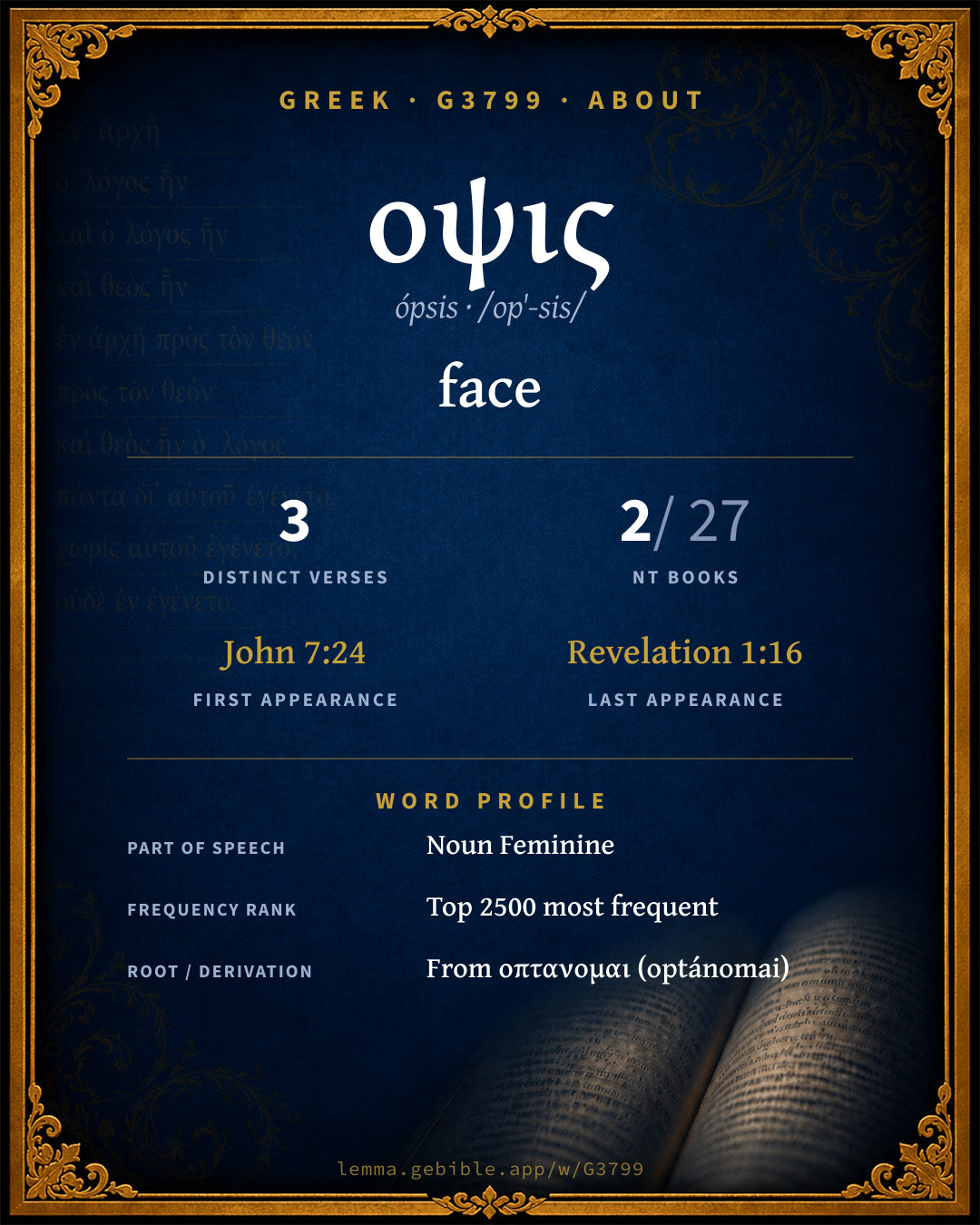
ὄψις
face
‘face’ is one of 3 main senses fuller range ↓
Full lexicon entry — Thayer's Greek Lexicon
From Thayer's Greek Lexicon
Where this word appears
See every Accusative-case word in the Greek New Testament →
Grammar key — what these labels mean
Part of speech
- Noun
- A naming word — a person, place, thing, or idea.
Case
- Nominative
- The case of the subject (and the predicate nominative).
- Accusative
- The case of the direct object and of extent.
Gender
- Feminine
- Grammatically feminine.
Number
- Singular
- One.
Every verse where G3799 appears in the Book of John — 2 distinct verses. Click any verse to open its interlinear word-by-word view. Verse text shown in the World English Bible for context — . Each verse’s Greek form is shown with its reference; the English is not keyword-highlighted, since the data carries no word-level English alignment. Use “Compare translations” on any verse to read it across multiple English versions. This concordance covers the Greek New Testament; Septuagint (Greek Old Testament) occurrences of this word are not indexed here.
John
About this entry
At a glance — auto-summarized from this page’s data, not written by a person. Every figure links to its source below. This summary describes the numbers; it doesn’t interpret them.
At its core, οψις (ópsis) means “face.” It occurs a mere 3 verses across Scripture. Its uses cluster heavily in John (67% of all occurrences). Scripture first uses it in John 7:24. Ranging over 3 senses, it is not a single-sense word. Each statement above links to its evidence; the full detail follows below.
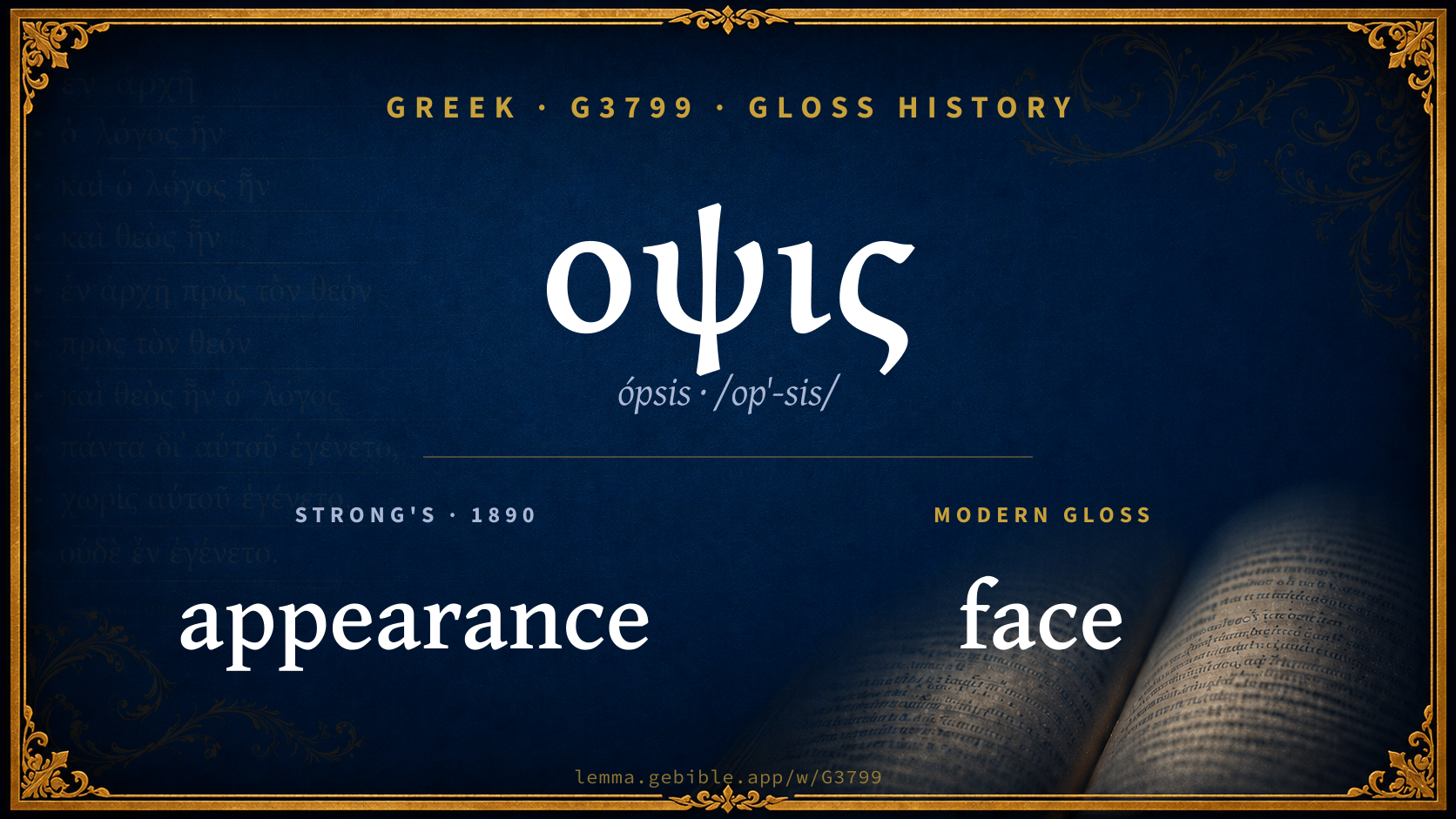
Gloss history
Strong's 1890 vs modern scholarship
About this word
Strong's G3799 catalogs a Greek word from the Greek New Testament.
These counts are not copied from any lexicon or concordance. They are computed here, from the morphology-tagged Greek New Testament. What Lemma adds →
- 3
- distinct verses
- The word appears in 3 distinct verses.
- 2 / 27
- NT books
- The word appears in 2 of 27 New Testament books.
- #2,203
- by frequency
- Top 2500 most frequent Greek words (rank 2,203 of 5,347 Greek words by occurrence).
View all 3 occurrences in the concordance →
Most concentrated in
- John 2 verses 67%
- Revelation 1 verse 33%
By section of the New Testament
By traditional corpus
Conventional, traditional groupings — biblical authorship is debated, so this is a traditional corpus grouping, not an authorship claim. Some books belong to more than one corpus (Luke is in both the Gospels and the Lukan corpus, and so on), so these shares overlap and need not total 100%. Each figure is a share of the word’s 3 distinct verses.
- Johannine 3 verses · 100%
- Gospels 2 verses · 67%
- Revelation 1 verse · 33%
How translations render this word
Counts come from each version’s own published word-to-Strong’s tagging or interlinear alignment — an approximate guide to how each version renders this word, not a word-level alignment the data otherwise carries. Because each total is that version’s own tagged count, the per-version totals vary from one another and need not match the appearance or distinct-verse counts above. These counts may also differ from a printed concordance because Lemma counts each distinctly tagged rendering and does not collapse phrase taggings into a single head-word total. This is a fixed set of word-tagged versions (KJV, ASV, BSB, ULT) and does not change with the reading translation you choose elsewhere. Each version’s license is shown beside its name below (and on Sources).
- King James Version: Appearance 1×, Countenance 1×, Face 1×
- American Standard Version: Appearance 1×, Countenance 1×, Face 1×
- Berean Standard Bible: Face 2×
- unfoldingWord Literal Text: Face 2×
King James Version Public Domain
Renders G3799 across 3 tagged occurrences — most commonly:
American Standard Version Public Domain
Renders G3799 across 3 tagged occurrences — most commonly:
Berean Standard Bible Public Domain
Renders G3799 across 3 tagged occurrences — most commonly:
Plus 1 rendering that appears only once — usually multi-word phrases or single function words the recovered tagging swept in, not distinct renderings.
unfoldingWord Literal Text CC BY-SA 4.0
Renders G3799 across 3 tagged occurrences — most commonly:
Plus 1 rendering that appears only once — usually multi-word phrases or single function words the recovered tagging swept in, not distinct renderings.
Senses in Thayer's
The 3 senses Thayer's distinguishes for this word, in lexicon order (not ranked by frequency or importance). The full entry — with sub-senses — is in the Lexicon Entry tab.
- seeing, sight
- face, countenance
- the outward appearance, look
Word origin
Derived from οπτανομαι (optánomai) (G3700) — to look at.
From G3700 ; properly sight (the act) that is (by implication) the visage an external show : - appearance countenance face.
— Strong’s Exhaustive Concordance (1890), public domain.
Forms in the corpus
The 2 distinct written forms G3799 takes in the Greek New Testament, most frequent first — each parse links to that case’s occurrences in the concordance.
| Form | Parsing | Example | Uses |
|---|---|---|---|
| ὄψις ópsis | Noun, Nominative, Singular, Feminine | John 11:44 | 2 |
| ὄψιν ópsin | Noun, Accusative, Singular, Feminine | John 7:24 | 1 |
Same root — word family
Other Thayer's entries built from the same root as G3799, grouped by Strong’s listed origin. These share a root / origin per the lexicon — not necessarily a shared meaning. Each links to that word’s own entry.
Derives from
Shares the same root
- ομμα ómma G3659 eye
- οπη opḗ G3692 opening
- οπισθεν ópisthen G3693 behind
- οπτασια optasía G3701 vision
- οραω horáō G3708 to see
- οφθαλμος ophthalmós G3788 eye
- οφις óphis G3789 serpent
- οφρυς ophrŷs G3790 eyebrow
- σκυθρωπος skythrōpós G4659 sad-faced
Proper names from this root
People and places named from this root — a name, not an additional meaning of the word.
Compare all same-root words → Showing 4 of 12 — not the complete family. 1 of the same-root words is a proper name (a person or place). They share a root, not necessarily a meaning.
Septuagint usage
The same Greek word οψις appears 39 times in the Greek Old Testament (Septuagint), across 37 verses in 11 books.
- 39
- LXX occurrences
- Tagged occurrences of this Greek word in the Septuagint.
- 37
- verses
- Distinct Septuagint verses containing this word.
- 11 / 39
- OT books
- The word appears in 11 of the 39 Old Testament books.
Sample Septuagint occurrences
- Genesis 24:16 ὄψις
- Exodus 10:5 ὄψις
- Leviticus 13:3 ὄψις
- Numbers 22:5 ὄψις
- 1 Samuel 16:7 ὄψις
- 1 Kings 1:6 ὄψις
- Song of Solomon 2:14 ὄψις
- Jeremiah 3:3 ὄψις
- Ezekiel 1:13 ὄψις
- Daniel 1:13 ὄψις
- Joel 2:4 ὄψις
Septuagint occurrences (same lexeme)
Every verse where the same Strong’s number (G3799) appears in the Greek Septuagint. Verse text shown in the World English Bible for context; the Greek form is the matched word — the English is not keyword-highlighted.
- Genesis 24:16 ὄψις The young lady was very beautiful to look at, a virgin, neither had any man known her. She went down to the spring, filled her pitcher, and came up.
- Genesis 26:7 ὄψις The men of the place asked him about his wife. He said, "She is my sister," for he was afraid to say, "My wife," lest, he thought, the men of the place might kill me for Rebekah, because she was beautiful to look on.
- Genesis 29:17 ὄψις Leah's eyes were weak, but Rachel was beautiful and well favored.
- Genesis 39:6 ὄψις He left all that he had in Joseph's hand. He didn't concern himself with anything, except for the food which he ate. Joseph was well-built and handsome.
- Genesis 41:21 ὄψις and when they had eaten them up, it couldn't be known that they had eaten them, but they were still ill-favored, as at the beginning. So I awoke.
- Exodus 10:5 ὄψις and they shall cover the surface of the earth, so that one won't be able to see the earth. They shall eat the residue of that which has escaped, which remains to you from the hail, and shall eat every tree which grows for you out of the field.
- Exodus 10:15 ὄψις For they covered the surface of the whole earth, so that the land was darkened, and they ate every herb of the land, and all the fruit of the trees which the hail had left. There remained nothing green, either tree or herb of the field, through all the land of Egypt.
- Exodus 34:29 ὄψις It happened, when Moses came down from Mount Sinai with the two tablets of the testimony in Moses' hand, when he came down from the mountain, that Moses didn't know that the skin of his face shone by reason of his speaking with him.
- Exodus 34:30 ὄψις When Aaron and all the children of Israel saw Moses, behold, the skin of his face shone; and they were afraid to come near him.
- Leviticus 13:3 ὄψις and the priest shall examine the plague in the skin of the body: and if the hair in the plague has turned white, and the appearance of the plague is deeper than the body's skin, it is the plague of leprosy; and the priest shall examine him, and pronounce him unclean.
- Leviticus 13:4 ὄψις If the bright spot is white in the skin of his body, and the appearance of it isn't deeper than the skin, and the hair of it hasn't turned white, then the priest shall isolate the infected person for seven days.
- Leviticus 13:20 ὄψις and the priest shall examine it; and, behold, if the appearance of it is lower than the skin, and the hair of it has turned white, then the priest shall pronounce him unclean. It is the plague of leprosy. It has broken out in the boil.
- Leviticus 13:25 ὄψις then the priest shall examine it; and, behold, if the hair in the bright spot has turned white, and the appearance of it is deeper than the skin; it is leprosy. It has broken out in the burning, and the priest shall pronounce him unclean. It is the plague of leprosy.
- Leviticus 13:30 ὄψις then the priest shall examine the plague; and, behold, if the appearance of it is deeper than the skin, and the hair in it is yellow and thin, then the priest shall pronounce him unclean: it is an itch, it is leprosy of the head or of the beard.
- Leviticus 13:31 ὄψις If the priest examines the plague of itching, and, behold, its appearance isn't deeper than the skin, and there is no black hair in it, then the priest shall isolate him the person infected with itching seven days.
- Leviticus 13:32 ὄψις On the seventh day the priest shall examine the plague; and, behold, if the itch hasn't spread, and there is no yellow hair in it, and the appearance of the itch isn't deeper than the skin,
- Leviticus 13:34 ὄψις On the seventh day, the priest shall examine the itch; and, behold, if the itch hasn't spread in the skin, and its appearance isn't deeper than the skin, then the priest shall pronounce him clean. He shall wash his clothes, and be clean.
- Leviticus 13:43 ὄψις Then the priest shall examine him; and, behold, if the rising of the plague is reddish-white in his bald head, or in his bald forehead, like the appearance of leprosy in the skin of the flesh,
- Leviticus 13:55 ὄψις Then the priest shall examine it, after the plague is washed; and, behold, if the plague hasn't changed its color, and the plague hasn't spread, it is unclean; you shall burn it in the fire. It is a mildewed spot, whether the bareness is inside or outside.
- Leviticus 14:37 ὄψις He shall examine the plague; and, behold, if the plague is in the walls of the house with hollow streaks, greenish or reddish, and it appears to be deeper than the wall;
- Leviticus 19:27 ὄψις You shall not cut the hair on the sides of your heads, neither shall you clip off the edge of your beard.
- Leviticus 21:5 ὄψις "'They shall not shave their heads, neither shall they shave off the corners of their beards, nor make any cuttings in their flesh.
- Numbers 22:5 ὄψις He sent messengers to Balaam the son of Beor, to Pethor, which is by the River, to the land of the children of his people, to call him, saying, Behold, there is a people come out from Egypt: behold, they cover the surface of the earth, and they abide over against me.
- Numbers 22:11 ὄψις Behold, the people that is come out of Egypt, it covers the surface of the earth: now, come curse me them; peradventure I shall be able to fight against them, and shall drive them out.
- 1 Samuel 16:7 ὄψις But Yahweh said to Samuel, "Don't look on his face, or on the height of his stature; because I have rejected him: for [Yahweh sees] not as man sees; for man looks at the outward appearance, but Yahweh looks at the heart."
- 1 Kings 1:6 ὄψις His father had not displeased him at any time in saying, Why have you done so? and he was also a very goodly man; and he was born after Absalom.
- Song of Solomon 2:14 ὄψις My dove in the clefts of the rock, In the hiding places of the mountainside, Let me see your face. Let me hear your voice; For your voice is sweet, and your face is lovely.
- Jeremiah 3:3 ὄψις Therefore the showers have been withheld, and there has been no latter rain; yet you have a prostitute's forehead, you refused to be ashamed.
- Ezekiel 1:13 ὄψις As for the likeness of the living creatures, their appearance was like burning coals of fire, like the appearance of torches: [the fire] went up and down among the living creatures; and the fire was bright, and out of the fire went forth lightning.
- Ezekiel 1:27 ὄψις I saw as it were glowing metal, as the appearance of fire within it round about, from the appearance of his loins and upward; and from the appearance of his loins and downward I saw as it were the appearance of fire, and there was brightness round about him.
- Ezekiel 10:9 ὄψις I looked, and behold, four wheels beside the cherubim, one wheel beside one cherub, and another wheel beside another cherub; and the appearance of the wheels was like a beryl stone.
- Ezekiel 10:10 ὄψις As for their appearance, they four had one likeness, as if a wheel have been within a wheel.
- Ezekiel 23:15 ὄψις girded with girdles on their loins, with flowing turbans on their heads, all of them princes to look on, after the likeness of the Babylonians in Chaldea, the land of their birth.
- Ezekiel 41:21 ὄψις As for the temple, the door-posts were squared; and as for the face of the sanctuary, the appearance [of it] was as the appearance [of the temple].
- Daniel 1:13 ὄψις Then let our faces be looked on before you, and the face of the youths who eat of the king's dainties; and as you see, deal with your servants.
- Daniel 1:15 ὄψις At the end of ten days their faces appeared fairer, and they were fatter in flesh, than all the youths who ate of the king's dainties.
- Joel 2:4 ὄψις The appearance of them is as the appearance of horses, And as horsemen, so do they run.
These are occurrences of the same Greek lexeme (G3799) in the Septuagint — not a translation of any one Hebrew word. The store carries no word-level Hebrew↔Greek alignment, so no Hebrew original is asserted here. Counts come from the recovered LXX Strong's tagging — high-frequency vocabulary is well covered, while rare or late forms may be untagged — so they reflect tagged occurrences and may slightly undercount.