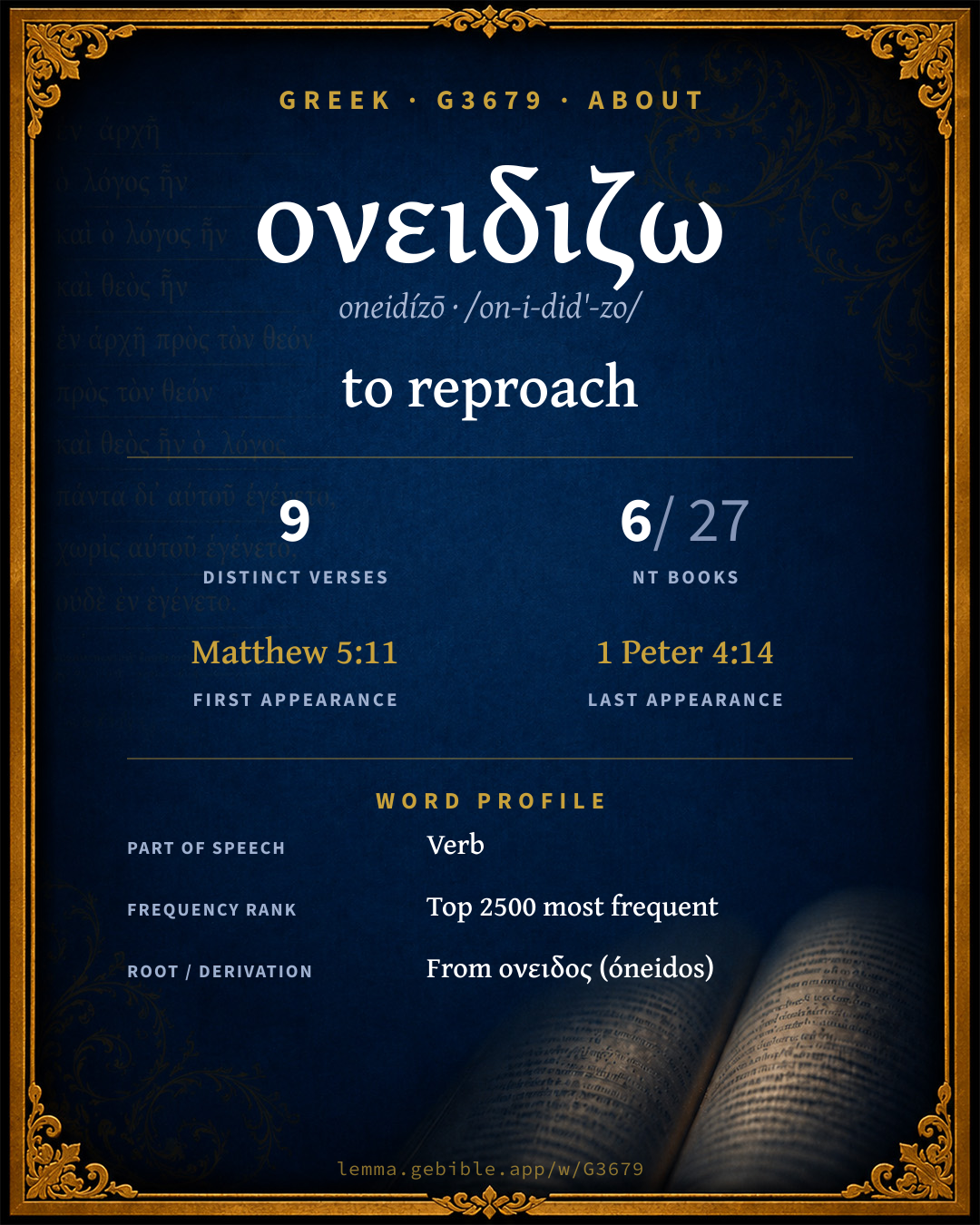
ονειδιζω
to reproach
Full lexicon entry — Thayer's Greek Lexicon
From Thayer's Greek Lexicon
Where this word appears
See every Aorist-tense verb in the Greek New Testament →
Grammar key — what these labels mean
Part of speech
- Verb
- An action or state-of-being word.
Tense
- Aorist
- Action viewed as a simple whole, without regard to duration — often past (perfective aspect).
- Imperfect
- Continuous or repeated action in past time (“was writing”).
- Present
- Ongoing or general action in present time (imperfective aspect).
Voice
- Active
- The subject performs the action.
- Passive
- The subject receives the action.
Mood
- Subjunctive
- Expresses probability, purpose, or possibility (the mood of contingency).
- Indicative
- States a fact or asks a factual question (the mood of reality).
- Infinitive
- A verbal noun (“to write”), unmarked for person or number.
- Participle
- A verbal adjective (“writing,” “having written”).
Case
- Genitive
- The case of source, possession, or “of” — answers “whose / from what.”
Person
- 3rd person
- The one spoken about (“he / she / it / they”).
- 2nd person
- The one addressed (“you”).
Gender
- Masculine
- Grammatically masculine.
Number
- Plural
- More than one.
- Singular
- One.
1 verse where G3679 appears in the Present tense in the Book of Matthew. Filtered view — show all forms. Click any verse to open its interlinear word-by-word view. Verse text shown in the World English Bible for context — . Each verse’s Greek form is shown with its reference; the English is not keyword-highlighted, since the data carries no word-level English alignment. Use “Compare translations” on any verse to read it across multiple English versions. This concordance covers the Greek New Testament; Septuagint (Greek Old Testament) occurrences of this word are not indexed here.
Matthew
About this entry
At a glance — auto-summarized from this page’s data, not written by a person. Every figure links to its source below. This summary describes the numbers; it doesn’t interpret them.
At its core, ονειδιζω (oneidízō) means “to reproach.” It first appears in Matthew 5:11. It turns up in 9 verses across 6 books, an uncommon footprint. The word gravitates to Matthew (33%), then Mark and Luke. It clusters with ονειδος and ονειδισμος under a shared root. Dig into 9-verse concordance and the renderings breakdown below.
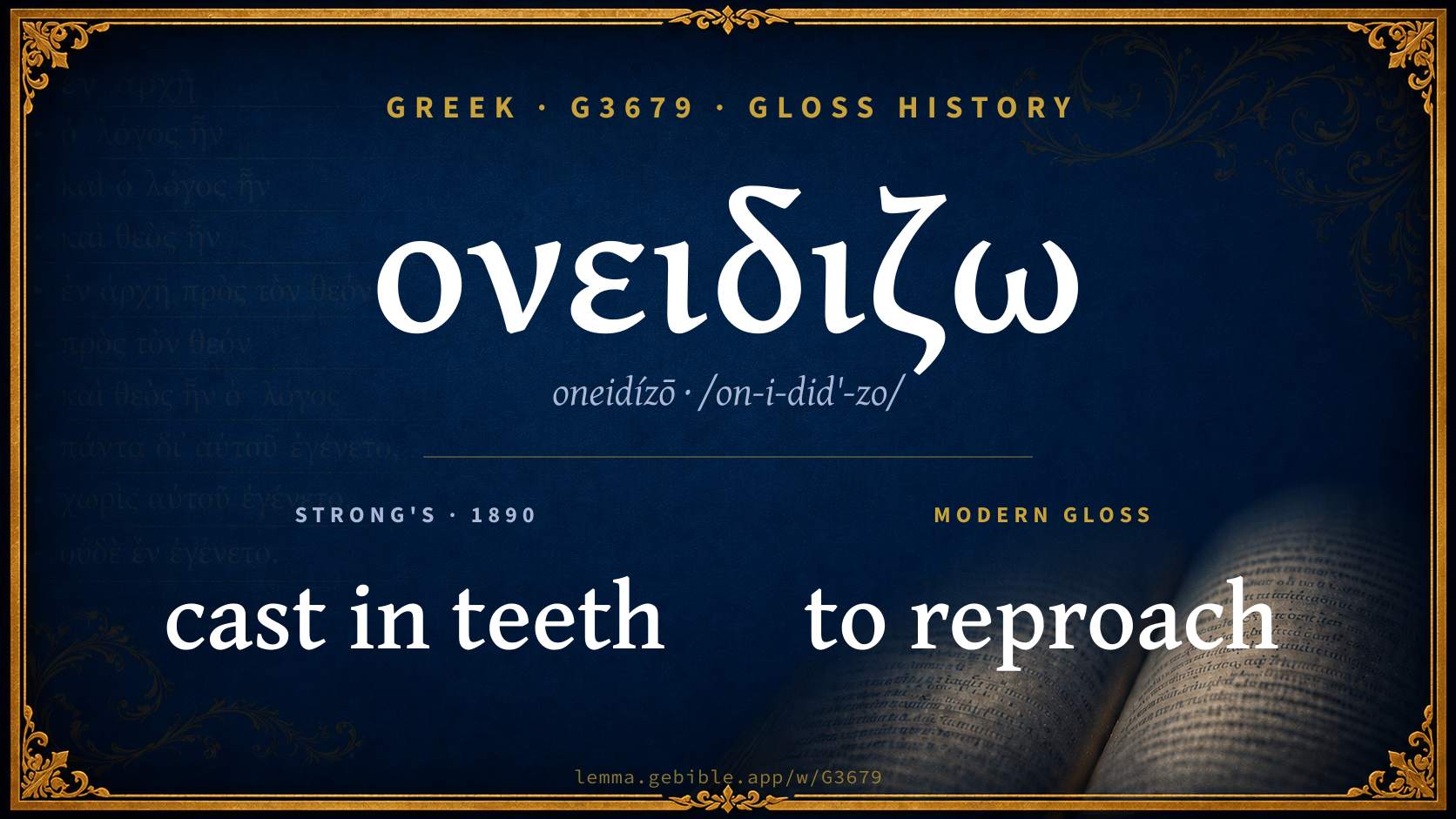
Gloss history
Strong's 1890 vs modern scholarship
About this word
Strong's G3679 catalogs a Greek word from the Greek New Testament.
These counts are not copied from any lexicon or concordance. They are computed here, from the morphology-tagged Greek New Testament. What Lemma adds →
- 9
- distinct verses
- The word appears in 9 distinct verses.
- 6 / 27
- NT books
- The word appears in 6 of 27 New Testament books.
- #1,140
- by frequency
- Top 2500 most frequent Greek words (rank 1,140 of 5,347 Greek words by occurrence).
View all 9 occurrences in the concordance →
By section of the New Testament
By traditional corpus
Conventional, traditional groupings — biblical authorship is debated, so this is a traditional corpus grouping, not an authorship claim. Some books belong to more than one corpus (Luke is in both the Gospels and the Lukan corpus, and so on), so these shares overlap and need not total 100%. Each figure is a share of the word’s 9 distinct verses.
- Gospels 6 verses · 67%
- General (Catholic) Epistles 2 verses · 22%
- Lukan (Luke–Acts) 1 verse · 11%
- Pauline corpus 1 verse · 11%
How translations render this word
Counts come from each version’s own published word-to-Strong’s tagging or interlinear alignment — an approximate guide to how each version renders this word, not a word-level alignment the data otherwise carries. Because each total is that version’s own tagged count, the per-version totals vary from one another and need not match the appearance or distinct-verse counts above. These counts may also differ from a printed concordance because Lemma counts each distinctly tagged rendering and does not collapse phrase taggings into a single head-word total. This is a fixed set of word-tagged versions (KJV, ASV, BSB, ULT) and does not change with the reading translation you choose elsewhere. Each version’s license is shown beside its name below (and on Sources).
- King James Version: Cast 1×, Men shall revile 1×, Reproached 1×
- American Standard Version: Reproach 2×, Reproached 2×
- Berean Standard Bible: Insult 3×, Berated 2×
- unfoldingWord Literal Text: Were reviling 2×
King James Version Public Domain
Renders G3679 across 11 tagged occurrences — most commonly:
American Standard Version Public Domain
Renders G3679 across 11 tagged occurrences — most commonly:
Plus 7 renderings that appear only once — usually multi-word phrases or single function words the recovered tagging swept in, not distinct renderings.
Berean Standard Bible Public Domain
Renders G3679 across 9 tagged occurrences — most commonly:
Plus 4 renderings that appear only once — usually multi-word phrases or single function words the recovered tagging swept in, not distinct renderings.
unfoldingWord Literal Text CC BY-SA 4.0
Renders G3679 across 9 tagged occurrences — most commonly:
Plus 7 renderings that appear only once — usually multi-word phrases or single function words the recovered tagging swept in, not distinct renderings.
Senses in Thayer's
The 1 sense Thayer's distinguishes for this word, in lexicon order (not ranked by frequency or importance). The full entry — with sub-senses — is in the Lexicon Entry tab.
- to reproach, upbraid, revile
Word origin
Derived from ονειδος (óneidos) (G3681) — shame.
From G3681 ; to defame that is rail at chide taunt : - cast in teeth (suffer) reproach revile upbraid.
— Strong’s Exhaustive Concordance (1890), public domain.
Forms in the corpus
The 7 distinct written forms G3679 takes in the Greek New Testament, most frequent first — each parse links to that tense’s occurrences in the concordance.
| Form | Parsing | Example | Uses |
|---|---|---|---|
| ὀνειδίσωσιν oneidísōsin | Verb, Aorist, Active, Subjunctive, 3rd person, Plural | Matthew 5:11 | 2 |
| ὠνείδιζον ōneídizon | Verb, Imperfect, Active, Indicative, 3rd person, Plural | Matthew 27:44 | 2 |
| ὀνειδίζειν oneidízein | Verb, Present, Active, Infinitive | Matthew 11:20 | 1 |
| ὀνειδίζεσθε oneidízesthe | Verb, Present, Passive, Indicative, 2nd person, Plural | 1 Peter 4:14 | 1 |
| ὀνειδίζοντος oneidízontos | Verb, Present, Active, Participle, Genitive, Singular, Masculine | James 1:5 | 1 |
| ὀνειδιζόντων oneidizóntōn | Verb, Present, Active, Participle, Genitive, Plural, Masculine | Romans 15:3 | 1 |
| ὠνείδισεν ōneídisen | Verb, Aorist, Active, Indicative, 3rd person, Singular | Mark 16:14 | 1 |
Same root — word family
Other Thayer's entries built from the same root as G3679, grouped by Strong’s listed origin. These share a root / origin per the lexicon — not necessarily a shared meaning. Each links to that word’s own entry.
Derives from
Derived from this word
Compare all same-root words → They share a root, not necessarily a meaning.
Septuagint usage
The same Greek word ονειδιζω appears 42 times in the Greek Old Testament (Septuagint), across 40 verses in 12 books.
- 42
- LXX occurrences
- Tagged occurrences of this Greek word in the Septuagint.
- 40
- verses
- Distinct Septuagint verses containing this word.
- 12 / 39
- OT books
- The word appears in 12 of the 39 Old Testament books.
Sample Septuagint occurrences
- Judges 5:18 ὀνειδίζω
- 1 Samuel 17:10 ὀνειδίζω
- 2 Samuel 21:21 ὀνειδίζω
- 2 Kings 19:4 ὀνειδίζω
- 1 Chronicles 20:7 ὀνειδίζω
- 2 Chronicles 32:17 ὀνειδίζω
- Ezra 16:13 ὀνειδίζω
- Psalms 34:7 ὀνειδίζω
- Proverbs 20:4 ὀνειδίζω
- Isaiah 27:8 ὀνειδίζω
- Jeremiah 15:9 ὀνειδίζω
- Zephaniah 2:8 ὀνειδίζω
Septuagint occurrences (same lexeme)
Every verse where the same Strong’s number (G3679) appears in the Greek Septuagint. Verse text shown in the World English Bible for context; the Greek form is the matched word — the English is not keyword-highlighted.
- Judges 5:18 ὀνειδίζω Zebulun was a people that jeopardized their lives to the death, Naphtali, on the high places of the field.
- Judges 8:15 ὀνειδίζω He came to the men of Succoth, and said, See Zebah and Zalmunna, concerning whom you did taunt me, saying, Are the hands of Zebah and Zalmunna now in your hand, that we should give bread to your men who are weary?
- 1 Samuel 17:10 ὀνειδίζω The Philistine said, I defy the armies of Israel this day; give me a man, that we may fight together.
- 1 Samuel 17:16 ὀνειδίζω The Philistine drew near morning and evening, and presented himself forty days.
- 1 Samuel 17:25 ὀνειδίζω The men of Israel said, Have you seen this man who is come up? surely to defy Israel is he come up: and it shall be, that the man who kills him, the king will enrich him with great riches, and will give him his daughter, and make his father's house free in Israel.
- 2 Samuel 21:21 ὀνειδίζω When he defied Israel, Jonathan the son of Shimei, David's brother, killed him.
- 2 Samuel 23:9 ὀνειδίζω After him was Eleazar the son of Dodai the son of an Ahohite, one of the three mighty men with David, when they defied the Philistines who were there gathered together to battle, and the men of Israel were gone away.
- 2 Kings 19:4 ὀνειδίζω It may be Yahweh your God will hear all the words of Rabshakeh, whom the king of Assyria his master has sent to defy the living God, and will rebuke the words which Yahweh your God has heard. Therefore lift up your prayer for the remnant that is left.
- 2 Kings 19:16 ὀνειδίζω Incline your ear, Yahweh, and hear; open your eyes, Yahweh, and see; and hear the words of Sennacherib, with which he has sent him to defy the living God.
- 2 Kings 19:22 ὀνειδίζω Whom have you defied and blasphemed? and against whom have you exalted your voice and lifted up your eyes on high? [even] against the Holy One of Israel.
- 2 Kings 19:23 ὀνειδίζω By your messengers you have defied the Lord, and have said, With the multitude of my chariots am I come up to the height of the mountains, to the innermost parts of Lebanon; and I will cut down the tall cedars of it, and the choice fir trees of it; and I will enter into his farthest lodging-place, the forest of his fruitful field.
- 1 Chronicles 20:7 ὀνειδίζω When he defied Israel, Jonathan the son of Shimea David's brother killed him.
- 2 Chronicles 32:17 ὀνειδίζω He wrote also letters, to rail on Yahweh, the God of Israel, and to speak against him, saying, As the gods of the nations of the lands, which have not delivered their people out of my hand, so shall the God of Hezekiah not deliver his people out of my hand.
- Ezra 16:13 ὀνειδίζω
- Psalms 34:7 ὀνειδίζω The angel of Yahweh encamps round about those who fear him, And delivers them.
- Psalms 41:11 ὀνειδίζω By this I know that you delight in me, Because my enemy doesn't triumph over me.
- Psalms 43:17 ὀνειδίζω
- Psalms 54:13 ὀνειδίζω
- Psalms 68:10 ὀνειδίζω Your congregation lived therein. You, God, prepared your goodness for the poor.
- Psalms 73:10 ὀνειδίζω Therefore their people return to them, And they drink up waters of abundance.
- Psalms 73:18 ὀνειδίζω Surely you set them in slippery places. You throw them down to destruction.
- Psalms 78:12 ὀνειδίζω He did marvelous things in the sight of their fathers, In the land of Egypt, in the field of Zoan.
- Psalms 88:52 ὀνειδίζω
- Psalms 101:9 ὀνειδίζω
- Psalms 118:42 ὀνειδίζω
- Proverbs 20:4 ὀνειδίζω The sluggard will not plow by reason of the winter; Therefore he shall beg in harvest, and have nothing.
- Proverbs 25:8 ὀνειδίζω Don't be hasty in bringing charges to court. What will you do in the end when your neighbor shames you?
- Proverbs 25:10 ὀνειδίζω Lest one who hears it put you to shame, And your bad reputation never depart.
- Isaiah 27:8 ὀνειδίζω In measure, when you send them away, you do contend with them; he has removed [them] with his rough blast in the day of the east wind.
- Isaiah 37:4 ὀνειδίζω It may be Yahweh your God will hear the words of Rabshakeh, whom the king of Assyria his master has sent to defy the living God, and will rebuke the words which Yahweh your God has heard. Therefore lift up your prayer for the remnant that is left.
- Isaiah 37:6 ὀνειδίζω Isaiah said to them, Thus shall you tell your master, Thus says Yahweh, Don't be afraid of the words that you have heard, with which the servants of the king of Assyria have blasphemed me.
- Isaiah 37:17 ὀνειδίζω Turn your ear, Yahweh, and hear; open your eyes, Yahweh, and behold; and hear all the words of Sennacherib, who has sent to defy the living God.
- Isaiah 37:23 ὀνειδίζω Whom have you defied and blasphemed? and against whom have you exalted your voice and lifted up your eyes on high? [even] against the Holy One of Israel.
- Isaiah 37:24 ὀνειδίζω By your servants have you defied the Lord, and have said, With the multitude of my chariots am I come up to the height of the mountains, to the innermost parts of Lebanon; and I will cut down the tall cedars of it, and the choice fir trees of it; and I will enter into its farthest height, the forest of its fruitful field;
- Isaiah 43:12 ὀνειδίζω I have declared, and I have saved, and I have shown; and there was no strange [god] among you: therefore you are my witnesses, says Yahweh, and I am God.
- Isaiah 54:4 ὀνειδίζω Don't be afraid; for you shall not be ashamed: neither be confounded; for you shall not be disappointed: for you shall forget the shame of your youth; and the reproach of your widowhood shall you remember no more.
- Isaiah 65:7 ὀνειδίζω your own iniquities, and the iniquities of your fathers together, says Yahweh, who have burned incense on the mountains, and blasphemed me on the hills; therefore will I first measure their work into their bosom.
- Jeremiah 15:9 ὀνειδίζω She who has borne seven languishes; she has given up the spirit; her sun is gone down while it was yet day; she has been disappointed and confounded: and the residue of them will I deliver to the sword before their enemies, says Yahweh.
- Zephaniah 2:8 ὀνειδίζω I have heard the reproach of Moab, and the insults of the children of Ammon, with which they have reproached my people, and magnified themselves against their border.
- Zephaniah 2:10 ὀνειδίζω This they will have for their pride, because they have reproached and magnified themselves against the people of Yahweh of Hosts.
These are occurrences of the same Greek lexeme (G3679) in the Septuagint — not a translation of any one Hebrew word. The store carries no word-level Hebrew↔Greek alignment, so no Hebrew original is asserted here. Counts come from the recovered LXX Strong's tagging — high-frequency vocabulary is well covered, while rare or late forms may be untagged — so they reflect tagged occurrences and may slightly undercount.