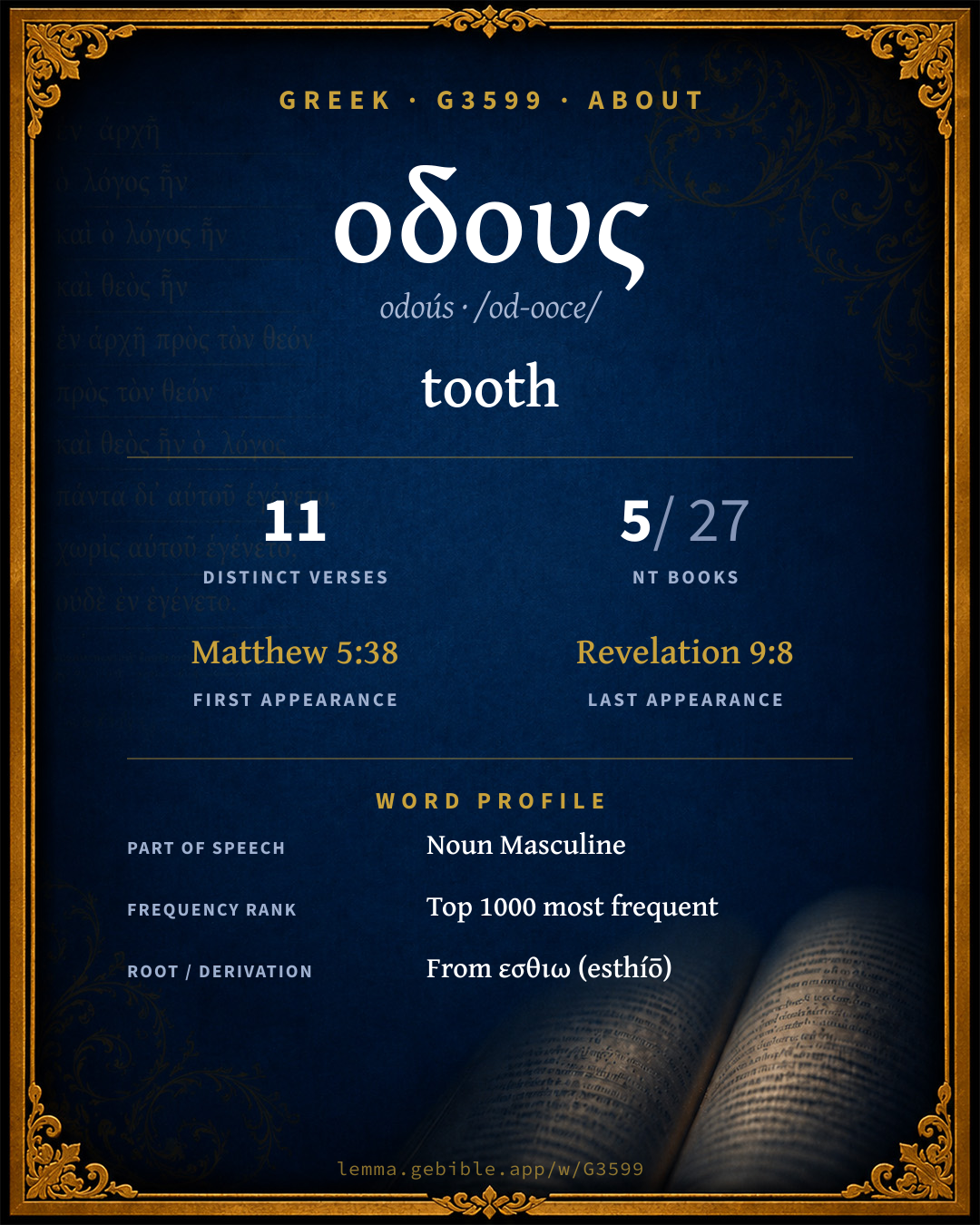
ὀδούς
tooth
Full lexicon entry — Thayer's Greek Lexicon
From Thayer's Greek Lexicon
Where this word appears
Grammar key — what these labels mean
Part of speech
- Noun
- A naming word — a person, place, thing, or idea.
Case
- Genitive
- The case of source, possession, or “of” — answers “whose / from what.”
- Accusative
- The case of the direct object and of extent.
- Nominative
- The case of the subject (and the predicate nominative).
Gender
- Masculine
- Grammatically masculine.
Number
- Plural
- More than one.
- Singular
- One.
Every verse where G3599 appears in the Book of Revelation — 1 distinct verse. Click any verse to open its interlinear word-by-word view. Verse text shown in the World English Bible for context — . Each verse’s Greek form is shown with its reference; the English is not keyword-highlighted, since the data carries no word-level English alignment. Use “Compare translations” on any verse to read it across multiple English versions. This concordance covers the Greek New Testament; Septuagint (Greek Old Testament) occurrences of this word are not indexed here.
Revelation
About this entry
At a glance — auto-summarized from this page’s data, not written by a person. Every figure links to its source below. This summary describes the numbers; it doesn’t interpret them.
At its core, οδους (odoús) means “tooth.” The word gravitates to Matthew (64%), then Mark and Luke. It appears 11 verses across 5 books of the Greek New Testament, among its uncommon vocabulary. First canonically at Matthew 5:38, it enters the text early. It shares a root with εσθιω, νηστις and φαγω. Each statement above links to its evidence; the full detail follows below.
Gloss history
Strong's 1890 vs modern scholarship
About this word
Strong's G3599 catalogs a Greek word from the Greek New Testament.
These counts are not copied from any lexicon or concordance. They are computed here, from the morphology-tagged Greek New Testament. What Lemma adds →
- 11
- distinct verses
- The word appears in 11 distinct verses.
- 5 / 27
- NT books
- The word appears in 5 of 27 New Testament books.
- #904
- by frequency
- Top 1000 most frequent Greek words (rank 904 of 5,347 Greek words by occurrence).
View all 11 occurrences in the concordance →
By section of the New Testament
By traditional corpus
Conventional, traditional groupings — biblical authorship is debated, so this is a traditional corpus grouping, not an authorship claim. Some books belong to more than one corpus (Luke is in both the Gospels and the Lukan corpus, and so on), so these shares overlap and need not total 100%. Each figure is a share of the word’s 11 distinct verses.
- Gospels 9 verses · 82%
- Lukan (Luke–Acts) 2 verses · 18%
- Johannine 1 verse · 9%
- Revelation 1 verse · 9%
How translations render this word
Counts come from each version’s own published word-to-Strong’s tagging or interlinear alignment — an approximate guide to how each version renders this word, not a word-level alignment the data otherwise carries. Because each total is that version’s own tagged count, the per-version totals vary from one another and need not match the appearance or distinct-verse counts above. These counts may also differ from a printed concordance because Lemma counts each distinctly tagged rendering and does not collapse phrase taggings into a single head-word total. This is a fixed set of word-tagged versions (KJV, ASV, BSB, ULT) and does not change with the reading translation you choose elsewhere. Each version’s license is shown beside its name below (and on Sources).
- King James Version: Teeth 10×, Tooth 2×
- American Standard Version: Teeth 10×, Tooth 2×
- Berean Standard Bible: Teeth 10×, Tooth 2×
- unfoldingWord Literal Text: Teeth 10×, Tooth 2×
King James Version Public Domain
Renders G3599 across 12 tagged occurrences — most commonly:
American Standard Version Public Domain
Renders G3599 across 13 tagged occurrences — most commonly:
Plus 1 rendering that appears only once — usually multi-word phrases or single function words the recovered tagging swept in, not distinct renderings.
Berean Standard Bible Public Domain
Renders G3599 across 12 tagged occurrences — most commonly:
unfoldingWord Literal Text CC BY-SA 4.0
Renders G3599 across 12 tagged occurrences — most commonly:
Senses in Thayer's
The 1 sense Thayer's distinguishes for this word, in lexicon order (not ranked by frequency or importance). The full entry — with sub-senses — is in the Lexicon Entry tab.
- a tooth
Word origin
Derived from εσθιω (esthíō) (G2068) — to eat.
Perhaps from the base of G2068 ; a tooth : - tooth.
— Strong’s Exhaustive Concordance (1890), public domain.
Forms in the corpus
The 5 distinct written forms G3599 takes in the Greek New Testament, most frequent first — each parse links to that case’s occurrences in the concordance.
| Form | Parsing | Example | Uses |
|---|---|---|---|
| ὀδόντων odóntōn | Noun, Genitive, Plural, Masculine | Matthew 8:12 | 7 |
| ὀδόντας odóntas | Noun, Accusative, Plural, Masculine | Mark 9:18 | 2 |
| ὀδόντα odónta | Noun, Accusative, Singular, Masculine | Matthew 5:38 | 1 |
| ὀδόντες odóntes | Noun, Nominative, Plural, Masculine | Revelation 9:8 | 1 |
| ὀδόντος odóntos | Noun, Genitive, Singular, Masculine | Matthew 5:38 | 1 |
Same root — word family
Other Thayer's entries built from the same root as G3599, grouped by Strong’s listed origin. These share a root / origin per the lexicon — not necessarily a shared meaning. Each links to that word’s own entry.
Derives from
Shares the same root
Compare all same-root words → They share a root, not necessarily a meaning.
Septuagint usage
The same Greek word οδους appears 46 times in the Greek Old Testament (Septuagint), across 40 verses in 19 books.
- 46
- LXX occurrences
- Tagged occurrences of this Greek word in the Septuagint.
- 40
- verses
- Distinct Septuagint verses containing this word.
- 19 / 39
- OT books
- The word appears in 19 of the 39 Old Testament books.
Sample Septuagint occurrences
- Genesis 49:12 ὀδούς
- Exodus 21:24 ὀδούς
- Leviticus 24:20 ὀδούς
- Numbers 11:33 ὀδούς
- Deuteronomy 19:21 ὀδούς
- 1 Samuel 13:21 ὀδούς
- 2 Chronicles 9:17 ὀδούς
- Job 13:14 ὀδούς
- Psalms 3:8 ὀδούς
- Proverbs 10:26 ὀδούς
- Song of Solomon 4:2 ὀδούς
- Jeremiah 38:29 ὀδούς
Septuagint occurrences (same lexeme)
Every verse where the same Strong’s number (G3599) appears in the Greek Septuagint. Verse text shown in the World English Bible for context; the Greek form is the matched word — the English is not keyword-highlighted.
- Genesis 49:12 ὀδούς His eyes will be red with wine, His teeth white with milk.
- Exodus 21:24 ὀδούς eye for eye, tooth for tooth, hand for hand, foot for foot,
- Exodus 21:27 ὀδούς If he strikes out his man-servant's tooth, or his maid-servant's tooth, he shall let him go free for his tooth's sake.
- Leviticus 24:20 ὀδούς fracture for fracture, eye for eye, tooth for tooth; as he has injured someone, so shall it be done to him.
- Numbers 11:33 ὀδούς While the flesh was yet between their teeth, before it was chewed, the anger of Yahweh was kindled against the people, and Yahweh struck the people with a very great plague.
- Deuteronomy 19:21 ὀδούς Your eyes shall not pity; life [shall go] for life, eye for eye, tooth for tooth, hand for hand, foot for foot.
- Deuteronomy 32:24 ὀδούς [They shall be] wasted with hunger, and devoured with burning heat Bitter destruction; The teeth of animals will I send on them, With the poison of crawling things of the dust.
- 1 Samuel 13:21 ὀδούς yet they had a file for the mattocks, and for the plowshares, and for the forks, and for the axes, and to set the goads.
- 2 Chronicles 9:17 ὀδούς Moreover the king made a great throne of ivory, and overlaid it with pure gold.
- 2 Chronicles 9:21 ὀδούς For the king had ships that went to Tarshish with the servants of Huram; once every three years came the ships of Tarshish, bringing gold, and silver, ivory, and apes, and peacocks.
- Job 13:14 ὀδούς Why should I take my flesh in my teeth, And put my life in my hand?
- Job 16:9 ὀδούς He has torn me in his wrath, and persecuted me; He has gnashed on me with his teeth: My adversary sharpens his eyes on me.
- Job 19:20 ὀδούς My bones stick to my skin and to my flesh. I have escaped by the skin of my teeth.
- Job 29:17 ὀδούς I broke the jaws of the unrighteous, And plucked the prey out of his teeth.
- Job 41:6 ὀδούς Will traders barter for him? Will they part him among the merchants?
- Psalms 3:8 ὀδούς Salvation belongs to Yahweh. Your blessing be on your people. Selah.
- Psalms 34:16 ὀδούς Yahweh's face is against those who do evil, To cut off the memory of them from the earth.
- Psalms 36:12 ὀδούς There the workers of iniquity are fallen. They are thrust down, and shall not be able to rise.
- Psalms 56:5 ὀδούς All day long they twist my words. All their thoughts are against me for evil.
- Psalms 57:7 ὀδούς My heart is steadfast, God, my heart is steadfast. I will sing, yes, I will sing praises.
- Psalms 111:10 ὀδούς The fear of Yahweh is the beginning of wisdom. All those who do his work have a good understanding. His praise endures forever!
- Psalms 123:6 ὀδούς
- Proverbs 10:26 ὀδούς As vinegar to the teeth, and as smoke to the eyes, So is the sluggard to those who send him.
- Proverbs 25:19 ὀδούς Confidence in someone unfaithful in time of trouble Is like a bad tooth, or a lame foot.
- Proverbs 30:14 ὀδούς There is a generation whose teeth are like swords, And their jaws like knives, To devour the poor from the earth, and the needy from among men.
- Song of Solomon 4:2 ὀδούς Your teeth are like a newly shorn flock, Which have come up from the washing, Where every one of them has twins. None is bereaved among them.
- Song of Solomon 6:6 ὀδούς Your teeth are like a flock of ewes, Which have come up from the washing; Of which every one has twins; None is bereaved among them.
- Song of Solomon 7:10 ὀδούς I am my beloved's. His desire is toward me.
- Jeremiah 38:29 ὀδούς
- Jeremiah 38:30 ὀδούς
- Lamentations 2:16 ὀδούς All your enemies have opened their mouth wide against you; They hiss and gnash the teeth; they say, We have swallowed her up; Certainly this is the day that we looked for; we have found, we have seen it.
- Lamentations 3:16 ὀδούς He has also broken my teeth with gravel stones; he has covered me with ashes.
- Ezekiel 18:2 ὀδούς What do you mean, that you use this proverb concerning the land of Israel, saying, The fathers have eaten sour grapes, and the children's teeth are set on edge?
- Ezekiel 27:15 ὀδούς The men of Dedan were your traffickers; many isles were the market of your hand: they brought you in exchange horns of ivory and ebony.
- Daniel 7:7 ὀδούς After this I saw in the night-visions, and, behold, a fourth animal, awesome and powerful, and strong exceedingly; and it had great iron teeth; it devoured and broke in pieces, and stamped the residue with its feet: and it was diverse from all the animals that were before it; and it had ten horns.
- Daniel 7:19 ὀδούς Then I desired to know the truth concerning the fourth animal, which was diverse from all of them, exceedingly terrible, whose teeth were of iron, and its nails of brass; which devoured, broke in pieces, and stamped the residue with its feet;
- Joel 1:6 ὀδούς For a nation has come up on my land, strong, and without number. His teeth are the teeth of a lion, And he has the fangs of a lioness.
- Amos 4:6 ὀδούς "I also have given you cleanness of teeth in all your cities, And lack of bread in every town; Yet you haven't returned to me," says Yahweh.
- Micah 3:5 ὀδούς Thus says Yahweh concerning the prophets who lead my people astray; for those who feed their teeth, they proclaim, "Peace!" and whoever doesn't provide for their mouths, they prepare war against him:
- Zechariah 9:7 ὀδούς I will take away his blood out of his mouth, And his abominations from between his teeth; And he also will be a remnant for our God; And he will be as a chieftain in Judah, And Ekron as a Jebusite.
These are occurrences of the same Greek lexeme (G3599) in the Septuagint — not a translation of any one Hebrew word. The store carries no word-level Hebrew↔Greek alignment, so no Hebrew original is asserted here. Counts come from the recovered LXX Strong's tagging — high-frequency vocabulary is well covered, while rare or late forms may be untagged — so they reflect tagged occurrences and may slightly undercount.