

Proverbs 10:26

Hebrew (Westminster Leningrad Codex) Proverbs 10:26 appears in the Hebrew Old Testament. The text above is from the Westminster Leningrad Codex. Each word links to its Strong’s number, a concise gloss, and parsing drawn from the Open Scriptures Hebrew Bible morphology. Click any word for its full Brown-Driver-Briggs (BDB) entry.
Download image
Cite this verse

Proverbs 10:26 (World English Bible). Public Domain. Lemma interlinear Bible study tool, https://lemma.gebible.app/v/proverbs/10/26.

Show BibTeX & RIS
BibTeX
RIS
English Translation
As vinegar to the teeth, and as smoke to the eyes, So is the sluggard to those who send him.
World English Bible · Public Domain
Download a study sheet

One document with this verse’s original text, its word-by-word gloss line, the meaning frame, cross-references with their text, attributed commentary, and full source and license credits — printable, and it pastes into notes with its structure intact.

This verse Autodidact and up

Study sheet (.html) Plain text (.txt)

A passage Seminary Student

Up to 50 verses in one chapter. A passage sheet keeps up to 6 commentary sources and 12 cross-references per verse, in the order this page ranks them, and says so on the sheet whenever that leaves anything out. Ask for a single verse and you get the Autodidact verse sheet above.

Everything on this page stays free to read, with no account — the sheet is a download of what is already on screen, not access to it.

Want to remove ads? Support Godless Engineer
Compare translations 3

The same verse in 3 English versions, stacked beneath the original-language interlinear above. Click any original word for its lexicon entry.

Each is an independent rendering of the whole verse — the interlinear is not word-aligned to these translations.

Highlighted words mark where these versions differ — a whole-verse word diff, not a word-by-word alignment.

  • World English Bible Public Domain
    As vinegar to the teeth, and as smoke to the eyes, So is the sluggard to those who send him.
  • King James Version Public Domain
    As vinegar to the teeth, and as smoke to the eyes, so is the sluggard to them that send him.
  • unfoldingWord Literal Text CC BY-SA 4.0
    Like vinegar to the teeth and smoke to the eyes, so the lazy one to one who sends him.

unfoldingWord Literal Text — © unfoldingWord, licensed CC BY-SA 4.0. Word-aligned USFM3 via Door43 (git.door43.org/unfoldingWord/en_ult).

Versions to compare (up to 4)

3 of 4 selected

Show all 18 translations

Every available English version of this verse, each an independent rendering of the whole verse.

  • World English Bible Public Domain
    As vinegar to the teeth, and as smoke to the eyes, So is the sluggard to those who send him.
  • Berean Standard Bible Public Domain
    Like vinegar to the teeth and smoke to the eyes, so is the slacker to those who send him.
  • Majority Standard Bible Public Domain
    Like vinegar to the teeth and smoke to the eyes, so is the slacker to those who send him.
  • King James Version Public Domain
    As vinegar to the teeth, and as smoke to the eyes, so is the sluggard to them that send him.
  • American Standard Version (1901) Public Domain
    As vinegar to the teeth, and as smoke to the eyes, So is the sluggard to them that send him.
  • Revised Version (1885) Public Domain
    As vinegar to the teeth, and as smoke to the eyes, so is the sluggard to them that send him.
  • Geneva Bible (1599) Public Domain
    As vineger is to the teeth, and as smoke to the eyes, so is the slouthful to them that send him.
  • Douay-Rheims (1899) Public Domain
    As vinegar to the teeth, and smoke to the eyes, so is the sluggard to them that sent him.
  • Young's Literal Translation Public Domain
    As vinegar to the teeth, And as smoke to the eyes, So `is' the slothful to those sending him.
  • Literal Standard Version CC BY-SA 4.0
    As vinegar to the teeth, || And as smoke to the eyes, || So [is] the slothful to those sending him.
  • Unlocked Literal Bible CC BY-SA 4.0
    Like vinegar on the teeth and smoke in the eyes, so is the sluggard to those who send him.
  • unfoldingWord Literal Text CC BY-SA 4.0
    Like vinegar to the teeth and smoke to the eyes, so the lazy one to one who sends him.
  • Darby Bible Public Domain
    As vinegar to the teeth, and as smoke to the eyes, so is the sluggard to them that send him.
  • World Messianic Bible Public Domain
    As vinegar to the teeth, and as smoke to the eyes, so is the sluggard to those who send him.
  • Webster's Bible Public Domain
    As vinegar to the teeth, and as smoke to the eyes, so is the sluggard to them that send him.
  • Free Bible Version CC BY-SA 4.0
    In the same way vinegar irritates the teeth and smoke irritates the eyes, lazy people irritate their employers.
  • Bible in Basic English Public Domain
    Like acid drink to the teeth and as smoke to the eyes, so is the hater of work to those who send him.
  • JPS Tanakh (1917) Public Domain
    As vinegar to the teeth, and as smoke to the eyes, so is the sluggard to them that send him.

Literal Standard Version (2020), Covenant Press — licensed CC BY-SA 4.0. Text via the HelloAO Bible API (eBible.org). Unlocked Literal Bible (unfoldingWord) — licensed CC BY-SA 4.0. Text via the HelloAO Bible API (eBible.org). unfoldingWord Literal Text — © unfoldingWord, licensed CC BY-SA 4.0. Word-aligned USFM3 via Door43 (git.door43.org/unfoldingWord/en_ult). Free Bible Version, Dr. Jonathan Gallagher — licensed CC BY-SA 4.0. Text via the HelloAO Bible API (eBible.org).

Word by word

More ways to search: Search by grammar → Find every occurrence → Compare this word →

Practice this passage: Drill this verse → Learn its vocabulary →

About this verse

These counts appear in no published source. They are computed here, from the morphology-tagged text and Lemma’s own curated glosses. What Lemma adds →

7
words
7
distinct lemmas
Wisdom
section

Notable vocabulary

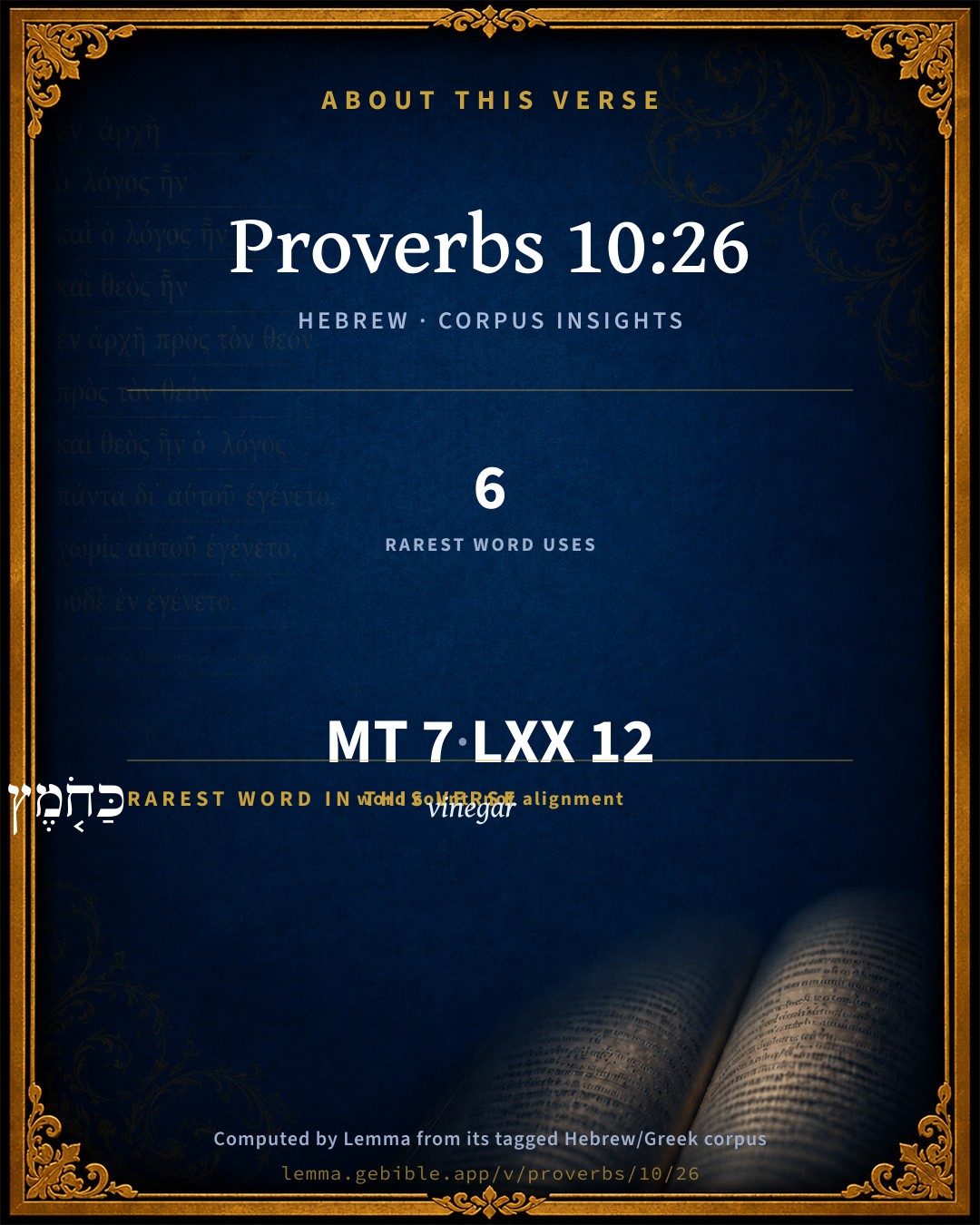
The rarest word here is כַּחֹ֤מֶץ vinegar H2558 — appearing just 6 times in the whole Hebrew Bible.

Shared distinctive vocabulary

כַּחֹ֤מֶץ vinegar H2558 occurs in 5 verses of the Hebrew Bible. Also found in:

Grammatical profile

  • 1 verb
  • 4 nouns
  • 1 adjective
  • 1 particle

Verb forms

  • לְשֹׁלְחָֽיו Qal · Participle Active

Hebrew & Septuagint length

In English translation the verse runs 20 words from the Hebrew and 21 from the Septuagint (LXX English) — closely comparable.

A rough comparison of the two English renderings, which tokenize alike — not a word-level alignment.

Word counts can differ between the Hebrew and the Greek without any difference in meaning — e.g. the Hebrew direct-object marker אֵת has no separate Greek word, and Greek often adds the article ὁ.

In the original languages it is 7 Hebrew tokens and 12 Greek tokens — but the two are counted differently (Hebrew bundles its prefixes and suffixes into one token; the Greek is in lemma form), so that isn’t a like-for-like length.

Cross-references

7

Topical passages linked to Proverbs 10:26 in the Treasury of Scripture Knowledge — connected by theme and wording, ordered by reader-vote popularity; previews shown in the World English Bible.

  • Proverbs 25:13 As the cold of snow in the time of harvest, So is a faithful messenger to those who send him; For he refreshes the soul of his masters.
  • Proverbs 26:6 One who sends a message by the hand of a fool Is cutting off feet and drinking violence.
  • Proverbs 25:20 As one who takes away a garment in cold weather, Or vinegar on soda, So is one who sings songs to a heavy heart.
  • Matthew 25:26 "But his lord answered him, 'You wicked and slothful servant. You knew that I reap where I didn't sow, and gather where I didn't scatter.
  • Isaiah 65:5 who say, Stand by yourself, don't come near to me, for I am holier than you. These are a smoke in my nose, a fire that burns all the day.
  • Romans 12:11 not lagging in diligence; fervent in spirit; serving the Lord;
  • Hebrews 6:12 that you won't be sluggish, but imitators of those who through faith and patience inherited the promises.

Cross-references courtesy of OpenBible.info (CC BY 4.0).

Hebrew and Greek witnesses Masoretic Hebrew ↔ Greek Septuagint

The same verse in the two great witnesses to the Old Testament, shown verse-for-verse.

These are two independent witnesses, not word-aligned to each other, and the Septuagint is shown in lemma (dictionary) form.

Hebrew Proverbs 10:26 Masoretic · Westminster Leningrad Codex

כַּחֹ֤מֶץ לַשִּׁנַּ֗יִם וְכֶעָשָׁ֥ן לָעֵינָ֑יִם כֵּ֥ן הֶ֝עָצֵ֗ל לְשֹׁלְחָֽיו

As vinegar to the teeth, and as smoke to the eyes, So is the sluggard to those who send him.

World English Bible · Public Domain

Greek LXX Proverbs 10:26 Septuagint · lemma form

ὥσπερ ὄμφαξ ὀδούς βλαβερός καί καπνός ὄμμα οὕτως παρανομία ὁ χράομαι αὐτός

As a sour grape is hurtful to the teeth, and smoke to the eyes, so iniquity hurts those that practise it.

LXX2012 (modern English Septuagint) · Public Domain

On this verse, John Gill's Exposition discusses the Septuagint’s reading. Read the note in Commentary ↓

Hebrew: Westminster Leningrad Codex (CC BY 4.0). Greek: Septuagint (public domain); English from LXX2012 (modern English Septuagint) (Public Domain). How the Septuagint differs from the Hebrew →

Commentary

Notes on Proverbs 10:26 from classic Christian and Jewish commentators (each source and its license shown beneath its notes). The classic Christian expositions comment on the surrounding passage and are grouped to its opening verse, so a note may address several verses; the Jewish commentaries on the Tanakh (Rashi and others) are per-verse, so they appear only where the commentator wrote on this verse.

Lemma curates 59 commentaries, every one of them public domain or Creative Commons licensed, each selected and text-cleaned for this edition rather than reprinted as found. About our sources →

Trapp's Complete Commentary

John Trapp

Pro 10:26 As vinegar to the teeth, and as smoke to the eyes, so [is] the sluggard to them that send him.

Ver. 26. So is the sluggard to them that send him.] Habent aulae suum cito, cito. What thou doest, do quickly, said our Saviour to the traitor. He cannot away with dulness and oscitancy in any of his, but condemns it in those slow things, νωθροι, the Hebrews, {Heb 5:11} and commands them double diligence. {Pro 6:11-12} "Not slothful in business; fervent in spirit; serving the Lord." {Rom 12:11} A dull heart makes no riddance. Baruc accendit seipsum {Neh 3:20} repairing earnestly, and so finished his task in shorter time. Let ambassadors, ministers, messengers, &c., nimble up their business, or look for no thank. What a deal of content gave Cranmer to Henry VIII, by his expediting the business of the divorce, both at home and abroad, in foreign universities! And what a deal of distaste gave Wolsey by the contrary!

John Trapp, A Commentary or Exposition upon All the Books of the Old and New Testament (1647–1656) — public domain. Text from a community e-Sword module.

Joseph Benson's Commentary

Pro 10:26. As vinegar to the teeth — Which, by its coldness and sharpness, it offends; and as smoke, &c., so is the sluggard — Unserviceable and vexatious. “A negligent, dilatory servant vexes those who send him, just as keen vinegar gives pain to the teeth, and bitter smoke torments the eyes.” — Schultens.

Joseph Benson's Commentary on the Old and New Testaments (1811–1818) — public domain. Text from a community e-Sword module.

The Preacher's Complete Homiletical Commentary

Joseph S. Exell (gen. ed.)

MAIN HOMILETICS OF Pro_10:26

THE VEXATIOUSNESS OF A SLUGGISH SERVANT

I. He is as smoke to the eyes. Smoke in the eyes prevents the accomplishment of a man’s purposes, or at least it hinders and annoys him in their execution. The eye is the light of the body; if vision is in any way obstructed or impaired, delay and vexation must ensue. So the employer of a sluggish servant must be the victim of perplexity and annoyance. He sends him on an errand, or entrusts him with a work which it is important should be done within a certain time. But he lingers over it until the time is long past, and perhaps an opportunity is lost which can never be recalled. Much often depends upon the performance of duties up to time. The want of punctuality sometimes is as disastrous as not doing the thing at all. How many plans have been frustrated, how many sufferings have in various ways been entailed upon men, by delay in the performance of duty. A master who has to depend upon a sluggard is like a man in the midst of the smoke of a burning house; he is uncertain as to his present whereabouts, and ignorant of what mishap may befal him next.

II. He is as vinegar to the teeth. He is most irritating to the temper. As vinegar sours everything with which it comes in contact, so a sluggard sours the temper of those with whom he has to do, and makes them sometimes not only irritable with him who is the offender, but with the innocent also.

OUTLINES AND SUGGESTIVE COMMENTS

Does, then, the sluggard disappoint and provoke his earthly master? See that we be not such sluggards to our Heavenly Master. Laodicean professors are especially hateful in his sight (Rev_3:16). The slothful minister carries in a tremendous account to Him that sent him. No more pitiable object is found than the man who has time to spare, who has no object of commanding interest, and is going on to the end as if he had spent his whole life in children’s play, and had lived to no useful purpose.… Why “standeth he idle in the market-place?” It cannot be—“No man hath hired him.” His master’s call sounds in his ears—“Go ye into the vineyard.” And at his peril he disobeys it (Mat_20:7-30).—Bridges.

Sluggishness is a cutting, vexing thing. If we are Christ’s, we should crucify this self-pleasing affection of the flesh.… It is a sin to waste another man’s time, as much as to waste his property. “Whatsoever ye do, do all to the glory of God.” No doubt it is the natural disposition of some people to be slovenly and unexact. But what is your religion worth if it do not correct such a propensity?… If any man be in Christ he is a new creature. If the new life is strong in the heart, it will send its warm pulses down to the extremest member.… He who is a Christian in little things is not a little Christian; he is the greatest Christian, and the most useful. The baptism of these little outlying things shows that he is full of grace, for these are grace’s overflowings; and they are ever the overflowings of the full well that refresh the desert. The great centre must be fully occupied before the stream can reach that outer edge.—Arnot.

The Preacher's Complete Homiletical Commentary (gen. ed. Joseph S. Exell; Funk & Wagnalls, c. 1892) — public domain (pre-1929). A full-Bible homiletical/sermon-outline anthology covering 65 of 66 books (2 John is absent from the source module). Text from a community e-Sword module.

Geneva Bible (1599)

Geneva Bible translators

He is but a trouble and grief to him about any business.

Geneva Bible (1599) marginal notes — public domain. Text via Bolls.life.

Matthew Henry's Commentary

Observe, 1. Those that are of a slothful disposition, that love their ease and cannot apply their minds to any business, are not fit to be employed, no, not so much as to be sent on an errand, for they will neither deliver a message with any care nor make any haste back. Such therefore are very unmeet to be ministers, Christ's messengers; he will not own the sending forth of sluggards into his harvest. 2. Those that are guilty of so great an oversight as to entrust such with any affair, and put confidence in them, will certainly have vexation with them. A slothful servant is to his master as uneasy and troublesome as vinegar to the teeth and smoke to the eyes; he provokes his passion, as vinegar sets the teeth on edge, and occasions him grief to see his business neglected and undone, as smoke sets the eyes a weeping.

Matthew Henry's Commentary on the Whole Bible (1708–1710) — public domain (CC PDM 1.0). Text via the HelloAO Bible API.

Jamieson, Fausset & Brown

Robert Jamieson, A. R. Fausset & David Brown

that is, causes vexation.

Jamieson, Fausset & Brown — Commentary Critical and Explanatory on the Whole Bible (1871) — public domain (CC PDM 1.0). Text via the HelloAO Bible API.

Adam Clarke's Commentary

Verse 26. As vinegar to the teeth] The acid softening and dissolving the alkali of the bone, so as to impair their texture, and render them incapable of masticating; and as smoke affects the eyes, irritating their tender vessels, so as to give pain and prevent distinct vision; so the sluggard, the lounging, thriftless messenger, who never returns in time with the desired answer.

Adam Clarke's Commentary on the Bible (1810–1826) — public domain. Text from a community e-Sword/MySword module.

The Cambridge Bible for Schools and Colleges

gen. ed. J. J. S. Perowne

26. them that send him] Contrast Pro_25:13.

The Cambridge Bible for Schools and Colleges (gen. ed. J. J. S. Perowne; Cambridge University Press, 1878–1918) — public domain. Text from a community e-Sword module.

John Gill's Exposition

As vinegar to the teeth,.... Which, with its coldness and sourness, blunts the teeth, and makes it troublesome to eat: the Septuagint, Syriac, and Arabic versions, render it,

"as the sour grape is hurtful to the teeth;''

sets them on edge;

and as smoke to the eye; dims the sight, causes the eye to water, and is very pernicious and vexatious:

so is the sluggard to them that send him: that is, the slothful messenger, as the Targum explains it; who, being sent on an errand, is dilatory, does not make haste to bring back the answer; which is very vexatious to those that send him, raises their passions, makes them fretful and very angry, be it on what account it will: so slothful and unprofitable servants, to whom talents are given for usefulness, which they hide or use not, are very provoking to Christ, and whom he will order into outer darkness; those who have gifts for sacred service ought not to be slothful in business, but fervent in spirit, serving the Lord, Mat 25:26.

John Gill's Exposition of the Whole Bible (1746–1763) — public domain (CC PDM 1.0). Text via the HelloAO Bible API.

Albert Barnes' Notes on the Bible

The teeth set on edge by the sour wine used by peasants Rth 2:14; Psa 69:21, the eye irritated by wood-smoke, these shadow the annoyance of having a messenger who will loiter on the way.

Albert Barnes' Notes on the Bible (1834–1885) — public domain. Text from a community e-Sword/MySword module.

Haydock's Catholic Bible Commentary

Him. He spoils all their projects, (Calmet) and becomes a nuisance.

George Leo Haydock (1774–1849), Haydock's Catholic Family Bible and Commentary, 1859 edition — public domain. Excludes Psalms (Douay-Rheims chapter numbering differs from Protestant) and Deuterocanonical books (Catholic canon only).

Matthew Poole's English Annotations

As vinegar to the teeth; Which by its cold and sharpness it offends.

So is the sluggard; unserviceable and vexatious.

Matthew Poole's English Annotations on the Holy Bible (1683–1685) — public domain. Text from a community e-Sword/MySword module.

Whedon's Commentary on the Bible

Daniel D. Whedon

26. As… smoke… so is the sluggard — Not an antithetic verse, but a similitude easily apprehended. A sluggard is an annoyance, as is acid to the teeth or smoke to the eyes.

Vinegar — Sour wine. Compare Num_6:3; Psa_69:21; Rth_2:14.

Daniel D. Whedon (gen. ed.), Commentary on the Old and New Testaments (1874–1909) — public domain. Text from a community e-Sword module.

The Pulpit Commentary

Vinegar. (Rth_2:14 Psa_69:21) As sour wine sets the teeth on edge. Septuagint, "as the unripe grape is harmful to the teeth". (Eze_18:2) Smoke. In a country where chimneys were unknown, and the fuel was wood or some substance more unsavoury, the eyes must have often been painfully affected by the household fire. Thus lacrimosus, "tear-producing," is a classical epithet of smoke (see Ovid, "Metam.," 10:6; Her., "Sat.," 1:5, 80). To these two annoyances is compared the messenger who loiters on his errand. The last clause is rendered by the LXX, "So is iniquity to those who practise it it brings only pain and vexation.

The lazy man a nuisance.

I HE IRRITATES HIS EMPLOYERS. The images of the teeth set on edge, the blinded, smarting eyes, give the thought with great force and great naivete.

II HE IS WORSE THAN USELESS. The Bible shows a great aversion from idleness, sluggishness. (Pro_6:6, seqq.; Pro_12:27 Pro_19:24 Pro_22:13)

1. Laziness is a vice and the parent of worse.

2. The swift discharge of duty is acceptable to God and man. J.

The Pulpit Commentary (1880–1919), ed. H.D.M. Spence-Jones & Joseph S. Exell — public domain. Text from a community e-Sword module.

John Wesley's Explanatory Notes

So - Unserviceable and vexatious.

John Wesley, Explanatory Notes Upon the Whole Bible (1754–1765) — public domain. Text via the GEBible commentary corpus.

Keil & Delitzsch

C. F. Keil & F. Delitzsch

21 The lips of the righteous edify many;

But fools die through want of understanding.

Keil & Delitzsch — Biblical Commentary on the Old Testament (1861–1891) — public domain (CC PDM 1.0). Text via the HelloAO Bible API. (Old Testament only.)

Bridges on Proverbs

Charles Bridges

A lively figure of the vexation of the sluggard to his employers! (Contrast Pro 26:6, with Pro 13:17 ; Pro 25:13 .) Suppose a fire to be extinguished, medical assistance needed, a message of urgent haste to be conveyed — he is worse than unserviceable. Common prudence dictates the selection of active and industrious servants. And such when influenced by godly principles, are "worthy of double honour." (Pro 22:29 . Gen 24:1-14 . 1Ti 5:17 .)

Does then the sluggard disappoint and provoke his earthly master? See that we be not such sluggards to our heavenly Master. Laodicean professors are specially hateful in his sight. (Rev 3:16 .) The slothful Minister carries in a tremendous account to him that sent him. No more pitiable object is found, than the man who has time to spare; who has no object of commanding interest; and is going on to the end, as if he had spent his whole life in children’s play, and had lived for no useful purpose. He may probably have parceled out a portion of his time for some miscalled religious duty. But he might as well be asleep as on his knees; in idleness as in meditation — so little pains — so little heart, is connected with his duties! Why "standeth he idle in the market-place?" It cannot be — "No man hath hired him." His Master’s call sounds in his ears — "Go ye into the vineyard." (Mat 20:7 .) And at his peril he disobeys it. (Mat 25:30 .)

Charles Bridges, An Exposition of the Book of Proverbs (1846) — public domain. Text from a community e-Sword module.

Kretzmann's Popular Commentary

Paul E. Kretzmann

v. 26. As vinegar to the teeth, affecting the enamel and tending to make the teeth feel dull, and as smoke to the eyes, affecting the sensitive membranes and interfering with sight, so is the sluggard to them that send him, a source of constant vexation and worry.

Paul E. Kretzmann, Popular Commentary of the Bible (1921–1924) — public domain. Text from a community e-Sword module.

unfoldingWord translationNotes

Door43 World Missions Community

Like vinegar on the teeth and smoke in the eyes, so is the sluggard to those who send him

"Vinegar" and "smoke" represent things that hurt a person's teeth and eyes. AT: "Sending a lazy person to accomplish a task is irritating and unpleasant" (See: Simile)

vinegar

a sour liquid used to flavor or preserve foods

the years of the wicked

"Years" represent the time a person lives. AT: "the lifetime of the evil person" (See: Metaphor)

translationWords

send

fear

Yahweh

life

evil

unfoldingWord translationNotes — © Distant Shores Media and the Door43 World Missions Community, licensed CC BY-SA 4.0. Source: git.door43.org/Door43/en_tn.

Lesson kit

Teaching starters — assembled from the data on this page, not authored interpretation. Every prompt links to the verse data it draws on. Edit before teaching.

Proverbs, in the Wisdom, opens this verse with 7 words (7 distinct Hebrew lemmas). Its most distinctive word is chômets (“vinegar”). A historical commentator’s framing appears above. Read the whole chapter for the surrounding context.

Discussion questions

  1. How does “vinegar” (chômets) shape what this verse is saying?
  2. Numbers 6:3 shares the word «vinegar» with this verse. How do the two illuminate each other?
  3. These translations render this verse differently; the difference is in the English rendering, not the original. What questions does that raise?
  4. The verb «לְשֹׁלְחָֽיו» is Qal Participle Active. How does its form color the action?
  5. Reading how Trapp's Complete Commentary and Joseph Benson's Commentary read this verse, where do the two commentators agree and where do they part?

Things to notice

Reading settings

Reading text

Shown beneath each verse's original-language words.

Old Testament
Old Testament edition

Read the OT as the Masoretic Hebrew (MT) or the Greek Septuagint (LXX).

English shown for the Greek Septuagint (in the Hebrew ↔ Greek comparison).

Comparing translations? Open the Compare panel on any verse page to stack up to four side by side.