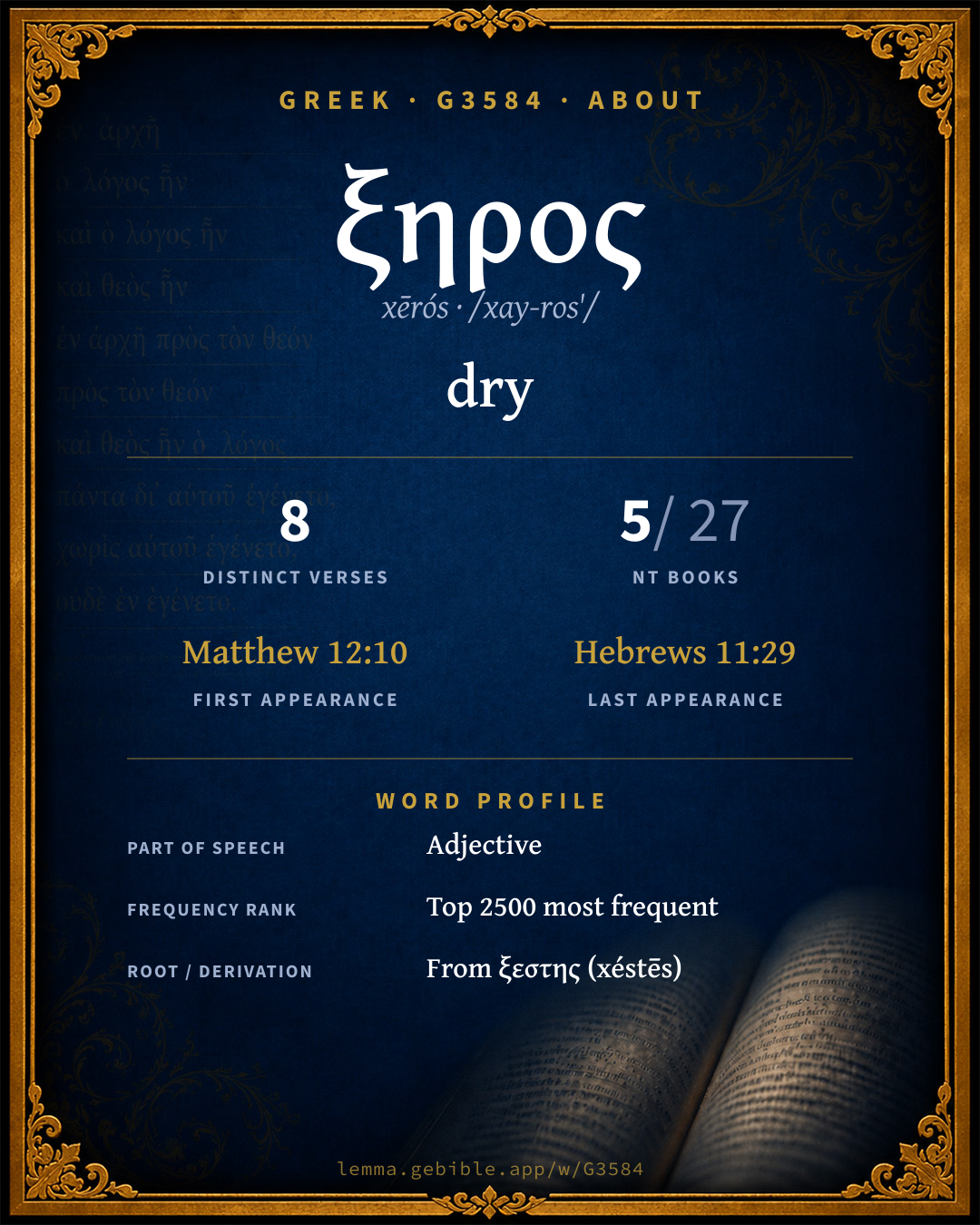
ξηρός
dry
Full lexicon entry — Thayer's Greek Lexicon
From Thayer's Greek Lexicon
Where this word appears
See every Accusative-case word in the Greek New Testament →
Grammar key — what these labels mean
Part of speech
- Adjective
- A word that describes or qualifies a noun.
Case
- Accusative
- The case of the direct object and of extent.
- Dative
- The case of the indirect object, means, or location — “to / for / with / in.”
- Genitive
- The case of source, possession, or “of” — answers “whose / from what.”
- Nominative
- The case of the subject (and the predicate nominative).
Gender
- Feminine
- Grammatically feminine.
- Neuter
- Grammatically neuter.
- Masculine
- Grammatically masculine.
Number
- Singular
- One.
- Plural
- More than one.
1 distinct verse where G3584 appears in the Nominative case, across 1 book. Filtered view — show all forms. Click any verse to open its interlinear word-by-word view. Verse text shown in the World English Bible for context — . Each verse’s Greek form is shown with its reference; the English is not keyword-highlighted, since the data carries no word-level English alignment. Use “Compare translations” on any verse to read it across multiple English versions. This concordance covers the Greek New Testament; Septuagint (Greek Old Testament) occurrences of this word are not indexed here.
Luke 1 verse
About this entry
At a glance — auto-summarized from this page’s data, not written by a person. Every figure links to its source below. This summary describes the numbers; it doesn’t interpret them.
At its core, ξηρος (xērós) means “dry.” First canonically at Matthew 12:10, it enters the text early. With 8 verses in 5 books, it is an uncommon word in the Greek New Testament. Its uses concentrate in Luke (38% of all occurrences). From the same root come ξεστης, ξυλον and λαξευτος. Each statement above links to its evidence; the full detail follows below.
Gloss history
Strong's 1890 vs modern scholarship
About this word
Strong's G3584 catalogs a Greek word from the Greek New Testament.
These counts are not copied from any lexicon or concordance. They are computed here, from the morphology-tagged Greek New Testament. What Lemma adds →
- 8
- distinct verses
- The word appears in 8 distinct verses.
- 5 / 27
- NT books
- The word appears in 5 of 27 New Testament books.
- #1,240
- by frequency
- Top 2500 most frequent Greek words (rank 1,240 of 5,347 Greek words by occurrence).
View all 8 occurrences in the concordance →
By section of the New Testament
By traditional corpus
Conventional, traditional groupings — biblical authorship is debated, so this is a traditional corpus grouping, not an authorship claim. Some books belong to more than one corpus (Luke is in both the Gospels and the Lukan corpus, and so on), so these shares overlap and need not total 100%. Each figure is a share of the word’s 8 distinct verses.
- Gospels 7 verses · 88%
- Lukan (Luke–Acts) 3 verses · 38%
- Johannine 1 verse · 13%
- Hebrews 1 verse · 13%
How translations render this word
Counts come from each version’s own published word-to-Strong’s tagging or interlinear alignment — an approximate guide to how each version renders this word, not a word-level alignment the data otherwise carries. Because each total is that version’s own tagged count, the per-version totals vary from one another and need not match the appearance or distinct-verse counts above. These counts may also differ from a printed concordance because Lemma counts each distinctly tagged rendering and does not collapse phrase taggings into a single head-word total. This is a fixed set of word-tagged versions (KJV, ASV, BSB, ULT) and does not change with the reading translation you choose elsewhere. Each version’s license is shown beside its name below (and on Sources).
- King James Version: Withered 4×, Dry 2×
- American Standard Version: Withered 4×, Dry 2×
- Berean Standard Bible: Withered 4×, Dry 2×
- unfoldingWord Literal Text: Withered 4×, Dry 2×
King James Version Public Domain
Renders G3584 across 7 tagged occurrences — most commonly:
Plus 1 rendering that appears only once — usually multi-word phrases or single function words the recovered tagging swept in, not distinct renderings.
American Standard Version Public Domain
Renders G3584 across 7 tagged occurrences — most commonly:
Plus 1 rendering that appears only once — usually multi-word phrases or single function words the recovered tagging swept in, not distinct renderings.
Berean Standard Bible Public Domain
Renders G3584 across 7 tagged occurrences — most commonly:
Plus 1 rendering that appears only once — usually multi-word phrases or single function words the recovered tagging swept in, not distinct renderings. Not rendered by a distinct English word in 1 further occurrence.
unfoldingWord Literal Text CC BY-SA 4.0
Renders G3584 across 8 tagged occurrences — most commonly:
Plus 2 renderings that appear only once — usually multi-word phrases or single function words the recovered tagging swept in, not distinct renderings.
Senses in Thayer's
The 1 sense Thayer's distinguishes for this word, in lexicon order (not ranked by frequency or importance). The full entry — with sub-senses — is in the Lexicon Entry tab.
- dry
Word origin
Derived from ξεστης (xéstēs) (G3582) — pitcher.
From the base of G3582 (through the idea of scorching ); arid ; by implication shrunken earth ( as opposed to water ): - dry land withered.
— Strong’s Exhaustive Concordance (1890), public domain.
Forms in the corpus
The 6 distinct written forms G3584 takes in the Greek New Testament, most frequent first — each parse links to that case’s occurrences in the concordance.
| Form | Parsing | Example | Uses |
|---|---|---|---|
| ξηρὰν xēràn | Adjective, Accusative, Singular, Feminine | Matthew 23:15 | 3 |
| ξηρά xērá | Adjective, Nominative, Singular, Feminine | Luke 6:6 | 1 |
| ξηράν xērán | Adjective, Accusative, Singular, Feminine | Matthew 12:10 | 1 |
| ξηρᾶς xērâs | Adjective, Genitive, Singular, Feminine | Hebrews 11:29 | 1 |
| ξηρῶν xērō̂n | Adjective, Genitive, Plural, Masculine | John 5:3 | 1 |
| ξηρῷ xērō̂ | Adjective, Dative, Singular, Neuter | Luke 23:31 | 1 |
Same root — word family
Other Thayer's entries built from the same root as G3584, grouped by Strong’s listed origin. These share a root / origin per the lexicon — not necessarily a shared meaning. Each links to that word’s own entry.
Derives from
Shares the same root
Derived from this word
Compare all same-root words → Showing 4 of 5 — not the complete family. They share a root, not necessarily a meaning.
Septuagint usage
The same Greek word ξηρος appears 33 times in the Greek Old Testament (Septuagint), across 30 verses in 11 books.
- 33
- LXX occurrences
- Tagged occurrences of this Greek word in the Septuagint.
- 30
- verses
- Distinct Septuagint verses containing this word.
- 11 / 39
- OT books
- The word appears in 11 of the 39 Old Testament books.
Sample Septuagint occurrences
- Genesis 1:9 ξηρός
- Exodus 4:9 ξηρός
- Joshua 3:17 ξηρός
- 1 Kings 16:28 ξηρός
- Job 24:19 ξηρός
- Psalms 65:6 ξηρός
- Isaiah 9:17 ξηρός
- Ezekiel 17:24 ξηρός
- Hosea 9:14 ξηρός
- Jonah 1:9 ξηρός
- Haggai 2:6 ξηρός
Septuagint occurrences (same lexeme)
Every verse where the same Strong’s number (G3584) appears in the Greek Septuagint. Verse text shown in the World English Bible for context; the Greek form is the matched word — the English is not keyword-highlighted.
- Genesis 1:9 ξηρός God said, "Let the waters under the sky be gathered together to one place, and let the dry land appear," and it was so.
- Genesis 1:10 ξηρός God called the dry land Earth, and the gathering together of the waters he called Seas. God saw that it was good.
- Genesis 7:22 ξηρός All in whose nostrils was the breath of the spirit of life, of all that was on the dry land, died.
- Exodus 4:9 ξηρός It will happen, if they will not believe even these two signs, neither listen to your voice, that you shall take of the water of the river, and pour it on the dry land. The water which you take out of the river will become blood on the dry land."
- Exodus 14:16 ξηρός Lift up your rod, and stretch out your hand over the sea, and divide it: and the children of Israel shall go into the midst of the sea on dry ground.
- Exodus 14:21 ξηρός Moses stretched out his hand over the sea, and Yahweh caused the sea to go back by a strong east wind all the night, and made the sea dry land, and the waters were divided.
- Exodus 14:22 ξηρός The children of Israel went into the midst of the sea on the dry ground, and the waters were a wall to them on their right hand, and on their left.
- Exodus 14:29 ξηρός But the children of Israel walked on dry land in the midst of the sea, and the waters were a wall to them on their right hand, and on their left.
- Exodus 15:19 ξηρός For the horses of Pharaoh went in with his chariots and with his horsemen into the sea, and Yahweh brought back the waters of the sea on them; but the children of Israel walked on dry land in the midst of the sea.
- Joshua 3:17 ξηρός The priests who bore the ark of the covenant of Yahweh stood firm on dry ground in the midst of the Jordan; and all Israel passed over on dry ground, until all the nation were passed clean over the Jordan.
- Joshua 4:22 ξηρός Then you shall let your children know, saying, Israel came over this Jordan on dry land.
- Joshua 9:5 ξηρός and old and patched shoes on their feet, and old garments on them; and all the bread of their provision was dry and was become moldy.
- 1 Kings 16:28 ξηρός So Omri slept with his fathers, and was buried in Samaria; and Ahab his son reigned in his place.
- Job 24:19 ξηρός Drought and heat consume the snow waters; So does Sheol those who have sinned.
- Psalms 65:6 ξηρός Who by his power forms the mountains, Having armed yourself with strength;
- Psalms 94:5 ξηρός They break your people in pieces, Yahweh, And afflict your heritage.
- Isaiah 9:17 ξηρός Therefore the Lord will not rejoice over their young men, neither will he have compassion on their fatherless and widows; for everyone is profane and an evil-doer, and every mouth speaks folly. For all this his anger is not turned away, but his hand is stretched out still.
- Isaiah 16:6 ξηρός We have heard of the pride of Moab, [that] he is very proud; even of his arrogance, and his pride, and his wrath; his boastings are nothing.
- Isaiah 37:27 ξηρός Therefore their inhabitants were of small power, they were dismayed and confounded; they were as the grass of the field, and as the green herb, as the grass on the housetops, and as a field [of grain] before it is grown up.
- Isaiah 56:3 ξηρός Neither let the foreigner, who has joined himself to Yahweh, speak, saying, Yahweh will surely separate me from his people; neither let the eunuch say, Behold, I am a dry tree.
- Ezekiel 17:24 ξηρός All the trees of the field shall know that I, Yahweh, have brought down the high tree, have exalted the low tree, have dried up the green tree, and have made the dry tree to flourish; I, Yahweh, have spoken and have done it.
- Ezekiel 21:3 ξηρός and tell the land of Israel, Thus says Yahweh: Behold, I am against you, and will draw forth my sword out of its sheath, and will cut off from you the righteous and the wicked.
- Ezekiel 37:2 ξηρός He caused me to pass by them round about: and, behold, there were very many in the open valley; and, behold, they were very dry.
- Ezekiel 37:4 ξηρός Again he said to me, Prophesy over these bones, and tell them, you dry bones, hear the word of Yahweh.
- Ezekiel 37:11 ξηρός Then he said to me, Son of man, these bones are the whole house of Israel: behold, they say, Our bones are dried up, and our hope is lost; we are clean cut off.
- Hosea 9:14 ξηρός Give them--Yahweh what will you give? Give them a miscarrying womb and dry breasts.
- Jonah 1:9 ξηρός He said to them, "I am a Hebrew, and I fear Yahweh, the God of heaven, who has made the sea and the dry land."
- Jonah 2:11 ξηρός
- Haggai 2:6 ξηρός For this is what Yahweh of Hosts says: 'Yet once, it is a little while, and I will shake the heavens, the earth, the sea, and the dry land;
- Haggai 2:21 ξηρός "Speak to Zerubbabel, governor of Judah, saying, 'I will shake the heavens and the earth.
These are occurrences of the same Greek lexeme (G3584) in the Septuagint — not a translation of any one Hebrew word. The store carries no word-level Hebrew↔Greek alignment, so no Hebrew original is asserted here. Counts come from the recovered LXX Strong's tagging — high-frequency vocabulary is well covered, while rare or late forms may be untagged — so they reflect tagged occurrences and may slightly undercount.