
Hosea 9:14

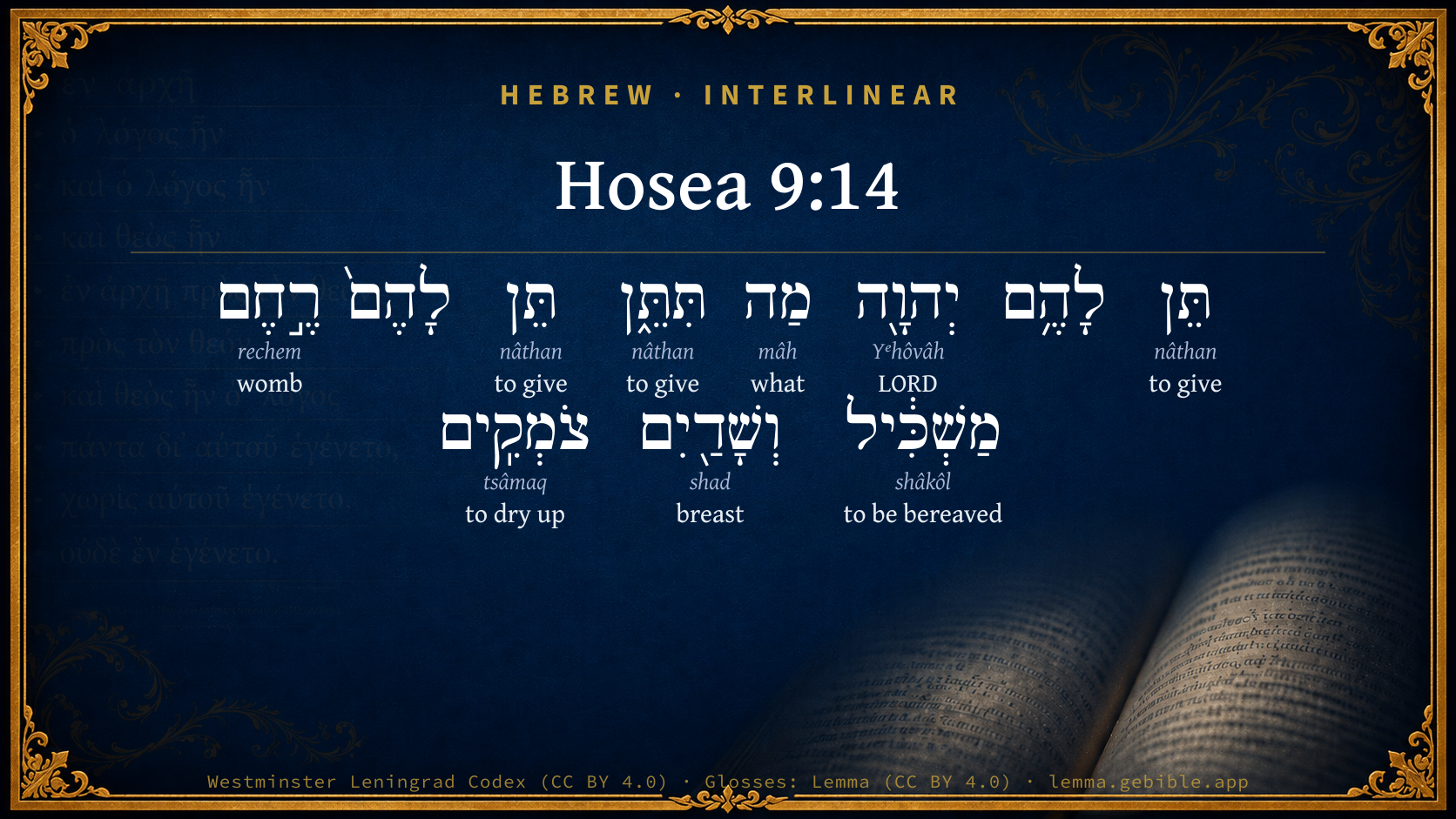
Hebrew (Westminster Leningrad Codex) Hosea 9:14 appears in the Hebrew Old Testament. The text above is from the Westminster Leningrad Codex. Each word links to its Strong’s number, a concise gloss, and parsing drawn from the Open Scriptures Hebrew Bible morphology. Click any word for its full Brown-Driver-Briggs (BDB) entry.
Download image
Cite this verse

Hosea 9:14 (World English Bible). Public Domain. Lemma interlinear Bible study tool, https://lemma.gebible.app/v/hosea/9/14.

Show BibTeX & RIS
BibTeX
RIS
English Translation
Give them--Yahweh what will you give? Give them a miscarrying womb and dry breasts.
World English Bible · Public Domain
Highlights
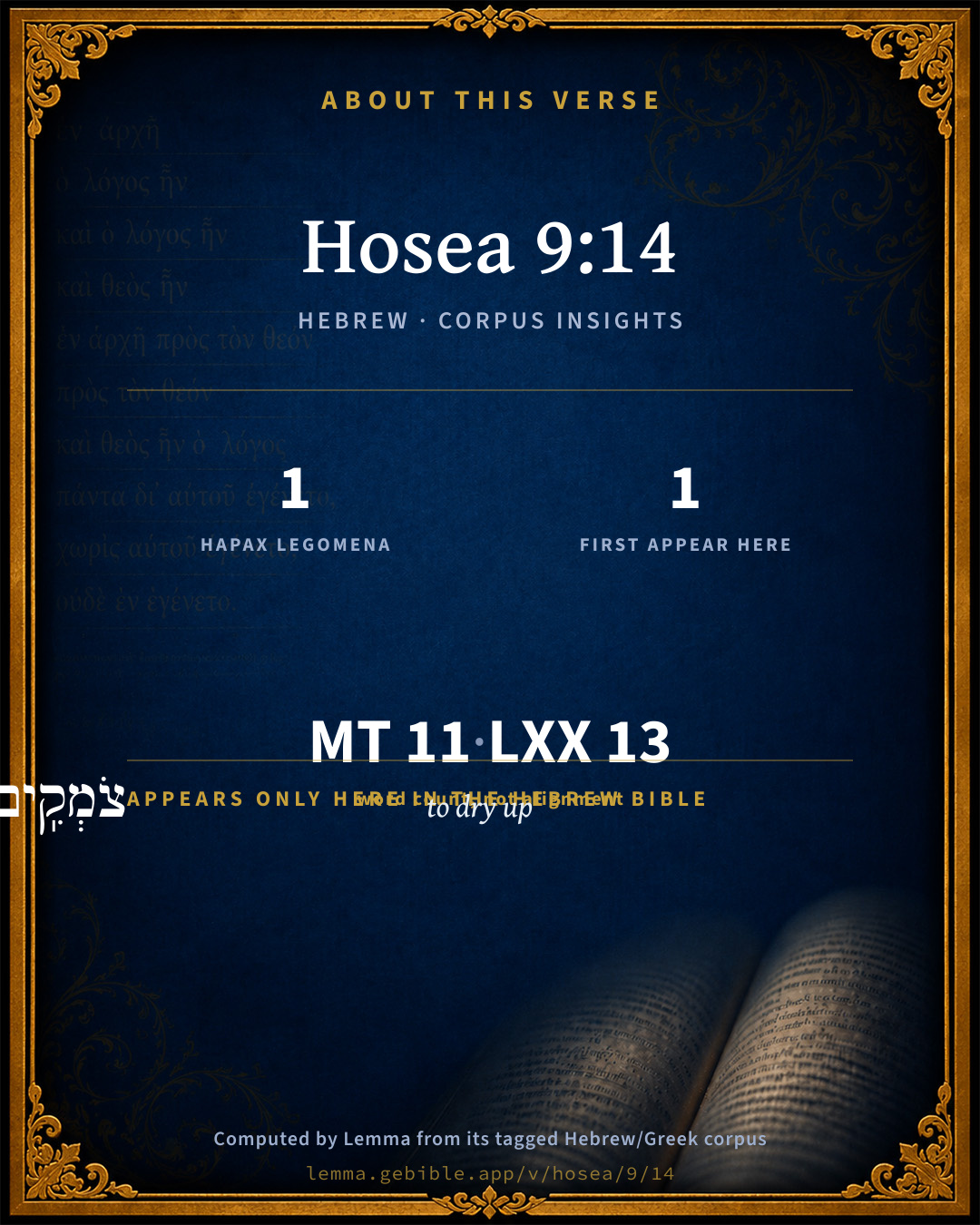
  • 1 hapax legomenon — only here in the Hebrew Bible
  • 1 first appearance in the Hebrew Bible
Full analysis ↓
Download a study sheet

One document with this verse’s original text, its word-by-word gloss line, the meaning frame, cross-references with their text, attributed commentary, and full source and license credits — printable, and it pastes into notes with its structure intact.

This verse Autodidact and up

Study sheet (.html) Plain text (.txt)

A passage Seminary Student

Up to 50 verses in one chapter. A passage sheet keeps up to 6 commentary sources and 12 cross-references per verse, in the order this page ranks them, and says so on the sheet whenever that leaves anything out. Ask for a single verse and you get the Autodidact verse sheet above.

Everything on this page stays free to read, with no account — the sheet is a download of what is already on screen, not access to it.

Want to remove ads? Support Godless Engineer
Compare translations 3

The same verse in 3 English versions, stacked beneath the original-language interlinear above. Click any original word for its lexicon entry.

Each is an independent rendering of the whole verse — the interlinear is not word-aligned to these translations.

Highlighted words mark where these versions differ — a whole-verse word diff, not a word-by-word alignment.

  • World English Bible Public Domain
    Give them--Yahweh what will you give? Give them a miscarrying womb and dry breasts.
  • King James Version Public Domain
    Give them, O LORD: what wilt thou give? give them a miscarrying womb and dry breasts.
  • unfoldingWord Literal Text CC BY-SA 4.0
    Give to them, Yahweh—what will you give? Give to them a miscarrying womb and dry breasts.

unfoldingWord Literal Text — © unfoldingWord, licensed CC BY-SA 4.0. Word-aligned USFM3 via Door43 (git.door43.org/unfoldingWord/en_ult).

Versions to compare (up to 4)

3 of 4 selected

Show all 18 translations

Every available English version of this verse, each an independent rendering of the whole verse.

  • World English Bible Public Domain
    Give them--Yahweh what will you give? Give them a miscarrying womb and dry breasts.
  • Berean Standard Bible Public Domain
    Give them, O LORD—what will You give? Give them wombs that miscarry and breasts that dry up!
  • Majority Standard Bible Public Domain
    Give them, O LORD—what will You give? Give them wombs that miscarry and breasts that dry up!
  • King James Version Public Domain
    Give them, O LORD: what wilt thou give? give them a miscarrying womb and dry breasts.
  • American Standard Version (1901) Public Domain
    Give them, O Jehovah-what wilt thou give? give them a miscarrying womb and dry breasts.
  • Revised Version (1885) Public Domain
    Give them, O LORD: what wilt thou give? give them a miscarrying womb and dry breasts.
  • Geneva Bible (1599) Public Domain
    O Lord, giue them: what wilt thou giue them? giue them a baren wombe and drie breasts.
  • Douay-Rheims (1899) Public Domain
    Give them, O Lord. What wilt thou give them? Give them a womb without children, and dry breasts.
  • Young's Literal Translation Public Domain
    Give to them, Jehovah -- what dost Thou give? Give to them miscarrying womb, and dry breasts.
  • Literal Standard Version CC BY-SA 4.0
    Give to them, YHWH—what do You give? Give to them miscarrying womb, and dry breasts.
  • Unlocked Literal Bible CC BY-SA 4.0
    Give them, Yahweh—what will you give them? Give them a miscarrying womb and breasts that give no milk.
  • unfoldingWord Literal Text CC BY-SA 4.0
    Give to them, Yahweh—what will you give? Give to them a miscarrying womb and dry breasts.
  • Darby Bible Public Domain
    Give them, Jehovah -- what wilt thou give? -- give them a miscarrying womb and dry breasts.
  • World Messianic Bible Public Domain
    Give them—LORD what will you give? Give them a miscarrying womb and dry breasts.
  • Webster's Bible Public Domain
    Give them, O LORD: what wilt thou give? give them a miscarrying womb and dry breasts.
  • Free Bible Version CC BY-SA 4.0
    Give them—well, Lord, what should you give them? Give them wombs that miscarry and dry breasts.
  • Bible in Basic English Public Domain
    O Lord, what will you give them? Give them bodies which may not give birth and breasts without milk.
  • JPS Tanakh (1917) Public Domain
    Give them, O LORD, whatsoever Thou wilt give; give them a miscarrying womb and dry breasts.

Literal Standard Version (2020), Covenant Press — licensed CC BY-SA 4.0. Text via the HelloAO Bible API (eBible.org). Unlocked Literal Bible (unfoldingWord) — licensed CC BY-SA 4.0. Text via the HelloAO Bible API (eBible.org). unfoldingWord Literal Text — © unfoldingWord, licensed CC BY-SA 4.0. Word-aligned USFM3 via Door43 (git.door43.org/unfoldingWord/en_ult). Free Bible Version, Dr. Jonathan Gallagher — licensed CC BY-SA 4.0. Text via the HelloAO Bible API (eBible.org).

Word by word

More ways to search: Search by grammar → Find every occurrence → Compare this word →

Practice this passage: Drill this verse → Learn its vocabulary →

צֹמְקִֽים
tsâmaq
H6784
“drying up”
Verb, Qal, Participle Active, Masculine, Plural, Absolute
Part of Speech
Verb
Stem
Qal
Form
Participle Active
Gender
Masculine
Number
Plural
State
Absolute
Full BDB Definition

Origin: a primitive root

TWOT: 1930

to dry, dry up, shrivel - (Qal) to shrivel (of women's breasts)
  1. תֵּן nâthan H5414 “give” Verb, Qal, Imperative, 2nd Person, Masculine, Singular
  2. יְהוָ֖ה Yᵉhôvâh H3068 “LORD” Noun, Proper
  3. מַה mâh H4100 “what” Particle, Interrogative
  4. תִּתֵּ֑ן nâthan H5414 “to give” Verb, Qal, Imperfect, 2nd Person, Masculine, Singular
  5. תֵּן nâthan H5414 “give” Verb, Qal, Imperative, 2nd Person, Masculine, Singular
  6. רֶ֣חֶם rechem H7358 “womb” Noun, Common, Masculine, Singular, Absolute
  7. מַשְׁכִּ֔יל shâkôl H7921 “being bereaved” Verb, Hiphil, Participle Active, Masculine, Singular, Absolute
  8. וְשָׁדַ֖יִם shad H7699 “and · breasts” Conjunction + Noun, Common, Masculine, Dual, Absolute

About this verse

These counts appear in no published source. They are computed here, from the morphology-tagged text and Lemma’s own curated glosses. What Lemma adds →

11
words
7
distinct lemmas
Prophets
section

Notable vocabulary

1 hapax legomenon — a word that appears only here in the entire Hebrew Bible:

  • צֹמְקִֽים to dry up H6784

First appearance in Scripture

This word makes its first canonical appearance in the Hebrew Bible here:

  • צֹמְקִֽים to dry up H6784

Shared distinctive vocabulary

מַשְׁכִּ֔יל to be bereaved H7921 occurs in 22 verses of the Hebrew Bible. Also found in:

Grammatical profile

  • 5 verbs
  • 3 nouns
  • 2 prepositions
  • 1 particle

Verb forms

  • תֵּן Qal · Imperative
  • תִּתֵּ֑ן Qal · Imperfect
  • תֵּן Qal · Imperative
  • מַשְׁכִּ֔יל Hiphil · Participle Active
  • צֹמְקִֽים Qal · Participle Active

Repetition

A word recurs within this verse — often emphatic in Hebrew:

  • תֵּן to give H5414 ×3

Hebrew & Septuagint length

In English translation the verse runs 14 words from the Hebrew and 15 from the Septuagint (LXX English) — closely comparable.

A rough comparison of the two English renderings, which tokenize alike — not a word-level alignment.

Word counts can differ between the Hebrew and the Greek without any difference in meaning — e.g. the Hebrew direct-object marker אֵת has no separate Greek word, and Greek often adds the article ὁ.

In the original languages it is 11 Hebrew tokens and 13 Greek tokens — but the two are counted differently (Hebrew bundles its prefixes and suffixes into one token; the Greek is in lemma form), so that isn’t a like-for-like length.

Cross-references

9

Topical passages linked to Hosea 9:14 in the Treasury of Scripture Knowledge — connected by theme and wording, ordered by reader-vote popularity; previews shown in the World English Bible.

  • Luke 23:29 For behold, the days are coming in which they will say, 'Blessed are the barren, the wombs that never bore, and the breasts that never nursed.'
  • Luke 21:23 Woe to those who are pregnant and to those who nurse infants in those days! For there will be great distress in the land, and wrath to this people.
  • 1 Corinthians 7:26 I think that it is good therefore, because of the distress that is on us, that it is good for a man to be as he is.
  • Job 21:10 Their bulls breed without fail. Their cows calve, and don't miscarry.
  • Hosea 9:11 As for Ephraim, their glory will fly away like a bird. There will be no birth, none with child, and no conception.
  • Hosea 9:13 Ephraim, like I have seen Tyre, is planted in a pleasant place; But Ephraim will bring out his children to the killer.
  • Hosea 9:16 Ephraim is struck. Their root has dried up. They will bear no fruit. Even though they bring forth, yet I will kill the beloved ones of their womb."
  • Matthew 24:19 But woe to those who are with child and to nursing mothers in those days!
  • Mark 13:17 But woe to those who are with child and to those who nurse babies in those days!

Cross-references courtesy of OpenBible.info (CC BY 4.0).

Hebrew and Greek witnesses Masoretic Hebrew ↔ Greek Septuagint

The same verse in the two great witnesses to the Old Testament, shown verse-for-verse.

These are two independent witnesses, not word-aligned to each other, and the Septuagint is shown in lemma (dictionary) form.

Hebrew Hosea 9:14 Masoretic · Westminster Leningrad Codex

תֵּן לָהֶ֥ם יְהוָ֖ה מַה תִּתֵּ֑ן תֵּן לָהֶם֙ רֶ֣חֶם מַשְׁכִּ֔יל וְשָׁדַ֖יִם צֹמְקִֽים

Give them--Yahweh what will you give? Give them a miscarrying womb and dry breasts.

World English Bible · Public Domain

Greek LXX Hosea 9:14 Septuagint · lemma form

δίδωμι αὐτός κύριος τίς δίδωμι αὐτός δίδωμι αὐτός μήτρα ἀτεκνόω καί μαστός ξηρός

Give them, O Lord: what will you give them? a miscarrying womb, and dry breasts.

LXX2012 (modern English Septuagint) · Public Domain

Hebrew: Westminster Leningrad Codex (CC BY 4.0). Greek: Septuagint (public domain); English from LXX2012 (modern English Septuagint) (Public Domain). How the Septuagint differs from the Hebrew →

Targum (Aramaic paraphrase)

1

The Targum is the ancient Jewish Aramaic paraphrase of the Hebrew Scriptures — an interpretive translation, not the Hebrew text itself. Onkelos (literal) and Pseudo-Jonathan (expansive) render the Torah, and Jonathan the Prophets. Coverage is partial: where no permissively-licensed English translation exists for a verse, only the Aramaic is shown. This is verse-level text, not a word-by-word alignment to the Hebrew.

  1. Targum Jonathan Prophets (Joshua–Malachi)
    הַב לְהוֹן יְיָ יַת תּוּשְׁלְמַת עוֹבָדֵיהוֹן הַב לְהוֹן רֶחֶם מַתְכֵּיל וּשְׁדֵין יְבִשִׁין:

    (no public-domain English translation for this verse)

    Targum Jonathan — Aramaic: “Mikraot Gedolot” (public domain). English: “Sefaria Community Translation” (CC0 1.0 (public-domain dedication)); “London "Chaldee Paraphrase," 1871” (public domain). Text via Sefaria.

Commentary

Notes on Hosea 9:14 from classic Christian and Jewish commentators (each source and its license shown beneath its notes). The classic Christian expositions comment on the surrounding passage and are grouped to its opening verse, so a note may address several verses; the Jewish commentaries on the Tanakh (Rashi and others) are per-verse, so they appear only where the commentator wrote on this verse.

Lemma curates 59 commentaries, every one of them public domain or Creative Commons licensed, each selected and text-cleaned for this edition rather than reprinted as found. About our sources →

Trapp's Complete Commentary

John Trapp

Hos 9:14 Give them, O LORD: what wilt thou give? give them a miscarrying womb and dry breasts.

Ver. 14. Give them, O Lord: what wilt thou give?] This question implieth abundance of affection in the prophet, praying for this forlorn people devoted to destruction. It is the property of gracious spirits to be more sensible of, and more deeply affected with, the calamities that are coming upon the wicked, than those wicked ones themselves are; as Daniel was for Nebuchadnezzar, whose dream he had interpreted, Dan 4:19, and as Habakkuk was for the Chaldeans, whose destruction he had afore prophesied, Hab 3:16. Hosea likewise (out of great commiseration of Ephraim’s direful and dreadful condition) sets himself to pray for them; though himself seems set at a stand, and in a manner nonplussed, that he cannot well tell what to ask for them. God once made a fair offer to a foul sinner, even to Ahaz, that sturdy stigmatic, Isa 7:11, "Ask thee a sign of the Lord thy God; ask it either in the depth, or in the height above. But Ahaz said" (churlishly enough), "I will not ask, neither will I try the Lord," Hos 9:12, he would none of God’s kindness, which yet the Lord there heapeth upon him, Hos 9:14, that where sin abounded grace might superabound. Had our prophet had but half such an offer, or any the least such encouragement, oh how gladly would he have embraced it, how hastily would he have catched at it, as those Syrians did at Ahab’s kind words, 1Ki 20:33? But he, considering the severity and certainty of God’s judgments denounced against them, Hos 9:12-13, and being much amazed thereat, sets himself to intercede and make request for his deplored countrymen; as Samuel did for Saul, rejected by God, 1Sa 16:1, as Paul did for the obdurate Jews, Rom 11:3. And because he saw that he could not obtain of the impartial judge of the world to let go such an impenitent people altogether unpunished, he begs for them, that of two evils they may suffer the least; and rather bring forth no children at all, or children that may die as soon as born (this had been threatened Hos 9:11-12), than "bring forth children to the murderer": it being the greatest misery that can befall a tender hearted parent, to see his dear children butchered before his eyes, as Zedekiah and Mauricius, the emperor, did; and before them both the king of Edom, whose eldest son was by the king of Moab sacrificed upon the wall, in his father’s sight, 2Ki 3:27 Amo 2:1. Thus Rabbi Kimchi giveth the sense of this text: Give, Lord, what thou wilt give? viz. that they may suffer in the womb, or at least in their infancy, that which they should otherwise suffer by the enemies’ sword. Confer Jer 20:18 Luk 23:28 Ecc 4:2 Job 3:10-11. The prophet knew well that God is never so bitterly bent against a people or person, but that something he will yield to faithful and fervent prayer, Mat 24:20.

“ Flectitur iratus voce rogante Deus. ”

John Trapp, A Commentary or Exposition upon All the Books of the Old and New Testament (1647–1656) — public domain. Text from a community e-Sword module.

Joseph Benson's Commentary

Hos 9:14. Give them, O Lord: what wilt thou give? — The prophet here speaks as one greatly agitated, and at a loss what to say upon what he had just heard; but at last concludes with beseeching God rather to let the women be barren, or miscarry; or, if they brought forth children, have no milk in their breasts to give them, that they might die soon after their birth, rather than that they should grow up to be slain by their enemies before their parents’ eyes, or carried into captivity; or, as it is expressed in the foregoing verse, that their parents should be driven to the hard necessity of bringing them forth for the murderer. Some interpret the verse thus: Give them a miscarrying womb, &c., “as a punishment for having inhumanly exposed their infants to death, by sacrificing them to their false gods; or, for having exposed them to the cruelty of the Assyrians, who destroyed them in war. The present passage is strikingly emphatical. But it is to be considered rather as a prediction of what was to happen as a punishment of their crimes, than as an imprecation.”

Joseph Benson's Commentary on the Old and New Testaments (1811–1818) — public domain. Text from a community e-Sword module.

Geneva Bible (1599)

Geneva Bible translators

The Prophet seeing the great plagues of God toward Ephraim, prayeth to God to make them barren, rather than that this great slaughter should come upon their children.

Geneva Bible (1599) marginal notes — public domain. Text via Bolls.life.

Jamieson, Fausset & Brown

Robert Jamieson, A. R. Fausset & David Brown

what wilt thou give?--As if overwhelmed by feeling, he deliberates with God what is most desirable.

give . . . a miscarrying womb--Of two evils he chooses the least. So great will be the calamity, that barrenness will be a blessing, though usually counted a great misfortune (Job 3:3; Jer 20:14; Luk 23:29).

Jamieson, Fausset & Brown — Commentary Critical and Explanatory on the Whole Bible (1871) — public domain (CC PDM 1.0). Text via the HelloAO Bible API.

Adam Clarke's Commentary

Verse 14. Give them, O Lord: what wilt thou give?] There is an uncommon beauty in these words. The prophet, seeing the evils that were likely to fall upon his countrymen, begins to make intercession for them; but when he had formed the first part of his petition, "Give them, O Lord!" the prophetic light discovered to him that the petition would not be answered and that God was about to give them something widely different. Then changing his petition, which the Divine Spirit had interrupted, by signifying that he must not proceed in his request, he asks the question, then, "What wilt thou give them?" and the answer is, "Give them a miscarrying womb, and dry breasts." And this he is commanded to announce. It is probable that the Israelites had prided themselves in the fruitfulness of their families, and the numerous population of their country. God now tells them that this shall be no more; their wives shall be barren, and their land cursed.

Adam Clarke's Commentary on the Bible (1810–1826) — public domain. Text from a community e-Sword/MySword module.

John Calvin's Commentaries

Interpreters translate these words in a different way: “Give them what thou art about to give,” then they repeats “Give them;” but, as I think, they do not comprehend the design of the Prophet, and are wholly mistaken; for the Prophet appears here as one anxious and perplexed. He therefore presents himself here before God as a suppliant, as though he said, “Lord, I would gladly intercede for this people: what then is it that I should chiefly desire for them? Doubtless my chief wish for them in their miserable dispersion is, that thou wouldest give them a killing womb and dry breasts;” that is, that none may be born of them. Christ says, that when the last destruction of Jerusalem should come, the barren would be blessed (Luke 23:29;) and this he took from the common doctrine of Scripture, for many such passages may be observed in the Prophets. Among the blessings of God, this, we know, is not the least, the birth of a numerous offspring. It is, therefore, a token of dreadful judgement, when barrenness, which in itself is deemed a curse, is desired as an especial blessing. For what can be more miserable than for infants to be snatched from their mothers’ bosom? and for children to be killed before their eyes, or for pregnant women to be slain? or for cities and fields to be consumed by fire, so that children, not yet born, should perish together with their mothers? But all these things happen when there is an utter destruction.

We hence see what the prophet chiefly meant: the state of the people would be so deplorable that nothing could be more desirable than the barrenness of the women, that no offspring might be afterwards born, but that the name and memory of the people might by degrees be blotted out.

He has, indeed, already denounced punishments sufficiently grievous and dreadful; but we know that the contumacy and hardness of those are very great on whom religion has no hold. Hence all threatening were derided by that obstinate people. This is the reason why the Prophet now takes the part of an intercessor. “O Lord,”, he adds “give them;” that is, “O Lord, forgive them at least in some measure, and grant them yet something.” And “what wilt thou give?” Here he reasons with himself, being as it were in suspense and perplexity; and he also reasons with God as to what would be the most desirable thing. “I am indeed a suppliant for my own nation, whom I pity; but what shall I ask? I would wish thee, Lord, to pardon this people; but what shall be the way, what can give me comfort, or what sort of remedy yet remains? Certainly I see nothing better than that they should be barren, that none hereafter should be born of them; but that thou shouldest suffer them to consume and die away; for this will be their chief happiness in a condition so deplorable.” It was then the Prophet’s design here, to strike hypocrites and profane men with terror, that they might understand that God’s vengeance, which was at hand, could by no means be fully expressed; for it would be the best thing for them to be deprived of the blessing of an offspring, that their infants might not perish with them, that they might not see women with child cruelly slain by their enemies, or their children led away as a spoil. That such things as these might not take place, the Prophet says, that barrenness ought to be desired by them as the chief blessing. The Prophet, I doubt not, meant this. It now follows —

John Calvin's Commentaries (1540-1563) — public domain. Text from the Calvin Translation Society English edition (1840s-50s) via the Christian Classics Ethereal Library (ccel.org). Calvin's coverage is partial (roughly two-thirds of the Bible); uncommented books and verses are honest gaps, never fabricated. The 19th-century editor's footnotes and remarks are omitted so the notes are faithfully Calvin's own voice.

Ellicott's Commentary for English Readers

(14) Better universal childlessness than that the off-spring should be exposed to so terrible a fate. Compare this with our Lord’s words: “Blessed are the barren, and the wombs that never bare,” &c.

A Bible Commentary for English Readers, edited by Charles John Ellicott (1878–1897) — public domain. Text from a community e-Sword module.

The Cambridge Bible for Schools and Colleges

gen. ed. J. J. S. Perowne

14. The prophet recognizes the necessity of a judgment, but pleads for a mitigation. Love for his people burns within him, and prompts him to do all that is consistent with his moral perceptions and the revelation made to him. Comp. the conduct of Moses in a similar case, Exo_32:11-14.

what wilt thou give them?] The prophet considers what he had best ask for. He is a patriot, but he is also a prophet; he loves his nation with a feminine tenderness, but in zeal for his God he is not inferior to Amos or Isaiah. Hence his momentary perplexity. And yet this is perhaps too literal an interpretation. Rather is it, to use Ewald’s language, ‘a paroxysm of despair.’ Better were it that the Israelites should be condemned to barrenness than lose their choicest young population thus! It is an involuntary cry from the heart.

The Cambridge Bible for Schools and Colleges (gen. ed. J. J. S. Perowne; Cambridge University Press, 1878–1918) — public domain. Text from a community e-Sword module.

John Gill's Exposition

Ah their wickedness is in Gilgal,.... A place in the ten tribes, where the covenant of circumcision was renewed in Joshua's time; the first passover was kept in the land of Canaan, and the people of Israel ate the firstfruits of the land; where the tabernacle was for a while, and sacrifices were offered up to the Lord: but now things were otherwise; all manner of iniquity was committed in it, especially idolatry; for which it was chosen by idolaters, because it had formerly been famous for religious worship: here, though not to the exclusion of other places, as Dan and Bethel, was the above sin committed; here it begun and spread itself, and had the measure of it filled up; here began the first departure from the Lord, rejecting him, and asking a king in the days of Samuel, as Kimchi and Abarbinel observe; and here were high places and altars erected for idolatry; and this is now the reason of the above threatenings of God, and the predictions of the prophet. Grotius thinks there is a mystical sense in the words, and that they have reference to the sin of the Jews in crucifying Christ on Golgotha; which, in the Syriac language, is the same with Gilgal; but both the people spoken of, and the place, are different:

for there I hated them; or "therefore" (m), because they sinned so greatly against him in a place where they had formerly worshipped him; their sacrifices there, instead of being acceptable, were the more abominable to him, as they were offered there where his tabernacle once was, and sacrifices were offered to him according to his will:

for the wickedness of their doings I will drive them out of mine house; not out of the house of my sanctuary, or the temple, as the Targum; unless this is to be understood of losing the opportunity of going to the temple at Jerusalem, which those of the ten tribes had while they were in their own land, which the few godly persons among them then took, and made use of; but now their idolatry increasing in Gilgal, and other places, they should be carried captive; and, if they would, could not go up to the house of the Lord, and worship him there: or rather this may design, either the visible church of God, out of which they would be now ejected; or their native country, where they had been, as the family and household of God; but now should be so no more, but, as afterwards said, wanderers among the nations, and no more reckoned as belonging to the Lord, and under his paternal care and protection:

I will love them no more; which is not to be understood of the special love and favour the Lord bears to his own people in Christ, which is everlasting and unchangeable; but of his general and providential favour and regard unto these people, which he had manifested in bestowing many great and good things upon them; but now would do so no more; he would do nothing to them, or for them, that looked like love, or be interpreted of it, but all the reverse; and, by his behaviour to them, show that they were the objects of his aversion and hatred; and this was to continue, and has continued, and will continue unto the time of their conversion in the latter day, when "all Israel shall be saved", Rom 11:26;

all their princes are revolters; from God and his worship, who should have set a good example to the people; and since these were perverse and rebellious against God, it is no wonder that the people in general apostatized. This is to be understood of their king as supreme, and all subordinate rulers; of their judges and magistrates of every order; of all their governors, both civil and ecclesiastic; and not at Gilgal only, but in all the land. There is an elegant play on words (n) in the original, the beauty of which cannot be expressed in the translation.

(m) "ideo", Rivet. (n) "Sharehem Sorerim".

John Gill's Exposition of the Whole Bible (1746–1763) — public domain (CC PDM 1.0). Text via the HelloAO Bible API.

Albert Barnes' Notes on the Bible

Give them a miscarrying womb - The prophet prays for Israel, and debates with himself what he can ask for, amid this their determined wickedness, and God’s judgments. Since “Ephraim” was “to bring forth children to the murderer,” then it was mercy to ask for them, that they might have no children. Since such are the evils which await their children, grant them, O Lord, as a blessing, the sorrows of barrenness. What God had before pronounced as a punishment, should, as compared to other evils, be a mercy, and an object of prayer. So our Lord pronounces as to the destruction of Jerusalem. “Behold the days are coming, in which they shall say, Blessed are the barren, and the wombs that never bare, and the paps that never gave suck” Luk 23:29. “O unhappy fruitfulness and fruitful unhappiness, compared with which, barrenness, which among them was accounted a curse, became blessedness.”

Albert Barnes' Notes on the Bible (1834–1885) — public domain. Text from a community e-Sword/MySword module.

Haydock's Catholic Bible Commentary

CHAPTER IX.

Children, as they have exposed them to the fury of the Assyrians, (Calmet) or to their idols. (Drusius) --- The prophet appears to demand vengeance through zeal; but it is only a prediction. (Calmet)

George Leo Haydock (1774–1849), Haydock's Catholic Family Bible and Commentary, 1859 edition — public domain. Excludes Psalms (Douay-Rheims chapter numbering differs from Protestant) and Deuterocanonical books (Catholic canon only).

Matthew Poole's English Annotations

Give them, O Lord; it is an abrupt but very pathetical speech of one that shows his trouble for the state of a sinking, undone nation, it is an intercession for them.

What wilt thou give? as if he should say he knew not what to ask, or how to pray for them; he knew God had peremptorily determined to punish them with a total extermination, and in a most dreadful manner, as described Hos 9:11-13. Now give some mercy.

Give them a miscarrying womb; the days are coming when the barren womb will be a blessing; give this, O Lord; it is less misery to have none, than to have all our children murdered by a barbarous enemy, Luk 23:29.

Dry breasts; not to starve the children born, but it is a further explication of the former; dry breasts are symptoms of a barren womb, whether by abortion or non-conception, by one or other. Prevent these woeful effects of our enemies’ unjust rage, and of thy most righteous displeasure against us, O Lord.

Matthew Poole's English Annotations on the Holy Bible (1683–1685) — public domain. Text from a community e-Sword/MySword module.

Whedon's Commentary on the Bible

Daniel D. Whedon

14. The judgment is richly deserved. The prophet understands, with all his love for the people, that mercy has become impossible; in holy indignation he prays Jehovah to execute his judgment. The abruptness of the style indicates the deep emotion of the prophet.

What wilt thou give — A rhetorical question. The prophet meditates what he should ask for. Shall it be mercy? That cannot be; and he offers a petition that Jehovah may allow justice to proceed. The interpretation of the verse as an “intercessory prayer on the part of the prophet that God will not punish the people too severely, but condemn them to barrenness rather than the loss of the young men,” is less probable.

Hos_9:15 is the continuation of Hos_9:13.

Their wickedness is in Gilgal — Is focused there (Hos_4:15; Hos_12:10; compare Amo_4:4; Amo_5:5). Gilgal must have been a prominent center of Hebrew worship. Perhaps the prophet has in mind some recent flagrant outburst of wickedness, now unknown.

For — Better, yea.

I hated — The love for Ephraim (Hos_9:10) was transformed into hate as a result of their wickedness, which Jehovah can endure no longer.

Drive them out of mine house — As in Hos_8:1, equivalent to my land; this will mean separation from his presence (see on Hos_9:3; compare 1Sa_26:19), and from his interest and love — Jehovah will completely withdraw his mercy and favor.

All their princes are revolters — Indicates one of the chief reasons for Jehovah’s rejection of Israel. The nobles who should have been the leaders of the common people have rebelled against their great leader, Jehovah, and thus they have become misleaders (Isa_3:12). The original contains a play upon words (as in Isa_1:23), which may be reproduced partly by rendering, “Their princes are unprincipled.” The judgment upon Israel is further described in Hos_9:16. In 16a, under the figure of a plant whose roots are dried up as a result of being smitten with withering heat (compare Jer_17:8), or by a worm (Jon_4:7), so that it can bear no more fruit (compare Hos_9:11 b); 16b returns to the thought of Hos_9:11-12, the destruction of the nation by cutting off the children and young men.

Hos_9:16 b would be most appropriate between Hos_9:11 and Hos_9:12; the former speaks of the cessation of childbirth; Hos_9:16 b continues, if by some chance children should be born, Jehovah will slay them; then Hos_9:12 adds, if somehow they should live for a while, they will die before reaching manhood (so Marti). In Hos_9:17 the prophet repeats, in his own words, the threat expressed by Jehovah in Hos_9:15.

My God — He is still the prophet’s God, but no longer that of Israel.

Did not hearken — The appeals of the prophet fell upon deaf ears (compare Hos_4:10). Now Jehovah must cast them off. Here the judgment is thought of not as extermination, but as banishment among the nations (Hos_9:15).

Wanderers — Or, fugitives (Gen_4:12); the same verb is used in a different sense in Hos_7:13. To secure a more satisfactory logical connection Harper rearranges Hos_9:10-17 as follows, Hos_9:10-11; Hos_9:16; Hos_9:12 (except the last clause), Hos_9:13-15; Hos_9:12 (last clause), Hos_9:17.

Daniel D. Whedon (gen. ed.), Commentary on the Old and New Testaments (1874–1909) — public domain. Text from a community e-Sword module.

John Wesley's Explanatory Notes

Give then - It is an abrupt but pathetic speech of one that shews his trouble for a sinking, undone nation. A miscarrying womb - It is less misery to have none, than to have all our children murdered.

John Wesley, Explanatory Notes Upon the Whole Bible (1754–1765) — public domain. Text via the GEBible commentary corpus.

Rashi

Rabbi Shlomo Yitzchaki (Rashi)

Give them, O Lord, what You will give The prophet prays that they should die when young, for the mourning for a child is not as bad as the mourning for an adult. Therefore, if it is impossible that they die from birth, from the womb, or from conception, for it was already decreed from the Creation of the world, (Gen. 3: l6) “And to your husband shall be your longing,” give them quickly in their childhood what you say to give to them after a time, for You said, “For, if they raise their children. I will bereave them.” [from Pesikta Rabbathi 45:3]

give them a bereaving womb When they emerge into the world (lit. the air of the world), let them die or let their mother’s breasts dry up so that they will have no milk to nurse them.

Rashi on the Tanakh — English translations: “The Judaica Press complete Tanach with Rashi, translated by A. J. Rosenberg” (CC BY 4.0); “Pentateuch with Rashi's commentary by M. Rosenbaum and A.M. Silbermann, 1929-1934” (public domain); “The Metsudah Tanach series, Lakewood, N.J” (CC BY 4.0); and “The Book of Joshua, Metsudah Publications, 1997” (CC BY 4.0). Text via Sefaria.

Lesson kit

Teaching starters — assembled from the data on this page, not authored interpretation. Every prompt links to the verse data it draws on. Edit before teaching.

Hosea, in the Prophets, opens this verse with 11 words (7 distinct Hebrew lemmas). Its most distinctive word is tsâmaq (“to dry up”). A historical commentator’s framing appears above. Read the whole chapter for the surrounding context.

Discussion questions

  1. What does “to dry up” (tsâmaq) contribute to the verse as a whole?
  2. This verse holds 1 word here found nowhere else in the Hebrew Bible. What might the rare word draw attention to?
  3. The word “to dry up” first appears here in Scripture. What is being introduced at this debut?
  4. Genesis 27:45 shares the word «to be bereaved» with this verse. How do the two illuminate each other?
  5. “to give” occurs 3× in this one verse. What is the effect of the repetition?
  6. These translations render this verse differently; the difference is in the English rendering, not the original. What questions does that raise?
  7. The verb «תֵּן» is Qal Imperative. How does its form color the action?
  8. Reading how Trapp's Complete Commentary and Joseph Benson's Commentary read this verse, where do the two commentators agree and where do they part?

Things to notice

  • 1 word in this verse appears nowhere else in the Hebrew Bible.
  • 1 word makes its first canonical appearance in Scripture here.
  • This verse counts 11 Hebrew ↔ 13 Greek words.
  • These translations choose different wording for 8 words in this verse.
  • “to give” occurs 3× in this single verse.

Reading settings

Reading text

Shown beneath each verse's original-language words.

Old Testament
Old Testament edition

Read the OT as the Masoretic Hebrew (MT) or the Greek Septuagint (LXX).

English shown for the Greek Septuagint (in the Hebrew ↔ Greek comparison).

Comparing translations? Open the Compare panel on any verse page to stack up to four side by side.