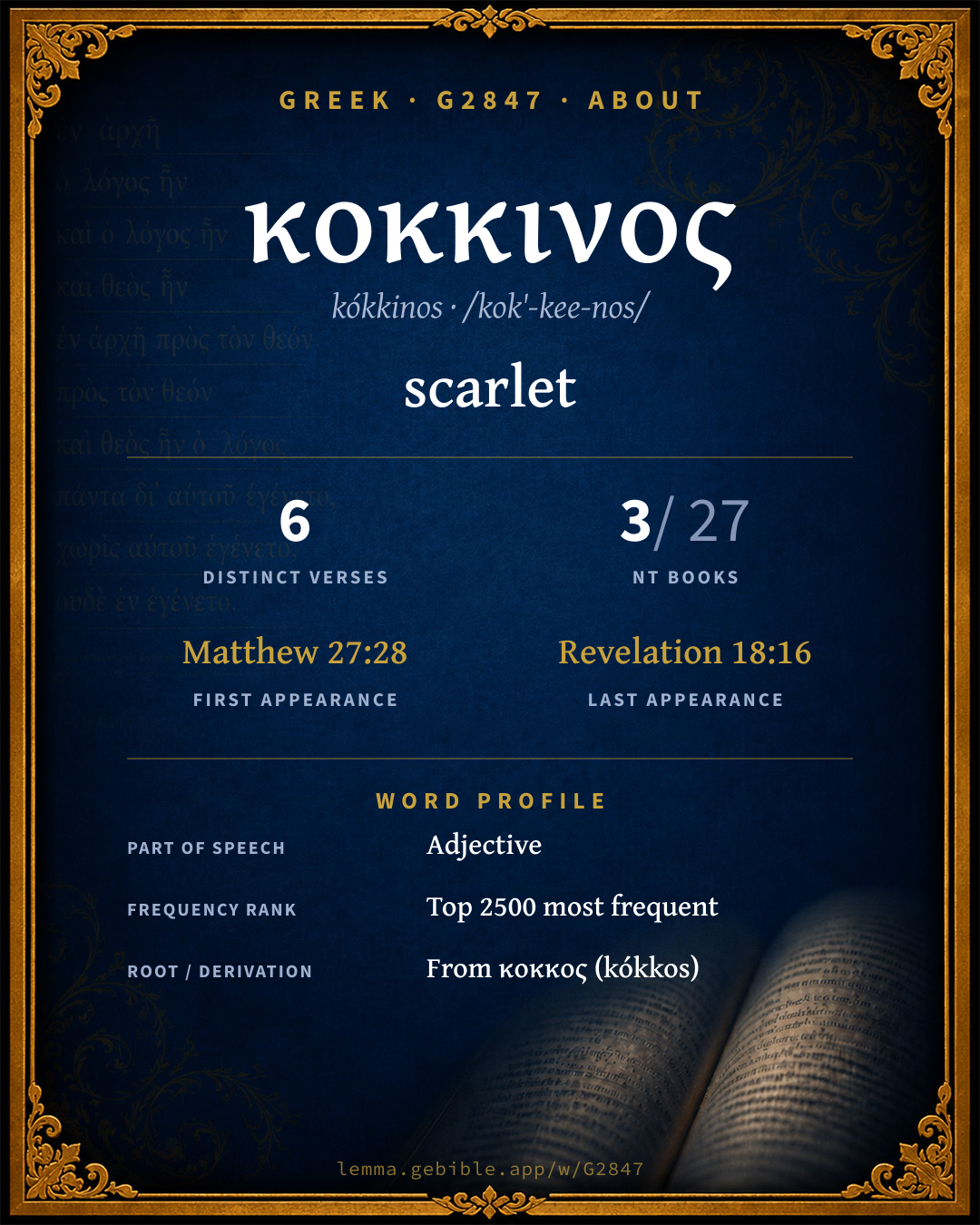
κόκκινος
scarlet
‘scarlet’ is one of 2 main senses fuller range ↓
Full lexicon entry — Thayer's Greek Lexicon
From Thayer's Greek Lexicon
Where this word appears
See every Accusative-case word in the Greek New Testament →
Grammar key — what these labels mean
Part of speech
- Adjective
- A word that describes or qualifies a noun.
Case
- Accusative
- The case of the direct object and of extent.
- Genitive
- The case of source, possession, or “of” — answers “whose / from what.”
Gender
- Neuter
- Grammatically neuter.
- Feminine
- Grammatically feminine.
Number
- Singular
- One.
Grammatical forms
- Adjective, Accusative, Singular, Neuter 3 times (50%)
- Adjective, Genitive, Singular, Neuter 2 times (33%)
- Adjective, Accusative, Singular, Feminine 1 time (17%)
Parsed forms decoded from the imported morphology (Robinson–Tischendorf, public domain), counted across 6 parsed occurrences — not distinct verses.
Every verse where G2847 appears — 6 distinct verses across 3 books. Click any verse to open its interlinear word-by-word view. Verse text shown in the World English Bible for context — . Each verse’s Greek form is shown with its reference; the English is not keyword-highlighted, since the data carries no word-level English alignment. Use “Compare translations” on any verse to read it across multiple English versions. This concordance covers the Greek New Testament; Septuagint (Greek Old Testament) occurrences of this word are not indexed here.
Matthew 1 verse
Hebrews 1 verse
Revelation 4 verses
- Revelation 17:3 κόκκινον adj acc sg neut He carried me away in the Spirit into a wilderness. I saw a woman sitting on a scarlet-colored animal, full of blasphemous names, having seven heads and ten horns.
- Revelation 17:4 κόκκινον adj acc sg neut The woman was dressed in purple and scarlet, and decked with gold and precious stones and pearls, having in her hand a golden cup full of abominations and the impurities of the sexual immorality of the earth.
- Revelation 18:12 κοκκίνου adj gen sg neut merchandise of gold, silver, precious stones, pearls, fine linen, purple, silk, scarlet, all expensive wood, every vessel of ivory, every vessel made of most precious wood, and of brass, and iron, and marble;
- Revelation 18:16 κόκκινον adj acc sg neut saying, 'Woe, woe, the great city, she who was dressed in fine linen, purple, and scarlet, and decked with gold and precious stones and pearls!
About this entry
At a glance — auto-summarized from this page’s data, not written by a person. Every figure links to its source below. This summary describes the numbers; it doesn’t interpret them.
“scarlet” is the headline sense of the Greek adjective κοκκινος (kókkinos). It clusters heavily in Revelation, which alone accounts for 67% of its uses. With 6 verses in 3 books, it is an uncommon word in the Greek New Testament. Scripture first uses it in Matthew 27:28. Catalogued under 2 senses, its meaning is not single-sense. See the sense tree, 6-verse concordance, and the renderings breakdown below.
Gloss history
Strong's 1890 vs modern scholarship
About this word
Strong's G2847 catalogs a Greek word from the Greek New Testament.
These counts are not copied from any lexicon or concordance. They are computed here, from the morphology-tagged Greek New Testament. What Lemma adds →
- 6
- distinct verses
- The word appears in 6 distinct verses.
- 3 / 27
- NT books
- The word appears in 3 of 27 New Testament books.
- #1,476
- by frequency
- Top 2500 most frequent Greek words (rank 1,476 of 5,347 Greek words by occurrence).
View all 6 occurrences in the concordance →
Most concentrated in
- Revelation 4 verses 67%
- Matthew 1 verse 17%
- Hebrews 1 verse 17%
By section of the New Testament
By traditional corpus
Conventional, traditional groupings — biblical authorship is debated, so this is a traditional corpus grouping, not an authorship claim. Some books belong to more than one corpus (Luke is in both the Gospels and the Lukan corpus, and so on), so these shares overlap and need not total 100%. Each figure is a share of the word’s 6 distinct verses.
- Johannine 4 verses · 67%
- Revelation 4 verses · 67%
- Gospels 1 verse · 17%
- Hebrews 1 verse · 17%
How translations render this word
Counts come from each version’s own published word-to-Strong’s tagging or interlinear alignment — an approximate guide to how each version renders this word, not a word-level alignment the data otherwise carries. Because each total is that version’s own tagged count, the per-version totals vary from one another and need not match the appearance or distinct-verse counts above. These counts may also differ from a printed concordance because Lemma counts each distinctly tagged rendering and does not collapse phrase taggings into a single head-word total. This is a fixed set of word-tagged versions (KJV, ASV, BSB, ULT) and does not change with the reading translation you choose elsewhere. Each version’s license is shown beside its name below (and on Sources).
- King James Version: Scarlet 4×
- American Standard Version: Scarlet 5×
- Berean Standard Bible: Scarlet 6×
- unfoldingWord Literal Text: Scarlet 4×
King James Version Public Domain
Renders G2847 across 6 tagged occurrences — most commonly:
Plus 2 renderings that appear only once — usually multi-word phrases or single function words the recovered tagging swept in, not distinct renderings.
American Standard Version Public Domain
Renders G2847 across 6 tagged occurrences — most commonly:
Plus 1 rendering that appears only once — usually multi-word phrases or single function words the recovered tagging swept in, not distinct renderings.
Berean Standard Bible Public Domain
Renders G2847 across 6 tagged occurrences — most commonly:
unfoldingWord Literal Text CC BY-SA 4.0
Renders G2847 across 6 tagged occurrences — most commonly:
Plus 2 renderings that appear only once — usually multi-word phrases or single function words the recovered tagging swept in, not distinct renderings.
Senses in Thayer's
The 2 senses Thayer's distinguishes for this word, in lexicon order (not ranked by frequency or importance). The full entry — with sub-senses — is in the Lexicon Entry tab.
- crimson…
- scarlet cloth or clothing
Word origin
Derived from κοκκος (kókkos) (G2848) — grain.
From G2848 (from the kernel shape of the insect); crimson colored : - scarlet (colour coloured).
— Strong’s Exhaustive Concordance (1890), public domain.
Forms in the corpus
The 3 distinct written forms G2847 takes in the Greek New Testament, most frequent first — each parse links to that case’s occurrences in the concordance.
| Form | Parsing | Example | Uses |
|---|---|---|---|
| κόκκινον kókkinon | Adjective, Accusative, Singular, Neuter | Revelation 17:3 | 3 |
| κοκκίνου kokkínou | Adjective, Genitive, Singular, Neuter | Hebrews 9:19 | 2 |
| κοκκίνην kokkínēn | Adjective, Accusative, Singular, Feminine | Matthew 27:28 | 1 |
Septuagint usage
The same Greek word κοκκινος appears 43 times in the Greek Old Testament (Septuagint), across 43 verses in 10 books.
- 43
- LXX occurrences
- Tagged occurrences of this Greek word in the Septuagint.
- 43
- verses
- Distinct Septuagint verses containing this word.
- 10 / 39
- OT books
- The word appears in 10 of the 39 Old Testament books.
Sample Septuagint occurrences
- Genesis 38:28 κόκκινος
- Exodus 25:4 κόκκινος
- Leviticus 14:4 κόκκινος
- Numbers 4:8 κόκκινος
- Joshua 2:18 κόκκινος
- 2 Samuel 1:24 κόκκινος
- 2 Chronicles 2:6 κόκκινος
- Song of Solomon 4:3 κόκκινος
- Isaiah 1:18 κόκκινος
- Jeremiah 4:30 κόκκινος
Septuagint occurrences (same lexeme)
Every verse where the same Strong’s number (G2847) appears in the Greek Septuagint. Verse text shown in the World English Bible for context; the Greek form is the matched word — the English is not keyword-highlighted.
- Genesis 38:28 κόκκινος It happened, when she travailed, that one put out a hand: and the midwife took and tied a scarlet thread on his hand, saying, "This came out first."
- Genesis 38:30 κόκκινος Afterward his brother came out, that had the scarlet thread on his hand, and his name was called Zerah.
- Exodus 25:4 κόκκινος blue, purple, scarlet, fine linen, goats' hair,
- Exodus 26:1 κόκκινος "Moreover you shall make the tent with ten curtains; of fine twined linen, and blue, and purple, and scarlet, with cherubim. The work of the skillful workman you shall make them.
- Exodus 26:31 κόκκινος "You shall make a veil of blue, and purple, and scarlet, and fine twined linen, with cherubim. The work of the skillful workman shall it be made.
- Exodus 26:36 κόκκινος "You shall make a screen for the door of the Tent, of blue, and purple, and scarlet, and fine twined linen, the work of the embroiderer.
- Exodus 27:16 κόκκινος For the gate of the court shall be a screen of twenty cubits, of blue, and purple, and scarlet, and fine twined linen, the work of the embroiderer; their pillars four, and their sockets four.
- Exodus 28:5 κόκκινος They shall take the gold, and the blue, and the purple, and the scarlet, and the fine linen.
- Exodus 28:8 κόκκινος The skillfully woven band, which is on it, that is on him, shall be like its work and of the same piece; of gold, of blue, and purple, and scarlet, and fine twined linen.
- Exodus 28:15 κόκκινος "You shall make a breastplate of judgment, the work of the skillful workman; like the work of the ephod you shall make it; of gold, of blue, and purple, and scarlet, and fine twined linen, shall you make it.
- Exodus 28:33 κόκκινος On its hem you shall make pomegranates of blue, and of purple, and of scarlet, around its hem; and bells of gold between them round about:
- Exodus 31:4 κόκκινος to devise skillful works, to work in gold, and in silver, and in brass,
- Exodus 35:6 κόκκινος blue, purple, scarlet, fine linen, goats' hair,
- Exodus 35:25 κόκκινος All the women who were wise-hearted spun with their hands, and brought that which they had spun, the blue, the purple, the scarlet, and the fine linen.
- Exodus 35:35 κόκκινος He has filled them with wisdom of heart, to work all manner of workmanship, of the engraver, of the skillful workman, and of the embroiderer, in blue, in purple, in scarlet, and in fine linen, and of the weaver, even of those who do any workmanship, and of those who make skillful works.
- Exodus 36:9 κόκκινος The length of each curtain was twenty-eight cubits, and the breadth of each curtain four cubits. All the curtains had one measure.
- Exodus 36:10 κόκκινος He coupled five curtains to one another, and the other five curtains he coupled one to another.
- Exodus 36:12 κόκκινος He made fifty loops in the one curtain, and he made fifty loops in the edge of the curtain that was in the second coupling. The loops were opposite one to another.
- Exodus 36:15 κόκκινος The length of each curtain was thirty cubits, and four cubits the breadth of each curtain. The eleven curtains had one measure.
- Exodus 36:31 κόκκινος He made bars of acacia wood; five for the boards of the one side of the tent,
- Exodus 36:36 κόκκινος He made four pillars of acacia for it, and overlaid them with gold. Their hooks were of gold. He cast four sockets of silver for them.
- Exodus 37:3 κόκκινος He cast four rings of gold for it, in its four feet; even two rings on its one side, and two rings on its other side.
- Exodus 37:5 κόκκινος He put the poles into the rings on the sides of the ark, to bear the ark.
- Exodus 37:16 κόκκινος He made the vessels which were on the table, its dishes, its spoons, its bowls, and its pitchers with which to pour out, of pure gold.
- Exodus 37:21 κόκκινος and a bud under two branches of one piece with it, and a bud under two branches of one piece with it, and a bud under two branches of one piece with it, for the six branches going out of it.
- Exodus 39:12 κόκκινος and the third row, a jacinth, an agate, and an amethyst;
- Leviticus 14:4 κόκκινος then the priest shall command them to take for him who is to be cleansed two living clean birds, and cedar wood, and scarlet, and hyssop.
- Leviticus 14:6 κόκκινος As for the living bird, he shall take it, and the cedar wood, and the scarlet, and the hyssop, and shall dip them and the living bird in the blood of the bird that was killed over the running water.
- Leviticus 14:49 κόκκινος To cleanse the house he shall take two birds, and cedar wood, and scarlet, and hyssop.
- Leviticus 14:51 κόκκινος He shall take the cedar wood, and the hyssop, and the scarlet, and the living bird, and dip them in the blood of the slain bird, and in the running water, and sprinkle the house seven times.
- Leviticus 14:52 κόκκινος He shall cleanse the house with the blood of the bird, and with the running water, with the living bird, with the cedar wood, with the hyssop, and with the scarlet;
- Numbers 4:8 κόκκινος They shall spread on them a scarlet cloth, and cover the same with a covering of sealskin, and shall put in its poles.
- Numbers 19:6 κόκκινος and the priest shall take cedar-wood, and hyssop, and scarlet, and cast it into the midst of the burning of the heifer.
- Joshua 2:18 κόκκινος Behold, when we come into the land, you shall bind this line of scarlet thread in the window which you did let us down by: and you shall gather to you into the house your father, and your mother, and your brothers, and all your father's household.
- 2 Samuel 1:24 κόκκινος You daughters of Israel, weep over Saul, Who clothed you in scarlet delicately, Who put ornaments of gold on your clothing.
- 2 Chronicles 2:6 κόκκινος But who is able to build him a house, seeing heaven and the heaven of heavens can't contain him? who am I then, that I should build him a house, save only to burn incense before him?
- 2 Chronicles 2:13 κόκκινος Now I have sent a skillful man, endowed with understanding, of Huram my father's,
- 2 Chronicles 3:14 κόκκινος He made the veil of blue, and purple, and crimson, and fine linen, and worked cherubim thereon.
- Song of Solomon 4:3 κόκκινος Your lips are like scarlet thread. Your mouth is lovely. Your temples are like a piece of a pomegranate behind your veil.
- Song of Solomon 6:7 κόκκινος Your temples are like a piece of a pomegranate behind your veil.
- Isaiah 1:18 κόκκινος "Come now, and let us reason together," says Yahweh: "Though your sins be as scarlet, they shall be as white as snow. Though they be red like crimson, they shall be as wool.
- Isaiah 3:23 κόκκινος the hand-mirrors, the fine linen garments, the tiaras, and the shawls.
- Jeremiah 4:30 κόκκινος You, when you are made desolate, what will you do? Though you clothe yourself with scarlet, though you deck you with ornaments of gold, though you enlarge your eyes with paint, in vain do you make yourself beautiful; [your] lovers despise you, they seek your life.
These are occurrences of the same Greek lexeme (G2847) in the Septuagint — not a translation of any one Hebrew word. The store carries no word-level Hebrew↔Greek alignment, so no Hebrew original is asserted here. Counts come from the recovered LXX Strong's tagging — high-frequency vocabulary is well covered, while rare or late forms may be untagged — so they reflect tagged occurrences and may slightly undercount.