
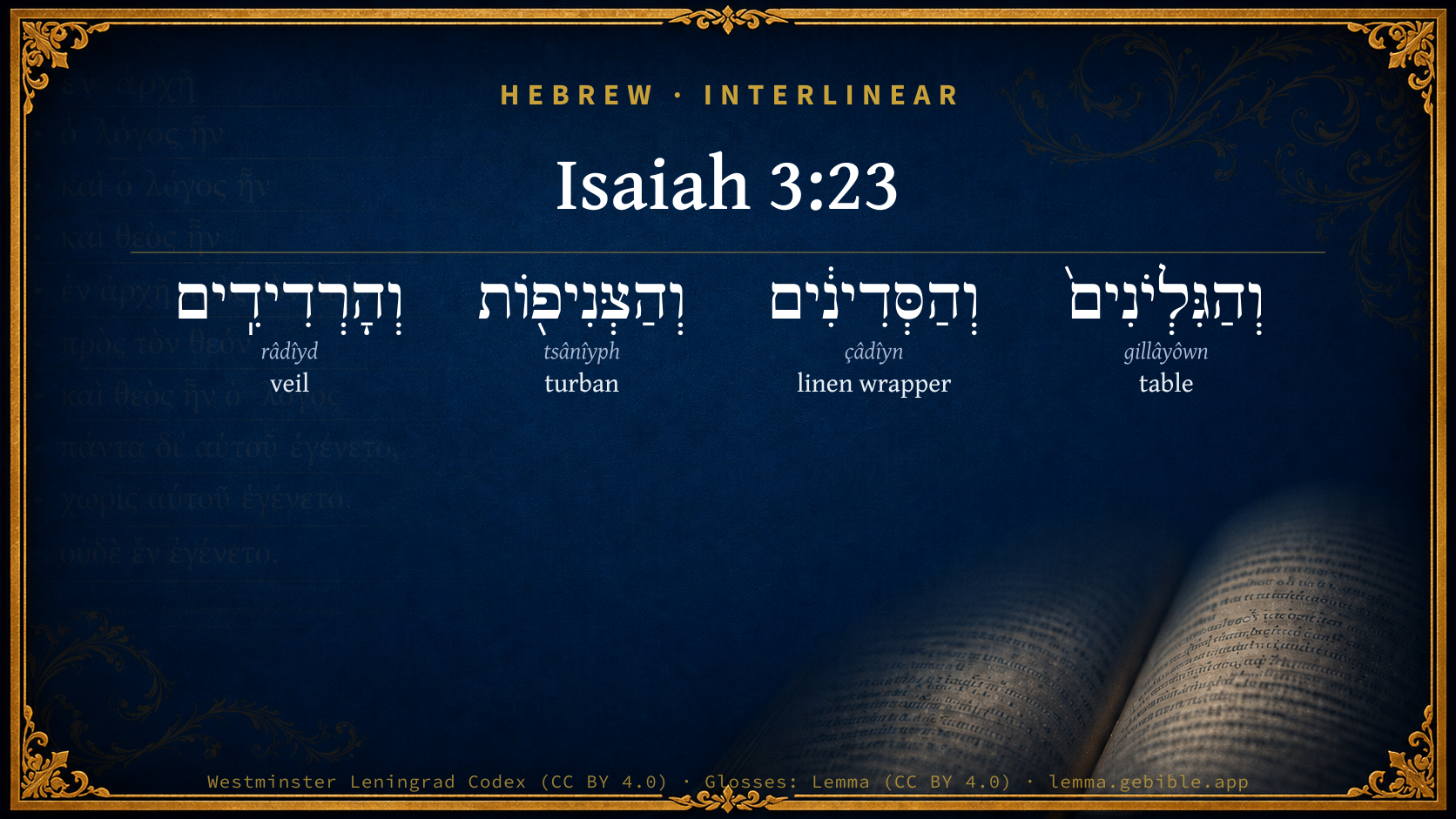
Isaiah 3:23

Hebrew (Westminster Leningrad Codex) Isaiah 3:23 appears in the Hebrew Old Testament. The text above is from the Westminster Leningrad Codex. Each word links to its Strong’s number, a concise gloss, and parsing drawn from the Open Scriptures Hebrew Bible morphology. Click any word for its full Brown-Driver-Briggs (BDB) entry.
Download image
Cite this verse

Isaiah 3:23 (World English Bible). Public Domain. Lemma interlinear Bible study tool, https://lemma.gebible.app/v/isaiah/3/23.

Show BibTeX & RIS
BibTeX
RIS
English Translation
the hand-mirrors, the fine linen garments, the tiaras, and the shawls.
World English Bible · Public Domain
Highlights Full analysis ↓
Download a study sheet

One document with this verse’s original text, its word-by-word gloss line, the meaning frame, cross-references with their text, attributed commentary, and full source and license credits — printable, and it pastes into notes with its structure intact.

This verse Autodidact and up

Study sheet (.html) Plain text (.txt)

A passage Seminary Student

Up to 50 verses in one chapter. A passage sheet keeps up to 6 commentary sources and 12 cross-references per verse, in the order this page ranks them, and says so on the sheet whenever that leaves anything out. Ask for a single verse and you get the Autodidact verse sheet above.

Everything on this page stays free to read, with no account — the sheet is a download of what is already on screen, not access to it.

Want to remove ads? Support Godless Engineer
Compare translations 3

The same verse in 3 English versions, stacked beneath the original-language interlinear above. Click any original word for its lexicon entry.

Each is an independent rendering of the whole verse — the interlinear is not word-aligned to these translations.

Highlighted words mark where these versions differ — a whole-verse word diff, not a word-by-word alignment.

  • World English Bible Public Domain
    the hand-mirrors, the fine linen garments, the tiaras, and the shawls.
  • King James Version Public Domain
    The glasses, and the fine linen, and the hoods, and the vails.
  • unfoldingWord Literal Text CC BY-SA 4.0
    and the mirrors and the linen garments and the turbans and the veils.

unfoldingWord Literal Text — © unfoldingWord, licensed CC BY-SA 4.0. Word-aligned USFM3 via Door43 (git.door43.org/unfoldingWord/en_ult).

Versions to compare (up to 4)

3 of 4 selected

Show all 18 translations

Every available English version of this verse, each an independent rendering of the whole verse.

  • World English Bible Public Domain
    the hand-mirrors, the fine linen garments, the tiaras, and the shawls.
  • Berean Standard Bible Public Domain
    and their mirrors, linen garments, tiaras, and shawls.
  • Majority Standard Bible Public Domain
    and their mirrors, linen garments, tiaras, and shawls.
  • King James Version Public Domain
    The glasses, and the fine linen, and the hoods, and the vails.
  • American Standard Version (1901) Public Domain
    the hand-mirrors, and the fine linen, and the turbans, and the veils.
  • Revised Version (1885) Public Domain
    the hand mirrors, and the fine linen, and the turbans, and the veils.
  • Geneva Bible (1599) Public Domain
    And the glasses and the fine linen, and the hoodes, and the launes.
  • Douay-Rheims (1899) Public Domain
    And looking-glasses, and lawns, and headbands, and fine veils.
  • Young's Literal Translation Public Domain
    Of the mirrors, and of the linen garments, And of the hoods, and of the vails,
  • Literal Standard Version CC BY-SA 4.0
    Of the mirrors, and of the linen garments, || And of the hoods, and of the veils,
  • Unlocked Literal Bible CC BY-SA 4.0
    the hand mirrors, the fine linen, the head pieces, and the wraps.
  • unfoldingWord Literal Text CC BY-SA 4.0
    and the mirrors and the linen garments and the turbans and the veils.
  • Darby Bible Public Domain
    the mirrors, and the fine linen bodices, and the turbans, and the flowing veils.
  • World Messianic Bible Public Domain
    the hand mirrors, the fine linen garments, the tiaras, and the shawls.
  • Webster's Bible Public Domain
    The glasses, and the fine linen, and the hoods, and the vails.
  • Free Bible Version CC BY-SA 4.0
    hand mirrors, fine linen underwear, head wraps, and shawls.
  • Bible in Basic English Public Domain
    The looking-glasses, and the fair linen, and the high head-dresses, and the veils.
  • JPS Tanakh (1917) Public Domain
    and the gauze robes, and the fine linen, and the turbans, and the mantles.

Literal Standard Version (2020), Covenant Press — licensed CC BY-SA 4.0. Text via the HelloAO Bible API (eBible.org). Unlocked Literal Bible (unfoldingWord) — licensed CC BY-SA 4.0. Text via the HelloAO Bible API (eBible.org). unfoldingWord Literal Text — © unfoldingWord, licensed CC BY-SA 4.0. Word-aligned USFM3 via Door43 (git.door43.org/unfoldingWord/en_ult). Free Bible Version, Dr. Jonathan Gallagher — licensed CC BY-SA 4.0. Text via the HelloAO Bible API (eBible.org).

Word by word

More ways to search: Search by grammar → Find every occurrence → Compare this word →

Practice this passage: Drill this verse → Learn its vocabulary →

About this verse

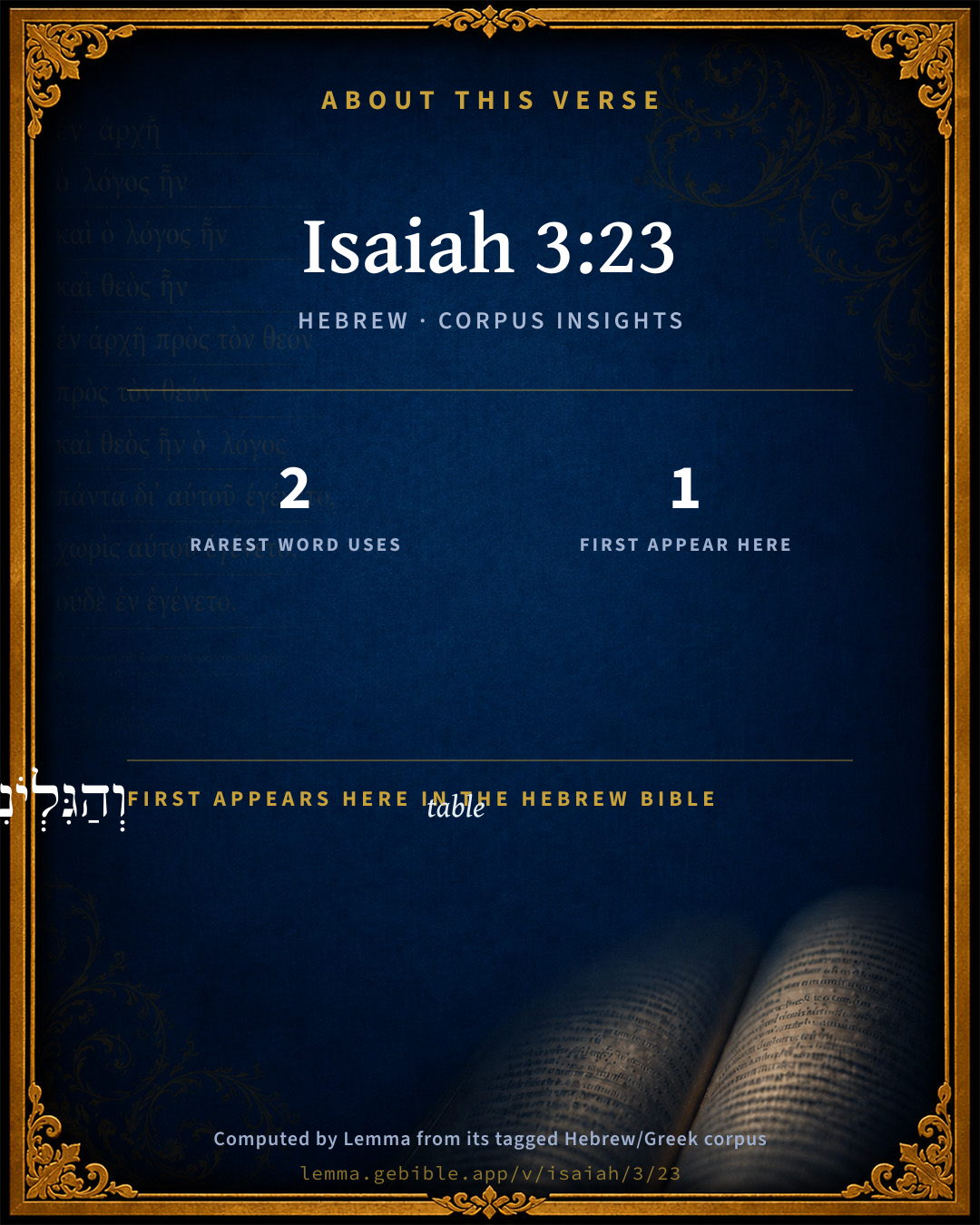
These counts appear in no published source. They are computed here, from the morphology-tagged text and Lemma’s own curated glosses. What Lemma adds →

4
words
4
distinct lemmas
Prophets
section

Notable vocabulary

The rarest word here is וְהַגִּלְיֹנִים֙ table H1549 — appearing just 2 times in the whole Hebrew Bible.

First appearance in Scripture

This word makes its first canonical appearance in the Hebrew Bible here:

  • וְהַגִּלְיֹנִים֙ table H1549

Shared distinctive vocabulary

וְהַגִּלְיֹנִים֙ table H1549 occurs in 2 verses of the Hebrew Bible. Also found in:

Grammatical profile

  • 4 nouns

Hebrew & Septuagint length

In English translation the verse runs 11 words from the Hebrew and 27 from the Septuagint (LXX English) — the Septuagint runs noticeably longer here. See the side-by-side →

A rough comparison of the two English renderings, which tokenize alike — not a word-level alignment.

Word counts can differ between the Hebrew and the Greek without any difference in meaning — e.g. the Hebrew direct-object marker אֵת has no separate Greek word, and Greek often adds the article ὁ.

Cross-references

10

Topical passages linked to Isaiah 3:23 in the Treasury of Scripture Knowledge — connected by theme and wording, ordered by reader-vote popularity; previews shown in the World English Bible.

  • Genesis 24:65 She said to the servant, "Who is the man who is walking in the field to meet us?" The servant said, "It is my master." She took her veil, and covered herself.
  • Genesis 41:42 Pharaoh took off his signet ring from his hand, and put it on Joseph's hand, and arrayed him in robes of fine linen, and put a gold chain about his neck,
  • Exodus 38:8 He made the basin of brass, and its base of brass, out of the mirrors of the ministering women who ministered at the door of the tent of meeting.
  • Ruth 3:15 He said, Bring the mantle that is on you, and hold it; and she held it; and he measured six [measures] of barley, and laid it on her: and he went into the city.
  • 1 Chronicles 15:27 David was clothed with a robe of fine linen, and all the Levites who bore the ark, and the singers, and Chenaniah the master of the song [with] the singers: and David had on him an ephod of linen.
  • Song of Solomon 5:7 The watchmen who go about the city found me. They beat me. They bruised me. The keepers of the walls took my cloak away from me.
  • Ezekiel 16:10 I clothed you also with embroidered work, and shod you with sealskin, and I girded you about with fine linen, and covered you with silk.
  • Luke 16:19 "Now there was a certain rich man, and he was clothed in purple and fine linen, living in luxury every day.
  • Revelation 19:8 It was given to her that she would array herself in bright, pure, fine linen: for the fine linen is the righteous acts of the saints.
  • Revelation 19:14 The armies which are in heaven followed him on white horses, clothed in white, pure, fine linen.

Cross-references courtesy of OpenBible.info (CC BY 4.0).

Hebrew and Greek witnesses Masoretic Hebrew ↔ Greek Septuagint

The same verse in the two great witnesses to the Old Testament, shown verse-for-verse.

Here the Septuagint runs noticeably longer than the Hebrew — LXX2012 (modern English Septuagint) 27 words vs World English Bible 11. A rough length comparison of the two English translations, not a word-level alignment — read both below.

These are two independent witnesses, not word-aligned to each other, and the Septuagint is shown in lemma (dictionary) form.

Hebrew Isaiah 3:23 Masoretic · Westminster Leningrad Codex

וְהַגִּלְיֹנִים֙ וְהַסְּדִינִ֔ים וְהַצְּנִיפ֖וֹת וְהָרְדִידִֽים

the hand-mirrors, the fine linen garments, the tiaras, and the shawls.

World English Bible · Public Domain

Greek LXX Isaiah 3:23 Septuagint · lemma form

καί ὁ βύσσινος καί ὁ ὑακίνθινος καί ὁ κόκκινος καί ὁ βύσσος σύν χρυσίον καί ὑάκινθος συν καταὑφαίνω καί θέριστρον κατάκλιτον

And your most beautiful son whom you love shall fall by the sword; and your mighty men shall fall by the sword, and shall be brought low.

LXX2012 (modern English Septuagint) · Public Domain

On this verse, Jamieson, Fausset & Brown discusses the Septuagint’s reading. Read the note in Commentary ↓

Hebrew: Westminster Leningrad Codex (CC BY 4.0). Greek: Septuagint (public domain); English from LXX2012 (modern English Septuagint) (Public Domain). How the Septuagint differs from the Hebrew →

Targum (Aramaic paraphrase)

1

The Targum is the ancient Jewish Aramaic paraphrase of the Hebrew Scriptures — an interpretive translation, not the Hebrew text itself. Onkelos (literal) and Pseudo-Jonathan (expansive) render the Torah, and Jonathan the Prophets. Coverage is partial: where no permissively-licensed English translation exists for a verse, only the Aramaic is shown. This is verse-level text, not a word-by-word alignment to the Hebrew.

  1. Targum Jonathan Prophets (Joshua–Malachi)
    וּמַחְזְיָתָא וְקַרְטְסַיָא וְכִתָּרַיָא וּכְבֵינָתָא:

    The mirrors, and the fine linen, and the crowns, and the veils.

    Targum Jonathan — Aramaic: “Mikraot Gedolot” (public domain). English: “Sefaria Community Translation” (CC0 1.0 (public-domain dedication)); “London "Chaldee Paraphrase," 1871” (public domain). Text via Sefaria.

Commentary

Notes on Isaiah 3:23 from classic Christian and Jewish commentators (each source and its license shown beneath its notes). The classic Christian expositions comment on the surrounding passage and are grouped to its opening verse, so a note may address several verses; the Jewish commentaries on the Tanakh (Rashi and others) are per-verse, so they appear only where the commentator wrote on this verse.

Lemma curates 59 commentaries, every one of them public domain or Creative Commons licensed, each selected and text-cleaned for this edition rather than reprinted as found. About our sources →

Trapp's Complete Commentary

John Trapp

Isa 3:23 The glasses, and the fine linen, and the hoods, and the vails.

Ver. 23. {See Trapp on "Isa 3:19"}

John Trapp, A Commentary or Exposition upon All the Books of the Old and New Testament (1647–1656) — public domain. Text from a community e-Sword module.

Geneva Bible (1599)

Geneva Bible translators

In rehearsing all these things particularly, he showeth the lightness and vanity of such as cannot be content with comely apparel according to their degree.

Geneva Bible (1599) marginal notes — public domain. Text via Bolls.life.

Jamieson, Fausset & Brown

Robert Jamieson, A. R. Fausset & David Brown

glasses--mirrors of polished metal (Exo 38:8). But the Septuagint, a transparent, gauze-like, garment.

hoods--miters, or diadems (Isa 62:3; Zac 3:5).

veils--large enough to cover the head and person. Distinct from the smaller veils ("mufflers") above (Gen 24:65). Token of woman's subjection (Co1 11:10).

Jamieson, Fausset & Brown — Commentary Critical and Explanatory on the Whole Bible (1871) — public domain (CC PDM 1.0). Text via the HelloAO Bible API.

Adam Clarke's Commentary

Verse 23. The glasses] The conjunction ו vau, and - AND the glasses, is added here by forty-three of Kennicott's and thirty-four of De Rossi's MSS., and one of my own, ancient, as well as by many editions.

And the veils. - "The transparent garments."] Τα διαφανη Λακωνικα, Sept. A kind of silken dress, transparent, like gauze; worn only by the most elegant women, and such as dressed themselves elegantius quam necesse esset probis, "more elegantly than modest women should." Such garments are worn to the present day; garments that not only show the shape of every part of the body, but the very colour of the skin. This is evidently the case in some scores of drawings of Asiatic females now before me. This sort of garments was afterwards in use among the Greeks. Prodicus, in his celebrated fable (Xenoph. Memorab. Socr. lib. ii.) exhibits the personage of Sloth in this dress: Εσθητα δε, εξ ἡς αν μαλιστα ὡρα διαλαμποι: -

"Her robe betray'd

Through the clear texture every tender limb,

Height'ning the charms it only seem'd to shade;

And as it flow'd adown so loose and thin,

Her stature show'd more tall, more snowy white her skin."

They were called multitia and coa (scil, vestimenta) by the Romans, from their being invented, or rather introduced into Greece, by one Pamphila of the island of Cos. This, like other Grecian fashions, was received at Rome, when luxury began to prevail under the emperors. It was sometimes worn even by the men, but looked upon as a mark of extreme effeminacy. See Juvenal, Sat. ii., 65, &c. Publius Syrus, who lived when the fashion was first introduced, has given a humorous satirical description of it in two lines, which by chance have been preserved: -

"AEquum est, induere nuptam ventum textilem?

Palam prostare nudam in nebula linea?"

Adam Clarke's Commentary on the Bible (1810–1826) — public domain. Text from a community e-Sword/MySword module.

Ellicott's Commentary for English Readers

(23) The glasses—i.e., the polished metal mirrors (as in Exo_38:3; Job_37:18; 1Co_13:12; Jas_1:23), which the Eastern lady carried in her hand, that she might adjust her toilet. The LXX. rendering, “Laconian [Spartan] garments,” i.e., indecently transparent, is curious enough to deserve notice, as throwing light on the social life of Alexandria, if not of Israel.

The fine linen—i.e., the chemise worn under the tunic next the skin. The Heb. sedîn, like the Greek σίνδων (Mar_14:51), seems to imply a commerce with India; so our muslin (mosul) and calico (calicut) bear record of their origin. In Sanscrit, sindhu is the term for fine linen.

The hoods—i.e., the turbans which completed the attire, and over which was thrown the “vail,” or gauze mantle. Jewish women, however, did not veil their faces after the manner of those of Turkey and Arabia. The prophet seems to have carried his eye upward from the feet to the head, as he catalogued with indignant scorn the long list of superfluities. We may compare the warnings of 1Ti_2:9; 1Pe_3:3. It is noticeable that stockings and handkerchiefs do not seem to have been used by the women of Judah.

A Bible Commentary for English Readers, edited by Charles John Ellicott (1878–1897) — public domain. Text from a community e-Sword module.

The Cambridge Bible for Schools and Colleges

gen. ed. J. J. S. Perowne

23. The mirrors (made of polished metal, see ch. Isa_8:1) and the shifts (Jdg_14:12 f.) and the turbans and the overalls (a kind of veil, Son_5:7).

The Cambridge Bible for Schools and Colleges (gen. ed. J. J. S. Perowne; Cambridge University Press, 1878–1918) — public domain. Text from a community e-Sword module.

John Gill's Exposition

The glasses,.... Looking glasses, by which they dressed themselves, see Exo 38:8 and so Kimchi explains the word; but elsewhere (e) he says it signifies thin garments, so called because the flesh is seen through them, being so exceeding thin; which sense is favoured by the Septuagint version, which renders it by garments which the Lacedemonians wore, which were so thin and transparent, that the naked body might be seen through them:

and the fine linen; of which several of their garments and ornaments were made, and particularly their veils, with which they veiled themselves, as Jarchi observes:

and the hoods; the word is used for a diadem and mitre, Isa 62:3 the Targum renders it "crowns"; and such the Jewish women wore; see Gill on Isa 3:20 and particularly newly married women (f):

and the veils; so the word is rendered in Sol 5:7 with which women covered their heads, either through modesty, or as a token of subjection to their husbands, see Gen 24:65 but, according to the Targum and Kimchi, these were thin garments which women wore in summertime; Jarchi says they are the same which the French call "fermelan", and are of gold, which they put about the cloak the woman is covered with; perhaps they were a sort of umbrellas, to keep off the heat of the sun.

(e) Ib. (In Sepher Shorash.) rad. (f) Misn. Sota, c. 9. sect. 14.

John Gill's Exposition of the Whole Bible (1746–1763) — public domain (CC PDM 1.0). Text via the HelloAO Bible API.

Albert Barnes' Notes on the Bible

The glasses - There is a great variety of opinion about the expression used here. That ancient Jews had “looking-glasses,” or mirrors, is manifest from the account in Exo 38:8. These “mirrors” were made of polished plates of brass. The Vulgate and Chaldee understand this of “mirrors.” The Septuagint understands by it a “thin, transparent covering like gauze,” perhaps like silk. The word is derived from the verb “to reveal, to make apparent,” etc., and applies either to mirrors or to a splendid shining garment. It is probable that their excessive vanity was evinced by carrying small mirrors in their hands - that they might examine and adjust their dress as might be necessary. This is now done by females of Eastern nations. Shaw informs us that, ‘In the Levant, looking-glasses are a part of female dress. The Moorish women in Barabary are so fond of their ornaments, and particularly of their looking-glasses, which they hang upon their breasts, that they will not lay them aside, even when, after the drudgery of the day, they are obliged to go two or three miles with a pitcher or a goat-skin to fetch water.’ - “Burder.” In Egypt, the mirror was made of mixed metal, chiefly of copper, and this metal was so highly polished, that in some of the mirrors discovered at Thebes, the luster has been partially restored, though they have been buried in the earth for many centuries. The mirror was nearly round, inserted in a handle of wood, stone, or metal, whose form varied according to the taste of the owner. The picture in the book will give you an idea of the ancient form of the mirror, and will show that they might be easily carried abroad as an ornament in public; compare Wilkinson’s “Manners and Customs of the Ancient Egyptians,” vol. iii., pp. 384-386.

And the fine linen - Anciently, the most delicate and fine garments were made from linen which was obtained chiefly from Egypt; see the note at Luk 16:19.

And the hoods - Or, “turbans.”

And the veils - This does not differ probably from the veils worn now, except that those worn by Eastern females are “large,” and made so as to cover the head and the shoulders, so that they may be drawn closely round the body, and effectually conceal the person; compare Gen 24:65.

Albert Barnes' Notes on the Bible (1834–1885) — public domain. Text from a community e-Sword/MySword module.

Matthew Poole's English Annotations

The glasses; the looking-glasses, as we call them, though in truth they were not made of glass, but of bright and burnished brass.

Matthew Poole's English Annotations on the Holy Bible (1683–1685) — public domain. Text from a community e-Sword/MySword module.

Whedon's Commentary on the Bible

Daniel D. Whedon

23. Glasses — Mirrors made of polished metal, carried on the person.

Fine linen — Inner wear, undergarments.

Hoods — Turbans, mitres, diadems. Isa_60:3; Zec_3:5.

Veils — Coverings of the face, minus the eyes, dropping to near the feet. Distinct from “mufflers,” or smaller veils. In 1Co_11:10 used as a token of woman’s subjection.

Daniel D. Whedon (gen. ed.), Commentary on the Old and New Testaments (1874–1909) — public domain. Text from a community e-Sword module.

The Pulpit Commentary

The glasses; rather, the mirrors. In ancient times these were not made of glass, but of some metal which took a high polish. Most commonly, the material seems to have been bronze. Many such mirrors have been found in Egypt, a few in Assyria, in Etruria a considerable number. They are of small size, intended to be carried in the hand, and have for that purpose a metal or a wooden handle, which is sometimes highly artistic. The fine linen; rather, the muslin robes. Sedin, the Hebrew word used, is probably a corruption or analogue of sin-don, the Greek name for Indian fabrics. It is only used here and in Jud_1:14:12, 13 Pro_31:24. The hoods, and the vails; or, the turbans and the scarfs. The word translated" hood" is nearly the same as that which designates the head-dress of the high priest in Exodus (Exo_28:4, Exo_28:37, 39 29:6, etc.) and Leviticus, (Lev_8:9 Lev_16:4) which seems to have been a "turban" (see note on Exo_28:4). The other word, here translated "vail," occurs only in this place and Song of Son_5:7. Its exact meaning is uncertain; but it can scarcely be a veil; since "veils" have been already mentioned (ver. 19).

The Pulpit Commentary (1880–1919), ed. H.D.M. Spence-Jones & Joseph S. Exell — public domain. Text from a community e-Sword module.

John Wesley's Explanatory Notes

Glasses - The looking-glasses, as we call them, tho' in truth they were not made of glass, but of bright and burnished brass.

John Wesley, Explanatory Notes Upon the Whole Bible (1754–1765) — public domain. Text via the GEBible commentary corpus.

J. A. Alexander on Isaiah

Joseph Addison Alexander

“The mirrors and the tunics (inner garments made of linen), and the turbans (the common oriental head-dress) and the veils.” The first word is explained by the Septuagint to mean thin transparent dresses; but most writers understand it to denote the small metallic mirrors carried about by oriental women.

Joseph Addison Alexander, The Prophecies of Isaiah (1846–1847; New York: Scribner, 1870–1878) — public domain. Text from a community e-Sword module.

Rashi

Rabbi Shlomo Yitzchaki (Rashi)

The mirrors Heb. גִּלְיוֹנִים. These are mirrors, as the Targum renders: מַחְזְיָתָא, miradojjr in O.F., and because they reveal (מְגַלּוֹת) the form of the face, they are called גִּלְיוֹנִים, or perhaps their mirrors were rolled (נִגְלָלוֹת).

and the sheets of linen with which they would enwrap themselves.

and the turbans Heb. וְהַצְּנִיפוֹת, molekin in O.F.

and the clasps Heb. וְהַרְדִידִים, Fermalc in O.F., and they are of gold with which the shawl is closed when the woman enwraps herself therein.

Rashi on the Tanakh — English translations: “The Judaica Press complete Tanach with Rashi, translated by A. J. Rosenberg” (CC BY 4.0); “Pentateuch with Rashi's commentary by M. Rosenbaum and A.M. Silbermann, 1929-1934” (public domain); “The Metsudah Tanach series, Lakewood, N.J” (CC BY 4.0); and “The Book of Joshua, Metsudah Publications, 1997” (CC BY 4.0). Text via Sefaria.

Ibn Ezra

Rabbi Abraham ibn Ezra

נליונים Cloth (cp. 8:1).

סדינים Fine linen (cp. Pr. 31:24).

צניפות An ornament for the head;

רדידים. In Arabic, this word signifies a dress in form of a taleth. All these things here enumerated are, in general, articles of clothing, and vary with the fashion of the country.

Ibn Ezra on the Tanakh — English translations: “Sefaria Community Translation” (CC0 1.0 (public-domain dedication)); “Yalkut, Sifsei Chachomim Chumash, Metsudah Publications, 2009” (CC BY 4.0); and “Commentary of Ibn Ezra on Isaiah - trans. by M. Friedlander, 1873” (public domain). Text via Sefaria.

Lesson kit

Teaching starters — assembled from the data on this page, not authored interpretation. Every prompt links to the verse data it draws on. Edit before teaching.

Isaiah, in the Prophets, opens this verse with 4 words (4 distinct Hebrew lemmas). Its most distinctive word is gillâyôwn (“table”). The Greek Septuagint runs longer here. A historical commentator’s framing appears above. Read the whole chapter for the surrounding context.

Discussion questions

  1. How does “table” (gillâyôwn) shape what this verse is saying?
  2. This is the first place “table” appears in Scripture (first appears here). What does its debut here establish?
  3. How does Isaiah 8:1, which shares the word «table», read alongside this verse?
  4. The Septuagint runs longer here than the Hebrew. What might account for the difference?
  5. The translations on this page render this verse differently — a whole-verse word diff, not a word-by-word alignment. What might account for the different wordings?
  6. Compare how Trapp's Complete Commentary and Geneva Bible (1599) read this verse. Where do they agree or differ?

Things to notice

Reading settings

Reading text

Shown beneath each verse's original-language words.

Old Testament
Old Testament edition

Read the OT as the Masoretic Hebrew (MT) or the Greek Septuagint (LXX).

English shown for the Greek Septuagint (in the Hebrew ↔ Greek comparison).

Comparing translations? Open the Compare panel on any verse page to stack up to four side by side.