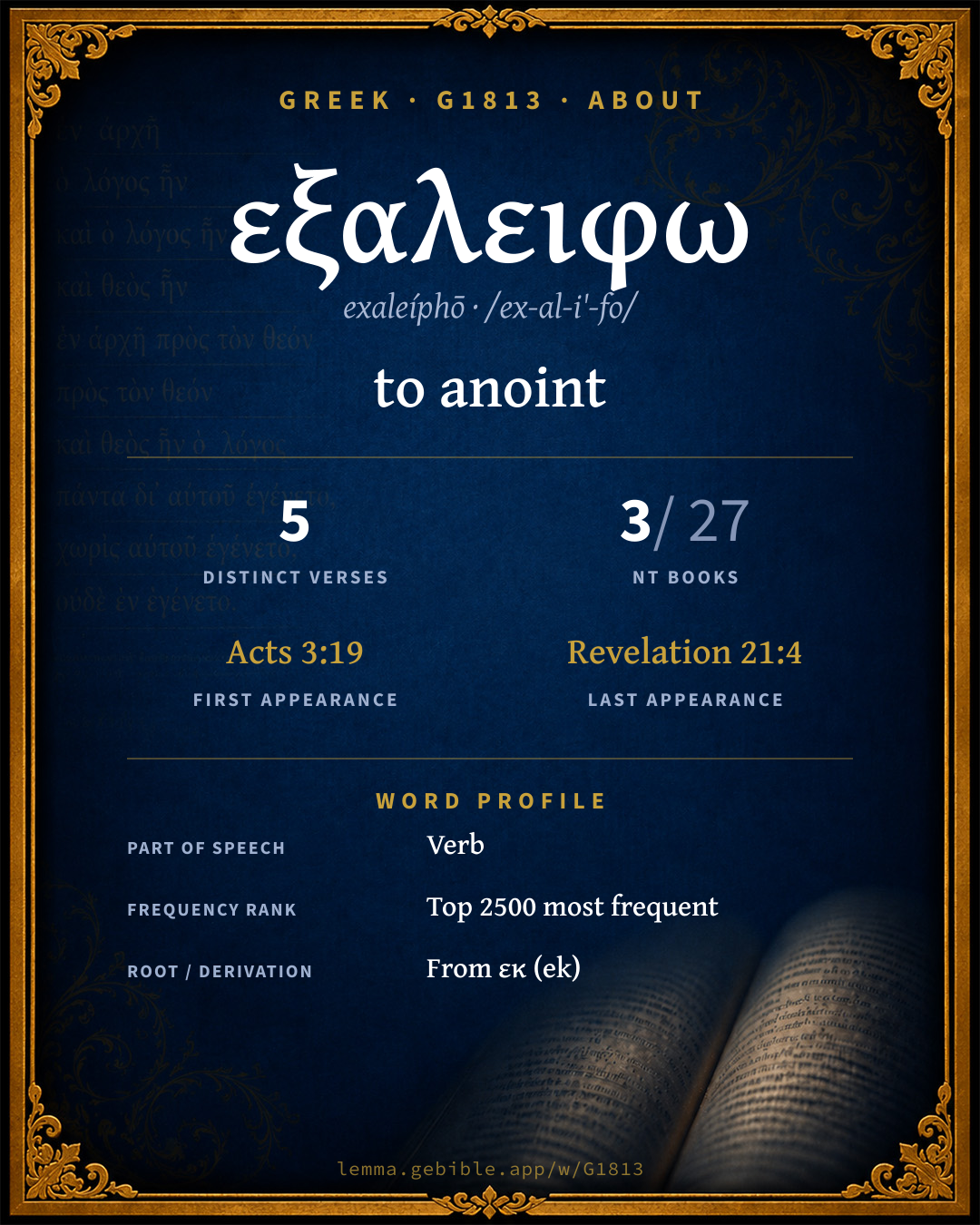
ἐξαλείφω
to anoint
‘to anoint’ is one of 2 main senses fuller range ↓
Full lexicon entry — Thayer's Greek Lexicon
From Thayer's Greek Lexicon
Where this word appears
See every Future-tense verb in the Greek New Testament →
Grammar key — what these labels mean
Part of speech
- Verb
- An action or state-of-being word.
Tense
- Future
- Action expected in future time.
- Aorist
- Action viewed as a simple whole, without regard to duration — often past (perfective aspect).
Voice
- Active
- The subject performs the action.
- Passive
- The subject receives the action.
Mood
- Indicative
- States a fact or asks a factual question (the mood of reality).
- Participle
- A verbal adjective (“writing,” “having written”).
- Infinitive
- A verbal noun (“to write”), unmarked for person or number.
Case
- Nominative
- The case of the subject (and the predicate nominative).
Person
- 3rd person
- The one spoken about (“he / she / it / they”).
- 1st person
- The speaker (“I / we”).
Gender
- Masculine
- Grammatically masculine.
Number
- Singular
- One.
3 distinct verses where G1813 appears in the Future tense, across 1 book. Filtered view — show all forms. Click any verse to open its interlinear word-by-word view. Verse text shown in the World English Bible for context — . Each verse’s Greek form is shown with its reference; the English is not keyword-highlighted, since the data carries no word-level English alignment. Use “Compare translations” on any verse to read it across multiple English versions. This concordance covers the Greek New Testament; Septuagint (Greek Old Testament) occurrences of this word are not indexed here.
Revelation 3 verses
- Revelation 3:5 ἐξαλείψω fut act ind 1sg He who overcomes will be arrayed in white garments, and I will in no way blot his name out of the book of life, and I will confess his name before my Father, and before his angels.
- Revelation 7:17 ἐξαλείψει fut act ind 3sg for the Lamb who is in the midst of the throne shepherds them, and leads them to springs of waters of life. And God will wipe away every tear from their eyes."
- Revelation 21:4 ἐξαλείψει fut act ind 3sg He will wipe away from them every tear from their eyes. Death will be no more; neither will there be mourning, nor crying, nor pain, any more. The first things have passed away."
About this entry
At a glance — auto-summarized from this page’s data, not written by a person. Every figure links to its source below. This summary describes the numbers; it doesn’t interpret them.
εξαλειφω (exaleíphō) is a Greek verb most often rendered “to anoint.” The Greek New Testament uses it only 5 verses. It clusters heavily in Revelation, which alone accounts for 60% of its uses. It first appears in Acts 3:19. Ranging over 2 senses, it is not a single-sense word. For the data behind this summary, explore the sense tree and the renderings breakdown below.
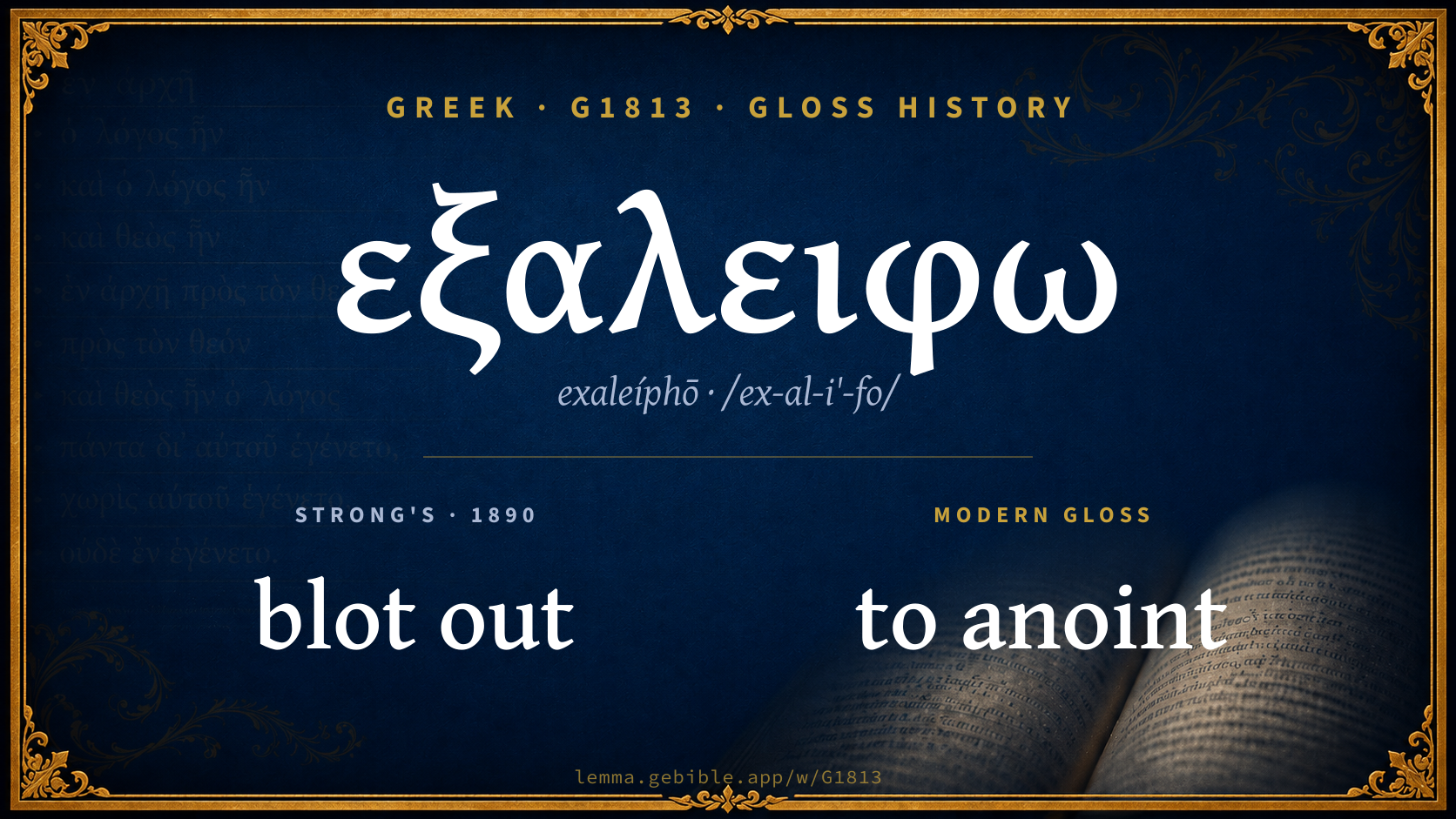
Gloss history
Strong's 1890 vs modern scholarship
About this word
Strong's G1813 catalogs a Greek word from the Greek New Testament.
These counts are not copied from any lexicon or concordance. They are computed here, from the morphology-tagged Greek New Testament. What Lemma adds →
- 5
- distinct verses
- The word appears in 5 distinct verses.
- 3 / 27
- NT books
- The word appears in 3 of 27 New Testament books.
- #1,648
- by frequency
- Top 2500 most frequent Greek words (rank 1,648 of 5,347 Greek words by occurrence).
View all 5 occurrences in the concordance →
Most concentrated in
- Revelation 3 verses 60%
- Acts 1 verse 20%
- Colossians 1 verse 20%
By section of the New Testament
By traditional corpus
Conventional, traditional groupings — biblical authorship is debated, so this is a traditional corpus grouping, not an authorship claim. Some books belong to more than one corpus (Luke is in both the Gospels and the Lukan corpus, and so on), so these shares overlap and need not total 100%. Each figure is a share of the word’s 5 distinct verses.
- Johannine 3 verses · 60%
- Revelation 3 verses · 60%
- Lukan (Luke–Acts) 1 verse · 20%
- Pauline corpus 1 verse · 20%
How translations render this word
Counts come from each version’s own published word-to-Strong’s tagging or interlinear alignment — an approximate guide to how each version renders this word, not a word-level alignment the data otherwise carries. Because each total is that version’s own tagged count, the per-version totals vary from one another and need not match the appearance or distinct-verse counts above. These counts may also differ from a printed concordance because Lemma counts each distinctly tagged rendering and does not collapse phrase taggings into a single head-word total. This is a fixed set of word-tagged versions (KJV, ASV, BSB, ULT) and does not change with the reading translation you choose elsewhere. Each version’s license is shown beside its name below (and on Sources).
- King James Version: Shall wipe away 2×
- American Standard Version: Shall wipe away 2×
- Berean Standard Bible: Having canceled 1×, He will wipe away 1×, I will never blot out 1×
- unfoldingWord Literal Text: Be wiped away 1×, Having canceled 1×, He will wipe away 1×
King James Version Public Domain
Renders G1813 across 6 tagged occurrences — most commonly:
Plus 4 renderings that appear only once — usually multi-word phrases or single function words the recovered tagging swept in, not distinct renderings.
American Standard Version Public Domain
Renders G1813 across 5 tagged occurrences — most commonly:
Plus 3 renderings that appear only once — usually multi-word phrases or single function words the recovered tagging swept in, not distinct renderings.
Berean Standard Bible Public Domain
Renders G1813 across 5 tagged occurrences — most commonly:
unfoldingWord Literal Text CC BY-SA 4.0
Renders G1813 across 6 tagged occurrences — most commonly:
Senses in Thayer's
The 2 senses Thayer's distinguishes for this word, in lexicon order (not ranked by frequency or importance). The full entry — with sub-senses — is in the Lexicon Entry tab.
- to anoint or wash in every part
- to obliterate, erase, wipe out, blot out
Word origin
Derived from εκ (ek) (G1537) — from.
Forms in the corpus
The 4 distinct written forms G1813 takes in the Greek New Testament, most frequent first — each parse links to that tense’s occurrences in the concordance.
| Form | Parsing | Example | Uses |
|---|---|---|---|
| ἐξαλείψει exaleípsei | Verb, Future, Active, Indicative, 3rd person, Singular | Revelation 7:17 | 2 |
| ἐξαλείψας exaleípsas | Verb, Aorist, Active, Participle, Nominative, Singular, Masculine | Colossians 2:14 | 1 |
| ἐξαλείψω exaleípsō | Verb, Future, Active, Indicative, 1st person, Singular | Revelation 3:5 | 1 |
| ἐξαλειφθῆναι exaleiphthē̂nai | Verb, Aorist, Passive, Infinitive | Acts 3:19 | 1 |
Same root — word family
Other Thayer's entries built from the same root as G1813, grouped by Strong’s listed origin. These share a root / origin per the lexicon — not necessarily a shared meaning. Each links to that word’s own entry.
Derives from
Shares the same root
- εκβαλλω ekbállō G1544 to cast out
- εκβασις ékbasis G1545 exit
- εκγαμιζω ekgamízō G1547 to give in marriage
- εκγαμισκω ekgamískō G1548 to give in marriage
- εκγονον ékgonon G1549 offspring
- εκδαπαναω ekdapanáō G1550 to spend
- εκδεχομαι ekdéchomai G1551 to receive
- εκδηλος ékdēlos G1552 evident
- εκδημεω ekdēméō G1553 to depart
- εκδιδωμι ekdídōmi G1554 to give out
- εκδιηγεομαι ekdiēgéomai G1555 to relate
- εκδικος ékdikos G1558 without justice
- εκδιωκω ekdiṓkō G1559 to banish
- εκδοτος ékdotos G1560 delivered up
- εκδυω ekdýō G1562 to put off
- εκζητεω ekzētéō G1567 to seek out
- εκθαμβος ékthambos G1569 astonished
- εκθετος ékthetos G1570 exposed
- εκκαθαιρω ekkathaírō G1571 to cleanse
- εκκαιω ekkaíō G1572 to burn
- εκκακεω ekkakéō G1573 to be exhausted
- εκκεντεω ekkentéō G1574 to pierce
- εκκλαω ekkláō G1575 to cut off
- εκκλειω ekkleíō G1576 to shut out
+88 more words share this root (not shown).
Compare all same-root words → Showing 4 of 114 — not the complete family. They share a root, not necessarily a meaning.
Septuagint usage
The same Greek word εξαλειφω appears 36 times in the Greek Old Testament (Septuagint), across 34 verses in 15 books.
- 36
- LXX occurrences
- Tagged occurrences of this Greek word in the Septuagint.
- 34
- verses
- Distinct Septuagint verses containing this word.
- 15 / 39
- OT books
- The word appears in 15 of the 39 Old Testament books.
Sample Septuagint occurrences
- Genesis 7:4 ἐκἀλείφω
- Exodus 17:14 ἐκἀλείφω
- Leviticus 14:42 ἐκἀλείφω
- Numbers 5:23 ἐκἀλείφω
- Deuteronomy 9:14 ἐκἀλείφω
- Judges 15:16 ἐκἀλείφω
- 2 Kings 14:27 ἐκἀλείφω
- 1 Chronicles 29:4 ἐκἀλείφω
- Ezra 23:14 ἐκἀλείφω
- Psalms 9:6 ἐκἀλείφω
- Proverbs 6:33 ἐκἀλείφω
- Isaiah 43:25 ἐκἀλείφω
Septuagint occurrences (same lexeme)
Every verse where the same Strong’s number (G1813) appears in the Greek Septuagint. Verse text shown in the World English Bible for context; the Greek form is the matched word — the English is not keyword-highlighted.
- Genesis 7:4 ἐκἀλείφω In seven days, I will cause it to rain on the earth for forty days and forty nights. Every living thing that I have made, I will destroy from the surface of the ground."
- Genesis 7:23 ἐκἀλείφω Every living thing was destroyed that was on the surface of the ground, including man, cattle, creeping things, and birds of the sky. They were destroyed from the earth. Only Noah was left, and those who were with him in the ark.
- Genesis 9:15 ἐκἀλείφω and I will remember my covenant, which is between me and you and every living creature of all flesh, and the waters will no more become a flood to destroy all flesh.
- Exodus 17:14 ἐκἀλείφω Yahweh said to Moses, "Write this for a memorial in a book, and rehearse it in the ears of Joshua: that I will utterly blot out the memory of Amalek from under the sky."
- Exodus 32:32 ἐκἀλείφω Yet now, if you will, forgive their sin-- and if not, please blot me out of your book which you have written."
- Exodus 32:33 ἐκἀλείφω Yahweh said to Moses, "Whoever has sinned against me, him will I blot out of my book.
- Leviticus 14:42 ἐκἀλείφω They shall take other stones, and put them in the place of those stones; and he shall take other mortar, and shall plaster the house.
- Leviticus 14:43 ἐκἀλείφω "If the plague comes again, and breaks out in the house, after he has taken out the stones, and after he has scraped the house, and after it was plastered;
- Leviticus 14:48 ἐκἀλείφω "If the priest shall come in, and examine it, and, behold, the plague hasn't spread in the house, after the house was plastered, then the priest shall pronounce the house clean, because the plague is healed.
- Numbers 5:23 ἐκἀλείφω "The priest shall write these curses in a book, and he shall blot them out into the water of bitterness.
- Numbers 27:4 ἐκἀλείφω Why should the name of our father be taken away from among his family, because he had no son? Give to us a possession among the brothers of our father.
- Deuteronomy 9:14 ἐκἀλείφω let me alone, that I may destroy them, and blot out their name from under the sky; and I will make of you a nation mightier and greater than they.
- Deuteronomy 25:6 ἐκἀλείφω It shall be, that the firstborn whom she bears shall succeed in the name of his brother who is dead, that his name not be blotted out of Israel.
- Deuteronomy 25:19 ἐκἀλείφω Therefore it shall be, when Yahweh your God has given you rest from all your enemies round about, in the land which Yahweh your God gives you for an inheritance to possess it, that you shall blot out the memory of Amalek from under the sky; you shall not forget.
- Deuteronomy 29:19 ἐκἀλείφω and it happen, when he hears the words of this curse, that he bless himself in his heart, saying, I shall have peace, though I walk in the stubbornness of my heart, to destroy the moist with the dry.
- Judges 15:16 ἐκἀλείφω Samson said, With the jawbone of a donkey, heaps on heaps, With the jawbone of a donkey I have struck a thousand men.
- Judges 21:17 ἐκἀλείφω They said, There must be an inheritance for those who are escaped of Benjamin, that a tribe not be blotted out from Israel.
- 2 Kings 14:27 ἐκἀλείφω Yahweh didn't say that he would blot out the name of Israel from under the sky; but he saved them by the hand of Jeroboam the son of Joash.
- 1 Chronicles 29:4 ἐκἀλείφω even three thousand talents of gold, of the gold of Ophir, and seven thousand talents of refined silver, with which to overlay the walls of the houses;
- Ezra 23:14 ἐκἀλείφω
- Psalms 9:6 ἐκἀλείφω The enemy is overtaken by endless ruin. The very memory of the cities which you have overthrown has perished.
- Psalms 50:3 ἐκἀλείφω Our God comes, and does not keep silent. A fire devours before him. It is very tempestuous around him.
- Psalms 50:11 ἐκἀλείφω I know all the birds of the mountains. The wild animals of the field are mine.
- Psalms 68:29 ἐκἀλείφω Because of your temple at Jerusalem, Kings shall bring presents to you.
- Psalms 108:13 ἐκἀλείφω Through God, we will do valiantly. For it is he who will tread down our enemies.
- Psalms 108:14 ἐκἀλείφω
- Proverbs 6:33 ἐκἀλείφω He will get wounds and dishonor. His reproach will not be wiped away.
- Isaiah 43:25 ἐκἀλείφω I, even I, am he who blots out your transgressions for my own sake; and I will not remember your sins.
- Jeremiah 18:23 ἐκἀλείφω Yet, Yahweh, you know all their counsel against me to kill me; don't forgive their iniquity, neither blot out their sin from your sight; but let them be overthrown before you; deal you with them in the time of your anger.
- Ezekiel 9:8 ἐκἀλείφω It happened, while they were smiting, and I was left, that I fell on my face, and cried, and said, Ah Lord Yahweh! will you destroy all the residue of Israel in your pouring out of your wrath on Jerusalem?
- Ezekiel 20:17 ἐκἀλείφω Nevertheless my eye spared them, and I didn't destroy them, neither did I make a full end of them in the wilderness.
- Ezekiel 22:30 ἐκἀλείφω I sought for a man among them, who should build up the wall, and stand in the gap before me for the land, that I should not destroy it; but I found none.
- Ezekiel 25:15 ἐκἀλείφω Thus says the Lord Yahweh: Because the Philistines have dealt by revenge, and have taken vengeance with despite of soul to destroy with perpetual enmity;
- Hosea 11:9 ἐκἀλείφω I will not execute the fierceness of my anger. I will not return to destroy Ephraim: For I am God, and not man; the Holy One in the midst of you; And I will not come in wrath.
These are occurrences of the same Greek lexeme (G1813) in the Septuagint — not a translation of any one Hebrew word. The store carries no word-level Hebrew↔Greek alignment, so no Hebrew original is asserted here. Counts come from the recovered LXX Strong's tagging — high-frequency vocabulary is well covered, while rare or late forms may be untagged — so they reflect tagged occurrences and may slightly undercount.