
Ezekiel 25:15

Hebrew (Westminster Leningrad Codex) Ezekiel 25:15 appears in the Hebrew Old Testament. The text above is from the Westminster Leningrad Codex. Each word links to its Strong’s number, a concise gloss, and parsing drawn from the Open Scriptures Hebrew Bible morphology. Click any word for its full Brown-Driver-Briggs (BDB) entry.
Download image
Cite this verse

Ezekiel 25:15 (World English Bible). Public Domain. Lemma interlinear Bible study tool, https://lemma.gebible.app/v/ezekiel/25/15.

Show BibTeX & RIS
BibTeX
RIS
English Translation
Thus says the Lord Yahweh: Because the Philistines have dealt by revenge, and have taken vengeance with despite of soul to destroy with perpetual enmity;
World English Bible · Public Domain
Download a study sheet

One document with this verse’s original text, its word-by-word gloss line, the meaning frame, cross-references with their text, attributed commentary, and full source and license credits — printable, and it pastes into notes with its structure intact.

This verse Autodidact and up

Study sheet (.html) Plain text (.txt)

A passage Seminary Student

Up to 50 verses in one chapter. A passage sheet keeps up to 6 commentary sources and 12 cross-references per verse, in the order this page ranks them, and says so on the sheet whenever that leaves anything out. Ask for a single verse and you get the Autodidact verse sheet above.

Everything on this page stays free to read, with no account — the sheet is a download of what is already on screen, not access to it.

Want to remove ads? Support Godless Engineer
Compare translations 3

The same verse in 3 English versions, stacked beneath the original-language interlinear above. Click any original word for its lexicon entry.

Each is an independent rendering of the whole verse — the interlinear is not word-aligned to these translations.

Highlighted words mark where these versions differ — a whole-verse word diff, not a word-by-word alignment.

  • World English Bible Public Domain
    Thus says the Lord Yahweh: Because the Philistines have dealt by revenge, and have taken vengeance with despite of soul to destroy with perpetual enmity;
  • King James Version Public Domain
    Thus saith the Lord GOD; Because the Philistines have dealt by revenge, and have taken vengeance with a despiteful heart, to destroy it for the old hatred;
  • unfoldingWord Literal Text CC BY-SA 4.0
    The Lord Yahweh says this, ‘The Philistines have taken vengeance with malice and from within themselves they tried to destroy Judah again and again.

unfoldingWord Literal Text — © unfoldingWord, licensed CC BY-SA 4.0. Word-aligned USFM3 via Door43 (git.door43.org/unfoldingWord/en_ult).

Versions to compare (up to 4)

3 of 4 selected

Show all 18 translations

Every available English version of this verse, each an independent rendering of the whole verse.

  • World English Bible Public Domain
    Thus says the Lord Yahweh: Because the Philistines have dealt by revenge, and have taken vengeance with despite of soul to destroy with perpetual enmity;
  • Berean Standard Bible Public Domain
    This is what the Lord GOD says: ‘Because the Philistines acted in vengeance, taking vengeance with malice of soul to destroy Judah with ancient hostility,
  • Majority Standard Bible Public Domain
    This is what the Lord GOD says: ‘Because the Philistines acted in vengeance, taking vengeance with malice of soul to destroy Judah with ancient hostility,
  • King James Version Public Domain
    Thus saith the Lord GOD; Because the Philistines have dealt by revenge, and have taken vengeance with a despiteful heart, to destroy it for the old hatred;
  • American Standard Version (1901) Public Domain
    Thus saith the Lord Jehovah: Because the Philistines have dealt by revenge, and have taken vengeance with despite of soul to destroy with perpetual enmity;
  • Revised Version (1885) Public Domain
    Thus saith the Lord GOD: Because the Philistines have dealt by revenge, and have taken vengeance with despite of soul to destroy it with perpetual enmity;
  • Geneva Bible (1599) Public Domain
    Thus sayth the Lord God, Because the Philistims haue executed vengeance, and reuenged themselues with a despitefull heart, to destroy it for the olde hatred,
  • Douay-Rheims (1899) Public Domain
    Thus saith the Lord God: Because the Philistines have taken vengeance, and have revenged themselves with all their mind, destroying and satisfying old enmities:
  • Young's Literal Translation Public Domain
    Thus said the Lord Jehovah: Because of the doings of the Philistines in vengeance, And they take vengeance with despite in soul, To destroy -- the enmity age-during!
  • Literal Standard Version CC BY-SA 4.0
    Thus said Lord YHWH: Because of the doings of the Philistines in vengeance, || And they take vengeance with despite in soul, || Destruction [with] continuous enmity,
  • Unlocked Literal Bible CC BY-SA 4.0
    The Lord Yahweh says this, 'The Philistines have taken vengeance with malice and from within themselves they tried to destroy Judah again and again.
  • unfoldingWord Literal Text CC BY-SA 4.0
    The Lord Yahweh says this, ‘The Philistines have taken vengeance with malice and from within themselves they tried to destroy Judah again and again.
  • Darby Bible Public Domain
    Thus saith the Lord Jehovah: Because the Philistines have dealt by revenge, and have taken vengeance with despite of soul, to destroy, from old hatred;
  • World Messianic Bible Public Domain
    “‘The Lord GOD says: “Because the Philistines have taken revenge, and have taken vengeance with contempt of soul to destroy with perpetual hostility,”
  • Webster's Bible Public Domain
    Thus saith the Lord GOD; Because the Philistines have dealt by revenge, and have taken vengeance with a despiteful heart, to destroy it for the old hatred;
  • Free Bible Version CC BY-SA 4.0
    This is what the Lord God says: Because the Philistines in their hatred repeatedly took revenge on Judah, trying to destroy the people,
  • Bible in Basic English Public Domain
    This is what the Lord has said: Because the Philistines have taken payment, with the purpose of causing shame and destruction with unending hate;
  • JPS Tanakh (1917) Public Domain
    Thus saith the Lord GOD: Because the Philistines have dealt by revenge, and have taken vengeance with disdain of soul to destroy, for the old hatred;

Literal Standard Version (2020), Covenant Press — licensed CC BY-SA 4.0. Text via the HelloAO Bible API (eBible.org). Unlocked Literal Bible (unfoldingWord) — licensed CC BY-SA 4.0. Text via the HelloAO Bible API (eBible.org). unfoldingWord Literal Text — © unfoldingWord, licensed CC BY-SA 4.0. Word-aligned USFM3 via Door43 (git.door43.org/unfoldingWord/en_ult). Free Bible Version, Dr. Jonathan Gallagher — licensed CC BY-SA 4.0. Text via the HelloAO Bible API (eBible.org).

Word by word

More ways to search: Search by grammar → Find every occurrence → Compare this word →

Practice this passage: Drill this verse → Learn its vocabulary →

בִּשְׁאָ֣ט
shᵉʼâṭ
H7589
“in/at · contempt”
Preposition + Noun, Common, Masculine, Singular, Absolute
Part of Speech
Preposition + Noun
Type
Common
Gender
Masculine
Number
Singular
State
Absolute
Full BDB Definition

Origin: from an unused root meaning to push aside

TWOT: 2345a

despite, contempt
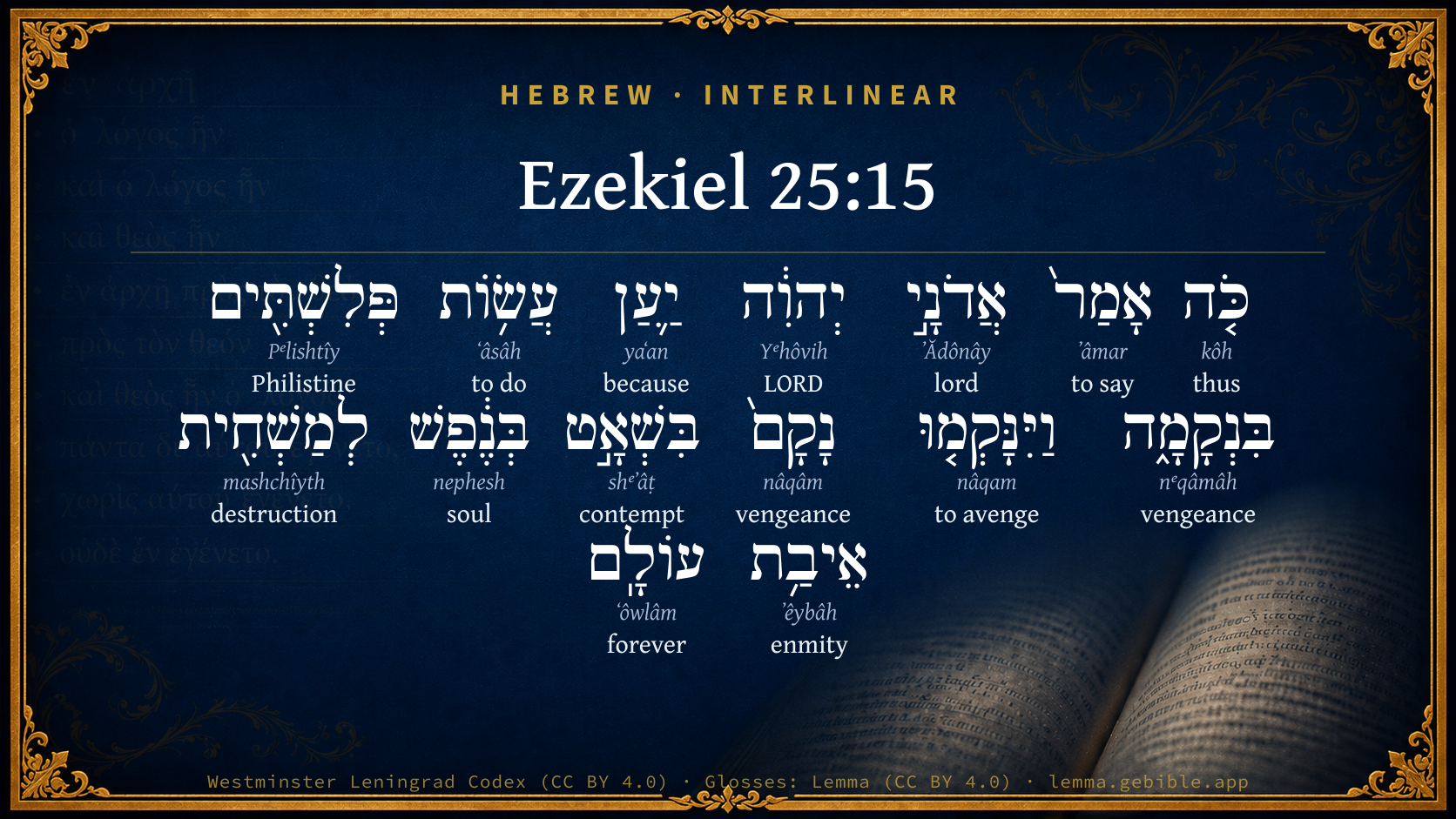
  1. כֹּ֤ה kôh H3541 “thus” Adverb
  2. אָמַר֙ ʼâmar H559 “to say” Verb, Qal, Perfect, 3rd Person, Masculine, Singular
  3. אֲדֹנָ֣י ʼĂdônây H136 “Lord · my” Noun, Common, Masculine, Plural, Construct + Suffix, Personal, 1st Person, Common, Singular
  4. יְהוִ֔ה Yᵉhôvih H3069 “LORD” Noun, Proper
  5. יַ֛עַן yaʻan H3282 “because” Conjunction
  6. עֲשׂ֥וֹת ʻâsâh H6213 “to do” Verb, Qal, Infinitive Construct
  7. פְּלִשְׁתִּ֖ים Pᵉlishtîy H6430 “Philistines” Noun, Gentilic, Masculine, Plural, Absolute
  8. בִּנְקָמָ֑ה nᵉqâmâh H5360 “in/at · vengeance” Preposition + Noun, Common, Feminine, Singular, Absolute
  9. וַיִּנָּקְמ֤וּ nâqam H5358 “and · to avenge” Conjunction + Verb, Niphal, Sequential Imperfect, 3rd Person, Masculine, Plural
  10. נָקָם֙ nâqâm H5359 “vengeance” Noun, Common, Masculine, Singular, Absolute
  11. בְּנֶ֔פֶשׁ nephesh H5315 “in/at · soul” Preposition + Noun, Common, Both, Singular, Absolute
  12. לְמַשְׁחִ֖ית mashchîyth H4889 “to/for · destruction” Preposition + Noun, Common, Masculine, Singular, Absolute
  13. אֵיבַ֥ת ʼêybâh H342 “enmity of” Noun, Common, Feminine, Singular, Construct
  14. עוֹלָֽם ʻôwlâm H5769 “forever” Noun, Common, Masculine, Singular, Absolute

About this verse

These counts appear in no published source. They are computed here, from the morphology-tagged text and Lemma’s own curated glosses. What Lemma adds →

15
words
15
distinct lemmas
Prophets
section

Notable vocabulary

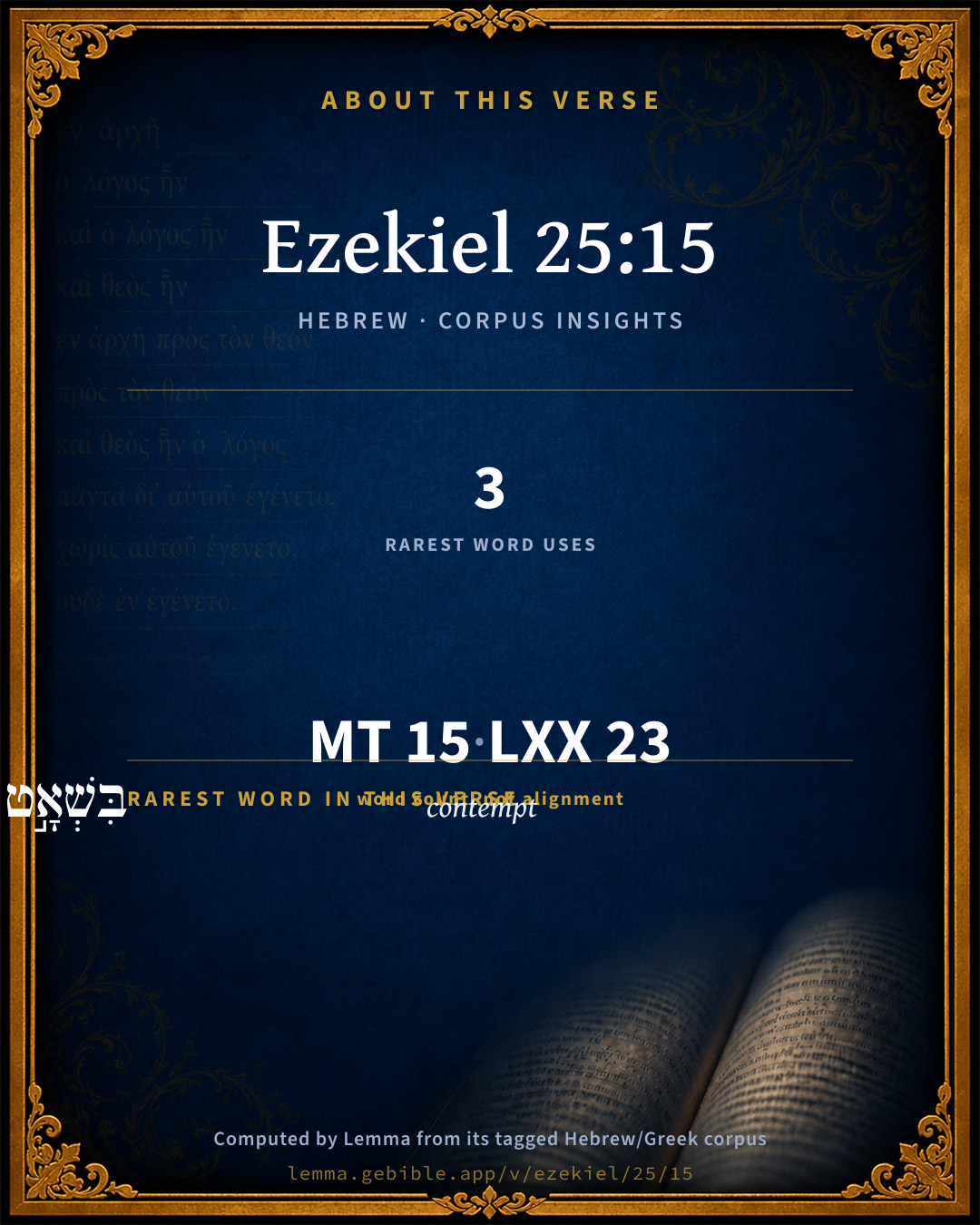
The rarest word here is בִּשְׁאָ֣ט contempt H7589 — appearing just 3 times in the whole Hebrew Bible.

Shared distinctive vocabulary

בִּשְׁאָ֣ט contempt H7589 occurs in 3 verses of the Hebrew Bible. Also found in:

Grammatical profile

  • 3 verbs
  • 10 nouns
  • 1 conjunction
  • 1 adverb

Verb forms

  • אָמַר֙ Qal · Perfect
  • עֲשׂ֥וֹת Qal · Infinitive Construct
  • וַיִּנָּקְמ֤וּ Niphal · Sequential Imperfect

Hebrew & Septuagint length

In English translation the verse runs 25 words from the Hebrew and 26 from the Septuagint (LXX English) — closely comparable.

A rough comparison of the two English renderings, which tokenize alike — not a word-level alignment.

Word counts can differ between the Hebrew and the Greek without any difference in meaning — e.g. the Hebrew direct-object marker אֵת has no separate Greek word, and Greek often adds the article ὁ.

In the original languages it is 15 Hebrew tokens and 23 Greek tokens — but the two are counted differently (Hebrew bundles its prefixes and suffixes into one token; the Greek is in lemma form), so that isn’t a like-for-like length.

Cross-references

19

Topical passages linked to Ezekiel 25:15 in the Treasury of Scripture Knowledge — connected by theme and wording, ordered by reader-vote popularity; previews shown in the World English Bible.

  • Ezekiel 25:6 For thus says the Lord Yahweh: Because you have clapped your hands, and stamped with the feet, and rejoiced with all the despite of your soul against the land of Israel;
  • Isaiah 14:29–31 Don't rejoice, O Philistia, all of you, because the rod that struck you is broken; for out of the serpent's root shall come forth an adder, and his fruit shall be a fiery flying serpent.
  • 2 Chronicles 28:18 The Philistines also had invaded the cities of the lowland, and of the South of Judah, and had taken Beth-shemesh, and Aijalon, and Gederoth, and Soco with the towns of it, and Timnah with the towns of it, Gimzo also and the towns of it: and they lived there.
  • Jeremiah 25:20 and all the mixed people, and all the kings of the land of the Uz, and all the kings of the Philistines, and Ashkelon, and Gaza, and Ekron, and the remnant of Ashdod;
  • Ezekiel 25:12 Thus says the Lord Yahweh: Because Edom has dealt against the house of Judah by taking vengeance, and has greatly offended, and revenged himself on them;
  • Zechariah 9:5–8 Ashkelon will see it, and fear; Gaza also, and will writhe in agony; As will Ekron, for her expectation will be disappointed; And the king will perish from Gaza, And Ashkelon will not be inhabited.
  • Judges 14:1–16 Samson went down to Timnah, and saw a woman in Timnah of the daughters of the Philistines.
  • 1 Samuel 4:1–6 The word of Samuel came to all Israel. Now Israel went out against the Philistines to battle, and encamped beside Ebenezer: and the Philistines encamped in Aphek.
  • 1 Samuel 13:1–14 Saul was [forty] years old when he began to reign; and when he had reigned two years over Israel,
  • 1 Samuel 17:1–58 Now the Philistines gathered together their armies to battle; and they were gathered together at Socoh, which belongs to Judah, and encamped between Socoh and Azekah, in Ephesdammim.
  • 1 Samuel 21:1–15 Then came David to Nob to Ahimelech the priest: and Ahimelech came to meet David trembling, and said to him, Why are you alone, and no man with you?
  • 2 Samuel 8:1–18 After this it happened that David struck the Philistines, and subdued them: and David took the bridle of the mother city out of the hand of the Philistines.
  • 1 Chronicles 7:21 and Zabad his son, and Shuthelah his son, and Ezer, and Elead, whom the men of Gath who were born in the land killed, because they came down to take away their cattle.
  • Psalms 83:7 Gebal, Ammon, and Amalek; Philistia with the inhabitants of Tyre;
  • Isaiah 9:12 the Syrians before, and the Philistines behind; and they shall devour Israel with open mouth. For all this his anger is not turned away, but his hand is stretched out still.
  • Jeremiah 47:1–7 The word of Yahweh that came to Jeremiah the prophet concerning the Philistines, before that Pharaoh struck Gaza.
  • Joel 3:4–21 "Yes, and what are you to me, Tyre, and Sidon, And all the regions of Philistia? Will you repay me? And if you repay me, I will swiftly and speedily return your repayment on your own head.
  • Amos 1:6–8 Thus says Yahweh: "For three transgressions of Gaza, yes, for four, I will not turn away its punishment; Because they carried away captive the whole community, To deliver them up to Edom;
  • Zephaniah 2:4–7 For Gaza will be forsaken, and Ashkelon a desolation. They will drive out Ashdod at noonday, and Ekron will be rooted up.

Cross-references courtesy of OpenBible.info (CC BY 4.0).

Hebrew and Greek witnesses Masoretic Hebrew ↔ Greek Septuagint

The same verse in the two great witnesses to the Old Testament, shown verse-for-verse.

These are two independent witnesses, not word-aligned to each other, and the Septuagint is shown in lemma (dictionary) form.

Hebrew Ezekiel 25:15 Masoretic · Westminster Leningrad Codex

כֹּ֤ה אָמַר֙ אֲדֹנָ֣י יְהוִ֔ה יַ֛עַן עֲשׂ֥וֹת פְּלִשְׁתִּ֖ים בִּנְקָמָ֑ה וַיִּנָּקְמ֤וּ נָקָם֙ בִּשְׁאָ֣ט בְּנֶ֔פֶשׁ לְמַשְׁחִ֖ית אֵיבַ֥ת עוֹלָֽם

Thus says the Lord Yahweh: Because the Philistines have dealt by revenge, and have taken vengeance with despite of soul to destroy with perpetual enmity;

World English Bible · Public Domain

Greek LXX Ezekiel 25:15 Septuagint · lemma form

διά οὗτος ὅδε λέγω κύριος ἀντί ὅς ποιέω ὁ ἀλλόφυλος ἐν ἐκδίκησις καί ἐκ ἀναἵστημι ἐκδίκησις ἐπιχαίρω ἐκ ψυχή ὁ ἐκἀλείφω ἕως αἰών

Therefore thus says the Lord, Because the Philistines have wrought revengefully, and raised up vengeance rejoicing from their heart to destroy the Israelites to a man;

LXX2012 (modern English Septuagint) · Public Domain

Hebrew: Westminster Leningrad Codex (CC BY 4.0). Greek: Septuagint (public domain); English from LXX2012 (modern English Septuagint) (Public Domain). How the Septuagint differs from the Hebrew →

Targum (Aramaic paraphrase)

1

The Targum is the ancient Jewish Aramaic paraphrase of the Hebrew Scriptures — an interpretive translation, not the Hebrew text itself. Onkelos (literal) and Pseudo-Jonathan (expansive) render the Torah, and Jonathan the Prophets. Coverage is partial: where no permissively-licensed English translation exists for a verse, only the Aramaic is shown. This is verse-level text, not a word-by-word alignment to the Hebrew.

  1. Targum Jonathan Prophets (Joshua–Malachi)
    כִּדְנַן אֲמַר יְיָ אֱלֹהִים חֲלַף דַעֲבָדוּ פְּלִשְׁתָּאֵי בִּדְבָבוּ וְיִתְפְּרָעוּן פּוּרְעֲנוּת בְּצִפּוּחַ נְפַשׁ בְּדִיל לְחַבְּלָא דְבָבוּת עֲלָם:

    (no public-domain English translation for this verse)

    Targum Jonathan — Aramaic: “Mikraot Gedolot” (public domain). English: “Sefaria Community Translation” (CC0 1.0 (public-domain dedication)); “London "Chaldee Paraphrase," 1871” (public domain). Text via Sefaria.

Commentary

Notes on Ezekiel 25:15 from classic Christian and Jewish commentators (each source and its license shown beneath its notes). The classic Christian expositions comment on the surrounding passage and are grouped to its opening verse, so a note may address several verses; the Jewish commentaries on the Tanakh (Rashi and others) are per-verse, so they appear only where the commentator wrote on this verse.

Lemma curates 59 commentaries, every one of them public domain or Creative Commons licensed, each selected and text-cleaned for this edition rather than reprinted as found. About our sources →

Trapp's Complete Commentary

John Trapp

Eze 25:15 Thus saith the Lord GOD; Because the Philistines have dealt by revenge, and have taken vengeance with a despiteful heart, to destroy [it] for the old hatred;

Ver. 15. Because the Philistines have dealt by revenge.] See on Eze 25:12-13. Heathens thought revenge lawful, and tallying of injuries to be but justice. But Christianity teacheth us that non minus mali est referre iniuriam, quam inferre, {a}

For the old hatred.] The Philistines were of the old inhabitants the Canaanites, and kept up a deadly feud.

{a} Lactant.

John Trapp, A Commentary or Exposition upon All the Books of the Old and New Testament (1647–1656) — public domain. Text from a community e-Sword module.

Joseph Benson's Commentary

Eze 25:15-17. Because the Philistines have dealt by revenge — The Philistines being borderers upon the Jews, were their ancient enemies, from the very time of the judges downward, more particularly in the time of Ahaz: see 2Ch 28:18. Therefore I will stretch out my hand upon the Philistines — I will bring calamities upon them, and enemies who shall subdue them. They were accordingly subdued by Nebuchadnezzar: see Jer 25:20; Jer 47:1. The Cherethims, or Cherethites, are the same with the Philistines, or a tribe of that people: see the margin. And destroy the remnant of the sea-coast — The same who are called the remnant of the Philistines, Amo 1:8; the remnant of Ashdod, Jer 25:20; and the remnant of the country of Caphthor, chap. Eze 47:4: on which two places see the notes. It is called the remnant, or remains, because the sea-coast of the Philistines, namely, about Ashdod, had been before much wasted and spoiled by the invasion of Psammetichus, king of Egypt.

Joseph Benson's Commentary on the Old and New Testaments (1811–1818) — public domain. Text from a community e-Sword module.

Whedon's Commentary on the Bible

Daniel D. Whedon

15, 16. The Philistines,… the Cherethim — Whether the Philistines were Aryans or Semites is not settled. George Adam Smith describes them as a Semitic people with non-Semitic habits, language, and institutions. An Egyptian traveler, 1000 B.C., declared that he found a colony of Philistines at the foot of Mount Carmel which traced its descent from the Zuk(k)ara, a warlike tribe of Asia Minor (Pap. Golenischeff). The original home of the Philistines, however, was not Asia Minor nor the Egyptian Delta (Sayce) nor Phoenicia (Muller), but almost certainly Crete. The features of the inhabitants of Philistia, as portrayed on the Egyptian monuments by Ramses II (1350 B.C.), have a Hittite cast and differ very greatly from those pictured by later Pharaohs, which probably indicates that this warlike people had entered the country and seized the “seacoast cities” — Gaza, Askelon, Ashdod, Ekron, Gath — which they ever afterward held, though it may possibly only point to an abnormal admixture of racial types in the nation. The Cretes were a mixed race, and the writer has noticed that the modern inhabitants of Philistia show this same peculiarity in a marked degree. Certain it is that only a little previous to the Exodus the Philistines began to figure prominently in the war records of Egypt (Egyptian, Purasati; Assyrian, Pulista or Pilista). In the latter part of the fifteenth century B.C., as is proved by the Tel-el-Amarna letters, the Philistine cities were in complete subjection to Egypt. They had rather a high degree of civilization. Clear cases of commerce with Cyprus were found at Tel-el-Hesy (Lachish). After the Exodus the Philistines (allying themselves with the Anakim) had many severe struggles with the Hebrews, with varying fortunes, as is proved by the story of David and Goliath, Shamgar, Samson, etc. Sometimes it seemed as if the Hebrews were destined to be nothing more than the abject slaves of this people. (See Jdg_5:8; 1Sa_13:19.) After Israel had successfully revolted, Philistia, no doubt, allied herself with her enemies for revenge (Eze_25:15). So great did the Philistines become that the land of Canaan and Israel is known by their name even to this day (Palestine). Philistia was always a stronghold of idolatry, and Gaza continued to boast of idol temples long after Christianity had dominated the rest of Palestine. The writer still saw indications of the survival of the old heathen worship as late as 1890. The Cherethims or Cherethites was probably another name of the Philistines, referring to their Cretan origin (Zep_2:5). Arthur J. Evans has proved that the Philistines on the Egyptian monuments wear Cretan dress and carry Cretan vases.

Daniel D. Whedon (gen. ed.), Commentary on the Old and New Testaments (1874–1909) — public domain. Text from a community e-Sword module.

Keil & Delitzsch

C. F. Keil & F. Delitzsch

Against the Philistines

Eze 25:15. Thus saith the Lord Jehovah, Because the Philistines act with revenge, and avenge themselves with contempt in the soul to destroy in everlasting enmity, Eze 25:16. Therefore thus saith the Lord Jehovah, Behold, I will stretch out my hand over the Philistines, and cut off the Cretans, and destroy the remnant by the seashore. Eze 25:17. And I will execute great vengeance upon them through chastisements of wrath, and they shall know that I am Jehovah, when I bring my vengeance upon them. - The Philistines resembled the Edomites and Ammonites in their disposition towards the covenant nation, the former in their thirst for revenge, the latter in their malicious rejoicing at Israel's fall. For this reason they had already been classed by Isaiah (Isa 11:14) with Edom, Moab, and Ammon as enemies, who would be successfully attacked and overcome by Israel, when the Lord had gathered it again from its dispersion. In the description of its sin towards Israel we have a combination of elements taken from the conduct of Edom and Ammon (vv. 12 and 6). They execute revenge with contempt in the soul (שׁאט בּנפשׁ, as in v. 6), with the intention to destroy (למשׁחית) Israel; and this revenge springs from eternal, never-ending hostility. The Lord will cut off the whole of the people of the Philistines for this. כּרתים, Cretans, originally a branch of the Philistian people, settled in the south-west of Canaan. The name is used by Ezekiel for the people, as it had already been by Zephaniah (Zep 2:5), for the sake of the paronomasia with הכרתּי. The origin of the name is involved in obscurity, as the current derivation from Creta rests upon a very doubtful combination (cf. Stark, Gaza, pp. 66 and 99ff.). By the "remnant of the sea-coast," i.e., the remnant of the inhabitants of the coast of the Mediterranean, in other words, of the Philistines, the destruction of which had already been predicted by Amos (Amo 1:8), Isaiah (Isa 14:30), and Jeremiah (Jer 42:4), we are to understand the whole nation to the very last man, all that was still left of the Philistines (see the comm. on Amo 1:8). - The execution of the vengeance threatened by God began in the Chaldean period, in which Gaza was attacked by Pharaoh, and, judging from Jer 47:1-7, the whole of Philistia was laid waste by the Chaldeans (see the fuller comments on this in the exposition of Jer 47:1-7). But the ultimate fulfilment will take place in the case of Philistia also, through the Messianic judgment, in the manner described in the commentary on Zep 2:10.

Keil & Delitzsch — Biblical Commentary on the Old Testament (1861–1891) — public domain (CC PDM 1.0). Text via the HelloAO Bible API. (Old Testament only.)

Fairbairn on Ezekiel, Jonah & the Pastoral Epistles

Patrick Fairbairn

IV. The judgment of the Philistines (Eze 25:15-17).

Eze 25:15. Thus saith the Lord Jehovah, Because of the doing of the Philistines in vengeance, and they have taken vengeance with disdain, with a mind to destroy (literally, with the soul, for destruction), an everlasting enmity;

Eze 25:16. Therefore, thus saith the Lord Jehovah, Behold, I stretch out my hand upon the Philistines, and I will cut off the Cherethim, (There is a paronomasia here in the original, which is preserved in the Vulgate: interficiam interfectores, I will slay the slayers—the Philistines being perhaps so designated from their warlike and cruel disposition. But Cherethim is also used as a proper name, the same probably with Cretans—the Philistines being supposed to be of Cretan extraction. (Comp. Jer 47:4; Amo 9:7; Deu 2:23; Vitringa on Isa 14:28.)) and destroy the remnant of the sea-coast.

Eze 25:17. And I will execute upon them great vengeance, with furious rebukes; and they shall know that I am Jehovah, when I lay my vengeance upon them.

Little requires to be said on this part of the prediction. The Philistines were the immediate neighbours of the people of Judah, on the opposite side to that occupied by Ammon and Moab. Their hereditary enmity to the covenant-people is sufficiently known. In the later times of the Hebrew commonwealth, they appear to have been in a very reduced condition, and to be quite unable to cope with Judah even in its comparatively enfeebled state. They were discomfited by Uzziah, and had their chief towns dismantled (2Ch 26:6). They were still further humbled and subdued in the days of Hezekiah (2Ki 18:8). From that time we hear nothing more of them in the historical books of Scripture; but as they still retained their enmity to the cause and people of God, they were made the subject of severe denunciations in the prophets; not, however, without some prospects being intermingled of coming good, and even of an interest in the peculiar blessings of the covenant (comp. especially Zec 9:7). As the country lay on the direct route from Egypt to Chaldea, it suffered exceedingly in the wars that were carried on between these rival kingdoms, and was the scene of some bloody conflicts. The wandering Arabs also gradually spread themselves over the district, and produced the usual results. Even at the Christian era it no longer appears as the residence of a separate and independent people; so that the vengeance threatened might even then be said to have reached its completion. Gaza alone, from its favourable position, has been able to retain something of its ancient importance, yet merely as a place of comparative wealth and commerce, and was for centuries the seat of a Christian bishop. In every way, both in respect to the evil and the good, the word of the Lord has taken full effect; and while Israel has risen aloft by being the root out of which has come the world’s Deliverer and heaven-appointed King, the Philistines have become the heirs only of trouble and desolation, excepting in so far as they yielded themselves to the sway of the King of Zion, and partook, as spiritual Israelites, of the blessings of the kingdom.

Patrick Fairbairn — An Exposition of Ezekiel (1851), Jonah (1849), and The Pastoral Epistles (1874) — public domain. Text from a community e-Sword module.

F. W. Grant's Numerical Bible

Section 3 (Eze 25:15-17).

The Philistines under ban.

The Philistines next come before us, as partakers of this inherent and perpetual enmity of Edom. They were intruders into a land promised to Israel, though with a conviction of their own prior right. They have given their name to the whole land (Palestine, from Phtlistia), which they claim, though they have never been able to take possession of more than its mere lowest border. We have seen them abundantly elsewhere, as typically natural men intruding into spiritual things. As Philistines they are "immigrants," but never Hebrews -that is, "passengers" or "pilgrims." They figure largely in the earlier historical books as far as Samuel, and must have a corresponding importance in their signification for us. As Christians, we should know these Philistines very well. They are seen today in what claims to be the Catholic, the Univer_ sal Church, but which spiritual judgment recognizes as but Judaism with a thin veil of Christianity drawn over its face, and with the full inheritance of Jewish enmity to the children of the free woman apparent through it. Into this also we cannot enter now, and need not, as any that will can find it fully where the interpretation naturally belongs. (See Notes on Gen 20:1-18; Gen 26:12; Jos 13:2-3; 1Sa 17:1-58, etc.)

We have but one class of these Philistines specially noticed here, the Cherethites, the "cutters off," which have been also elsewhere considered. (See Act 27:1-44, Notes.) "Cutting off" naturally characterizes asceticism in its every shape, a remnant merely of the old heathenism, whatever its Christian dress. Externalism is manifest here, even in the most zealous forms of devotion. The Cherethites are taken by many, in certain passages at least, to mean "executioners," and in this form of cutting off, Philistinism has ever distinguished itself; and, doubtless, many who sacrificed in this way the deepest feelings of their nature have thought they were doing God service. But all through, the enmity against Israel (the literal as well as the typical enmity) is apparent in what is here, and God threatens the Cherethites in a special manner: "Behold, I will stretch out my hands upon the Philistines, and I will cut off the Cherethites, and destroy the remnant of the seacoast." Thus Philistia will perish in the day of God, and all that are with God will only rejoice over the judgment.

F. W. Grant, The Numerical Bible (4th ed., 1903) — public domain. Text from a community e-Sword module.

Tyndale Open Study Notes

Tyndale Open Resources

25:15-17 The Philistines also had a long-standing contempt for Judah. Their crimes are not specified, but they did not escape the Lord’s notice, and he would return vengeance for vengeance. Then they, too, would recognize the Lord’s sovereign power. • The Kerethites were a Philistine tribe (see 1 Sam 30:14).

Tyndale Open Study Notes — © Tyndale Open Resources, licensed CC BY-SA 4.0. Text via the HelloAO Bible API.

Jamieson, Fausset & Brown

Robert Jamieson, A. R. Fausset & David Brown

(1Sa. 13:1-14:52; Ch2 28:18). The "old hatred" refers to their continual enmity to the covenant-people. They lay along Judea on the seacoast at the opposite side from Ammon and Moab. They were overthrown by Uzziah (Ch2 26:6), and by Hezekiah (Kg2 18:8). Nebuchadnezzar overran the cities on the seacoast on his way to Egypt after besieging Tyre (Jer 47:1-7). God will take vengeance on those who take the avenging of themselves out of His hands into their own (Rom 12:19-21; Jam 2:13).

Jamieson, Fausset & Brown — Commentary Critical and Explanatory on the Whole Bible (1871) — public domain (CC PDM 1.0). Text via the HelloAO Bible API.

Adam Clarke's Commentary

Verse 15. Because the Philistines] They were as inimical to the Jews as the Ammonites, c., were. Nebuchadnezzar punished them because they had assisted the Tyrians during the time he was besieging their city.

I will cut off the Cherethims] 2Sa 8:18.

The remnant of the sea coasts.] The different seignories of the Philistines inhabited the coast of the Mediterranean Sea, from Judea to Egypt. For other matters relative to these prophecies, see the passages in the margin.

Adam Clarke's Commentary on the Bible (1810–1826) — public domain. Text from a community e-Sword/MySword module.

Ellicott's Commentary for English Readers

(15) The Philistines.—The historical books of the Old Testament are almost a continuous record of the hostility of the Philistines. At times they held the greater part of the land of Israel in subjection, and at times were subdued in their turn. Although belonging to another branch of the Hamitic family, their land was included with that of the Canaanites in the territory to be given to the Israelites (Jos_13:2-3). It was never, however, occupied by them, although the cities were fortified and garrisoned by some of the kings. The land lay along the coast of the Mediterranean, on the highway between Egypt and Assyria and Chaldæa, and consequently, in the struggles of those nations with each other the Philistines were gradually more and more reduced, until they disappeared entirely. Among the many prophecies against them, the following may be especially referred to: Isa_14:29-32; Jeremiah 47; Amo_1:6-8; Zep_2:4-7.

A Bible Commentary for English Readers, edited by Charles John Ellicott (1878–1897) — public domain. Text from a community e-Sword module.

The Cambridge Bible for Schools and Colleges

gen. ed. J. J. S. Perowne

15–17. Prophecy against the Philistines

15. with a despiteful heart] Lit. with despite in soul, as Eze_25:6, i.e. the deepest despite of heart, chaps. Eze_16:57, Eze_36:5.

destroy it for the old hatred] Rather: to destroy with perpetual hatred, cf. Eze_35:5; Amo_1:11. The power of the Philistines was conclusively broken by David, but references to their rancour and injuriousness when opportunity occurred run through all the literature of Israel, Amo_1:6 seq.; Isa_9:12; Zep_2:5; Oba_1:19; Joe_3:4; Zec_9:5.

The Cambridge Bible for Schools and Colleges (gen. ed. J. J. S. Perowne; Cambridge University Press, 1878–1918) — public domain. Text from a community e-Sword module.

John Gill's Exposition

Thus saith the Lord God,.... Once more, and concerning another enemy of the people of Israel, and who had been of old an implacable one:

because the Philistines have dealt by revenge: for what they suffered in the times of Saul, when Goliath was slain by David, and their army was discomfited; and for the overthrow of them by David, when he came to throne; and for his burning their images, and subduing them, Sa1 17:51, this revenge they took in the time of Ahaz, Ch2 28:18, and very probably also showed their spite at the time of Jerusalem's destruction:

and have taken vengeance with a despiteful heart, to destroy it for the old hatred; which they bore to the people of Israel, from their first settlement in Canaan; from the times of the judges, particularly Samson; and from the times of Saul and David: it was an old grudge they bore, they had spite and malice in their hearts, and wanted an opportunity to vent it; having determined to take vengeance when they could, and utterly destroy them from being a people; very likely, through despite, they assisted the Chaldean army: or, this they did "with a perpetual hatred" (z); they did everything they could, in a spiteful and malicious way, to perpetuate the hatred between them and Israel.

(z) "inimictias perpetuas", Pagninus; "iuimietia perpetua", Junius & Tremellius, Piscator.

John Gill's Exposition of the Whole Bible (1746–1763) — public domain (CC PDM 1.0). Text via the HelloAO Bible API.

Albert Barnes' Notes on the Bible

The Philistines occupying lands to the south of Judah were a Hamite race Gen 10:14, but of a different branch from the Canaanites. They were a powerful people never dispossessed by the Israelites Jos 13:3. They were a thorn in the side of the chosen people throughout, and joined in attacking Jerusalem in the day of her trouble. They were much reduced by the Assyrians Isa 14:31, and Egyptians Jer 47:1-7, before the time of this prophecy, but further destruction came upon them in the general ruin of the inhabitants of Canaan, which commenced with the destruction of Jerusalem by Nebuchadnezzar.

Eze 25:16

Cherethims - The inhabitants of the southern portion of Philistia Zep 2:5.

Albert Barnes' Notes on the Bible (1834–1885) — public domain. Text from a community e-Sword/MySword module.

Haydock's Catholic Bible Commentary

Enmities. They also watched every moment to injure the Jews, Amos i. 5. But Nabuchodonosor was irritated, because they had assisted Tyre, Jeremias xlvii. 4.

George Leo Haydock (1774–1849), Haydock's Catholic Family Bible and Commentary, 1859 edition — public domain. Excludes Psalms (Douay-Rheims chapter numbering differs from Protestant) and Deuterocanonical books (Catholic canon only).

Matthew Poole's English Annotations

The Philistines; next neighbours to the Jews, between whom many quarrels, wars, and mutual spoil, slaughter, and injuries happened, as ever among borderers, who make all their own they can catch.

Have dealt by revenge; took the opportunity to revenge themselves when the Jews were weak and low.

With a despiteful heart; with hatred to them, and contempt of them.

To destroy it for the old hatred: this tells us what their hatred appeared in, it was a hatred to the name and being of Israel, they would cut them off, as Psa 83:7, with a perpetuated, endless enmity pursuing them.

Matthew Poole's English Annotations on the Holy Bible (1683–1685) — public domain. Text from a community e-Sword/MySword module.

The Pulpit Commentary

The sin of the Philistines is virtually the same as that of the Edomites. They also had a perpetual hatred. Century after century they had been, with various fortunes, the enemies of Israel defeated (to confine ourselves to more recent history) by Jehoshaphat (2Ch_17:11) and Uzziah, (2Ch_26:6) formidable under Jehoram (2Ch_21:16) and Ahaz, (2Ch_28:18) repressed by Hezekiah, (Isa_14:31) combining with Amalek, and Ammon, and Tyre, and Assyria against Jerusalem. (Psa_83:7)

Vers. 15-17. The hating nation.

The Philistines are signalized by an ugly preeminence in hatred, and they are to be punished with an extremity of Divine vengeance.

I THE PRE-EMINENT HATRED. Partly through her own mischief-making, but largely on account of unwarrantable jealousy, the favored land of Israel had been troubled with the enmity of most of her neighbors. But no people had shown such bitter and long-cherished animosity as the little fishing and farming community on its southwestern border. From the days of the judges, the Philistines appear as the hereditary enemies of Israel. Possibly the fact that they were hemmed in between the hill country of Judah and the sea, and so were cramped for room and had their access to the east and the west cut off from them, made them jealous of their more prosperous and expansive neighbors. Be that as it may, hatred characterizes the relations between the two peoples. Close contact does not produce friendship if sympathy or its worldly substitute, mutual interest, be lacking. The most bitter quarrels are those between near neighbors. Family feuds are proverbially rancorous. Means of communication will not bring "peace on earth" and "good will towards men." Commerce does not abolish war. Railways have not made friends of France and Germany. Hatred must be conquered by deeper means than worldly advantage.

II THE DREADFUL DOOM.

1. It is a Divine vengeance. This must always be fearful; but there are degrees in the execution of it determined by varieties in the character and conduct of men. Here it is described as peculiarly heavy vengeance," "with furious rebukes." There is nothing that God prizes so highly as unselfish love, the queen of all virtues; and accordingly there is nothing that he so deeply hates as hatred. This is a sin that most surely provokes the wrath of Heaven.

2. It is seen in destructions. The Philistines had been named "Cherethims from their old land when they came as exiles across theLevant and settled on its eastern shore. Now they will deserve that name a second time, for they must be extirpated outright. This thing has been accomplished. The Philistines have ceased to exist. A similar doom had been threatened against the other nations, but with Philistia it was most impressive, as coming most directly from the hand of God.

3. It is experienced after long delay. For generations the Philistines had been the incessant enemies of Judah, a perpetual thorn in her side, sometimes utilized for purposes of needful castigation, often slumbering in impotent inactivity, but never truly reconciled to the Jews. Their punishment was long delayed, but it was not outlived. It is a fearful thing to suffer from accumulated punishment. Awful must be the doom of the aged sinner. Yet it is never too late to return. Even penitent Philistines will be pardoned.

Vers. 15-17. The old hatred.

Between the Israelites, the children of light, and the Philistines, the children of darkness, there existed for centuries almost uninterrupted hostility. Their position upon the coast, their powerful cities, their formidable warriors, their imposing yet debasing religion, concurred to make them mighty. And the immediate neighborhood of the descendants of Abraham brought the two peoples into frequent collision. The Philistines were sometimes used as the means of humiliating the unfaithful and disobedient children of Israel; and bitterly was the discipline felt when the Philistines rejoiced over them. For the Philistines on the west, as well as for the Ammonites and Edomites upon the east, the day of reckoning was at hand.

I THE HATRED OF THE PHILISTINES TOWARDS ISRAEL WAS ANCIENT, PERENNIAL, AND UNDECAYING. This may be illustrated from the historical books of the Old Testament Scriptures.

II THIS HATRED HAD ITS POLITICAL ORIGIN IN THE SETTLEMENT OF THE ISRAELITES IN CANAAN.

III AND ITS RELIGIOUS ORIGIN IN THE CONTRAST BETWEEN THE PURE WORSHIP OF JEHOVAH AND THE DEGRADING RELIGION PRACTICED IN PHILISTIA.

IV THIS HATRED DISPLAYED ITSELF OFFENSIVELY IN THE TIME OF ISRAEL"S DEPRESSION AND HUMILIATION.

V THIS HATRED BROUGHT DOWN UPON THE PHILISTINES THE INDIGNATION AND THE RETRIBUTIVE RECOMPENSE OF THE MOST HIGH.

VI THIS HATRED THUS FURNISHED AN OCCASION FOR THE VINDICATION BY GOD OF HIS OWN RIGHTEOUS GOVERNMENT AND IRRESISTIBLE AUTHORITY.

APPLICATION.

1. There is such a thing as national morality. Apart from the character and conduct of individuals, a nation by its collective action proves itself to possess a certain moral unity.

2. There is such a thing as national responsibility. The people sin, and the people suffer; the people repent and call upon God, and the people are saved.

3. There is especial scope for the display of national virtues, and for the right use of national opportunity and probation, in the relations which subsist between different and sometimes rival communities.

4. National pride, power, and prosperity are of no avail in God"s sight, if injustice and malevolence are exhibited by nations in their intercourse and transactions with each other. "The righteous Lord loveth righteousness. T.

Vers. 15-17. The heinous sin and severe punishment of the Philistines.

saith the Lord God; Because the Philistines have dealt by revenge," etc. This paragraph treating of the Philistines is similar in its prominent features to those which dealt with the Ammonites, Moabites, and Edomites, especially the last. In each case there is a setting forth of the sin and an announcement of the punishment. And there is a close resemblance between the Edomites and the Philistines, both in their sin and in their punishment. With this similarity of essential character in the paragraphs of this chapter, it is not easy to suggest variety of homiletical treatment for each paragraph. In our text we have

I A BRIEF STATEMENT OF A LONG COURSE OF HEINOUS SIN. "The Philistines have dealt by revenge, and have taken vengeance with despite of soul to destroy it with perpetual enmity." Mark the gradations of their sin as they are indicated in the text.

1. The sin of the Philistines was hatred against the Jews. They were a powerful people, occupying territory to the south-west of Judah, and were unvarying in their hostility to the Israelites. Their sin was the very opposite of that love which God commands as the supreme duty of man to his fellow-man: "Thou shalt love thy neighbor as thyself". (Lev_19:18) And in Christian ethics their sin is equivalent to murder: "Whosoever hateth his brother is a murderer". (1Jn_3:15)

2. Their hatred was intense and scornful, it was no superficial emotion. They took "vengeance with despite of soul." They were hearty and passionate and zealous in their enmity to the Jews.

3. Their hatred was inveterate. "The old hatred," or "perpetual enmity." A glance at their history shows this. In the time of the judges "they vexed and oppressed the children of Israel". (Jud_1:10:7, 8) Near the close of the career of Eli they defeated Israel in battle with great slaughter, and seized the ark of God. (1Sa_4:10, 1Sa_4:11) They were conquered by the Israelites under Samuel, and were kept in check all his days. (1Sa_7:7-14) But in the days of Saul they again became troublesome, and brought Israel in a measure into subjection to them. (1Sa_13:19, 1Sa_13:20) In the battle in which Saul and his sons were slain, they inflicted a disastrous defeat upon Israel. (1Sa 31) They were vanquished by David. But in after-times they caused much trouble and damage to Judah. (2Ch_21:16, 17 28:18) And they showed their old animosity by acts of hostility at the time when Nebuchadnezzar besieged Jerusalem. Their hatred was ancient and persistent.

4. Their hatred was habitually active. "The Philistines have dealt by revenge, and have taken vengeance." Their enmity existed not simply as an emotion, but found vigorous expression. And it expressed itself, not simply in hostile and bitter words, but in malignant deeds, in revengeful actions. And these deeds were not occasional, but habitual. They "dealt by revenge," as if it had been their trade or occupation. "A perpetually enduring war," says Schroder, "is the standing feature of the relation, while fixed hostility was the root of it.

5. This hatred was destructive in its design. "Have taken vengeance with despite of soul to destroy it with perpetual enmity." The aim of the hostile Philistines was to bring the Jewish nation to an utter end. This was their steadfast purpose. One aspect of hatred is very conspicuous in this brief delineation, and it is as admonitory as it is conspicuous, viz. its tendency to continuance and growth. If animosity be not resisted, if it be not combated by the presentation of prayer to God and by the cultivation and expression of kindness towards men, especially towards the object of our aversion, it will increase in depth and intensity. Hence it is of the utmost importance to check the beginnings of hatred. "Let all bitterness, and wrath, and anger, and clamor, and railing be put away from you, with all malice; and be ye kind one to another, tender-hearted, forgiving each other, even as God also in Christ forgave you.

II A STARTLING ANNOUNCEMENT OF SEVERE PUNISHMENT FOR PROTRACTED AND HEINOUS SINS. "Therefore thus saith the Lord God; Behold, I will stretch out mine hand upon the Philistines," etc. (Vers. 16, 17). We see here:

1. Punishment of great severity. "I will execute great vengeance upon them with furious rebukes." Who can conceive the dread severity of the great vengeance of the Almighty with furious rebukes? They who had dealt by revenge and taken vengeance on Israel should suffer the great vengeance of the God of Israel. After the destruction of Jerusalem, when Nebuchadnezzar turned his mighty forces against Egypt, "the result was specially disastrous to the Philistines: Gaza was taken by the Egyptians, and the population of the whole plain was reduced to a mere "remnant" by the invading armies.

2. Punishment ending in destruction. "I will cut off the Cherethites, and destroy the remnant of the sea coast." The name "Cherethites" is given "to the whole of the Philistines, for the sake of the paronomasia." The name signifies "cut off," or "extirpated," and it was to find its fulfillment in their doom. "The destruction of the remnant points to this," says Hengstenberg, "that they shall be destroyed to the last man, as in fact the Philistines have utterly disappeared. It is the great privilege of the people of God, that how heavy soever the judgments of God may be upon them, never will it be said of them, "I will destroy the remnant." "They who had made it their object to destroy the Jewish nation should themselves be destroyed by the Almighty. "With what measure ye mete, it shall be measured unto you.

3. Punishment from the hand of God. Thus saith the Lord God; Behold, I will stretch out mine hand upon the Philistines," etc. The Chaldeans and others were but as weapons in the hands of the supreme Sovereign and righteous Judge of all.

The Lord sitteth as King for ever: He hath prepared his throne for judgment. And he shall judge the world in righteousness, He shall minister judgment to the peoples in uprightness.

And if men will not be brought to know him by the sweet influences of his grace, then by the stern severities of his vengeance they shall know that he is the Lord. W.J.

The Pulpit Commentary (1880–1919), ed. H.D.M. Spence-Jones & Joseph S. Exell — public domain. Text from a community e-Sword module.

John Wesley's Explanatory Notes

It - Israel.

John Wesley, Explanatory Notes Upon the Whole Bible (1754–1765) — public domain. Text via the GEBible commentary corpus.

unfoldingWord translationNotes

Door43 World Missions Community

The Philistines have taken vengeance with malice and from within themselves they tried to destroy Judah again and again

The phrase "from within themselves" is an idiom. AT: "The Philistines hate Judah and have tried to take revenge against it by their own strength again and again" (See: Idiom)

to destroy Judah

Here "Judah" refers to the people who live there. AT: "to destroy the people of Judah" (See: Metonymy)

Behold

This tells the reader to pay special attention to what follows. AT: "Look" or "Listen" or "Pay attention to what I am about to tell you"

I will reach out with my hand against the Philistines

Here Yahweh's power is represented by his "hand." AT: "I will turn my powerful hand against the Philistines" or "I will turn my great power against the Philistines" (See: Metonymy)

I will cut off

This is an idiom. AT: "I will destroy" or "I will get rid of" (See: Idiom)

Kerethites

people who lived in the city of Kereth in Philistia (See: How to Translate Names)

translationWords

Lord Yahweh

Philistines

avenge

remnant

punish

unfoldingWord translationNotes — © Distant Shores Media and the Door43 World Missions Community, licensed CC BY-SA 4.0. Source: git.door43.org/Door43/en_tn.

Rashi

Rabbi Shlomo Yitzchaki (Rashi)

Because the Philistines acted with vengeance With hatred and with rigor, like a man who wreaks vengeance upon his enemy.

Rashi on the Tanakh — English translations: “The Judaica Press complete Tanach with Rashi, translated by A. J. Rosenberg” (CC BY 4.0); “Pentateuch with Rashi's commentary by M. Rosenbaum and A.M. Silbermann, 1929-1934” (public domain); “The Metsudah Tanach series, Lakewood, N.J” (CC BY 4.0); and “The Book of Joshua, Metsudah Publications, 1997” (CC BY 4.0). Text via Sefaria.

Lesson kit

Teaching starters — assembled from the data on this page, not authored interpretation. Every prompt links to the verse data it draws on. Edit before teaching.

Ezekiel, in the Prophets, opens this verse with 15 words (15 distinct Hebrew lemmas). Its most distinctive word is shᵉʼâṭ (“contempt”). A historical commentator’s framing appears above. Read the whole chapter for the surrounding context.

Discussion questions

  1. How does “contempt” (shᵉʼâṭ) shape what this verse is saying?
  2. Ezekiel 25:6 shares the word «contempt» with this verse. How do the two illuminate each other?
  3. These translations render this verse differently. What is at stake in choosing one wording over another?
  4. The verb «אָמַר֙» is Qal Perfect. How does its form color the action?
  5. Reading how Trapp's Complete Commentary and Joseph Benson's Commentary read this verse, where do the two commentators agree and where do they part?

Things to notice

Reading settings

Reading text

Shown beneath each verse's original-language words.

Old Testament
Old Testament edition

Read the OT as the Masoretic Hebrew (MT) or the Greek Septuagint (LXX).

English shown for the Greek Septuagint (in the Hebrew ↔ Greek comparison).

Comparing translations? Open the Compare panel on any verse page to stack up to four side by side.