Ezekiel 20:17

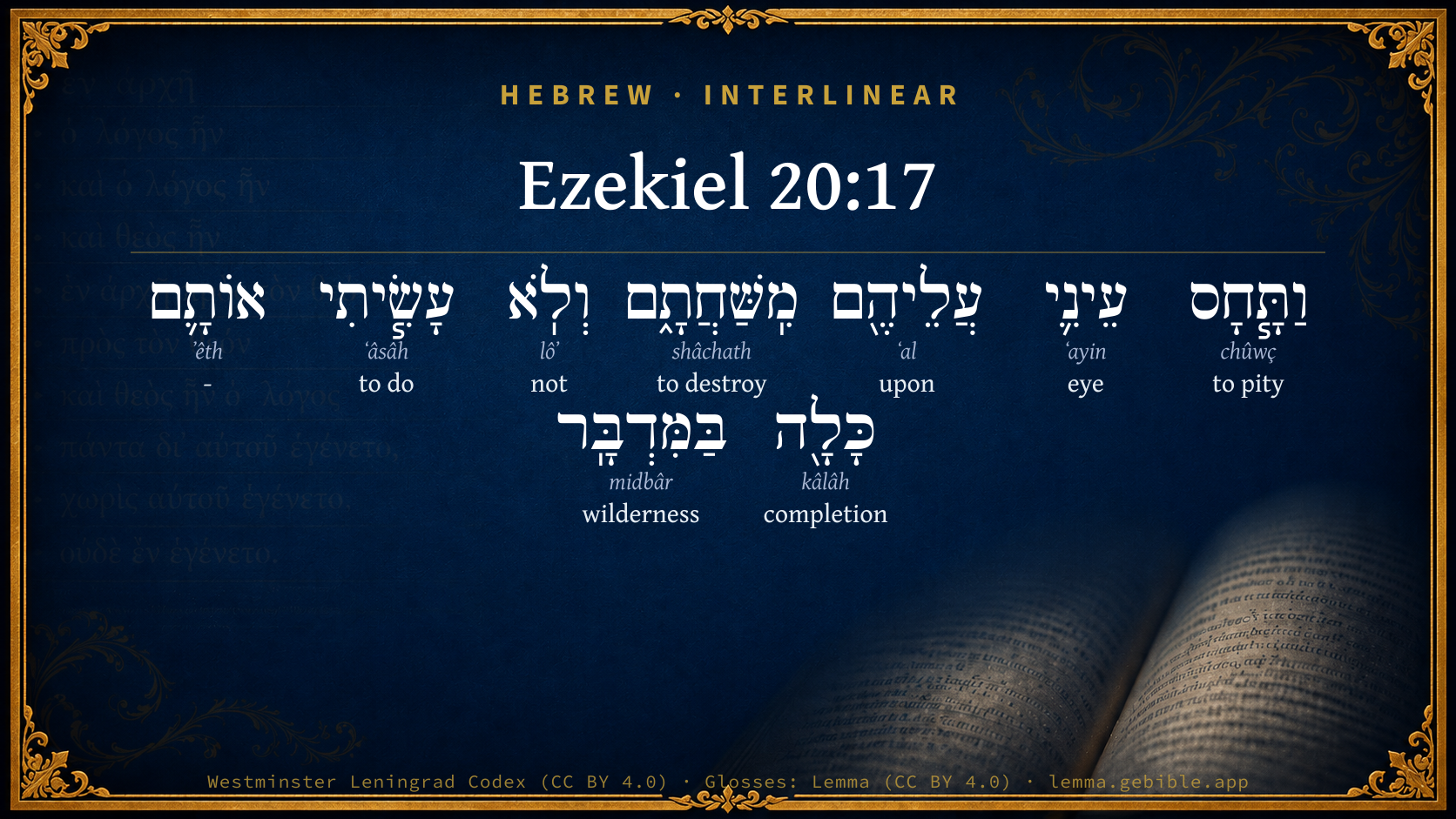
Hebrew (Westminster Leningrad Codex) Ezekiel 20:17 appears in the Hebrew Old Testament. The text above is from the Westminster Leningrad Codex. Each word links to its Strong’s number, a concise gloss, and parsing drawn from the Open Scriptures Hebrew Bible morphology. Click any word for its full Brown-Driver-Briggs (BDB) entry.
Download image
Cite this verse

Ezekiel 20:17 (World English Bible). Public Domain. Lemma interlinear Bible study tool, https://lemma.gebible.app/v/ezekiel/20/17.

Show BibTeX & RIS
BibTeX
RIS
English Translation
Nevertheless my eye spared them, and I didn't destroy them, neither did I make a full end of them in the wilderness.
World English Bible · Public Domain
Download a study sheet

One document with this verse’s original text, its word-by-word gloss line, the meaning frame, cross-references with their text, attributed commentary, and full source and license credits — printable, and it pastes into notes with its structure intact.

This verse Autodidact and up

Study sheet (.html) Plain text (.txt)

A passage Seminary Student

Up to 50 verses in one chapter. A passage sheet keeps up to 6 commentary sources and 12 cross-references per verse, in the order this page ranks them, and says so on the sheet whenever that leaves anything out. Ask for a single verse and you get the Autodidact verse sheet above.

Everything on this page stays free to read, with no account — the sheet is a download of what is already on screen, not access to it.

Want to remove ads? Support Godless Engineer
Compare translations 3

The same verse in 3 English versions, stacked beneath the original-language interlinear above. Click any original word for its lexicon entry.

Each is an independent rendering of the whole verse — the interlinear is not word-aligned to these translations.

Highlighted words mark where these versions differ — a whole-verse word diff, not a word-by-word alignment.

  • World English Bible Public Domain
    Nevertheless my eye spared them, and I didn't destroy them, neither did I make a full end of them in the wilderness.
  • King James Version Public Domain
    Nevertheless mine eye spared them from destroying them, neither did I make an end of them in the wilderness.
  • unfoldingWord Literal Text CC BY-SA 4.0
    But my eye spared them from their destruction and I did not annihilate them in the wilderness.

unfoldingWord Literal Text — © unfoldingWord, licensed CC BY-SA 4.0. Word-aligned USFM3 via Door43 (git.door43.org/unfoldingWord/en_ult).

Versions to compare (up to 4)

3 of 4 selected

Show all 18 translations

Every available English version of this verse, each an independent rendering of the whole verse.

  • World English Bible Public Domain
    Nevertheless my eye spared them, and I didn't destroy them, neither did I make a full end of them in the wilderness.
  • Berean Standard Bible Public Domain
    Yet I looked on them with pity and did not destroy them or bring them to an end in the wilderness.
  • Majority Standard Bible Public Domain
    Yet I looked on them with pity and did not destroy them or bring them to an end in the wilderness.
  • King James Version Public Domain
    Nevertheless mine eye spared them from destroying them, neither did I make an end of them in the wilderness.
  • American Standard Version (1901) Public Domain
    Nevertheless mine eye spared them, and I destroyed them not, neither did I make a full end of them in the wilderness.
  • Revised Version (1885) Public Domain
    Nevertheless mine eye spared them from destroying them, neither did I make a full end of them in the wilderness.
  • Geneva Bible (1599) Public Domain
    Neuerthelesse, mine eye spared them, that I would not destroye them, neither would I consume them in the wildernes.
  • Douay-Rheims (1899) Public Domain
    Yet my eye spared them, so that I destroyed them not: neither did I consume them in the desert.
  • Young's Literal Translation Public Domain
    And Mine eye hath pity on them -- against destroying them, And I have not made of them an end in the wilderness.
  • Literal Standard Version CC BY-SA 4.0
    And My eye has pity on them—against destroying them, || And I have not made an end of them in the wilderness.
  • Unlocked Literal Bible CC BY-SA 4.0
    But my eye spared them from their destruction and I did not annihilate them in the wilderness.
  • unfoldingWord Literal Text CC BY-SA 4.0
    But my eye spared them from their destruction and I did not annihilate them in the wilderness.
  • Darby Bible Public Domain
    But mine eye spared them so as not to destroy them, neither did I make a full end of them in the wilderness.
  • World Messianic Bible Public Domain
    Nevertheless my eye spared them, and I didn’t destroy them. I didn’t make a full end of them in the wilderness.
  • Webster's Bible Public Domain
    Nevertheless my eye spared them from destroying them, neither did I make an end of them in the wilderness.
  • Free Bible Version CC BY-SA 4.0
    Even so I was sorry for them and I didn't destroy them; I didn't wipe them out in the desert.
  • Bible in Basic English Public Domain
    But still my eye had pity on them and I kept them from destruction and did not put an end to them completely in the waste land.
  • JPS Tanakh (1917) Public Domain
    Nevertheless Mine eye spared them from destroying them, neither did I make a full end of them in the wilderness.

Literal Standard Version (2020), Covenant Press — licensed CC BY-SA 4.0. Text via the HelloAO Bible API (eBible.org). Unlocked Literal Bible (unfoldingWord) — licensed CC BY-SA 4.0. Text via the HelloAO Bible API (eBible.org). unfoldingWord Literal Text — © unfoldingWord, licensed CC BY-SA 4.0. Word-aligned USFM3 via Door43 (git.door43.org/unfoldingWord/en_ult). Free Bible Version, Dr. Jonathan Gallagher — licensed CC BY-SA 4.0. Text via the HelloAO Bible API (eBible.org).

Word by word

More ways to search: Search by grammar → Find every occurrence → Compare this word →

Practice this passage: Drill this verse → Learn its vocabulary →

כָּלָ֖ה
kâlâh
H3617
“completion”
Noun, Common, Feminine, Singular, Absolute
Part of Speech
Noun
Type
Common
Gender
Feminine
Number
Singular
State
Absolute
Full BDB Definition

Origin: from H3615

TWOT: 982a

completion, termination, full end, complete destruction, consumption, annihilation - completion - completely, altogether (adverb) - complete destruction, consumption, annihilation
  1. וַתָּ֧חָס chûwç H2347 “and · to pity” Conjunction + Verb, Qal, Sequential Imperfect, 3rd Person, Feminine, Singular
  2. עֵינִ֛י ʻayin H5869 “eye · my” Noun, Common, Both, Singular, Construct + Suffix, Personal, 1st Person, Common, Singular
  3. עֲלֵיהֶ֖ם ʻal H5921 “upon · them” Preposition + Suffix, Personal, 3rd Person, Masculine, Plural
  4. מִֽשַּׁחֲתָ֑ם shâchath H7843 “from · to destroy · them” Preposition + Verb, Piel, Infinitive Construct + Suffix, Personal, 3rd Person, Masculine, Plural
  5. וְלֹֽא lôʼ H3808 “and · not” Conjunction + Particle, Negative
  6. עָשִׂ֧יתִי ʻâsâh H6213 “to do” Verb, Qal, Perfect, 1st Person, Common, Singular
  7. אוֹתָ֛ם ʼêth H853 “- · them” Particle, Direct Object + Suffix, Personal, 3rd Person, Masculine, Plural
  8. בַּמִּדְבָּֽר midbâr H4057 “in/at the · wilderness” Preposition, Determined + Noun, Common, Masculine, Singular, Absolute

About this verse

These counts appear in no published source. They are computed here, from the morphology-tagged text and Lemma’s own curated glosses. What Lemma adds →

9
words
9
distinct lemmas
Prophets
section

Notable vocabulary

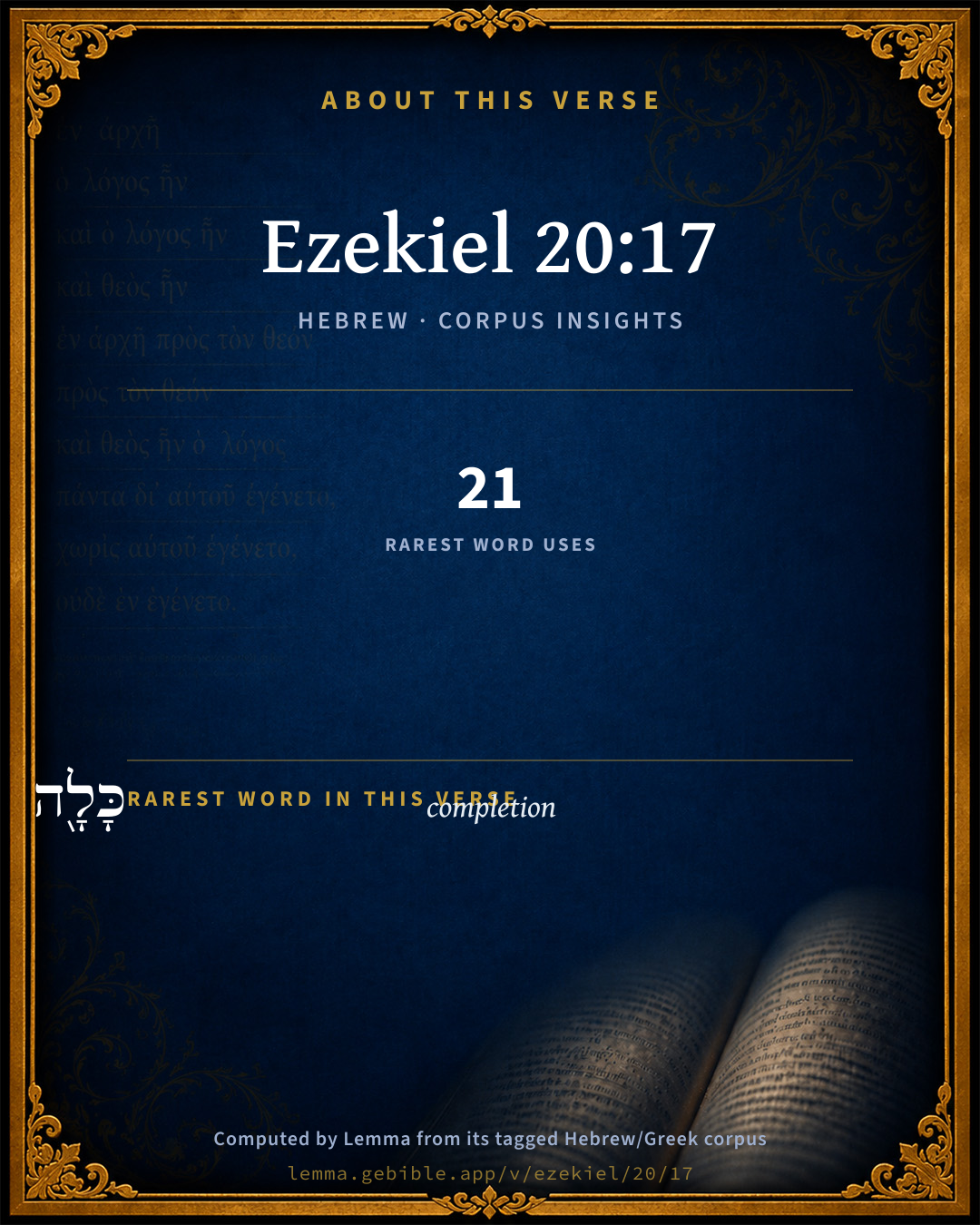
The rarest word here is כָּלָ֖ה completion H3617 — appearing just 21 times in the whole Hebrew Bible.

Shared distinctive vocabulary

כָּלָ֖ה completion H3617 occurs in 19 verses of the Hebrew Bible. Also found in:

Grammatical profile

  • 3 verbs
  • 3 nouns
  • 1 preposition
  • 2 particles

Verb forms

  • וַתָּ֧חָס Qal · Sequential Imperfect
  • מִֽשַּׁחֲתָ֑ם Piel · Infinitive Construct
  • עָשִׂ֧יתִי Qal · Perfect

Hebrew & Septuagint length

In English translation the verse runs 22 words from the Hebrew and 24 from the Septuagint (LXX English) — closely comparable.

A rough comparison of the two English renderings, which tokenize alike — not a word-level alignment.

Word counts can differ between the Hebrew and the Greek without any difference in meaning — e.g. the Hebrew direct-object marker אֵת has no separate Greek word, and Greek often adds the article ὁ.

Cross-references

10

Topical passages linked to Ezekiel 20:17 in the Treasury of Scripture Knowledge — connected by theme and wording, ordered by reader-vote popularity; previews shown in the World English Bible.

  • Ezekiel 11:13 It happened, when I prophesied, that Pelatiah the son of Benaiah died. Then fell I down on my face, and cried with a loud voice, and said, Ah Lord Yahweh! will you make a full end of the remnant of Israel?
  • Jeremiah 4:27 For thus says Yahweh, The whole land shall be a desolation; yet will I not make a full end.
  • Jeremiah 5:18 But even in those days, says Yahweh, I will not make a full end with you.
  • 1 Samuel 24:10 Behold, this day your eyes have seen how that Yahweh had delivered you today into my hand in the cave: and some bade me kill you; but [my eye] spared you; and I said, I will not put forth my hand against my lord; for he is Yahweh's anointed.
  • Nehemiah 9:19 yet you in your manifold mercies didn't forsake them in the wilderness: the pillar of cloud didn't depart from over them by day, to lead them in the way; neither the pillar of fire by night, to show them light, and the way in which they should go.
  • Psalms 78:37–38 For their heart was not right with him, Neither were they faithful in his covenant.
  • Ezekiel 7:2 You, son of man, thus says the Lord Yahweh to the land of Israel, An end: the end is come on the four corners of the land.
  • Ezekiel 8:18 Therefore will I also deal in wrath; my eye shall not spare, neither will I have pity; and though they cry in my ears with a loud voice, yet will I not hear them.
  • Ezekiel 9:10 As for me also, my eye shall not spare, neither will I have pity, but I will bring their way on their head.
  • Nahum 1:8–9 But with an overflowing flood, he will make a full end of her place, and will pursue his enemies into darkness.

Cross-references courtesy of OpenBible.info (CC BY 4.0).

Hebrew and Greek witnesses Masoretic Hebrew ↔ Greek Septuagint

The same verse in the two great witnesses to the Old Testament, shown verse-for-verse.

These are two independent witnesses, not word-aligned to each other, and the Septuagint is shown in lemma (dictionary) form.

Hebrew Ezekiel 20:17 Masoretic · Westminster Leningrad Codex

וַתָּ֧חָס עֵינִ֛י עֲלֵיהֶ֖ם מִֽשַּׁחֲתָ֑ם וְלֹֽא עָשִׂ֧יתִי אוֹתָ֛ם כָּלָ֖ה בַּמִּדְבָּֽר

Nevertheless my eye spared them, and I didn't destroy them, neither did I make a full end of them in the wilderness.

World English Bible · Public Domain

Greek LXX Ezekiel 20:17 Septuagint · lemma form

καί φείδομαι ὁ ὀφθαλμός ἐγώ ἐπί αὐτός ὁ ἐκἀλείφω αὐτός καί οὐ ποιέω αὐτός εἰς συντέλεια ἐν ὁ ἔρημος

Yet my eyes spared them, so as not to destroy them utterly, and I did not make an end of them in the wilderness.

LXX2012 (modern English Septuagint) · Public Domain

Hebrew: Westminster Leningrad Codex (CC BY 4.0). Greek: Septuagint (public domain); English from LXX2012 (modern English Septuagint) (Public Domain). How the Septuagint differs from the Hebrew →

Targum (Aramaic paraphrase)

1

The Targum is the ancient Jewish Aramaic paraphrase of the Hebrew Scriptures — an interpretive translation, not the Hebrew text itself. Onkelos (literal) and Pseudo-Jonathan (expansive) render the Torah, and Jonathan the Prophets. Coverage is partial: where no permissively-licensed English translation exists for a verse, only the Aramaic is shown. This is verse-level text, not a word-by-word alignment to the Hebrew.

  1. Targum Jonathan Prophets (Joshua–Malachi)
    וְחָס מֵימְרִי עֲלֵיהוֹן מִלְחַבְּלוּתְהוֹן וְלָא עֲבָדִית עִמְהוֹן גְמִירָא בְּמַדְבְּרָא:

    (no public-domain English translation for this verse)

    Targum Jonathan — Aramaic: “Mikraot Gedolot” (public domain). English: “Sefaria Community Translation” (CC0 1.0 (public-domain dedication)); “London "Chaldee Paraphrase," 1871” (public domain). Text via Sefaria.

Commentary

Notes on Ezekiel 20:17 from classic Christian and Jewish commentators (each source and its license shown beneath its notes). The classic Christian expositions comment on the surrounding passage and are grouped to its opening verse, so a note may address several verses; the Jewish commentaries on the Tanakh (Rashi and others) are per-verse, so they appear only where the commentator wrote on this verse.

Lemma curates 59 commentaries, every one of them public domain or Creative Commons licensed, each selected and text-cleaned for this edition rather than reprinted as found. About our sources →

Trapp's Complete Commentary

John Trapp

Eze 20:17 Nevertheless mine eye spared them from destroying them, neither did I make an end of them in the wilderness.

Ver. 17. Nevertheless mine eye spared them.] It was by a non obstante of God’s mercy, and by a prop of his extraordinary patience, that they subsisted.

John Trapp, A Commentary or Exposition upon All the Books of the Old and New Testament (1647–1656) — public domain. Text from a community e-Sword module.

Jamieson, Fausset & Brown

Robert Jamieson, A. R. Fausset & David Brown

Nevertheless--How marvellous that God should spare such sinners! His everlasting covenant explains it, His long-suffering standing out in striking contrast to their rebellions (Psa 78:38; Jer 30:11).

Jamieson, Fausset & Brown — Commentary Critical and Explanatory on the Whole Bible (1871) — public domain (CC PDM 1.0). Text via the HelloAO Bible API.

John Calvin's Commentaries

This is added, because God often afflicted the people with heavy punishments, but he restrained himself, that he should not utterly destroy both their persons and their name. He says, then, that he spared them through respect for his own name, as he formerly said, that he should not execute consumption on them; that is, that he should not utterly blot out the memory of them. He did not spare them entirely to foster their depravity by his indulgence, but as we shall afterwards see, he withdrew his hand that he should not consume them, as he might most justly have done. It now follows —

John Calvin's Commentaries (1540-1563) — public domain. Text from the Calvin Translation Society English edition (1840s-50s) via the Christian Classics Ethereal Library (ccel.org). Calvin's coverage is partial (roughly two-thirds of the Bible); uncommented books and verses are honest gaps, never fabricated. The 19th-century editor's footnotes and remarks are omitted so the notes are faithfully Calvin's own voice.

The Cambridge Bible for Schools and Colleges

gen. ed. J. J. S. Perowne

17. Another motive besides regard for his own name moved Jehovah to spare Israel—pity for the sinners; cf. Psa_78:38, “But he being full of compassion forgave their iniquity and destroyed them not; yea many a time he turned his anger away”. Num_14:20.

The Cambridge Bible for Schools and Colleges (gen. ed. J. J. S. Perowne; Cambridge University Press, 1878–1918) — public domain. Text from a community e-Sword module.

John Gill's Exposition

Nevertheless, mine eye spared them from destroying them,.... Utterly, so as to leave neither root nor branch; for though the whole generation died excepting two, either by the immediate hand of God in wrath, or else by ordinary deaths; yet there was a generation raised up in their stead, to whom mercy was shown:

neither did I make an end of them in the wilderness; that they should be no more a nation and people; though the carcasses of them that believed not fell in the wilderness, and never saw the good land, yet their posterity was spared to see it, and did.

John Gill's Exposition of the Whole Bible (1746–1763) — public domain (CC PDM 1.0). Text via the HelloAO Bible API.

Matthew Poole's English Annotations

Nevertheless mine eye spared them; though they did highly provoke God, and deserved to be cut off, yet his eye pitied them: they provoked his wrath, he stirred up his compassions.

Them; not all of them, for many did die in the wilderness, and, among these, some by immediate wrath; but how many soever they were, yet the growing generation was spared, and the nation was not extirpated.

Matthew Poole's English Annotations on the Holy Bible (1683–1685) — public domain. Text from a community e-Sword/MySword module.

Whedon's Commentary on the Bible

Daniel D. Whedon

17. Nevertheless mine eye spared them — So identified were Israel and Jehovah in the eyes of the nations that he could not have utterly annihilated the nation, as justice seemed to demand, without bringing dishonor upon his own name (Deu_9:28-29). Therefore, and because of his own special love and pity for them (Num_14:20; Psa_78:38), he did not wholly cut them off, root and branch, in the wilderness; but, while he executed judgment upon that generation (Eze_20:15; Num_14:28), he spared the children and exhorted them to do better than their fathers (Eze_20:18). It is worthy of notice that Ezekiel knew the Hebrew history well and gave the same interpretation of it that orthodoxy has always given.

Daniel D. Whedon (gen. ed.), Commentary on the Old and New Testaments (1874–1909) — public domain. Text from a community e-Sword module.

Lesson kit

Teaching starters — assembled from the data on this page, not authored interpretation. Every prompt links to the verse data it draws on. Edit before teaching.

Ezekiel, in the Prophets, opens this verse with 9 words (9 distinct Hebrew lemmas). Its most distinctive word is kâlâh (“completion”). A historical commentator’s framing appears above. Read the whole chapter for the surrounding context.

Discussion questions

  1. How does “completion” (kâlâh) shape what this verse is saying?
  2. How does Genesis 18:21, which shares the word «completion», read alongside this verse?
  3. The translations on this page render this verse differently — a whole-verse word diff, not a word-by-word alignment. What might account for the different wordings?
  4. «וַתָּ֧חָס» is a Qal Sequential Imperfect verb. How does that grammatical form shape the action described?
  5. Compare how Trapp's Complete Commentary and Jamieson, Fausset & Brown read this verse. Where do they agree or differ?

Things to notice

Reading settings

Reading text

Shown beneath each verse's original-language words.

Old Testament
Old Testament edition

Read the OT as the Masoretic Hebrew (MT) or the Greek Septuagint (LXX).

English shown for the Greek Septuagint (in the Hebrew ↔ Greek comparison).

Comparing translations? Open the Compare panel on any verse page to stack up to four side by side.