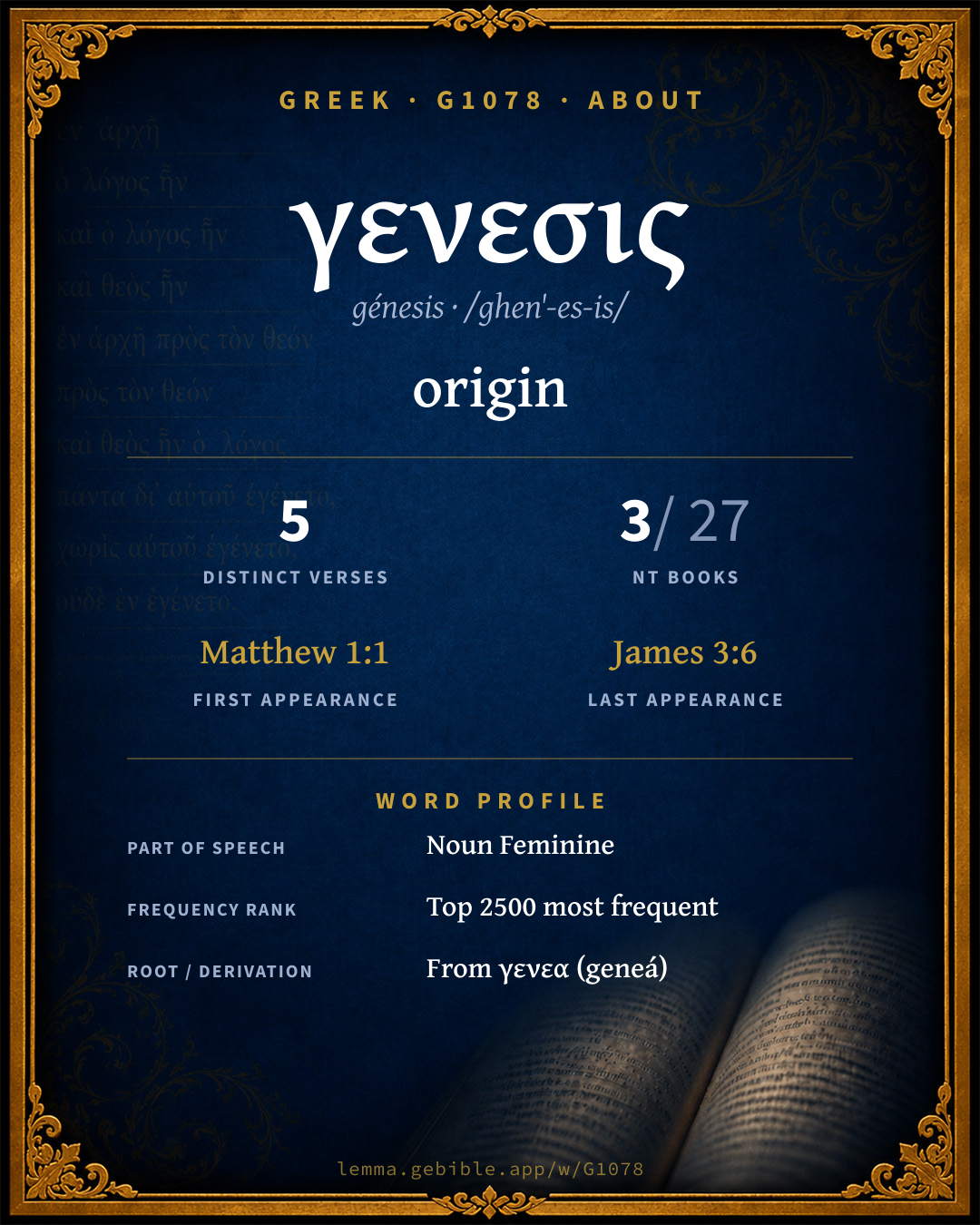
γένεσις
origin
‘origin’ is one of 3 main senses fuller range ↓
Full lexicon entry — Thayer's Greek Lexicon
From Thayer's Greek Lexicon
Where this word appears
See every Genitive-case word in the Greek New Testament →
Grammar key — what these labels mean
Part of speech
- Noun
- A naming word — a person, place, thing, or idea.
Case
- Genitive
- The case of source, possession, or “of” — answers “whose / from what.”
- Dative
- The case of the indirect object, means, or location — “to / for / with / in.”
- Nominative
- The case of the subject (and the predicate nominative).
Gender
- Feminine
- Grammatically feminine.
Number
- Singular
- One.
3 distinct verses where G1078 appears in the Genitive case, across 2 books. Filtered view — show all forms. Click any verse to open its interlinear word-by-word view. Verse text shown in the World English Bible for context — . Each verse’s Greek form is shown with its reference; the English is not keyword-highlighted, since the data carries no word-level English alignment. Use “Compare translations” on any verse to read it across multiple English versions. This concordance covers the Greek New Testament; Septuagint (Greek Old Testament) occurrences of this word are not indexed here.
Matthew 1 verse
James 2 verses
- James 1:23 γενέσεως n gen sg fem For if anyone is a hearer of the word and not a doer, he is like a man beholding his natural face in a mirror;
- James 3:6 γενέσεως n gen sg fem And the tongue is a fire. The world of iniquity among our members is the tongue, which defiles the whole body, and sets on fire the course of nature, and is set on fire by Gehenna.
About this entry
At a glance — auto-summarized from this page’s data, not written by a person. Every figure links to its source below. This summary describes the numbers; it doesn’t interpret them.
γενεσις (génesis) is a Greek noun most often rendered “origin.” The Greek New Testament uses it only 5 verses. It concentrates in Matthew, which alone accounts for 40% of its uses. It first appears in Matthew 1:1. Its lexical range runs to 3 senses. For the data behind this summary, explore the sense tree and the renderings breakdown below.
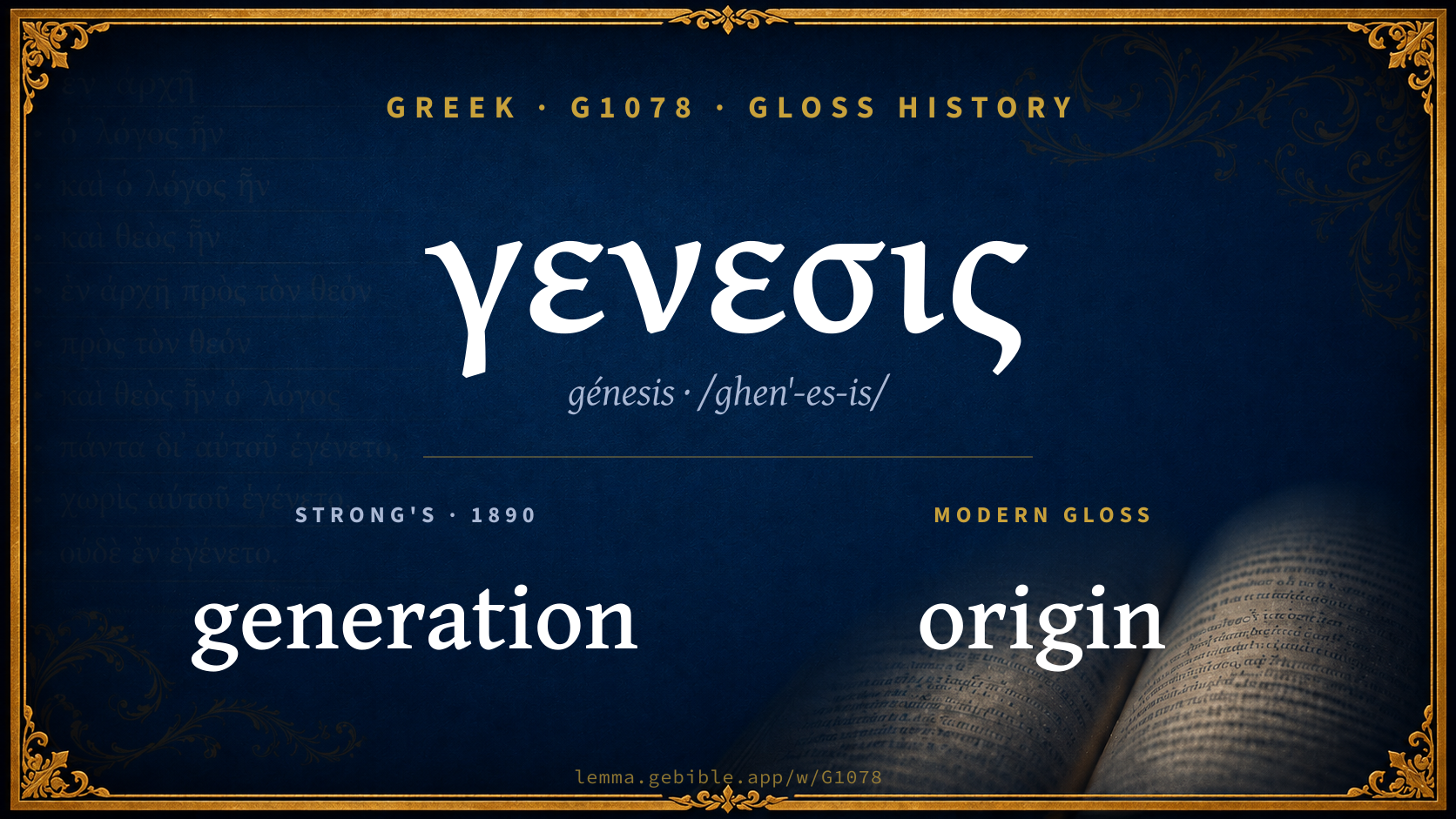
Gloss history
Strong's 1890 vs modern scholarship
About this word
Strong's G1078 catalogs a Greek word from the Greek New Testament.
These counts are not copied from any lexicon or concordance. They are computed here, from the morphology-tagged Greek New Testament. What Lemma adds →
- 5
- distinct verses
- The word appears in 5 distinct verses.
- 3 / 27
- NT books
- The word appears in 3 of 27 New Testament books.
- #1,648
- by frequency
- Top 2500 most frequent Greek words (rank 1,648 of 5,347 Greek words by occurrence).
View all 5 occurrences in the concordance →
By section of the New Testament
By traditional corpus
Conventional, traditional groupings — biblical authorship is debated, so this is a traditional corpus grouping, not an authorship claim. Some books belong to more than one corpus (Luke is in both the Gospels and the Lukan corpus, and so on), so these shares overlap and need not total 100%. Each figure is a share of the word’s 5 distinct verses.
- Gospels 3 verses · 60%
- General (Catholic) Epistles 2 verses · 40%
- Lukan (Luke–Acts) 1 verse · 20%
How translations render this word
Counts come from each version’s own published word-to-Strong’s tagging or interlinear alignment — an approximate guide to how each version renders this word, not a word-level alignment the data otherwise carries. Because each total is that version’s own tagged count, the per-version totals vary from one another and need not match the appearance or distinct-verse counts above. These counts may also differ from a printed concordance because Lemma counts each distinctly tagged rendering and does not collapse phrase taggings into a single head-word total. This is a fixed set of word-tagged versions (KJV, ASV, BSB, ULT) and does not change with the reading translation you choose elsewhere. Each version’s license is shown beside its name below (and on Sources).
- King James Version: Generation 1×, Natural 1×, Nature 1×
- American Standard Version: Generation 1×, Natural 1×, Nature 1×
- Berean Standard Bible: Birth 2×
- unfoldingWord Literal Text: Birth 3×
King James Version Public Domain
Renders G1078 across 3 tagged occurrences — most commonly:
American Standard Version Public Domain
Renders G1078 across 3 tagged occurrences — most commonly:
Berean Standard Bible Public Domain
Renders G1078 across 4 tagged occurrences — most commonly:
Plus 2 renderings that appear only once — usually multi-word phrases or single function words the recovered tagging swept in, not distinct renderings.
unfoldingWord Literal Text CC BY-SA 4.0
Renders G1078 across 6 tagged occurrences — most commonly:
Plus 3 renderings that appear only once — usually multi-word phrases or single function words the recovered tagging swept in, not distinct renderings.
Senses in Thayer's
The 3 senses Thayer's distinguishes for this word, in lexicon order (not ranked by frequency or importance). The full entry — with sub-senses — is in the Lexicon Entry tab.
- source, origin
- used of birth, nativity
- of that which follows origin, viz. existence, life
Word origin
Derived from γενεα (geneá) (G1074) — generation.
From the same as G1074 ; nativity ; figuratively nature : - generation nature (-ral).
— Strong’s Exhaustive Concordance (1890), public domain.
Forms in the corpus
The 3 distinct written forms G1078 takes in the Greek New Testament, most frequent first — each parse links to that case’s occurrences in the concordance.
| Form | Parsing | Example | Uses |
|---|---|---|---|
| γενέσεως genéseōs | Noun, Genitive, Singular, Feminine | Matthew 1:1 | 3 |
| γένεσις génesis | Noun, Nominative, Singular, Feminine | Matthew 1:18 | 1 |
| γενέσει genései | Noun, Dative, Singular, Feminine | Luke 1:14 | 1 |
Same root — word family
Other Thayer's entries built from the same root as G1078, grouped by Strong’s listed origin. These share a root / origin per the lexicon — not necessarily a shared meaning. Each links to that word’s own entry.
Derives from
Shares the same root
Derived from this word
Compare all same-root words → Showing 4 of 5 — not the complete family. They share a root, not necessarily a meaning.
Septuagint usage
The same Greek word γενεσις appears 40 times in the Greek Old Testament (Septuagint), across 40 verses in 9 books.
- 40
- LXX occurrences
- Tagged occurrences of this Greek word in the Septuagint.
- 40
- verses
- Distinct Septuagint verses containing this word.
- 9 / 39
- OT books
- The word appears in 9 of the 39 Old Testament books.
Sample Septuagint occurrences
- Genesis 2:4 γένεσις
- Exodus 6:24 γένεσις
- Numbers 1:18 γένεσις
- Ruth 2:11 γένεσις
- 1 Chronicles 1:17 γένεσις
- Ecclesiastes 7:1 γένεσις
- Ezekiel 4:14 γένεσις
- Daniel 2:43 γένεσις
- Hosea 2:5 γένεσις
Septuagint occurrences (same lexeme)
Every verse where the same Strong’s number (G1078) appears in the Greek Septuagint. Verse text shown in the World English Bible for context; the Greek form is the matched word — the English is not keyword-highlighted.
- Genesis 2:4 γένεσις This is the history of the generations of the heavens and of the earth when they were created, in the day that Yahweh God made earth and the heavens.
- Genesis 5:1 γένεσις This is the book of the generations of Adam. In the day that God created man, he made him in God's likeness.
- Genesis 6:9 γένεσις This is the history of the generations of Noah. Noah was a righteous man, blameless among the people of his time. Noah walked with God.
- Genesis 10:1 γένεσις Now this is the history of the generations of the sons of Noah and of Shem, Ham, and Japheth. Sons were born to them after the flood.
- Genesis 10:32 γένεσις These are the families of the sons of Noah, after their generations, in their nations. Of these were the nations divided in the earth after the flood.
- Genesis 11:10 γένεσις This is the history of the generations of Shem. Shem was one hundred years old, and became the father of Arpachshad two years after the flood.
- Genesis 11:27 γένεσις Now this is the history of the generations of Terah. Terah became the father of Abram, Nahor, and Haran. Haran became the father of Lot.
- Genesis 25:12 γένεσις Now this is the history of the generations of Ishmael, Abraham's son, whom Hagar the Egyptian, Sarah's handmaid, bore to Abraham.
- Genesis 25:19 γένεσις This is the history of the generations of Isaac, Abraham's son. Abraham became the father of Isaac.
- Genesis 31:13 γένεσις I am the God of Bethel, where you anointed a pillar, where you vowed a vow to me. Now arise, get out from this land, and return to the land of your birth."
- Genesis 32:10 γένεσις I am not worthy of the least of all the loving kindnesses, and of all the truth, which you have shown to your servant; for with just my staff I passed over this Jordan; and now I have become two companies.
- Genesis 36:1 γένεσις Now this is the history of the generations of Esau (the same is Edom).
- Genesis 36:9 γένεσις This is the history of the generations of Esau the father of the Edomites in the hill country of Seir:
- Genesis 37:2 γένεσις This is the history of the generations of Jacob. Joseph, being seventeen years old, was feeding the flock with his brothers. He was a boy with the sons of Bilhah and Zilpah, his father's wives. Joseph brought an evil report of them to their father.
- Genesis 40:20 γένεσις It happened the third day, which was Pharaoh's birthday, that he made a feast for all his servants, and he lifted up the head of the chief cupbearer and the head of the chief baker among his servants.
- Exodus 6:24 γένεσις The sons of Korah: Assir, and Elkanah, and Abiasaph; these are the families of the Korahites.
- Exodus 6:25 γένεσις Eleazar Aaron's son took one of the daughters of Putiel as his wife; and she bore him Phinehas. These are the heads of the fathers' houses of the Levites according to their families.
- Exodus 28:10 γένεσις six of their names on the one stone, and the names of the six that remain on the other stone, in the order of their birth.
- Numbers 1:18 γένεσις They assembled all the congregation together on the first day of the second month; and they declared their ancestry by their families, by their fathers' houses, according to the number of the names, from twenty years old and upward, one by one.
- Numbers 3:1 γένεσις Now this is the history of the generations of Aaron and Moses in the day that Yahweh spoke with Moses in Mount Sinai.
- Ruth 2:11 γένεσις Boaz answered her, It has fully been shown me, all that you have done to your mother-in-law since the death of your husband; and how you have left your father and your mother, and the land of your birth, and have come to a people that you didn't know before.
- Ruth 4:18 γένεσις Now this is the history of the generations of Perez: Perez became the father of Hezron,
- 1 Chronicles 1:17 γένεσις The sons of Shem: Elam, and Asshur, and Arpachshad, and Lud, and Aram, and Uz, and Hul, and Gether, and Meshech.
- 1 Chronicles 4:2 γένεσις Reaiah the son of Shobal became the father of Jahath; and Jahath became the father of Ahumai and Lahad. These are the families of the Zorathites.
- 1 Chronicles 4:21 γένεσις The sons of Shelah the son of Judah: Er the father of Lecah, and Laadah the father of Mareshah, and the families of the house of those who worked fine linen, of the house of Ashbea;
- 1 Chronicles 4:38 γένεσις these mentioned by name were princes in their families: and their fathers' houses increased greatly.
- 1 Chronicles 5:7 γένεσις His brothers by their families, when the genealogy of their generations was reckoned: the chief, Jeiel, and Zechariah,
- 1 Chronicles 7:2 γένεσις The sons of Tola: Uzzi, and Rephaiah, and Jeriel, and Jahmai, and Ibsam, and Shemuel, heads of their fathers' houses, [to wit], of Tola; mighty men of valor in their generations: their number in the days of David was twenty-two thousand six hundred.
- 1 Chronicles 7:4 γένεσις With them, by their generations, after their fathers' houses, were bands of the host for war, thirty-six thousand; for they had many wives and sons.
- 1 Chronicles 7:9 γένεσις They were reckoned by genealogy, after their generations, heads of their fathers' houses, mighty men of valor, twenty thousand two hundred.
- 1 Chronicles 8:28 γένεσις These were heads of fathers' [houses] throughout their generations, chief men: these lived in Jerusalem.
- 1 Chronicles 9:9 γένεσις and their brothers, according to their generations, nine hundred fifty-six. All these men were heads of fathers' [houses] by their fathers' houses.
- 1 Chronicles 9:34 γένεσις These were heads of fathers' [houses] of the Levites, throughout their generations, chief men: these lived at Jerusalem.
- 1 Chronicles 26:31 γένεσις Of the Hebronites was Jerijah the chief, even of the Hebronites, according to their generations by fathers' [houses]. In the fortieth year of the reign of David they were sought for, and there were found among them mighty men of valor at Jazer of Gilead.
- Ecclesiastes 7:1 γένεσις A good name is better than fine perfume; and the day of death better than the day of one's birth.
- Ezekiel 4:14 γένεσις Then said I, Ah Lord Yahweh! behold, my soul has not been polluted; for from my youth up even until now have I not eaten of that which dies of itself, or is torn of animals; neither came there abominable flesh into my mouth.
- Ezekiel 16:3 γένεσις and say, Thus says the Lord Yahweh to Jerusalem: Your birth and your birth is of the land of the Canaanite; the Amorite was your father, and your mother was a Hittite.
- Ezekiel 16:4 γένεσις As for your birth, in the day you were born your navel was not cut, neither were you washed in water to cleanse you; you weren't salted at all, nor swaddled at all.
- Daniel 2:43 γένεσις Whereas you saw the iron mixed with miry clay, they shall mingle themselves with the seed of men; but they shall not cling to one another, even as iron does not mingle with clay.
- Hosea 2:5 γένεσις For their mother has played the prostitute. She who conceived them has done shamefully; For she said, 'I will go after my lovers, Who give me my bread and my water, My wool and my flax, My oil and my drink.'
These are occurrences of the same Greek lexeme (G1078) in the Septuagint — not a translation of any one Hebrew word. The store carries no word-level Hebrew↔Greek alignment, so no Hebrew original is asserted here. Counts come from the recovered LXX Strong's tagging — high-frequency vocabulary is well covered, while rare or late forms may be untagged — so they reflect tagged occurrences and may slightly undercount.