Joel 3:10

Hebrew (Westminster Leningrad Codex) Joel 3:10 appears in the Hebrew Old Testament. The text above is from the Westminster Leningrad Codex. Each word links to its Strong’s number, a concise gloss, and parsing drawn from the Open Scriptures Hebrew Bible morphology. Click any word for its full Brown-Driver-Briggs (BDB) entry.
Download image
Cite this verse

Joel 3:10 (World English Bible). Public Domain. Lemma interlinear Bible study tool, https://lemma.gebible.app/v/joel/3/10.

Show BibTeX & RIS
BibTeX
RIS
English Translation
Beat your plowshares into swords, And your pruning hooks into spears. Let the weak say, "I am strong."
World English Bible · Public Domain
Highlights
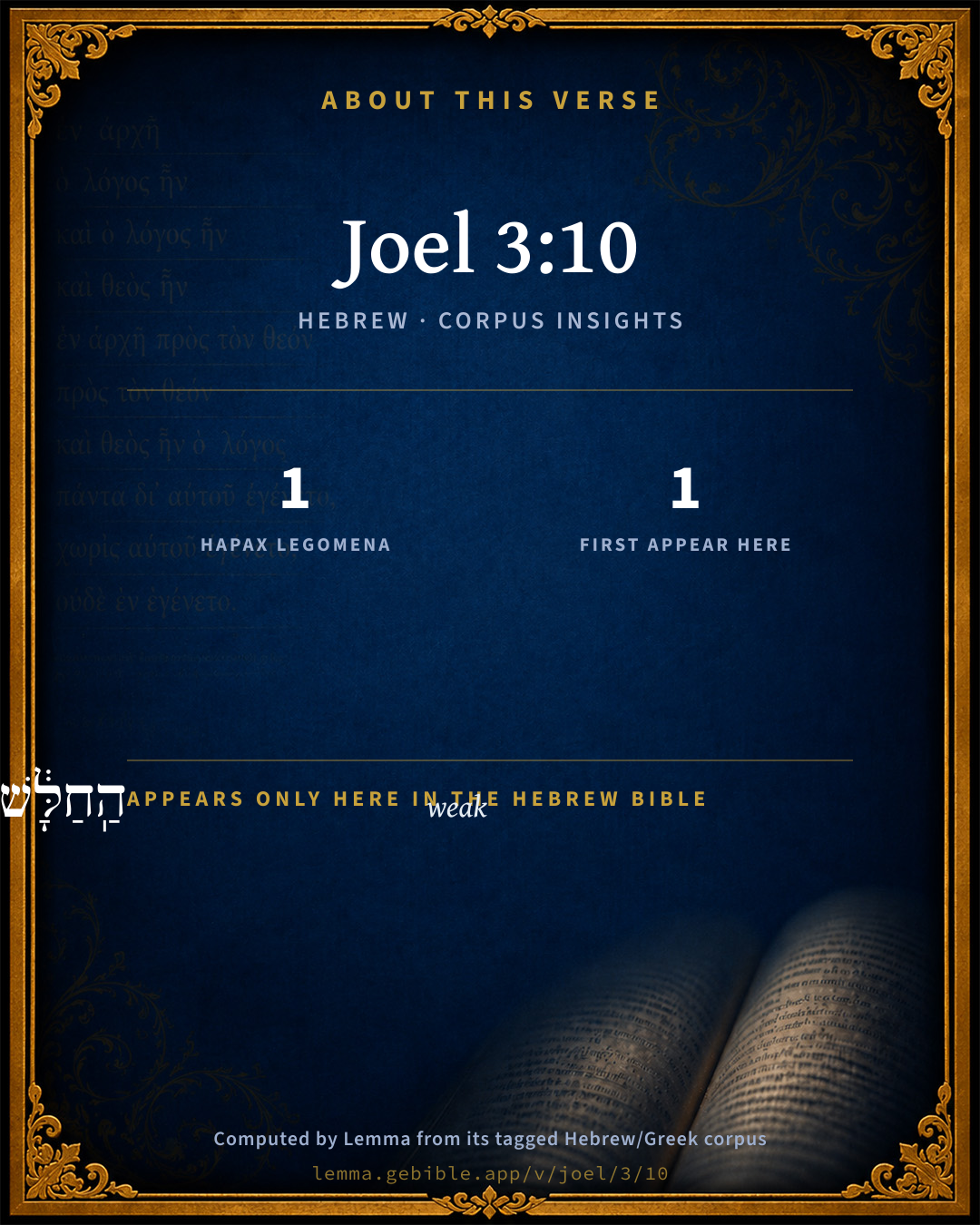
  • 1 hapax legomenon — only here in the Hebrew Bible
  • 1 first appearance in the Hebrew Bible
Full analysis ↓
Download a study sheet

One document with this verse’s original text, its word-by-word gloss line, the meaning frame, cross-references with their text, attributed commentary, and full source and license credits — printable, and it pastes into notes with its structure intact.

This verse Autodidact and up

Study sheet (.html) Plain text (.txt)

A passage Seminary Student

Up to 50 verses in one chapter. A passage sheet keeps up to 6 commentary sources and 12 cross-references per verse, in the order this page ranks them, and says so on the sheet whenever that leaves anything out. Ask for a single verse and you get the Autodidact verse sheet above.

Everything on this page stays free to read, with no account — the sheet is a download of what is already on screen, not access to it.

Want to remove ads? Support Godless Engineer
Compare translations 3

The same verse in 3 English versions, stacked beneath the original-language interlinear above. Click any original word for its lexicon entry.

Each is an independent rendering of the whole verse — the interlinear is not word-aligned to these translations.

Highlighted words mark where these versions differ — a whole-verse word diff, not a word-by-word alignment.

  • World English Bible Public Domain
    Beat your plowshares into swords, And your pruning hooks into spears. Let the weak say, "I am strong."
  • King James Version Public Domain
    Beat your plowshares into swords and your pruninghooks into spears: let the weak say, I am strong.
  • unfoldingWord Literal Text CC BY-SA 4.0
    Beat your plowshares into swords and your pruning hooks into spears. Let the weak say, ‘I strong.’

unfoldingWord Literal Text — © unfoldingWord, licensed CC BY-SA 4.0. Word-aligned USFM3 via Door43 (git.door43.org/unfoldingWord/en_ult).

Versions to compare (up to 4)

3 of 4 selected

Show all 18 translations

Every available English version of this verse, each an independent rendering of the whole verse.

  • World English Bible Public Domain
    Beat your plowshares into swords, And your pruning hooks into spears. Let the weak say, "I am strong."
  • Berean Standard Bible Public Domain
    Beat your plowshares into swords and your pruning hooks into spears. Let the weak say, ‘I am strong!’
  • Majority Standard Bible Public Domain
    Beat your plowshares into swords and your pruning hooks into spears. Let the weak say, ‘I am strong!’
  • King James Version Public Domain
    Beat your plowshares into swords and your pruninghooks into spears: let the weak say, I am strong.
  • American Standard Version (1901) Public Domain
    Beat your plowshares into swords, and your pruning-hooks into spears: let the weak say, I am strong.
  • Revised Version (1885) Public Domain
    Beat your plowshares into swords, and your pruninghooks into spears: let the weak say, I am strong.
  • Geneva Bible (1599) Public Domain
    Breake your plowshares into swords, and your sithes into speares: let the weake say, I am strong.
  • Douay-Rheims (1899) Public Domain
    Cut your ploughshares into swords, and your spades into spears. Let the weak say: I am strong.
  • Young's Literal Translation Public Domain
    Beat your ploughshares to swords, And your pruning-hooks to javelins, Let the weak say, `I `am' mighty.'
  • Literal Standard Version CC BY-SA 4.0
    Beat your plowshares to swords, || And your pruning-hooks to javelins, || Let the weak say, “I [am] mighty.”
  • Unlocked Literal Bible CC BY-SA 4.0
    Beat your plowshares into swords and your pruning knives into spears. Let the weak say, 'I am strong.'
  • unfoldingWord Literal Text CC BY-SA 4.0
    Beat your plowshares into swords and your pruning hooks into spears. Let the weak say, ‘I strong.’
  • Darby Bible Public Domain
    Beat your ploughshares into swords, and your pruning-knives into spears; let the weak say, I am strong.
  • World Messianic Bible Public Domain
    Beat your plowshares into swords, and your pruning hooks into spears. Let the weak say, ‘I am strong.’
  • Webster's Bible Public Domain
    \\3:5\\Because ye have taken my silver and my gold, and have carried into your temples my goodly pleasant things.
  • Free Bible Version CC BY-SA 4.0
    Hammer your plow blades and turn them into swords. Turn your pruning hooks into spears. Even the weak should say ‘I am a strong fighter!’
  • Bible in Basic English Public Domain
    For you have taken my silver and my gold, putting in the houses of your gods my beautiful and pleasing things.
  • JPS Tanakh (1917) Public Domain
    (4-10) Beat your plowshares into swords, and your pruning-hooks into spears; let the weak say: 'I am strong.'

Literal Standard Version (2020), Covenant Press — licensed CC BY-SA 4.0. Text via the HelloAO Bible API (eBible.org). Unlocked Literal Bible (unfoldingWord) — licensed CC BY-SA 4.0. Text via the HelloAO Bible API (eBible.org). unfoldingWord Literal Text — © unfoldingWord, licensed CC BY-SA 4.0. Word-aligned USFM3 via Door43 (git.door43.org/unfoldingWord/en_ult). Free Bible Version, Dr. Jonathan Gallagher — licensed CC BY-SA 4.0. Text via the HelloAO Bible API (eBible.org).

Word by word

More ways to search: Search by grammar → Find every occurrence → Compare this word →

Practice this passage: Drill this verse → Learn its vocabulary →

הַֽחַלָּ֔שׁ
challâsh
H2523
“the · weak”
Particle, Definite Article + Adjective, Adjective, Masculine, Singular, Absolute
Part of Speech
Particle + Adjective
Type
Adjective
Gender
Masculine
Number
Singular
State
Absolute
Full BDB Definition

Origin: from H2522

TWOT: 671a

weak
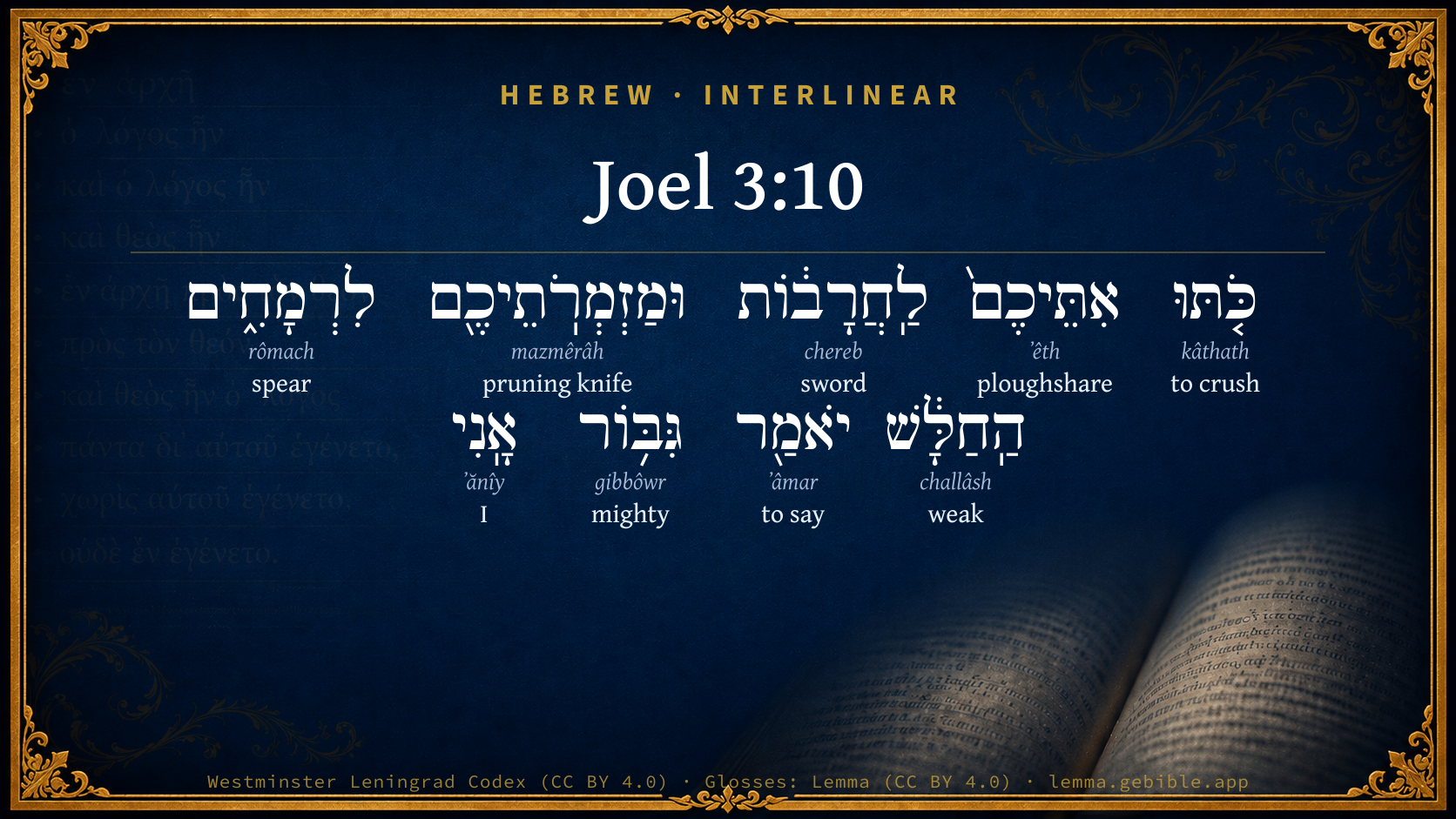
  1. כֹּ֤תּוּ kâthath H3807 “crush” Verb, Qal, Imperative, 2nd Person, Masculine, Plural
  2. אִתֵּיכֶם֙ ʼêth H855 “ploughshares · your” Noun, Common, Masculine, Plural, Construct + Suffix, Personal, 2nd Person, Masculine, Plural
  3. לַֽחֲרָב֔וֹת chereb H2719 “to/for · swords” Preposition + Noun, Common, Feminine, Plural, Absolute
  4. וּמַזְמְרֹֽתֵיכֶ֖ם mazmêrâh H4211 “and · pruning knives · your” Conjunction + Noun, Common, Feminine, Plural, Construct + Suffix, Personal, 2nd Person, Masculine, Plural
  5. לִרְמָחִ֑ים rômach H7420 “to/for · spears” Preposition + Noun, Common, Masculine, Plural, Absolute
  6. יֹאמַ֖ר ʼâmar H559 “to say” Verb, Qal, Jussive, 3rd Person, Masculine, Singular
  7. גִּבּ֥וֹר gibbôwr H1368 “mighty” Adjective, Adjective, Masculine, Singular, Absolute
  8. אָֽנִי ʼănîy H589 “I” Pronoun, Personal, 1st Person, Common, Singular

About this verse

These counts appear in no published source. They are computed here, from the morphology-tagged text and Lemma’s own curated glosses. What Lemma adds →

9
words
9
distinct lemmas
Prophets
section

Notable vocabulary

1 hapax legomenon — a word that appears only here in the entire Hebrew Bible:

  • הַֽחַלָּ֔שׁ weak H2523

First appearance in Scripture

This word makes its first canonical appearance in the Hebrew Bible here:

  • הַֽחַלָּ֔שׁ weak H2523

Shared distinctive vocabulary

וּמַזְמְרֹֽתֵיכֶ֖ם pruning knife H4211 occurs in 4 verses of the Hebrew Bible. Also found in:

Grammatical profile

  • 2 verbs
  • 4 nouns
  • 2 adjectives
  • 1 pronoun

Verb forms

  • כֹּ֤תּוּ Qal · Imperative
  • יֹאמַ֖ר Qal · Jussive

Hebrew & Septuagint length

In English translation the verse runs 18 words from the Hebrew and 17 from the Septuagint (LXX English) — closely comparable.

A rough comparison of the two English renderings, which tokenize alike — not a word-level alignment.

Word counts can differ between the Hebrew and the Greek without any difference in meaning — e.g. the Hebrew direct-object marker אֵת has no separate Greek word, and Greek often adds the article ὁ.

Cross-references

5

Topical passages linked to Joel 3:10 in the Treasury of Scripture Knowledge — connected by theme and wording, ordered by reader-vote popularity; previews shown in the World English Bible.

  • Zechariah 12:8 In that day Yahweh will defend the inhabitants of Jerusalem. He who is feeble among them at that day will be like David, and the house of David will be like God, like the angel of Yahweh before them.
  • Micah 4:3 And he will judge between many peoples, And will decide concerning strong nations afar off. They will beat their swords into plowshares, And their spears into pruning hooks. Nation will not lift up sword against nation, Neither will they learn war any more.
  • Isaiah 2:4 He will judge between the nations, And will decide concerning many peoples; And they shall beat their swords into plowshares, And their spears into pruning-hooks. Nation shall not lift up sword against nation, Neither shall they learn war any more.
  • 2 Chronicles 25:8 But if you will go, do [valiantly], be strong for the battle: God will cast you down before the enemy; for God has power to help, and to cast down.
  • Luke 22:36 Then he said to them, "But now, whoever has a purse, let him take it, and likewise a wallet. Whoever has none, let him sell his cloak, and buy a sword.

Cross-references courtesy of OpenBible.info (CC BY 4.0).

Hebrew and Greek witnesses Masoretic Hebrew ↔ Greek Septuagint

The same verse in the two great witnesses to the Old Testament, shown verse-for-verse.

These are two independent witnesses, not word-aligned to each other, and the Septuagint is shown in lemma (dictionary) form.

Hebrew Joel 3:10 Masoretic · Westminster Leningrad Codex

כֹּ֤תּוּ אִתֵּיכֶם֙ לַֽחֲרָב֔וֹת וּמַזְמְרֹֽתֵיכֶ֖ם לִרְמָחִ֑ים הַֽחַלָּ֔שׁ יֹאמַ֖ר גִּבּ֥וֹר אָֽנִי

Beat your plowshares into swords, And your pruning hooks into spears. Let the weak say, "I am strong."

World English Bible · Public Domain

Greek LXX Joel 3:10 Septuagint · lemma form
Beat your plowshares into swords, and your sickles into spears: let the weak say, I am strong.

LXX2012 (modern English Septuagint) · Public Domain

Hebrew: Westminster Leningrad Codex (CC BY 4.0). Greek: Septuagint (public domain); English from LXX2012 (modern English Septuagint) (Public Domain). How the Septuagint differs from the Hebrew →

Commentary

Notes on Joel 3:10 from classic Christian and Jewish commentators (each source and its license shown beneath its notes). The classic Christian expositions comment on the surrounding passage and are grouped to its opening verse, so a note may address several verses; the Jewish commentaries on the Tanakh (Rashi and others) are per-verse, so they appear only where the commentator wrote on this verse.

Lemma curates 59 commentaries, every one of them public domain or Creative Commons licensed, each selected and text-cleaned for this edition rather than reprinted as found. About our sources →

Trapp's Complete Commentary

John Trapp

Joe 3:10 Beat your plowshares into swords, and your pruninghooks into spears: let the weak say, I [am] strong.

Ver. 10. Beat your ploughshares into swords] Come with the best preparation you can make, that ye may seem (as they say of a travelling Turk) to be so many walking armouries.

Let the weak say, I am strong] Come forth full and whole, young and old, weak and strong, all that are able to bear arms, without excuse. It is an ancient custom in Scotland, in cases of importance, to command the fire cross to be carried, that is, two firebrands set in fashion of a cross, and pitched upon the point of a spear, and proclamation is thereupon made that all men over sixteen years of age and under sixty, shall come into the field to oppose the enemy. Those were desperate boys in Ket’s conspiracy, that at the battle near Norwich pulled the arrows out of their own flesh, and delivered them to be shot again by the archers on their side: and those other wounded and weakened, no less desperately resolved, who being disabled almost to hold up their weapons, would strive what they could to strike their enemies; others being thrust through the body with a spear, would run themselves further on, to reach those that wounded them deadly. The enemies of the truth will make hard shift, but they will bear arms against Christ; and though feeble, yet will say, "I am strong," a Satana impulsi et armati, saith Mercer here, as being pricked on, armed and agitated by the devil, that old manslayer; according to that of Bernard, Seest thou thy persecutor outrageous, marvel not; but know that the devil rides him, makes him run, Scito quia ab ascensore suo daemone perurgetur.

John Trapp, A Commentary or Exposition upon All the Books of the Old and New Testament (1647–1656) — public domain. Text from a community e-Sword module.

Tyndale Open Study Notes

Tyndale Open Resources

3:10 Hammer your plowshares into swords: Deliberately reversing an image from Isa 2:4 and Mic 4:3, Joel ordered the nations to mobilize every resource for the forthcoming battle. Even those unfit for war, the weaklings, must become soldiers.

Tyndale Open Study Notes — © Tyndale Open Resources, licensed CC BY-SA 4.0. Text via the HelloAO Bible API.

Geneva Bible (1599)

Geneva Bible translators

When I shall execute my judgments against mine enemies, I will cause everyone to be ready, and to prepare their weapons to destroy one another for my Church’s sake.

Geneva Bible (1599) marginal notes — public domain. Text via Bolls.life.

Jamieson, Fausset & Brown

Robert Jamieson, A. R. Fausset & David Brown

Beat your ploughshares into swords--As the foes are desired to "beat their ploughshares into swords, and their pruning hooks into spears," that so they may perish in their unhallowed attack on Judah and Jerusalem, so these latter, and the nations converted to God by them, after the overthrow of the antichristian confederacy, shall, on the contrary, "beat their swords into ploughshares, and their spears into pruning hooks," when under Messiah's coming reign there shall be war no more (Isa 2:4; Hos 2:18; Mic 4:3).

let the weak say, I am strong--So universal shall be the rage of Israel's foes for invading her, that even the weak among them will fancy themselves strong enough to join the invading forces. Age and infirmity were ordinarily made valid excuses for exemption from service, but so mad shall be the fury of the world against God's people, that even the feeble will not desire to be exempted (compare Psa 2:1-3).

Jamieson, Fausset & Brown — Commentary Critical and Explanatory on the Whole Bible (1871) — public domain (CC PDM 1.0). Text via the HelloAO Bible API.

John Calvin's Commentaries

He afterwards adds, Beat your plowshares into swords. When Isaiah and Micah prophesied of the kingdom of Christ, they said, ‘Beat your swords into pruninghooks, and your spears into plowshares’, (Isaiah 2:4, Micah 4:3.) This sentence is now inverted by Joel. The words of Isaiah and Micah were intended figuratively to show that the world would be at peace when Christ reconciled men to God, and taught them to cultivate brotherly kindness. But the Prophet says here, that there would be turbulent commotions everywhere, so that there would be no use made of the plough or of the pruninghook; husbandmen would cease from their labor, the land would remain waste; for this is the case when a whole country is exposed to violence; no one dares go out, all desert their fields, cultivation is neglected. Hence the Prophet says, ‘Turn your plowshares into swords, and your pruninghooks into spears;’ that is, field labor will cease, and all will strenuously apply themselves to war. And let the weak say, I am strong, for there will then be no exemption from war. Excuses, we know, availed formerly on the ground of age or disease, when soldiers were collected; and if any one could have pleaded disease, he was dismissed; but the Prophet says, that there will be no exemption then; “God”, he says, “will excuse none, he will compel all to become warriors, he will even draw out all the sick from their beds; all will be constrained to put on arms”. It hence appears how ardently the Lord loves his Church, since he spares no nations and no people, and exempts none from punishment; for all who have vexed the Church must necessarily receive their recompense. Since then God so severely punishes the enemies of his Church, he thereby gives a singular evidence of his paternal love to us.

John Calvin's Commentaries (1540-1563) — public domain. Text from the Calvin Translation Society English edition (1840s-50s) via the Christian Classics Ethereal Library (ccel.org). Calvin's coverage is partial (roughly two-thirds of the Bible); uncommented books and verses are honest gaps, never fabricated. The 19th-century editor's footnotes and remarks are omitted so the notes are faithfully Calvin's own voice.

Ellicott's Commentary for English Readers

(10) Beat your plowshares . . .—When the contest was over, and the victory of the Lord achieved, Micah foresaw the reversal of this order: the weapons of offence were once more to resume their peaceful character. “They “—i.e., the nations—“shall beat their swords into plowshares, and their spears into pruning-hooks; nation shall not lift up sword against nation, neither shall they learn war any more” (Mic_4:3).

A Bible Commentary for English Readers, edited by Charles John Ellicott (1878–1897) — public domain. Text from a community e-Sword module.

The Cambridge Bible for Schools and Colleges

gen. ed. J. J. S. Perowne

10. The nations are to put forth all their strength: the implements of peace are to be transformed into weapons of war; even the weak is to take courage, and feel himself a warrior, “as is wont to happen when martial enthusiasm seizes a whole people” (Hitz.).

Beat, &c.] comp. Isa_2:4 (= Mic_4:3), where the opposite process to that which is here commanded is instanced as a feature of the future ideal reign of peace.

spears] lances (1Ki_18:28), not the word (ḥǎnîth) used in Isa_2:4, Mic_4:3 (which is the ordinary one for spear), but one with Aramaic affinities, and otherwise found chiefly either in North-Israelitish writings (Jdg_5:8; 1Ki_18:28), or in late authors (1Ch_12:8; 1Ch_12:24; 2Ch_11:12; 2Ch_14:7; 2Ch_25:5; 2Ch_26:14; Neh_4:7; Neh_4:10; Neh_4:15 [A.V. 13, 16, 21]: otherwise only Num_25:7; Jer_46:4; Eze_39:9). The word being an uncommon one, its use gives a distinctive colouring to the verse of Joel, which ought, if possible, to be preserved in a translation.

I am strong] a mighty man, a warrior: the same word which is used in Joe_3:9.

The Cambridge Bible for Schools and Colleges (gen. ed. J. J. S. Perowne; Cambridge University Press, 1878–1918) — public domain. Text from a community e-Sword module.

John Gill's Exposition

Beat your ploughshares into swords, and your pruning hooks into spears,.... Let not only soldiers, and such as have been trained up in military discipline, appear in the field on this occasion; but let husbandmen and vinedressers leave their fields and vineyards, and turn their instruments of husbandry and vinedressing into weapons of war; let them not plead want of armour, but convert these to such uses: on the contrary, when this battle will be over, swords shall be beaten into ploughshares, and spears into pruning hooks, Isa 2:4;

let the weak say, I am strong; such as are weak, through sickness, or old age, let them not plead their weakness to excuse them from engaging in this war; but let them make the best of themselves, and say they are strong and healthy, and fit for it, and enter in it with all courage and bravery: this is said either ironically to the enemies of God's people, suggesting that all hands would be wanted, and should be employed, weak and strong, and all little enough; when they had made the utmost effort they could, it would be in vain: or else they are seriously spoken to the people of God, that none of them should excuse themselves, or be discouraged because of their weakness from engaging in this last and more battle; but take heart, and be of good courage, and quit themselves like men, and be strong, since they might be sure of victory beforehand. The Apostle Paul refers to this text in Co2 12:10; and applies it to spiritual weakness and strength; and indeed the weakest believer, that is so in faith and knowledge, may say he is strong, in comparison of what he once was, and others are; strong, not in himself, but in Christ, and the power of his might, and in the grace that is in him; nor should he excuse himself from fighting the Lord's battles, against sin, Satan, and the world, and false teachers; or from doing the Lord's work, any service he calls him to; or from bearing the cross he lays on him on account of his weakness; nor should he: be discouraged by it from those things; but let him strengthen himself, as Aben Ezra interprets it, take heart, and be of good courage.

John Gill's Exposition of the Whole Bible (1746–1763) — public domain (CC PDM 1.0). Text via the HelloAO Bible API.

Albert Barnes' Notes on the Bible

Beat your plowshares into swords - Peace had been already promised, as a blessing of the gospel. “In His days,” foretold Solomon, “shall the righteous flourish, and abundance of peace, so long as the moon endureth” Psa 72:7. And another, “He maketh thy borders peace” Psa 147:14. Peace within with God flows forth in peace with man. “Righteousness and peace kissed each other” Psa 85:10. Where there is not rest in God, all is unrest. And so, all which was needful for life, the means of subsistence, care of health, were to be forgotten for war.

Let the weak say, I am strong - It is one last gathering of the powers of the world against their Maker; the closing scene of man’s rebellion against God. It is their one universal gathering. None, however seemingly unfit, was to be spared from this conflict; no one was to remain behind. The farmer was to forge for war the instruments of his peaceful toil; the sick was to forget his weakness and to put on a strength which he had not, and that to the uttermost. But as weakness is, in and through God, strength, so all strength out of God is weakness. Man may say, I am strong; but, against God, he remains weak as, it is said, that weak man Psa 10:18) from the earth may no more oppress.

Albert Barnes' Notes on the Bible (1834–1885) — public domain. Text from a community e-Sword/MySword module.

Matthew Poole's English Annotations

Beat your ploughshares into swords: here is a prediction of war, and such as should continue, with some intermissions, through many years; as, on the contrary, when swords were to be beaten into ploughshares, and spears into pruning-hooks, it was a prediction of peace, Isa 2:4; lay aside your husbandry in ploughing and sowing.

And your pruning-hooks into spears; and let gardeners, vinedressers, and planters think of getting spears instead of pruning-hooks.

Let the weak, either of body, through sickness or natural weakness, or else weak of mind, fearful and cowardly, say,

I am strong: put on strength and valour greater than he hath, let none be absent from this war.

Matthew Poole's English Annotations on the Holy Bible (1683–1685) — public domain. Text from a community e-Sword/MySword module.

The Pulpit Commentary

Beat your ploughshares into swords, and your pruning-hooks into spears. The weapons of war are to be provided; and the speediest way in which the manufacture of those weapons could be effected was by turning their implements of husbandry into them. The figure may, perhaps, have been suggested by the interest King Uzziah took in, and the encouragement he consequently gave to, husbandry and vine-culture, if we may presume Joel to have been in part contemporary with that king, of whom we are informed that "he had much cattle, both in the low country, and in the plains: husbandmen also, and vinedressers in the mountains, and in Carmel: for he loved husbandry." It is also a familiar fact that Isaiah and Micah reverse the expression in their description of Messianic times; while well-known parallels are quoted from the Latin classics. Let the weak say, I am strong; or, a hero. The approaching war was to be one in which no release, no excuse, and no exemption from any cause would be allowed, nay, the excitement of the occasion should warm the cold blood of the weakling into some degree of warlike enthusiasm. The address, it will be observed, of the previous verse is to the heroic chiefs; that of this verse, to the rank-and-file of the army.

The Pulpit Commentary (1880–1919), ed. H.D.M. Spence-Jones & Joseph S. Exell — public domain. Text from a community e-Sword module.

John Wesley's Explanatory Notes

I am strong - Put on strength and valour; let none be absent from this war.

John Wesley, Explanatory Notes Upon the Whole Bible (1754–1765) — public domain. Text via the GEBible commentary corpus.

Lesson kit

Teaching starters — assembled from the data on this page, not authored interpretation. Every prompt links to the verse data it draws on. Edit before teaching.

Joel, in the Prophets, opens this verse with 9 words (9 distinct Hebrew lemmas). Its most distinctive word is challâsh (“weak”). A historical commentator’s framing appears above. Read the whole chapter for the surrounding context.

Discussion questions

  1. The word challâsh carries the sense “weak.” How does it shape the verse?
  2. This verse holds 1 word here found nowhere else in the Hebrew Bible. What might the rare word draw attention to?
  3. The word “weak” first appears here in Scripture. What is being introduced at this debut?
  4. Isaiah 2:4 shares the word «pruning knife» with this verse. How do the two illuminate each other?
  5. These translations render this verse differently. What is at stake in choosing one wording over another?
  6. The verb «כֹּ֤תּוּ» is Qal Imperative. How does its form color the action?
  7. Reading how Trapp's Complete Commentary and Tyndale Open Study Notes read this verse, where do the two commentators agree and where do they part?

Things to notice

  • 1 word in this verse appears nowhere else in the Hebrew Bible.
  • 1 word makes its first canonical appearance in Scripture here.
  • These translations choose different wording for 4 words in this verse.
  • 9 distinct Hebrew lemmas span 9 words in this verse.

Reading settings

Reading text

Shown beneath each verse's original-language words.

Old Testament
Old Testament edition

Read the OT as the Masoretic Hebrew (MT) or the Greek Septuagint (LXX).

English shown for the Greek Septuagint (in the Hebrew ↔ Greek comparison).

Comparing translations? Open the Compare panel on any verse page to stack up to four side by side.