Romans 11:23

Greek (Tischendorf 8th ed.) Romans 11:23 appears in the Greek New Testament. The text above is from the Tischendorf 8th edition. Each word links to its Strong’s number and a concise gloss. Click any word for its full Thayer’s Greek Lexicon entry.
Download image
Cite this verse

Romans 11:23 (World English Bible). Public Domain. Lemma interlinear Bible study tool, https://lemma.gebible.app/v/romans/11/23.

Show BibTeX & RIS
BibTeX
RIS
English Translation
They also, if they don't continue in their unbelief, will be grafted in, for God is able to graft them in again.
World English Bible · Public Domain
Download a study sheet

One document with this verse’s original text, its word-by-word gloss line, the meaning frame, cross-references with their text, attributed commentary, and full source and license credits — printable, and it pastes into notes with its structure intact.

This verse Autodidact and up

Study sheet (.html) Plain text (.txt)

A passage Seminary Student

Up to 50 verses in one chapter. A passage sheet keeps up to 6 commentary sources and 12 cross-references per verse, in the order this page ranks them, and says so on the sheet whenever that leaves anything out. Ask for a single verse and you get the Autodidact verse sheet above.

Everything on this page stays free to read, with no account — the sheet is a download of what is already on screen, not access to it.

Want to remove ads? Support Godless Engineer
Compare translations 3

The same verse in 3 English versions, stacked beneath the original-language interlinear above. Click any original word for its lexicon entry.

Each is an independent rendering of the whole verse — the interlinear is not word-aligned to these translations.

Highlighted words mark where these versions differ — a whole-verse word diff, not a word-by-word alignment.

  • World English Bible Public Domain
    They also, if they don't continue in their unbelief, will be grafted in, for God is able to graft them in again.
  • King James Version Public Domain
    And they also, if they abide not still in unbelief, shall be graffed in: for God is able to graff them in again.
  • unfoldingWord Literal Text CC BY-SA 4.0
    But those, if they do not continue in their unbelief, will be grafted in. For God is able to graft them in again.

unfoldingWord Literal Text — © unfoldingWord, licensed CC BY-SA 4.0. Word-aligned USFM3 via Door43 (git.door43.org/unfoldingWord/en_ult).

Versions to compare (up to 4)

3 of 4 selected

Show all 19 translations

Every available English version of this verse, each an independent rendering of the whole verse.

  • World English Bible Public Domain
    They also, if they don't continue in their unbelief, will be grafted in, for God is able to graft them in again.
  • Berean Standard Bible Public Domain
    And if they do not persist in unbelief, they will be grafted in, for God is able to graft them in again.
  • Majority Standard Bible Public Domain
    And if they also do not persist in unbelief, they will be grafted in, for God is able to graft them in again.
  • King James Version Public Domain
    And they also, if they abide not still in unbelief, shall be graffed in: for God is able to graff them in again.
  • American Standard Version (1901) Public Domain
    And they also, if they continue not in their unbelief, shall be grafted in: for God is able to graft them in again.
  • Revised Version (1885) Public Domain
    And they also, if they continue not in their unbelief, shall be grafted in: for God is able to graft them in again.
  • Geneva Bible (1599) Public Domain
    And they also, if they abide not still in vnbeliefe, shall be graffed in: for God is able to graffe them in againe.
  • Douay-Rheims (1899) Public Domain
    And they also, if they abide not still in unbelief, shall be grafted in: for God is able to graft them in again.
  • Young's Literal Translation Public Domain
    And those also, if they may not remain in unbelief, shall be graffed in, for God is able again to graff them in;
  • Literal Standard Version CC BY-SA 4.0
    And those also, if they may not remain in unbelief, will be grafted in, for God is able to graft them in again;
  • Unlocked Literal Bible CC BY-SA 4.0
    And even they, if they do not continue in their unbelief, will be grafted in. For God is able to graft them in again.
  • unfoldingWord Literal Text CC BY-SA 4.0
    But those, if they do not continue in their unbelief, will be grafted in. For God is able to graft them in again.
  • Darby Bible Public Domain
    And *they* too, if they abide not in unbelief, shall be grafted in; for God is able again to graft them in.
  • World Messianic Bible Public Domain
    They also, if they don’t continue in their unbelief, will be grafted in, for God is able to graft them in again.
  • Webster's Bible Public Domain
    And they also, if they abide not still in unbelief, shall be ingrafted: for God is able to ingraft them again.
  • Free Bible Version CC BY-SA 4.0
    If they no longer refuse to trust in God, they can be grafted in as well, for God is able to graft them back in again.
  • Bible in Basic English Public Domain
    And they, if they do not go on without faith, will be united to the tree again, because God is able to put them in again.
  • Text-Critical English NT CC BY 4.0
    And if they do not continue in unbelief, they will be grafted in; for God is able to graft them in again.
  • Tyndale New Testament (1534) Public Domain
    and they yf they byde not still in vnbelefe shalbe graffed in agayne. For God is of power to graffe them in agayne.

Literal Standard Version (2020), Covenant Press — licensed CC BY-SA 4.0. Text via the HelloAO Bible API (eBible.org). Unlocked Literal Bible (unfoldingWord) — licensed CC BY-SA 4.0. Text via the HelloAO Bible API (eBible.org). unfoldingWord Literal Text — © unfoldingWord, licensed CC BY-SA 4.0. Word-aligned USFM3 via Door43 (git.door43.org/unfoldingWord/en_ult). Free Bible Version, Dr. Jonathan Gallagher — licensed CC BY-SA 4.0. Text via the HelloAO Bible API (eBible.org).

Word by word

More ways to search: Search by grammar → Find every occurrence → Compare this word →

Practice this passage: Drill this verse → Learn its vocabulary →

ἐνκεντρισθήσονται
enkentrízō
G1461
“to graft”
Verb, Future, Passive, Indicative, 3rd person, Plural
Part of Speech
Verb
Tense
Future
Voice
Passive
Mood
Indicative
Person
3rd person
Number
Plural
Full Thayer's Definition

Origin: from G1722 and a derivative of G2759

TDNT: None

1. to cut into for the sake of inserting a scion 2. to inoculate, ingraft, graft in
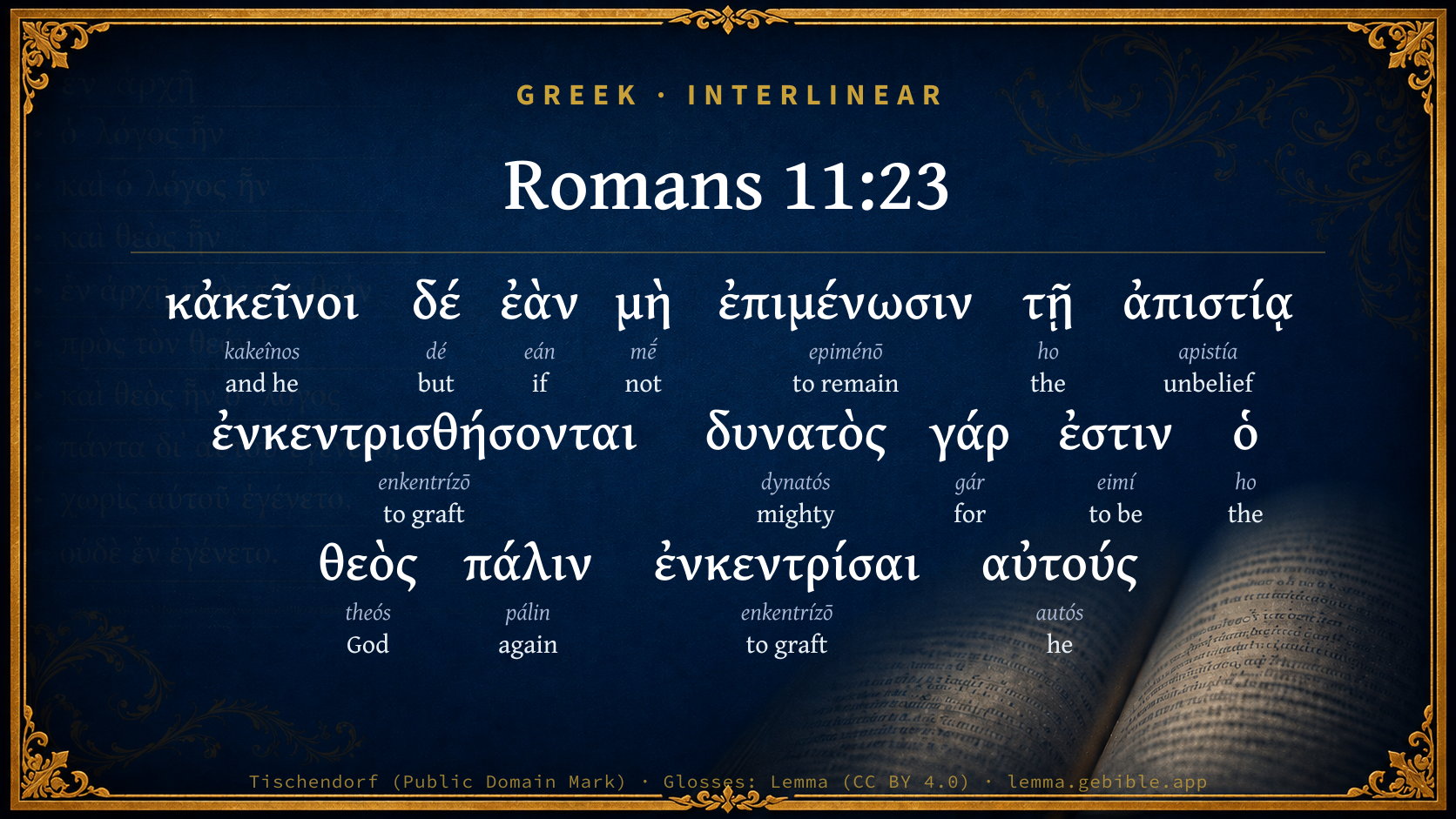
  1. κἀκεῖνοι kakeînos G2548 “and he” Demonstrative pronoun, Nominative, Plural, Masculine, Aramaic form
  2. δέ dé G1161 “but” Conjunction
  3. ἐὰν eán G1437 “if” Conditional
  4. μὴ mḗ G3361 “not” Particle, Negative
  5. ἐπιμένωσιν epiménō G1961 “to remain” Verb, Present, Active, Subjunctive, 3rd person, Plural
  6. τῇ ho G3588 “the” Article, Dative, Singular, Feminine
  7. ἀπιστίᾳ apistía G570 “unbelief” Noun, Dative, Singular, Feminine
  8. δυνατὸς dynatós G1415 “mighty” Adjective, Nominative, Singular, Masculine
  9. γάρ gár G1063 “for” Conjunction
  10. ἐστιν eimí G1510 “to be” Verb, Present, Active, Indicative, 3rd person, Singular
  11. ὁ ho G3588 “the” Article, Nominative, Singular, Masculine
  12. θεὸς theós G2316 “God” Noun, Nominative, Singular, Masculine
  13. πάλιν pálin G3825 “again” Adverb
  14. ἐνκεντρίσαι enkentrízō G1461 “to graft” Verb, Aorist, Active, Infinitive
  15. αὐτούς autós G846 “he” Personal pronoun, Accusative, Plural, Masculine

About this verse

These counts appear in no published source. They are computed here, from the morphology-tagged text and Lemma’s own curated glosses. What Lemma adds →

16
words
14
distinct lemmas
Pauline Epistles
section

Notable vocabulary

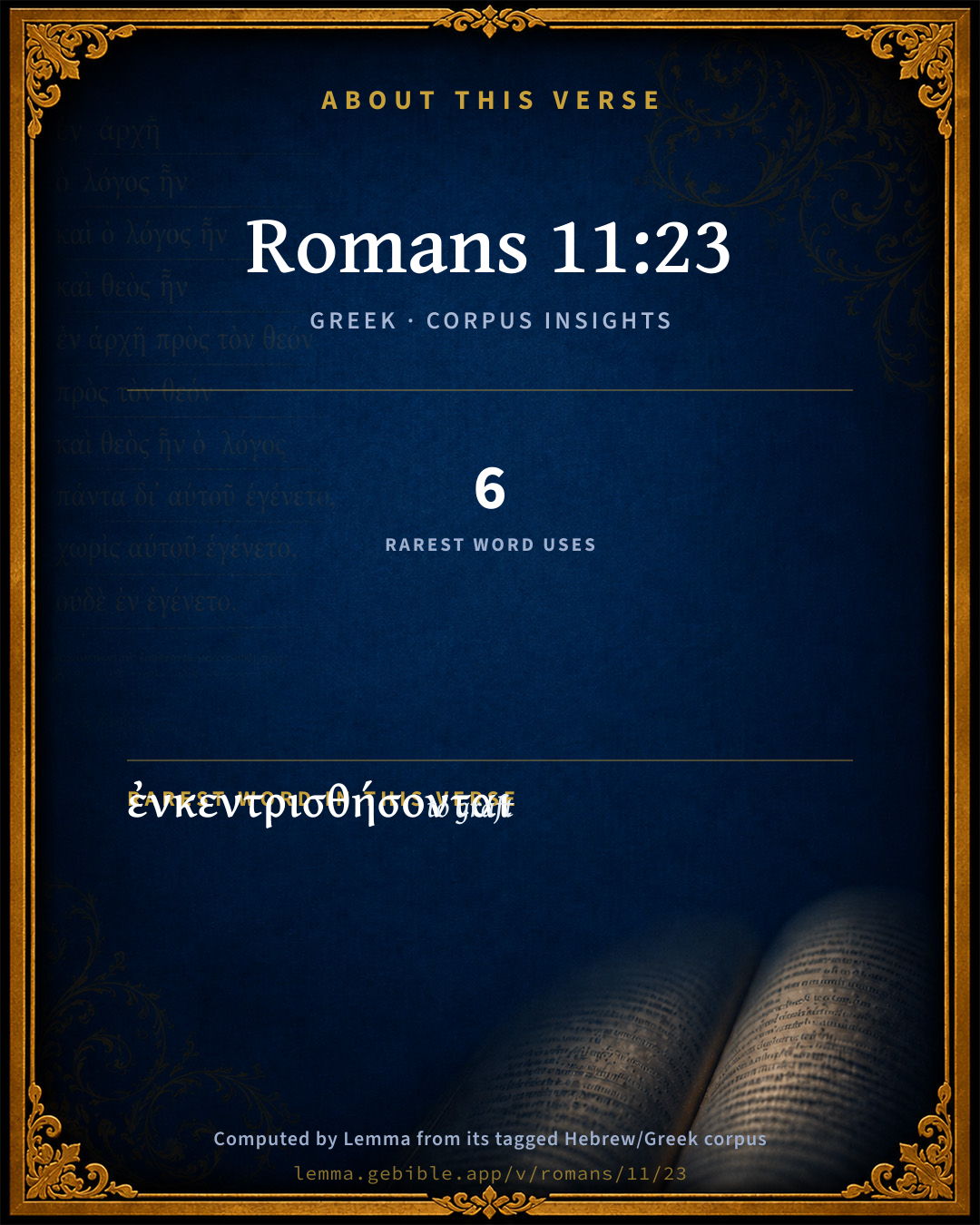
The rarest word here is ἐνκεντρισθήσονται to graft G1461 — appearing just 6 times in the whole Greek New Testament.

Shared distinctive vocabulary

ἐνκεντρισθήσονται to graft G1461 occurs in 4 verses of the Greek New Testament. Also found in:

Repetition

Words recur within this verse:

  • ἐνκεντρισθήσονται to graft G1461 ×2
  • τῇ the G3588 ×2

Cross-references

3

Topical passages linked to Romans 11:23 in the Treasury of Scripture Knowledge — connected by theme and wording, ordered by reader-vote popularity; previews shown in the World English Bible.

  • 2 Corinthians 3:16 But whenever one turns to the Lord, the veil is taken away.
  • Zechariah 12:10 I will pour on the house of David, and on the inhabitants of Jerusalem, the spirit of grace and of supplication; and they will look to me whom they have pierced; and they shall mourn for him, as one mourns for his only son, and will grieve bitterly for him, as one grieves for his firstborn.
  • Matthew 23:39 For I tell you, you will not see me from now on, until you say, 'Blessed is he who comes in the name of the Lord!'"

Cross-references courtesy of OpenBible.info (CC BY 4.0).

Commentary

Notes on Romans 11:23 from classic Christian and Jewish commentators (each source and its license shown beneath its notes). The classic Christian expositions comment on the surrounding passage and are grouped to its opening verse, so a note may address several verses; the Jewish commentaries on the Tanakh (Rashi and others) are per-verse, so they appear only where the commentator wrote on this verse.

Lemma curates 59 commentaries, every one of them public domain or Creative Commons licensed, each selected and text-cleaned for this edition rather than reprinted as found. About our sources →

The Preacher's Complete Homiletical Commentary

Joseph S. Exell (gen. ed.)

CRITICAL NOTES

Rom_11:25.—πλήρωμα is a word specially applied to ships. The full complement of the Gentile world shall enter the sacred vessel of the Church, the ark of salvation.

MAIN HOMILETICS OF THE PARAGRAPH—Rom_11:23-28

Dual aspects.—The gifts and calling of God are without repentance, and therefore God is unchangeable. There is no change in God, though there may appear change to men. God joins, then separates, then joins again. But faith is the cementing clay by which the branches are united to the vine. Faith lost, the sap ceases to flow and the branches fall off. Divine purposes work along the lines of human faith and human obedience. God is able to graft without faith, for we must not limit His ability—if we did, we might suppose Him grafting without faith, and yet not being able to make such branches fruitful. They might be united to the good olive tree, and yet not be possessed of any spiritual fatness. The promise is to faith; the blessing is obtained by believing. Let us be afraid of continuing in unbelief. Be not high-minded, but fear. If the natural branches were cut off, how careful should we be who were once branches wild by nature!

I. A dual method of working.—God’s ability is such that He can work both contrary to nature and in harmony with nature. God has grafted contrary to nature; how much more in accordance with nature! Many wild oleaster branches have been grafted, and have been wondrous specimens of the power of divine grace. Some of the noblest branches of the Christian tree have been wild Gentile branches. The ecclesiastical tree, primitive, mediæval, and modern, is crowded with many glorious branches of Gentile origin that suggest the most honoured names in the roll of the Church’s history. God can work contrary to nature, as nature is seen and described by short-sighted men. Miracles are contrary to nature—contrary to man’s nature, not contrary to God’s nature. Man’s nature is a circumscribed sphere, cribbed, cabined, and confined by men’s petty notions, which they call laws, and declare to be immutable and inexorable. God’s nature is a boundless sphere. His footsteps tread the vast unknown. The laws of men are only inductions from a part of the divine ways. The laws of God are hidden away in the infinite abyss. The laws of God, like the ways of God, like the sublime being of God, are unknowable. Our laws of nature are limited, for they are the expressions of limited minds—the readings of nature’s methods by finite intellects. For aught we know the laws of God are unlimited, being the expressions of an unlimited intellect. We do not know all the laws of God, even those expressed in nature’s operations. It does not become finite man to be wise in his own conceits. He should seek to be wise in the light of divine teaching and divine revelation.

II. A dual method of concealing and revealing.—God has His divine arcana. We remember a preacher discoursing in order to show that it was not to the glory of God to conceal a thing. Perhaps the proverbs of Solomon contained more wisdom than the utterances of the modern popular preacher. The glory of the Infinite is concealment. How can an infinite Being reveal Himself in fulness to a finite creature? What glory would there be about a God whom I could comprehend and reduce to my own level? The hero-worshipper ceases his homage when the hero appears to be stripped of transcendent and almost super humanqualities. Some ask for a knowable God—a being without any secrets, any mysteries, any hidden purposes. The reverent aspirations of my worshipping nature go out and up towards an unknowable God. The God of mystery is the God of sublime glory. The expanding and inquiring soul, even through eternal cycles, will fail to comprehend all the mysteries of the divine nature and the divine purposes. This is but to say that our littleness cannot contain God’s greatness, that the finite cannot receive and possess the Infinite. But God has mysteries which He reveals and explains; and the revelation tends to unfold the greatness of God, and to impress the receptive mind with a feeling of its own littleness. The revelation of one mystery opens out a wide prospect. Part of the divine ways is known, and we consider the dark unknown with profound awe. We ascend one mountain peak. It is very high, and its immensity subdues us with the sense of our own littleness as we see vaster heights beyond, as we consider that alps of divine nature on alps arise, and that it is hopeless for us to attempt to scale the divine altitudes. “For I would not, brethren, that ye should be ignorant of this mystery, lest ye should be wise in your own conceits.” The mystery of partial blindness to Israel is in a measure explained by the fact that it tends to the enlightenment of the Gentiles. The blindness is not final. The rejection of the Jews has two ends—the proximate and the final. “The proximate end was to facilitate the conversion of the Gentiles; the final end is to restore the Jews themselves by means of the converted Gentiles, and that to bring down at length on the latter the fulness of the divine blessing.”

III. A dual method of salvation.—Salvation for the Gentiles through the Jews; salvation for the Jews through the Gentiles. There shall come out of Zion a Deliverer. A mighty Deliverer has come out of the heavenly Zion to the earthly plains. He spoke in righteousness, travelling in the greatness of His strength, for He was mighty to save. And again in manifest and more victorious manner shall the Deliverer come out of the heavenly Zion and turn away ungodliness from Jacob; and Jew and Gentile shall embrace each other beneath the banner of mediatorial love. The Deliverer came with noiseless tread, with the silent but pervasive power of nature. And it may be that in the final ingathering there will be no miraculous interventions. All things will seem to be moving as before, until one day the Church will wake up to find herself pressed on all sides with ingathering adherents. Gladsome time when Jews and Gentiles shall love and worship the world’s great King—when the vast races of humanity shall bow, as one great army of the living God, beneath the spell of omnipotent and redeeming love!

IV. A dual emotional aspect.—“Enemies for your sakes. Beloved for the fathers’ sakes.” God is not a series of cold abstractions. God is emotional. Let us not be wise in our own conceits by pretending to explain the motions of hatred and love in a God. Perhaps, however, we may say divine hatred is the projection of human wrongdoing. Divine love is the projection of the divine attribute into humanity, removing human enmities, and filling the world with a new light. Let us fear lest we invoke divine enmity. Let us supplicate divine love. “Beloved for the fathers’ sakes.” Good fathers are a blessed heritage to their children. Here learn the greatness of man. He possesses a dual nature: one aspect stirs the divine enmity; another aspect elicits the divine love. God looks at the man and drives him from the divine presence. God looks again at the man and embraces him as beloved. Even in the expulsion there is a force of outreaching love. Is it not thus that we often appear to ourselves? We shrink with utmost loathing from one aspect, and then we taste some little comfort by the contemplation of another aspect. But oh to be beloved for the Son’s sake! The fathers of the race, the elected of God, were noble and beloved; but rising above all, and nobler than all, and more beloved than all, is the only begotten Son. Beloved for the Son’s sake! “He that spared not His own Son, but delivered Him up for us all, how shall He not with Him also freely give us all things!”—the needful, ofttimes more than the needful, in the present; the pleasant, the joy-inspiring, in the blessed future.

SUGGESTIVE COMMENTS ON Rom_11:23-28

Providence a school of virtue.—That the fulfilment of these prophecies is still to come, it appears pretty obvious that a great national movement towards Christianity on the part of the Jews, and their actual adoption of a faith which they have so long held in detestation, must tell with mighty and decisive effect on the rest of the world. If the very existence of the Jews as a separate people be in itself the indication of a providence, a singular event in history which demonstrates the part taken by Him who overrules all history in the affairs of men, how much more impressive will the evidence become when this same people shall describe the actual evolution which it was predicted they should do more than two thousand years ago, shall after the dispersions and the desolations of many generations reach at last the very landing-place to which the finger of prophecy has been pointing from an antiquity so high as that of the patriarchal ages! We know not if this splendid era is to be ushered in by palpable and direct miracle. But should there be no such manifestation of the divine power conjoined with this marvellous fulfilment, there will at least be such a manifestation of the divine knowledge as will incontestably prove that God has had to do with it, and so as that history shall of itself perform the office of revelation, or men will trace the finger of the Almighty in the events which are sensibly passing before their eyes. And besides we have reason to believe of these converted Jews that they will become the most zealous and successful of all missionaries; or, like Paul before them, the preachers of that faith which they persecuted in times past and once laboured to destroy. It is said of a single Christian that he may be “the light of the world.” How much more will be a whole nation of Christians! Verily, like Paul, the great prototype of the Jews, they will pre-eminently be the apostles of the Gentiles; and there will be a light to lighten these Gentiles in the very glory of the people of Israel. We must look to futurity for this great accomplishment, for, most obviously, it has not yet been realised. It will be “in the last days, that the mountain of the Lord’s house shall be established in the top of the mountains, and shall be exalted above the hills; and all nations shall flow unto it. And many people shall go and say, Come ye, and let us go up to the mountain of the Lord, to the house of the God of Jacob; and He will teach us of His ways, and we will walk in His paths: for out of Zion shall go forth the law, and the word of the Lord from Jerusalem.” This is all yet to come, else how could it be spoken, as an immediate sequence of its fulfilment, that “He shall judge among the nations, and shall rebuke many people”? In a school of virtue one chief end were the enforcement of great moral lessons; and this perhaps were best effected by bringing out in boldest possible relief the evil of sin, and in all their beauty and brightness the characteristics of highest moral perfection, or, which is tantamount to this, the high and holy attributes of Him in whom all perfection, as well as all power, have had their everlasting dwelling-place. Now providence is pre-eminently a school of virtue; and we may therefore expect that history, and in a more especial manner sacred history, where the manifestations of providence are seen in nearest connection with the designs of grace, will abound in such lessons. And accordingly such is the manifest purpose of many revealed evolutions or passages in the history of the divine administration, of God’s dealings with the world. One main end of the divine policy in the government and final destiny of men seems to be manifestation, that both heaven and earth might learn thereby the more to hate all evil, to love and admire all worth and goodness and true greatness, whether in themselves or as exemplified by Him in whom all greatness and goodness are personified. In harmony with this view we read of the Lord Jesus being revealed with His mighty angels on that dread occasion when the glory of His power and sacredness shall be displayed in the destruction of sinners, and the glory of His infinite love for the holy in the triumph and happiness of the saints. And so His disposal of the Church does not terminate in but has an ulterior object to itself, even “to the intent that now unto the principalities and powers in heavenly places might be known, by the Church, the manifold wisdom of God.”—Chalmers.

ILLUSTRATIONS TO CHAPTER 11

Rom_11:24-25. Beholding the deliverer.—On the occasion of President Lincoln’s visit to Richmond, as soon as his arrival became known, the coloured people whom he had delivered from bondage crowded around in wild enthusiasm. They gazed upon the wonderful man; they shouted, they danced; waved their handkerchiefs and hats; they cheered enthusiastically. Some cried, “Glory, glory!” others, “Thank you, dear Jesus, for this!” others, “God bless you, Massa Linkum!” others, “Bless de Lord!” What triumphal entry into Rome ever equalled this entry into Richmond by our delivering President? But ere long we shall all gaze on a Greater than he, with even greater satisfaction than those redeemed ones experienced.

Rom_11:24-25. Let us pray for the restoration of Israel.—Oh, shall we not lament the long rejection of the ancient people of God? Their seventy years in Babylon was nothing to this; yea, their four hundred and thirty years’ bondage in Egypt was nothing to this. Alas! how long—how long shall God’s anger last against that people? How long shall they be under the guilt of the blood of Christ, which they imprecated upon themselves and their posterity, saying, “His blood be upon us and our children”? Oh, pray—pray for that ancient people of God! Oh, pray that the blood of Shiloh may cleanse them from blood-guiltiness! When they were in favour with God, the believers among them had mind of us poor Gentiles, when we were the little sister that had no breasts; and now, when we are sucking at the breasts of gospel ordinances and sacramental solemnities, oh! shall we not mind them when “their breasts are cut off,” and we that were of “the wild olive tree,” are grafted in to partake of the root and fatness of the good olive tree? Oh, let us not boast against the branches!—“for if thou boastest, thou bearest not the root, but the root thee.” Let us not boast, but let us beg that they may be grafted in; “for if the casting away of them be the reconciling of the world, what shall the receiving of them be but life from the dead?” The day of the return and conversion of the Jews will be a day of greater gathering to Shiloh, even among the Gentiles, than we have yet seen; and it would fare better with us if we were more employed in praying for them.

Rom_11:28-32. Providence always at work.—God’s work of providence is “His most holy, wise, and powerful preserving and governing of all His creatures and all their actions.” It has no Sabbath, no night suspends it, and from its labours God never rests. If, for the sake of illustration, I may compare small things with great, it is like the motion of the heart. Beating our march to the grave since the day we began to live, the heart has never ceased to beat. Our limbs grow weary; not it. We sleep; it never sleeps. Needing no period of repose to recruit its strength, by night and day it throbs in every pulse, and constantly supplying nourishment to the meanest as well as to the noblest organs of our frame, with measured, steady, untired stroke, it drives the blood along the bounding arteries without any exercise of will on our part, and even when the consciousness of our own existence is lost in dreamless slumber

The Preacher's Complete Homiletical Commentary (gen. ed. Joseph S. Exell; Funk & Wagnalls, c. 1892) — public domain (pre-1929). A full-Bible homiletical/sermon-outline anthology covering 65 of 66 books (2 John is absent from the source module). Text from a community e-Sword module.

Bengel's Gnomon

Johann Albrecht Bengel

Rom 11:23. Ἐὰν μὴ, if not) Therefore their conversion will not be [the effect of] irresistible [grace].—δυνατὸς, [able] powerful) it might be a principal objection: how will the Jews be converted, who for so many ages act so as to withdraw themselves from the faith, separate [draw aside] the Old Testament revelations from the true Messiah, and snatch them out of the hands of believers? Paul answers, God has power: comp. the, powerful [able], ch. Rom 14:4: and He will show the glory of this power, against which no one in the Gentile world can strive. There will then be a great work!—πάλιν, again) not only in [with] a smaller [comparatively small] number, as now, but in [with] a greater number, as formerly, when they were the people of God.

Bengel's Gnomon of the New Testament — English translation (T&T Clark, Edinburgh, 1860) — public domain. Text from a community e-Sword module.

Expositor's Greek Testament

ed. W. Robertson Nicoll

Rom 11:23 . κἀκεῖνοι δέ : and they too, they on the other hand, viz. , the un-believing Jews. ἐὰν μὴ κ . τ . λ ., unless they remain on in their unbelief. It is assumed that they need not do this. The hardening spoken of in Rom 11:7-10 , though it is a judgment upon sin, and may seem from the nature of the case to be irremediable, is not to be so absolutely taken. Even in the most hardened rejector of the Gospel we are not to limit either the resources of God’s power, or the possibilities of change in a self-conscious, self-determining creature. All things are possible to him that believeth, and we are not to say that in this man or that, Jew or Gentile, unbelief is final, and belief an impossibility. If the Jews give up their unbelief ἐγκεντρισθήσονται they will be incorporated again in the true people of God. δυνατὸς γάρ ἐστιν ὁ θεός κ . τ . λ . The phrase implies not only the possibility but the difficulty of the operation. Cf. Rom 14:4 . With man it is impossible, but not with God. Nothing less than the thought of God could keep Paul from despairing of the future of Israel.

The Expositor's Greek Testament, edited by W. Robertson Nicoll (1897–1910) — public domain. Text from a community e-Sword module.

Hodge's Commentary on Romans, Ephesians & First Corinthians

Charles Hodge

Rom_11:23

And they also, if they abide not in unbelief shall be graffed in, etc. The principle which the apostle had just stated as applicable to the Gentiles, is applicable also to the Jews. Neither one nor the other, simply because Jew or Gentile, is either retained in the church or excluded from it. As the one continues in this relation to God, only on condition of faith, so the other is excluded by his unbelief alone. Nothing but unbelief prevents the Jews being brought back, for God is able to graff them in again.‹62› That is, not merely has God the power to accomplish this result, but the difficulty or impediment is not in him, but solely in themselves. There is no inexorable purpose in the divine mind, nor any insuperable obstacle in the circumstances of the case, which forbids their restoration; on the contrary, the event is, in itself considered, far more probable than the calling of the Gentiles.

Charles Hodge — Commentary on Romans (1835), First Corinthians (1857), and Ephesians (1856) — public domain. Text from a community e-Sword module.

Geneva Bible (1599)

Geneva Bible translators

Many are now for a season cut off, that is, are without the root, which in their time shall be grafted in: and again there are a great sort, which after a sort, and touching the outward show, seem to be ingrafted, which notwithstanding through their own fault afterward are cut off and clean cast away: which thing is especially to be considered in nations and peoples, as in the Gentiles and Jews.

Geneva Bible (1599) marginal notes — public domain. Text via Bolls.life.

Jamieson, Fausset & Brown

Robert Jamieson, A. R. Fausset & David Brown

And they also--"Yea, and they"

if they abide not still in unbelief, shall be grafted in: for God is able to graft them in again--This appeal to the power of God to effect the recovery of His ancient people implies the vast difficulty of it--which all who have ever labored for the conversion of the Jews are made depressingly to feel. That intelligent expositors should think that this was meant of individual Jews, reintroduced from time to time into the family of God on their believing on the Lord Jesus, is surprising; and yet those who deny the national recovery of Israel must and do so interpret the apostle. But this is to confound the two things which the apostle carefully distinguishes. Individual Jews have been at all times admissible, and have been admitted, to the Church through the gate of faith in the Lord Jesus. This is the "remnant, even at this present time, according to the election of grace," of which the apostle, in the first part of the chapter, had cited himself as one. But here he manifestly speaks of something not then existing, but to be looked forward to as a great future event in the economy of God, the reingrafting of the nation as such, when they "abide not in unbelief." And though this is here spoken of merely as a supposition (if their unbelief shall cease)--in order to set it over against the other supposition, of what will happen to the Gentiles if they shall not abide in the faith--the supposition is turned into an explicit prediction in the verses following.

Jamieson, Fausset & Brown — Commentary Critical and Explanatory on the Whole Bible (1871) — public domain (CC PDM 1.0). Text via the HelloAO Bible API.

Adam Clarke's Commentary

Verse 23. If they abide not in unbelief] So, we find that their rejection took place in consequence of their wilful obstinacy: and, that they may return into the fold, the door of which still stands open.

For God is able to graft them in again.] Fallen as they are and degraded, God can, in the course of his providence and mercy, restore them to all their forfeited privileges; and this will take place if they abide not in unbelief: which intimates that God has furnished them with all the power and means necessary for faith, and that they may believe on the Lord Jesus whenever they will. The veil now continues on their heart; but it is not a veil which God has spread there, but a veil occasioned by their own voluntary and obstinate unbelief: and, when they shall turn to the Lord, (Jesus,) the veil shall be taken away. See what the apostle has said, 2Co 3:6-18.

Adam Clarke's Commentary on the Bible (1810–1826) — public domain. Text from a community e-Sword/MySword module.

John Calvin's Commentaries

23. For God is able, etc. Frigid would this argument be to the profane; for however they may concede power to God, yet as they view it at a distance, shut up as it were in heaven, they do for the most part rob it of its effect. But as the faithful, whenever they hear God’s power named, look on it as in present operation, he thought that this reason was sufficient to strike their minds. We may add, that he assumes this as an acknowledged axiom, — that God had so punished the unbelief of his people as not to forget his mercy; according to what he had done before, having often restored the Jews, after he had apparently banished them from his kingdom. And he shows at the same time by the comparison, how much more easy it would be to reverse the present state of things than to have introduced it; that is, how much easier it would be for the natural branches, if they were again put in the place from which they had been cut off, to draw substance from their own root, than for the wild and the unfruitful, from a foreign stock: for such is the comparison made between the Jews and the Gentiles.

John Calvin's Commentaries (1540-1563) — public domain. Text from the Calvin Translation Society English edition (1840s-50s) via the Christian Classics Ethereal Library (ccel.org). Calvin's coverage is partial (roughly two-thirds of the Bible); uncommented books and verses are honest gaps, never fabricated. The 19th-century editor's footnotes and remarks are omitted so the notes are faithfully Calvin's own voice.

The Cambridge Bible for Schools and Colleges

gen. ed. J. J. S. Perowne

23. graff them in again] Every Jewish convert from the first age till now has been an example of this statement. St Paul is not yet dealing with the question of a conversion of Israel en masse; he has in view individual Gentile faith and individual Jewish faith; and he regards each Jew as (ideally) once a branch in the sacred Tree, but cut out of it, and awaiting a gracious re-ingrafting.

The Cambridge Bible for Schools and Colleges (gen. ed. J. J. S. Perowne; Cambridge University Press, 1878–1918) — public domain. Text from a community e-Sword module.

John Gill's Exposition

And they also, if they abide not still in unbelief,.... The apostle suggests that the Jews also might be recovered and brought into a Gospel church state, provided they did not continue in infidelity; but inasmuch as they seem to lie under invincible ignorance, obstinacy, and unbelief, and were such bitter enemies to the Gospel, and abhorrers of Gospel ordinances, and a Gospel church state; yea, that they must and will abide in unbelief, unless the Spirit of God convinces them of it, and it is given to them to believe in Christ, and they are powerfully drawn by the Father to come to the Son, there is no possibility or likelihood that they

shall be grafted in, or taken into a Gospel church state; to which the apostle answers, and argues for their ingrafting, and the possibility of it from the power of God:

for God is able to graft them in again; as many of them were in the times of the apostles, and some since, for nothing is impossible with God; he can remove their unbelief, knock off the shackles and fetters in which they are held, and bring, them out of the prison of infidelity, in which they are shut up; he is able to take away the blindness of their minds, and the hardness of their hearts, the veil that is over them, and turn them to the Lord; he can by his mighty power work faith in them, and cause them to look on him whom they have pierced, and mourn in an evangelical manner; he can bring them to Christ, and into his churches, and among his people, and fold them with the rest of his sheep; so that there one fold of Jew and Gentile, under one shepherd, Jesus Christ.

John Gill's Exposition of the Whole Bible (1746–1763) — public domain (CC PDM 1.0). Text via the HelloAO Bible API.

Trapp's Complete Commentary

John Trapp

23 And they also, if they abide not still in unbelief, shall be graffed in: for God is able to graff them in again.

Ver. 23. God is able] He can fetch heart of oak out of a hollow tree, and of carnal make a people created again, Psa 102:18; Eph 2:10.

John Trapp, A Commentary or Exposition upon All the Books of the Old and New Testament (1647–1656) — public domain. Text from a community e-Sword module.

Albert Barnes' Notes on the Bible

And they also - The Jews.

If they bide not ... - If they do not continue in willful obstinacy and rejection of the Messiah. As their unbelief was the sole cause of their rejection, so if that be removed, they may be again restored to the divine favor.

For God is able ... - He has,

Power to restore them, to bring them back and replace them in his favor.

(2)He has not bound himself utterly to reject them, and forever to exclude them.

In this way the apostle reaches his purpose, which was to show them that God had not cast away his people or finally rejected the Jewish nation; Rom 11:1-2. That God has this power, the apostle proceeds to show in the next verse.

Albert Barnes' Notes on the Bible (1834–1885) — public domain. Text from a community e-Sword/MySword module.

Matthew Poole's English Annotations

Here he adds another argument, to repress the arrogance and insulting of the Gentiles; and it is taken from the hope of the Jews’ restoration. Though for the present they seem to be in a desperate and forlorn condition, yet the restoring and re-ingrafting of them into the church is not impossible. The great obstacle is their unbelief, which God is able to remove. The same God that rejected them is able to restore them; to him all things are possible, he can cause dead and dry bones to live. An argument from the power of God (and that in the very words of this text) is frequently made use of in Scripture, to excite hope and assurance. Rom 4:21; 14:4; 2Co 9:8; 2Ti 1:12; Heb 2:18; 11:19.

Matthew Poole's English Annotations on the Holy Bible (1683–1685) — public domain. Text from a community e-Sword/MySword module.

Whedon's Commentary on the Bible

Daniel D. Whedon

23. Abide… able—The exertion of God’s ability to graft them again into the true Church depends upon their not abiding in unbelief. The future restoration of the Jews is, therefore, intrinsically contingent. It is not absolutely secured by God, but being foreknown by God as future is recognized in his plan of his own divine conduct.

Daniel D. Whedon (gen. ed.), Commentary on the Old and New Testaments (1874–1909) — public domain. Text from a community e-Sword module.

Scofield Reference Notes

C. I. Scofield

abide

See, Jer 3:21-25; Jer 50:4; Jer 50:5; 2Co 3:16.

The Scofield Reference Bible (1917 edition), notes by C. I. Scofield — public domain. Text from a community e-Sword module.

McGarvey & Pendleton's Commentaries

J. W. McGarvey

And they [the unbelieving mass of Israel] also [together with you], if they continue not in their unbelief [for it is not a question of any comparative lack of legal merit on their part], shall be grafted in: for God is able to graft them in again . [There is no insuperable reason why they can not be grafted in, and that blessed event will take place whenever the unbelief which has caused their severance shall cease. In Paul's day individual Jews were being grafted in (the "some" of verse 14); but in the glad future of which the apostle here speaks, the nation (or the "all Israel" of verse 26) shall be grafted in. However, the word "able" suggests the extreme difficulty of overcoming the obdurate unbelief of Israel. It is a task for God's almightiness, but, though difficult, yet, as verse 24 shows, most natural, after all.]

J. W. McGarvey (with Philip Y. Pendleton), Commentaries on the New Testament (The Fourfold Gospel, 1914; Acts; and the epistles) — public domain. Text from a community e-Sword/MySword module.

The People's New Testament

B. W. Johnson

23. And they also, if they abide not still in unbelief. As Gentile believers will be cut off unless they “continue in the goodness of God,” so the Jews, if they abandon their unbelief, shall again be grafted in. They are not cut off by a decree of God casting them away, but by their own unbelief.

B. W. Johnson's The People's New Testament with Notes (1889–1891) — public domain. Electronic text from the Christian Classics Ethereal Library (CCEL) ThML edition.

unfoldingWord translationNotes

Door43 World Missions Community

if they do not continue in their unbelief

The phrase "do not continue in their unbelief" is a double negative. You can translate this in a positive form. AT: "if the Jews start believing in Christ" (See: Double Negatives)

will be grafted in

Paul speaks of the Jews as if they were branches that could be grafted back into a tree if they start to believe in Jesus. You can translate this in an active form. AT: "God will graft them back in" (See: Metaphor and Active or Passive)

graft

This is a common process where the end of a live branch of one tree is inserted into another tree so that the new branch will continue to grow in that tree.

For if you were cut out of what is by nature a wild olive tree, and contrary to nature were grafted into a good olive tree, how much more will these Jews, who are the natural branches, be grafted back into their own olive tree?

Paul continues speaking of the Gentile believers and Jews as if they were branches of a tree. You can translate this in an active form. AT: "For if God had cut you out of what is by nature a wild olive tree, and contrary to nature had grafted you into a good olive tree, how much more will he graft these Jews, who are the natural branches, into their own olive tree?" (See: Metaphor and Active or Passive)

branches

Paul is speaking of the Jews and Gentiles as if they were branches. The "natural branches" represent the Jews, and the "grafted branches" represent the Gentile believers. (See: Metaphor)

they ... them

All occurrences of "they" or "them" refer to the Jews.

translationWords

believe

God

good

unfoldingWord translationNotes — © Distant Shores Media and the Door43 World Missions Community, licensed CC BY-SA 4.0. Source: git.door43.org/Door43/en_tn.

Cambridge Greek Testament for Schools and Colleges

23. As the Gentiles came to share in the hope of Israel, so fallen Israel may share the hope of the redeemed Gentile. He now explicitly declares his hope for Israel, hinted in Rom 11:12.

δυνατὸς γάρ κ.τ.λ. The same power which grafted the Gentile branches can graft again the broken branches of Israel, and indeed (24) the exercise of power is less, as they naturally belong to the stock.

Cambridge Greek Testament for Schools and Colleges (Cambridge University Press, 1896; 21 vols, various authors incl. Carr, Maclear, Plummer, Farrar, Lumby, Moule, M. R. James, Simcox) — public domain. Text from a community e-Sword module.

Alford’s Greek Testament

Henry Alford

23.] And they moreover, if they continue not (not exactly the same meaning as before: the χρηστότης before being external and objective, this, as in ch. 6:1, a subjective state) in their (see on ver. 20) unbelief, shall be grafted in: for God is able to graft them in again. Some, e.g. Grot., represent this last clause as implying, that God’s power to graft them in again has always been the same, but has waited for their change of mind, to act: ‘Nihil est præter incredulitatem quod Deum impediat eos rursum pro suis assumere et paterne tractare:’—but surely De W.’s interpretation is far better:—‘The Apostle obscurely includes in the ἐγκεντρ. the removal of their unbelief and the awakening of faith, and this last especially he looks for from above:’—for, as he observes, the power of God would not be put forward, if the other were the meaning.

Henry Alford, The Greek Testament (1849–1861) — public domain. Text from a community e-Sword module.

International Critical Commentary

23. St. Paul now turns from the warning to the Gentile Christians, which was to a certain extent incidental, to the main subject of the paragraph, the possibility of the return of the Jews to the Divine Kingdom; their grafting into the Divine stock.

καὶ ἐκεῖνοι δέ: ‘yes, and they too.’

International Critical Commentary — older volumes (1896–1929), various authors — public domain. Text from a community e-Sword module.

Vincent's Word Studies in the New Testament

Marvin R. Vincent

Able [δυνατος] . See on ch. Rom 4:21.

Marvin R. Vincent, Word Studies in the New Testament (1887–1900) — public domain. Text from a community e-Sword/MySword module.

Godet's Commentaries

Frédéric Louis Godet

Vv. 23, 24. “And they also, if they abide not still in unbelief, shall be grafted in; for God is able to graft them in again. For if thou wert cut out of the olive tree which is wild by nature, and wert grafted contrary to nature into a good olive tree, how much more shall these, which be the natural branches, be grafted into their own olive tree!”

Severity to the Jews was a threat to the Gentiles; so the goodness displayed to the Gentiles is a pledge, as it were, of mercy to the Jews. Let them only give up persisting in their unbelief (a contrast to the non-persistence of the Gentiles in faith, Rom 11:22), and on this one condition the power of God will restore them their place in His kingdom. It will engraft them on Christ, who will become to them a vivifying stem, as well as to the Gentiles. And this transplantation will be effected more easily still in their case than in the case of the Gentiles.

Frédéric Louis Godet — Commentaries on Luke, John, Romans, and 1 Corinthians — English translation (T&T Clark, Edinburgh, 1870s–1890s) — public domain. Text from a community e-Sword module.

Lesson kit

Teaching starters — assembled from the data on this page, not authored interpretation. Every prompt links to the verse data it draws on. Edit before teaching.

Romans, in the Pauline Epistles, opens this verse with 16 words (14 distinct Greek lemmas). Its most distinctive word is enkentrízō (“to graft”). A historical commentator’s framing appears above. Read the whole chapter for the surrounding context.

Discussion questions

  1. How does “to graft” (enkentrízō) shape what this verse is saying?
  2. How does Romans 11:17, which shares the word «to graft», read alongside this verse?
  3. What does the repetition of “to graft” (2× in this one verse) do in this verse?
  4. The translations on this page render this verse differently — a whole-verse word diff, not a word-by-word alignment. What might account for the different wordings?
  5. Compare how The Preacher's Complete Homiletical Commentary and Bengel's Gnomon read this verse. Where do they agree or differ?

Things to notice

  • These translations choose different wording for 12 words in this verse.
  • “to graft” occurs 2× in this single verse.
  • 14 distinct Greek lemmas span 16 words in this verse.

Reading settings

Reading text

Shown beneath each verse's original-language words.

Old Testament
Old Testament edition

Read the OT as the Masoretic Hebrew (MT) or the Greek Septuagint (LXX).

English shown for the Greek Septuagint (in the Hebrew ↔ Greek comparison).

Comparing translations? Open the Compare panel on any verse page to stack up to four side by side.