Ezekiel 33:17

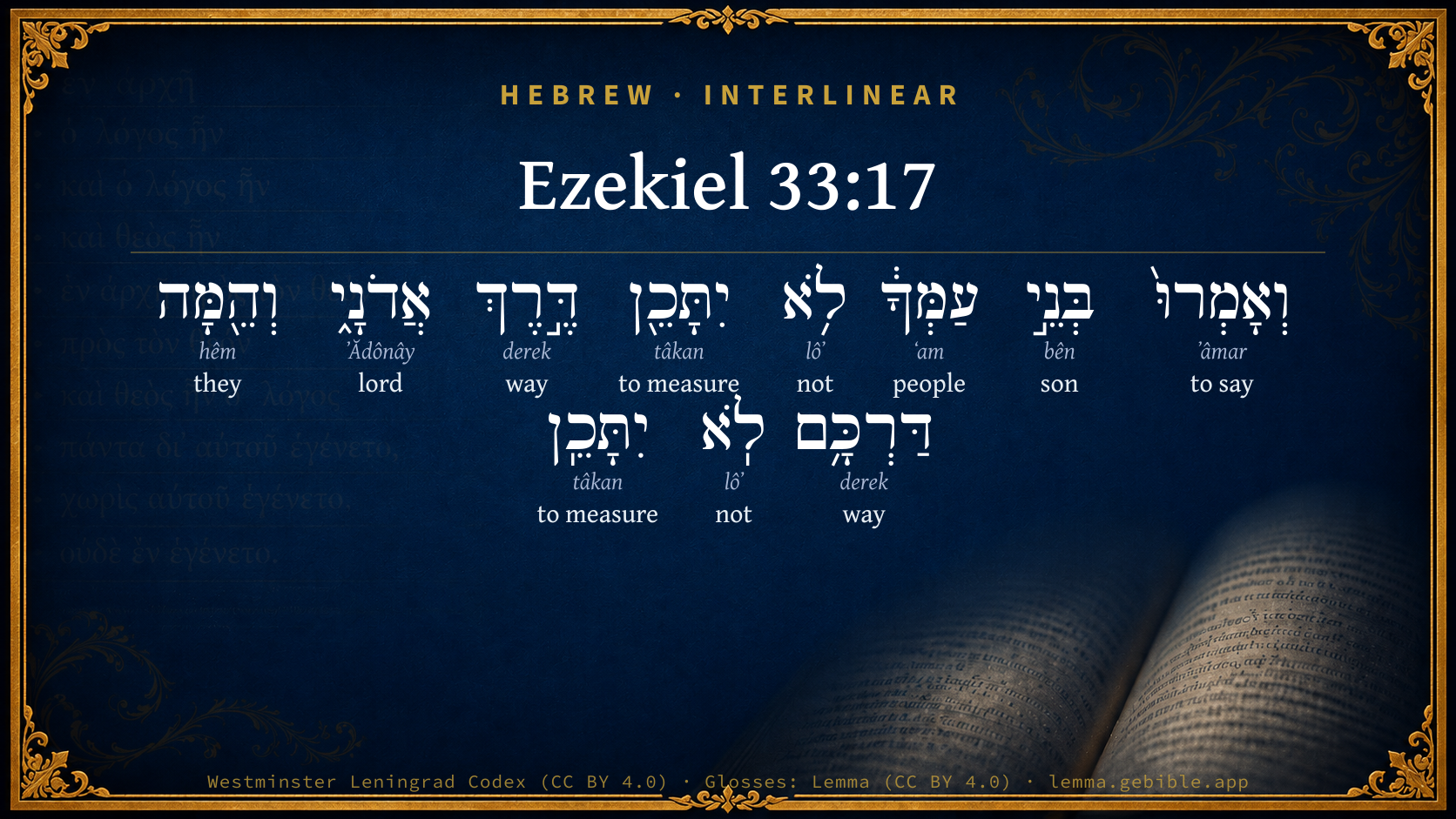
Hebrew (Westminster Leningrad Codex) Ezekiel 33:17 appears in the Hebrew Old Testament. The text above is from the Westminster Leningrad Codex. Each word links to its Strong’s number, a concise gloss, and parsing drawn from the Open Scriptures Hebrew Bible morphology. Click any word for its full Brown-Driver-Briggs (BDB) entry.
Download image
Cite this verse

Ezekiel 33:17 (World English Bible). Public Domain. Lemma interlinear Bible study tool, https://lemma.gebible.app/v/ezekiel/33/17.

Show BibTeX & RIS
BibTeX
RIS
English Translation
Yet the children of your people say, The way of the Lord is not equal: but as for them, their way is not equal.
World English Bible · Public Domain
Download a study sheet

One document with this verse’s original text, its word-by-word gloss line, the meaning frame, cross-references with their text, attributed commentary, and full source and license credits — printable, and it pastes into notes with its structure intact.

This verse Autodidact and up

Study sheet (.html) Plain text (.txt)

A passage Seminary Student

Up to 50 verses in one chapter. A passage sheet keeps up to 6 commentary sources and 12 cross-references per verse, in the order this page ranks them, and says so on the sheet whenever that leaves anything out. Ask for a single verse and you get the Autodidact verse sheet above.

Everything on this page stays free to read, with no account — the sheet is a download of what is already on screen, not access to it.

Want to remove ads? Support Godless Engineer
Compare translations 3

The same verse in 3 English versions, stacked beneath the original-language interlinear above. Click any original word for its lexicon entry.

Each is an independent rendering of the whole verse — the interlinear is not word-aligned to these translations.

Highlighted words mark where these versions differ — a whole-verse word diff, not a word-by-word alignment.

  • World English Bible Public Domain
    Yet the children of your people say, The way of the Lord is not equal: but as for them, their way is not equal.
  • King James Version Public Domain
    Yet the children of thy people say, The way of the Lord is not equal: but as for them, their way is not equal.
  • unfoldingWord Literal Text CC BY-SA 4.0
    But your people say, “The way of the Lord is not fair!” but it is your ways that are not fair!

unfoldingWord Literal Text — © unfoldingWord, licensed CC BY-SA 4.0. Word-aligned USFM3 via Door43 (git.door43.org/unfoldingWord/en_ult).

Versions to compare (up to 4)

3 of 4 selected

Show all 18 translations

Every available English version of this verse, each an independent rendering of the whole verse.

  • World English Bible Public Domain
    Yet the children of your people say, The way of the Lord is not equal: but as for them, their way is not equal.
  • Berean Standard Bible Public Domain
    Yet your people say, ‘The way of the Lord is not just.’ But it is their way that is not just.
  • Majority Standard Bible Public Domain
    Yet your people say, ‘The way of the Lord is not just.’ But it is their way that is not just.
  • King James Version Public Domain
    Yet the children of thy people say, The way of the Lord is not equal: but as for them, their way is not equal.
  • American Standard Version (1901) Public Domain
    Yet the children of thy people say, The way of the Lord is not equal: but as for them, their way is not equal.
  • Revised Version (1885) Public Domain
    Yet the children of thy people say, The way of the Lord is not equal: but as for them, their way is not equal.
  • Geneva Bible (1599) Public Domain
    Yet the children of thy people say, The way of the Lord is not equall: but their owne way is vnequall.
  • Douay-Rheims (1899) Public Domain
    And the children of thy people have said: The way of the Lord is not equitable: whereas their own way is unjust.
  • Young's Literal Translation Public Domain
    And the sons of thy people have said: The way of the Lord is not pondered, As to them -- their way is not pondered.
  • Literal Standard Version CC BY-SA 4.0
    And the sons of your people have said: The way of the Lord is not pondered, || As for them—their way is not pondered.
  • Unlocked Literal Bible CC BY-SA 4.0
    But your people say, “The way of the Lord is not fair!” but it is your ways that are not fair!
  • unfoldingWord Literal Text CC BY-SA 4.0
    But your people say, “The way of the Lord is not fair!” but it is your ways that are not fair!
  • Darby Bible Public Domain
    Yet the children of thy people say, The way of the Lord is not equal: but as for them, their way is not equal.
  • World Messianic Bible Public Domain
    “‘Yet the children of your people say, “The way of the Lord is not fair;” but as for them, their way is not fair.
  • Webster's Bible Public Domain
    Yet the children of thy people say, The way of the Lord is not equal: but as for them, their way is not equal.
  • Free Bible Version CC BY-SA 4.0
    However, your people are complaining, ‘What the Lord does isn't right.’ But it's what they're doing that isn't right.
  • Bible in Basic English Public Domain
    But the children of your people say, The way of the Lord is not equal: when it is they whose way is not equal.
  • JPS Tanakh (1917) Public Domain
    Yet the children of thy people say: The way of the Lord is not equal; but as for them, their way is not equal.

Literal Standard Version (2020), Covenant Press — licensed CC BY-SA 4.0. Text via the HelloAO Bible API (eBible.org). Unlocked Literal Bible (unfoldingWord) — licensed CC BY-SA 4.0. Text via the HelloAO Bible API (eBible.org). unfoldingWord Literal Text — © unfoldingWord, licensed CC BY-SA 4.0. Word-aligned USFM3 via Door43 (git.door43.org/unfoldingWord/en_ult). Free Bible Version, Dr. Jonathan Gallagher — licensed CC BY-SA 4.0. Text via the HelloAO Bible API (eBible.org).

Word by word

More ways to search: Search by grammar → Find every occurrence → Compare this word →

Practice this passage: Drill this verse → Learn its vocabulary →

יִתָּכֵ֖ן
tâkan
H8505
“to measure”
Verb, Niphal, Imperfect, 3rd Person, Masculine, Singular
Part of Speech
Verb
Stem
Niphal
Form
Imperfect
Person
3rd Person
Gender
Masculine
Number
Singular
Full BDB Definition

Origin: a primitive root

TWOT: 2511

to regulate, measure, estimate, ponder, balance, make even, level, weigh, be equal, be weighed out, test, prove - (Qal) estimate (participle) - (Niphal) - to be estimated - to be made even or right, be adjusted to the standard - (Piel) to weigh out, mete out - (Pual) - to be weighed out, be measured out - measured out (participle)
  1. וְאָמְרוּ֙ ʼâmar H559 “and · to say” Conjunction + Verb, Qal, Sequential Perfect, 3rd Person, Common, Plural
  2. בְּנֵ֣י bên H1121 “sons of” Noun, Common, Masculine, Plural, Construct
  3. עַמְּךָ֔ ʻam H5971 “people · your” Noun, Common, Masculine, Singular, Construct + Suffix, Personal, 2nd Person, Masculine, Singular
  4. לֹ֥א lôʼ H3808 “not” Particle, Negative
  5. דֶּ֣רֶךְ derek H1870 “way of” Noun, Common, Both, Singular, Construct
  6. אֲדֹנָ֑י ʼĂdônây H136 “Lord · my” Noun, Common, Masculine, Plural, Construct + Suffix, Personal, 1st Person, Common, Singular
  7. וְהֵ֖מָּה hêm H1992 “and · they” Conjunction + Pronoun, Personal, 3rd Person, Masculine, Plural
  8. דַּרְכָּ֥ם derek H1870 “way · their” Noun, Common, Both, Singular, Construct + Suffix, Personal, 3rd Person, Masculine, Plural
  9. לֹֽא lôʼ H3808 “not” Particle, Negative
  10. יִתָּכֵֽן tâkan H8505 “to measure” Verb, Niphal, Imperfect, 3rd Person, Masculine, Singular

About this verse

These counts appear in no published source. They are computed here, from the morphology-tagged text and Lemma’s own curated glosses. What Lemma adds →

11
words
8
distinct lemmas
Prophets
section

Notable vocabulary

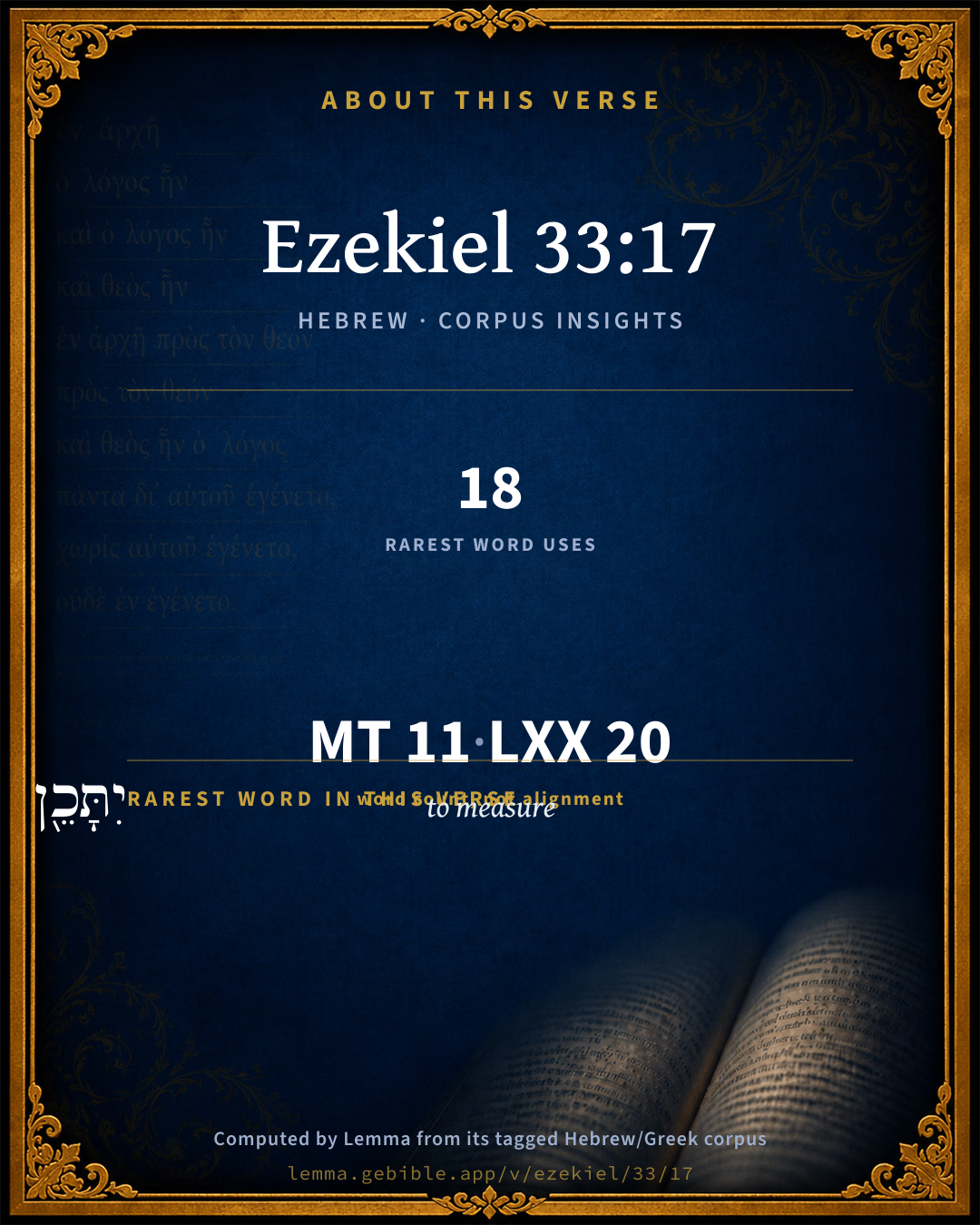
The rarest word here is יִתָּכֵ֖ן to measure H8505 — appearing just 18 times in the whole Hebrew Bible.

Shared distinctive vocabulary

יִתָּכֵ֖ן to measure H8505 occurs in 13 verses of the Hebrew Bible. Also found in:

Grammatical profile

  • 3 verbs
  • 5 nouns
  • 1 pronoun
  • 2 particles

Verb forms

  • וְאָמְרוּ֙ Qal · Sequential Perfect
  • יִתָּכֵ֖ן Niphal · Imperfect
  • יִתָּכֵֽן Niphal · Imperfect

Repetition

Words recur within this verse — often emphatic in Hebrew:

  • יִתָּכֵ֖ן to measure H8505 ×2
  • דֶּ֣רֶךְ way H1870 ×2
  • לֹ֥א not H3808 ×2

Hebrew & Septuagint length

In English translation the verse runs 24 words from the Hebrew and 23 from the Septuagint (LXX English) — closely comparable.

A rough comparison of the two English renderings, which tokenize alike — not a word-level alignment.

Word counts can differ between the Hebrew and the Greek without any difference in meaning — e.g. the Hebrew direct-object marker אֵת has no separate Greek word, and Greek often adds the article ὁ.

In the original languages it is 11 Hebrew tokens and 20 Greek tokens — but the two are counted differently (Hebrew bundles its prefixes and suffixes into one token; the Greek is in lemma form), so that isn’t a like-for-like length.

Cross-references

7

Topical passages linked to Ezekiel 33:17 in the Treasury of Scripture Knowledge — connected by theme and wording, ordered by reader-vote popularity; previews shown in the World English Bible.

  • Ezekiel 18:25 Yet you say, The way of the Lord is not equal. Hear now, house of Israel: Is my way not equal? Aren't your ways unequal?
  • Ezekiel 18:29 Yet says the house of Israel, The way of the Lord is not equal. house of Israel, are not my ways equal? are not your ways unequal?
  • Matthew 25:24–26 "He also who had received the one talent came and said, 'Lord, I knew you that you are a hard man, reaping where you did not sow, and gathering where you did not scatter.
  • Job 35:2 "Do you think this to be your right, Or do you say, 'My righteousness is more than God's,'
  • Job 40:8 Will you even annul my judgment? Will you condemn me, that you may be justified?
  • Ezekiel 33:20 Yet you say, The way of the Lord is not equal. House of Israel, I will judge you everyone after his ways.
  • Luke 19:21–22 for I feared you, because you are an exacting man. You take up that which you didn't lay down, and reap that which you didn't sow.'

Cross-references courtesy of OpenBible.info (CC BY 4.0).

Hebrew and Greek witnesses Masoretic Hebrew ↔ Greek Septuagint

The same verse in the two great witnesses to the Old Testament, shown verse-for-verse.

These are two independent witnesses, not word-aligned to each other, and the Septuagint is shown in lemma (dictionary) form.

Hebrew Ezekiel 33:17 Masoretic · Westminster Leningrad Codex

וְאָמְרוּ֙ בְּנֵ֣י עַמְּךָ֔ לֹ֥א יִתָּכֵ֖ן דֶּ֣רֶךְ אֲדֹנָ֑י וְהֵ֖מָּה דַּרְכָּ֥ם לֹֽא יִתָּכֵֽן

Yet the children of your people say, The way of the Lord is not equal: but as for them, their way is not equal.

World English Bible · Public Domain

Greek LXX Ezekiel 33:17 Septuagint · lemma form

καί εἶπον ὁ υἱός ὁ λαός σύ οὐ εὐθύς ὁ ὁδός ὁ κύριος καί οὗτος ὁ ὁδός αὐτός οὐ εὐθύς

Yet the children of your people will say, The way of the Lord is not straight: whereas this their way is not straight.

LXX2012 (modern English Septuagint) · Public Domain

Hebrew: Westminster Leningrad Codex (CC BY 4.0). Greek: Septuagint (public domain); English from LXX2012 (modern English Septuagint) (Public Domain). How the Septuagint differs from the Hebrew →

Targum (Aramaic paraphrase)

1

The Targum is the ancient Jewish Aramaic paraphrase of the Hebrew Scriptures — an interpretive translation, not the Hebrew text itself. Onkelos (literal) and Pseudo-Jonathan (expansive) render the Torah, and Jonathan the Prophets. Coverage is partial: where no permissively-licensed English translation exists for a verse, only the Aramaic is shown. This is verse-level text, not a word-by-word alignment to the Hebrew.

  1. Targum Jonathan Prophets (Joshua–Malachi)
    וְיֵימְרוּן בְּנֵי עַמָךְ לָא מְפָרְשָׁן לָנָא אוֹרְחַת טוּבָא דַייָ וְאִינוּן אוֹרְחַתְהוֹן דִילְהוֹן לָא תִקְנָן:

    (no public-domain English translation for this verse)

    Targum Jonathan — Aramaic: “Mikraot Gedolot” (public domain). English: “Sefaria Community Translation” (CC0 1.0 (public-domain dedication)); “London "Chaldee Paraphrase," 1871” (public domain). Text via Sefaria.

Commentary

Notes on Ezekiel 33:17 from classic Christian and Jewish commentators (each source and its license shown beneath its notes). The classic Christian expositions comment on the surrounding passage and are grouped to its opening verse, so a note may address several verses; the Jewish commentaries on the Tanakh (Rashi and others) are per-verse, so they appear only where the commentator wrote on this verse.

Lemma curates 59 commentaries, every one of them public domain or Creative Commons licensed, each selected and text-cleaned for this edition rather than reprinted as found. About our sources →

Trapp's Complete Commentary

John Trapp

Eze 33:17 Yet the children of thy people say, The way of the Lord is not equal: but as for them, their way is not equal.

Ver. 17. Yet the children of the people say.] This was a second cavil of theirs. See Eze 33:10; Eze 18:25. Archesilas was surnamed Cavillator: so might these well have been.

Their way is not equal.] There is no equity at all in this causeless quarrel of theirs.

John Trapp, A Commentary or Exposition upon All the Books of the Old and New Testament (1647–1656) — public domain. Text from a community e-Sword module.

Tyndale Open Study Notes

Tyndale Open Resources

33:17-20 The Lord isn’t doing what’s right: The perception was that God’s bringing Babylon to destroy Jerusalem was inappropriate. The Lord immediately refuted this argument (33:18). • they . . . are not doing what’s right: The people’s fault was in refusing to repent and in accusing God of injustice. • I judge each of you according to your deeds: The Lord’s judgment upon his people is never arbitrary but is a fitting response to their sins. If they repent, trust the Lord for salvation, and do what is just and right, they have hope for the future (cp. Eph 2:8-10).

Tyndale Open Study Notes — © Tyndale Open Resources, licensed CC BY-SA 4.0. Text via the HelloAO Bible API.

Jamieson, Fausset & Brown

Robert Jamieson, A. R. Fausset & David Brown

The way of the Lord--The Lord's way of dealing in His moral government.

Jamieson, Fausset & Brown — Commentary Critical and Explanatory on the Whole Bible (1871) — public domain (CC PDM 1.0). Text via the HelloAO Bible API.

The Cambridge Bible for Schools and Colleges

gen. ed. J. J. S. Perowne

17. Cf. Eze_18:25; Eze_18:29.

The Cambridge Bible for Schools and Colleges (gen. ed. J. J. S. Perowne; Cambridge University Press, 1878–1918) — public domain. Text from a community e-Sword module.

John Gill's Exposition

When the righteous turneth from his righteousness,.... This and what is said in the following verse are clear instances of the equality, justness, and goodness of the ways of God; and are again repeated, if possible, to make it clear and plain to them that their charge and complaint were groundless; See Gill on Eze 18:24, Eze 18:26.

.

Ezekiel 33:19

eze 33:19

eze 33:19

eze 33:19But if the wicked turn from his wickedness,.... See Gill on Eze 18:27.

John Gill's Exposition of the Whole Bible (1746–1763) — public domain (CC PDM 1.0). Text via the HelloAO Bible API.

Haydock's Catholic Bible Commentary

Equitable; as we are much more inclined to vice than to virtue. This argumentation is inconclusive, as God owes nothing to man; and what good the latter does, is an effect of His grace. The propensity to evil is no excuse, as man is still free. He is judged according to the dispositions in which he is found at the hour of death; yet we must not infer, that those who have spent their lives in sinning will be no worse treated than the person who dies guilty of a single crime.

George Leo Haydock (1774–1849), Haydock's Catholic Family Bible and Commentary, 1859 edition — public domain. Excludes Psalms (Douay-Rheims chapter numbering differs from Protestant) and Deuterocanonical books (Catholic canon only).

Matthew Poole's English Annotations

These impious, obstinate quarrellers will accuse and do condemn the just and holy God, that they may acquit themselves. See this verse explained, See Poole "Eze 18:25", See Poole "Eze 18:29".

Matthew Poole's English Annotations on the Holy Bible (1683–1685) — public domain. Text from a community e-Sword/MySword module.

The Pulpit Commentary

The way of the Lord is not equal. The prophet now proclaims what he had been taught, perhaps then, without proclaiming it, in Eze_18:25-30. Men are dealt with by the Divine Judge, not as their fathers have Been before them, not even as they themselves have been in times past, but exactly as they are. Where could there be a more perfect rule of equity? The question how far Ezekiel thinks of the judgment itself as final, whether there is the possibility of repentance and pardon after it has fallen, and during its continuance, is not directly answered. He is speaking, we must remember, of a judgment on this side the grave, and therefore what we call the problems of eschatology were not before him. But the language of the document which lies at the basis of his theology (Lev_26:41) asserts that if men repented and, "accepted" their earthly punishment, then Jehovah would remember his covenant, and would not destroy them utterly. And his own language as to Sodom and Samaria (Eze_16:53) indicates a leaning to the wider hope. If the problems of the unseen world had been brought before him, we may believe that he would have dealt with them as with those with which he actually came in contact, and that there also his words would have been, "O house of Israel, O sons of men, are not my ways equal? are not your ways unequal?

Charging God with injustice.

I IT IS NATURAL FOR MEN TO BE CONCERNED ABOUT THE JUSTICE OF GOD"S ACTIONS. The moral character of Providence is of immense importance. If God acted from caprice, there would be no ground on which we could rely in approaching him, and our whole lives would lie at the mercy of chance. If he were unjust, the most fearful confusion would result. Our security lies in the justice of God, in our knowledge that he will only do what is fair and equable and right. Though we depend on the mercy of God, we cannot refrain from appealing repeatedly to his justice. We are much concerned to know that he is perfectly just.

II THERE ARE CIRCUMSTANCES UNDER WHICH GOD APPEARS TO BE UNJUST. It certainly cannot be said that nature and providence are clear revelations of Divine justice, so legibly written that he who runs may read. The world abounds with inequalities. There are the greatest differences in the lots of innocent children. Good men fall into adversity; bad men prosper. The special ground of difficulty with the readers of Ezekiel was that men of time-honored character were punished, while notorious sinners were pardoned. This was apparently a matter of much distress and doubt, leading to accusations against God for not acting equally, i.e. fairly.

III IT IS FOOLISH TO FORM HASTY OPINIONS CONCERNING GOD"S JUSTICE.

1. We do not know all the facts. We see a certain superficial condition; what lies deeper is hidden. Possibly Ezekiel"s contemporaries did not know of the fall of the men of good repute, or of the amendment of their notoriously wicked acquaintances.

2. We do not know all the principles on which God acts. They may be ultimately based on justice, and yet they may be complicated with various considerations. God is not only rewarding and punishing.

3. We do not know the true character of events. What we name evil may really be good. At all events, there may be mercies in disguise.

IV MEN ARE SLOW TO RECOGNIZE GOD"S PERCEPTION OF CHARACTER. Most people are reluctant to admit that characters are susceptible of change. They label their acquaintances with certain moral titles, and they refuse to allow that those titles are altered. At all events, this is especially true in regard to changes for the worse in themselves and in regard to alterations for the better in others. A man takes it for granted that he will always be estimated according to his old good character. On the other hand, the world is slow to believe in repentance and amendment. It regards the pardon of the sinner as unreasonable, because it will not see that when he repents he is no longer a sinner.

V IT IS COMMON TO LAY THE CHARGE OF MAN"S INJUSTICE TO GOD"S ACCOUNT. "But as for them, their way is not equal." Straight lines look crooked when regarded through a crooked glass. To the unjust man justice seems to be unjust. Sin gives an evil color to holiness. The righteousness of God is obscured by man"s unrighteousness,

VI IT WOULD BE WELL FOR MEN TO CONSIDER THEIR OWN WAYS INSTEAD OF JUICING GOD"S WAYS. The trouble that is wasted in difficult theological speculations had better be spent in searching self-examination. While we are looking for a mote in God"s eye, we Jail to see the beam in our own eye the beam that caused us to fancy there was any mote in God"s eye at all! Theology is too often an excuse for the neglect of religion, but difficulties in providence do not destroy the guilt of sin.

The Pulpit Commentary (1880–1919), ed. H.D.M. Spence-Jones & Joseph S. Exell — public domain. Text from a community e-Sword module.

unfoldingWord translationNotes

Door43 World Missions Community

General Information:

Yahweh continues giving Ezekiel his message to the Israelites.

your people

These are the people of Israel. The word "your" refers to Ezekiel.

The way of the Lord ... your ways that are not fair

Behaviors or actions is spoken of as if they were a way or road on which a person travels. AT: "What the Lord does ... the things you do that are not fair" (See: Metaphor)

but it is your ways

The word "your" refers to the people of Israel. This can be stated in third person. AT: "but it is their ways" (See: First, Second, or Third Person)

turns away from his righteousness

No longer doing something is spoken of as if it were physically turning away from something. AT: "stops doing what is right" (See: Metaphor)

die in it

"die because of his sins"

turns away from his wickedness

No longer doing something is spoken of as if it were physically turning away from something. AT: "stops doing wicked things" (See: Metaphor)

because of those things

"because he does what is just and righteous"

you people

These are the people of Israel.

house of Israel

Here "house" represents people. AT: "people of Israel" (See: Metonymy)

translationWords

people group

lord

righteous

evil

just

judge

house

Israel

unfoldingWord translationNotes — © Distant Shores Media and the Door43 World Missions Community, licensed CC BY-SA 4.0. Source: git.door43.org/Door43/en_tn.

Lesson kit

Teaching starters — assembled from the data on this page, not authored interpretation. Every prompt links to the verse data it draws on. Edit before teaching.

Ezekiel, in the Prophets, opens this verse with 11 words (8 distinct Hebrew lemmas). Its most distinctive word is tâkan (“to measure”). A historical commentator’s framing appears above. Read the whole chapter for the surrounding context.

Discussion questions

  1. What does “to measure” (tâkan) contribute to the verse as a whole?
  2. How does 1 Samuel 2:3, which shares the word «to measure», read alongside this verse?
  3. What does the repetition of “to measure” (2× in this one verse) do in this verse?
  4. The translations on this page render this verse differently — a whole-verse word diff, not a word-by-word alignment. What might account for the different wordings?
  5. «וְאָמְרוּ֙» is a Qal Sequential Perfect verb. How does that grammatical form shape the action described?
  6. Compare how Trapp's Complete Commentary and Tyndale Open Study Notes read this verse. Where do they agree or differ?

Things to notice

Reading settings

Reading text

Shown beneath each verse's original-language words.

Old Testament
Old Testament edition

Read the OT as the Masoretic Hebrew (MT) or the Greek Septuagint (LXX).

English shown for the Greek Septuagint (in the Hebrew ↔ Greek comparison).

Comparing translations? Open the Compare panel on any verse page to stack up to four side by side.