Ephesians 4:24

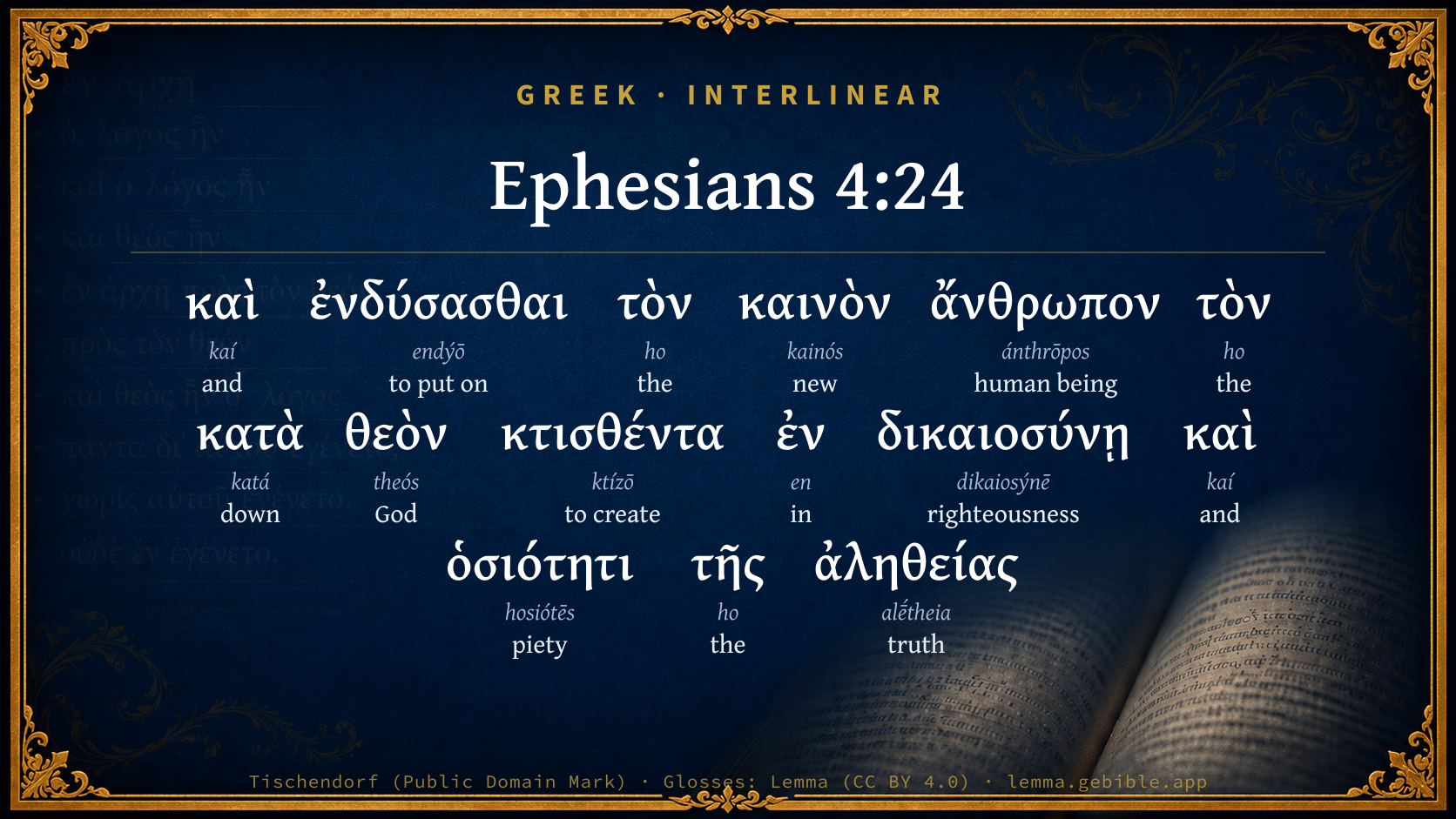
Greek (Tischendorf 8th ed.) Ephesians 4:24 appears in the Greek New Testament. The text above is from the Tischendorf 8th edition. Each word links to its Strong’s number and a concise gloss. Click any word for its full Thayer’s Greek Lexicon entry.
Download image
Cite this verse

Ephesians 4:24 (World English Bible). Public Domain. Lemma interlinear Bible study tool, https://lemma.gebible.app/v/ephesians/4/24.

Show BibTeX & RIS
BibTeX
RIS
English Translation
and put on the new man, who in the likeness of God has been created in righteousness and holiness of truth.
World English Bible · Public Domain
Download a study sheet

One document with this verse’s original text, its word-by-word gloss line, the meaning frame, cross-references with their text, attributed commentary, and full source and license credits — printable, and it pastes into notes with its structure intact.

This verse Autodidact and up

Study sheet (.html) Plain text (.txt)

A passage Seminary Student

Up to 50 verses in one chapter. A passage sheet keeps up to 6 commentary sources and 12 cross-references per verse, in the order this page ranks them, and says so on the sheet whenever that leaves anything out. Ask for a single verse and you get the Autodidact verse sheet above.

Everything on this page stays free to read, with no account — the sheet is a download of what is already on screen, not access to it.

Want to remove ads? Support Godless Engineer
Compare translations 3

The same verse in 3 English versions, stacked beneath the original-language interlinear above. Click any original word for its lexicon entry.

Each is an independent rendering of the whole verse — the interlinear is not word-aligned to these translations.

Highlighted words mark where these versions differ — a whole-verse word diff, not a word-by-word alignment.

  • World English Bible Public Domain
    and put on the new man, who in the likeness of God has been created in righteousness and holiness of truth.
  • King James Version Public Domain
    And that ye put on the new man, which after God is created in righteousness and true holiness.
  • unfoldingWord Literal Text CC BY-SA 4.0
    and to put on the new man according to God—having been created in righteousness and holiness of the truth.

unfoldingWord Literal Text — © unfoldingWord, licensed CC BY-SA 4.0. Word-aligned USFM3 via Door43 (git.door43.org/unfoldingWord/en_ult).

Versions to compare (up to 4)

3 of 4 selected

Show all 19 translations

Every available English version of this verse, each an independent rendering of the whole verse.

  • World English Bible Public Domain
    and put on the new man, who in the likeness of God has been created in righteousness and holiness of truth.
  • Berean Standard Bible Public Domain
    and to put on the new self, created to be like God in true righteousness and holiness.
  • Majority Standard Bible Public Domain
    and to put on the new self, created to be like God in true righteousness and holiness.
  • King James Version Public Domain
    And that ye put on the new man, which after God is created in righteousness and true holiness.
  • American Standard Version (1901) Public Domain
    and put on the new man, that after God hath been created in righteousness and holiness of truth.
  • Revised Version (1885) Public Domain
    and put on the new man, which after God hath been created in righteousness and holiness of truth.
  • Geneva Bible (1599) Public Domain
    And put on ye new man, which after God is created vnto righteousnes, and true holines.
  • Douay-Rheims (1899) Public Domain
    And put on the new man, who according to God is created in justice and holiness of truth.
  • Young's Literal Translation Public Domain
    and to put on the new man, which, according to God, was created in righteousness and kindness of the truth.
  • Literal Standard Version CC BY-SA 4.0
    and to put on the new man, which, according to God, was created in righteousness and kindness of the truth.
  • Unlocked Literal Bible CC BY-SA 4.0
    and to put on the new man that is created in the image of God—in true righteousness and holiness.
  • unfoldingWord Literal Text CC BY-SA 4.0
    and to put on the new man according to God—having been created in righteousness and holiness of the truth.
  • Darby Bible Public Domain
    and [your] having put on the new man, which according to God is created in truthful righteousness and holiness.
  • World Messianic Bible Public Domain
    and put on the new man, who in the likeness of God has been created in righteousness and holiness of truth.
  • Webster's Bible Public Domain
    And that ye put on the new man, which after God is created in righteousness and true holiness.
  • Free Bible Version CC BY-SA 4.0
    and put on your new nature that God created so you will be like him, right and holy in the truth.
  • Bible in Basic English Public Domain
    And put on the new man, to which God has given life, in righteousness and a true and holy way of living.
  • Text-Critical English NT CC BY 4.0
    and to put on the new self, created according to the image of God in true righteousness and holiness.
  • Tyndale New Testament (1534) Public Domain
    and put on that newe man which after the ymage of God is shapen in ryghtewesnes and true holynes.

Literal Standard Version (2020), Covenant Press — licensed CC BY-SA 4.0. Text via the HelloAO Bible API (eBible.org). Unlocked Literal Bible (unfoldingWord) — licensed CC BY-SA 4.0. Text via the HelloAO Bible API (eBible.org). unfoldingWord Literal Text — © unfoldingWord, licensed CC BY-SA 4.0. Word-aligned USFM3 via Door43 (git.door43.org/unfoldingWord/en_ult). Free Bible Version, Dr. Jonathan Gallagher — licensed CC BY-SA 4.0. Text via the HelloAO Bible API (eBible.org).

Word by word

More ways to search: Search by grammar → Find every occurrence → Compare this word →

Practice this passage: Drill this verse → Learn its vocabulary →

ὁσιότητι
hosiótēs
G3742
“piety”
Noun, Dative, Singular, Feminine
Part of Speech
Noun
Case
Dative
Number
Singular
Gender
Feminine
Full Thayer's Definition

Origin: from G3741

TDNT: 13:13,7

1. piety towards God, fidelity in observing the obligations of piety, holiness
  1. καὶ kaí G2532 “and” Conjunction
  2. ἐνδύσασθαι endýō G1746 “to put on” Verb, Aorist, Middle, Infinitive
  3. τὸν ho G3588 “the” Article, Accusative, Singular, Masculine
  4. καινὸν kainós G2537 “new” Adjective, Accusative, Singular, Masculine
  5. ἄνθρωπον ánthrōpos G444 “human being” Noun, Accusative, Singular, Masculine
  6. τὸν ho G3588 “the” Article, Accusative, Singular, Masculine
  7. κατὰ katá G2596 “down” Preposition
  8. θεὸν theós G2316 “God” Noun, Accusative, Singular, Masculine
  9. κτισθέντα ktízō G2936 “to create” Verb, Aorist, Passive, Participle, Accusative, Singular, Masculine
  10. ἐν en G1722 “in” Preposition
  11. δικαιοσύνῃ dikaiosýnē G1343 “righteousness” Noun, Dative, Singular, Feminine
  12. καὶ kaí G2532 “and” Conjunction
  13. τῆς ho G3588 “the” Article, Genitive, Singular, Feminine
  14. ἀληθείας alḗtheia G225 “truth” Noun, Genitive, Singular, Feminine

About this verse

These counts appear in no published source. They are computed here, from the morphology-tagged text and Lemma’s own curated glosses. What Lemma adds →

15
words
12
distinct lemmas
Pauline Epistles
section

Notable vocabulary

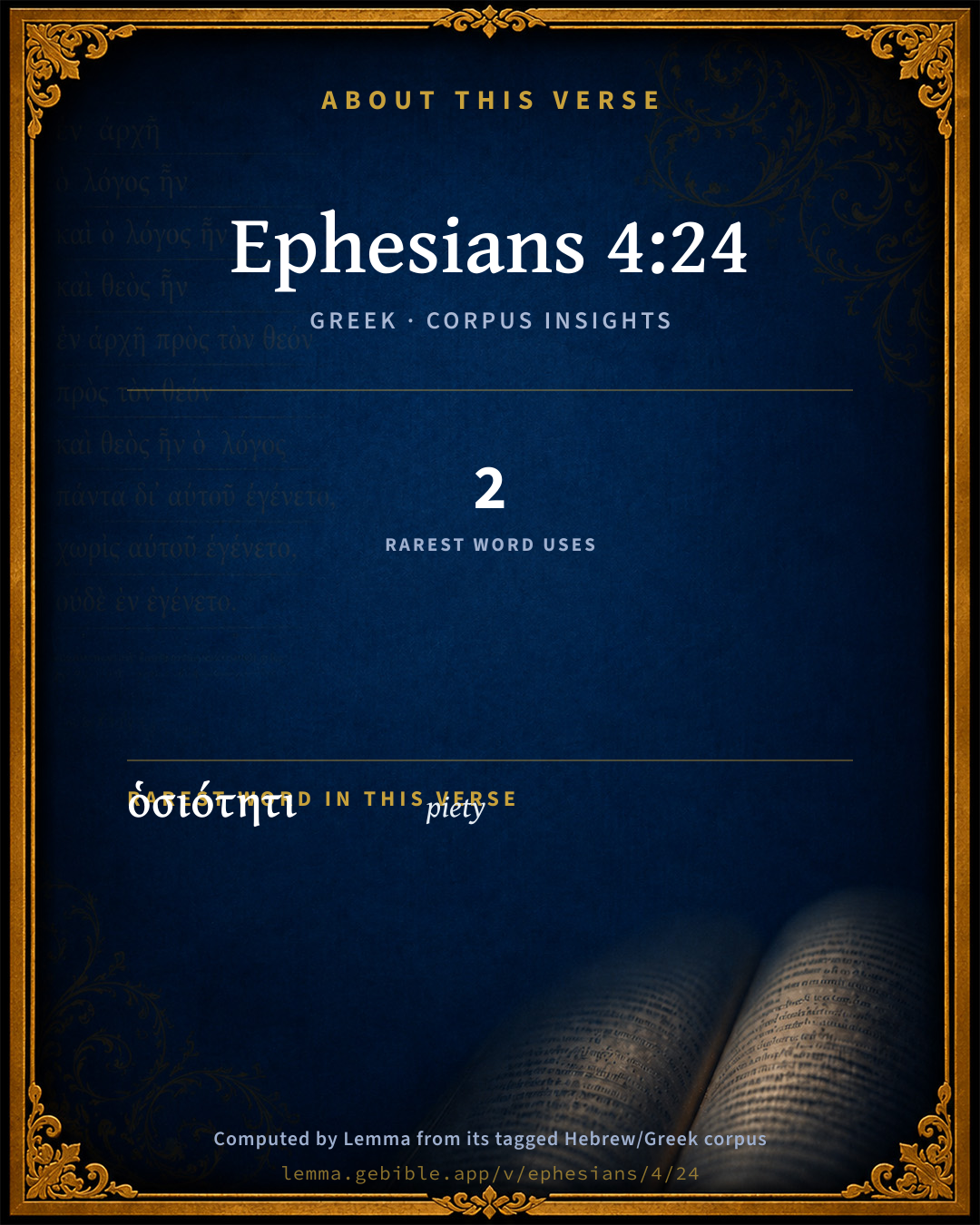
The rarest word here is ὁσιότητι piety G3742 — appearing just 2 times in the whole Greek New Testament.

Shared distinctive vocabulary

ὁσιότητι piety G3742 occurs in 2 verses of the Greek New Testament. Also found in:

Repetition

Words recur within this verse:

Cross-references

25

Topical passages linked to Ephesians 4:24 in the Treasury of Scripture Knowledge — connected by theme and wording, ordered by reader-vote popularity; previews shown in the World English Bible.

  • Colossians 3:10–14 and have put on the new man, that is being renewed in knowledge after the image of his Creator,
  • 2 Corinthians 5:17 Therefore if anyone is in Christ, he is a new creation. The old things have passed away. Behold, all things have become new.
  • Ephesians 2:10 For we are his workmanship, created in Christ Jesus for good works, which God prepared before that we would walk in them.
  • Romans 13:14 But put on the Lord Jesus Christ, and make no provision for the flesh, for its lusts.
  • Romans 6:4 We were buried therefore with him through baptism to death, that just like Christ was raised from the dead through the glory of the Father, so we also might walk in newness of life.
  • Ephesians 6:11 Put on the whole armor of God, that you may be able to stand against the wiles of the devil.
  • 2 Corinthians 3:18 But we all, with unveiled face beholding as in a mirror the glory of the Lord, are transformed into the same image from glory to glory, even as from the Lord, the Spirit.
  • Romans 13:12 The night is far gone, and the day is near. Let's therefore throw off the works of darkness, and let's put on the armor of light.
  • 2 Corinthians 4:16 Therefore we don't faint, but though our outward man is decaying, yet our inward man is renewed day by day.
  • 1 John 3:2–3 Beloved, now we are children of God, and it is not yet revealed what we will be. But we know that, when he is revealed, we will be like him; for we will see him just as he is.
  • Titus 2:14 who gave himself for us, that he might redeem us from all iniquity, and purify for himself a people for his own possession, zealous for good works.
  • 1 Peter 2:2 as newborn babes, long for the pure milk of the Word, that you may grow thereby,
  • Genesis 1:26–27 God said, "Let us make man in our image, after our likeness: and let them have dominion over the fish of the sea, and over the birds of the sky, and over the cattle, and over all the earth, and over every creeping thing that creeps on the earth."
  • John 17:17 Sanctify them in your truth. Your word is truth.
  • Romans 8:29 For whom he foreknew, he also predestined to be conformed to the image of his Son, that he might be the firstborn among many brothers.
  • Galatians 6:15 For in Christ Jesus neither is circumcision anything, nor uncircumcision, but a new creation.
  • Isaiah 52:1 Awake, awake, put on your strength, Zion; put on your beautiful garments, Jerusalem, the holy city: for henceforth there shall no more come into you the uncircumcised and the unclean.
  • Galatians 3:27 For as many of you as were baptized into Christ have put on Christ.
  • Job 29:14 I put on righteousness, and it clothed me. My justice was as a robe and a diadem.
  • 1 Corinthians 15:53 For this corruptible must put on incorruption, and this mortal must put on immortality.
  • Psalms 45:6–7 Your throne, God, is forever and ever. A scepter of equity is the scepter of your kingdom.
  • Ephesians 2:15 having abolished in the flesh the hostility, the law of commandments contained in ordinances, that he might create in himself one new man of the two, making peace;
  • Isaiah 59:17 He put on righteousness as a breastplate, and a helmet of salvation on his head; and he put on garments of vengeance for clothing, and was clad with zeal as a mantle.
  • Hebrews 1:8 but of the Son he says, "Your throne, O God, is forever and ever; The scepter of uprightness is the scepter of your Kingdom.
  • Hebrews 12:14 Follow after peace with all men, and the sanctification without which no man will see the Lord,

Cross-references courtesy of OpenBible.info (CC BY 4.0).

Commentary

Notes on Ephesians 4:24 from classic Christian and Jewish commentators (each source and its license shown beneath its notes). The classic Christian expositions comment on the surrounding passage and are grouped to its opening verse, so a note may address several verses; the Jewish commentaries on the Tanakh (Rashi and others) are per-verse, so they appear only where the commentator wrote on this verse.

Lemma curates 59 commentaries, every one of them public domain or Creative Commons licensed, each selected and text-cleaned for this edition rather than reprinted as found. About our sources →

The Biblical Illustrator

Joseph S. Exell

Eph_4:24

And that ye put on the new man, which after God is created in righteousness and true holiness.

Putting on

Observe--

I. That Christian life begins in renunciation, but does not finish there. It is a great mistake to imagine that Christian life ends with renunciation, or that renunciation constitutes the sum of that life. Great, however, as that mistake may be, it very largely prevails, and works much mischief. It is felt that Christian life is chiefly occupied with sacrifice and resistance; what we forego is the main matter, the great idea being that of renunciation throughout. Out of this negative view, constantly set forth and exaggerated, sprung great evils.

1. One unfortunate result of this view of Christian life is disappointed experiences. It is no uncommon thing to find Christian people with a sense of disappointment in the life they are striving to live; they do not experience all the satisfaction and joy the New Testament obviously promises. A lady told the present writer, that on returning from India with her little daughter, when the cliffs of England first came into view she lifted the child to catch sight of the welcome land. The child had heard much, of course, of England, of its wonderful scenes and stories, and seeing the cold coast in the grey mist, she was much disappointed and murmured, Is that England? It does not look much! No; England does not look much from that particular point of view; you must land; you must penetrate it; you must wander on the banks of the Wye, by the lakes of Cumberland, on the hills of Derbyshire; you must see the ferns and flowers of Devonshire; the gardens of Kent, the orchards of Gloucestershire, rivers, mountains, parks, landscapes, cities, cathedrals; and then England will grow upon you, and you shall acknowledge the half has not been told. Many are similarly disappointed with religion, simply because they have not gone on to realize its treasures and blessings. They have understood that Christianity means renunciation rather than appropriation; and whilst they have given up the false and base, whilst they have left the far country and returned to their fatherland, they have known little more than its grey cliffs, and feel the sense of keen disappointment. For all that we give up for Christs sake, a new world opens to us of fresh interests, activities, and pleasures, and this world we must forthwith claim and realize. We put off not that we may be found naked and comfortless, but that we may put on--put on beauty for ashes, the oil of joy for mourning, the garment of praise for the spirit of heaviness.

2. Another unhappy result of this negative view of Christian life is found in poverty of character. It is not enough that we are free from old vices; we must put new virtues in their place, equally living and bold; and we suffer when this view is not fully entertained. Carlyle has a pregnant passage on this subject: Washington is another of our perfect characters, to me a most limited uninteresting sort. The thing is not only to avoid error, but to attain immense masses of truth. There are many such as Washington--perfect characters so far that they refuse evil and avoid error, and yet limited, uninteresting, because they have not gone on to attain fulness of knowledge, depth of feeling, strength and richness of character. Simply to renounce error and evil will leave us neutral characters, without attractiveness or force; we must attain immense masses of truth, immense masses of purity, immense masses of kindness, immense masses of whatever is lovely and of good report. As in the springtime the old withered leaves are expelled by new buds and replaced by unfolding blossoms, so the old evil characteristics of our life must be rejected and supplanted by the new radiant graces and joys which spring from the Spirit of God renewing the spirit of our mind.

3. Another unhappy result of this negative view of Christian life is found in many painful lapses. The Christian life begins with renunciation, but renunciation leading to possession--possession of higher and nobler qualities and characteristics. The ground is cleared of the thorn, that the green fir tree may disport itself; of the brier, that the fragrant myrtle may fill the air with sweetness; and if the fir and myrtle do not speedily spring forth, the wild growths of the wilderness again shoot and bear their fruits of bitterness.

II. That the good of the Christian life is the assumption of sublimest character. We are to aspire to a Divine moral likeness, to be perfect, even as our Father who is in heaven is perfect. Some say they cannot believe in God, the God of the Bible, because He is only a magnified man. Well, and what special difficulty is there if that were so? What is a true man? The best we know! and that magnified can be no bad thing. What could be more admirable than the genius of Shakespeare indefinitely magnified, the charity of Howard, the righteousness of Paul, the gentleness of John? We might have the conception of a worse God than that; could we easily have a better? What about God being a magnified man, if man is first a minified God? Here is the truth: there is more of the Spirit of the Universe in us than some think. We were made in the image of God, our nature in its depths bears the likeness of God, and it is our calling to strive until we put on that glorious personality which after Gods image is created in righteousness and holiness. But where shall we acquaint ourselves with this new man, so utterly glorious and Divine? The truth for us is the truth as it is in Jesus, and all the glorious features of our great ideal are definite in Jesus Christ. (W. L. Watkinson.)

The new man

I. New thoughts. Formerly chaos; now light.

II. New motives. The glory of God and the welfare of fellow man take the place of selfish and sinful motives. Order and beauty dislodge confusion and fruitlessness.

III. New dispositions. The blood of Jesus has washed away the corrupting inclinations of the heart.

IV. New enjoyments. The surroundings are new, the experiences are also new, and consequently the heart has new joys. The new man is immortal. (The Weekly Pulpit.)

Moral renewal

I. The great purpose of the gospel is our moral renewal.

II. This moral renewal, is a creation in the image of God.

III. This new creation has to be put on and appropriated by us.

IV. The means of appropriating this new nature is contact with the truth. (Homiletic Hints.)

Spring clothing

At this season of the year many living things around us are daily putting on a new appearance. The grass, which, dining the winter, has worn the dullest green, is now putting on the brightest verdure. The shrubs, which have been clothed in raiment of leaden hue, are now putting on their beautiful garments. The trees, which put off their foliage for the dark and cold months of winter, are now again putting on their new and shiny leaves in harmony with the lengthened days and with sunny skies. Seeds and roots, which, during many weeks, have been hid in the soil, are putting off the old man of the unquickened and undeveloped state, and are putting on the new man of germ life, and of plant life, and of bloom life. The effect of all these changes around us is to produce corresponding changes in the spirits, and in the health, and in the habits of the people. This extends to things both small and great. All, who have the means, lay aside the raiment which spring suns show to be threadbare and soiled, and attire themselves in clothing which will bear the manifestation of light; while those whose poverty prevents such changes, try to make all things new, by making all things clean. The changes to which we refer in the vegetable kingdom, are the result of newness of life. Under the influence of vernal light and heat, the seed germinates, the sap rises in the shrub, and in the tree, and circulates through every branch, and bough, and stem; and the improved appearance of all things in the vegetable kingdom, is the result of an increased power of life. The changes, too, which men make at this season are partly the result of an increase in the animal spirits and in physical energy. No such changes as those we have been speaking of, pass however upon that which is artificial. The grass, and the shrubs, and the trees, in the landscape of the painter, change not with the season. The true Christian has a new man to put on. The mere formalist, like a stuffed animal, or like an artificial flower, or like a painting from the life, is now what he was in the beginning. There can be no change, no satisfactory change even in the outer life, just because there is no religious or spiritual vitality in the soul. The new man which, according to this precept, we are to put on, and which is of God, is, as the very words indicate, outside the man. The reference here is not to the inner man which God alone sees, but to the outer man, which is the only part of our being that our fellow men can see. There are precepts which require attention to the inner man, as for example, Keep thy heart with all diligence, and it is useless to attend to the outer man, unless we give first and commanding attention to the inner man; but the outer man--the character which a Christian has among his fellow Christians, and which he has in the world--is of immense moment--of such immense moment that God gives us directions like the text, Put on, He says, the new man. Now, the outside man consists, as you well know, of words, looks, demeanour, behaviour, actions, the company which a man keeps, the occupation he adopts and pursues, the connections he forms, his pleasures and recreations, and especially his habits. Well, this outside man, we say again, is of importance, for this is the only part of the man that is really seen--by his fellow men. Hereby, therefore, is the man judged, judged in the Church, and judged in the world. The influence of a man upon his fellows, and the services he renders them, are dependent entirely upon the outward life. And then, this new man is to be put on in connection with a new heart and with a renewed heart. Sometimes, when men are describing hypocrisy, or describing conduct which they resent, they say of certain behaviour, it is put on. Now there is a putting on which is of course sinful and to be deprecated, but there is a putting on which becomes a duty. The artiste in the theatre puts on a certain attire for the sake of acting, for the sake of mere play. But a man in ordinary circumstances, puts on raiment for the sake of covering, for warmth and health, for convenience and preservation of life. Now, because some clothe themselves in peculiar attire simply for the purpose of play, we do not condemn the putting on of suitable clothing for the purposes of work. Just so with reference to outward character. There is an outward character which it is the duty of every man to study. If a man neglect his outward character, he is decidedly committing sin; he is breaking such distinct and positive commandments as that which we are now considering--put on the new man. But then this new man is to be put on in connection with a new heart and with a renewed heart. Now the characteristic of the new man is, of course, godliness, and its distinctive features are righteousness and true holiness. Hence, following the text, you find the words, which after God is created in righteousness and true holiness. The apostle names some of the things in which this righteousness and true holiness consist. It is very remarkable that he should mention such things as he does here speak of. For example, he goes on to say, Putting away lying, let every man speak truth with his neighbour, for we are members one of another, recognizing truthfulness as a part of righteousness and true holiness, and lying as the opposite of righteousness and true holiness. Again we find him saving, Let him that stole steal no more, but rather let him labour, working with his hands the thing which is good, that he may have to give to him that needeth. Now, you know, brethren, that there are people who think that righteousness and true holiness consist principally in making prayers, and in coming to places of worship, and in taking the Lords Supper, and in tallying godliness and religion from morning to night; and you find that such people will lie, and they will not blush when charged with lying; you find they will Steal and even justify theft; you find they will walk in a path that many an upright worldly man will not dare to put his foot upon. Now, all these cursed opinions, with their hellish fruit, require to be driven away. People sometimes justify the retention of that which Paul calls the old man by saying, Such a thing is my habit, or my temper, or my temperament, or my constitution, or my nature; but you know this is no justification for continuance in evil. It is absurd to talk about evil feelings being your temper or temperament, or constitution, or nature; you, Christian, are a new creature, and there is a new man to put on. Others justify the repression of very much that is within them by saying I feel it, although I do not express myself. I am kind to that man in heart, but I do not show it. Look here, what does our text mean? Put on the new man. If God has changed that heart of yours, turned out the wrath and enmity, and put kindness there, you must put on the new man. It is of no use, though you may have kind feelings within, to show on the outside the angry man; you must show on the outside the kind, considerate, and compassionate man. Then, we say again, what have you in daily wear as spiritual attire? Do you speak of religious subjects in the same tone, and in the same phrases, and with no more intelligence, sagacity, and feelings, than you did, say ten years ago? Does your countenance show only as much interest in spiritual things as when you first gave heed to them? Is your walk through life upon the same incline as when you first moved heavenward? (S. Martin, D. D.)

The Biblical Illustrator, edited by Joseph S. Exell (c. 1880s–1900s) — public domain. Text from a community e-Sword module.

MacLaren's Expositions of Holy Scripture

Alexander MacLaren

EPHESIANS

THE NEW MAN

Eph 4:24

We had occasion to remark in a former sermon that Paul regards this and the preceding clauses as the summing up of ‘the truth in Jesus’; or, in other words, he considers the radical transformation and renovation of the whole moral nature as being the purpose of the revelation of God in Christ. To this end they have ‘heard Him.’ To this end they have ‘learned Him.’ To this end they have been ‘taught in Him,’ receiving, by union with Him, all the various processes of His patient discipline. This is the inmost meaning of all the lessons in that great school in which all Christians are scholars, and Christ is the teacher and the theme, and union to Him the condition of entrance, and the manifold workings of His providence and His grace the instruments of training, and heaven the home when school time is over-that we should become new men in Christ Jesus.

This great practical issue is set forth here under three aspects-one negative, two positive. The negative process is single and simple-’put off the old man.’ The positive is double-a spiritual ‘renewal’ effected in our spirits, in the deep centre of our personal being, by that Divine Spirit who, dwelling in us, is ‘the spirit of our minds’; and then, consequent upon that inward renewal, a renovation of life and character, which is described as being the ‘putting on,’ as if it were a garment, of ‘the new man,’ created by a divine act, and consisting in moral and spiritual likeness to God. It is not necessary to deal, except incidentally, with the two former, but I desire to consider the last of these-the putting on of the new man-a little more closely, and to try to bring out the wealth and depth of the Apostle’s words in this wonderful text.

The ideas contained seem to me in brief to be these-the great purpose of the Gospel is our moral renewal; that moral renewal is a creation after God’s image; that new creation has to be put on or appropriated by us; the great means of appropriating it is contact with God’s truth. Let us consider these points in order.

I. The great purpose of the Gospel is our moral renewal; ‘the new man ... created in righteousness and ... holiness.’

Now, of course, there are other ways of stating the end of the Gospel. This is by no means an exhaustive setting forth of its purpose. We may say that Christ has come in order that men may know God. We may say that He comes in order that the Divine Love, which ever delights to communicate, may bestow itself, and may conceive of the whole majestic series of acts of self-revelation from the beginning as being-if I may so say-for the gratification of that impulse to impart itself, which is the characteristic of love in God and man. We may say that the purpose of the whole is the deliverance of men from the burden and guilt of sin. But whether we speak of the end of the Gospel as the glory of God, or the blessedness of man, or as here, as being the moral perfection of the individual or of the race, they are all but various phrases of the one complete truth. The Gospel is the consequence and the manifestation of the love of God, which delights to be known and possessed by loving souls, and being known, changes them into its own likeness, which to know is to be happy, which to resemble is to be pure.

The first thing that strikes me about this representation of our text is the profound sense of human sinfulness which underlies it.

The language is utterly unmeaning-or at all events grossly exaggerated-unless all have sinned, and the nature which belongs to men universally, apart from the transforming power of Christ’s Spirit, be corrupt and evil. And that it is so is the constant view of Scripture. The Bible notion of what men need in order to be pure and good is very different from the superficial notions of worldly moralists and philanthropists. We hear a great deal about ‘culture,’ as if all that were needed were the training and strengthening of the nature, as if what was mainly needed was the development of the understanding. We hear about ‘reformation’ from some who look rather deeper than the superficial apostles of culture. And how singularly the very word proclaims the insufficiency of the remedy which it suggests! ‘Re-formation’ affects form and not substance. It puts the old materials into a new shape. Exactly so-and much good may be expected from that! They are the old materials still, and it matters comparatively little how they are arranged. It is not re-formation, but re-novation, or, to go deeper still, re-generation, that the world needs; not new forms, but a new life; not the culture and development of what it has in itself, but extirpation of the old by the infusion of something now and pure that has no taint of corruption, nor any contact with evil. ‘Verily, I say unto you, ye must be born again.’

All slighter notions of the need and more superficial diagnoses of the disease lead to a treatment with palliatives which never touch the true seat of the mischief, The poison flowers may be plucked, but the roots live on. It is useless to build dykes to keep out the wild waters. Somewhere or other they will find a way through. The only real cure is that which only the Creating hand can effect, who, by slow operation of some inward agency, can raise the level of the low lands, and lift them above the threatening waves. What is needed is a radical transformation, going down to the very roots of the being; and that necessity is clearly implied in the language of this text, which declares that a nature possessing righteousness and holiness is ‘a new man’ to be ‘put on’ as from without, not to be evolved as from within.

It is to be further noticed what the Apostle specifies as the elements, or characteristics of this new nature-righteousness and holiness.

The proclamation of a new nature in Christ Jesus, great and precious truth as it is, has often been connected with teaching which has been mystical in the bad sense of that word, and has been made the stalking horse of practical immorality. But here we have it distinctly defined in what that new nature consists. There is no vague mystery about it, no tampering with the idea of personality. The people who put on the new man are the same people after as before. The newness consists in moral and spiritual characteristics. And these are all summed up in the two-righteousness and holiness. To which is added in the substantially parallel passage in Colossians, ‘Renewed in knowledge after the image of Him that created Him,’ where, I suppose, we must regard the ‘knowledge’ as meaning that personal knowledge and acquaintance which has its condition in love, and is the foundation of the more purely moral qualities of which our text speaks.

Is there, then, any distinction between these two? I think there is very obviously so. ‘Righteousness’ is, I suppose, to be understood here in its narrower meaning of observance of what is right, the squaring of conduct according to a solemn sovereign law of duty. Substantially it is equivalent to the somewhat heathenish word ‘morality,’ and refers human conduct and character to a law or standard. What, then, is ‘holiness’? It is the same general conduct and character, considered, however, under another aspect, and in another relation. It involves the reference of life and self to God, consecration to, and service of Him. It is not a mere equivalent of purity, but distinctly carries the higher reference. The obedience now is not to a law but to a Lord. The perfection now does not consist in conformity to an ideal standard, but in likeness and devotion to God. That which I ought to do is that which my Father in heaven wills. Or, if the one word may roughly represent the more secular word ‘morality,’ the other may roughly represent the less devout phrase, ‘practical religion.’

These are ‘new,’ as actually realised in human nature. Paul thinks that we shall not possess them except as a consequence of renovation. But they are not ‘new’ in the sense that the contents of Christian morality are different from the contents of the law written on men’s hearts. The Gospel proclaims and produces no fantastic ethics of its own. The actions which it stamps in its mint are those which pass current in all lands-not a provincial coinage, but recognised as true in ring, and of full weight everywhere. Do not fancy that Christian righteousness is different from ordinary ‘goodness,’ except as being broader and deeper, more thorough-going, more imperative. Divergences there are, for our law is more than a republication of the law written on men’s hearts. Though the one agrees with the other, yet the area which they cover is not the same. The precepts of the one, like some rock-hewn inscriptions by forgotten kings, are weathered and indistinct, often illegible, often misread, often neglected. The other is written in living characters in a perfect life. It includes all that the former attempts to enjoin, and much more besides. It alters the perspective, so to speak, of heathen morals, and brings into prominence graces overlooked or despised by them. It breathes a deeper meaning and a tenderer beauty into the words which express human conceptions of virtue, but it does take up these into itself. And instead of setting up a ‘righteousness’ which is peculiar to itself, and has nothing to do with the world’s morality, Christianity says, as Christ has taught us, ‘Except your righteousness exceed the righteousness of the scribes and Pharisees, ye shall not enter into the kingdom of God.’ The same apostle who here declares that actual righteousness and holiness are new things on the earth, allows full force to whatsoever weight may be in the heathen notion of ‘virtue,’ and adopts the words and ideas which he found ready made to his hands, in that notion-as fitly describing the Christian graces which he enjoined. Grecian moralists supplied him with the names true, honest, just, and pure. His ‘righteousness’ accepted these as included within its scope. And we have to remember that we are not invested with that new nature, unless we are living in the exercise of these common and familiar graces which the consciences and hearts of all the world recognise for ‘lovely’ and ‘of good report,’ hail as ‘virtue,’ and crown with ‘praise.’

So, then, let me pause here for a moment to urge you to take these thoughts as a very sharp and salutary test. You call yourselves Christian people. The purpose of your Christianity is your growth and perfecting in simple purity, and devotion to, and dependence on, our loving Father. Our religion is nothing unless it leads to these. Otherwise it is like a plant that never seeds, but may bear some feeble blossoms that drop shrunken to the ground before they mature. To very many of us the old solemn remonstrance should come with awakening force-’Ye did run well, what did hinder you?’ You have apprehended Christ as the revealer and bringer of the great mercy of God, and have so been led in some measure to put your confidence in Him for your salvation and deliverance. But have you apprehended Him as the mould into which your life is to be poured, that life having been made fluent and plastic by the warmth of His love? You have apprehended Him as your refuge; have you apprehended Him as your inward sanctity? You have gone to Him as the source of salvation from the guilt and penalties of sin; have you gone to Him, and are you daily growing in the conscious possession of Him, as the means of salvation from the corruption and evil of sin? He comes to make us good. What has He made you? Anything different from what you were twenty years ago? Then, if not, and in so far as you are unchanged and unbettered, the Gospel is a failure for you, and you are untrue to it. The great purpose of all the work of Christ-His life, His sorrows, His passion, His resurrection, His glory, His continuous operation by the Spirit and the word is to make new men who shall be just and devout, righteous and holy.

II. A second principle contained in these words, is that this moral Renewal is a Creation in the image of God.

The new man is ‘created after the image of God’-that is, of course, according to or in the likeness of God. There is evident reference here to the account of man’s creation in Genesis, and the idea is involved that this new man is the restoration and completion of that earlier likeness, which, in some sense, has faded out of the features and form of our sinful souls. It is to be remembered, however, that there is an image of God inseparable from human nature, and not effaceable by any obscuring or disturbance caused by sin. Man’s likeness to God consists in his being a person, possessed of a will and self-consciousness, and that mysterious gift of personality abides whatever perishes. But beyond that natural image of God, as we may call it, there is something else which fades wholly with the first breath of evil, like the reflexion of the sky on some windless sea. The natural likeness remains, and without it no comparison would be possible. We should not think of saying that a stone or an eagle were unlike God. But while the personal being makes comparison fitting, what makes the true contrast? In what respect is man unlike God? In moral antagonism. What is the true likeness? Moral harmony. What separates men from their Father in heaven? Is it that His ‘years are throughout all generations,’ and ‘my days are as an handbreadth’? Is it that His power is infinite, and mine all thwarted by other might and over tending to weakness and extinction? Is it that His wisdom, sunlike, waxes not nor wanes, and there is nothing hid from its beams, while my knowledge, like the lesser light, shines by reflected radiance, serves but to make the night visible, and is crescent and decaying, changeful and wandering? No. All such distinctions based upon what people call the sovereign attributes of God-the distinctions of creator and created, infinite and finite, omnipotent and weak, eternal and transient-make no real gulf between God and man. If we have only to say, ‘As the heavens are higher than the earth, so are’ His ‘ways higher than’ our ‘ways,’ that difference is not unlikeness, and establishes no separation; for low and flat though the dull earth be, does not heaven bend down round it, and send rain and sun, dew and blessing? But it is because ‘your ways are not as my ways’-because there is actual opposition, because the directions are different-that there is unlikeness. The image of God lies not only in that personality which the ‘Father of Lies’ too possesses, but in ‘righteousness and holiness.’

But besides this reference to the original creation of man, there is another reason for the representation of the new nature as being a work of divine creative power. It is in order to give the most emphatic expression possible to the truth that we do not make our righteousness for ourselves, but receive it as from Him. The new man is not our work, it is God’s creation. As at the beginning, the first human life is represented as not originated in the line of natural cause and effect, but as a new and supernatural commencement, so in every Christian soul the life which is derived from God, and will unfold itself in His likeness, comes from His own breath inbreathed into the nostrils. It too is out of the line of natural causes. It too is a direct gift from God. It too is a true supernatural being-a real and new creation.

May I venture a step further? ‘The new man’ is spoken of here as if it had existence ere we ‘put it on.’ I do not press that, as if it necessarily involved the idea which I am going to suggest, for the peculiar form of expression is probably only due to the exigencies of the metaphor. Still it may not be altogether foreign to the whole scope of the passage, if I remind you that the new man, the true likeness of God, has, indeed, a real existence apart from our assumption of it. Of course, the righteousness and holiness which make that new nature in me have no being till they become mine. But we believe that the righteousness and holiness which we make ours come from another, who bestows them on us. ‘The new man’ is not a mere ideal, but has a historical and a present existence. The ideal has lived and lives, is a human person, even Jesus Christ the express image of the Father, who is the beginning of the new creation, who of God is made unto us wisdom and righteousness. That fair vision of a humanity detached from all consequences of sin, renewed in perfect beauty, stainless and Godlike, is no unsubstantial dream, but a simple fact. He ever liveth. His word to us is, ‘I counsel thee to buy of me-white raiment.’ And a full parallel to the words of our text, which bid us ‘put on the new man, created after God in righteousness and holiness,’ is found in the other words of the same Apostle-’Let us cast off the works of darkness, and let us put on the armour of light. Put ye on the Lord Jesus Christ.’

In accordance with this-

III. It is further to be noticed that this new creation has to be put on and appropriated by us.

The same idea which, as I have already remarked, is conveyed by the image of a new creation, is reiterated in this metaphor of putting on the new nature, as if it were a garment. Our task is not to weave it, but to wear it. It is made and ready.

And that process of assumption or putting on has two parts. We are clothed upon with Christ in a double way, or rather in a double sense. We are ‘found in Him not having our own righteousness,’ but invested with His for our pardon and acceptance. We are clothed with His righteousness for our purifying and sanctifying.

Both are the conditions of our being like God. Both are the gifts of God. The one, however, is an act; the other a process. Both are received. The one is received on condition of simple faith; the other is received by the medium of faithful effort. Both are included in the wide conception of salvation, but the law for the one is ‘Not by works of righteousness which we have done, but by His mercy He saved us’; and the law for the other is-’Work out your own salvation with fear and trembling.’ Both come from Christ, but for the one we have the invitation, ‘Buy of Me white raiment that thou mayest be clothed’; and for the other we have the command, ‘Put on the Lord Jesus Christ, and make not provision for the flesh.’ There is the assumption of His righteousness which makes a man a Christian, and has for its condition simple faith. There is the assumption of His righteousness sanctifying and transforming us which follows in a Christian course, as its indispensable accompaniment and characteristic, and that is realised by daily and continuous effort.

And one word about the manner, the effort as set forth here; twofold, as I have already pointed out-a negative and positive. We are not concerned here with the relations of these amongst themselves, but I may remark that there is no growth in holiness possible without the constant accompanying process of excision and crucifixion of the old. If you want to grow purer and liker Christ, you must slay yourselves. You cannot gird on ‘righteousness’ above the old self, as some beggar might buckle to himself royal velvet with its ermine over his filthy tatters. There must be a putting off in order to and accompanying the putting on. Strip yourselves of yourselves, and then you ‘shall not be found naked,’ but clothed with the garments of salvation, as the bride with the robe which is the token of the bridegroom’s love, and the pledge of her espousals to him.

And let nobody wonder that the Apostle here commands us, as by our own efforts, to put on and make ours what is in many other places of Scripture treated as God’s gift. These earnest exhortations are perfectly consistent with the belief that all comes from God. Our faithful adherence to our Lord and Master, our honest efforts in His strength to secure more and more of His likeness, determine the extent to which we shall possess that likeness. The new nature is God’s gift, and it is given to us according to His own fulness indeed, but also according to the measure of our faith. Blessed be His name! we have nothing to do but to accept His gift. The garment with which He clothes our nakedness and hides our filth is woven in no earthly looms. As with the first sinful pair, so with all their children since, ‘the Lord God made them’ the covering which they cannot make for themselves. But we have to accept it, and we have by daily toil, all our lives long, to gather it more and more closely around us, to wrap ourselves more and more completely in its ample folds. We have by effort and longing, by self-abnegation and aspiration, by prayer and work, by communion and service, to increase our possession of that likeness to God which lives in Jesus Christ, and from Him is stamped ever more and more deeply on the heart. For the strengthening of our confidence and our gratitude, we have to remember with lowly trust that it is true of us, ‘If any man be in Christ he is a new creature.’ For the quickening of our energy and faithful efforts we have to give heed to the command, and fulfil it in ourselves-’Be ye renewed in the Spirit of your minds, and put on the new man.’

IV. And, finally, the text contains the principle that the means of appropriating this new nature is contact with the truth.

If you will look at the margins of some Bibles you will see that our translators have placed there a rendering, which, as is not unfrequently the case, is decidedly better than that adopted by them in the text. Instead of ‘true holiness,’ the literal rendering is ‘holiness of truth’-and the Apostle’s purpose in the expression is not to particularise the quality, but the origin of the ‘holiness.’ It is ‘of truth,’ that is, produced by the holiness which flows from the truth as it is in Jesus, of which he has been speaking a moment before.

And we come, therefore, to this practical conclusion, that whilst the agent of renovation is the Divine Spirit, and the condition of renovation is our cleaving to Christ, the medium of renovation and the weapon which transforming grace employs is ‘the word of the truth of the Gospel’ whereby we are sanctified. There we get the law, and there we get the motive and the impulse. There we get the encouragement and the hope. In it, in the grand simple message-’God was in Christ, reconciling the world unto Himself, not imputing their trespasses unto them,’ lie the germs of all moral progress. And in proportion as we believe that-not with the cold belief of our understandings, but with the loving affiance of our hearts and our whole spiritual being-in proportion as we believe that, in that proportion shall we grow in ‘knowledge,’ shall we grow in ‘righteousness,’ in the ‘image of Him that created us.’ The Gospel is the great means of this change, because it is the great means by which He who works the change comes near to our understandings and our hearts.

So let us learn how impossible are righteousness and holiness, morality and religion in men, unless they flow from this source. It is the truth that sanctifies. It is the Spirit who wields that truth who sanctifies. It is Christ who sends the Spirit who sanctifies. But, brethren, beyond the range of this light is only darkness, and that nature which is not cleansed by His priestly hand laid upon it remains leprous, and he who is clothed with any other garment than His righteousness will find ‘the covering narrower than that he can wrap himself in it.’ And let us learn, on the other hand, the incompleteness and monstrosity of a professed belief in ‘the truth’ which does not produce this righteousness and holiness. It may be real-God forbid that we should step into His place and assume His office of discerning the thoughts of the heart, and the genuineness of Christian professions! But, at any rate, it is no exaggeration nor presumption to say that a professed faith which is not making us daily better, gentler, simpler, purer, more truthful, more tender, more brave, more self-oblivious, more loving, more strong-more like Christ-is wofully deficient either in reality or in power-is, if genuine, ready to perish-if lit at all, smouldering to extinction. Christian men and women! is ‘the truth’ moulding you into Christ’s likeness? If not, see to it whether it be the truth which you are holding, and whether you are holding the truth or have unconsciously let it slip from a grasp numbed by the freezing coldness of the world.

And for us all, let us see that we lay to heart the large truths of this text, and give them that personal bearing without which they are of no avail. I need renovation in my inmost nature. Nothing can renew my soul but the power of Christ, who is my life. I am naked and foul. Nothing can cleanse and clothe me but He. The blessed truth which reveals Him calls for my individual faith. And if I put my confidence in that Lord, He will dwell in my inmost spirit, and so sway my affections and mould my will that I shall be transformed unto His perfect likeness. He begins with each one of us by bringing the best robe to cast over the rags of the returning prodigal. He ends not with any who trust Him, until they stand amid the hosts of the heavens who follow Him, clothed with fine linen clean and white, which is the righteousness of His Holy ones.

Alexander MacLaren, Expositions of Holy Scripture (1904–1910) — public domain. Text from a community e-Sword module.

Tyndale Open Study Notes

Tyndale Open Resources

4:24 A believer has a new nature: God’s Spirit expresses his life within the believer (see Col 3:10; cp. Gen 1:26; Rom 12:1-2; Gal 5:22-23). The transforming work of God’s Spirit is part of the gift of salvation (Eph 2:8-10).

Tyndale Open Study Notes — © Tyndale Open Resources, licensed CC BY-SA 4.0. Text via the HelloAO Bible API.

Bengel's Gnomon

Johann Albrecht Bengel

Eph 4:24. Τὸν καινὸν) Τὸν νέον is used, Col 3:10, of that which is native [the new man becomes natural, i.e. the true nature] in believers; but here ἀνανεοῦσθαι has been used by him just before. [Therefore he does not repeat νέον, the conjugate]. Vice versa in the passage of Col. just quoted, ἀνακαινούμενον is subjoined [νέον having gone just before] concerning the aims and pursuits of believers.[69]—κτισθέντα, which has been created) at the beginning of Christianity. This new man is created in Christ: comp. ch. Eph 2:10.

[69] Νέος, recent, lately originated, in opposition to what was originated some time back. Καινὸς, new, not yet used, in opposition to that which has existed long and been in use: νέον οἶνον, but καινοὺς ἀσκούς, Mat 9:16-17. So νέος ἄνθρωπος in Col. refers to the ἀναγέννησις, whereas the καινος is one who differs from the former man: the νέος is one who is ἀνακαινούμενος κατʼ εικονα of God.—Tittm. Syn. Gr. Test. Καινὸς more applied to the results of renewal on the Christian character and walk. Νέος, the new nature of believers. Νέος is applied to persons in the sense young, which καινὸς is not. Καινὸς is what is fresh, as opposed to what is worn and trite. It is also said of what is strange and foreign.—ED.

Bengel's Gnomon of the New Testament — English translation (T&T Clark, Edinburgh, 1860) — public domain. Text from a community e-Sword module.

Meyer's Critical & Exegetical Commentary

Heinrich August Wilhelm Meyer

Eph_4:24. Observe the change of tenses. The laying aside of the old man is the negative commencement of the change, and hence is represented as a momentary act; the becoming renewed is an enduring process, the finishing act of which is the putting on of the new man, correlative to the ἀποθέσθαι,. Hence ἀποθέσθαι, aorist; ἀνανεοῦσθαι, present; ἐνδύσασθαι, aorist.

τὸν καινὸν ἄνθρωπον] As previously the old immoral state is objectivized, and objectivized indeed as a person, so is it also here with the new Christian moral state. Thus this new habitus appears as the new man, which God has created (κτισθέντα), but man appropriates for himself (ἐνδύσασθαι), so that thus moral freedom is not annulled by Gods ethical creative action.

κτισθέντα] not present, but the new moral habitus of the Christian is set forth as the person created by God, which in the individual cases is not first constituted by growth, but is received, and then exhibits itself experimentally in the case of those who, according to the figurative expression of the passage, have put it on.

κατὰ Θεόν] Comp. Col_3:10; not merely divinely, and that in contrast to human propagation (Hofmann, Schriftbew. I. p. 289), but: according to God, i.e. ad exemplum Dei (Gal_4:28). Thereby the creation of the new man is placed upon a parallel with that of our first parents (Gen_1:27), who were created after Gods image (κατʼ εἰκόνα τοῦ κτίσαντος, Col_3:10); they, too, until through Adam sin came into existence, were as sinless ἐν δικαιοσύνῃ καὶ ὁσιότητι τῆς ἀληθείας.[243]

ἘΝ ΔΙΚΑΙΟΣΎΝῌ Κ.Τ.Λ.] belongs to ΤῸΝ ΚΑΤᾺ ΘΕῸΝ ΚΤΙΣΘΈΝΤΑ, expressing the constitution of the new man created after God; furnished, provided with rectitude and holiness of the truth (on ἐν, see Matthiae, p. 1340). The truth is the opposite of the ἀπάτη, Eph_4:22 and like this personified. As in the old man the ἈΠΆΤΗ pursues its work, so in the new man the ἈΛΉΘΕΙΑ, i.e. the Truth κατʼ ἐξοχήν, the divine evangelical truth, bears sway, and the moral effects of the truth, righteousness and holiness, appear here, where the truth is personified, as its attributes, which now show themselves in the new man who has been created. The resolving it into an adjective: true, not merely apparent, righteousness and holiness (Chrysostom, Luther, Castalio, Beza, Calvin, Grotius, and most expositors), is arbitrary and tame. And to take ἐν instrumentally (Morus, Flatt) is erroneous, for the reason that righteousness and holiness form the ethical result of the creation of the new man; hence Beza, Koppe, and others thought that ἐν must be taken for ΕἸς. ΔΙΚΑΙΟΣΎΝΗ and ὉΣΙΌΤΗς (comp. Luk_1:75; 1Th_2:10; Tit_1:8) are distinguished so, that the latter places rectitude in itself (ΔΙΚΑΙΟΣΎΝΗ), in relation to God (sanctitas); τὸ μὲν τοῖς θεοῖς προσφιλὲς ὅσιον, Plat. Euth. p. 6 E. See Tittmann, Synon. p. 25, and the passages in Wetstein. With special frequency the two notions are associated in Plato.

[243] Comp. Ernesti, Ursprung der Sünde, II. p. 135 ff., in opposition to Julius Müller, II. p. 487, who calls in question the identity of contents between the κατὰ θεόν and the original divine image.

Meyer — Critical and Exegetical Commentary on the New Testament — English translation by Peter Christie, edited by Frederick Crombie (T&T Clark, 1880) — public domain. Text from a community e-Sword module.

Expositor's Greek Testament

ed. W. Robertson Nicoll

Eph 4:24 . καὶ ἐνδύσασθαι τὸν καινον ἄνθρωπον : and put on the new man . For ἐνδύσασθαι the imper. ἐνδύσασθε is read by some authorities of consequence ( [448] [449] [450] 1 [451] 2 , etc.). The aor. is appropriately used again, as before in Eph 4:22 ; “putting off” and “putting on” being acts, while renewal ( ἀνανεοῦσθαι ) is a process. For καινὸς ἄνθρωπος see on Eph 2:15 above. τὸν κατὰ Θεὸν κτισθέντα : which after God was created . The aor. κτισθέντα suggests that the “new man” is regarded here not as a nature created anew for the individual, but as “the holy form of human life which results from redemption,” created once for all in and by Christ, and participated in by the individual convert. (See Ell., in loc. , and Müller, Christ. Doctr. of Sin , ii., p. 392). The phrase κατὰ Θεόν has sometimes the simple sense of “godly,” “in a godly manner” (2Co 7:9-11 ). Hence it is held by some to mean nothing more here than created “divinely” (Hofm.) or “according to the will of God” (Abb.). But κατά is also used to express likeness (1Ki 11:10 ; Heb 8:8 ; Gal 4:28 ; 1Pe 1:15 ; 1Pe 4:6 ). Here, therefore, it may mean “like God” or “after the image of God”. That this is the sense is confirmed by the use of κτισθέντα (which recalls Gen 1:27 ), and by the fuller parallel statement in Col 3:10 : τὸν νεὸν , τὸν ἀνακαινούμενον εἰς ἐπίγνωσιν κατʼ εἰκόνα τοῦ κτίσαντος αὐτόν . The clause, therefore, affirms a new creation of man, and describes that creation as being according to the image or likeness of God. It neither states nor suggests, however, that the image of God in which man was first created was lost and has been restored in Christ. What it does state is simply that this second creation, like the first, was in conformity with the Divine likeness or after the example of what God is. ἐν δικαιοσύνῃ καὶ ὁσιότητι τῆς ἀληθείας : in righteousness and holiness of the truth . For τῆς ἀληθείας some few authorities give καὶ ἀληθείᾳ ( [452] 1 [453] , Cypr., Hil., etc.). This clause specifies the things in which the new man was created and in which the likeness between him and God consisted. ἐν , therefore denotes the quality or ethical condition in which the creation realised itself. δικαιοσύνη and ὀσιότης are coupled again in Luk 1:75 ( cf. also Wis 9:3 ; Clem. Rom., First Corinthians , xlviii., 4). Plato distinguishes in two ways between the idea of δίκαιος and that of ὅσιος . He defines δίκαιος as the generic term and ὅσιος as the specific ( Euthyp. , p. 12 E); and he describes the former as having regard to our relations to men , the latter to our relations to God ( Gorg. , p. 507 B). The latter distinction is also given by other Greek writers (Polyb., xxiii., 10, 8, etc.). It is not easy, indeed, to say how far this distinction holds good in the NT. But both in profane and in biblical Greek the two words, adjective, adverb or noun, are often combined in one statement ( e.g. , Plato, Protag. , 329 C; Theaet. , 176 B; Rep. , x., 615 B; Laws , ii., 663 B; Joseph., Antiq. , viii., 9, 1; Luk 1:75 ; 1Th 2:10 ; Tit 1:8 ). In many of these cases the distinction between integrity and piety is certain, and it is suitable to all. The NT also clearly distinguishes between δίκαιος and εὐλαβής (Luk 2:25 ). It may be said, therefore, that δικαιοσύνη and ὁσιότης are not used vaguely or interchangeably, but that, while both are of grace and both consequently have a new meaning Godward, the former expresses the right conduct of the Christian man more distinctively in its bearings on his fellow-men, and the latter the same conduct distinctively in its relation to God. τῆς ἀληθείας is not to be reduced to “true holiness” as in AV, but is to be taken as the gen. of origin and as qualifying both nouns. Further, ἀλήθεια with the article, contrasting with τῆς ἀπάτης of Eph 4:22 , seems to be more than Truth in the abstract or a quasi-personification of Truth. It may mean “ the truth” par excellence , the evangelical message, the objective truth given in the Gospel ( ἡ ἀλήθεια τοῦ εὐαγγελίου , Gal 2:5 ; Gal 2:14 ; or simply, as here, ἡ ἀλήθεια , Joh 8:32 ; Joh 8:40 ; Joh 17:19 ; Gal 5:7 ; 2Co 4:2 ; 2Co 13:8 , etc.). The creation of the new man in the Divine likeness realises itself, therefore, in something better than the ceremonial rectitude of the Jew or the self-contained virtue of the heathen in a righteousnes and a holiness born of the new truth contained in the Evangel.

[448] Codex Sinaiticus (sæc. iv.), now at St. Petersburg, published in facsimile type by its discoverer, Tischendorf, in 1862.

[449] Codex Mosquensis (sæc. ix.), edited by Matthæi in 1782.

[450] Codex Vaticanus (sæc. iv.), published in photographic facsimile in 1889 under the care of the Abbate Cozza-Luzi.

[451] Codex Claromontanus (sæc. vi.), a Græco-Latin MS. at Paris, edited by Tischendorf in 1852.

[452] Codex Claromontanus (sæc. vi.), a Græco-Latin MS. at Paris, edited by Tischendorf in 1852.

[453] Codex Boernerianus (sæc. ix.), a Græco-Latin MS., at Dresden, edited by Matthæi in 1791. Written by an Irish scribe, it once formed part of the same volume as Codex Sangallensis ( δ ) of the Gospels. The Latin text, g, is based on the O.L. translation.

The Expositor's Greek Testament, edited by W. Robertson Nicoll (1897–1910) — public domain. Text from a community e-Sword module.

Hodge's Commentary on Romans, Ephesians & First Corinthians

Charles Hodge

Eph_4:24

Καὶ ἐνδύσασθαι τὸν καινὸν ἆνθρωπον, and that ye put on the new man. As we are called to put off our corrupt nature as a ragged and filthy garment, so we are required to put on our new nature as a garment of light. And as the former was personified as an old man, decrepit, deformed, and tending to corruption so the latter is personified as a new man, fresh, beautiful, and vigorous, like God, for it is τὸν κατὰ θεὸν κτισθέντα, κτλ., after God created in righteousness and holiness of the truth. In the parallel passage it is said to be renewed after the image of God, Col_3:10. After God, therefore, means after his image. That in which this image consists is said to be righteousness and holiness. The former of these words, δικαιοσύνῃ, when it stands alone often includes all the forms of moral excellence; but when associated with ὁσιότης, the one means rectitude, the being or doing right; and the other, holiness. The one renders us just to our neighbors; the other, pious towards God. The two substantives are united in Luk_1:75; the adjectives, just and holy, in Tit_1:8; and the adverbs holily and justly, in 1Th_2:10. The Greeks made the same distinction, πρὸς θεούς ὅσιον καί πρὸς ἀνθρώπους ἐστι. In our version this clause is rendered, in righteousness and true holiness; but the word ἀληθείας stands in the same relation to both nouns, and if taken as a mere qualifying genitive the translation should be, in true righteousness and holiness. Most modern commentators, however, consider the truth here as opposed to the deceit spoken of in Eph_4:22. Righteousness and holiness of the truth would then mean that righteousness and holiness which the truth has, or which the truth produces. If the principle of indwelling sin is there personified as ἀμάτη, deceit, producing and exercising those lusts which lead to destruction; the principle of spiritual life is here personified ἀληθείας, truth, which produces righteousness and holiness. Truth is spiritual knowledge, that knowledge which is eternal life, which not only illuminates the understanding but sanctifies the heart. The Holy Ghost is called the Spirit of truth as the author of this divine illumination which irradiates the whole soul. This truth came by Jesus Christ, Joh_1:17. He is the truth and the life, Joh_14:6. We are made free by the truth, and sanctified by the truth. The Gospel is called the word of truth, as the objective revelation of that divine knowledge which subjectively is the principle of spiritual life. Taking the word in this sense, the passage is brought into nearer coincidence with the parallel passage in Col_3:10. Here the image of God is said to consist in righteousness and holiness of the truth; there it is said to consist in knowledge. The new man is renewed unto knowledge after the image of him that created him. These passages differ only in that one is more concise than the other. Knowledge (the ἐπίγνωσις τοῦ Θεοῦ) includes righteousness, holiness, and truth. Nothing, therefore, can be more contrary to Scripture than to undervalue divine truth, and to regard doctrines as matters pertaining merely to the speculative understanding. Righteousness and holiness, morality and religion, are the products of the truth, without which they cannot exist.

This passage is of special doctrinal importance, as teaching us the true nature of the image of God in which man was originally created. That image did not consist merely in mans rational nature, nor in his immortality, nor in his dominion, but specially in that righteousness and holiness, that rectitude in all his principles, and that susceptibility of devout affections which are inseparable from the possession of the truth, or true knowledge of God. This is the scriptural view of the original state of man, or of original righteousness, as opposed, on the one hand, to the Pelagian theory that man was created without moral character; and on the other, to the Romish doctrine, that original righteousness was a supernatural endowment not belonging to mans nature. Knowledge, and consequently righteousness and holiness, were immanent or concreated in the first man, in the same sense as were his sense of beauty and susceptibility of impression from the external world. He opened his eyes and saw what was visible, and perceived its beauty; he turned his mind on God, perceived his glory, and was filled with all holy affections.

Charles Hodge — Commentary on Romans (1835), First Corinthians (1857), and Ephesians (1856) — public domain. Text from a community e-Sword module.

Geneva Bible (1599)

Geneva Bible translators

After the image of God.

Not fained nor counterfeit.

The effect and end of the new creation.

Geneva Bible (1599) marginal notes — public domain. Text via Bolls.life.

Jamieson, Fausset & Brown

Robert Jamieson, A. R. Fausset & David Brown

put on the new man--Opposed to "the old man," which is to be "put off" (Eph 4:22). The Greek here (kainon) is different from that for "re-new-ed" (Eph 4:23). Put on not merely a renovated nature, but a new, that is, altogether different nature, a changed nature (compare Note,, see on Col 3:10).

after God, &c.--Translate, "Which hath been created (once for all: so the Greek aorist means: in Christ, Eph 2:10; so that in each believer it has not to be created again, but to be put on) after (the image of) God" (Gen 1:27; Col 3:10; Pe1 1:15), &c. God's image in which the first Adam was originally created, is restored, to us far more gloriously in the second Adam, the image of the invisible God (Co2 4:4; Col 1:15; Heb 1:3).

in righteousness--"IN" it as the element of the renewed man.

true holiness--rather, as the Greek, "holiness of the truth"; holiness flowing from sincere following of "the truth of God" (Rom 1:25; Rom 3:7; Rom 15:8): opposed to "the lusts of deceit" (Greek, Eph 4:22); compare also Eph 4:21, "truth is in Jesus." "Righteousness" is in relation to our fellow men, the second table of the law; "Holiness," in relation to God, the first table; the religious observance of offices of piety (compare Luk 1:75). In the parallel (Col 3:10) it is, "renewed in knowledge after the image," &c. As at Colosse the danger was from false pretenders to knowledge, the true "knowledge" which flows from renewal of the heart is dwelt on; so at Ephesus, the danger being from the corrupt morals prevalent around, the renewal in "holiness," contrasted with the Gentile "uncleanness" (Eph 4:19), and "righteousness," in contrast to "greediness," is made prominent.

Jamieson, Fausset & Brown — Commentary Critical and Explanatory on the Whole Bible (1871) — public domain (CC PDM 1.0). Text via the HelloAO Bible API.

Adam Clarke's Commentary

Verse 24. Put on the new man] Get a new nature; for in Christ Jesus-under the Christian dispensation, neither circumcision avails any thing, nor uncircumcision, but a new creation. Therefore ye must be renewed in the spirit of your mind.

Which after God is created in righteousness] Here is certainly an allusion to the creation of man. Moses tells us, Ge 1:27, that God created man in his own image; that is, God was the model according to which he was formed in the spirit of his mind. St. Paul says here that they should put on the new man, which after God is created in righteousness and true holiness, or, οσιοτητι της αληθειας, in the holiness of truth. Both certainly refer to the same thing, and the one illustrates the other. From the apostle we learn what Moses meant by the image of God; it was righteousness and the truth of holiness. See Clarke on Ge 1:26. It is not this or the other degree of moral good which the soul is to receive by Jesus Christ, it is the whole image of God; it is to be formed κατα θεου, according to God; the likeness of the Divine Being is to be traced upon his soul, and he is to bear that as fully as his first father Adam bore it in the beginning.

Adam Clarke's Commentary on the Bible (1810–1826) — public domain. Text from a community e-Sword/MySword module.

John Calvin's Commentaries

24. And that ye put on the new man. All that is meant is, “Be renewed in the spirit, or, be renewed within or completely, — beginning with the mind, which appears to be the part most free from all taint of sin.” What is added about the creation, may refer either to the first creation of man, or to the second creation, which is effected by the grace of Christ. Both expositions will be true. Adam was at first created after the image of God, and reflected, as in a mirror, the Divine righteousness; but that image, having been defaced by sin, must now be restored in Christ. The regeneration of the godly is indeed — as we have formerly explained — nothing else than the formation anew of the image of God in them. There is, no doubt, a far more rich and powerful manifestation of Divine grace in this second creation than in the first; but our highest perfection is uniformly represented in Scripture as consisting in our conformity and resemblance to God. Adam lost the image which he had originally received, and therefore it becomes necessary that it shall be restored to us by Christ. The design contemplated by regeneration is to recall us from our wanderings to that end for which we were created.

In righteousness. If righteousness be taken as a general term for uprightness, holiness will be something higher, or that purity which lies in being devoted to the service of God. I am rather inclined to consider holiness as referring to the first table, and righteousness to the second table, of the law, as in the song of Zacharias,

“That we may serve him in holiness and righteousness, all the days of our life.” (Luke 1:74,75.)

Plato lays down the distinction correctly, that holiness (ὁσιότης) lies in the worship of God, and that the other part, righteousness, (δικαιοσύνη,) bears a reference to men. The genitive, of truth, (τὢς αληθείας,) is put in the place of an adjective, and refers to both terms; so that, while it literally runs, in righteousness and holiness of truth, the meaning is, in true righteousness and holiness. He warns us that both ought to be sincere; because we have to do with God, whom it is impossible to deceive.

John Calvin's Commentaries (1540-1563) — public domain. Text from the Calvin Translation Society English edition (1840s-50s) via the Christian Classics Ethereal Library (ccel.org). Calvin's coverage is partial (roughly two-thirds of the Bible); uncommented books and verses are honest gaps, never fabricated. The 19th-century editor's footnotes and remarks are omitted so the notes are faithfully Calvin's own voice.

Ellicott's Commentary for English Readers

(24) And that ye put on . . .—But this effect of “the putting off of the old man” is at once absorbed in the stronger idea of “putting on the new man.” In the “new man” here is implied not merely youthfulness, but the freshness of a higher nature (as in Eph_2:15). To “put on the new man” is, therefore, to “put on the Lord Jesus Christ,” by that divine process of which we have the beginning in Gal_3:27, the continuation in Rom_13:14, and the completion in 1Co_15:53-54; 2Co_5:3. For He is “the new man,” “the second Adam,” “formed after God, in righteousness and holiness of the truth.”

Holiness (used only here and in Luk_1:75) is “purity” consecrated to God in His “Holy One” (Act_2:27). It describes the “purity of heart” of which our Lord Himself speaks as a still higher grace, gifted with a higher reward, than even “hunger and thirst after righteousness” (Mat_5:6; Mat_5:8). “Righteousness” is goodness shown to others, to man and to God: “holiness” is goodness in itself, as it is in “the High and Holy One who inhabiteth eternity.” Stress is laid upon it here in contrast with the lusts and uncleanness described above.

Truth is similarly opposed to the “deceit” of Eph_4:22. Christ is Himself “the Truth,” as being the manifestation of “the fulness of the Godhead.” As the corrupting and beguiling lusts belong to the spirit of Deceit, so righteousness and holiness to the Truth.

A Bible Commentary for English Readers, edited by Charles John Ellicott (1878–1897) — public domain. Text from a community e-Sword module.

The Cambridge Bible for Schools and Colleges

gen. ed. J. J. S. Perowne

24. that ye put on] See note on “put off,” Eph_4:22. Here again is an aorist infinitive in the Gr.; and we may correspondingly paraphrase, “(you were taught) with regard to the fact that the new man was put on.”

On the meaning of the phrase here, see notes on Eph_4:22, where it is explained by contrast and implication. The “putting on the new man” is the inseparable converse to the “putting off the old man.” There is no neutral border; to step out of the old position and connexion, out of Adam, is to step into the new, into Christ.

Meantime, what is in covenant and in principle a thing done, is to be in realization and application a thing doing, a thing repeated. So we have Rom_13:14; “put ye on the Lord Jesus Christ,” an exhortation to a new act of realization. And cp. Col_3:12. The other side, the side (as we believe) of this passage, appears Gal_3:27; “ye did put on Christ.”

the new man] Practically, the new position and power (legal and moral, see note on Eph_4:22) of the regenerated self. In a deeper analysis, we trace (as above on Eph_4:22) a reference to the Second Man, the Second Adam, Christ. (See the quotation from St Ignatius, Introd., p. 28. See also, for another aspect of this phrase, Eph_2:15). By incorporation with Him His “members” become (in a sense needing reverent caution in the statement) repetitions of Him the glorious Archetype, as occupants of His position of Acceptance, and as “one spirit” with Him, and as enabled in Him to live a life whose principle is His—separation from sin to God. To come to be “in Him” is thus to “put on the New Man” in the sense of part and lot in the standing and in the power of the Lord as Second Covenant Head. But, we repeat it, the practical reference of the verse is to the “newness” of the believer’s standing and power, acquired in regeneration.

which] Better, in modern English, who.

after God] “Answering His great Idea,” His plan and will.

is created] Better, was created. This “creation” was accomplished, ideally, when the new Covenant Head of the regenerate Race was provided, in eternal purpose; historically, when He was “made Man,” in time; actually, for individuals, when each believer “put on Christ,” came to be “in Him.” Cp. on the thought of spiritual “creation” ch. Eph_2:10; Eph_2:15; 2Co_5:17; Gal_6:15; and especially Col_3:10, a close and suggestive parallel here.

righteousness] Of which the essential idea is willing conformity to Law; “the keeping of His commandments.”

true holiness] Lit., sanctity of the truth. We use “sanctity” rather than “holiness,” to mark the fact that the Gr. word (hosiotés) is not akin to that commonly rendered “holy.” Its meaning is discussed by Abp Trench (N. T. Synonyms ii. § xxxviii). He shews it to be the virtue which “reverences everlasting sanctities, and owns their obligation”; the intuitive conviction, e.g., of the sacredness of an oath, or of marriage, or, in the spiritual sphere, of God’s absolute claims, wholly apart from a calculation of results. “Piety” would fairly, though not fully, represent the word. In two places (Rev_15:4; Rev_16:5) the cognate adjective is used of God Himself. It there suggests His own inviolable regard for His own truth, in mercy and judgment.

The word (noun, adjective, or adverb) occurs (as here) with “righteous” or “righteousness” Luk_1:75; 1Th_2:10; Tit_1:8. It is the almost invariable rendering in the LXX. for the Heb. châsîd; e.g. Psa_16:10, quoted Act_2:27; Act_13:35 (A.V. “thy Holy One”); and Isa_55:3, quoted Act_13:34 (where lit. “the holy things of David,” the inviolable promises given to him[38]).

[38] The lit. rendering of the Heb. of Isa_55:3 is “the mercies of David, the assured (mercies).” The LXX. represents, but does not translate, this. In Psa_16:10 render lit., “Thy godly One,” or perhaps, “Thy favoured, beloved, One.” (Note by the Dean of Peterborough).

“Of the truth”:—so lit., and so, looking at St Paul’s usage, we translate; not “of truth,” as R.V. and marg. A.V. This “sanctity” or “piety” is “of” the truth of the Gospel, because the Gospel explains it, and it characterizes the Gospel; and this is equally so, whether the thought is of its manifestation in Christ or in Christians, in Head or in Members.

The Cambridge Bible for Schools and Colleges (gen. ed. J. J. S. Perowne; Cambridge University Press, 1878–1918) — public domain. Text from a community e-Sword module.

John Gill's Exposition

Be ye angry, and sin not,.... There is anger which is not sinful; for anger is fouled in God himself, in Jesus Christ, in the holy angels, and in God's people; and a man may be said to be angry and not sin, when his anger arises from a true zeal for God and religion; when it is kindled not against persons, but sins; when a man is displeased with his own sins, and with the sins of others: with vice and immorality of every kind; with idolatry and idolatrous worship, and with all false doctrine; and also when it is carried on to answer good ends, as the good of those with whom we are angry, the glory of God, and the promoting of the interest of Christ: and there is an anger which is sinful; as when it is without a cause; when it exceeds due bounds; when it is not directed to a good end; when it is productive of bad effects, either in words or actions; and when it is soon raised, or long continues: the Jews have a like distinction of anger; they say (e),

"there is an anger and an anger; there is an anger which is blessed above and below, and it is called blessed, as it is said Gen 14:19 and there is an anger which is cursed above and below, as it is said Gen 3:14''

And these two sorts are compared to "Ebal" and "Gerizzim", from the one of which proceeded blessing, and from the other cursing: anger for the most part is not only sinful, but it tends to sin, and issues in it; hence that saying of the Jews, , "be not angry, and thou wilt not sin" (f): the spring of it is a corrupt heart, it is stirred up by Satan, encouraged by pride, and increased by grievous words and reproachful language:

let not the sun go down upon your wrath; there is an allusion to Deu 24:10 it seems to be a proverbial expression; and the design of it is to show, that anger should not be continued; that it should not last at furthest more than a day; that when the heat of the day is over, the heat of anger should be over likewise; and that we should not sleep with it, lest it should be cherished and increased upon our pillows; and besides, the time of the going down of the sun, is the time of evening prayer, which may be greatly interrupted and hindered by anger. R. Jonah (g) has an expression or two like to this;

"let not the indignation of anyone abide upon thee; and let not a night sleep with thee, and anger be against any one:''

it should be considered, that as God is slow to anger, so he does not retain it for ever; and that to retain anger, is to gratify the devil; wherefore it follows,

(e) Zohar in Gen. fol. 104. 1. (f) T. Bab. Beracot fol. 80. 3. (g) Apud Capell. in Matt. v. 23.

John Gill's Exposition of the Whole Bible (1746–1763) — public domain (CC PDM 1.0). Text via the HelloAO Bible API.

Trapp's Complete Commentary

John Trapp

24 And that ye put on the new man, which after God is created in righteousness and true holiness.

Ver. 24. Which after God is created] The new man is nothing else but the happy cluster of heavenly graces.

And true holiness] Or, holiness of truth. Opposite to that deceitfulness of lusts, Eph 4:22.

John Trapp, A Commentary or Exposition upon All the Books of the Old and New Testament (1647–1656) — public domain. Text from a community e-Sword module.

Albert Barnes' Notes on the Bible

And that ye put on the new man - The new man refers to the renovated nature. This is called in other places, the “new creature, or the new creation” (see the notes on 2Co 5:17), and refers to the condition after the heart is changed. The change is so great, that there is no impropriety in speaking of one who has experienced it as “a new man.” He has new feelings, principles, and desires. He has laid aside his old principles and practices, and, in everything that pertains to moral character, he is new. His body is indeed the same; the intellectual structure of his mind the same; but there has been a change in his principles and feelings which malco him, in all the great purposes of life, a new being. Learn, that regeneration is not a trifling change. It is not a mere change of relations, or of the outward condition. It is not merely being brought from the world into the church, and being baptized, though by the most holy hands; it is much more. None of these things would make proper the declaration, “he is a new man.” Regeneration by the Spirit of God does.

After God - κατὰ Θεὸν kata Theon. In respect to God. The idea is, evidently, that man is so renewed as to become “like” God, or the divine image is restored to the soul. In the parallel passage in Colossians Col 3:9, the idea is expressed more fully, “renewed in knowledge after “the image” of him that created him.” Man, by regeneration, is restored to the lost image of God; compare Gen 1:26.

Is created - A word that is often used to denote the new birth, from its strong resemblance to the first act of creation; see it explained in the notes on 2Co 5:17.

In righteousness - That is, the renewed man is made to resemble God in righteousness. This proves that man, when he was made, was righteous; or that righteousness constituted a part of the image of God in which lie was created. The object of the work of redemption is to restore to man the lost image of God, or to bring him back to the condition in which he was before he fell.

And true holiness - Margin, as in Greek, “holinese of truth” - standing in contrast with “lusts of deceit” (Greek), in Eph 4:22. “Holiness” properly refers to purity toward God, and “righteousness” to integrity toward people; but it is not cerrain that this distinction is observed here. The general idea is, that the renovated man is made an upright and a pious man; and that, therefore, he should avoid the vices which are practiced by the pagan, and which the apostle proceeds to specify. This phrase also proves that, when man was created, he was a holy being.

Albert Barnes' Notes on the Bible (1834–1885) — public domain. Text from a community e-Sword/MySword module.

Matthew Poole's English Annotations

And that ye put on; the same metaphor of a garment as before, to show the intimateness of the new man with us, and its being an ornament to us.

The new man; i.e. a new disposition or constitution of the whole man, called the new creature, 2Co 5:17, and a divine nature, 2Pe 1:4.

Which after God; after God’s image.

Is created in righteousness and true holiness; either righteousness may relate to the second table, and

holiness to the first, and so both contain our duty to man and to God; or righteousness may imply that Divine principle in us, whereby we perform our whole duty to God and the creature, and holiness that which denieth all mixture of corruption in onr duty to God and man.

True; sincere and sound. As

righteousness and holiness are opposed to lusts, Eph 4:22, so true here, to deceitful there.

Matthew Poole's English Annotations on the Holy Bible (1683–1685) — public domain. Text from a community e-Sword/MySword module.

Whedon's Commentary on the Bible

Daniel D. Whedon

24. After God—So Col_3:10. “Renewed in knowledge after the image of Him that created him.”

Created—As Ellicott well notes, in the past tense, as if the image in which we are to be being renewed was itself created at first, though our renewal be a progressive work, to be completed at “the manifestation of the sons of God,” Rom_8:19, when we are to be completely “conformed to the image of his Son” at the final “regeneration,” Mat_20:28, when we are “children,” or rather, sons, “of the resurrection.” Luk_20:36. And here we learn wherein, in some respects, is the image of God in which Adam was first created, and in which our renewal ultimates.

Righteousness… holiness— Rectitude in our dealings with men, holiness in our relations with God; yet the latter giving a higher tone to the former than it could of itself possess. Virtue is hardly virtue until verified by piety. See note on Mat_5:7. Ellicott well notes “a faint contrast” between righteousness here and greediness, Eph_4:19, (gain-greed, as we have translated it.) as well as between holiness and uncleanness, or baseness, as we have rendered it. If the entire “contrast” which we exhibit, as intended by Paul in these two paragraphs, is realized, the contrast Dr. Ellicott notices ceases to be faint. Our renderings, which exclude the reference to sexuality alone, are thereby confirmed.

True—This adjective is in the Greek a genitive noun of truth, and commentators now agree should so be rendered: righteousness and holiness of truth. Truth, then, is here contrasted with the deceit of Eph_4:22, where see our note. And this contrast again confirms our rendering in that verse.

Daniel D. Whedon (gen. ed.), Commentary on the Old and New Testaments (1874–1909) — public domain. Text from a community e-Sword module.

The Pulpit Commentary

And put on the new man. As the fruit of inward renewal, let there be outward renovation. A new object is clean, fresh, tidy; let your life have something of the same aspect let your principles, aims, habits, be new, in the sense of being conformed to Christ, who is your life. Which after God has been created in righteousness and holiness of truth.

God," equivalent to "after the image of him that created him". (Col_3:10) Some think" the new man" equivalent to "Christ", (Rom_13:14) constituted the Head of renewed humanity, as Adam of depraved. But this would not correspond with the exhortation to put off the old man, nor should we be exhorted to put on Christ after being exhorted to be renewed in the spirit of our minds. In what sense, then, has the "new man" been created? The idea presented itself to the apostle in the abstract there has been a creation of a new man; but concretely, we have to conform to the Divine creation, in respect of righteousness and holiness; righteousness denoting personal uprightness and fidelity to all social duties; holiness, the state of the spirit toward God. The last words, "of truth," denote the relation of righteousness and holiness to the truth. The words are opposed to "of deceit" in ver. 22. Lust is bred of deceit, but righteousness and holiness of truth. They never deceive, never disappoint, are solid to the end.

The Pulpit Commentary (1880–1919), ed. H.D.M. Spence-Jones & Joseph S. Exell — public domain. Text from a community e-Sword module.

John Wesley's Explanatory Notes

The new man - Universal holiness. After - In the very image of God.

John Wesley, Explanatory Notes Upon the Whole Bible (1754–1765) — public domain. Text via the GEBible commentary corpus.

Scofield Reference Notes

C. I. Scofield

new man

The new man is the regenerate man as distinguished from the old man (See Scofield "Rom 6:6") and is a new man as having become a partaker of the divine nature and life 2Pe 1:4; Col 3:3; Col 3:4 and in no sense the old man made over, or improved; 2Co 5:17; Gal 6:15; Eph 2:10; Col 3:10. The new man is Christ, "formed" in the believer; Gal 2:20; Gal 4:19; Col 1:27; 1Jn 4:12.

righteousness (See Scofield "Rom 10:10").

The Scofield Reference Bible (1917 edition), notes by C. I. Scofield — public domain. Text from a community e-Sword module.

The People's New Testament

B. W. Johnson

24. And that ye put on the new man. He who has a new mind within him is a new man. He who is born anew, “of water and of the Spirit” (John 3:5), is newly created in righteousness. This is still part of what they were taught (verse 21). The new creation described took place at conversion.

B. W. Johnson's The People's New Testament with Notes (1889–1891) — public domain. Electronic text from the Christian Classics Ethereal Library (CCEL) ThML edition.

Cambridge Greek Testament for Schools and Colleges

24. καὶ ἐνδύσασθαι, the Aorist again. ‘Putting on’ is the natural antithesis to the ‘putting off,’ cf. Eph 4:22. Cf. Gal 3:27; Rom 13:14 and esp. Col 3:10; Col 3:12. In Gal. and Rom. ‘Christ’ or ‘the Lord Jesus Christ’ is the new vesture. Here and in Col 3:10 it is the ‘New Man.’ In Col 3:12 it is ‘pity, kindness, humility, meekness, longsuffering.’

τὸν καινὸν ἄνθρωπον κ.τ.λ. This describes in detail what St Paul expresses in the earlier epistles by the concise phrase ‘καινὴ κτίσις’. It is the character produced in the man who realizes his position in Christ and yields himself to be moulded by His Spirit after His likeness, that is after the likeness of God.

κατὰ θεὸν. In justification of the rendering ‘after the likeness of God’ see Hort on 1Pe 1:15 κατὰ τὸν καλέσαντα.

κτισθέντα. Cf. on Eph 2:10; Eph 2:15. The new Creation like the old is regarded as ideally complete. Though it needs all the ages for its realization, the pattern has been perfectly expressed in the humanity of Jesus Christ.

ἐν δικαιοσύνῃ καὶ ὁσιότητι τῆς ἀληθείας. Cf. Luk 1:75. In Wis 9:3 Man is fashioned to administer the world ἐν ὁσιότητι καὶ δικ. ὁσιότης is rare in LXX., once for ישֶׁר ‘uprightness,’ twice for תֹּם ‘integrity.’ ὅσιος is constant in the Psalter for חָסִיד. See Lightfoot on 1Th 2:10.

τῆς ἀληθείας. Appropriate to and springing from the truth revealed and lived. So in Joh 17:17 sanctification is in the truth.

Cambridge Greek Testament for Schools and Colleges (Cambridge University Press, 1896; 21 vols, various authors incl. Carr, Maclear, Plummer, Farrar, Lumby, Moule, M. R. James, Simcox) — public domain. Text from a community e-Sword module.

Alford’s Greek Testament

Henry Alford

24.] and put on (see on ἀποθέσθαι above) the new man (as opposed to παλαιόν; not meaning Christ, any further than as He is its great Head and prototype, see on κτισθ.), which was created (mark the aorist, as historical fact, once for all, in Christ. In each individual case, it is not created again, but put on: cf. Rom 13:14) after God (= κατʼ εἰκόνα τοῦ κτίσαντος αὐτόν, Col 3:10: also κατʼ εἰκόνα θεοῦ ἐποίησεν αὐτόν, Gen 1:27: so 1Pe 1:15, κατὰ τὸν καλέσαντα ὑμᾶς ἅγιον καὶ αὐτοὶ ἅγιοι κ.τ.λ. The doctrine of the restoration to us of the divine image in Christ, as here implied, is not to be overlooked. Müller, ‘Lehre von der Sünde,’ ii. p. 485 ff., denies any allusion to it here, but on insufficient grounds, as indeed he himself virtually allows. Not the bare fact of Gen 1:27, but the great truth which that fact represents, is alluded to. The image of God in Christ is a far more glorious thing than Adam ever had, or could have had: but still the κατʼ εἰκόνα θεοῦ, = κατὰ θεόν, is true of both: and, as Müller himself says, ‘jenes ist erst die wahrhafte Erfüllung von diesem’) in (element, or sphere, of the character of the new man) righteousness and holiness of truth (again, beware of ‘true holiness,’ E. V.—as destroying the whole antithesis and force of the words. The genitive, too, belongs to both substantives.

ἡ ἀλήθεια, God’s essence, Joh 3:33; Rom 1:25; Rom 3:7; Rom 15:8, opposed to ἡ ἀπάτη above. “δικαιοσύνη and ὁσιότης occur together, but in contrary order, in ref. Luke, and Wisd. 9:3. The adjectives and adverbs are connected, 1Th 2:10: Tit 1:8. δικαιοσύνη betokens a just relation among the powers of the soul within, and towards men and duties without. But ὁσιότης, as the Heb. תָּמִים (Pro 2:21.Amo 5:10Amo 5:10), betokens the integrity of the spiritual life, and the piety towards God of which that is the condition. Hence both expressions together complete the idea of moral perfection (Mat 5:48). As here the ethical side of the divine image is brought out, Col 3:10 brings out the intellectual. The new birth alone leads to ἐπίγνωσις: all knowledge which proceeds not from renewal of heart, is but outward appearance: and of this kind was that among the false Colossian teachers. On the other hand, in Wisd. 2:23 (ὁ θεὸς ἔκτισεν τὸν ἄνθρωπον ἐπʼ ἀφθαρσίᾳ, καὶ εἰκόνα τῆς ἰδίας ἰδιότητος (ἀϊδιότ. F. (not A.)) ἐποίησεν αὐτόν) the physical side of the divine image is brought out.” Olsh. Stier suggests that there is perhaps a slight contrast in δικαιοσύνη to πλεονεξία ver. 19, and in ὁσιότης (τὸ καθαρόν, Chr.) to ἀκαθαρσία).

Henry Alford, The Greek Testament (1849–1861) — public domain. Text from a community e-Sword module.

International Critical Commentary

24. καὶ ἐνδύσασθαι τὸν καινὸν ἄνθρωπον. Note the correctness of the tenses: ἀποθέσθαι and ἐνδύσασθαι aorists, because a single act is meant; ἀνανεοῦσθαι present, because a continuing process. So in the parallel Col 3:9, Col 3:10, καινός differs from νέος in that the latter refers only to time, new, not long in existence, the former to quality also, as opposed to effeteness: cf. Heb 8:13. The καινὸς ἄνθρ., like the καινὴ διαθήκη, is always καινός, but not always νεός.

κατὰ Θεόν. Compare Col 3:10, τὸν νέον τὸν ἀνακαινούμενον εἰς ἐπίγνωσιν κατʼ εἰκόνα τοῦ κτίσαντος αὐτόν. From the parallel, Meyer and Ellicott conclude that κατὰΘεόν = “ad exemplum Dei,” there being an allusion to Gen 1:27. Meyer compares Gal 4:28, κατὰ Ἰσαάκ. But in Col. it is just the word εἰκόνα that expresses the idea sought to be introduced here. That κατʼ εἰκόνα means “after the likeness of,” is no proof that κατά = “after the likeness of.” κατά in that phrase means “after the manner of,” and if so taken here it would imply that the parallelism was in the action of the verb, i.e. that God was κτισθείς. For a similar reason 1Pe 1:15 is not parallel, κατὰ τὸν καλέσαντα ὑμᾶς ἅγιον, καὶ αὐτοὶ ἅγιοι.

κατὰ Θεόν occurs 2Co 7:9, 2Co 7:10, 2Co 7:11 = “in a godly manner,” and this suggests the true interpretation, viz. “according to the will of God.” It may be said that this is flat compared with the other view; but if so, that does not justify us in giving κατά an unexampled sense.

ἐν δικαιοσύνῃ καὶ ὁσιότητι τῆς ἀληθείας. The AV. “righteousness and true holiness” is doubly wrong; in connecting the genitive with the latter substantive only, and in resolving it adjectivally. The Bishops’ Bible was correct, “in righteousness and holiness of truth.” Yet Chrysostom understood the words as meaning true as opposed to false, δικ. and ὁς. The usual distinction between these substantives is that ὁσιότης has reference to God, δικαιοσύνη to men; so Plato, Philo, and other Greek writers distinctively state; but Plato tells us in one place that δικαιοσύνη was a general term including ὁσιότης; in fact, it meant righteousness or propriety of conduct in itself. In the N.T. the adjectives are combined in Tit 1:8, the adverbs in 1Th 2:10, and the substantives in Luk 1:75 and Clem. Rom. Cor. 48. In 1Ti 2:8, ἐπαίροντας ὁσίους χεῖρας χωρὶς ὀργῆς καὶ διαλογισμῶν, the added words do not define the ὁσιότης. The hands are ὅσιοι when not unfitted to be lifted up in prayer. Nor is the use of ὅσιος with ἀρχιερεύς, Heb 7:26, at all peculiar. ὅσιος occurs thrice in the Acts in quotations from the O.T. which do not concern St. Paul’s usage. Here, as in Luk 1:75 and Wisd. 9:5, the words seem used in a way which had become familiar as a summary of human virtue. The suggestion that δικαιοσύνη is in contrast to πλεονεξία, and ὁσιότης to ἀκαθαρσία (Olsh., Alf., Ell.), has against it, not only the distance from ver. 19, and the ἐν there (not καί), but also the fact that these are not the proper opposites. The opposite of ἀκαθ. is not ὁσιότης but ἁγνότης; and δικαιοσύνη is very much more than the opposite of πλεονεξία in any sense of that word

τῆς ἀληθείας. D1 G, It, Cypr., Hil. read καὶ ἀληθείᾳ.

International Critical Commentary — older volumes (1896–1929), various authors — public domain. Text from a community e-Sword module.

Vincent's Word Studies in the New Testament

Marvin R. Vincent

New man [καινον] . See on Mt 26:29.

Created [κτισθεντα] . See on ch. Eph 2:10.

In righteousness and true holiness [εν δικιαιοσυνη και οσιοτητι της αληθειας] . Rev., correctly, in righteousness and holiness of truth. See on Luk 1:75. Truth. Opposed to deceit, ver. 22, and likewise personified. Righteousness and holiness are attributes of truth.

Marvin R. Vincent, Word Studies in the New Testament (1887–1900) — public domain. Text from a community e-Sword/MySword module.

Lesson kit

Teaching starters — assembled from the data on this page, not authored interpretation. Every prompt links to the verse data it draws on. Edit before teaching.

Ephesians, in the Pauline Epistles, opens this verse with 15 words (12 distinct Greek lemmas). Its most distinctive word is hosiótēs (“piety”). A historical commentator’s framing appears above. Read the whole chapter for the surrounding context.

Discussion questions

  1. The word hosiótēs carries the sense “piety.” How does it shape the verse?
  2. Luke 1:75 shares the word «piety» with this verse. How do the two illuminate each other?
  3. “the” occurs 3× in this one verse. What is the effect of the repetition?
  4. These translations render this verse differently; the difference is in the English rendering, not the original. What questions does that raise?
  5. Reading how The Biblical Illustrator and MacLaren's Expositions of Holy Scripture read this verse, where do the two commentators agree and where do they part?

Things to notice

Reading settings

Reading text

Shown beneath each verse's original-language words.

Old Testament
Old Testament edition

Read the OT as the Masoretic Hebrew (MT) or the Greek Septuagint (LXX).

English shown for the Greek Septuagint (in the Hebrew ↔ Greek comparison).

Comparing translations? Open the Compare panel on any verse page to stack up to four side by side.