Joshua 14:8

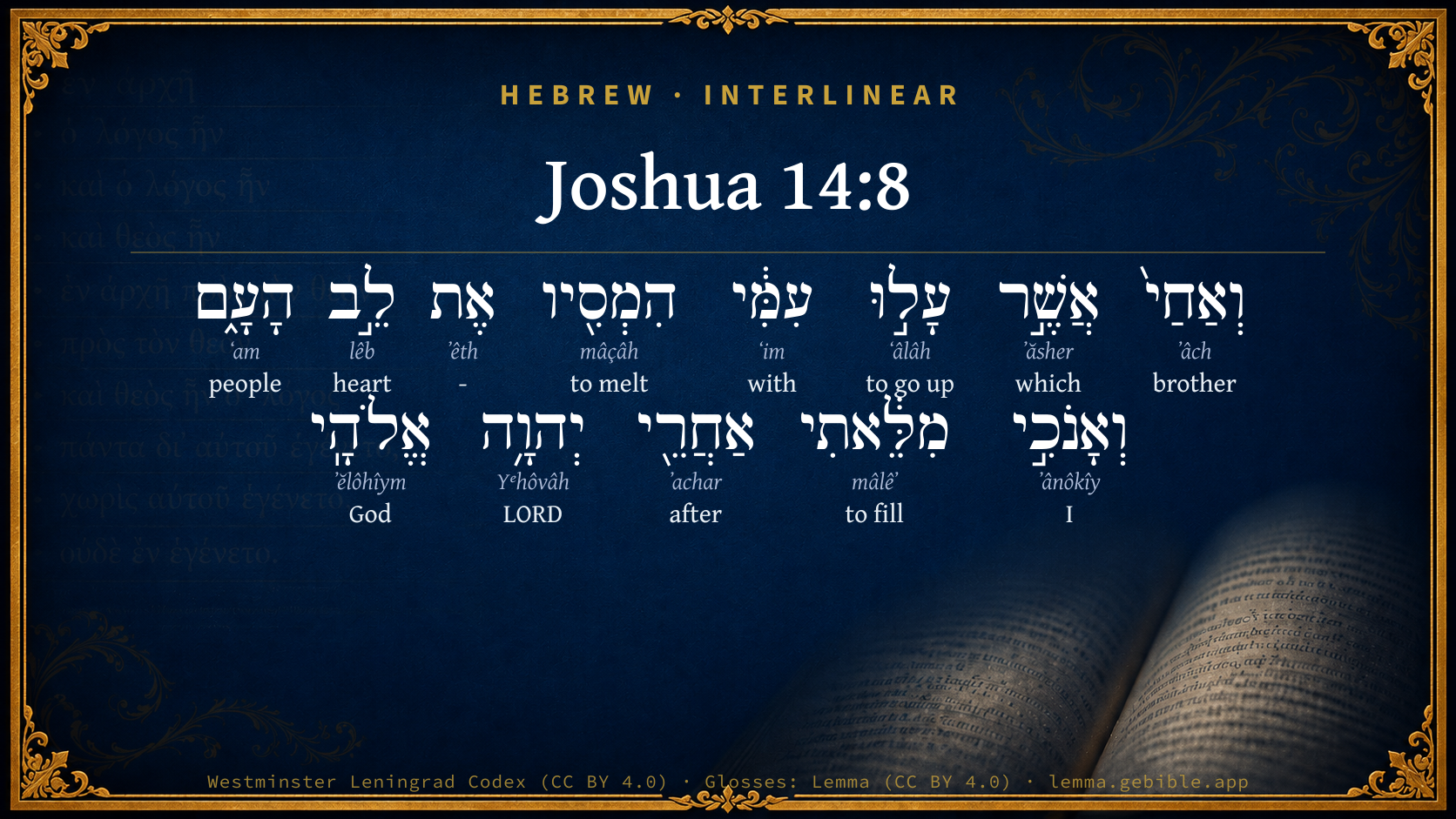
Hebrew (Westminster Leningrad Codex) Joshua 14:8 appears in the Hebrew Old Testament. The text above is from the Westminster Leningrad Codex. Each word links to its Strong’s number, a concise gloss, and parsing drawn from the Open Scriptures Hebrew Bible morphology. Click any word for its full Brown-Driver-Briggs (BDB) entry.
Download image
Cite this verse

Joshua 14:8 (World English Bible). Public Domain. Lemma interlinear Bible study tool, https://lemma.gebible.app/v/joshua/14/8.

Show BibTeX & RIS
BibTeX
RIS
English Translation
Nevertheless my brothers who went up with me made the heart of the people melt; but I wholly followed Yahweh my God.
World English Bible · Public Domain
Highlights
  • 1 first appearance in the Hebrew Bible
Full analysis ↓
Download a study sheet

One document with this verse’s original text, its word-by-word gloss line, the meaning frame, cross-references with their text, attributed commentary, and full source and license credits — printable, and it pastes into notes with its structure intact.

This verse Autodidact and up

Study sheet (.html) Plain text (.txt)

A passage Seminary Student

Up to 50 verses in one chapter. A passage sheet keeps up to 6 commentary sources and 12 cross-references per verse, in the order this page ranks them, and says so on the sheet whenever that leaves anything out. Ask for a single verse and you get the Autodidact verse sheet above.

Everything on this page stays free to read, with no account — the sheet is a download of what is already on screen, not access to it.

Want to remove ads? Support Godless Engineer
Compare translations 3

The same verse in 3 English versions, stacked beneath the original-language interlinear above. Click any original word for its lexicon entry.

Each is an independent rendering of the whole verse — the interlinear is not word-aligned to these translations.

Highlighted words mark where these versions differ — a whole-verse word diff, not a word-by-word alignment.

  • World English Bible Public Domain
    Nevertheless my brothers who went up with me made the heart of the people melt; but I wholly followed Yahweh my God.
  • King James Version Public Domain
    Nevertheless my brethren that went up with me made the heart of the people melt: but I wholly followed the LORD my God.
  • unfoldingWord Literal Text CC BY-SA 4.0
    But my brothers who went up with me made the heart of the people melt. But I myself was full after Yahweh my God.

unfoldingWord Literal Text — © unfoldingWord, licensed CC BY-SA 4.0. Word-aligned USFM3 via Door43 (git.door43.org/unfoldingWord/en_ult).

Versions to compare (up to 4)

3 of 4 selected

Show all 18 translations

Every available English version of this verse, each an independent rendering of the whole verse.

  • World English Bible Public Domain
    Nevertheless my brothers who went up with me made the heart of the people melt; but I wholly followed Yahweh my God.
  • Berean Standard Bible Public Domain
    Although my brothers who went with me made the hearts of the people melt with fear, I remained loyal to the LORD my God.
  • Majority Standard Bible Public Domain
    Although my brothers who went with me made the hearts of the people melt with fear, I remained loyal to the LORD my God.
  • King James Version Public Domain
    Nevertheless my brethren that went up with me made the heart of the people melt: but I wholly followed the LORD my God.
  • American Standard Version (1901) Public Domain
    Nevertheless my brethren that went up with me made the heart of the people melt; but I wholly followed Jehovah my God.
  • Revised Version (1885) Public Domain
    Nevertheless my brethren that went up with me made the heart of the people melt: but I wholly followed the LORD my God.
  • Geneva Bible (1599) Public Domain
    But my brethren that went vp with me, discouraged the heart of the people: yet I followed still the Lord my God.
  • Douay-Rheims (1899) Public Domain
    But my brethren, that had gone up with me, discouraged the heart of the people: and I nevertheless followed the Lord my God.
  • Young's Literal Translation Public Domain
    and my brethren who have gone up with me have caused the heart of the people to melt, and I have been fully after Jehovah my God;
  • Literal Standard Version CC BY-SA 4.0
    and my brothers who have gone up with me have caused the heart of the people to melt, and I have been fully after my God YHWH;
  • Unlocked Literal Bible CC BY-SA 4.0
    But my brothers who went up with me made the heart of the people melt with fear. But I completely followed Yahweh my God.
  • unfoldingWord Literal Text CC BY-SA 4.0
    But my brothers who went up with me made the heart of the people melt. But I myself was full after Yahweh my God.
  • Darby Bible Public Domain
    And my brethren that had gone up with me made the heart of the people melt; but I wholly followed Jehovah my God.
  • World Messianic Bible Public Domain
    Nevertheless, my brothers who went up with me made the heart of the people melt; but I wholly followed the LORD my God.
  • Webster's Bible Public Domain
    Nevertheless, my brethren that went up with me made the heart of the people melt: but I wholly followed the LORD my God.
  • Free Bible Version CC BY-SA 4.0
    But those who went with me made our people afraid. However, I have faithfully followed the Lord my God.
  • Bible in Basic English Public Domain
    My brothers, however, who went up with me, made the heart of the people like water: but I was true to the Lord with all my heart.
  • JPS Tanakh (1917) Public Domain
    Nevertheless my brethren that went up with me made the heart of the people melt; but I wholly followed the LORD my God.

Literal Standard Version (2020), Covenant Press — licensed CC BY-SA 4.0. Text via the HelloAO Bible API (eBible.org). Unlocked Literal Bible (unfoldingWord) — licensed CC BY-SA 4.0. Text via the HelloAO Bible API (eBible.org). unfoldingWord Literal Text — © unfoldingWord, licensed CC BY-SA 4.0. Word-aligned USFM3 via Door43 (git.door43.org/unfoldingWord/en_ult). Free Bible Version, Dr. Jonathan Gallagher — licensed CC BY-SA 4.0. Text via the HelloAO Bible API (eBible.org).

Word by word

More ways to search: Search by grammar → Find every occurrence → Compare this word →

Practice this passage: Drill this verse → Learn its vocabulary →

הִמְסִ֖יו
mâçâh
H4529
“to melt”
Verb, Hiphil, Perfect, 3rd Person, Common, Plural
Part of Speech
Verb
Stem
Hiphil
Form
Perfect
Person
3rd Person
Gender
Common
Number
Plural
Full BDB Definition

Origin: a primitive root

TWOT: 1219

to melt, dissolve, be liquefied - (Hiphil) - to melt, cause to dissolve, consume, cause to vanish - to intimidate (figuratively)
  1. וְאַחַי֙ ʼâch H251 “and · brothers · my” Conjunction + Noun, Common, Masculine, Plural, Construct + Suffix, Personal, 1st Person, Common, Singular
  2. אֲשֶׁ֣ר ʼăsher H834 “which” Particle, Relative
  3. עָל֣וּ ʻâlâh H5927 “to go up” Verb, Qal, Perfect, 3rd Person, Common, Plural
  4. עִמִּ֔י ʻim H5973 “with · me” Preposition + Suffix, Personal, 1st Person, Common, Singular
  5. אֶת ʼêth H853 “-” Particle, Direct Object
  6. לֵ֣ב lêb H3820 “heart of” Noun, Common, Masculine, Singular, Construct
  7. הָעָ֑ם ʻam H5971 “the · people” Particle, Definite Article + Noun, Common, Masculine, Singular, Absolute
  8. וְאָנֹכִ֣י ʼânôkîy H595 “and · I” Conjunction + Pronoun, Personal, 1st Person, Common, Singular
  9. מִלֵּ֔אתִי mâlêʼ H4390 “to fill” Verb, Piel, Perfect, 1st Person, Common, Singular
  10. אַחֲרֵ֖י ʼachar H310 “after” Preposition
  11. יְהוָ֥ה Yᵉhôvâh H3068 “LORD” Noun, Proper
  12. אֱלֹהָֽי ʼĕlôhîym H430 “God(s) · my” Noun, Common, Masculine, Plural, Construct + Suffix, Personal, 1st Person, Common, Singular

About this verse

These counts appear in no published source. They are computed here, from the morphology-tagged text and Lemma’s own curated glosses. What Lemma adds →

13
words
13
distinct lemmas
Historical
section

Notable vocabulary

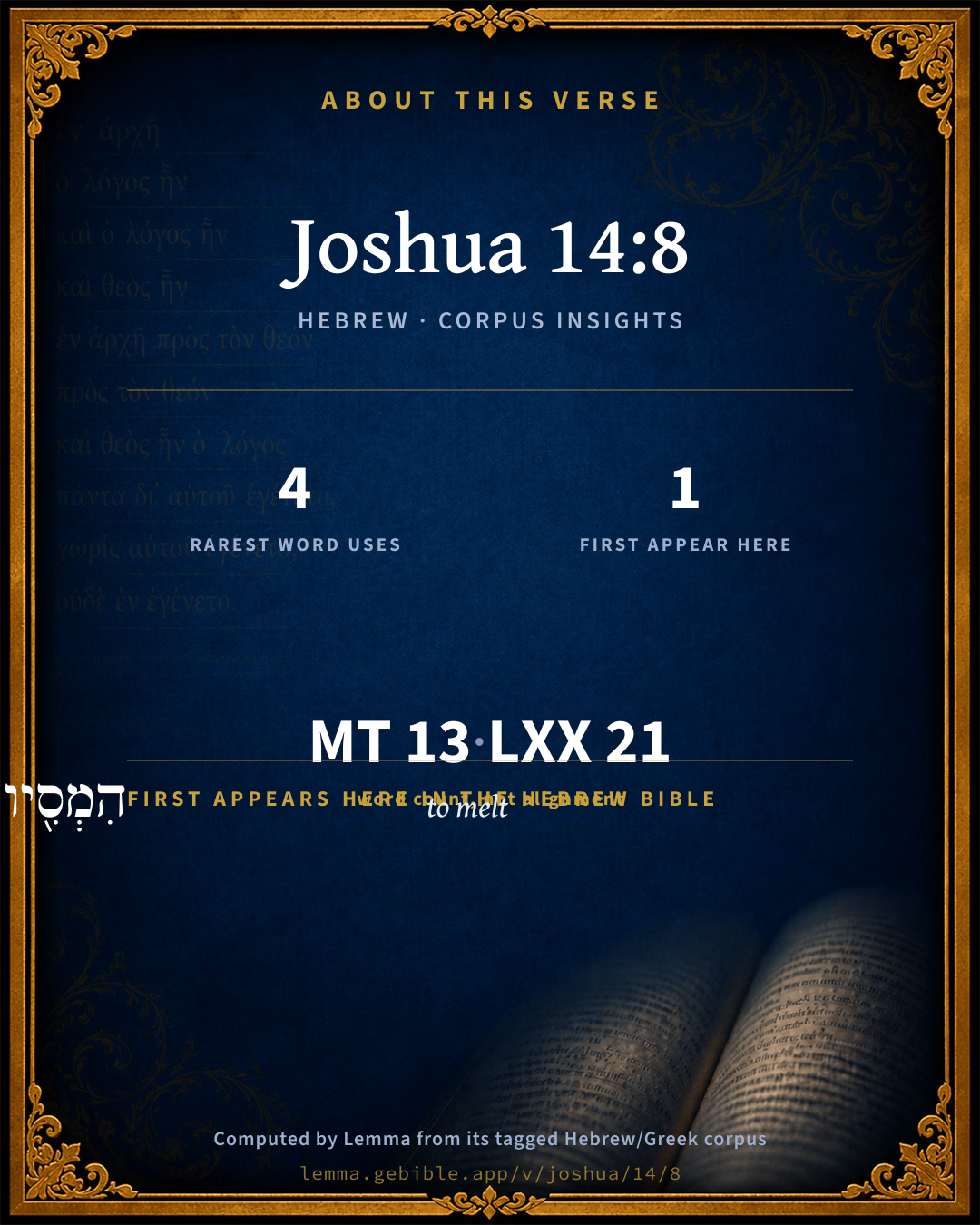
The rarest word here is הִמְסִ֖יו to melt H4529 — appearing just 4 times in the whole Hebrew Bible.

First appearance in Scripture

This word makes its first canonical appearance in the Hebrew Bible here:

  • הִמְסִ֖יו to melt H4529

Shared distinctive vocabulary

הִמְסִ֖יו to melt H4529 occurs in 4 verses of the Hebrew Bible. Also found in:

Grammatical profile

  • 3 verbs
  • 5 nouns
  • 1 pronoun
  • 2 prepositions
  • 2 particles

Verb forms

  • עָל֣וּ Qal · Perfect
  • הִמְסִ֖יו Hiphil · Perfect
  • מִלֵּ֔אתִי Piel · Perfect

Hebrew & Septuagint length

In English translation the verse runs 22 words from the Hebrew and 25 from the Septuagint (LXX English) — closely comparable.

A rough comparison of the two English renderings, which tokenize alike — not a word-level alignment.

Word counts can differ between the Hebrew and the Greek without any difference in meaning — e.g. the Hebrew direct-object marker אֵת has no separate Greek word, and Greek often adds the article ὁ.

In the original languages it is 13 Hebrew tokens and 21 Greek tokens — but the two are counted differently (Hebrew bundles its prefixes and suffixes into one token; the Greek is in lemma form), so that isn’t a like-for-like length.

Cross-references

5

Topical passages linked to Joshua 14:8 in the Treasury of Scripture Knowledge — connected by theme and wording, ordered by reader-vote popularity; previews shown in the World English Bible.

  • Numbers 14:24 but my servant Caleb, because he had another spirit with him, and has followed me fully, him will I bring into the land into which he went; and his seed shall possess it.
  • Deuteronomy 1:36 save Caleb the son of Jephunneh: he shall see it; and to him will I give the land that he has trodden on, and to his children, because he has wholly followed Yahweh.
  • Numbers 13:31 But the men who went up with him said, We aren't able to go up against the people; for they are stronger than we.
  • Joshua 14:14 Therefore Hebron became the inheritance of Caleb the son of Jephunneh the Kenizzite to this day; because that he wholly followed Yahweh, the God of Israel.
  • Revelation 14:4 These are those who were not defiled with women, for they are virgins. These are those who follow the Lamb wherever he goes. These were redeemed by Jesus from among men, the first fruits to God and to the Lamb.

Cross-references courtesy of OpenBible.info (CC BY 4.0).

Hebrew and Greek witnesses Masoretic Hebrew ↔ Greek Septuagint

The same verse in the two great witnesses to the Old Testament, shown verse-for-verse.

These are two independent witnesses, not word-aligned to each other, and the Septuagint is shown in lemma (dictionary) form.

Hebrew Joshua 14:8 Masoretic · Westminster Leningrad Codex

וְאַחַי֙ אֲשֶׁ֣ר עָל֣וּ עִמִּ֔י הִמְסִ֖יו אֶת לֵ֣ב הָעָ֑ם וְאָנֹכִ֣י מִלֵּ֔אתִי אַחֲרֵ֖י יְהוָ֥ה אֱלֹהָֽי

Nevertheless my brothers who went up with me made the heart of the people melt; but I wholly followed Yahweh my God.

World English Bible · Public Domain

Greek LXX Joshua 14:8 Septuagint · lemma form

ὁ δέ ἀδελφός ἐγώ ὁ ἀναβαίνω μετά ἐγώ μεταἵστημι ὁ καρδία ὁ λαός ἐγώ δέ προςτίθημι ἐπιἀκολουθέω κύριος ὁ θεός ἐγώ

My brethren that went up with me turned away the heart of the people, but I applied my self to follow the Lord my God.

LXX2012 (modern English Septuagint) · Public Domain

Hebrew: Westminster Leningrad Codex (CC BY 4.0). Greek: Septuagint (public domain); English from LXX2012 (modern English Septuagint) (Public Domain). How the Septuagint differs from the Hebrew →

Targum (Aramaic paraphrase)

1

The Targum is the ancient Jewish Aramaic paraphrase of the Hebrew Scriptures — an interpretive translation, not the Hebrew text itself. Onkelos (literal) and Pseudo-Jonathan (expansive) render the Torah, and Jonathan the Prophets. Coverage is partial: where no permissively-licensed English translation exists for a verse, only the Aramaic is shown. This is verse-level text, not a word-by-word alignment to the Hebrew.

  1. Targum Jonathan Prophets (Joshua–Malachi)
    וְאַחַי דִסְלִיקוּ עִמִי תְּבַרוּ יַת לִבָּא דְעַמָא וַאֲנָא אַשְׁלֵמִית בָּתַר דַחַלְתָּא דַייָ אֱלָהִי:

    (no public-domain English translation for this verse)

    Targum Jonathan — Aramaic: “Mikraot Gedolot” (public domain). English: “Sefaria Community Translation” (CC0 1.0 (public-domain dedication)); “London "Chaldee Paraphrase," 1871” (public domain). Text via Sefaria.

Commentary

Notes on Joshua 14:8 from classic Christian and Jewish commentators (each source and its license shown beneath its notes). The classic Christian expositions comment on the surrounding passage and are grouped to its opening verse, so a note may address several verses; the Jewish commentaries on the Tanakh (Rashi and others) are per-verse, so they appear only where the commentator wrote on this verse.

Lemma curates 59 commentaries, every one of them public domain or Creative Commons licensed, each selected and text-cleaned for this edition rather than reprinted as found. About our sources →

Trapp's Complete Commentary

John Trapp

Jos 14:8 Nevertheless my brethren that went up with me made the heart of the people melt: but I wholly followed the LORD my God.

Ver. 8. But I wholly followed the Lord my God.] Heb., I fulfilled after the Lord. A metaphor taken from a ship under sail carried strongly with the wind, as if it feared neither rocks nor sands. Thus he commendeth himself, that none might tax him of injustice or ambition, for that which he was now about to require of Joshua.

John Trapp, A Commentary or Exposition upon All the Books of the Old and New Testament (1647–1656) — public domain. Text from a community e-Sword module.

Keil & Delitzsch

C. F. Keil & F. Delitzsch

Whereas the other spies discouraged the people by exaggerated reports concerning the inhabitants of Canaan, he had followed the Lord with perfect fidelity (Num 13:31-33). He had not been made to waver in his faithfulness to the Lord and His promises either by the evil reports which the other spies had brought of the land, or by the murmuring and threats of the excited crowd (see Num 14:6-10). "My brethren" (Jos 14:8) are the rest of the spies, of course with the exception of Joshua, to whom Caleb was speaking.

(Note: That Joshua was not included was evident from this circumstance alone, and consequently it is a complete perversion on the part of Knobel to argue, that because the expression is a general one, i.e., because Joshua is not expressly excepted by name, therefore he cannot have been one of the spies, not to mention the fact that the words "concerning me and thee," in v. 6, are sufficient to show to any one acquainted with the account in Num 13-14, that Joshua was really one of them.)

המסין for המסוּ (see Ges. 75, anm. 17, and Ewald, 142, a.), from מסה = מסס (see Jos 2:11).

Keil & Delitzsch — Biblical Commentary on the Old Testament (1861–1891) — public domain (CC PDM 1.0). Text via the HelloAO Bible API. (Old Testament only.)

Geneva Bible (1599)

Geneva Bible translators

Which were the ten other spies.

Geneva Bible (1599) marginal notes — public domain. Text via Bolls.life.

The Cambridge Bible for Schools and Colleges

gen. ed. J. J. S. Perowne

8. made the heart of the people melt] (Comp. Num_14:1; Num_14:4; Deu_1:28), so that they murmured against Moses and Aaron, and wanted to return again to Egypt. “Discomfortiden the herte of the puple,” Wyclif.

The Cambridge Bible for Schools and Colleges (gen. ed. J. J. S. Perowne; Cambridge University Press, 1878–1918) — public domain. Text from a community e-Sword module.

John Gill's Exposition

Nevertheless, my brethren that went up with me,.... Meaning the rest of the spies, excepting Joshua, that went up with him into the land of Canaan to spy it, which they might be properly said to do, since they went up a hill or mountain, in order to go into it, Num 13:17,

made the heart of the people melt; discouraged them, filled them with fears, sunk their spirits, that their hearts flowed, and became as weak as water, having no strength left in them, or hope of possessing the land; being told what stout and gigantic men the inhabitants of it were, and how strongly fortified were their cities:

but I wholly followed the Lord my God; and did not join with them in an ill report of the good land; but having the fear of God before his eyes, walked after that, and delivered in his report faithfully, according to the dictates of his conscience, and the real sentiments of his mind; of this phrase; see Gill on Num 14:24.

John Gill's Exposition of the Whole Bible (1746–1763) — public domain (CC PDM 1.0). Text via the HelloAO Bible API.

Matthew Poole's English Annotations

Which self-commendation is justifiable, because it was necessary, as being the ground and foundation of his petition.

Matthew Poole's English Annotations on the Holy Bible (1683–1685) — public domain. Text from a community e-Sword/MySword module.

Whedon's Commentary on the Bible

Daniel D. Whedon

8. My brethren — Words of tenderness for his long-remembered comrades.

Heart… melt — In modern sense this would indicate compassion; in the ancient, fear.

Wholly followed the Lord my God — This phrase wholly followed is emphatically repeated from Jehovah’s own words, (Num_14:24; Deu_1:36,) here reiterated at Jos_14:9 and at Jos_14:14. This wholeness of his adherence to Jehovah is explained by his and Joshua’s loyal speech, given Num_14:6-10. There no treachery of their brethren the fellow-spies, no panic of their own, no fury of the people, could disturb the calmness of their witness for God. Then and there the sentence of death in the wilderness, passed upon the entire people, left them untouched. And of that eventful day these two Hebrew princes were now the sole living and speaking mementoes.

Daniel D. Whedon (gen. ed.), Commentary on the Old and New Testaments (1874–1909) — public domain. Text from a community e-Sword module.

The Pulpit Commentary

But I wholly followed. Literally, "I fulfilled after." That is to say, he rendered a full obedience to the precepts of the Most High. So also in the next verse.

HOMILIES BY S.R. ALDRIDGE Ver. 8. Personal influence.

Assuredly no Israelite could look without emotion upon the face and form of Caleb, the utterer of the words of the text. His very existence was a memorial of a memorable day. And when he arose and stood before Joshua, and the two engaged in the conversation recorded in this chapter, who could note them without recollecting that out of the laymen of Israel they were the only survivors of the generation to which they belonged? Like venerable towers that rear their heads above the building which is attached to them but plainly bears the marks of more recent construction, these two men stood an age above their surroundings, but with strength as unyielding as that of their latest compeers. Time and sickness had levelled their contemporaries with the dust, but they remained "with eye undimmed and natural force unabated." God had kept His threat and promise. Caleb"s utterance may suggest some useful reflections.

I THE FACILITY WITH WHICH MEN ARE DETERRED FROM NOBLE ENTERPRISES. What a lamentable incident was that to which these words refer: "My brethren that were with me made the heart of the people melt." Recall the story of the twelve men and their reconnoitering expedition. They searched the south of Palestine, and admired the fruit which grew there in such abundance; but the hearts of the majority were terrified at the sight of fenced cities and the giants who inhabited them. And so when they returned to their brethren they gave such a discouraging account that the people cried, "Would to God we had died in Egypt!" Caleb tried to still their murmuring, but in vain. The cowardly spirit prevailed. Apparently fear is more easily engendered than hope. It is easier to depress than to cheer. How many religious undertakings have failed through the excessive caution of even good men? It is noteworthy that in the account which Moses gives in Deu_1:21 he refers to the fact that on the arrival of the Israelites at Kadesh he exhorted them to "go up and possess the land: fear not." Well would it have been if they had acted on the bold counsel of their leader. But they came near and suggested what seemed an exceedingly wise plan to send men first to spy out the land and dire was the ultimate effect! We do not inculcate rashness; we only say that courage is sometimes better than caution, and quick action than slow resolves. We need a holy enthusiasm that will minimize dangers and make us "strong in faith.

II THE DANGER OF EXERTING AN EVIL INFLUENCE. Great responsibility rested on the men who were the means of damping the ardour of their countrymen. Whilst they themselves died of the plague, the rest of the people were condemned to forty years" weary traversing of the desert. So fierce was the wrath of God at the unbelief of the Israelites. This gift of influence God has bestowed on every person. We all wield this power to a greater or less extent. We may repel or attract, and in either case we are helping to mould the opinions and form the practices of our neighbours. We direct their aspirations and colour the spectacles through which they look at men and things. Is our life report for good or for evil?

III THE SECURITY AGAINST WIELDING AND YIELDING TO AN EVIL INFLUENCE. It is to be noted that Caleb did not seek to persuade his fellows to renounce the idea of invading the Holy Land, and also did not allow himself so to be persuaded by them. He gives us in the text the reason which swayed him and the power which sustained him in opposition to the fears of the other Israelites: "I wholly followed the Lord my God." There might be times in which the mind would be left in suspense as to the proper course to pursue, in which the chief difficulty would be in ascertaining the will of Heaven. But on this occasion there seemed to Caleb but one thing to be done. Precepts and promises clearly showed that it was the duty and privilege of the Israelites to march to the possession of their inheritance. The path was plainly marked; to hesitate was to turn aside from following the Lord. Unswerving obedience to God"s declared will is the grand security against ill conduct. All that we read of Caleb proves him to have been a man of strong determination. Whatever he did he did with his might. There is a deal of meaning in that word "wholly." A man whose face is partly to God and partly to the world may have his attention distracted, but he who maintains an attitude that has respect to God only will remain uninfluenced by either the hopes and fears or the blandishments and threats of men. Urge the necessity and helpfulness of taking a decided step, of becoming openly connected with God"s people, of avowing an attachment to Christ. Some may raise a difficulty in the way of imitating Caleb"s whole-heartedness. This man was gifted with force of character. Now an objector may say, "I by nature am weak, irresolute, easily moved. Why am I blamed if I do not manifest that firmness which others display?" This inquiry runs into a fundamental problem the reason of the election of men to different degrees of intellectual and moral ability, and the different degrees of accountability resulting therefrom. We cannot well separate the direct gifts of God from the achievements of the individual. We are bound to honour men even for what they owe entirely to God, since the honour reaches higher than men and is laid as an offering before the Throne. But what we must remember is that we are capable of acquiring qualifications which we previously lacked, and we may to a wonderful degree strengthen and improve the powers with which we are endowed. A.

"I wholly followed the Lord my God.

I TRUE RELIGION IS BASED ON PERSONAL RELATIONS WITH GOD. Caleb ascribes his courage and fidelity to his connection with God, and he speaks of the Lord as "my God.

(1) Religion is individual. We must pass from "our" God to "my" God. Each soul is called to as private communion with God as if there were no other souls in existence.

(2) Religion establishes close relations with God. In His personal dealings with the soul God comes near to it, so that He appropriates the soul and the soul lays claim to possessing God.

II RIGHT PERSONAL RELATIONS WITH GOD WILL BE SHOWN BY OUR FOLLOWING HIM. It is not sufficient that we believe, worship, manifest affection. We must show our devotion by a consistent course of life.

(1) This is to seek to be near to God, love and duty drawing us Godward.

(2) It is to obey His commands, following the course of His will

(3) It is to emulate His example trying to do as He does. (Mat_5:48) Christianity consists in following Christ. (Mar_1:17, 18)

III WE ONLY FOLLOW GOD ARIGHT WHEN WE FOLLOW HIM WHOLLY. We cannot serve God and mammon. We must choose whom we will serve. Half hearted service is no true service. Following God wholly implies

(1) not desisting from service on account of loss or trouble incurred;

(2) taking no account of the opinion and conduct of other men when these would deflect us from fidelity to God;

(3) serving God in all the relations of life, business, social, domestic, and private.

IV UNDIVIDED DEVOTION TO GOD IS NECESSARY FOR SUCCESS IN HIS WORK. We see how thoroughness and singleness of aim are essential to success in secular pursuits in business, science, art, literature. They are not less essential in spiritual things. Much of our work fails for lack of thoroughness. Hesitating belief, divided aims, mingled motives, often render religious efforts weak and futile. We need to be more perfectly devoted, giving ourselves wholly to God"s service. W.F.A. (1Ti_4:15)

The Pulpit Commentary (1880–1919), ed. H.D.M. Spence-Jones & Joseph S. Exell — public domain. Text from a community e-Sword module.

John Wesley's Explanatory Notes

I wholly followed the Lord - Which self-commendation is justifiable, because it was necessary, as being the ground of his petition. Therefore it was not vain glory in him to speak it: no more than it is for those, who have God's spirit witnessing with their spirits, that they are the children of God, humbly and thankfully to tell others, for their encouragement, what God hath done for their souls.

John Wesley, Explanatory Notes Upon the Whole Bible (1754–1765) — public domain. Text via the GEBible commentary corpus.

unfoldingWord translationNotes

Door43 World Missions Community

made the heart of the people melt with fear

Making the people very afraid is spoken of as if it were making the hearts of the people melt. AT: "made the people very afraid" (See: Metaphor)

I completely followed Yahweh

Being loyal to Yahweh is spoken of as if it were completely following Yahweh. AT: "I remained loyal to Yahweh" (See: Metaphor)

the land ... will be an inheritance for you and for your children forever

The land that Caleb and his descendants would have is spoken of as if it were an inheritance that they would receive as a permanent possession. (See: Metaphor)

the land on which your foot has walked

Here "your foot" represents Caleb. AT: "the land on which you have walked" (See: Synecdoche)

translationWords

brother

heart

fear

Moses

inherit

children

eternity

unfoldingWord translationNotes — © Distant Shores Media and the Door43 World Missions Community, licensed CC BY-SA 4.0. Source: git.door43.org/Door43/en_tn.

Lesson kit

Teaching starters — assembled from the data on this page, not authored interpretation. Every prompt links to the verse data it draws on. Edit before teaching.

Joshua, in the Historical, opens this verse with 13 words (13 distinct Hebrew lemmas). Its most distinctive word is mâçâh (“to melt”). A historical commentator’s framing appears above. Read the whole chapter for the surrounding context.

Discussion questions

  1. How does “to melt” (mâçâh) shape what this verse is saying?
  2. This is the first place “to melt” appears in Scripture (first appears here). What does its debut here establish?
  3. How does Psalms 6:6, which shares the word «to melt», read alongside this verse?
  4. These translations render this verse differently; the difference is in the English rendering, not the original. What questions does that raise?
  5. «עָל֣וּ» is a Qal Perfect verb. How does that grammatical form shape the action described?
  6. Compare how Trapp's Complete Commentary and Keil & Delitzsch read this verse. Where do they agree or differ?

Things to notice

Reading settings

Reading text

Shown beneath each verse's original-language words.

Old Testament
Old Testament edition

Read the OT as the Masoretic Hebrew (MT) or the Greek Septuagint (LXX).

English shown for the Greek Septuagint (in the Hebrew ↔ Greek comparison).

Comparing translations? Open the Compare panel on any verse page to stack up to four side by side.