Galatians 1:24

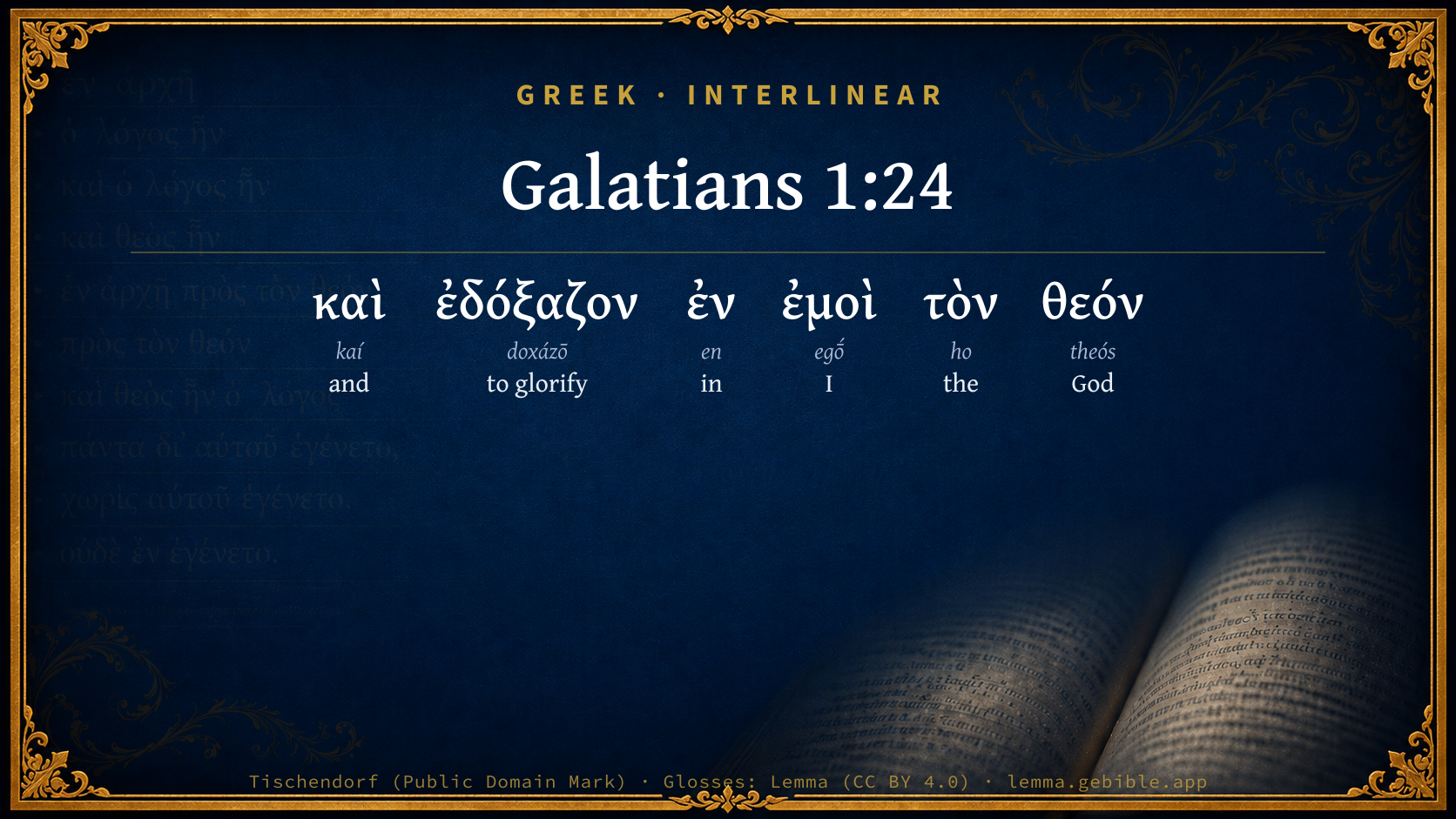
Greek (Tischendorf 8th ed.) Galatians 1:24 appears in the Greek New Testament. The text above is from the Tischendorf 8th edition. Each word links to its Strong’s number and a concise gloss. Click any word for its full Thayer’s Greek Lexicon entry.
Download image
Cite this verse

Galatians 1:24 (World English Bible). Public Domain. Lemma interlinear Bible study tool, https://lemma.gebible.app/v/galatians/1/24.

Show BibTeX & RIS
BibTeX
RIS
English Translation
And they glorified God in me.
World English Bible · Public Domain
Download a study sheet

One document with this verse’s original text, its word-by-word gloss line, the meaning frame, cross-references with their text, attributed commentary, and full source and license credits — printable, and it pastes into notes with its structure intact.

This verse Autodidact and up

Study sheet (.html) Plain text (.txt)

A passage Seminary Student

Up to 50 verses in one chapter. A passage sheet keeps up to 6 commentary sources and 12 cross-references per verse, in the order this page ranks them, and says so on the sheet whenever that leaves anything out. Ask for a single verse and you get the Autodidact verse sheet above.

Everything on this page stays free to read, with no account — the sheet is a download of what is already on screen, not access to it.

Want to remove ads? Support Godless Engineer
Compare translations 3

The same verse in 3 English versions, stacked beneath the original-language interlinear above. Click any original word for its lexicon entry.

Each is an independent rendering of the whole verse — the interlinear is not word-aligned to these translations.

Highlighted words mark where these versions differ — a whole-verse word diff, not a word-by-word alignment.

  • World English Bible Public Domain
    And they glorified God in me.
  • King James Version Public Domain
    And they glorified God in me.
  • unfoldingWord Literal Text CC BY-SA 4.0
    and they were glorifying God in me.

unfoldingWord Literal Text — © unfoldingWord, licensed CC BY-SA 4.0. Word-aligned USFM3 via Door43 (git.door43.org/unfoldingWord/en_ult).

Versions to compare (up to 4)

3 of 4 selected

Show all 18 translations

Every available English version of this verse, each an independent rendering of the whole verse.

  • World English Bible Public Domain
    And they glorified God in me.
  • Berean Standard Bible Public Domain
    And they glorified God because of me.
  • Majority Standard Bible Public Domain
    And they glorified God because of me.
  • King James Version Public Domain
    And they glorified God in me.
  • American Standard Version (1901) Public Domain
    and they glorified God in me.
  • Revised Version (1885) Public Domain
    and they glorified God in me.
  • Douay-Rheims (1899) Public Domain
    And they glorified God in me.
  • Young's Literal Translation Public Domain
    and they were glorifying God in me.
  • Literal Standard Version CC BY-SA 4.0
    and they were glorifying God in me.
  • Unlocked Literal Bible CC BY-SA 4.0
    So they glorified God because of me.
  • unfoldingWord Literal Text CC BY-SA 4.0
    and they were glorifying God in me.
  • Darby Bible Public Domain
    and they glorified God in me.
  • World Messianic Bible Public Domain
    So they glorified God in me.
  • Webster's Bible Public Domain
    And they glorified God in me.
  • Free Bible Version CC BY-SA 4.0
    —and they praised God because of me.
  • Bible in Basic English Public Domain
    And they gave glory to God in me.
  • Text-Critical English NT CC BY 4.0
    So they were glorifying God because of me.
  • Tyndale New Testament (1534) Public Domain
    And they glorified God on my behalffe.

Literal Standard Version (2020), Covenant Press — licensed CC BY-SA 4.0. Text via the HelloAO Bible API (eBible.org). Unlocked Literal Bible (unfoldingWord) — licensed CC BY-SA 4.0. Text via the HelloAO Bible API (eBible.org). unfoldingWord Literal Text — © unfoldingWord, licensed CC BY-SA 4.0. Word-aligned USFM3 via Door43 (git.door43.org/unfoldingWord/en_ult). Free Bible Version, Dr. Jonathan Gallagher — licensed CC BY-SA 4.0. Text via the HelloAO Bible API (eBible.org).

Word by word

More ways to search: Search by grammar → Find every occurrence → Compare this word →

Practice this passage: Drill this verse → Learn its vocabulary →

ἐδόξαζον
doxázō
G1392
“to glorify”
Verb, Imperfect, Active, Indicative, 3rd person, Plural
Part of Speech
Verb
Tense
Imperfect
Voice
Active
Mood
Indicative
Person
3rd person
Number
Plural
Full Thayer's Definition

Origin: from G1391

TDNT: 06:13,2

1. to think, suppose, be of opinion 2. to praise, extol, magnify, celebrate 3. to honour, do honour to, hold in honour 4. to make glorious, adorn with lustre, clothe with splendour a. to impart glory to something, render it excellent b. to make renowned, render illustrious 1. to cause the dignity and worth of some person or thing to become manifest and acknowledged
  1. καὶ kaí G2532 “and” Conjunction
  2. ἐν en G1722 “in” Preposition
  3. ἐμοὶ egṓ G1473 “I” Personal pronoun, 1st person, Dative, Singular
  4. τὸν ho G3588 “the” Article, Accusative, Singular, Masculine
  5. θεόν theós G2316 “God” Noun, Accusative, Singular, Masculine

About this verse

These counts appear in no published source. They are computed here, from the morphology-tagged text and Lemma’s own curated glosses. What Lemma adds →

6
words
6
distinct lemmas
Pauline Epistles
section

Cross-references

12

Topical passages linked to Galatians 1:24 in the Treasury of Scripture Knowledge — connected by theme and wording, ordered by reader-vote popularity; previews shown in the World English Bible.

  • Luke 15:10 Even so, I tell you, there is joy in the presence of the angels of God over one sinner repenting."
  • Acts 11:18 When they heard these things, they held their peace, and glorified God, saying, "Then God has also granted to the Gentiles repentance to life!"
  • Matthew 9:8 But when the multitudes saw it, they marveled and glorified God, who had given such authority to men.
  • Luke 2:14 "Glory to God in the highest, On earth peace, good will toward men."
  • Luke 15:32 But it was appropriate to celebrate and be glad, for this, your brother, was dead, and is alive again. He was lost, and is found.'"
  • Colossians 1:3–4 We give thanks to God the Father of our Lord Jesus Christ, praying always for you,
  • 2 Thessalonians 1:10 when he comes to be glorified in his saints, and to be admired among all those who have believed (because our testimony to you was believed) in that day.
  • 2 Thessalonians 1:12 that the name of our Lord Jesus may be glorified in you, and you in him, according to the grace of our God and the Lord Jesus Christ.
  • Numbers 23:23 Surely there is no enchantment with Jacob; Neither is there any divination with Israel: Now shall it be said of Jacob and of Israel, What has God done!
  • Luke 7:16 Fear took hold of all, and they glorified God, saying, "A great prophet has arisen among us!" and, "God has visited his people!"
  • Acts 21:19–20 When he had greeted them, he reported one by one the things which God had worked among the Gentiles through his ministry.
  • 2 Corinthians 9:13 seeing that through the proof given by this service, they glorify God for the obedience of your confession to the Gospel of Christ, and for the liberality of your contribution to them and to all;

Cross-references courtesy of OpenBible.info (CC BY 4.0).

Commentary

Notes on Galatians 1:24 from classic Christian and Jewish commentators (each source and its license shown beneath its notes). The classic Christian expositions comment on the surrounding passage and are grouped to its opening verse, so a note may address several verses; the Jewish commentaries on the Tanakh (Rashi and others) are per-verse, so they appear only where the commentator wrote on this verse.

Lemma curates 59 commentaries, every one of them public domain or Creative Commons licensed, each selected and text-cleaned for this edition rather than reprinted as found. About our sources →

The Biblical Illustrator

Joseph S. Exell

Gal_1:24

And they glorified God in me.

Gods glory in the soul

I. In the act of conversion God is glorified. It is strange how many misapplications of this word conversion prevail in the world and the Churches. It is used to express the change from one civilization to another; the Chinaman is converted when he becomes an American. It is employed to tell the story of a change of philosophical thought, when one begins to believe in the existence of spirits after having all his days supposed that God had nothing in this universe like unto Himself, but all was dead, inert matter. It is introduced, again, as the explanation of a persons change of ecclesiastical relations. One passes from your church into the church opposite to yours, and he is converted, according to the usage of many. He has changed the mere form of his profession, whilst he holds to the same great essential truths. Yet not one nor all of these are here meant by the words in the sacred Scriptures. It tells the story of a Divine impulse upon our affections, to turn them from the things they have loved before; upon our will, to entirely change the purposes and desires which have prevailed before; upon our life, to make perfect the contrast of that it had been theretofore. It is the impulse of God upon man, turning him away from the things that tempt him further from God unto the things that attract him into nearer associations and relationship. And every part of the act of conversion is Divine. This act of conversion includes several facts.

1. The sense of estrangement from God is its first feature. Now you will admit that this is not a common experience among men. God produces this sense of estrangement. All conversions begin here, and no power but that which is Divine can make a man realize that great truth.

2. Instantly the desire for reconciliation springs up in the heart of him whom God is converting. This has God wrought. No human being can pump up such a desire out of his estranged heart. It is like the spring in the soil which God feeds from the clouds--it would run dry if He did not give the early and the latter rain and the morning and the evening dew.

3. Now comes the determination to return. It may have occupied only minutes, but what a journey it is of soul!

II. But I want to speak, secondly, of the influence of conversion. This is the glory of God. Both our conscious and unconscious influence as converted men and women is continually crying, Let God be glorified.

1. In this influence of a converted soul, the first fact is the withdrawal from dishonouring associations. Conversion to God, says one of the old seventeenth century divines, begins with aversion from sin.

2. A second fact in this influence is the attachment of ones self to Gods people. Let God be glorified, is the desire and the expression of the soul. There is a ministry to which this influence impels him. The convert seeks his brother to save him.

III. Now, lastly, I want to point out some aspects of Gods glory that converted lives do testify. God does it all, and it takes all that there is in God to do it. It is no light work, Wherever you see a converted man, brother, there has been an Omnipresent God, there has been an Omniscient God, there has been the exercise of the omnipotence of God. Every natural perfection of God is engaged in the conversion of a soul. Now, it is very difficult to conceive of God in our times of thought, still less in our times of devotion. The eye is made for taking in the things of beauty in this world; the reason is adapted to comprehend principles. But the eye cannot look at the full meridian sun, and the reason is blinded when it searches the depths of Gods glory. Yet, when He manifests Himself in the works of His hands; when He brings the soul out of darkness into light; when He transforms a backsliding infidel into a true and accepted and faithful child of His; we testify, God has been here. The Arab was asked how he knew that there was a God; and he answered, When I look out of my door in the morning, how do I know it was a man, and not a camel, that passed my tent? We know Him from the marks of His presence. A converted soul glorifies all the natural perfections of God. The moral attributes are equally engaged in a souls conversion. Justice, mercy, love, fidelity, holiness; all these are rays of His glory. Take that prism, to-morrow, and let the sun shine through it, and you will see marvels. The white, pure light is divided into many colours. Even so this gospel of Gods grace analyzes the glory of God, and shows how justice and mercy have met together; how righteousness and peace have kissed each other. At Bethlehem! see God condescending; in Galilee I see God obeying; in Gethsemane I see God struggling and agonizing; on Golgotha I see God bowing his head in the substitution for mans sin. What glorious rays of beauty! But when, with Peter and James and John, we stand on Mount Hermon to view a transfigured Christ, whose face did shine as the sun, we behold the glory of God in marvellous combination. Each ray may be contemplated in itself, but all blend in the glory of God a Saviour. All that each event of life testifies is there, and far, far more than the mind of man can ever conceive. But then, more than that, the covenant relations of God are glorified. The converted man finds a Father--meets a Saviour--is welcomed by a Friend. Now, it is sometimes the experience of children in this world, who never go away from home, that they find their parents in a new and better sense than they had ever met them before. If they have doubted them, if they have been disobedient to them, if they have suspected them, and if, at length, the dark cloud between child and parent passes away, the little one comes with new confidence to bury his head in his fathers bosom, or on his mothers neck, to say, I never knew you until now; I never understood you till now. The love has been deep down in my heart, but now I have found my father, I know the one with whom I have so long been living. Even so is it here, dear friends. The converted man finds the fatherhood of God, who has been his father in Jesus Christ, ever since he was born; realizes the Saviourhood of God, who bought him with a price before his first returnings were ever experienced; and rests in the friendship of God, who is his abiding, faithful supporter and strength. This is my subject--the glory of God in the conversion of a soul. Now, dear brother, let us bring it down to one single point. Has any one glorified God on your behalf? (S. H. Tyng; D. D.)

Gods glory incapable of addition

The God whose glory is in the heavens, revealed in the history of earth, and declared by the experience of every sincere and trusting soul, has perfections impossible of addition as they are evasive of all analysis. He is the standard of holiness, the source of life, the saviour from wrong. His glory belongeth unto Him; He will not give it to another; yet every soul, every life, every home, every Church, dwelling in the brightness of the beauty of God, declares, extends, exalts His glory. Before the eye and in the ear of rational creatures, theology cannot make God either more or less than He is. The panegyric does not add one virtue to the person about whom it is told; the picture that is true cannot make the portrait more beautiful than the face; the window, translucent, does not create, but lets in, the light; even so our relation to God in His glory. It belongs unto us to declare--it does not belong unto us either to diminish or increase the majesty of God. All our consecration cannot add one ray, all our scorning cannot detract aught from Him. (S. H. Tyng; D. D.)

They glorified God in me

I. THE MANIFESTATION OF GOD IN MAN. God is manifested--

1. In nature.

2. But this is surpassed by His manifestation in man.

(1) Physically;

(2) mentally;

(3) morally; and because this latter is based on the manifestation of God in Christ--

(a) in the New Testament;

(b) in the believer;

(c) in ministerial gifts and fruit.

II. The glorification of God for this manifestation. In the way of--

1. Gratitude.

2. Imitation.

3. Trust that God will maintain the succession. (J. Stoughton, D. D.)

He does not say they marvelled at me, they praised me, they were struck with admiration of me, but they glorified God in me. (Chrysostom.)

They praised God, and took courage to believe the more in the mercy of God for that He had mercy on such a great sinner as he. In me. They wondered that grace should be so rich as to take hold of such a wretch as I was, and for my sake believed in Christ the more. (Bunyan.)

Christ glorified in Pauls conversion

I am sure there was never a man who had more hurtful thoughts of the Son of Man, Jesus Christ, than Paul had, for he could not endure to hear of His name, nor to hear of any that professed His name, but persecuted them all most cruelly. And yet our Lord, He did no more but speak a word or two to him, and with these same few words He cast him off his high horse, whereupon he rode so triumphantly, and lays him down upon his back and under his feet, to make him say, Lord, what wilt Thou have me to do? That is a cast of the power of our Lords right arm. (S. Rutherford.)

Divine grace seen in the life

Can I see the dew of heaven as it falls on a summer evening? I cannot. It comes down softly and gently, noiselessly and imperceptibly. But when I go forth in the morning, after a cloudless night, and see every leaf sparkling with moisture, and feel every blade of grass damp and wet, I say at once, There has been a dew. Just so it is with the presence of the Spirit in the soul. (Bishop Ryle.)

That the conversion of an immortal soul is cause of great joy and thanksgiving to the God of grace

I. This will appear if we consider the nature of the human soul, and the misery from which it is rescued.

II. If we contemplate the felicity to which a saved soul is exalted.

III. It will further appear if we consider the price paid for the salvation of the soul.

IV. This is evinced by the perfect nature of salvation. (The Pulpit.)

They glorified God in--

I. The subjection of the persecutor.

II. The conversion of the sinner.

III. The zeal and success of the preacher.

IV. The dignity of his office. (J. Lyth.)

God glorified in Paul

I. In his conversion--a persecutor and a Pharisee--yet called by special grace (verses 13-15).

II. In his call to the ministry--Divinely qualified (verse 16)--and instructed (verses 11, 12, 17).

III. In his labours--incessant--widely distributed--unsupported by human influence--yet abundant to the glory of God. (J. Lyth.)

God glorified in Christians

It should ever be the end of the Christian man, not only to promote the glory of God by his works, but to illustrate the glory of God in his character; in this, as in nothing else, are the goodness and power of God seen most strikingly. An architect rears a building. It is admired for its beauty in detail, and its grandeur as a whole; but the praise belongs not to the building, but to the builder. A tutor takes a youth under his care, and sends him forth to attain eminence and distinction in the early struggles and in the highest positions of life, but the tutor is glorified in the pupil. So the creation is the result of the Almighty hand, and He is glorified in it. Impressions of His glory are left upon the largest and upon the least; upon the stars in their courses discovered to the telescope; and on the minutest specimens of organized life which the microscope opens to our startled eye. And shall my God be less glorified in the new creation than He is in the old? Shall He not be glorified by the humblest Christian, just as He was glorified by the great apostle? All stars shine by His will, and one star differs from another star in glory, for this is His will; but each renders to Him its measure of praise. God, who is glorified in Saul of Tarsus pre-eminently, must be glorified in each of us, as Christians, according to our position and opportunity. If we have a Christians hope, it is to the glory of His name; if we have a Christians life, it is to the glory of His cross; if we have performed a duty, it is to the glory of His grace; if we have borne a trial, it is to the glory of His support; if we have overcome a sinful habit, or the lust which led to it, it is to the glory of His power which gave us self-mastery. (C. J. P. Eyre, M. A.)

The Biblical Illustrator, edited by Joseph S. Exell (c. 1880s–1900s) — public domain. Text from a community e-Sword module.

Bengel's Gnomon

Johann Albrecht Bengel

Gal 1:24. Ἐδόξαζον, they glorified) And in the present day the Church glorifies God in Paul. [Remember thou to observe the same thing (to glorify God) as often as a good report (about some one converted from ungodliness), has been brought to thee.—V. g.]—ἐν ἐμοὶ, in me) comp. note to Gal 1:16. They glorified God previously, they now glorified Him also on account of Paul.

Bengel's Gnomon of the New Testament — English translation (T&T Clark, Edinburgh, 1860) — public domain. Text from a community e-Sword module.

Expositor's Greek Testament

ed. W. Robertson Nicoll

Gal 1:24 . They glorified God in Saul, ascribing the change entirely to the grace of God working on his heart.

The Expositor's Greek Testament, edited by W. Robertson Nicoll (1897–1910) — public domain. Text from a community e-Sword module.

Jamieson, Fausset & Brown

Robert Jamieson, A. R. Fausset & David Brown

in me--"in my case." "Having understood the entire change, and that the former wolf is now acting the shepherd's part, they received occasion for joyful thanksgiving to God in respect to me" [THEODORET]. How different, he implies to the Galatians, their spirit from yours!

Next: Galatians Chapter 2

Jamieson, Fausset & Brown — Commentary Critical and Explanatory on the Whole Bible (1871) — public domain (CC PDM 1.0). Text via the HelloAO Bible API.

Adam Clarke's Commentary

Verse 24. They glorified God in me.] Hearing now that I preached that faith which before I had persecuted and endeavoured to destroy, they glorified God for the grace which had wrought my conversion. I owe nothing to them; I owe all to God; and they themselves acknowledge this. I received all from God, and God has all the glory.

1. IT appeared of great importance to St. Paul to defend and vindicate his Divine mission. As he had none from man, it was the more necessary that he should be able to show plainly that he had one from God. Paul was not brought into the Christian ministry by any rite ever used in the Christian Church. Neither bishop nor presbyter ever laid hands on him; and he is more anxious to prove this, because his chief honour arose from being sent immediately by God himself: his conversion and the purity of his doctrine showed whence he came. Many since his time, and in the present day, are far more anxious to show that they are legitimately appointed by MAN than by GOD; and are fond of displaying their human credentials. These are easily shown; those that come from God are out of their reach. How idle and vain is a boasted succession from the apostles, while ignorance, intolerance, pride, and vain-glory prove that those very persons have no commission from heaven! Endless cases may occur where man sends and yet God will not sanction. And that man has no right to preach, nor administer the sacraments of the Church of Christ, whom God has not sent; though the whole assembly of apostles had laid their hands on him. God never sent, and never will send, to convert others, a man who is not converted himself. He will never send him to teach meekness, gentleness, and long suffering, who is proud, overbearing, intolerant, and impatient. He, in whom the Spirit of Christ does not dwell, never had a commission to preach the Gospel; he may boast of his human authority, but God will laugh him to scorn. On the other hand, let none run before he is sent; and when he has got the authority of God, let him be careful to take that of the Church with him also.

2. The apostle was particularly anxious that the Gospel should not be corrupted, that the Church might not be perverted. Whatever corrupts the GOSPEL, subverts the CHURCH. The Church is a spiritual building, and stands on a spiritual foundation. Its members are compared to stones in a building, but they are living stones-each instinct with the spirit of a Divine life; Jesus is not only the foundation and the head-stone, but the spirit that quickens and animates all. A Church, where the members are not alive to God, and where the minister is not filled with the meekness and gentleness of Jesus, differs as much from a genuine Church as a corpse does from an active human being. False teachers in Galatia corrupted the Church, by introducing those Jewish ceremonies which God had abolished; and the doctrine of justification by the use of those ceremonies which God had shown by the death of his Son to be of none effect. "If those," says Quesnel, "are justly said to pervert the Gospel of Christ, who were for joining with it human ceremonies which God himself instituted, what do those do, who would fondly reconcile and blend it with the pomps of the devil? The purity of the Gospel cannot admit of any mixture. Those who do not love it, are so far from building up that they trouble and overturn all. There is no ground of trust and confidence for such workmen."

3. If he be a dangerous man in the Church who introduces Jewish or human ceremonies which God has not appointed, how much more is he to be dreaded who introduces any false doctrine, or who labours to undermine or lessen the influence of that which is true? And even he who does not faithfully and earnestly preach and inculcate the true doctrine is not a true pastor. It is not sufficient that a man preach no error; he must preach the truth, the whole truth, and nothing but the truth.

4. How is it that we have so many Churches like those in Galatia? Is it not because, on one hand, we disturb the simplicity of the Christian worship by Jewish, heathenish, or improper rites and ceremonies; and on the other, corrupt the purity of its doctrines by the inventions of men? How does the apostle speak of such corrupters? Let them be accursed. How awful is this! Let every man who officiates as a Christian minister look well to this. His own soul is at stake; and, if any of the flock perish through his ignorance or neglect, their blood will God require at the watchman's hand.

5. St. Paul well knew that, if he endeavoured to please man, he could not be the servant of Christ. Can any minor minister hope to succeed, where even an apostle, had he followed that line, could not? The interests of Christ and those of the world are so opposite, that it is impossible to reconcile them; and he who attempts it shows thereby that he knows neither Christ nor the world, though so deeply immersed in the spirit of the latter.

6. God generally confounds the expectations of men-pleasing ministers; they never ultimately succeed even with men. God abhors them, and those whom they have flattered find them to be dishonest, and cease to trust them. He who is unfaithful to his God should not be trusted by man.

Adam Clarke's Commentary on the Bible (1810–1826) — public domain. Text from a community e-Sword/MySword module.

John Calvin's Commentaries

24. And they glorified God in me This was an evident proof that his ministry was approved by all the churches of Judea, and approved in such a manner, that they broke out into admiration and praise of the wonderful power of God. Thus he indirectly reproves their malice, by showing that their venom and slanders could have no other effect than to hide the glory of God, which, as the apostles admitted and openly acknowledged, shone brightly in the apostleship of Paul.

This reminds us of the light in which the saints of the Lord ought to be regarded by us. When we behold men adorned with the gifts of God, such is our depravity, or ingratitude, or proneness to superstition, that we worship them as gods, unmindful of Him by whom those gifts were bestowed. These words remind us, on the contrary, to lift up our eyes to the Great Author, and to ascribe to Him what is his own, while they at the same time inform us that an occasion of offering praise to God was furnished by the change produced on Paul, from being an enemy to becoming a minister of Christ.

John Calvin's Commentaries (1540-1563) — public domain. Text from the Calvin Translation Society English edition (1840s-50s) via the Christian Classics Ethereal Library (ccel.org). Calvin's coverage is partial (roughly two-thirds of the Bible); uncommented books and verses are honest gaps, never fabricated. The 19th-century editor's footnotes and remarks are omitted so the notes are faithfully Calvin's own voice.

Ellicott's Commentary for English Readers

(24) They glorified God in me.—This verse represents the proper attitude of Christian hero-worship. An eminent Christian is like a “city set on a hill.” But the admiration which he attracts does not rest in him; it is made the occasion for giving praise to God.

A Bible Commentary for English Readers, edited by Charles John Ellicott (1878–1897) — public domain. Text from a community e-Sword module.

The Cambridge Bible for Schools and Colleges

gen. ed. J. J. S. Perowne

24. The conduct of the Judæan Christians is noteworthy, not only as in marked contrast with that of the Judaizing party in Galatia, but as testifying to the soundness of the Apostle’s teaching. The Gospel which he preached, though independent of them as to its source, was identical with that which they had themselves welcomed. And they ascribed the glory to God in the grace given to His servant.

This is a sure test of the reality of our faith and love:—when we read or hear of men being raised up to “preach the faith” in days that are past, or in distant lands (as, for example, in the great missionary work of the Church), do we glorify God in them? This was well understood by the English Reformers.

In the Commemoration Service (dating from the time of Q. Elizabeth, and not improbably drawn up by Abp Parker) which is used in the University, and some, if not all of the Colleges of Cambridge, there is a prayer commencing, ‘O Lord, we glorify Thee in these Thy servants our Benefactors departed out of this present life.’ No better commentary on the expression can be found than the Collect for the Conversion of St Paul. Compare also our Lord’s words, “All mine (neut. but including masc. and fem.) are thine, and thine are mine; and I am glorified in them.”

The Cambridge Bible for Schools and Colleges (gen. ed. J. J. S. Perowne; Cambridge University Press, 1878–1918) — public domain. Text from a community e-Sword module.

John Gill's Exposition

And they glorified God in me. Or "for me"; on his account; for the wonderful grace bestowed on him and wrought in him; for the surprising change that was made in him, that of a persecutor he should become a preacher, which they ascribed, as he himself did, to the abundant grace of God; they were greatly thankful and blessed God, who had given him such large gifts, and made him so greatly useful in the cause, and among the churches of Christ. And by observing this, how much the churches in Judea were affected with the grace of God vouchsafed to him, though they had never seen him nor heard him, he tacitly strikes at and rebukes the false teachers, and the Galatians that adhered to them, for their different treatment of him; to whom he was not only known by face, but had preach among them so fully, clearly, and powerfully, the Gospel of the grace of God.

Next: Galatians Chapter 2

John Gill's Exposition of the Whole Bible (1746–1763) — public domain (CC PDM 1.0). Text via the HelloAO Bible API.

Trapp's Complete Commentary

John Trapp

24 And they glorified God in me.

Ver. 24. And they glorified God] "Whoso offereth praise, he glorifieth me," Psa 50:23. God accounts himself as it were to receive a new being, by those inward conceptions of his glory, and by those outward honours that we do to him.

John Trapp, A Commentary or Exposition upon All the Books of the Old and New Testament (1647–1656) — public domain. Text from a community e-Sword module.

Albert Barnes' Notes on the Bible

And they glorified God in me - They praised God on my account. They regarded me as a true convert and a sincere Christian; and they praised God that he had converted such a persecutor, and had made him a preacher of the gospel. The design for which this is mentioned is, to show that though he was personally unknown to them, and had not derived his views of the gospel from them, yet that he had their entire confidence. They regarded him as a convert and an apostle, and they were disposed to praise God for his conversion. This fact would do much to conciliate the favor of the Galatians, by showing them that he had the confidence of the churches in the very land where the gospel was first planted, and which was regarded as the source of ecclesiastical authority. In view of this we may remark:

(1) That it is the duty of Christians kindly and affectionately to receive among their number those who have been converted from a career of persecution or of sin in any form. And it is always done by true Christians. It is easy to forgive a man who has been actively engaged in persecuting the church, or a man who has been profane, intemperate, dishonest, or licentious, if he becomes a true penitent, and confesses and forsakes his sins. No matter what his life has been; no matter how abandoned, sensual, or devilish; if he manifests true sorrow and gives evidence of a change of heart, he is cordially received into any church, and welcomed as a fellow-laborer in the cause which he once destroyed. Here, at least, is one place where forgiveness is cordial and perfect. His former life is not remembered, except to praise God for His grace in recovering a sinner from such a course. The evils that he has done are forgotten, and he is henceforward regarded as entitled to all the privileges and immunities of a member of the household of faith. There is not on earth an infuriated persecutor or blasphemer who would not be cordially welcomed to any Christian church upon the evidence of his repentance; not a person so debased and vile that the most pure, and elevated, and learned, and wealthy Christians would not rejoice to sit down with him at the same communion table upon the evidence of his conversion to God.

(2) We should “glorify” or praise God for all such instances of conversion. We should do it because:

(a) Of the abstraction of the talents of the persecutor from the cause of evil. Paul could have done, and would have done immense service to the enemies of Christianity if he had pursued the career which he had commenced. But when he was converted, all that bad influence ceased. So when an infidel or a profligate man is converted now:

(b) Because now his talents will be consecrated to a better service, they will be employed in the cause of truth and salvation. All the power of the matured and educated talent will now be devoted to the interests of religion; and it is a fact for which we should thank God, that he often takes educated talent, and commanding influence, and an established reputation for ability, learning, and zeal, and devotes it to his own service.

(c) Because there will be a change of destiny; because the enemy of the Redeemer will now be saved. The moment when Saul of Tarsus was converted, was the moment which determined a change in his eternal destiny. Before, he was on the broad way to hell; henceforward, he walked in the path of life and salvation. Thus, we should always rejoice over a sinner returning from the error of his ways; and should praise God that he who was in danger of eternal ruin is now an heir of glory. Christians are not jealous in regard to the numbers who shall enter heaven. They feel that there is “room” for all; that the feast is ample for all; and they rejoice when any can be induced to come with them and partake of the happiness of heaven.

(3) We may still glorify and praise God for the grace manifested in the conversion of Saul of Tarsus. What does not the world owe to him! What do we not owe to him! No man did as much in establishing the Christian religion as he did; no one among the apostles was the means of converting and saving so many souls; no one has left so many and so valuable writings for the edification of the church. To him we owe the invaluable epistles - so full of truth, and eloquence, and promises, and consolations - upon which we are commenting; and to him the church owes, under God, some of its most elevated and ennobling views or the nature of Christian doctrine and duty. After the lapse, therefore, of more than 1,800 years, we should not cease to glorify God for the conversion of this wonderful man, and should feel that we have cause of thankfulness that he changed the infuriated persecutor to a holy and devoted apostle.

(4) Let us remember that God has the same power now. There is not a persecutor whom he could not convert with the same ease with which he changed Saul of Tarsus. There is not a vile and sensual man that he could not make pure; not a dishonest man that his grace could not make honest: not a blasphemer that he could not teach to venerate his name; not a lost and abandoned sinner that he cannot receive to himself. Let us then without ceasing cry unto him that his grace may be continually manifested in reclaiming such sinners from the error of their ways, and bringing them to the knowledge of the truth, and to a consecration of their lives to his service.

Albert Barnes' Notes on the Bible (1834–1885) — public domain. Text from a community e-Sword/MySword module.

Matthew Poole's English Annotations

And they praised God on his behalf, for working so great a change in him.

Matthew Poole's English Annotations on the Holy Bible (1683–1685) — public domain. Text from a community e-Sword/MySword module.

Whedon's Commentary on the Bible

Daniel D. Whedon

24. Glorified God—Rendered thanks and praise that the persecutor had become a preacher. But this was the Church from which, under pressure of the temple hierarchy, Paul’s Judaizing troublers came. Fourteen years afterwards, as he will soon say, he came to meet them at Jerusalem and settle accounts.

In me—Rather, upon me; as the basis upon which their glorifying of God was founded.

Daniel D. Whedon (gen. ed.), Commentary on the Old and New Testaments (1874–1909) — public domain. Text from a community e-Sword module.

The Pulpit Commentary

And they glorified God in me (kaixazon ejn ejmoi ton); and they were glorifying God in me; that is, for what they recognized as God s work in me and through me; in my own conversion, and in my effective ministering of the gospel to others. The ejn denotes the sphere in which they found occasion for praising God. Instances of a somewhat similar use of the preposition are 1Co_4:2, Ina ejn hJmin maqhte: 9:15, Zhteitai ejn toiv oijkonomoiv: ver. 6, Ina outw genhtai ejn ejmoi. The sentence is not essential to the line of thought in vers. 21-23. The apostle was probably prompted to add it by the complacency which he felt in the interest and sympathy which in those days the Jewish Churches showed towards him sentiments which afterwards faded too much away into those of suspicion and alienation. (comp. Act_21:21) He rejoices to remember, and he will have the Galatian Churchmen know, that once the believers of the circumcision were proud of him, and were satisfied that he was preaching the true gospel of Christ. And his preaching was the same now as it had been then.

God glorified in man.

I THE CHURCH SHOULD HEARTILY WELCOME NEW CONVERTS. St. Paul proves conclusively that he obtained neither his Christian faith nor his apostleship from the Church at Jerusalem. But in doing so he gives little ground for the view of those who hold that he was in direct antagonism to that Church. On the contrary, he distinctly asserts that the Jewish Christians welcomed him and praised God for his conversion. This was an act of large-hearted confidence.

1. It shows a genuine Christian spirit to honour ungrudgingly a spiritualwork in which we have taken no part. There is always a temptation to slight such work and to regard the fruits of it with suspicion.

2. The beauty of Christian charity is also seen in the warm welcome of onewho had been an enemy. The persecutor preaches what he had opposed. That is enough for the Church at Jerusalem. If we had more faith in such conversions we should encourage them more readily.

3. The breadth of this charity is still further noticeable in readiness towelcome as a brother a man whose views and habits differ from our own. From the first St. Paul"s Christianity must have borne a different colour from that of St. James. But the common faith in Christ united them.

II THE GLORY OF CHRISTIAN GRACES IS DUE TO GOD. They are "graces:" and gifts, not attainments which a man acquires for himself. The wonderful change of the zealous persecutor of Christianity into the equally zealous preacher is wholly attributed to God. It is not St. Paul who is glorified by the Church at Jerusalem. We make the mistake of unduly praising the character of a saint without recognizing sufficiently the source of his saintliness, or we make the equally foolish error of honouring the preacher for the fruit of teaching which would never have been reaped but for the Divine power of which the man was only the conductor.

III GOD"S GLORY IS NOWHERE SHOWN MORE RICHLY THAN IN THE WORK OF CHRISTIAN GRACE. It flashes from the face of nature, glowing in the broad heavens, smiling on the beautiful earth. It breaks out through the course of history in grand indications of providential justice and mercy. It gleams in wonderful truths revealed to the eyes of seers who speak it forth in articulate prophecy. Above all, it shines most brightly in the life and person of Christ. But as Christ is full of grace and truth, every Christian has some measure of the same blessings, and according to his measure manifests the glory of them. God may be glorified in a man. Man often dishonours God. He may also reveal God"s glory. Just as the brightness of the sun is not seen in its beauty till it is reflected from earth, or sea, or sky, the glory of God must be shown on some object. Shining on the face of a Christian, it is revealed. It is well to recognize this. Our religion is too selfish, and therefore it is too gloomy. We often pray when we should be praising. We seek good things for ourselves unceasingly when we should be losing ourselves in the contemplation of the glory of God. We cannot add to that glory; yet we may and should glorify God by joyously declaring the works of his grace. W.F.A.

The Pulpit Commentary (1880–1919), ed. H.D.M. Spence-Jones & Joseph S. Exell — public domain. Text from a community e-Sword module.

John Wesley's Explanatory Notes

In me - That is, on my account.

John Wesley, Explanatory Notes Upon the Whole Bible (1754–1765) — public domain. Text via the GEBible commentary corpus.

Luther on Galatians

Martin Luther

see note on vs 22

Martin Luther — Commentary on the Epistle to the Galatians (1535), English translation by Theodore Graebner (Zondervan, 1939) — public domain (U.S. copyright not renewed). Text from a community e-Sword module.

McGarvey & Pendleton's Commentaries

J. W. McGarvey

and they glorified God in me. [The term "three years" may be taken to mean three full years, or one year and parts of two others. Assuming that Paul was converted in A. D. 37, the visit to Jerusalem took place somewhere between A. D. 38 and 40. Luke describes this same period as "many days" ( Act_9:23 ). For a curious parallel see 1 Kings 2:38, 39. Persecution drove Paul from Damascus ( Act_9:22-25 ; 2Co_11:31-32 ), and the desire to form the acquaintance of Peter led him to Jerusalem. The James whom he met was, as described, "the Lord's brother," and was neither James, the son of Zebedee, nor James, the son of Alphæus. In fact, he was not properly an apostle, but was called such probably because of his nearness to Jesus and his great influence. Paul's reasons for leaving Jerusalem are found at Act_9:29-30 ; Act_22:17-21 . Cilicia was commonly coupled with Syria in popular phrase; for, though part of Asia Minor, it was cut off from that district by the high ridge of Mt. Taurus, and so formed social and commercial affinities with Syria. The gist of Paul's argument is this: My gospel did not come to me from Jerusalem, for,

1. I was in no haste to go there.

2. I did not go there for the purpose of perfecting my knowledge of the gospel.

3. I was not there long enough to perfect such knowledge.

4. Leaving there, I was conscious of no deficiency of knowledge, but went at once to localities far distant, and was not personally known in the regions contiguous to Jerusalem, as I must have been had I lingered in that city long enough to learn the gospel history.

5. But I was known to them by my repentance, and by works for which they praised God, which facts show that I was recognized by them as proficient in a gospel which I did not learn from them.]

J. W. McGarvey (with Philip Y. Pendleton), Commentaries on the New Testament (The Fourfold Gospel, 1914; Acts; and the epistles) — public domain. Text from a community e-Sword/MySword module.

The People's New Testament

B. W. Johnson

24. They glorified God in me. Glorified God for the work I was doing. The idea of glorifying men for the success of their work was unknown in the early church.

B. W. Johnson's The People's New Testament with Notes (1889–1891) — public domain. Electronic text from the Christian Classics Ethereal Library (CCEL) ThML edition.

Cambridge Greek Testament for Schools and Colleges

24. καὶ ἐδόξαζον. In this meaning, frequent in N.T. and LXX. From Polybius onwards in the passive voice only (see Nägeli. Wortschatz, p. 61). The tense suggests that they found continued cause for δόξα. They kept on recognizing God’s handiwork in me and giving Him praise.

ἐν ἐμοὶ, more than “in my case.” They found the cause for glory in my person, i.e. my history, words and deeds.

τὸν θεόν. At the end, for emphasis. Certain Jewish Christians now find fault with me. It was not so. The churches of Judaea, who may be supposed to know what was right, were satisfied with what they heard of me and glorified God (Mat 5:16).

Possibly also the words suggest the reason stated by Theodore of Mopsuestia: “maxime cum nemo hominum perspiciatur qui conversionis ejus auctor esse videatur.”

Cambridge Greek Testament for Schools and Colleges (Cambridge University Press, 1896; 21 vols, various authors incl. Carr, Maclear, Plummer, Farrar, Lumby, Moule, M. R. James, Simcox) — public domain. Text from a community e-Sword module.

International Critical Commentary

24. καὶ ἐδόξαζον ἐν ἐμοὶ τὸν θεόν. “and they glorified God in me,” i. e., found in me occasion and reason for praising God. On this use of ἐν of that which constitutes the ground or basis of an action (derived from the use of the preposition to denote the sphere within which the action takes place) see Th. 16 c, though the classification at this point is far from satisfactory; W. XLVIII a (3) c; Ell. ad loc., though here also the matter is stated with unnecessary obscurity; and such passages as Mat 6:7, Act 7:29, Rom 2:17, Rom 2:23, Rom 2:5:9, Gal 3:11, Gal 3:14. The satisfaction which the churches of Judea found in Paul’s missionary activity in this period is in sharp contrast with the opposition to him which later developed in Jerusalem. See 2:1-10. Of the several explanations that might be given of the more friendly attitude of the early period, (a) that Paul had not yet begun to preach the gospel of freedom from the law, or (b) that though he was doing so the Christians of Judea were not aware of this aspect of his work, or (c) that the strenuous opposition to the offering of the gospel to the Gentiles apart from the law had not yet developed in the churches of Judea, the first is probably true in the sense and to the extent that Paul had not yet had occasion to assume a polemic attitude in the matter; but in any other sense seems excluded by his repeated implication that the gospel which he now preached he had preached from the beginning (see 1:11, 2:2 and comment). But in that case there is little room for the second. The third is, moreover, the one most consistent with the testimony of this letter; see especially 2:4, with its distinct implication that the opponents of Paul’s liberalism were a recent and pernicious addition to the Jerusalem church. And this in turn suggests that the apostle’s reason for adding the statement καὶ ἐδόξαζον … ἐμοί was incidentally to give strength to his contention for the legitimacy of his mission by intimating, what 2:4 says more clearly, that the opposition to him was a recent matter, and did not represent the original attitude of the Judean Christians. On the other hand, it must not be forgotten that his main contention throughout this chapter and the next is not that he had been approved by the Judean Christians, but that he had from the first acted independently. The whole sentence μόνον … ἐν ἐμοί is a momentary digression from that point of view.

S. and H. Sanday, Wm., and Headlam, A. C.. A Critical and Exegetical Commentary on the Epistle to the Romans. Edinburgh and New York, 1895.

Cf. Confer, compare.

Th. Thayer, Joseph Henry, A Greek English Lexicon of the New Testament. New York, 1886. Rev. edition, 1889.

* Cf. Philo, Leg. Alleg. I 41 (13): τὰ μὲν καὶ ὑπὸ θεοῦ γίνεται καὶ διʼ αὐτοῦ, τὰ δὲ ὑπὸ θεοῦ μέν, οὐ δι῾ αὐτοῦ δέ. He illustrates this general statement by the assertion that the mind of man is created both by and through God, the irrational parts of the soul by God but not through God, being produced through the reasoning power that rules in the soul.

Sief. Sieffert, F. Galatien und seine ersten Christengemeinden, in Zeitschrift für nistorische Theologie., vol. XLI, 1871.

Wies. Wieseler, Karl, Commentar über den Brief Pauli an die Galater. Göttingen, 1859.

WH. Westcott, B. F., and Hort, F. J. A., The New Testament in the original Greek. London, 1881. Vol. I, Text; vol. II, Introduction and Appendix.

Bous. Bousset, Wilhelm, in Die Schriften des Neuen Testaments. Göttingen, 1907. 2te Aufl., 1908.

Hilg. Hilgenfeld, Adolph, Der Galaterbrief übersetzt, in seinen geschichtlichen Bezie-hungen untersucht und erklärt. Leipzig, 1852.

Ltft. Lightfoot, Joseph Barber, Saint Paul’s Epistle to the Galatians. London, 1865. 2d ed., revised, 1866. Various later editions.

Ell. Ellicott, Charles John, A Critical and Grammatical Commentary on St. Paul’s Epistle to the Galatians. London, 1854. Various subsequent editions.

Introd. Introduction.

אԠא. Codex Sinaiticus. Fourth century. In Imperial Library, Petrograd. Edited by Tischendorf, 1862; photographic reproduction by H. and K. Lake, Oxford, 1911.

A A. Codex Alexandrinus. Fifth century. In British Museum, London. Edited by Woide, 1786; N. T. portion by Cowper, 1860; Hansell, 1864; in photographic facsimile, by E. Maunde Thompson, 1879; and again in photographic simile by F. G. Kenyon in 1909.

33 33 (Tischendorf, Constantin, Novum Testamentum Grœce. 17). Ninth or tenth century. In National Library, Paris. Called by Eichhorn “the queen of the cursives.” Cited by Tischendorf in Galatians more frequently than any other cursive. Contains the Prophets as well as Gospels, Acts, Cath. Epp. and Paul.

Ambrst. Ambrosiaster. Ca. 305 a.d. See Lightfoot, Joseph Barber, Saint Paul’s Epistle to the Galatians. London, 1865. 2d ed., revised, 1866. Various later editions., p. 232; Dictionary of Christian Biography, Literature, Sects, and Doctrines. Edited by Wm. Smith and Henry Wace. 4 vols. London 1877-87.

B B. Codex Vaticanus. Fourth century. In Vatican Library, Rome. Photographic facsimile by Cozza-Luzi, 1889; and a second issued by the Hoepli publishing house, 1904.

D D. Codex Claromontanus. Sixth century. In National Library, Paris. Greek-Latin. Edited by Tischendorf, 1852.

F F. Codex Augiensis. Ninth century. In Trinity College, Cambridge. Greek-Latin. Edited by Scrivener, 1859. Closely related to Codex Bærnerianus. See Gregory, Textkritik des Neuen Testaments, vol. II, Leipzig, 1902, pp. 113 f.

G G. Codex Bærnerianus. Ninth century. In Royal Library, Dresden. Greek-Latin. Edited by Matthæi, 1791; photographic reproduction issued by the Hiersemann publishing house, Leipzig, 1909.

H H. Sixth century. The fragments of this ms. are scattered in six European libraries. The portion at Athos contains Gal 1:1-4 2:Gal 1:14-17; that in the Imperial Library at Petrograd Gal 1:4-10 2:Gal 1:9-14; that in the National Library in Paris Gal 4:30-5. The portions known at that time were published by Tischendorf in Mon. Sac. Ined. Bd. VIII; Duchesne published the Athos and Paris fragments in Archives des Missons sc. et lit. Ser. III, vol. 3, pp. 420-429, Paris, 1876; and H. Omont published the entire ms. as then known (forty-one leaves) in Notice sur un très ancien manuscrit grec en onciales des èpîtres de Saint Paul, conservé à la Bibliothèque Nationale, Paris, 1889; which is republished in Notices et Extraits des manuscrits de la Bibliothèque Nationale, vol. 33, pp. 145-192, Paris, 1890. From the offset on opposite leaves J. A. Robinson published sixteen pages of the ms., including Gal 4:27-30 5:Gal 4:6-10, in Texts and Studies, vol. III, No. 3, Cambridge, 1895. Kirsopp Lake reproduced the Athos fragments in facsimile and a transcribed text in Facsimiles of the Athos Fragment of Codex H of the Pauline Epistles, Oxford, 1905. The citations of the text in this commentary are made from the publications of Omont, Robinson, and Lake.

K K. Codex Mosquensis. Ninth century. In Moscow.

31 31 (Tischendorf, Constantin, Novum Testamentum Grœce. 37) the so-called Leicester Codex. Fifteenth century. At Leicester, England. Described by J. Rendel Harris in The Origin of the Leicester Codex of the New Testament, London, 1887.

Vg. Vulgate, text of the Latin Bible.

Victorin. C. Marius Victorinus. Ca. 360 a.d. See Lightfoot, Joseph Barber, Saint Paul’s Epistle to the Galatians. London, 1865. 2d ed., revised, 1866. Various later editions., p. 231; Dictionary of Christian Biography, Literature, Sects, and Doctrines. Edited by Wm. Smith and Henry Wace. 4 vols. London 1877-87.;

Hier. Eusebius Hieronymus (Jerome). † 420. See Lightfoot, Joseph Barber, Saint Paul’s Epistle to the Galatians. London, 1865. 2d ed., revised, 1866. Various later editions., p. 232, and Dictionary of Christian Biography, Literature, Sects, and Doctrines. Edited by Wm. Smith and Henry Wace. 4 vols. London 1877-87.

424 424 (Tischendorf, Constantin, Novum Testamentum Grœce. Paul 67). Eleventh century. In Vienna. It is in the corrections of the second hand (424:2) that the pre-Syrian element especially appears. See Westcott and Hort, [Westcott, B. F., and Hort, F. J. A., The New Testament in the original Greek. London, 1881. Vol. I, Text; vol. II, Introduction and Appendix.] Introd. § 212, p. 155.

P P. Codex Porphyrianus. Ninth century. In Imperial Library, Petrograd. Published by Tischendorf in Mon. Sac. Ined. Bd. V, 1865.

* An interesting parallel, the only other observed instance of αἰὼν ἕνεστώς, is found in an inscription of 37 A. D., ὡς ἂν τοῦ ἡδιστου ἀνθρώποις αἰῶνο (ς) νῦν ἐνεστῶτος (Dittenberger, Sylloge, 364. 9); quoted by M. and M Voc. s. v., who suggest that αἰών means “period of life,” but without obvious ground; it seems clearly to mean “age” (of human history).

* The idea of removal from the present life by death or translation is itself naturally suggested by the words ἐκ τ. αἰ. τ. ἐνεστ. πον., but is rendered improbable by the usage of the word ἐξέληται (see above) and decisively excluded by the wholly un-Pauline character of the thought that the salvation through Christ shortens the earthly life of the saved.

Lxx The Old Testament in Greek according to the Septuagint. Quotations are from the edition of H. B. Swete. 3 vols. Cambridge, 1887-94.

M. and M. Moulton, J. H., and Milligan, G., Vocabulary of the Greek New Testament. 1914-.

B Burton, Ernest De Witt, Syntax of the Moods and Tenses in New Testament Greek. Third edition. Chicago, 1898.

Luth.

Luther, Martin, In Epistolam Pauli ad Galatas Commentarius. Leipzig, 1519. German edition, 1525. and Sanday, Wm., and Headlam, A. C.. A Critical and Exegetical Commentary on the Epistle to the Romans. Edinburgh and New York, 1895. , p. ciii.

——, In Epistolam S. Pauli ad Galatas Commentarius ex Prœlectione D. M. Lutheri collectus. Wittenberg, 1535. (Not a revised edition of the preceding, but a distinct and larger work. See preface to the edition of J. C. Irmischer, Erlangen, 1843, 1844.) Many other editions and translations. For characterisation, see Sanday, Wm., and Headlam, A. C.. A Critical and Exegetical Commentary on the Epistle to the Romans. Edinburgh and New York, 1895. , p. ciii.

Calv.

Calvin, J., Commentarii in quatuor Pauli Epistolas (Gal. Eph. Phil. Col.). Geneva, 1548.

——, In omnes Pauli Apostoli Epistolas Commentarii. Geneva, 1565. Various later editions and translations.

Beng. Bengel, Johann Albrecht, in Gnomon Novi Testamenti. Tübingen, 1742. See Sanday, Wm., and Headlam, A. C.. A Critical and Exegetical Commentary on the Epistle to the Romans. Edinburgh and New York, 1895. , p. ciii.

Chrys. Joannes Chrysostomus. † 407. See Lightfoot, Joseph Barber, Saint Paul’s Epistle to the Galatians. London, 1865. 2d ed., revised, 1866. Various later editions., p. 228.

Mey. Meyer, Heinrich August Wilhelm, Kritisch-exegetisches Handbuch über den Brief an die Galater. Göttingen, 1841, in Kritisch-exegetischer Kommentar über das Neue Testament, 1832-59. E. T., with bibliography, by Venables and Dickson. Edinburgh, 1873-85. Various later editions. See also under Sieffert, F. Galatien und seine ersten Christengemeinden, in Zeitschrift für nistorische Theologie., vol. XLI, 1871.

u. s. ut supra, as above.

Grot. Grotius, Hugo (Huig van Groot), Annotationes in Novum Testamentum. Paris, 1644. See Sanday, Wm., and Headlam, A. C.. A Critical and Exegetical Commentary on the Epistle to the Romans. Edinburgh and New York, 1895. , p. civ.

Rück. Rückert, Leopold Immanuel, Commentar über den Brief Pauli an die Galater. Leipzig, 1833.

Grimm Grimm, C. L. W., Lexicon Grœco-Latinum in Libros Novi Testamenti. (Based on the Clavis Novi Testamenti Philologica of C. G. Wilke.) Editio secunda, emendata et aucta. Leipzig, 1879.

ARV. The Holy Bible, Revised, American Standard Edition. New York, 1901.

* The relative ὅ might indeed be taken to refer to ἕτερον εὐαγγέλιον, the expression οὐκ ἄλλο εί μή being still interpreted as meaning “not other than” or “nothing else than,” and against this the objection of Sief. (cf. also Wies.) that in that case ὅτι must have been inserted, as in 2Co 12:13, or εἰσἰν omitted, is hardly valid in view of Mar 6:5, Rom 14:14. But there would still remain the first and fourth objections, and these, taken together, are decisive against this interpretation.

Kühner-Gerth Kühner, Raphael, Ausführliche Grammatik der griechischen Sprache. Dritte Auflage in neuer Bearbeitung, besorgt von Bernhard Gerth. 2 vols. Leipzig, 1898, 1904.

† The idea of qualitative non-distinction (“not other than.” “the same as”) is, of course, not the same as (numerical) exception to a negative statement (“no other except,” “none beside,” or “not except”). For this latter the Lxx use οὐκ ἄλλος πλήν (Exo 8:10, Isa 45:21a Bel. 41); οὐκ ἕτι πλήν (Deu 4:35), ἐκτὸς ἅλλος οὐκ (Isa 26:13). οὐκ παρέξ (Isa 45:21b), οὐκ εί μή (Neh 2:12). N. T. writers use most commonly οὐκ (or οὐδείς, μηδείς) εί μή (Mat 11:27, Mat 17:8, Mat 21:19, Rom 7:7, Rom 7:13:1, Rom 7:8, 1Co 1:14, etc.), once οὐκ ἄλλος πλήν (Mar 12:32; quotation from Lxx), once ἕτερος οὐκ εἰ μή (Gal 1:19), and once ἄλλος οὐκ εἰ μή (Joh 6:22). These last two expressions most closely resemble the one before us in v. 7, Joh 6:22, being the only exact verbal parallel (and not even this in order of words) found in either Lxx or N. T. But in both these passages what is expressed is not qualitative non-distinction, but exception (rather loosely attached) to a preceding negative statement. They furnish no argument, therefore, for taking the present passage in the sense “not other than,” but in so far as they weigh at all favour taking εἰ μή as introducing an exceptive clause, qualifying the preceding relatively complete statement, rather than as coalescing with the preceding ἄλλο to express a single idea, “not other than,” “equivalent to saying.” The use of οὐδεις ἄλλος in Joh 15:24, Act 4:12, meaning “no one else,” and of οὐδὲν ἅλλο in Gal 5:10 in the sense “nothing else” creates some probability that if Paul had meant here “nothing else than” he would have written οὐδὲν ἄλλο instead of οὐκ ἅλλο. But the fact that nowhere in Lxx or N. T. is οὐδὲν ἄλλο used in a phrase meaning “nothing else than” forbids laying stress on this argument.

Thdrt. Theodoretus. † ca. 458. See Lightfoot, Joseph Barber, Saint Paul’s Epistle to the Galatians. London, 1865. 2d ed., revised, 1866. Various later editions., p. 230; Dictionary of Christian Biography, Literature, Sects, and Doctrines. Edited by Wm. Smith and Henry Wace. 4 vols. London 1877-87.

W. Winer, G. B., Grammatik des neutestamentlichen Sprachidioms. Various editions and translations.

Rad. Radermacher, L., Neutestameniliche Grammatik. Tübingen, 1911.

Gild. Gildersleeve, Basil L., Syntax of Classical Greek from Homer to Demosthenes. 2 vols. New York, 1900, 1911.

Rob. Robertson, Archibald T., Grammar of the Greek New Testament. New York, 1914.

Euthal. Euthalius. 459. See Lightfoot, Joseph Barber, Saint Paul’s Epistle to the Galatians. London, 1865. 2d ed., revised, 1866. Various later editions., p. 230, and Dictionary of Christian Biography, Literature, Sects, and Doctrines. Edited by Wm. Smith and Henry Wace. 4 vols. London 1877-87.

Dam. Joannes Damascenus. † ca. 756. See Sanday, Wm., and Headlam, A. C.. A Critical and Exegetical Commentary on the Epistle to the Romans. Edinburgh and New York, 1895. , p. c.; Dictionary of Christian Biography, Literature, Sects, and Doctrines. Edited by Wm. Smith and Henry Wace. 4 vols. London 1877-87.

Ln. Lachmann, C., Novum Testamentum Grœce et Latine. (Ed. major) 2 vols. Berlin, 1842, 1850.

Tdf. Tischendorf, Constantin, Novum Testamentum Grœce. Editio octava crit. maj. Leipzig, 1869-72.

Sd. Soden, Hermann Freiherr von, Die Schriften des Neuen Testaments. Göttingen, 1902-13. Handausgabe (Griechisches Neues Testament), 1913.

Cyr Cyril of Jerusalem. † 386. See Dictionary of Christian Biography, Literature, Sects, and Doctrines. Edited by Wm. Smith and Henry Wace. 4 vols. London 1877-87.

RV. The Holy Bible, Revised Oxford, N.T., 1881, O.T.1884.

ZntW. Zeitschrift für die neutestamentliche Wissenschaft.

GMT Gildersleeve, Basil L., Syntax of the Moods and Tenses of the Greek Verb. Revised and enlarged. Boston, 1889.

Preusch. Preuschen, Erwin, Vollständiges -Griechisch- Deutsches Handwörterbuch zu den Schriften des Neuen Testaments und der übrigen urchristlichen Literatur. Giessen, 1910.

TR. Textus Receptus, the Greek text of the New Testament as commonly accepted from 1516 till the modern critical period.

Cremer Cremer, H., Biblisch-theologisches Wörterbuch der neutestamentlichen Gräcität. Zehnte völlig durchgearbeitete Auflage herausgegeben von Julius Kögel. Gotha, 1911-15.

Aug. Aurelius Augustinus. Ca. 394. See Lightfoot, Joseph Barber, Saint Paul’s Epistle to the Galatians. London, 1865. 2d ed., revised, 1866. Various later editions., p. 232; Dictionary of Christian Biography, Literature, Sects, and Doctrines. Edited by Wm. Smith and Henry Wace. 4 vols. London 1877-87.

Cyr. Cyril of Alexandria. † 444. See Dictionary of Christian Biography, Literature, Sects, and Doctrines. Edited by Wm. Smith and Henry Wace. 4 vols. London 1877-87.

Wetst. Wetstein (or Wettstein), J. J., Novum Testamentum Græcum. Amsterdam, 1751, 1752.

SNT. Die Schriften des Neuen Testaments, herausgegeben von J. Weiss. Zweite Auflage. Göttingen, 1907-8.

AV. The Holy Bible. Authorised Version of 1611.

436 436 (Tischendorf, Constantin, Novum Testamentum Grœce. 80). Eleventh century. In the Vatican Library, Rome.

442 442 (Tischendorf, Constantin, Novum Testamentum Grœce. 73). Thirteenth century. In Upsala.

Butt. Buttmann, A., A Grammar of the New Testament Greek. E. T. by J. H. Thayer. Andover, 1873.

L.&S. Liddell, H. G., and Scott, R., Greek English Lexicon. Seventh edition revised. New York, 1882.

* νῦν δὲ δηλῶσαι βούλομαι, ὅτι νόμιμά τινα παρέδοσαν τῷ δήμῳ οὶ φαρισαῖοι ἐκ πατέρων διαδοχῆς, ἅπερ οὐκ ἀναγέγραπται ἐν τοῖς Μωυσέως νόμοις, καὶ διὰ τοῦτο ταῦτα τὸ Σαδδουκαιων γένος ἐκβάλλει, λέγον ἐκεῖνα δεῖν ὴγεῖσθαι νόμιμα τὰ γεγραμμένα, τὰ δʼ ἐκ παραδόσεως τῶν πατέρων μὴ τηρεῖν: “And now I wish to show that the Pharisees transmitted to the people certain usages received from the fathers which are not recorded in the laws of Moses, and on this account the sect of the Sadducees rejects them, saying that it is necessary to regard as obligatory those things that are written, but not to observe the things handed down by tradition from the fathers.”

Epiph. Epiphanius. † 404. See Dictionary of Christian Biography, Literature, Sects, and Doctrines. Edited by Wm. Smith and Henry Wace. 4 vols. London 1877-87.

Lxx The Old Testament in Greek according to the Septuagint. Quotations are from the edition of H. B. Swete. 3 vols. Cambridge, 1887-94.

S. and H. Sanday, Wm., and Headlam, A. C.. A Critical and Exegetical Commentary on the Epistle to the Romans. Edinburgh and New York, 1895.

Cf. Confer, compare.

Ltft. Lightfoot, Joseph Barber, Saint Paul’s Epistle to the Galatians. London, 1865. 2d ed., revised, 1866. Various later editions.

אԠא. Codex Sinaiticus. Fourth century. In Imperial Library, Petrograd. Edited by Tischendorf, 1862; photographic reproduction by H. and K. Lake, Oxford, 1911.

A A. Codex Alexandrinus. Fifth century. In British Museum, London. Edited by Woide, 1786; N. T. portion by Cowper, 1860; Hansell, 1864; in photographic facsimile, by E. Maunde Thompson, 1879; and again in photographic simile by F. G. Kenyon in 1909.

K K. Codex Mosquensis. Ninth century. In Moscow.

L G. Codex Bærnerianus. Ninth century. In Royal Library, Dresden. Greek-Latin. Edited by Matthæi, 1791; photographic reproduction issued by the Hiersemann publishing house, Leipzig, 1909.

Vg. Vulgate, text of the Latin Bible.

Euthal. Euthalius. 459. See Lightfoot, Joseph Barber, Saint Paul’s Epistle to the Galatians. London, 1865. 2d ed., revised, 1866. Various later editions., p. 230, and Dictionary of Christian Biography, Literature, Sects, and Doctrines. Edited by Wm. Smith and Henry Wace. 4 vols. London 1877-87.

Cyr. Cyril of Alexandria. † 444. See Dictionary of Christian Biography, Literature, Sects, and Doctrines. Edited by Wm. Smith and Henry Wace. 4 vols. London 1877-87.

Dam. Joannes Damascenus. † ca. 756. See Sanday, Wm., and Headlam, A. C.. A Critical and Exegetical Commentary on the Epistle to the Romans. Edinburgh and New York, 1895. , p. c.; Dictionary of Christian Biography, Literature, Sects, and Doctrines. Edited by Wm. Smith and Henry Wace. 4 vols. London 1877-87.

Victorin. C. Marius Victorinus. Ca. 360 a.d. See Lightfoot, Joseph Barber, Saint Paul’s Epistle to the Galatians. London, 1865. 2d ed., revised, 1866. Various later editions., p. 231; Dictionary of Christian Biography, Literature, Sects, and Doctrines. Edited by Wm. Smith and Henry Wace. 4 vols. London 1877-87.;

Ambrst. Ambrosiaster. Ca. 305 a.d. See Lightfoot, Joseph Barber, Saint Paul’s Epistle to the Galatians. London, 1865. 2d ed., revised, 1866. Various later editions., p. 232; Dictionary of Christian Biography, Literature, Sects, and Doctrines. Edited by Wm. Smith and Henry Wace. 4 vols. London 1877–87.

Aug. Aurelius Augustinus. Ca. 394. See Lightfoot, Joseph Barber, Saint Paul’s Epistle to the Galatians. London, 1865. 2d ed., revised, 1866. Various later editions., p. 232; Dictionary of Christian Biography, Literature, Sects, and Doctrines. Edited by Wm. Smith and Henry Wace. 4 vols. London 1877–87.

Hier. Eusebius Hieronymus (Jerome). † 420. See Lightfoot, Joseph Barber, Saint Paul’s Epistle to the Galatians. London, 1865. 2d ed., revised, 1866. Various later editions., p. 232, and Dictionary of Christian Biography, Literature, Sects, and Doctrines. Edited by Wm. Smith and Henry Wace. 4 vols. London 1877–87.

B B. Codex Vaticanus. Fourth century. In Vatican Library, Rome. Photographic facsimile by Cozza-Luzi, 1889; and a second issued by the Hoepli publishing house, 1904.

D D. Codex Claromontanus. Sixth century. In National Library, Paris. Greek-Latin. Edited by Tischendorf, 1852.

F F. Codex Augiensis. Ninth century. In Trinity College, Cambridge. Greek-Latin. Edited by Scrivener, 1859. Closely related to Codex Bærnerianus. See Gregory, Textkritik des Neuen Testaments, vol. II, Leipzig, 1902, pp. 113 f.

Tdf. Tischendorf, Constantin, Novum Testamentum Grœce. Editio octava crit. maj. Leipzig, 1869–72.

WH. Westcott, B. F., and Hort, F. J. A., The New Testament in the original Greek. London, 1881. Vol. I, Text; vol. II, Introduction and Appendix.

Sief. Sieffert, F. Galatien und seine ersten Christengemeinden, in Zeitschrift für nistorische Theologie., vol. XLI, 1871.

Sd. Soden, Hermann Freiherr von, Die Schriften des Neuen Testaments. Göttingen, 1902–13. Handausgabe (Griechisches Neues Testament), 1913.

Bous. Bousset, Wilhelm, in Die Schriften des Neuen Testaments. Göttingen, 1907. 2te Aufl., 1908.

Encyc. Encyclopedia Biblica. Edited by T. K. Cheyne and J. S. Black. 4 vols. London, 1899–1903.

* Zahn, Neue kirchl. Zeitschr., 1904, pp. 34–41, and following him, Bachmann, Der zweite Brief d. Paulus an die Korinther, p. 383, think that the ethnarch had jurisdiction over (nomad?) Nabateans in the vicinity of Damascus. But while this supposition comports well with ἐφρούρει τὴν πόλιν, it is less accordant with ἐν Δαμασκῷ.

33 33 (Tischendorf, Constantin, Novum Testamentum Grœce. 17). Ninth or tenth century. In National Library, Paris. Called by Eichhorn “the queen of the cursives.” Cited by Tischendorf in Galatians more frequently than any other cursive. Contains the Prophets as well as Gospels, Acts, Cath. Epp. and Paul.

Hilg. Hilgenfeld, Adolph, Der Galaterbrief übersetzt, in seinen geschichtlichen Bezie-hungen untersucht und erklärt. Leipzig, 1852.

Ell. Ellicott, Charles John, A Critical and Grammatical Commentary on St. Paul’s Epistle to the Galatians. London, 1854. Various subsequent editions.

Th. Thayer, Joseph Henry, A Greek English Lexicon of the New Testament. New York, 1886. Rev. edition, 1889.

Smith, William Smith’s Dictionary of the Bible. Revised and edited by H. B. Hackett and Ezra Abbot. Boston, 1867.

H Dictionary of the Bible. Edited by James Hastings. 5 vols Edinburgh and New York, 1898–1905.

u. s. ut supra, as above.

GMT Gildersleeve, Basil L., Syntax of the Moods and Tenses of the Greek Verb. Revised and enlarged. Boston, 1889.

B Burton, Ernest De Witt, Syntax of the Moods and Tenses in New Testament Greek. Third edition. Chicago, 1898.

W. Winer, G. B., Grammatik des neutestamentlichen Sprachidioms. Various editions and translations.

International Critical Commentary — older volumes (1896–1929), various authors — public domain. Text from a community e-Sword module.

Vincent's Word Studies in the New Testament

Marvin R. Vincent

In me. The sense is different from that in verse 16, see note. Here the meaning is that they glorified God as the author and source of what they saw in me.

Marvin R. Vincent, Word Studies in the New Testament (1887–1900) — public domain. Text from a community e-Sword/MySword module.

Lesson kit

Teaching starters — assembled from the data on this page, not authored interpretation. Every prompt links to the verse data it draws on. Edit before teaching.

Galatians, in the Pauline Epistles, opens this verse with 6 words (6 distinct Greek lemmas). Its most distinctive word is doxázō (“to glorify”). A historical commentator’s framing appears above. Read the whole chapter for the surrounding context.

Discussion questions

  1. What does “to glorify” (doxázō) contribute to the verse as a whole?
  2. How does Luke 15:10, which shares this passage’s theme, read alongside this verse?
  3. The translations on this page render this verse differently — a whole-verse word diff, not a word-by-word alignment. What might account for the different wordings?
  4. Compare how The Biblical Illustrator and Bengel's Gnomon read this verse. Where do they agree or differ?

Things to notice

Reading settings

Reading text

Shown beneath each verse's original-language words.

Old Testament
Old Testament edition

Read the OT as the Masoretic Hebrew (MT) or the Greek Septuagint (LXX).

English shown for the Greek Septuagint (in the Hebrew ↔ Greek comparison).

Comparing translations? Open the Compare panel on any verse page to stack up to four side by side.