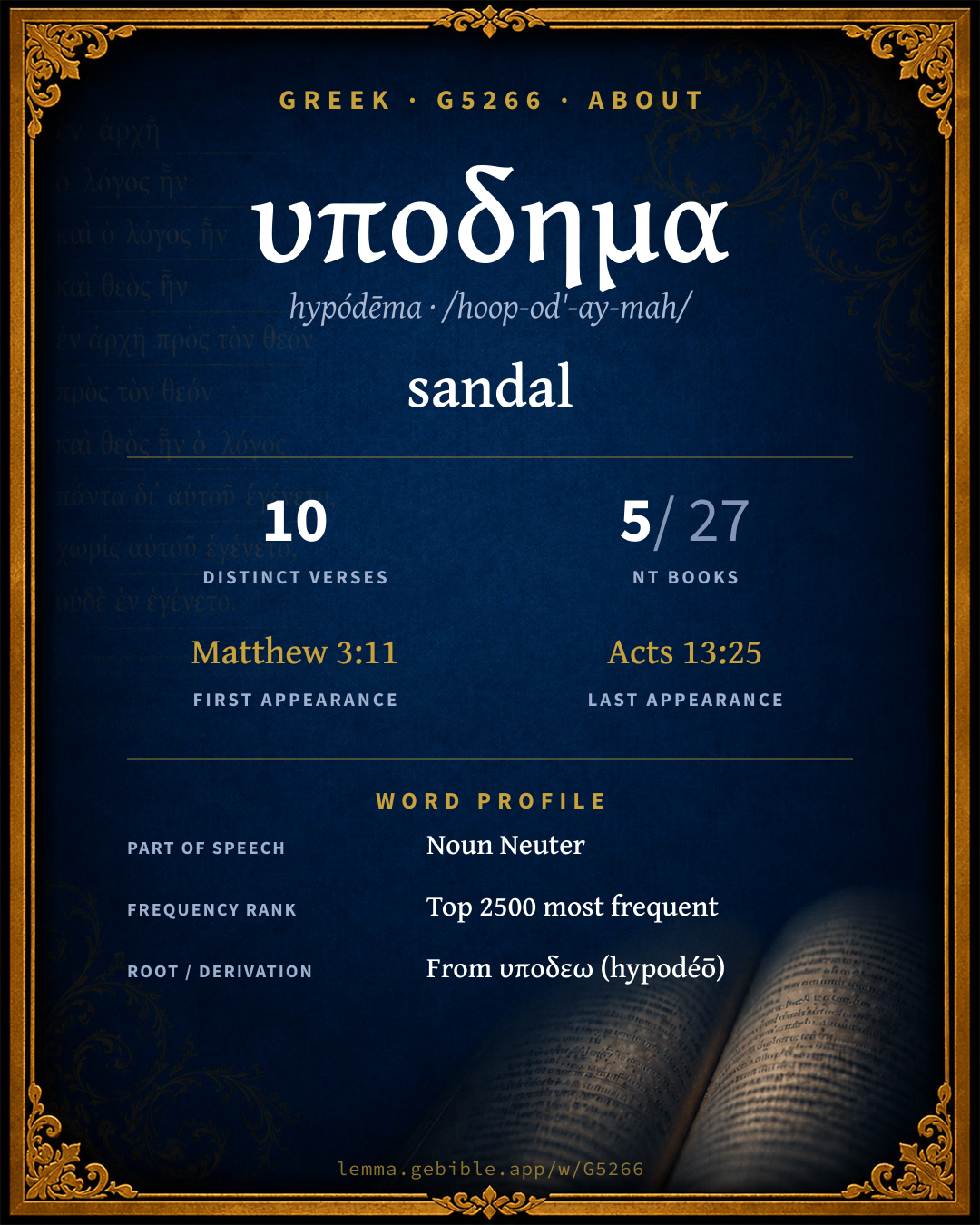
ὑπόδημα
sandal
Full lexicon entry — Thayer's Greek Lexicon
From Thayer's Greek Lexicon
Where this word appears
See every Accusative-case word in the Greek New Testament →
Grammar key — what these labels mean
Part of speech
- Noun
- A naming word — a person, place, thing, or idea.
Case
- Accusative
- The case of the direct object and of extent.
- Genitive
- The case of source, possession, or “of” — answers “whose / from what.”
Gender
- Neuter
- Grammatically neuter.
Number
- Plural
- More than one.
- Singular
- One.
Grammatical forms
- Noun, Accusative, Plural, Neuter 4 times (40%)
- Noun, Genitive, Plural, Neuter 3 times (30%)
- Noun, Accusative, Singular, Neuter 2 times (20%)
- Noun, Genitive, Singular, Neuter 1 time (10%)
Parsed forms decoded from the imported morphology (Robinson–Tischendorf, public domain), counted across 10 parsed occurrences — not distinct verses.
Every verse where G5266 appears — 10 distinct verses across 5 books. Click any verse to open its interlinear word-by-word view. Verse text shown in the World English Bible for context — . Each verse’s Greek form is shown with its reference; the English is not keyword-highlighted, since the data carries no word-level English alignment. Use “Compare translations” on any verse to read it across multiple English versions. This concordance covers the Greek New Testament; Septuagint (Greek Old Testament) occurrences of this word are not indexed here.
Matthew 2 verses
- Matthew 3:11 ὑποδήματα n acc pl neut I indeed baptize you in water for repentance, but he who comes after me is mightier than I, whose shoes I am not worthy to carry. He will baptize you in the Holy Spirit.
- Matthew 10:10 ὑποδήματα n acc pl neut Take no bag for your journey, neither two coats, nor shoes, nor staff: for the laborer is worthy of his food.
Mark 1 verse
Luke 4 verses
- Luke 3:16 ὑποδημάτων n gen pl neut John answered them all, "I indeed baptize you with water, but he comes who is mightier than I, the latchet of whose sandals I am not worthy to loosen. He will baptize you in the Holy Spirit and fire,
- Luke 10:4 ὑποδήματα n acc pl neut Carry no purse, nor wallet, nor sandals. Greet no one on the way.
- Luke 15:22 ὑποδήματα n acc pl neut "But the father said to his servants, 'Bring out the best robe, and put it on him. Put a ring on his hand, and shoes on his feet.
- Luke 22:35 ὑποδημάτων n gen pl neut He said to them, "When I sent you out without purse, and wallet, and shoes, did you lack anything?" They said, "Nothing."
John 1 verse
Acts 2 verses
- Acts 7:33 ὑπόδημα n acc sg neut The Lord said to him, 'Take your sandals off of your feet, for the place where you stand is holy ground.
- Acts 13:25 ὑπόδημα n acc sg neut As John was fulfilling his course, he said, 'What do you suppose that I am? I am not he. But behold, one comes after me the sandals of whose feet I am not worthy to untie.'
About this entry
At a glance — auto-summarized from this page’s data, not written by a person. Every figure links to its source below. This summary describes the numbers; it doesn’t interpret them.
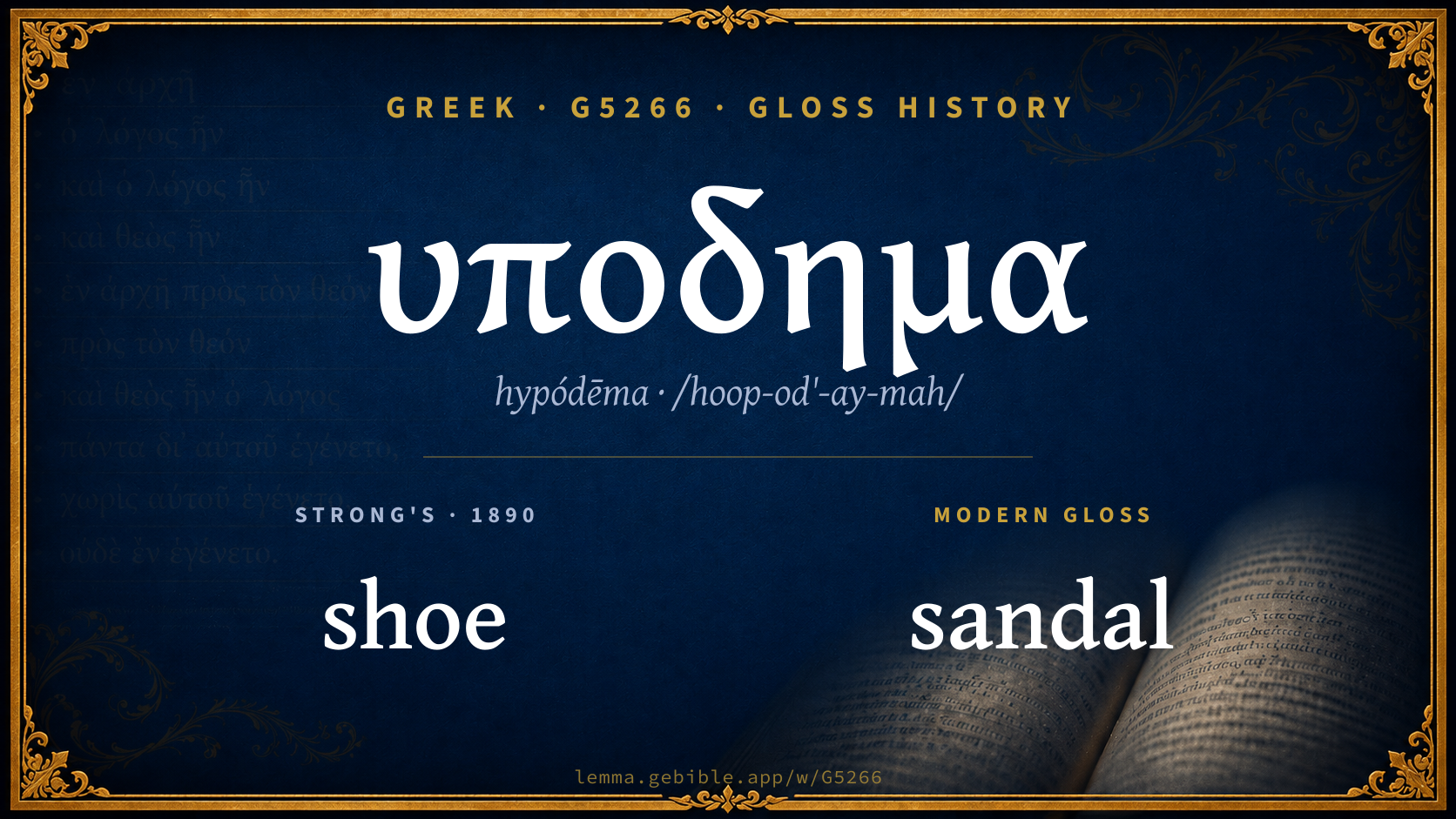
The Greek noun υποδημα centers on the idea of “sandal.” Older and newer Bibles part ways — “shoes” in the King James Version, “sandals” (Berean Standard Bible) in modern versions. See the renderings breakdown. It turns up in 10 verses across 5 books, an uncommon footprint. The word gravitates to Luke (40%), then Matthew and Acts. Its earliest occurrence is Matthew 3:11. Dig into 10-verse concordance and the renderings breakdown below.
Gloss history
Strong's 1890 vs modern scholarship
About this word
Strong's G5266 catalogs a Greek word from the Greek New Testament.
These counts are not copied from any lexicon or concordance. They are computed here, from the morphology-tagged Greek New Testament. What Lemma adds →
- 10
- distinct verses
- The word appears in 10 distinct verses.
- 5 / 27
- NT books
- The word appears in 5 of 27 New Testament books.
- #1,056
- by frequency
- Top 2500 most frequent Greek words (rank 1,056 of 5,347 Greek words by occurrence).
View all 10 occurrences in the concordance →
By section of the New Testament
By traditional corpus
Conventional, traditional groupings — biblical authorship is debated, so this is a traditional corpus grouping, not an authorship claim. Some books belong to more than one corpus (Luke is in both the Gospels and the Lukan corpus, and so on), so these shares overlap and need not total 100%. Each figure is a share of the word’s 10 distinct verses.
- Gospels 8 verses · 80%
- Lukan (Luke–Acts) 6 verses · 60%
- Johannine 1 verse · 10%
How translations render this word
Counts come from each version’s own published word-to-Strong’s tagging or interlinear alignment — an approximate guide to how each version renders this word, not a word-level alignment the data otherwise carries. Because each total is that version’s own tagged count, the per-version totals vary from one another and need not match the appearance or distinct-verse counts above. These counts may also differ from a printed concordance because Lemma counts each distinctly tagged rendering and does not collapse phrase taggings into a single head-word total. This is a fixed set of word-tagged versions (KJV, ASV, BSB, ULT) and does not change with the reading translation you choose elsewhere. Each version’s license is shown beside its name below (and on Sources).
- King James Version: Shoes 8×
- American Standard Version: Shoes 9×
- Berean Standard Bible: Sandals 10×
- unfoldingWord Literal Text: Sandals 8×, Of 3×, Sandal 2×
King James Version Public Domain
Renders G5266 across 9 tagged occurrences — most commonly:
Plus 1 rendering that appears only once — usually multi-word phrases or single function words the recovered tagging swept in, not distinct renderings. Not rendered by a distinct English word in 1 further occurrence.
American Standard Version Public Domain
Renders G5266 across 10 tagged occurrences — most commonly:
Plus 1 rendering that appears only once — usually multi-word phrases or single function words the recovered tagging swept in, not distinct renderings.
Berean Standard Bible Public Domain
Renders G5266 across 10 tagged occurrences — most commonly:
unfoldingWord Literal Text CC BY-SA 4.0
Renders G5266 across 13 tagged occurrences — most commonly:
Senses in Thayer's
The 1 sense Thayer's distinguishes for this word, in lexicon order (not ranked by frequency or importance). The full entry — with sub-senses — is in the Lexicon Entry tab.
- what is bound under, a sandal, a sole fastened to the foot with thongs
Word origin
Derived from υποδεω (hypodéō) (G5265) — to bind on.
From G5265 ; something bound under the feet that is a shoe or sandal : - shoe.
— Strong’s Exhaustive Concordance (1890), public domain.
Forms in the corpus
The 4 distinct written forms G5266 takes in the Greek New Testament, most frequent first — each parse links to that case’s occurrences in the concordance.
| Form | Parsing | Example | Uses |
|---|---|---|---|
| ὑποδήματα hypodḗmata | Noun, Accusative, Plural, Neuter | Matthew 3:11 | 4 |
| ὑποδημάτων hypodēmátōn | Noun, Genitive, Plural, Neuter | Mark 1:7 | 3 |
| ὑπόδημα hypódēma | Noun, Accusative, Singular, Neuter | Acts 7:33 | 2 |
| ὑποδήματος hypodḗmatos | Noun, Genitive, Singular, Neuter | John 1:27 | 1 |
Septuagint usage
The same Greek word υποδημα appears 24 times in the Greek Old Testament (Septuagint), across 24 verses in 13 books.
- 24
- LXX occurrences
- Tagged occurrences of this Greek word in the Septuagint.
- 24
- verses
- Distinct Septuagint verses containing this word.
- 13 / 39
- OT books
- The word appears in 13 of the 39 Old Testament books.
Sample Septuagint occurrences
- Genesis 14:23 ὑπόδημα
- Exodus 3:5 ὑπόδημα
- Deuteronomy 25:9 ὑπόδημα
- Joshua 5:15 ὑπόδημα
- Ruth 4:7 ὑπόδημα
- 1 Samuel 12:3 ὑπόδημα
- 1 Kings 2:5 ὑπόδημα
- Psalms 59:10 ὑπόδημα
- Song of Solomon 7:2 ὑπόδημα
- Isaiah 5:27 ὑπόδημα
- Ezekiel 24:17 ὑπόδημα
- Daniel 3:21 ὑπόδημα
Septuagint occurrences (same lexeme)
Every verse where the same Strong’s number (G5266) appears in the Greek Septuagint. Verse text shown in the World English Bible for context; the Greek form is the matched word — the English is not keyword-highlighted.
- Genesis 14:23 ὑπόδημα that I will not take a thread nor a shoe-latchet nor anything that is yours, lest you should say, 'I have made Abram rich.'
- Exodus 3:5 ὑπόδημα He said, "Don't come close. Take off your sandals from off your feet, for the place you are standing on is holy ground."
- Exodus 12:11 ὑπόδημα This is how you shall eat it: with your loins girded, your shoes on your feet, and your staff in your hand; and you shall eat it in haste: it is Yahweh's Passover.
- Deuteronomy 25:9 ὑπόδημα then his brother's wife shall come to him in the presence of the elders, and loose his shoe from off his foot, and spit in his face; and she shall answer and say, So shall it be done to the man who does not build up his brother's house.
- Deuteronomy 25:10 ὑπόδημα His name shall be called in Israel, The house of him who has his shoe untied.
- Deuteronomy 29:4 ὑπόδημα but Yahweh has not given you a heart to know, and eyes to see, and ears to hear, to this day.
- Deuteronomy 33:25 ὑπόδημα Your bars shall be iron and brass; As your days, so shall your strength be.
- Joshua 5:15 ὑπόδημα The prince of Yahweh's host said to Joshua, Put off your shoe from off your foot; for the place whereon you stand is holy. Joshua did so.
- Joshua 9:5 ὑπόδημα and old and patched shoes on their feet, and old garments on them; and all the bread of their provision was dry and was become moldy.
- Joshua 9:13 ὑπόδημα and these wine-skins, which we filled, were new; and, behold, they are torn: and these our garments and our shoes are become old by reason of the very long journey.
- Ruth 4:7 ὑπόδημα Now this was [the custom] in former time in Israel concerning redeeming and concerning exchanging, to confirm all things: a man drew off his shoe, and gave it to his neighbor; and this was the [manner of] attestation in Israel.
- Ruth 4:8 ὑπόδημα So the near kinsman said to Boaz, Buy it for yourself. He drew off his shoe.
- 1 Samuel 12:3 ὑπόδημα Here I am: witness against me before Yahweh, and before his anointed: whose ox have I taken? or whose donkey have I taken? or whom have I defrauded? whom have I oppressed? or of whose hand have I taken a ransom to blind my eyes therewith? and I will restore it you.
- 1 Kings 2:5 ὑπόδημα Moreover you know also what Joab the son of Zeruiah did to me, even what he did to the two captains of the hosts of Israel, to Abner the son of Ner, and to Amasa the son of Jether, whom he killed, and shed the blood of war in peace, and put the blood of war on his sash that was about his loins, and in his shoes that were on his feet.
- Psalms 59:10 ὑπόδημα My God will go before me with his loving kindness. God will let me look at my enemies in triumph.
- Psalms 107:10 ὑπόδημα Some sat in darkness and in the shadow of death, Being bound in affliction and iron,
- Song of Solomon 7:2 ὑπόδημα Your body is like a round goblet, No mixed wine is wanting. Your waist is like a heap of wheat, Set about with lilies.
- Isaiah 5:27 ὑπόδημα None shall be weary nor stumble among them; None shall slumber nor sleep; Neither shall the belt of their loins be untied, Nor the latchet of their shoes be broken:
- Isaiah 11:15 ὑπόδημα Yahweh will utterly destroy the tongue of the Egyptian sea; and with his scorching wind will he wave his hand over the River, and will strike it into seven streams, and cause men to march over in sandals.
- Ezekiel 24:17 ὑπόδημα Sigh, but not aloud, make no mourning for the dead; bind your headdress on you, and put your shoes on your feet, and don't cover your lips, and don't eat men's bread.
- Ezekiel 24:23 ὑπόδημα Your tires shall be on your heads, and your shoes on your feet: you shall not mourn nor weep; but you shall pine away in your iniquities, and moan one toward another.
- Daniel 3:21 ὑπόδημα Then these men were bound in their pants, their tunics, and their mantles, and their [other] garments, and were cast into the midst of the burning fiery furnace.
- Amos 2:6 ὑπόδημα Thus says Yahweh: "For three transgressions of Israel, yes, for four, I will not turn away its punishment; Because they have sold the righteous for silver, And the needy for a pair of shoes;
- Amos 8:6 ὑπόδημα That we may buy the poor for silver, And the needy for a pair of shoes, And sell the sweepings with the wheat?'"
These are occurrences of the same Greek lexeme (G5266) in the Septuagint — not a translation of any one Hebrew word. The store carries no word-level Hebrew↔Greek alignment, so no Hebrew original is asserted here. Counts come from the recovered LXX Strong's tagging — high-frequency vocabulary is well covered, while rare or late forms may be untagged — so they reflect tagged occurrences and may slightly undercount.